
Specs are compiled from manufacturer listings and verified buyer reviews and can change over time — please confirm the key details on the product page before buying.
If your expensive television, receiver, or amplifier keeps dying early, the problem is usually not the gear itself — it is the dirty, unstable power coming out of your wall. A good AV surge protector (a power strip built to absorb voltage spikes and filter electrical line noise before it reaches your audio and video equipment) does two jobs at once: it swallows the sudden spikes that fry circuit boards, and it cleans the constant electrical hiss that muddies your sound and picture.
I’m Mohammad Maruf — the founder and writer behind KitchPrep. This guide is built by comparing the manufacturers’ published specifications and the patterns across verified customer reviews, so you get each pick’s real strengths and trade-offs instead of marketing spin.
You will see how joule ratings, clamping voltage, and outlet counts actually translate to real protection for a home theater rack. The right pick shields your gear from both sudden spikes and slow brownouts that wear components down over time.
Our Picks at a Glance

How To Choose The Best AV Surge Protector
To pick the right unit for your setup, focus on three things: how much surge energy you need to absorb, how many devices you are plugging in, and if you want line conditioning to clean up the power itself. Get those three right and you will not overspend on a strip with more outlets or joules than your rack needs.
Match the joule rating to your equipment
A joule is a measure of energy, and a surge protector’s joule rating tells you how much spike energy it can swallow before it stops protecting. A higher number means more absorption capacity, which matters most for expensive gear like an OLED television or a high-end amplifier. Budget-friendly strips often sit in the low thousands, while premium options push much higher for heavier protection.
Check the clamping voltage, not just joules
Clamping voltage is the point at which the strip starts redirecting excess power away from your devices. A lower clamping number means your gear sees less of the spike. Many buyers obsess over a giant joule figure while ignoring clamping, which is a mistake — both numbers work together to define real protection.
Count your outlets against your gear
Home theater racks fill up fast: a TV, a receiver, a cable box, a streaming stick, a gaming console, and a router can eat six spots before you blink. Pay attention to outlet spacing too, because a bulky power brick can block two or three slots on a tightly packed strip. If you need to power an entire rack from one unit, a rackmount model with many outlets is worth considering.
Quick Comparison
| Model | Best For | Surge Rating | Outlets | Amperage | Amazon |
|---|---|---|---|---|---|
| Eaton Tripp Lite TLP1208SAT★ Best Overall | Whole-home-theater coverage | 2880 joules | 12 | 15 A | Amazon |
| Pyle PCO865Rack Specialist | Rack and studio builds | — | 19 | 15 A | Amazon |
| AudioQuest PowerQuest G8Audiophile’s Choice | Audiophile stereo setups | — | 8 | 10 A | Amazon |
| Monster Power Center Vertex XL | Desks and entertainment centers | 5000 joules | 10 | — | Amazon |
| Furman PST-8 | Serious AV noise filtration | — | 8 | 15 A | Amazon |
| Panamax M8-AV-PRO | Voltage-triggered rack control | 1875 joules | 8 | 15 A | Amazon |
| Furman AC-215A | Compact installs and guitar rigs | — | 2 | 10 A | Amazon |
| Panamax MR4000 | Slim rackmount protection | 1,350 joules | 8 | 15 A | Amazon |
| Eaton Tripp Lite LC1200 | Correcting bad or unsteady voltage | 1200 joules | 4 | — | Amazon |
In‑Depth Reviews
1. Eaton Tripp Lite TLP1208SAT Flat Plug Surge Protector 12 Outlets Home TV
Our pick — over 4.5★ from 550+ verified ratings; the strongest balance of quality and price.
The one strip that guards your entire home theater, including the cables running into it
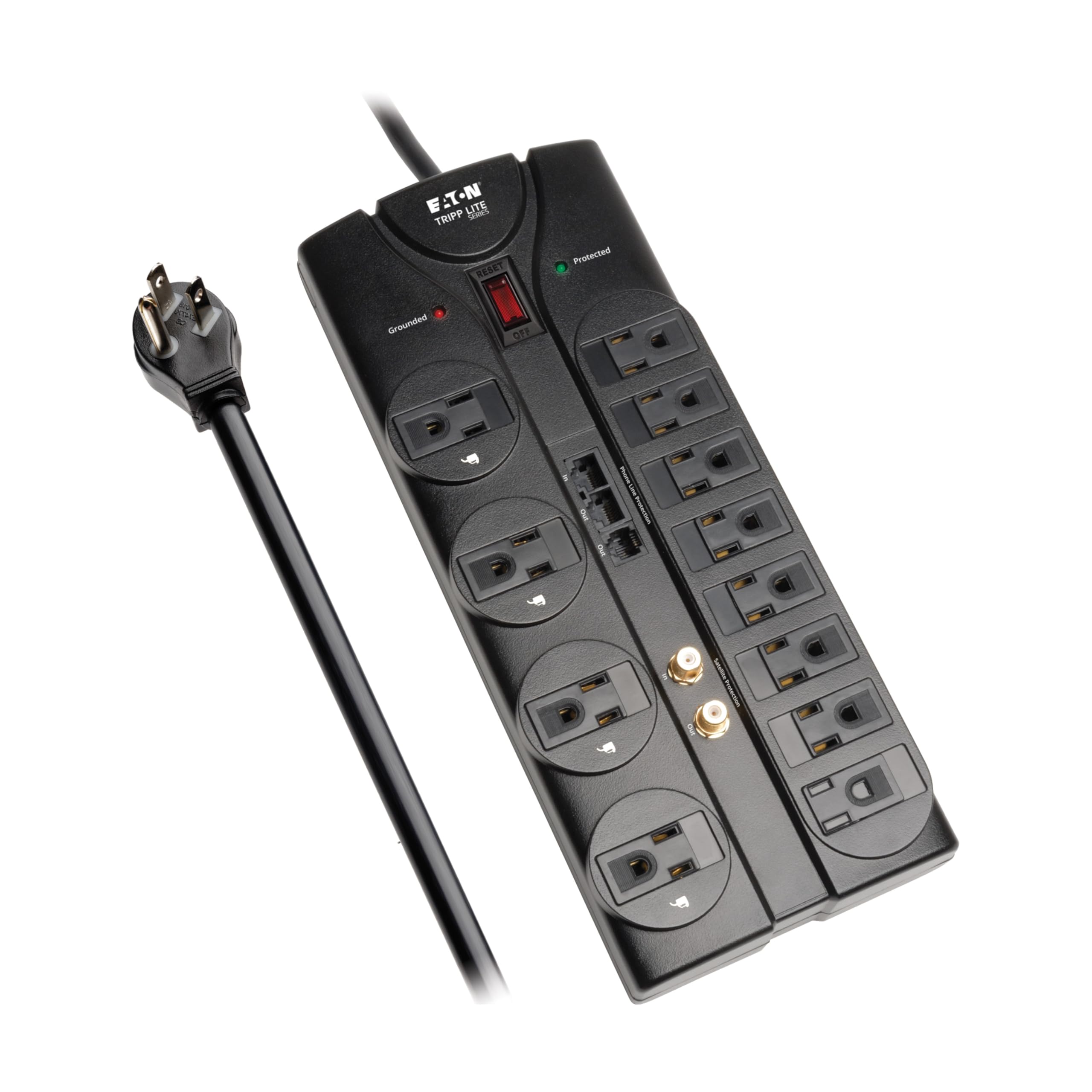
If your setup includes a cable box, a router, and a television, this is the pick to start with. It carries a 2880 joule rating — a measure of how much surge energy the strip can absorb — and spreads it across 12 outlets, so you can plug in an entire rack without hunting for a second strip. What makes it stand apart is that it also protects the signal lines feeding your gear, not just the power lines.
That signal protection is the real story here. There are dedicated ports for coax (the round screw-on cable connectors), telephone line (RJ11), and Ethernet (RJ45), so a surge riding in on your cable or internet line gets stopped before it reaches your equipment. Buyers report pairing it with an Xfinity cable modem over RG6 coax and keeping full 1000/120 Mbps speeds with signal levels unchanged, which means the protection does not degrade the connection you actually pay for. The eight-foot extension cord ends in a flat plug that lets furniture sit flush against the wall.
The trade-off to know before buying is outlet spacing. Four of the slots are deliberately spaced wide for chunky power bricks, but the rest sit close together, and one owner found several outlets too tight for standard plugs to seat easily. That is a fit quirk, not a build flaw — the housing itself has a sturdy, well-made feel, and the sliding covers over unused outlets keep dust out. If your gear uses standard two-prong cords, this is a non-issue. Pair it with the fact that this unit is UL Certified and UL Listed, and you have one of the more thoroughly vetted strips on this list.
What Earns Its Keep
- High 2880 joule capacity absorbs heavy spikes aimed at expensive AV gear
- Coax, RJ11 phone, and RJ45 Ethernet ports protect signal cables, not just power cords
- Four widely spaced outlets accommodate bulky adapters that block normal strips
- Flat plug and eight-foot cord tuck furniture flush to the wall
- UL Certified and UL Listed with a lifetime warranty and connected-equipment coverage
Where It Falls Short
- Unspaced outlets run tight, so two-prong plugs may need a firm push to seat
- The Ethernet pass-through tops out at 100 Mbps, which is fine for most homes but not gigabit
- The network protection standard is older, so tech-forward buyers may want more headroom
Best for: Home theater owners who want power, coax, and data lines all guarded from one strip.
Look elsewhere if: You need gigabit Ethernet pass-through or outlet spacing that fits every oversized brick.
2. Pyle 19 Outlet 1U 19″ Rackmount PDU Power Distribution Supply Center Conditioner Strip Unit Surge Protector 15 Amp Circuit Breaker 4 USB Multi Device Charge Ports 15FT Cord, Black – PCO865
Nineteen outlets in a single rack slot, built for the gear that never leaves the studio
For anyone running a rack, this is the outlet-count champion of the list: 19 sockets total, split between 3 wide-spaced outlets on the front panel and 16 rear-facing plugs for the equipment that never needs unplugging. It is a 1U form factor (a single rack unit of height, the standard slim slot in a 19-inch rack), so it claims almost no vertical space in a crowded cabinet. The detachable mounting flanges can also be swung around for wall-mount or under-counter installation, which gives you flexibility a fixed strip does not.
Where this unit beats the other picks is raw distribution. It offers 19 outlets versus the 12 on the Eaton Tripp Lite TLP1208SAT above, and its rear-facing plugs are designed with room for AC adapters and transformers. Four USB ports handle portable electronics so your wall sockets stay reserved for the heavy gear. One owner summed up the appeal: “This pigtail PDU allowed me to put all my power cords inside my stereo cabinet.” A single front switch lets you kill power to the whole rack at once, retiring the daily ritual of flipping individual switches.
Weight and reach are on your side here too. At 7.1 pounds it is noticeably heavier than the 1.7-pound AudioQuest PowerQuest G8 further down, and its 15-foot cord gives you far more placement freedom than a shorter strip would. The honest caveat is the mounting hardware: the rack ears do not always line up with standard rack holes, and enlarging them may need a metal drill bit. Alongside that, the shared complaints about this unit center on quality-control inconsistencies rather than the core function.
The rack realists’ pick: If your cabinet is bursting at the seams and you want one switched unit to rule the whole setup, the outlet count and 15-foot reach deliver in a way smaller strips simply cannot.
Where it stumbles: The mounting ears are the recurring sore spot — buy it for the outlets and USB ports, but budget a few minutes with a drill if your rack holes are not forgiving.
Pick it if: You run a 19-inch rack and want maximum outlets with single-switch power control.
skip it if: Your rack has tight hole spacing or you expect plug-and-play rack ears without any drilling.
3. AudioQuest PowerQuest G8 – 8-Outlet Surge Protector
Built for ears that notice when the background goes quiet
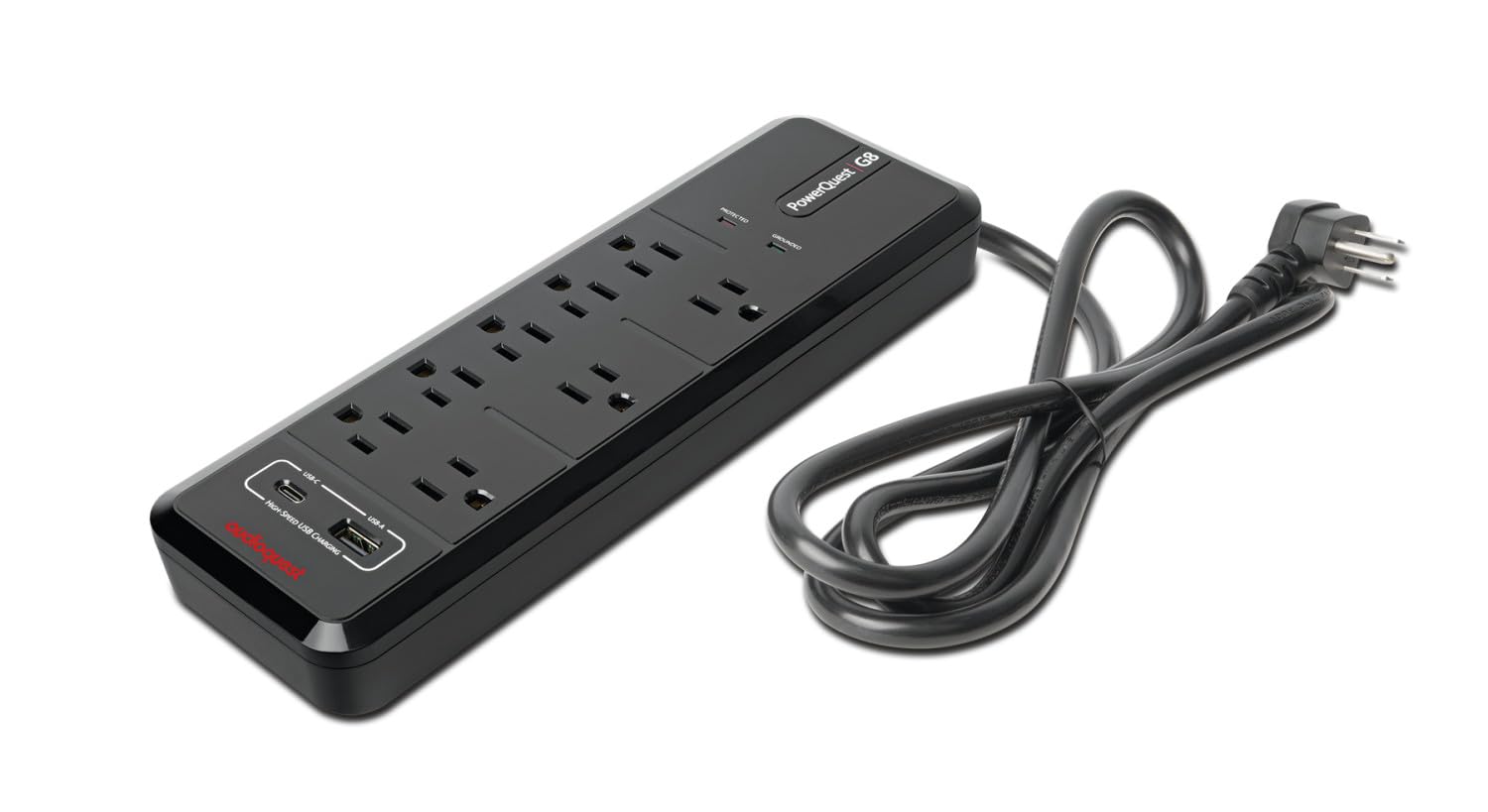
This one is for the listener who already spent real money on a stereo and is not going to feed it noisy power. The PowerQuest G8 handles 8 outlets and adds RF Noise-Dissipation, which is a way of describing how it fights the radio-frequency interference that phones, Wi-Fi, and Bluetooth throw around a room. It also guards against micro spikes — the tiny, fast power blips that wear equipment down over time rather than killing it in one blow.
Lightning-grade protection and high-speed USB charging for both Type-C and Type-A round out the feature set. AudioQuest replaces a standard strip’s flimsy plug with a flat-to-wall 45-degree design on a 6-foot cable, which slides behind furniture in spots where a standard plug would not fit. It is physically light at 1.7 pounds — versus the 7.1-pound Pyle rack unit above — so it hangs or tucks easily. It runs off a 10 A circuit, which is a lower ceiling than the 15 A units on this list.
What owners actually notice is a change in the sound. Stereo setups fed through this unit tend to pick up a bit more clarity, and the reviews back that up: as owners put it, it can “improve sound quality unlike other hi-fi power supplies.” You will not get the 19 outlets or the coax and phone ports of the big rack units, but you do get a well-built, heavy-duty-corded strip with outlets spaced to avoid crowding.
Built for a specific buyer: This is audiophile gear first, surge protection second, and it earns its place if your stereo is the centerpiece of the room.
The honest limiter: It tops out at 10 amps with 8 outlets and no coax or phone ports, so a wall of home-theater gear is not its job.
Reach for this if: You want the cleanest possible power feed for a two-channel stereo or a small AV stack.
Think twice if: You need high amperage headroom or signal-line protection for multiple cable runs.
4. Monster Power Center Vertex XL Surge Protector With Detachable Power Strip, 10 AC Outlets, 2 USB-A Ports & 1 USB-C Port (20W)

The power center with a charging pod that snaps off and follows you
Here is the feature nobody else on this list has: a detachable USB charging hub (2 USB-A plus 1 USB-C) that pops off the main body and mounts wherever you want using the included 3M adhesive. Its USB-C port handles Power Delivery, so it charges a phone or tablet at a faster rate than a basic port. No other pick on this list has a detachable charging hub.
The main body carries 10 AC outlets and a 5000 joule rating — the highest absorption figure on the list — which absorbs enough spike energy to guard a full desk or entertainment center. A 6-foot nylon-braided cord terminates in a flat plug, so it sits tight against the wall. The reviews love the USB arrangement, which is the standout strength owners keep pointing to, with one buyer noting the detachable hub is great for fast phone charging. It suits a desk or a single entertainment center.
Space between outlets is the catch. Larger power bricks can block adjacent slots, and one owner felt the magnetic hold on the USB hub could be stronger. Neither issue is a dealbreaker for a desk, but if you run several chunky adapters side by side, you will feel the squeeze. A TV, console, and a few chargers fit its 10 outlets without crowding.
The reason to pick this one: The 5000 joule rating is the tallest shield here, and the detachable USB pod turns a fixed strip into something you actually enjoy using.
The one thing to plan for: Tight outlet spacing means bulky bricks may crowd each other, so map out your plugs before committing.
Best for: Desks and streaming corners where a detachable fast-charging pod beats a static strip.
Not for: Anyone with a wall of oversized adapters that need generous breathing room.
5. Furman PST-8 Power Station 8-Outlet Surge Protector, SMP Lift EVS 15A

A power station that refuses to sacrifice itself, cleaning the current for good
Furman built this for people who have been through one too many cheap strips. Its headline trick is non-sacrificial SMP surge protection — that means the strip absorbs and clamps surges without burning out an internal part the way most budget strips do, so it keeps working instead of becoming a dead weight after one big hit. LiFT filtration handles steady AC noise, and EVS extreme voltage shutdown cuts power at 137 volts to defend against open-neutral and over-voltage events.
Eight linearly filtered outlets run the whole rack, and a zero-ground-contamination design keeps interference off your signal ground. Coax and telephone protection are included, so your cable and satellite lines get the same treatment as your power cords. Owners who put one to work on a home theater report a punchier, cleaner sound after install, and repeated saves when a nearby strike would otherwise have fried their display. The unit has a stainless steel enclosure with real heft behind it.
The size reflects the substantial internal components, and for anyone with unstable rural power or a lightning-prone area, that trade is usually easy to make.
Why It Wins
- Non-sacrificial design survives repeated surges instead of quitting after one
- LiFT filtration and zero-ground contamination clean the power for clearer audio and video
- EVS shuts down at 137 volts to defend against dangerous over-voltage
- Coax and telephone line protection cover signal cables as well as power cords
- Stainless steel enclosure and 15 A rating suit a full AV or instrument rack
Before You Commit
- The 17.75-inch chassis needs a wide shelf or floor spot, so space is a real consideration
- Premium pricing puts it well above entry-level strips
Built for: Owners of pricey gear in high-surge areas who want protection that outlasts a single storm.
Size check first: Confirm you have the shelf space before you commit, because this unit is genuinely large.
6. Panamax M8-AV-PRO 8-Outlet Home Theater Power Conditioner

For the rack that turns on as one, driven by a single 12-volt signal
If your home theater setup spans separate power amplifiers that all need to switch on together, the M8-AV-PRO solves a problem most strips ignore: a 12-volt trigger built into a 1/8-inch mono jack. That lets a receiver wake up the amps in the chain without anyone pushing a button. Four of the eight outlets run on that trigger while the rest stay live for components you want on all the time.
On the protective side, this is a full power conditioner with 1875 joules of surge protection and Automatic Voltage Monitoring. AVM watches the incoming line and disconnects your gear during over- or under-voltage, then restores power automatically when the danger passes. That makes it a good fit for the brownout-prone homes and voltage-sagging circuits that quietly wear out electronics. There is AC noise filtration plus coax and telephone protection, and the whole thing is split across two noise-isolated outlet banks.
Owners who have relied on Panamax units for years describe them as reliable workhorses, and one reported success using a 12V trigger to shut off their Crown amps without the thump that usually comes with powering down a rack. Step carefully on the cable side though: this unit can filter a satellite signal to the point of picture dropouts, so if you run DishTV, route that coax elsewhere. It is also important to confirm Amazon is the direct seller for the warranty and free returns.
The trigger is the star: For multi-amp racks, the 12V trigger and switched outlet bank make this the easiest unit on the list.
Watch the cable runs: Coax filtering can knock out satellite reception, so keep your satellite feed off this conditioner.
Choose this if: You run separate amps and want them to power up cleanly off one signal.
Avoid if: Your main concern is protecting a satellite TV signal, which this unit may filter too aggressively.
7. Furman AC-215A Compact Power Conditioner with Auto-Resetting Voltage Protection – Black

A small box that quietly kills the hum nobody could diagnose
A compact conditioner with just two outlets might look modest, but this unit earns its spot on a very specific job: cleaning up noise that ruins audio. Its auto-reset EVS circuitry detects dangerous voltage swings and safely powers down everything connected, then brings it back automatically once conditions are safe. It runs on a 10-amp circuit with a built-in breaker and delivers 1200 watts of power.
The real draw is how it handles stubborn noise problems. Owners have used it to silence a years-long guitar amp buzz traced to a grounding issue in an old house, and to stop studio monitors from flickering and popping when building appliances switched on. Its compact chassis attaches to a flat-screen TV mount or tucks into a remote corner, and the stainless steel housing gives it a solid, pro-audio feel. Two outlets is the whole story, so this pairs with a mixer or a single amp rather than a full rack.
The 10-amp rating is the main ceiling, and more than one buyer wished for a 15-amp version to match a bigger load. If your rig pulls more current than that, or you need five or six outlets, look at the larger Furman PST-8 above. Two filtered outlets cover a single television plus receiver, a recording corner, or a small live-sound rig.
Standout Strengths
- LiFT filtration and SMP protection clean power in a chassis small enough to mount almost anywhere
- Auto-reset EVS powers down on unsafe voltage and restores on its own
- Proven at killing hum, buzz, and popping in real audio setups
- Stainless steel build with a 10-amp breaker and 1200-watt capacity
Real Constraints
- Just two outlets, so a full rack will outgrow it fast
- 10-amp ceiling is lower than the 15-amp units on this list
Suits: Studio, guitar, and small AV setups chasing noise-free sound in tight spaces.
Outgrow it if: You need more than two outlets or a higher current rating.
8. Panamax MR4000 8-Outlet Home Theater Power Conditioner & Surge Protector

A rack-friendly conditioner that slips into a thin slot and shuts down on bad voltage
This one is built for the clean rack look. Its 1U rackmount design is a low-profile 15-amp, 1800-watt chassis with rack hardware included, so it slides neatly into a standard AV rack alongside your other components. Eight filtered outlets — seven around the back and one on the front — split a Level-2 linear noise filter across the whole bank, and coax plus LAN protection shield your antenna and network lines from surges that ride in on signal cables.
Protection here is Protect-or-Disconnect, rated at 1,350 joules with a 52,000-amp peak. That second number describes how much peak current the strip can handle in a spike, and if the surge circuitry ever gives out, power is cut rather than left running unprotected. Automatic Voltage Monitoring disconnects gear during unsafe over- or under-voltage and restores power on its own when it is safe again. Owners with frequent surges say it quietly guards their entire entertainment center, and the noise filtering produces a measurable improvement in listening quality.
What buyers mention most about the fit is that it arrives smaller than expected — slim enough to save rack space, but not so tall that you can stack a cable box on top of it. Its slim 1U chassis fits a rack shelf or a shelf under a TV. If you need something bigger-looking or you want a live voltmeter, this one shows power status with blue light lines rather than a numeric readout.
The rack-sensible pick: Low-profile fit, 1,350 joules of Protect-or-Disconnect protection, and noisy-line cleanup make this a tidy choice for a rack-mounted theater.
Keep in mind: The slim chassis runs shorter than the photos suggest, so plan your rack stacking around its real footprint.
A natural fit for: A/V racks that need thin, filtered protection with automatic voltage shutdown.
Not the match if: You want a tall unit to double as a shelf base or a live voltage display.
9. Eaton Tripp Lite LC1200 Power Conditioner Surge Protector 1200W 4 Outlets

For homes where the wall voltage dips, this box actively corrects it
Most strips on this list protect against surges, but this one actually fixes the voltage before it reaches your gear. It boosts under-voltages by 9%, trims over-voltages by 10%, and corrects severe under-voltages by 19%, keeping your equipment running on a steadier supply instead of the sagging line the utility hands you. An EMI/RFI filter strips up to 75 dB of line noise, which is the kind of electrical hiss that muddies audio. Four rear outlets handle a television, receiver, router, or point-of-sale setup, and the unit is rated at 120 volts and 1200 watts with a 7-foot cord.
Front-panel LEDs show AC power, incoming voltage level, and line status at a glance, and a lighted on-off switch controls everything connected. When the box corrects voltage you will hear a soft click as internal relays switch taps — owners mention the clicking is normal and lines up with big draws like whole-house air conditioning kicking in. It carries 1200 joules of network-grade surge suppression and filters out the line noise that can disrupt equipment performance.
The honest catch is what this unit is not. One long-running owner pointed out it behaves more like a step voltage regulator than a true conditioner — it does not reshape a bad waveform, only adjusts the strength of the line. It uses MOV surge components that are sacrificial, and a couple of owners flag that a standby transformer pulls power even when appliances are off. It also ships with only four outlets and is not a battery backup, so it will not keep anything running through an outage.
what separates it
- Actively boosts low voltage and trims high voltage to steady your gear’s supply
- Filters up to 75 dB of EMI/RFI line noise for cleaner audio
- 1200 joules of network-grade surge suppression in a compact chassis
- Runs quietly with no fan and clicks audibly when it corrects voltage
- Diagnostic LEDs show power, voltage level, and line status at a glance
Trade-offs To Weigh
- Corrects voltage strength but does not reshape a distorted waveform
- Sacrificial MOV components wear out over time
- Only four outlets and a standby transformer that draws power when idle
Best for: Homes with genuinely unstable voltage where a plain surge strip would leave gear exposed to brownouts.
Look past it if: You need battery backup or more than four outlets.
Understanding the Specs
Joule Rating
A joule is a unit of energy, and the joule rating on a surge protector tells you how much spike energy it can soak up before it reaches the end of its protection life. Higher numbers mean more absorption capacity, which matters most for costly gear like a big-screen television or a power amplifier. A strip rated at 5000 joules can swallow more energy than one rated at 1,350 joules, but joules are only half the story — they must be paired with sensible clamping voltage to mean much in practice.
Clamping Voltage
Clamping voltage is the threshold where a strip begins diverting excess power away from your equipment. A lower clamping figure means your devices see less voltage before protection kicks in. Some units also add voltage regulation that actively boosts weak power or trims high power, which is a different job from surge clamping. If your home voltage runs high or low regularly, regulation matters more than a big joule number, since a spike you never see can still wear components down over years.
Line Conditioning and Noise Filtration
Line conditioning, also called AC filtering, removes the electrical noise that travels along your wiring from motors, dimmers, and other appliances. One unit here filters up to 75 dB of that noise. Clean power often translates to a lower noise floor and clearer audio or a steadier picture, especially on sensitive AV equipment. This is separate from surge protection, so a strip can ace one job and skip the other entirely.
Signal-Line Protection
Surges do not only travel on power cords — they can ride in on coax, telephone, or Ethernet cables too. Ports for these lines protect the gear connected to them, whether that is a cable box, a modem, or a router. Worth noting: the protection a port adds comes with a bandwidth ceiling, and one unit here caps Ethernet pass-through at 100 Mbps, so gigabit households should choose carefully.
FAQ
How many joules do I need to protect a home theater?
Can a surge protector keep my expensive TV from dying in a storm?
What is clamping voltage and why does it matter more than joules?
Will plugging my TV into a surge protector hurt picture quality?
Do I need coax and Ethernet protection or just power outlets?
How long does a surge protector last before it needs replacing?
Is a surge protector the same as a power conditioner?
Can I plug two surge protectors into each other for more protection?
Will a 15-amp surge protector handle my receiver and amplifier?
Does a rackmount surge protector work outside a server rack?
Final Thoughts: The Verdict
With 4.7 stars across 500+ owner ratings, the Eaton Tripp Lite TLP1208SAT is the smart first buy for most home theater setups, because it guards your power, coax, phone, and network lines all from one sturdy strip. If your stereo deserves cleaner power and you do not need the extra outlets, the Furman PST-8 brings non-sacrificial protection that shrugs off repeated surges. And when the problem is genuinely unstable wall voltage, the Eaton Tripp Lite LC1200 is the one that actively corrects it. Match the pick to your actual threat — spikes, line noise, or sagging voltage — and you protect the gear you already own.
How We Picked
We do not accept paid placement. Every pick is matched to a real buyer and a real use-case; we do not hands-on test units.
Sources & Methodology
Specifications: manufacturer listings and product documentation. Review insights: verified customer reviews, as of September 2026. Pricing: not shown on this page (it changes often); check the current price via the retailer link.
As an Amazon Associate, KitchPrep earns from qualifying purchases. This does not affect which products we feature.
Related Guides
