
Specs are compiled from manufacturer listings and verified buyer reviews and can change over time — please confirm the key details on the product page before buying.
You buy an automatic transfer switch so you never have to touch it. When the grid drops, the switch senses your portable generator running, waits until its voltage settles, and moves your home or RV circuits over to generator power by itself. That means no extension cords across the wet lawn and no breaker panel to flip by hand in the dark. Here is the short answer you actually want: to power a whole house panel from a portable generator, the GenerLink is the only pick in this guide that mounts at the meter and feeds your entire breaker panel. For an RV or camper, the Progressive Dynamics PD52V is the one to beat — and that same unit is also the best overall pick here.
I’m Mohammad Maruf — the founder and writer behind KitchPrep. This guide is built by comparing the manufacturers’ published specifications and the patterns across verified customer reviews, so you get each pick’s real strengths and trade-offs instead of marketing spin.
Below you will find the specs that actually change the buying decision — amperage, voltage, delay timing, and enclosure type — laid out side by side. Every entry here is a true automatic transfer switch, meaning it switches power on its own when your generator starts, not a manual box you operate by hand. Whether you are wiring a 30-amp camper circuit or a 50-amp motorhome feed, this list of the best automatic transfer switch for a portable generator covers amperage, voltage, delay timing and enclosure type.
Our Picks at a Glance


How To Choose The Best Automatic Transfer Switch for a Portable Generator
An automatic transfer switch sits between two power sources — your utility line and your generator — and lets only one of them into your panel at a time. Getting the match wrong is not a small mistake: a switch rated for the wrong current will either trip constantly or fail under load. Four things decide whether a given unit is right for you.
Match the amperage and voltage to your panel first
Amperage is how much current the switch can pass through continuously. Voltage is the pressure of that current. A 50-amp, 240-volt unit like the Progressive Dynamics PD52V suits a large motorhome or a home subpanel, while a 30-amp, 120-volt unit like the Progressive PD5110010QV fits a smaller camper circuit. Never buy above your panel’s rating to “future-proof” — the switch’s rating must match the service it protects.
Understand the time delay before you pick
Generators need a few seconds to stabilize after they start. A time delay circuit holds the transfer until that voltage is steady, so your refrigerator compressor and electronics do not get hit with a ragged startup wave. Most switches here use a delay in the 20 to 30 second range, and some make it adjustable or defeatable for inverter use.
Look at the interlock, not just the brains
The contactors are the heavy relays that physically open and close each power path. A mechanical interlock guarantees both contactors can never close at once, which is the single most important safety function in the box. This is the difference between a switch that protects your wiring and one that can back-feed a live line.
Enclosure and mounting decide the lifespan
Transfer switches live in electrical bays that vibrate and get hot. A steel enclosure resists thermal damage better than plastic, but a UL94 fire-rated plastic housing can pass the same safety standards. Where you mount it — indoors in a bay or outdoors at the meter — narrows the field fast.
Quick Comparison
| Model | Best For | Current | Voltage | Enclosure | Amazon |
|---|---|---|---|---|---|
| Progressive Dynamics PD52V 5200 Series★ Best Overall | Whole-motorhome 50-amp feed | 50 A | 120/240 VAC | Steel box | Amazon |
| Progressive PD5110010QV 5100 SeriesBest Value | Small 30-amp camper circuits | 30 A | 120 Vac | Compact housing | Amazon |
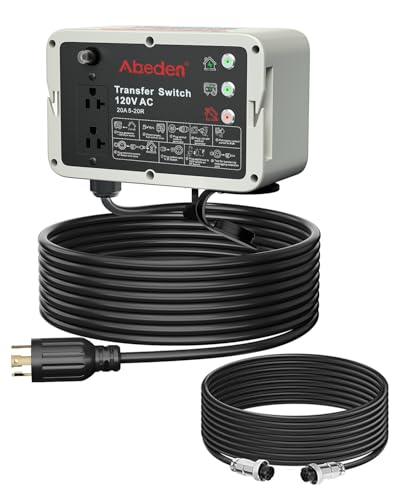
| Abeden Smart Transfer Switch (Westinghouse-Ready)Most Versatile | Plug-and-play Westinghouse generator backup | 20 A | 120V AC | Plastic, IP44 | Amazon |
| Technology Research Surge Guard 40100 | RV owners who want built-in surge protection | 50 A | RV power systems | Metal contactors | Amazon |
| Surge Guard 40100 Basic ATS | Simple 50-amp motorhome replacement | 50 A | 120/240 V | Plastic box | Amazon |
| Elkhart LPT50BRD | Quiet all-night motorhome installs | 50 A per pole | 120/240 V | Sturdy metal box | Amazon |
| Go Power TS-50 | Solar, inverter and generator switching | 50 A | 120/240 V | Knockout enclosure | Amazon |
| Furrion F50-ATS | Vibration-heavy RV and toy hauler installs | 50 A | 125/250 V AC | UL94 fireproof plastic | Amazon |
| GenerLink Meter-Mounted ATS | Whole-home panel from a portable generator | 40 A | 240 V | UV-resistant outdoor housing | Amazon |
In‑Depth Reviews
1. Progressive Dynamics PD52V 5200 Series Automatic Transfer Switch
Our pick — over 4.5★ from 550+ verified ratings; the strongest balance of quality and price.
The 50-amp workhorse that switches your whole motorhome feed without a hum.
If you are feeding a full 50-amp motorhome circuit from a portable generator, start with this box. It handles 240 VAC (volts alternating current, the standard household power type) at 50 amps, which is double the voltage of the Progressive PD5110010QV’s 120 Vac and two-thirds more current than that unit’s 30 Amp — you can see both figures side by side in the comparison table above. That headroom means your air conditioner, microwave and water heater can all draw power at once without the switch straining.
What sells it is the delay logic. The time delay circuit board holds the transfer until your generator’s output has settled into a stable voltage, then lets it through — so your electronics never see a rough startup surge. It also mechanically prevents the two power sources from entering your AC distribution panel at the same time, which keeps your wiring safe. Inside is a steel box with screw-type wiring terminals ready to wire straight to the contactor base, plus an easy-to-remove cover with the wiring schematic printed right inside it. No hunting for a manual in a dark bay.
Put it in a motorhome with a new generator, protect it with an upstream surge protector, and it runs without attention. The recurring gripe in the review pages is the contactor thump when it closes — audible at night if shore power cuts out, though the same owners call it quieter than the plastic-bodied units it replaces. A small number of units have failed early, so pair it with surge protection and treat the one-year limited warranty as your safety net.
Where it earns its keep
- 240 VAC at 50 Amp handles a full motorhome load — double the voltage of the 30-amp Progressive unit
- Time delay circuit holds transfer until generator voltage is stable
- Steel enclosure with the wiring schematic printed inside the removable cover
- Screw-type terminals wire straight to the contactor base with no adapters
What to plan around
- Contactor closes with a solid thump that is noticeable overnight when shore power fails
- Knockouts fit 1-inch clamps that are not included, and thick 50-amp cables can be hard to secure
- No indicator lights on the newer revision, so you lose a quick visual status check
Made for: Anyone powering a 50-amp RV or subpanel who wants the simplest reliable auto-switch.
Think twice if: You need silent overnight operation or you are running a small 30-amp camper circuit.
2. Progressive PD5110010QV 5100 Series Automatic Transfer Switch
The 30-amp camper circuit switch built so the board swaps out without rewiring.
Smaller campers and vans run a 30-amp service, and this is the Progressive switch scaled for exactly that. It moves 3600 watts at 120 Vac, so it is a fraction of the load the 50-amp PD52V above carries — 30 Amp against that unit’s 50 Amp. If your rig uses a 30-amp cord, this is the correct pairing; a 50-amp box would be overkill and would not match your wiring.
The feature that separates it is serviceability. The quick-change circuit board can be replaced on its own if it ever fails, so you do not have to disconnect and reinstall the whole unit. Built-in strain reliefs (the clamps that stop wires from pulling loose) let you push the branch circuit wires straight into the housing and connect them — no separate strain reliefs to buy for each circuit. Later units ship with Quick Flip Lever Lock Connectors, which owners describe as a real upgrade over the old cramped terminal block.
Full-time 30-amp RVers replace the older PD5110610 with this model regularly, and the flip connectors get most of the praise. The honest caveat: some units arrive with no instructions in the box at all, and the wiring is unlabeled, so photograph your original connections before you pull them. The manual, when present, is thin on labels.
Why the board swap matters: A failed card means replacing one part instead of the whole unit — a genuine cost saver over the years.
Ideal for: 30-amp camper and van owners who want a repairable switch rather than a sealed one.
skip it if: You run a 50-amp rig — the 120 Vac, 30 Amp rating cannot match that service.
3. Abeden Smart Transfer Switch for Westinghouse Portable Generators
The plug-and-play box for a Westinghouse Smart Switch Ready generator.
Not everyone wants to open a breaker panel. This unit is aimed at the opposite buyer: someone with a Westinghouse Smart Switch Ready generator who would rather plug in than wire in. It is rated 20 A (amps, the measure of electrical current) at 120V AC with 5-20R outlets supporting loads up to 2400W — enough to run a refrigerator, a sump pump or a furnace blower. That is the point of backing up critical appliances instead of a whole house.
Compatibility is where you must pay attention. It works specifically with Westinghouse generators that carry Smart Switch Ready outlets, listed as the WGen5300, WGen7500, WGen7500DF, WGen9500, WGen9500DF, WGen12000 and WGen12000DF. If your generator is not on that list, look elsewhere in this guide. On the right generator it is genuinely simple: the box comes with the transfer switch unit, a power cable and a control cable, weighs 9 lb, and carries an IP44 rating — a two-finger water-resistance grade indicating protection against splashing water, which suits an outdoor install.
The reviews are the strongest of any pick here, and the standout story is a Ford F-150 PowerBoost hybrid owner who ran an AC, microwave, water heater and lights from the truck through an adapter, reporting it worked “just like it is supposed to do.” The trade-off is scope: at 20 A and 2400W it protects a handful of circuits, not your whole panel, so think of it as critical-appliance backup rather than whole-home power.
Perfect for: Westinghouse Smart Switch Ready owners who want backup without an electrician.
Not the pick if: You need whole-panel coverage or run a non-Westinghouse generator.
4. Technology Research Surge Guard 40100 50 Amp Automatic Transfer Switch

A 50-amp RV switch that guards the whole rig from faulty park power.
Most transfer switches only move power. This one adds a layer of protection while it does it, guarding your RV from faulty power at the pedestal as well as switching between shore and generator automatically. The build uses mechanical interlocking contactors — heavy relays that can never both close at once — with a generous time delay at power up and an automatic transfer to generator power after a 30 second delay.
On a 50-amp service it is a direct alternative to the Surge Guard 40100 Basic below, but the headline here is the added surge function rather than the raw switching. Install it with hand tools and it drops into a bay that previously held a similar unit. One owner credits it with saving a motorhome from lightning damage, and the fit on older coaches — including a 2005 Newmar Essex — comes up repeatedly as straightforward.
Two things to weigh. It produces a slight buzz, which owners neutralize by fitting rubber washers behind the mounting holes so the noise only carries directly in front of the box. And the smaller punch-out hole is a non-standard size, which forces some buyers to get creative or supply their own protection nuts. Hardware stores rarely stock a 50-amp RV transfer switch locally, so plan the install around shipping.
Arguments for it
- Combines automatic transfer with built-in Surge Guard protection against faulty park power
- Mechanical interlocking contactors plus a 30-second time delay at power up
- Simple hand-tool install that fits older coaches like a 2005 Newmar Essex
Set your expectations
- A slight buzz is normal; rubber washers behind the mounting holes help quiet it
- The smaller punch-out is an odd size, so you may need to supply your own protection nuts
- One reviewer noted a unit that disconnected under microwave load, so test under real load early
Choose it when: You want surge protection and automatic transfer in a single 50-amp box.
Consider the Basic instead if: You already run a separate surge protector and only need the switching.
5. Surge Guard 40100 Basic Automatic Transfer Switch
The no-frills 50-amp replacement that switches in about 45 seconds and out almost instantly.
When a factory transfer switch burns out and you need a like-for-like swap, this is the straightforward answer. It is a 50-amp, 120/240-volt, 60 Hz unit with mechanical interlocking contactors and a time delay at power up, and it uses screw terminals for the connections. Generator dominant means that if both shore power and generator are available, generator wins until it stops.
Owners who have lived with it describe a roughly 45-second delay switching from shore to generator — long enough for the generator to warm up — and a near-instant switch back to shore, with an audible click when the generator takes over that they all agree is normal. It replaces the older Model 40100 unit directly, and fit differs only slightly from the box it supersedes.
Two honest notes. The case is now plastic where the old one was metal, which some owners flag as a downgrade even though the function is identical. And no instructions ship in the box, so this is a job for someone comfortable with 50-amp wiring — the audible “ca-chunk” on every switch is the other thing new owners notice first.
Straight swap appeal: A direct replacement that restores a motorhome’s power without redesigning the bay.
Right for: Seasoned RV owners replacing a burnt-out 50-amp switch who value a plain, proven design.
Reconsider if: You are wiring your first transfer switch — there are no instructions in the box.
6. Elkhart LPT50BRD 50 Amp Automatic Transfer Switch

The relay-based switch that trades a hum for a single click, so you sleep through the transfer.
Here is the pick for anyone who has lain awake listening to a transfer switch hum all night under the bed. This Elkhart unit runs on a relay-based design with a terminal strip, rated 50 Amp per pole with a 70 Amp neutral, and it uses a 22 second nominal time delay to let the generator get up to speed. The delay is defeatable if you want instant switching. It runs 120/240 volt with shore power pass-through, so when you are on shore power the relay stays out of the circuit entirely.
That pass-through design is the durability story. The relay only engages when the generator is actually running, which owners point out is far less often than the RV spends plugged in — so the switching parts wear far more slowly. It replaced the IOTA ITS-50R in many older Holiday Rambler and Monaco coaches as a drop-in, in a sturdy metal box that runs slightly larger than the original.
The complaint worth knowing: this ships with minimal protection in the box, and styrofoam has arrived shattered with little bubble wrap. Inspect it the moment it lands. A rare unit has needed a tap to power on and drew a warranty dispute, though that is the outlier across a body of otherwise quiet, long-service reports. The accessory note for serious installers — the box could be roomier for large #6 gauge wiring.
Why owners stay with it
- Silent except for the initial power-on click — the relay stays idle on shore power pass-through
- 22 second nominal generator delay, defeatable for instant switching
- Terminal strip wiring for easy connections and 70 Amp neutral
- Sturdy metal box that drops into older Holiday Rambler and Monaco coaches
Watch these points
- Ships with thin packaging; inspect for transit damage immediately
- Internal space is tight for large #6 gauge wiring
- Documentation is sparse, so wiring knowledge is assumed
Built for: Motorhome owners replacing a noisy under-bed switch who want a quiet night’s sleep.
Weigh the cost if: You want generous wiring space or you are installing large #6 conductors.
7. Go Power TS-50 50 Amp Automatic Transfer Switch
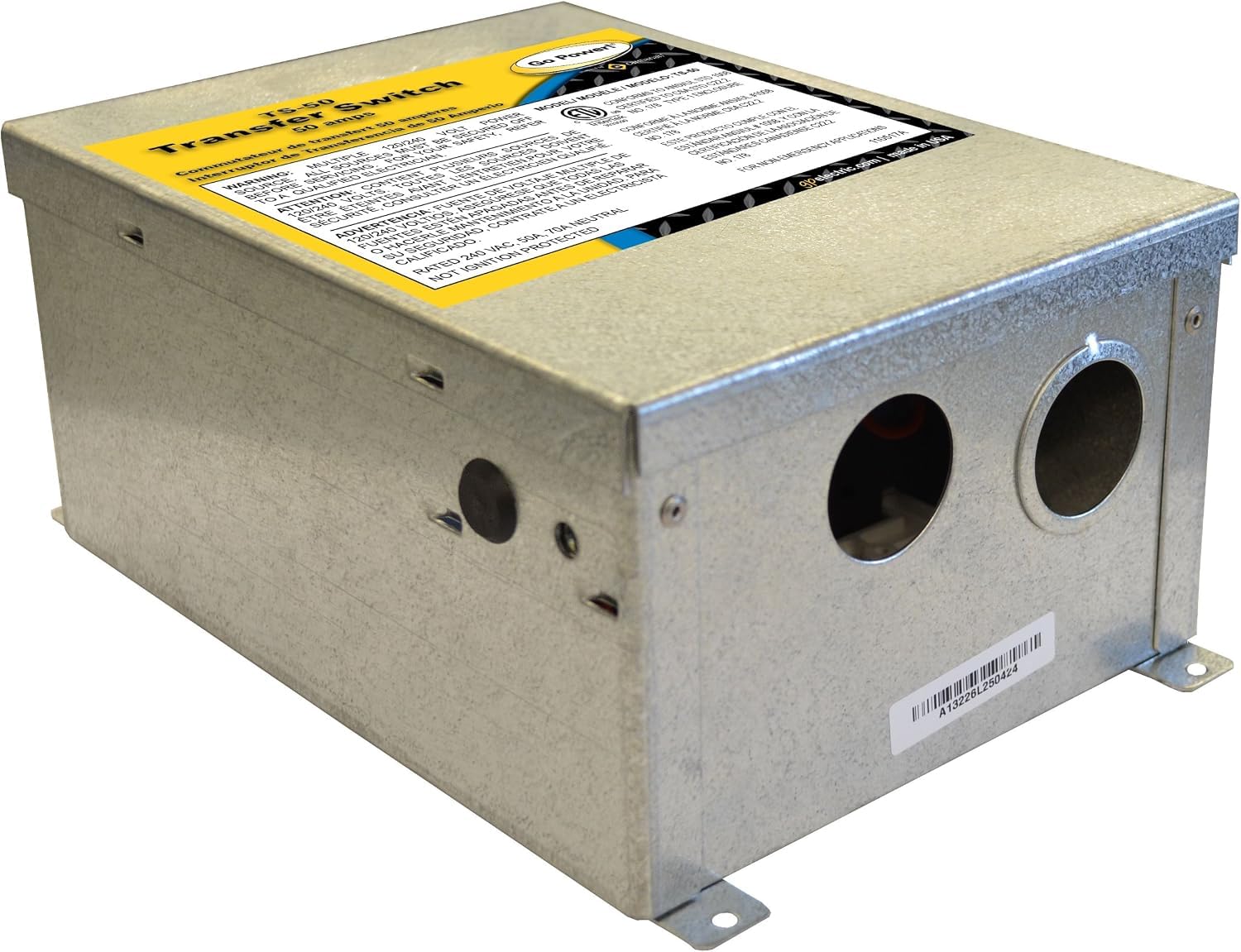
The three-source switch for rigs juggling shore, generator, inverter and solar.
Some setups are not a simple two-way choice. If your RV or off-grid system switches between shore power, a generator, an inverter and solar panels, this 50-amp unit is built for that layered job. It pairs with inverters, shore power and generators, includes a delay switch for safe generator operation, and comes with knockouts to speed up installation. It weighs 8 lb.
Where it shines is speed. An owner running an off-grid setup between solar and generator reports the switchover is fast enough that a TV stays on throughout — no blink, no reset. That is the difference between a switch you notice and one you never think about. It also carries a solid reputation for standing behind the product: when one failed at 19 months, Go Power support diagnosed the relay failure over the phone and sent a replacement on proof of purchase.
Two cautions from the field. There is a documented conflict case where a 1500W pure sine inverter mimicked a 50-amp shoreline, which the owner solved by rewiring to a 30-amp circuit. And the instructions use inconsistent terminology, so expect to do a little research to map the terminals. One unit failed after around 50 switches, which is the exception across an otherwise solid record.
What earns the recommendation: Three-source switching with enough speed to keep electronics alive through the changeover.
Reach for this if: Your rig switches among shore, generator, inverter and solar and you want a switch fast enough to hide the changeover.
Look elsewhere if: You want a plain two-way shore-and-generator box with clear, simple instructions.
8. Furrion F50-ATS 50 Amp Automatic Transfer Switch

A 50-amp switch engineered to shrug off road vibration and temperature swings.
If your transfer switch lives where the road shakes it daily, the build quality here is the reason to look. Furrion starts with a mechanical interlock between the contactors — the guarantee that both can never close in parallel and overvoltage your output line — and builds the rest for punishment. It runs on brass terminals that are nickel plated to resist corrosion, with a UL94 fireproof plastic casing, and it is certified to UL1008, the standard for transfer switching equipment.
The two branded technologies are VibrationSmart and ClimateSmart, which the maker states are built to withstand constant vibration and extreme temperatures. It handles two 125/250 volt AC sources — generator, shore cord or inverter — with a 20-30 second delay once the generator is sensed at Input 2, giving it time to reach running speed before load is applied. The delay is generous enough that no appliance sees the ragged startup wave.
The catch is noise over time. Buyers report that after about a year and a half a low hum begins, traced in one case to the shore power relay. There is also a report of chatter when switching and a unit that failed after two weeks, so it is worth stress-testing in the first month. Fitted correctly, though, it is one of the tidier installs here — an owner replacing an older IOTA unit noted it caught visible arcing in the old switch.
What stands out: VibrationSmart and ClimateSmart construction plus brass, nickel-plated terminals for a bay that never stops moving.
Made for: Toy haulers and full-time RVs where vibration and heat are the daily reality.
Think about it if: A quiet bay matters most — some units develop a hum over time.
9. GenerLink Meter-Mounted Automatic Transfer Switch for Home Generator
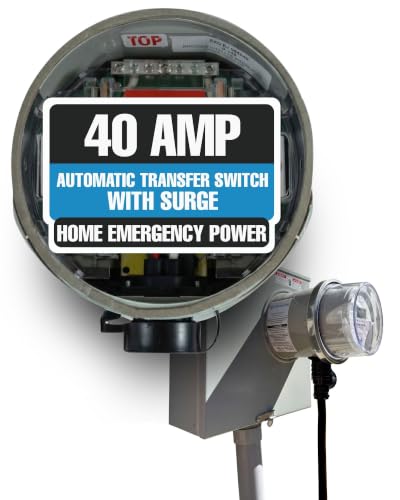
The meter-mounted switch that powers your entire home panel from one portable generator.
Every other pick here lives inside a coach or a bay. This one mounts behind your home’s electric meter and powers your entire breaker panel — every circuit, no limit — from a portable generator. It is rated 40 A at 240 V, compatible with generators running below 10,000 watts and electrical services up to 200 amps, and it comes with a 20-foot GenerLok power cable using an L14-50 straight connector. No extension cords and no manual rewiring.
The safety package is the real draw for a home install. It carries 75kA surge protection to shield your appliances and electronics, an audible alarm for surge events, and prevention of back-feeding utility lines — which protects linemen working the outage as much as your equipment. It is UL-listed to UL1008M and compliant with the 2020 National Electric Code. The housing is UV-resistant and weatherproof, built for year-round outdoor mounting.
Installation is the wrinkle: it is designed to be fitted by your utility personnel or a licensed electrician, and one buyer found their local electric co-op did not permit its use at all — check with your power company before buying. When it is allowed, an electrician can have it running in about 30 minutes, and it is portable to a new home if you move. That combination of whole-panel coverage and meter mounting is what the premium buys.
Why it wins on scope
- Powers the entire breaker panel with no limit on circuits, unlike every RV-bound pick here
- 75kA surge protection plus an audible alarm and anti-back-feed safety
- UL-listed to UL1008M and compliant with the 2020 National Electric Code
- Weatherproof, UV-resistant housing made for permanent outdoor mounting
Plan ahead for these
- Requires installation by utility personnel or a licensed electrician — not a DIY box
- Some utility companies do not allow it on their lines, so confirm before ordering
- The premium price reflects whole-panel coverage rather than circuit-level backup
Best for: Homeowners who want their whole panel backed up by a portable generator with one automatic, cordless connection.
Not for you if: Your utility forbids meter-mounted switches — confirm that first.
Understanding the Specs
Amperage and Voltage — the first thing to match
Amperage is how much current a switch can carry continuously, and voltage is the pressure of that current. You match them to the service you are protecting: a 30-amp, 120-volt switch suits a small camper circuit, while a 50-amp, 240-volt unit handles a large motorhome or subpanel. Choosing a rating higher than your service does not add safety — the switch should match what your wiring actually carries.
Time Delay — protecting the generator and the load
Generators do not produce clean power the instant they fire. A time delay circuit holds the transfer until the generator’s voltage is stable, so compressors and electronics never see a ragged startup. Switches here typically use a delay in the 20 to 30 second range, and some make it adjustable or defeatable for setups that also run inverters.
FAQ
What size automatic transfer switch do I need for my generator?
Can I install an automatic transfer switch myself?
What is the difference between a 30-amp and a 50-amp transfer switch?
Will an automatic transfer switch work with a Westinghouse generator?
Why does my transfer switch hum or thump when it switches?
How long should an automatic transfer switch last?
Do I need a separate surge protector with a transfer switch?
What is a mechanical interlock and why does it matter?
Can a transfer switch power my whole house from a portable generator?
Does my utility company need to approve a meter-mounted transfer switch?
Final Thoughts: The Verdict
For most people, the best automatic transfer switch for a portable generator is the Progressive Dynamics PD52V because it carries a 50-amp, 240 VAC load with a steel enclosure, a time delay that stabilizes your generator’s output, and a schematic printed inside the cover for the easiest self-install. If you want built-in surge protection in the same 50-amp box, reach for the Technology Research Surge Guard 40100. And if your goal is backing up your entire home instead of an RV bay, the meter-mounted GenerLink is the one to call your utility about.
How We Picked
We do not accept paid placement. Every pick is matched to a real buyer and a real use-case; we do not hands-on test units.
Sources & Methodology
Specifications: manufacturer listings and product documentation. Review insights: verified customer reviews, as of September 2026. Pricing: not shown on this page (it changes often); check the current price via the retailer link.
As an Amazon Associate, KitchPrep earns from qualifying purchases. This does not affect which products we feature.
Related Guides
