
Specs are compiled from manufacturer listings and verified buyer reviews and can change over time — please confirm the key details on the product page before buying.
An automatic pasta machine does one job: it takes a lump of dough and turns it into rolled sheets and cut noodles without you cranking a handle. The two things that decide whether you will still love it next year are how the motor is geared and how many cutting blades you actually get, because almost every complaint about these machines traces back to one of those two. This guide covers nine electric models, from compact countertop units to a large-capacity Philips, and explains plainly which one suits a weeknight cook, which suits a big family batch, and which suits someone who wants a machine built for heavy use.
I’m Mohammad Maruf — the founder and writer behind KitchPrep. This guide is built by comparing the manufacturers’ published specifications and the patterns across verified customer reviews, so you get each pick’s real strengths and trade-offs instead of marketing spin.
Motor wattage, blade count and dough capacity separate a machine you use weekly from one that sits in a cupboard. That is exactly what this breakdown of the best automatic pasta machine unpacks for you.
Our Picks at a Glance

How To Choose The Best Automatic Pasta Machine
An automatic pasta machine is a motorized countertop appliance that presses dough into a flat sheet and then cuts that sheet into noodles, so you never turn a crank by hand. Three specifications decide almost everything about how it feels to own one.
Motor power and how hard you can push it
Wattage tells you how much muscle the motor has. The motors in this round-up range from 135W up to 700W, and that gap matters most with stiff, low-hydration dough. A stronger motor rolls a firm dough sheet without stalling. A gentler motor still works fine if you keep batches small.
Heat is the real enemy. A 135W unit in this list is rated to run for up to 1 hour because its motor sits next to a heat dissipation system, while a 700W model asks you to run it in 15-minute batches with a 5-minute cool-down in between. Follow the maker’s pacing and the motor keeps going.
Blade count and dough thickness, in plain terms
A blade is the slotted cutter that turns a flat dough sheet into strands. One machine here ships with a single built-in knife that cuts 2.5mm round, 4mm flat and 9mm flat noodles. Others give you 3 or 4 separate moulds. More blades mean more shapes from one appliance.
Thickness settings are measured in millimeters. A 1.5mm sheet is thin enough for delicate pasta; 3mm or thicker is for dumpling and wonton wrappers. One unit lets you push dough thickness all the way to 5mm, which is genuinely thick. If you want lasagna sheets and dumpling wrappers from the same machine, check the thick end of its range, not just the thin end.
Quick Comparison
| Model | Best For | Power | Noodle Sizes | Thickness Range | Amazon |
|---|---|---|---|---|---|
| Newhai Electric Pasta Maker★ Best Overall | Everyday family batches | 135W | 1.5mm thin, 4mm flat (2 blades) | 0.5–3mm | Amazon |
| Shule Electric Pasta MakerBest Value | Budget beginners and crafters | 110V motor, 2 speeds | 1.5mm, 6.6mm | 0.5–3mm | Amazon |
| GVODE Electric Pasta Maker MachineTop Performer | Long fettuccine and lasagna sessions | 700W | Angel hair, fettuccine, spaghetti | 0.4–2mm | Amazon |
| WICHEMI Electric Pasta Maker | High-output noodle making | 135W | 2.5mm round, 4mm, 9mm flat (3 blades) | 1–3.5mm | Amazon |
| NEWTRY Electric Pasta Maker | Heavy stainless build | Electric, 110V | 2.5mm round, 4mm, 9mm wide (3 blades) | 1–4mm | Amazon |
| Luzrise Electric Pasta Maker | Shape variety in one unit | 135W | 1.5mm, 2.5mm, 4mm, 9mm flat (4 blades) | 0.5–5mm | Amazon |
| Philips Compact Pasta and Noodle Maker | Quick small-batch weeknights | Automatic | Spaghetti, penne, fettuccini plus 4 kit shapes | — | Amazon |
| MARCATO Atlasmotor 110V | Manual or motor, your choice | Pastadrive motor | Sheets, 11 optional accessory cuts | 1.5mm | Amazon |
| Philips 7000 Series Pasta Maker | Big family batches fast | 150W | 8 discs | 1–1.5mm | Amazon |
In‑Depth Reviews
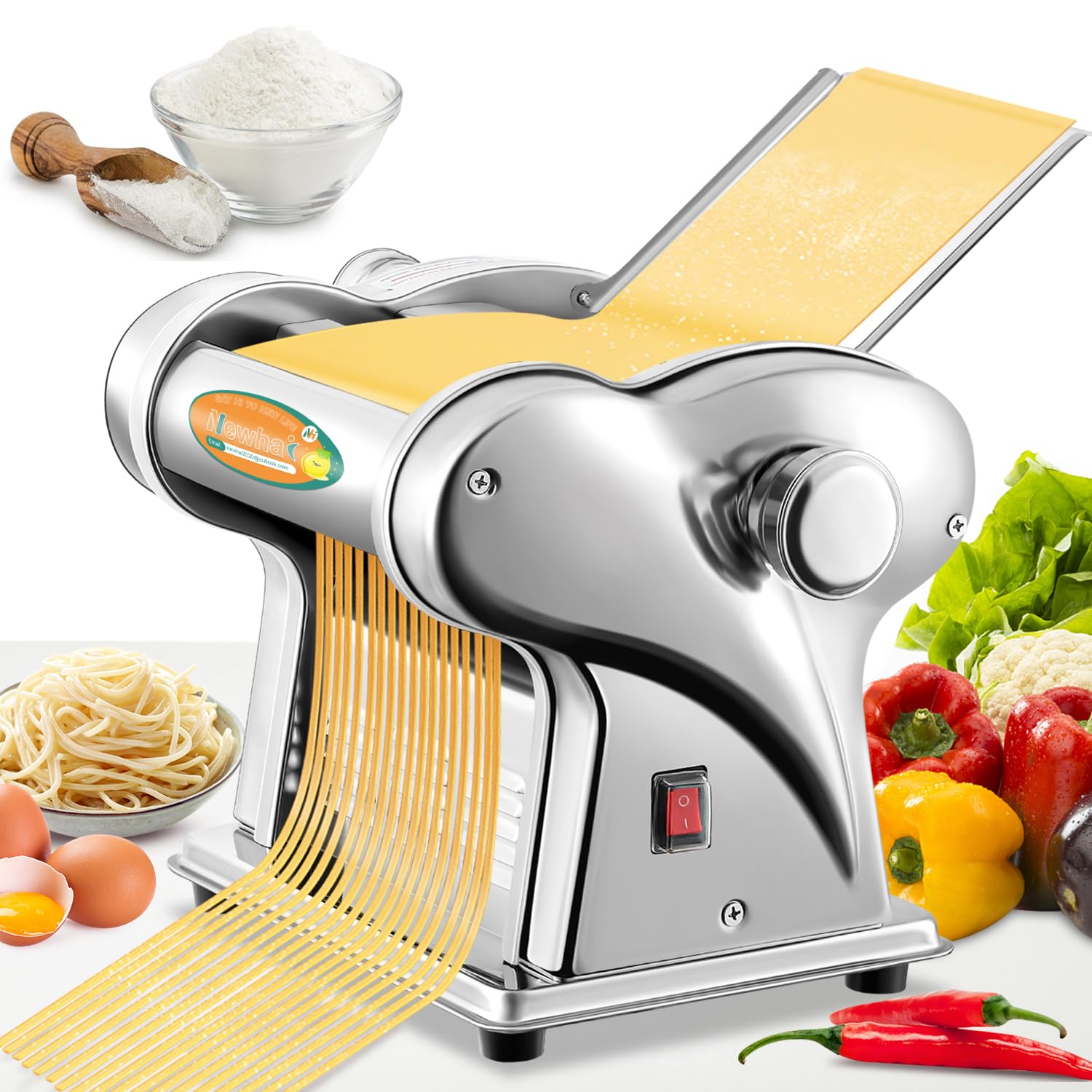
1. Newhai Electric Pasta Maker, Stainless Steel 135W for Home, 2 Noodle Sizes
Our pick — over 4★ from 100+ verified ratings; the strongest balance of quality and price.
A 135W stainless machine rated for 11lb of noodles an hour.
If you cook pasta for a household several times a week, this is the machine to beat. Its 135W motor presses dough and cuts noodles with one key, so you flip from rolling to cutting without stopping to swap anything.
The rollers, blade and body are 430 stainless steel, a rust-resistant food-grade alloy that holds up to daily contact with dough. Eight thickness gears run from 0.5mm to 3mm, and the maker suggests working below gear 5 for pasta and above gear 6 for dumpling or wonton wrappers. Two blades cover the basics: a 1.5mm thin noodle and a 4mm flat noodle. There is a genuine advantage to how it forms noodles, too. Buyers report that the cut strands come out firm and hold their shape in a way extruder machines often do not — the review pages sum it up as: “the process is simple and enjoyable, making it a fantastic activity for quality family time in the kitchen.”
The catch is cleanup. Dough residue works into crevices and the manufacturer says never to use water, so a dry brush or a blast of compressed air is the practical routine. There is also a residual protective oil on the rollers when new, and the maker advises running a piece of scrap dough through repeatedly to lift it off before your first real batch. Budget a few practice passes and the machine settles in.
What earns its keep
- 135W motor rolls and cuts with one key, rated for 11lb/h of output
- 430 stainless steel body, roller and blade resist rust
- Eight gears span 0.5mm to 3mm for pasta, wrappers and dumpling skins
- Two noodle sizes from the start, 1.5mm thin and 4mm flat
Worth knowing before you buy
- Dry-clean only — no water on the machine, so a brush is essential
- Ships with protective grease that needs a scrap dough pass first
- Just two blades, so no wide 9mm noodle option
Buy it if you want a stainless machine that makes a big batch fast and holds noodle shape.
Think twice if you want extra-wide noodles or you would rather rinse parts under the tap.
2. Shule Electric Pasta Maker with Motorized Roller, Stainless Steel
Two ways to roll, one machine — motor on for big batches, crank on for small.
Here is the smartest budget move in this list. The Shule comes as a classic stainless pasta machine plus a motor you can bolt on, and the motor lifts off when you would rather crank by hand for a quick portion. It also comes with a hand crank in the box, plus a motor fixing plate, table holder and brush. Because the hand crank is always there, a motor failure never leaves you with a brick.
Quality is the thing buyers talk about most, and the roller and cutters run on anodized aluminum, which resists corrosion. The dial regulates dough thickness from 0.5mm to 3mm, and the included attachments cut strands at 1.5mm and 6.6mm — that second size gives you a wider ribbon than the Newhai’s 4mm flat noodle. Two speeds drive the roller, and the whole motor section detaches so the machine itself stays compact.
Be honest about the noise. Machine noise is a recurring note in the feedback, so if you roll dough at dawn, expect the household to hear it. There are also plastic guards on the unit, and some long-term owners mention those guards chipping with heavy clay or dough use — treat the covers gently and avoid forcing stiff material through on the narrowest setting. Cleanup is dry only: a soft brush or cloth, never water or the dishwasher.
The budget backbone: you get a real stainless machine, a detachable motor and a backup hand crank, which is more hardware than most entry-level units include.
Honest noise note: the motor is not quiet, and the plastic guards are the part to handle with care over the years.
Reach for this if you want the lowest-risk entry into motorized pasta and like having a manual fallback.
Look elsewhere if you need silent operation or a fully metal body with no plastic covers.
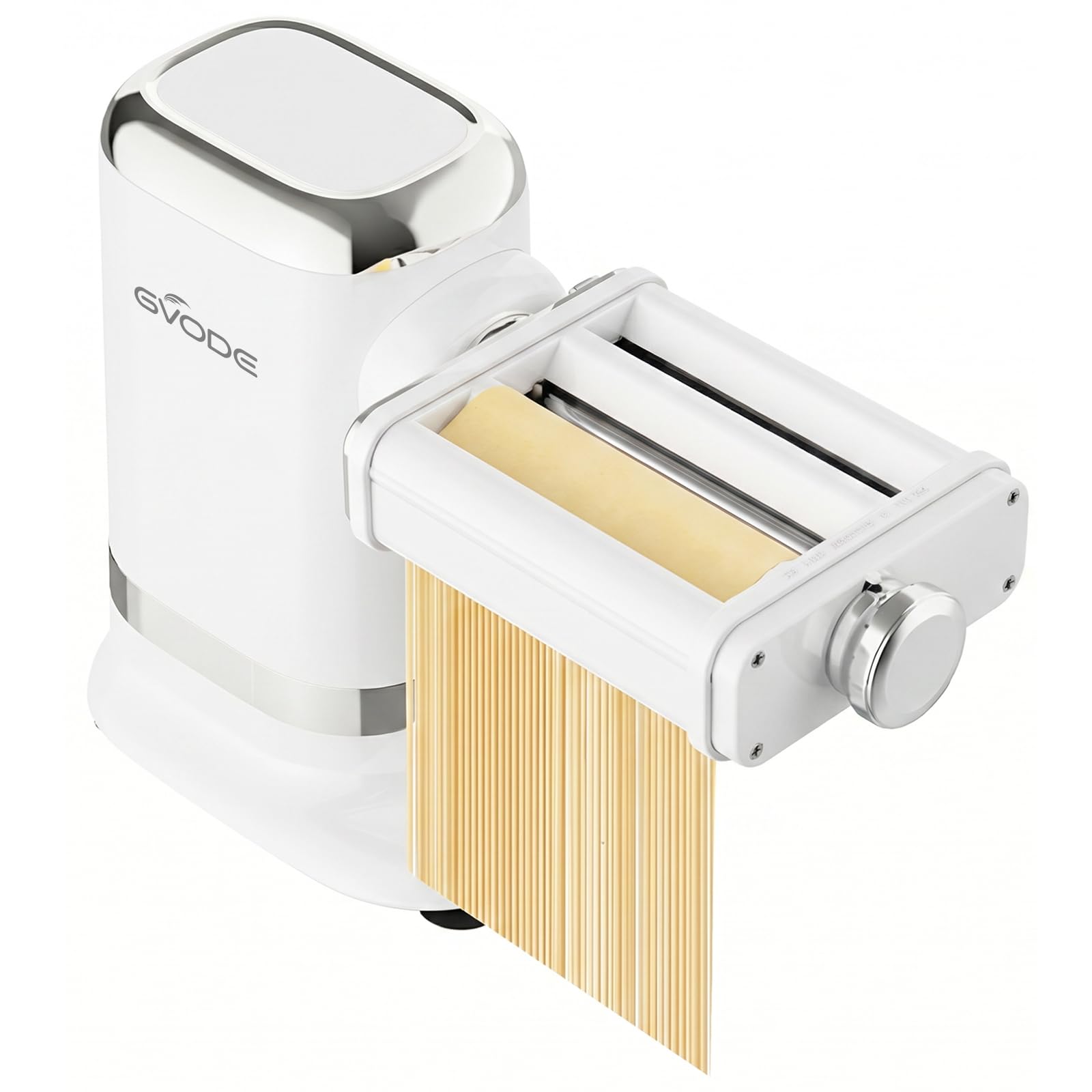
3. GVODE Electric Pasta Maker Machine, 3-in-1 Pasta Roller & Cutter Set, White
A 700W motor that powers through stiff dough in a light, stowable body.
Motor muscle is where the GVODE separates itself from the rest of the field — 700W versus the 135W in the Newhai and WICHEMI units above, so pushing a firm dough sheet through is not the battle it can be on a lower-powered machine. Two speeds plus a reverse function let you back dough out if it bunches at the roller, which saves a frustrating re-feed.
Eight thickness settings stretch from 0.4mm to 2mm, thin enough for delicate angel hair sheets and wide enough for lasagna. On a machine this size, the housing is durable plastic, which keeps the whole thing light enough to move between counter and cupboard — a real advantage in a tight kitchen. The drive gears, though, are metal rather than plastic, so the rollers stay aligned batch after batch, and the smooth shell wipes clean in a single pass. Buyers clearly value the pace: the machine has rolled and cut six batches of fettuccine in under 20 minutes for one owner.
There is a rhythm to follow here. GVODE asks you to run in 15-minute batches with a 5-minute cool-down between, and keeping the motor-base vents clear while it runs. That rest step is the single biggest factor in motor life — skip it and the machine is more likely to cut out mid-session. On the value question, opinion is split among owners, with some calling it a solid affordable pick and others feeling it did not deliver enough for what they paid. For a light-to-medium home cook, the balance tips in its favor.
The GVODE is your pick if you want real motor power, eight thickness settings and a light body you can stow easily.
It is not your machine if you would rather run long continuous sessions than batch in 15-minute intervals.
4. WICHEMI Electric Pasta Maker Machine 3 IN 1 Automatic Dough Pasta Roller

A 304 stainless 3-in-1 roller with three built-in blades and 22lb/h output.
Noodle variety is the reason to look here. A built-in knife cuts three shapes — 2.5mm round noodles, 4mm flat noodles and 9mm flat noodles — and you switch functions with a single mode knob rather than swapping attachments. That 9mm option is the widest flat cut in this group, the sort of ribbon that suits pappardelle-style dishes.
The body is 304 food-grade stainless steel, which resists rust and stays rigid, and the 135W motor is rated at 22lb/h of output — the highest efficiency figure in this round-up. A one-button control keeps operation simple for any skill level, and the dough thickness adjusts from 1mm to 3.5mm, so dumpling and wonton skins sit within reach alongside standard noodles. It is at home on a countertop where a compact footprint matters.
Two honest notes to weigh. The fine-spaghetti setting runs thin — owners who prefer a thicker strand sometimes wish it were chunkier, and the 2.5mm round cut is not for everyone’s taste. Separately, the motor can run warm during longer sessions, which owners notice and simply work around with shorter runs. Both are manageable habits rather than roadblocks.
The shape argument: three built-in blades covering round, 4mm and wide 9mm noodles is more cutting range than most single-knife machines offer.
One warm-motor habit to note: the motor runs warm on extended sessions, so break long noodle-making runs into shorter stretches.
Choose this one if wide flat noodles and high hourly output are what you are after.
skip it if you only ever make thin spaghetti — the fine setting runs delicate here.
5. NEWTRY Electric Pasta Maker Noodle Machine, Dough Roller Cutter, 3 Blades

A heavy 410 stainless roller with a twist knob that sets thickness and switches modes.
Weight is the first thing you notice — this machine is built heavy, and the stainless body, rollers and blades give it a solid, planted feel on the counter. It runs a single speed, and that speed is fast. Three blades cut 2.5mm round, 4mm flat and 9mm wide noodles, and the rollers press an even, delicate dough sheet across a 5.5-inch width.
The knob is the standout upgrade over older designs. Instead of a snap-fit part, it turns left and right to adjust dough thickness and switch between cutting and pressing, and the maker says it is built to resist breakage for longer service. Thickness spans 1mm to 4mm, and the guidance is to work at gear 5 or below for pasta and gear 6 or above for dumpling wrappers. Buyers consistently find it straightforward to operate, and the results speak for themselves on the plate.
Reliability is the honest caveat here. Feedback is genuinely split — some owners run it happily for months of weekly use, while others report breakdowns after only a few sessions, and there are accounts of the power switch going unresponsive within six months. The manufacturer’s support line does respond: owners who had problems report quick replies, troubleshooting videos and replacement offers. New users should also run scrap dough through several times first, because the rollers carry residue when new.
Fit for a heavy user: the 410 stainless body and rapid single speed suit someone who values a rigid machine and fast output.
The durability question: experiences vary widely, so this one rewards a buyer who registers the machine and keeps the purchase receipt handy for the warranty window.
Worth considering if you want a heavy stainless machine, a fast single speed and responsive after-sales support.
Look elsewhere if you want the most predictable long-term reliability in this group.
6. Luzrise Electric Pasta Maker Automatic Noodle Machine, 4 Blades, 9 Thickness Settings

Nine thickness settings from 0.5mm to 5mm and four blades covering 1.5mm to 9mm.
Nobody else here offers this much range in one unit. Nine adjustable thickness settings run from 0.5mm to 5mm — that 5mm top end is the thickest sheet in this round-up, generous enough for hearty dumpling wrappers and rolled stuffed pasta. Four blades cover 1.5mm, 2.5mm, 4mm and 9mm noodles, so spaghetti, linguine and wide ribbons all come from the same machine without buying extras.
The 135W motor sits inside the housing rather than bolting on, and the maker rates it for stable, jam-free operation for up to 1 hour, positioned next to a heat dissipation system to keep temperatures in check. Anti-slip pads under the base stop the unit sliding or rattling during a batch. The body and blades are 304 stainless steel, and a smooth polished surface plus an eco-friendly ABS shield keeps scratches at bay. A 14cm roller mimics a hand-rolled sheet, flattening dough evenly across its width.
The build holds up to real use. One owner has run this daily for three years making empanadas and calls it still going strong, and the support side is solid too — a defective first unit was replaced in two days and then performed perfectly. The one instance where it falls short is ultra-specific: a buyer who wanted extra-wide chicken-and-noodle strands found the machine only cut spaghetti and linguine sizes and ended up finishing the job with a knife. Check the blade list against the shape you actually want.
Range you will actually use
- Nine thickness settings spanning 0.5mm to 5mm, the widest in this list
- Four blades cover 1.5mm, 2.5mm, 4mm and 9mm noodles
- Built-in 135W motor rated for up to 1 hour of jam-free running
- 304 stainless body and blades with a 2-year warranty
Where it is narrower than you hope
- Widest cut tops out at 9mm, so ultra-wide strands are not happening
- Requires a scrap dough pass at the start to clear packing oil
- Compact footprint means smaller batches than a high-capacity extruder
A strong match for a cook who wants one machine to handle thin spaghetti through thick dumpling skins.
Not the right fit if you specifically need very wide flat noodles for a particular dish.
7. Philips Compact Pasta and Noodle Maker with 3 Interchangeable Pasta Shape Plates

It kneads and extrudes 2-3 servings in an 18-minute hands-off cycle.
This one changes the workflow entirely. Instead of rolling a sheet you feed by hand, the Philips kneads and extrudes 2-3 servings of fresh pasta in just 18 minutes using a stirring bar that mixes the dough itself. That hands-off cycle is the whole appeal for a busy weeknight. This bundle pairs the machine with a 4-in-1 accessory kit for pappardelle, tagliatelle, angel hair and lasagna.
from the start you get three classic shaping discs for spaghetti, penne and fettuccini, and the special discs use a double extrusion process to push out smooth, consistent strands. The accessory set adds the four shapes above, so seven discs in total cover everything from thin angel hair to wide pappardelle. The design is genuinely slim — it slides into a compact space on the counter rather than dominating it, and the additional attachments are dishwasher-safe.
Portion size is the honest trade-off. Because it handles 2-3 servings per batch, a household of two or more will often run it twice for a full meal. There is also a technique to learn: the dough needs to be weighed with a scale rather than scooped by cup, and a crumbly texture at the start is correct, not a mistake. Get the ratio right and results are repeatable batch after batch. Owners also note that cleaning immediately, before flour and water harden, keeps the parts easy to wipe down.
Who it fits: a two-person household that wants fresh pasta with almost no hands-on time and values a slim footprint.
What to expect: small batches mean two runs for a bigger family, and a kitchen scale is a practical companion.
Pick the Philips if you want kneading and shaping handled for you in a single 18-minute cycle.
Think twice if you regularly cook for four or more and would rather make it all in one pass.
8. MARCATO Made in Italy Atlasmotor 110V Electric Pasta Machine, Chrome Steel

An Italian-made Atlas 150 with a Pastadrive motor and a hand crank.
This is a different philosophy of machine. The set includes the Atlas 150 pasta machine plus a Pastadrive motor, a hand crank and a clamp, so you can motorize your rolling or switch to the crank whenever you prefer. Everything is made and assembled in Italy, and it rolls pasta sheets up to 150mm wide — six inches — in one pass.
Precision is the Atlas’s calling card. A 10-position adjustment knob sets pasta thickness with clear, repeatable stops, and the resin scrapers clean the rollers as you roll, so cleanup is a dry brush after the machine sits out for at least 30 minutes. Twelve pounds is the number to note — that is heavier than the Newhai at 16 pounds on paper, but it feels more like a bench tool than a countertop appliance. The machine also takes 11 separately sold Marcato accessories, so it grows into whatever shape you keep reaching for.
The honest split here is durability and cost. Some owners describe a machine built for heavy, professional-style use that holds up over years, while others report the motor failing in under a year. At this level of spend, that is the risk to weigh. One thing is certain from the feedback: it makes excellent pasta. The makers of full-flavoured, hand-rolled style sheets with a 50:50 semolina and 00 flour blend are the ones who rave loudest. It also gets used by crafters rolling polymer clay, though that pushes the motor harder than dough ever will.
Choose it if you want Italian build quality, the option to crank by hand, and room to add accessories over time.
Reconsider if you want the simplest possible one-button machine or you are nervous about motor longevity.
9. Philips 7000 Series Pasta Maker, ProExtrude Technology 150W, 8 discs

A 150W extruder that makes up to 8 portions in under 10 minutes.
When you are feeding a crowd, capacity beats finesse. The Philips 7000 Series turns out up to 8 portions of fresh pasta in one go, and the cycle runs in under 10 minutes — one owner reports spaghetti coming together in about 5. That 150W motor with ProExtrude technology pushes dough through the shaping discs smoothly, and eight discs ship in the box.
It is not only a pasta machine. A versatile mixing function lets you use it for cookies and to kickstart pizza and bread prep, so the footprint earns its space between pasta nights. Parts are non-stick and dishwasher-safe, the included cleaning tool gets stuck dough out of the disc holes, and a measuring cup is in the box. The HomeID app walks you through step-by-step recipes including vegan and gluten-free options. Solid construction is a recurring note — the machine feels stable on the counter rather than wobbling under load. With 823 ratings landing at 4.2 stars, it is the most-reviewed pick in this guide.
The recurring challenge is dough consistency, and it is worth understanding before you buy. Mixing paddles spin one way to combine and reverse to extrude, and the biggest factor in success is the liquid-to-flour ratio. A common pitfall is adding too much water, which makes dough too smooth and wet — a dry, pebbly texture is actually what you want. A few owners hit a defective unit or found the extrusion-only button finicky, but those are the exception, not the pattern. Expect a short practice curve and then reliable results.
What makes it the big-batch pick
- Makes up to 8 portions in one cycle, in under 10 minutes
- 150W ProExtrude motor with eight shaping discs included
- Mixing function also handles cookies, pizza and bread prep
- Non-stick, dishwasher-safe parts plus a cleaning tool
The learning curve to expect
- Dough needs careful measuring — too much liquid is the commonest misstep
- Extruding disc holes can trap dough, so the cleaning tool matters
- Premium tier pricing puts it at the top of this group
Best for a family that wants a big bowl of fresh pasta on the table fast, with a mixing function that does double duty.
Look elsewhere if you only cook for one or two and would rather not fuss with dough ratios.
Understanding the Specs
Motor wattage and heat pacing
Wattage is the motor’s raw strength, and it decides how firm a dough the machine can push through without stalling. Lower-wattage units in this group are rated to run for up to an hour of continuous use, while higher-powered models often ask you to work in short batches with a rest between. That resting habit is what keeps a motor alive long-term, so always check the maker’s stated pacing and follow it. Wattage also shapes speed — a stronger motor rolls more dough per hour.
Blades and thickness settings
Blades are the slotted cutters that turn a flat sheet into strands, and thickness settings are the millimetre gaps the rollers use to flatten dough. Thin ranges suit delicate pasta; the wider ends of the scale handle dumpling and wonton wrappers. More blades mean more shapes from one appliance without buying add-ons, so match the count to the noodles you actually eat. Always run a scrap dough through a new machine first to lift packing oil off the rollers.
FAQ
Can an automatic pasta machine make gluten-free pasta?
What thickness setting should I use for spaghetti vs dumpling wrappers?
How do I clean an electric pasta machine without ruining it?
Why does my new pasta machine leave black marks on the dough?
Is a roller machine better than an extruder machine for noodles?
How many blades do I need on an electric pasta maker?
Can I use a pasta machine for polymer clay instead of dough?
How long can I run an electric pasta maker before it needs a break?
Do I need to weigh flour or can I use measuring cups?
What is the difference between 135W and 700W in a pasta machine?
Final Thoughts: The Verdict
For most people, the automatic pasta machine worth choosing first is the Newhai Electric Pasta Maker, because its 430 stainless steel body, eight thickness gears and 11lb/h output make short work of a family-sized batch while the noodles themselves come out firm and shapely. If you want the option to roll by hand when the batch is small, grab the Shule Electric Pasta Maker and keep its hand crank close. And if you feed a crowd and want pasta in under ten minutes without any rolling at all, the Philips 7000 Series Pasta Maker is the one to reach for.
How We Picked
We do not accept paid placement. Every pick is matched to a real buyer and a real use-case; we do not hands-on test units.
Sources & Methodology
Specifications: manufacturer listings and product documentation. Review insights: verified customer reviews, as of September 2026. Pricing: not shown on this page (it changes often); check the current price via the retailer link.
As an Amazon Associate, KitchPrep earns from qualifying purchases. This does not affect which products we feature.
Related Guides
