
Specs are compiled from manufacturer listings and verified buyer reviews and can change over time — please confirm the key details on the product page before buying.
If you have ever finished a batch of homemade noodles with a sore wrist and a flour-dusted kitchen, an automatic noodle machine is the fix. These are motorized pasta makers that knead, roll, and cut for you — you load the dough and press a button. The quick answer for most kitchens: the Newhai Electric Pasta Maker is the safest all-round buy, because it does both jobs — pressing dough sheets and cutting noodles — in one stainless steel unit. Below are nine machines, sorted from best overall down to budget-friendly picks, with the real trade-offs spelled out so you pick once and cook for years.
I’m Mohammad Maruf — the founder and writer behind KitchPrep. This guide is built by comparing the manufacturers’ published specifications and the patterns across verified customer reviews, so you get each pick’s real strengths and trade-offs instead of marketing spin.
Some machines extrude soft dough through a die while others roll and cut firm sheets, and that single difference changes the texture on your plate. The picks below are the best automatic noodle machine options for home kitchens that want fresh pasta without the hand crank.
Our Picks at a Glance


How To Choose The Best Automatic Noodle Machine
The first decision is the type of machine, because it decides the texture of the noodle on your plate. An extruder pushes soft dough through a shaped disc (a metal plate with holes cut in the noodle shape) — that is how you get macaroni, penne, and bucatini. A roller-and-cutter presses dough into a flat sheet first, then slices it — that is how you get spaghetti, fettuccine, and lasagna sheets. If you cook mostly Asian noodles, dumplings, or ramen, the roller style is the one you want.
Flour capacity and output per hour
Flour capacity tells you how much you can make in one go. The VEVOR handles 500g of flour, enough for about four people in roughly 14 minutes. The Cuisinart mixes and extrudes up to one pound of fresh pasta in 20 minutes. Output ratings like 11lb/h describe steady commercial-style production, not a normal home batch — treat them as a ceiling, not a promise for your Tuesday dinner.
Thickness range and what it lets you cook
A wider thickness range gives you more dishes from one machine. The GVODE rolls sheets from 0.4mm up to 2mm; the NEWTRY goes from 1mm to 4mm, which covers noodles and dumpling wrappers. The Newhai adjusts from 0.5mm to 3mm, and its own manual suggests staying below gear 5 for pasta and using 6 and above for dumpling and wonton wrappers. Thin settings are for delicate pasta; thicker settings are for wrappers and sturdy noodles.
The habit that decides how long your motor lasts
A pasta motor is a small motor doing real work, so it needs rest. The GVODE manual recommends 15-minute batches with a 5-minute cool-down between. Overheating is a real risk on cheaper units — the NEWTRY has customer reports of the machine running hot, and the Cuisinart has reports of a bowl that detaches mid-run. Give any machine a rest between batches and you will get far more years out of it.
Quick Comparison
| Model | Best For | Type | Thickness Range | Power / Weight | Amazon |
|---|---|---|---|---|---|
| Newhai Electric Pasta Maker★ Best Overall | Everyday family pasta | Roller & cutter | 0.5mm – 3mm | 135W / 16 lb | Amazon |
| VEVOR Electric Pasta MakerTop Performer | Beginners and speed | Extruder | — | 150W / 11 lb | Amazon |
| Shule Electric Pasta MakerBest Value | Clever budget rolling | Roller & cutter | 0.5mm – 3mm | 110V / — | Amazon |
| WICHEMI Electric Pasta Maker | Multiple noodle widths | Roller & cutter | 1.5mm – 3.5mm | 135W / 17.6 lb | Amazon |
| GVODE Electric Pasta Maker | Compact kitchens | Roller & cutter | 0.4mm – 2mm | 700W / 5.2 lb | Amazon |
| Cuisinart PM-1 | Pasta plus bread dough | Extruder | — | — / 16 oz | Amazon |
| NEWTRY Electric Pasta Maker | Short quick batches | Roller & cutter | 1mm – 4mm | 110V Plug-In / 19.3 lb | Amazon |
| Luzrise Electric Pasta Maker | Asian & ramen noodles | Roller & cutter | 0.5mm – 5mm | 135W / — | Amazon |
| Philips 7000 Series Pasta Maker | Large households | Extruder | 1mm – 1.5mm | 150W / 20 lb | Amazon |
In‑Depth Reviews
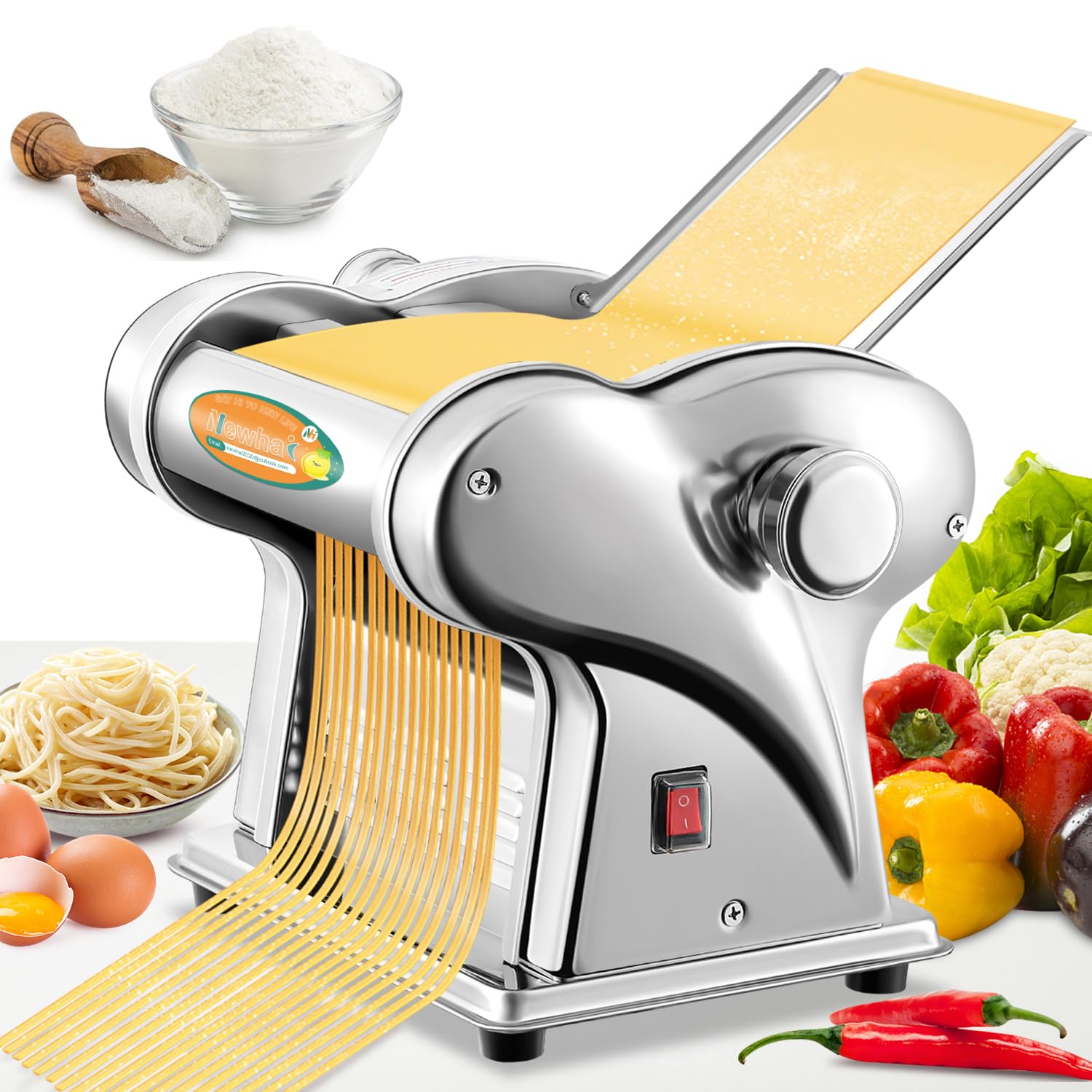
1. Newhai Electric Pasta Maker, Stainless Steel 135W for Home, 2 Noodle Sizes
Our pick — over 4★ from 100+ verified ratings; the strongest balance of quality and price.
The one machine that presses the sheet and cuts the noodle in one press of a key.
If your family eats noodles more than once a week, this is where your money goes furthest. It is a two-in-one roller: it presses dough into a sheet up to 5.5″ wide, then cuts that sheet into a 1.5mm thin round noodle or a 4mm flat noodle. The body, roller, and blades are all 430 stainless steel (a rust-resistant food-grade steel), so the parts that touch your dough are the ones built to last. At 135W, the work is handed to the motor while you just feed the dough.
You get eight thickness choices on the dial, from gear 1 to gear 8, covering 0.5mm to 3mm. Newhai’s own advice is to stay below gear 5 for pasta and use gear 6 or above for dumpling and wonton wrappers. The finished noodles hold their shape well because the sheet is rolled and cut rather than pushed through a die (a metal plate that squeezes dough into a shape). Owners who have made both say the texture is firmer than an extruder’s. What wins people over is the performance — this machine earns more owner praise for how it works than for any other single trait. The follow-up in second place is how much fun families have running it together. One owner pushed 50 lbs of noodles through it in two days, and reviews report clean spaghetti and fettuccine cuts.
Here is the honest part. Cleaning is the real chore — dried flour works its way into the gears, and the manufacturer’s own instruction is to never wash the machine with water. Owners recommend compressed air or a dry brush, and one long-term note in the reviews is an oil smell that lingers. It is also built for home kitchens, not a restaurant; the 16 lb frame is steady on a counter but you will not want to move it often. If you want noodles for two, a cheaper machine will do. If you want the widest mix of shapes for a family and can accept a five-minute brush-down afterward, this is the one.
The case for the Newhai
- Two noodle widths built in — 1.5mm round and 4mm flat — plus a dough-press function for wrappers
- 430 stainless steel body, roller, and blades keep it rust-resistant
- Adjustable thickness from 0.5mm to 3mm across 8 gears
- Low operating noise won’t interrupt the household
- One-key switch from pressing to cutting
The honest trade-offs
- Never wash with water — clean with a dry brush or compressed air only
- Flour builds up in the gears over time
- Only two noodle sizes, so no macaroni or rigatoni shapes
- 16 lb is too much to lift often; it is a leave-on-the-counter machine
The one to buy if: you cook for a family and want firm, cut noodles in two widths rather than soft extruded shapes.
skip it if: you need macaroni or penne shapes, or you want a machine you can rinse under the tap.
2. VEVOR Electric Pasta Maker, 150W Automatic Noodle Maker Machine with 8 Pasta Shapes, 4 Intelligent Modes, 500g Flour Capacity
Four discs more than the Newhai and a 150W motor for one-button pasta night.
The VEVOR is the machine to buy when you want variety without a big spend. It carries eight pasta discs compared with the two blades on the Newhai, so you can do spaghetti, rigatoni, and other shapes from a single unit. The 500g flour capacity makes enough noodles for about four people in roughly 14 minutes, and its 150W motor nudges the Newhai’s 135W — the only real power difference between the two. The two-way kneading rod and four-dimensional mixing (the machine’s way of pressing and folding the dough) are meant to mimic hand-kneading, which is why the texture comes out closer to fresh than machine-made.
Ease of use is what wins people over — this machine gets far more praise for how simple it is than for any other trait, and the dishwasher-safe parts are a close second. The included measuring cups, spatula, and cleaning brush remove the guesswork, and the whole kit is in the box, so you can start the same day. Cleanup is refreshingly simple: let the flour dry, tap it off, and the parts go in the dishwasher.
Be honest about one thing — measurements matter enormously with this machine. If the water ratio is off, the dough will not push through the die and will cake around the inside. It is also built for home use, not commercial volume, so keep batches reasonable. Water too thin will make sticky dough that fights you; the ratio table in the guide is your friend.
Who the VEVOR suits: anyone who wants lots of pasta shapes from one easy machine and does not want to fuss with setting a dough sheet first.
One real limitation: the dough feed and extrusion can be finicky if the water is off, so measure to the line listed in the guide.
Reach for this if: you want the widest shape menu for the least fuss, with a dishwashable basket after.
Look elsewhere if: your kitchen has no space for a machine and you want the firm bite of a rolled noodle rather than an extruded one.
3. Shule Electric Pasta Maker with Motorized Roller, Stainless Steel
Two speeds, a hand crank for backup, and a motor you can lift off the machine.
Here is the smart-money play: this is the only pick in the line-up where the motor comes off and you keep a hand crank in the box, so a motor failure does not kill the whole tool. It runs on 110V with two automatic speeds, and you can also turn the crank manually when you want. The roller and cutter are made of anodized aluminum (a hardened coating that resists corrosion), and the stainless steel body stands up to daily countertop use. The thickness dial runs from 0.5mm to 3mm across 7 or 9 positions depending on the build, with cutting attachments for 1.5mm and 6.6mm noodles.
Quality is what wins people over here, and functionality is a close second. This machine has spent years in kitchens, and a lot of owners use it for polymer clay sculpting as well as pasta. The purchase numbers back that up — Over 500 ratings at 4.2 stars confirm it holds up as a mid-tier appliance.. The 6.6mm cutter is broader than anything on the Newhai or VEVOR, which suits wide egg noodles and lasagna strips.
The honest catch is noise and the plastic guards. The machine is loud enough that owners advise against running it while people are sleeping, and the clear plastic scraper covers have a habit of chipping over time. Assembly also trips some owners up — some find it easy, some do not. It will not fit every aftermarket roller you might have, so if you plan to mix and match parts, measure first.
Why buyers stick with it: the two-speed motor and hand-crank fallback make this the most bulletproof budget-to-mid pick.
The recurring gripe: noise, plus plastic guards that wear — handle the covers gently and it lasts.
Pick it for: a backup crank, wider 6.6mm noodles, and two speeds to match your dough.
Think twice if: you need quiet operation during early mornings or share a wall with a light sleeper.
4. GVODE Electric Pasta Maker Machine, 3-in-1 Pasta Roller & Cutter Set, White
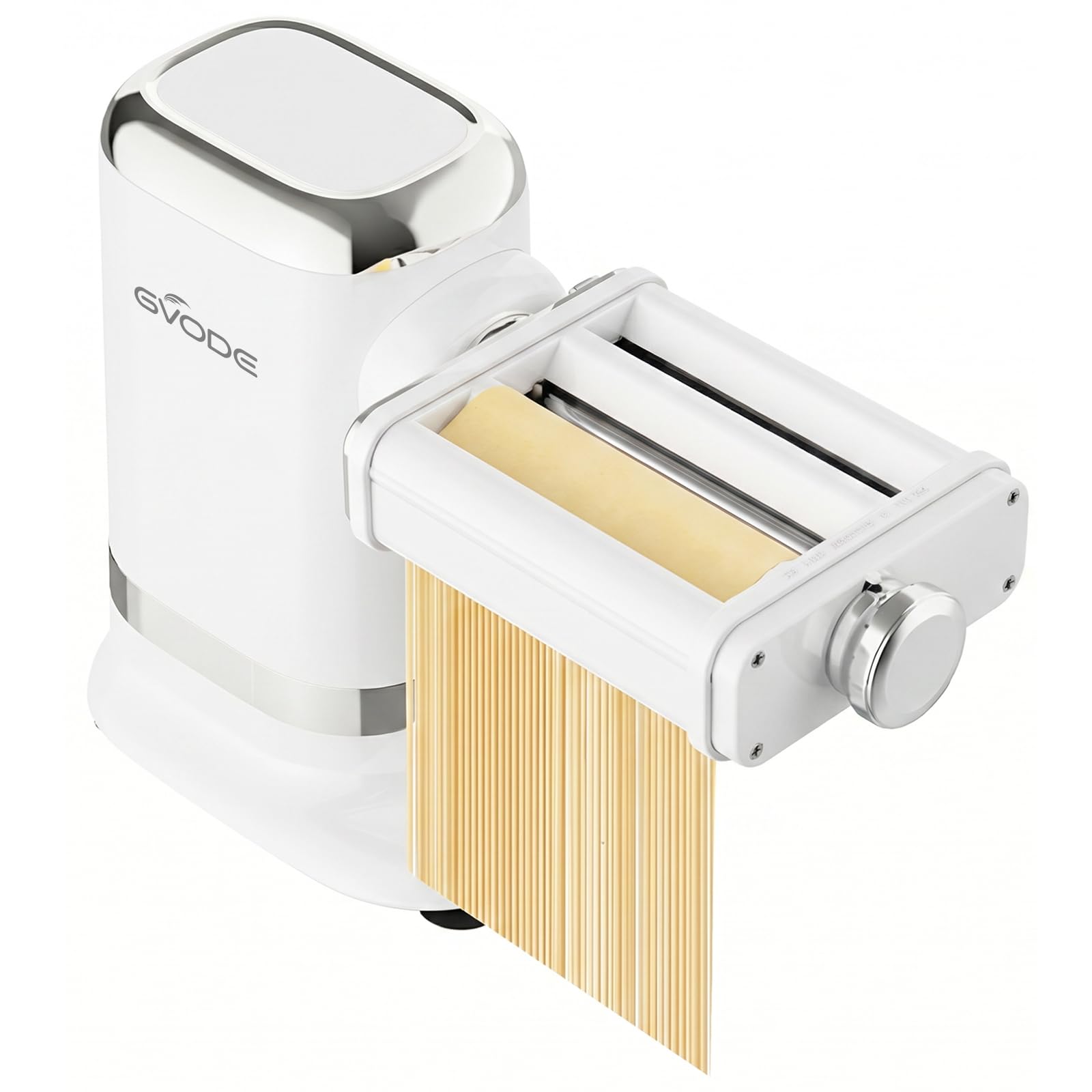
The lightest machine here — 5.2 lb — with a 700W motor under the hood.
If your countertop is small, the GVODE is the one you can actually lift and put away. At 5.2 lb it is far lighter than the 16 lb Newhai or the 20 lb Philips, so it lives in a cupboard and comes out when you need it. The 700W motor is the strongest of the group, and the plastic housing carries metal drive gears (the gear teeth that turn the roller) — that combination means the rollers hold their alignment batch after batch while the shell wipes clean in one pass. Eight thickness settings roll sheets from 0.4mm to 2mm, covering angel-hair-thin up to lasagna.
Performance is what wins people over — the machine earns more owner praise for how it works than for anything else, and speed is a close second. Owners roll and cut six batches of fettuccine in under 20 minutes. Cleanup is simple, and the compact footprint means it does not take over your workspace.
The catch is heat and batch discipline. GVODE’s own guidance is 15-minute runs with a 5-minute cool-down between them, because the reviews include a machine that cut out mid-process on a first use. Follow that rhythm and it runs reliably; hammer it and the motor complains. Some owners also note the dial numbers run 7 down to 1 from the back, the opposite of a standard roller, which takes a batch or two to get used to. Remember the cool-down and it is a great value pick.
What earns its keep
- 5.2 lb is the easiest machine here to store in a cupboard
- 700W motor is the highest-wattage unit in this comparison
- 8 thickness settings from 0.4mm up to 2mm for delicate pasta or thick lasagna
- Metal drive gears hold roller alignment over time
- Two speeds plus reverse to back dough out if it bunches
What to watch
- Needs 15-minute batches with a 5-minute cool-down for long motor life
- Dial numbers run 7 down to 1 — reversed from a standard roller
- Plastic housing will not feel as solid as a stainless body
Best for: small kitchens, apartment counters, and anyone who wants fresh pasta from a machine they can lift with one hand.
The limit to know: run it in 15-minute batches and it stays happy — treat it like a marathon runner, not a sprinter.
5. WICHEMI Electric Pasta Maker Machine 3 IN 1 Automatic Dough Pasta Roller

Three built-in cutters turn out round, flat, and wide noodles on one dial.
The WICHEMI answers the question “why buy three machines?” It has a built-in knife that cuts three noodle widths — 2.5mm round, 4mm flat, and 9mm wide — plus a dough press for dumpling and wonton skins. The one-key knob switches between pressing and cutting modes. The body is 304 stainless steel (a food-grade steel used in commercial kitchens) and the listed output is 22lb/h, so it moves dough fast once you get the rhythm. At 17.6 lb it is heavy enough to stay put while you work.
The WICHEMI also carries a design that most others skip: it is built for home and light commercial use — noodle stands, dumpling shops, and small restaurants are named in the specs alongside household kitchens. The 1.5mm to 3.5mm thickness range fits dumpling skins, and the 9mm cutter makes short, wide noodles that the Newhai’s 4mm cutter cannot match.
The honest note is heat and finish. There is a customer report of the motor warming up during use, and one buyer described the finished noodles coming out with dark marks that traced back to machine oil. That is the kind of thing a first-run dough purge prevents — always run a throwaway dough through before you cook with it. Treat the motor to a rest between batches and this is a very capable all-rounder.
The appeal: three widths plus a wrapper press make this the most shapes-per-machine pick here, at a workhorse weight that stays put.
Worth knowing: oil residue is a first-use issue on some units — a throwaway dough run fixes it, and the motor runs warm, so pace your batches.
Go for this if: you want round, flat, and wide noodles plus dumpling wrappers from one dial and one motor.
Choose another if: you want a machine that stays cool to the touch and needs no dough purge before the first real batch.
6. Cuisinart Bread, Pasta & Dough Maker Machine, White, PM-1

One countertop machine that mixes, kneads, and extrudes pasta or bread dough.
If you cook both pasta and bread, the Cuisinart takes one spot on the counter and fills two jobs. It mixes, kneads, and extrudes up to one pound of fresh pasta in 20 minutes, or mixes and kneads up to one pound of bread dough in the same machine. Six pasta discs ship in the box — spaghetti, rigatoni, small macaroni, fettuccine, and bucatini — along with flour and liquid measuring cups, a storage drawer, a storage bag, and a cleaning tool. It is covered by a limited 3-year warranty and is BPA free.
The strength here is the simple flow. Owners describe pressing Auto and walking away while the machine mixes and extrudes, and the easiness of that process — along with easy cleaning — is what keeps the ratings steady. The plastic measuring cups are the weak link in the box; owners say the fill line is hard to read, so a set of your own measuring cups is worth having on hand.
This one bites you on capacity and precision. It holds 2 to 3.25 cups of flour, so it is a single-meal machine rather than a batch machine — plan your dinners around that limit. The manual is genuinely sparse; several owners found the instructions did not explain the buttons or the disc removal, and a few ran into a dough ball that would not extrude on the first tries. Follow the water ratio carefully and the machine does its job; treat it as a machine that rewards reading the manual twice.
Suits you if: you want one appliance that handles bread dough and extruded pasta shapes, and you value a 3-year warranty.
Not for you if: you plan to make big batches — the flour bowl tops out well short of the extruder machines above.
7. NEWTRY Electric Pasta Maker Noodle Machine, Dough Roller Cutter, 3 Blades

The 4mm top of the thickness dial reaches dumpling-wrapper territory no other pick hits.
This is the machine for cooks who want noodles and wrappers from one unit. Its roller runs from 1mm to 4mm — the widest upward stretch in this line-up — and it uses three cutting blades for 2.5mm round noodles, 4mm flat noodles, and 9mm wide noodles. The 410 stainless steel body is food-grade and rust-resistant, the upgraded dial turns left and right to swap between pressing and cutting, and the 110V plug-in motor handles the grind. Roller width is 5.5″/14cm, which is generous for home batches.
The motion is quick and simple — one speed, and it runs fast, so short batches are its balance. The 410 stainless steel build is heavier than the plastic-body machines here; owners describe it as very sturdy and very heavy. That weight keeps it steady on the counter while you feed dough.
The honest warning is heat and giving it air. Buyers report the motor warming up during use and advise keeping batches short. There are also reports of roller alignment drifting over months of hard use, and at least one machine failed within the first months and was covered by after-sale service. Treat the 4mm setting as a bonus for dumpling wrappers and keep the pasta runs short; the machine stays reliable longer if you let it cool between runs.
Where it wins: the 1mm–4mm range makes it the only pick that rolls dumpling-wrapper thickness without a separate press.
What to plan for: it runs fast and hot — short batches and a cool-down between them are what this machine asks of you.
Pick it if: you want the widest thickness range here, in a heavy stainless body that will not slide around.
Skip the upgrade if: you mostly cook pasta and want the calm pace of a multi-speed machine instead.
8. Luzrise Electric Pasta Maker Automatic Noodle Machine, 4 Blades, 9 Thickness Settings, 135W

Built for people who cook noodles weekly — and want a 2-year warranty behind them.
The Luzrise lines up four blades instead of the usual two or three: 1.5mm, 2.5mm, 4mm, and 9mm, so you can do ramen, linguine, and wide flats from one machine. Its thickness range beats every pick here at 0.5mm to 5mm across nine settings. The built-in 135W motor sits beside the heat-dissipation system to keep the unit cool, the base has anti-slip pads, and the 304 stainless body and blades are food-grade. Look at the two-year warranty: it is the longest in this comparison and the reason owners say the value lines up.
What wins people over is the durability, and the practical feedback backs that up. One owner ran it daily for three years making empanadas before buying a replacement. Another owner swapped out a stand-mixer attachment because it could not take large chunks of dough, and this one took barely kneaded dough and laminated the folds instead. It rolls and cuts quickly once you get the rhythm, and the 4mm blade is perfect for udon-sized round noodles.
Be aware of two things. First, some owners use this for polymer clay, which requires a full cleaning afterward to avoid stray bits in the next batch — worth knowing if you plan the same. Second, a first unit can arrive defective (Luzrise replaced one in two days, and the 30-day refund and 2-year warranty cover the rest). Overall, this is the machine that holds up to heavy, year-round noodle making better than anything else in this price band.
Why noodle regulars like it
- 4 blades including 1.5mm, 2.5mm, 4mm, and 9mm — the widest blade selection here
- 0.5mm to 5mm thickness across nine settings, the largest range in this line-up
- Built-in 135W motor with heat-dissipation system and anti-slip base pads
- 2-year warranty and 30-day refund policy back the build
- 304 stainless steel body and blades clean easily
What to keep in mind
- Not every unit arrives perfect — the warranty covers the rare defective unit, with a 2-day turnaround reported
- Polymer clay use leaves residue that needs a full cleaning before the next dough batch
- Heavy unit — best left on a dedicated counter spot
Best fit for: weekly noodle cooks who want four blade widths, the biggest thickness range, and a long two-year warranty.
The one caution: a rare defective first unit — hold on to the warranty card, because Luzrise replaced one in two days without a fight.
9. Philips 7000 Series Pasta Maker, ProExtrude Technology 150W, 8 discs, HomeID App, White, (HR2660/03)

The one machine here that will feed a dinner party in one go — up to 8 portions.
When you cook for a crowd, capacity is the whole point. The Philips 7000 Series makes up to 8 portions of fresh pasta in one batch, and the ProExtrude 150W motor pushes it out in under 10 minutes. It carries eight discs, ships with a cleaning tool and measuring cup, and the parts are non-stick and dishwasher-safe. The HomeID app walks you through recipes including vegan and gluten-free versions. There is also a mixing function that goes beyond pasta — use it for cookies or to start pizza and bread dough.
The mechanics here are the smoothest in this comparison. Owners describe it as quicker and simpler than a stand-mixer attachment, and one owner reports spaghetti extruded in about five minutes. It handles durum wheat flour evenly and repeats the same result batch after batch, which is why owners mention buying it before they expected to. There is even a pattern that floats to the top of the reviews: customers note that about 6.1 oz of liquid to 500g of flour turns flabby dough into clean extrusion, and once you hit that number everything clicks. Cleanup is short — one owner ran a double batch plus cleanup in 25 minutes.
Two honest points. The discs and dies have their own quirks — the smaller holes need a pin or needle to clear, and a limited set of owners had an out-of-box issue where the mixing paddle did not switch correctly. Philips turned those around, and the eight-disc set and app guidance make the learning curve shorter than most. If you cook for a family of four to eight, this is the pick where the capacity actually matters.
Where it wins: the 8-portion batch and under-10-minute cycle, which no other extruder here matches, plus dishwasher-safe parts.
A limit worth naming: small dies need a pin to clear dough, and cleanup of many discs takes a few minutes — buy it for the batch size, not the accessory count.
Reach for it if: you regularly cook fresh pasta for a family of four or more and want the shortest, most repeatable batch in this group.
Look lower if: you cook for two — the smaller picks above do the same job for a much lighter footprint.
Understanding the Specs
Extruder vs roller-and-cutter
An extruder (like the VEVOR, Cuisinart PM-1, and Philips 7000 Series) pushes soft dough through a disc, which is how you get macaroni, rigatoni, and bucatini. A roller-and-cutter (like the Newhai or NEWTRY) presses the dough into a flat sheet first, then slices it, which is how you get spaghetti, fettuccine, and wide noodle strips. Rolled noodles tend to have a firmer bite; extruded shapes tend to be smoother. Neither is better — they just do different jobs.
Motor wattage and why cool-down matters
Wattage is the power rating for the motor. A higher number means the motor can handle tougher dough, but no motor likes being run hot. The GVODE manual suggests 15-minute batches with a 5-minute cool-down between them, and the NEWTRY has user reports of the motor warming up. Whether your machine is 135W or 150W, resting it between batches is the single habit that stretches its life. Clear the vents and never cover them while running.
Thickness range in millimeters
Thickness is the measurement of the compressed dough sheet the machine makes. A wide range gives you more dishes: the GVODE covers 0.4mm to 2mm (angel hair up to lasagna), the Newhai covers 0.5mm to 3mm (pasta up to dumpling wrappers), and the Luzrise goes from 0.5mm all the way to 5mm. Thinner sheets cook fast and tear easily, so beginners should start at a thicker setting than they expect.
Capacity and output ratings
Two numbers describe how much a machine makes. Flour capacity is how much flour fits in one batch — the Cuisinart takes 2 to 3.25 cups, the VEVOR takes 500g, and the Philips makes up to 8 portions. Output (listed in lbs per hour) is the steady production ceiling, which matters for a restaurant and matters far less in a home kitchen. If you feed a family of four, batch capacity is the number to check.
FAQ
Do automatic noodle machines work with Asian noodles like udon and ramen?
Can I make dumpling wrappers with an automatic pasta machine?
How long does the motor last before it needs a replacement?
Is a stainless steel pasta machine harder to clean than a plastic one?
Can I run bread dough through an automatic noodle machine?
What ratio of flour to water actually produces good dough?
Will these machines make gluten-free pasta?
Do I need to run a throwaway batch through a new machine?
Can the automatic machines handle semolina flour?
Final Thoughts: The Verdict
For most home cooks, the automatic noodle machine winner is the Newhai Electric Pasta Maker, because it combines two noodle functions — pressing dough sheets and cutting noodles — in a body of 430 stainless steel, with a 0.5mm to 3mm dial that also handles dumpling wrappers. If you want the widest shape variety and easy dishwasher cleaning, grab the VEVOR Electric Pasta Maker and its eight pasta discs. And for Asian noodles in a household that cooks them weekly, the Luzrise Electric Pasta Maker is the one to reach for — four blades, a 0.5mm to 5mm range, and the longest warranty here at two years. Whichever you choose, run a throwaway dough through it before your first real batch and let the motor rest between runs; those two habits are what separate a machine that lasts a decade from one that quits in a season.
How We Picked
We do not accept paid placement. Every pick is matched to a real buyer and a real use-case; we do not hands-on test units.
Sources & Methodology
Specifications: manufacturer listings and product documentation. Review insights: verified customer reviews, as of September 2026. Pricing: not shown on this page (it changes often); check the current price via the retailer link.
As an Amazon Associate, KitchPrep earns from qualifying purchases. This does not affect which products we feature.
Related Guides
