
Specs are compiled from manufacturer listings and verified buyer reviews and can change over time — please confirm the key details on the product page before buying.
If you have ever watched a deli counter worker turn a roast into a neat stack of sandwich slices in under a minute, you already know why a motorized slicer beats a knife. The machine holds the food steady, spins a round blade at a fixed speed, and lets you dial the thickness so every slice comes out the same. What you are really shopping for is the right balance of motor watts, blade diameter, and how much of the machine comes apart for washing — because those three things decide whether a slicer earns counter space or collects dust.
I’m Mohammad Maruf — the founder and writer behind KitchPrep. This guide is built by comparing the manufacturers’ published specifications and the patterns across verified customer reviews, so you get each pick’s real strengths and trade-offs instead of marketing spin.
From there, every pick below gets the same honest read: what it does well, where it struggles, and who should actually buy it. Two blades beat one, a bigger blade handles bigger cuts, and a machine you can break down in ten minutes is the one you will keep using.
Our Picks at a Glance

How To Choose The Best Automatic Meat Slicer
An automatic meat slicer is a countertop appliance with a round motor-driven blade and a sliding carriage that feeds food into it. The word “automatic” here means the blade spins on its own power — you still guide the food carriage by hand on almost every home model. Only a true fully automatic machine runs the carriage for you, and that feature sits at the top of the price range. For everything else, you are choosing motor power, blade size, and how much of the machine disassembles.
Blade diameter is the first number to check
A 7.5-inch blade (the cutting disc’s diameter) handles sandwich meat, cheese blocks, and vegetables fine. An 8.7-inch blade gives you more surface per rotation, so a wide roast or a full slab of bacon clears in fewer passes. Step up to a 10-inch or 12-inch blade and you are cutting whole hams, frozen blocks, and large deli-style portions without sawing back and forth. Bigger blades also need bigger, heavier bodies to stay stable, so a 12-inch machine usually weighs far more than a 7.5-inch one. Match the blade to the largest thing you plan to slice, not the smallest.
Motor power and noise
Wattage tells you how much work the motor can do before it slows down. A 200W motor is enough for home slicing — cooked roasts, cheese, bread, and vegetables — as long as you do not force frozen meat through it. A 240W to 370W motor handles denser foods and longer sessions without bogging. The 420W and 500W motors on the commercial-grade machines are built to run continuously in a busy kitchen. DC motors (direct-current motors) tend to run quieter than their AC counterparts at the same wattage, and several machines here advertise exactly that lower-noise operation.
Thickness control and safety
An adjustable thickness knob sets how far the food carriage sits from the blade, and most machines here cover the same useful range — from paper-thin deli slices to a thick cut for sandwiches. Look for a knob that clicks or holds its setting, because a knob that creeps while you slice gives you uneven cuts. On the safety side, check for a blade cover or transparent shield, a food pusher that keeps your fingers back, non-slip feet, and a child lock. A machine that will not start until the blade cover and tray are locked in place is the safest design to live with.
Cleaning is the deal-maker
The single most common reason a slicer stops getting used is cleanup. A machine where the blade, food tray, and pusher lift straight off takes minutes to wash. A machine that needs a screwdriver and a full teardown takes longer than slicing dinner did. Before you buy, check which parts detach and whether they are dishwasher safe — that one detail decides how often you will actually reach for the slicer.
Quick Comparison
| Model | Best For | Motor | Blade Diameter | Thickness Range | Amazon |
|---|---|---|---|---|---|
| Borlebbi 200W Food Slicer★ Best Overall | Everyday home sandwiches | 200W DC | 7.5 in (two blades) | 0-15 mm | Amazon |
| FOHERE 250W Electric Meat SlicerBest Blade Variety | Bread and cheese slicing | 250W | 7.5 in (three blades) | 0-15 mm | Amazon |
| OSTBA 8.7″ Meat SlicerBiggest Home Blade | Bigger cuts, fewer passes | 200W DC | 8.7 in (two blades) | 0-15 mm | Amazon |
| Zomagas 10-in Semi-Auto Slicer | Home charcuterie and meal prep | 240W | 10 in | 0-13 mm | Amazon |
| LELOCLE 10-in Commercial Slicer | Small kitchens, tight counters | 340W | 10 in | 0-12 mm | Amazon |
| ROVSUN 12-in 500W Slicer | High-volume home and small deli | 500W | 12 in | 0-15 mm | Amazon |
| BESWOOD 10″ Deli Slicer | Quiet precision slicing | 240W | 10 in | Adjustable | Amazon |
| FOHERE 12-in 370W Commercial | Food trailer and deli counter | 370W | 12 in | 0-12 mm | Amazon |
| KWS KitchenWare MS-12SL | Serious home and restaurant use | 420W | 12 in | 0-15 mm | Amazon |
In‑Depth Reviews
1. Meat Slicer Machine for Home, 200W Food Slicer with Two 7.5″ Blades
Our pick — 4.5★ from 650+ verified ratings; the strongest balance of quality and price.
The quiet two-blade workhorse that makes sandwich meat without waking the house
Start with what actually gets used: a 200W DC motor (a quieter, steadier motor type) paired with two 7.5-inch stainless steel blades — one serrated for bread and one smooth for meat and cheese. That DC design is why this one runs softly instead of grinding, and it is the reason the machine stays planted on the counter thanks to non-slip feet. The 0-15mm thickness dial takes you from a shaved onion-thin slice right up to a thick slab for sandwiches, all with one knob.
What wins people over is raw performance — it is the single most-praised thing about this slicer, and the reason it lands at the top of the list. It handles the full range a home cook throws at it: sourdough, hard cheese, cucumbers, onions, turkey breast, even homemade jerky. Buyers report it “saves money over pre-sliced” meat and lets them “choose my own thickness.” For anyone tired of paying deli prices for a half-pound of ham, this machine pays attention to what you feed it.
The honest limit is the slide platform. It holds a full block of cheese and most sandwich cuts with room to spare, but a whole half-slab of bacon needs a wider table than this one offers. The push guard’s plastic spikes can also let slippery meat slip, so keep the food flat and let the 7.5-inch blade do the work rather than forcing it. Cleanup is where this pick earns its keep — the blade, food tray, and pusher all lift off, and the removable stainless steel tray rinses fast. One owner drives the point home: “Works great and is easy to clean.”
What buyers keep coming back to
- 200W DC motor runs quiet and steady, so late-night meal prep does not wake anyone
- Two 7.5-inch stainless steel blades — serrated for bread, smooth for meat and cheese — cover more jobs than a single-blade machine
- 0-15mm dial gives you shaved-thin deli slices or thick sandwich cuts from one knob
- Child safety locks, non-slip feet, and a blade cover keep hands clear of the edge
- Removable blade, tray, and pusher make cleanup quick
Where it asks you to compromise
- The slide platform is narrower than bigger machines, so a half-slab of bacon is awkward
- Lightweight plastic push guard can let smooth meat slip if you press too hard
- Slice thickness is the most-discussed trade-off — a few find the dial needs a careful hand for paper-thin cuts
Reach for this if: you want a quiet, easy-to-clean slicer that handles everyday sandwiches, cheese, veggies, and bread — and you would rather not spend more than the basics cost.
Think twice if: your goal is slicing whole pork bellies or heavy frozen blocks, where a wider platform and a bigger blade are the better tool.
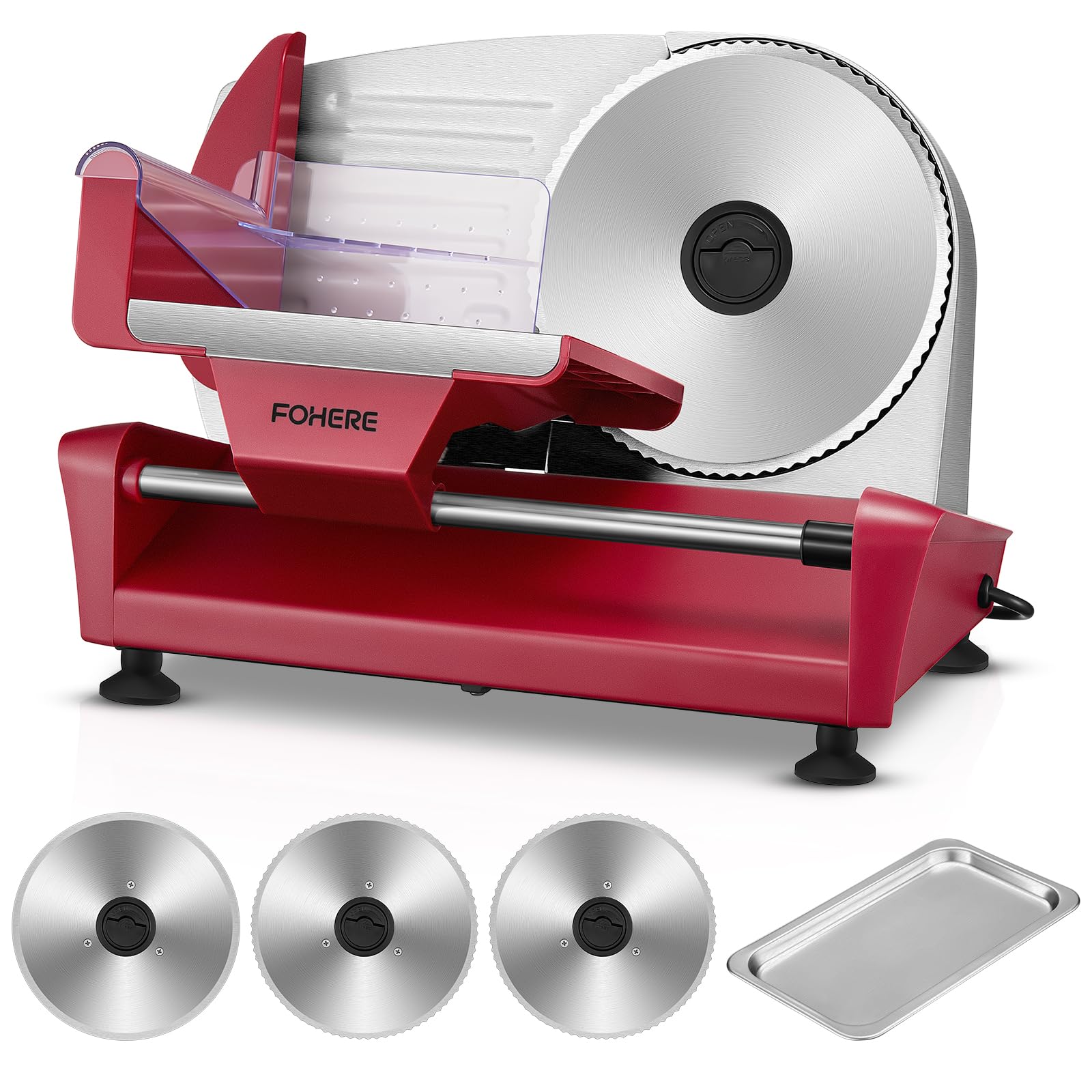
2. FOHERE 250W Electric Meat Slicer Machine for Home
Three blades in the box and a motor that punches above its wattage on roasts
The FOHERE pushes 250W through the same 7.5-inch blade size as the top pick — a full 25% more motor power than that 200W machine, and more than enough to power through a turkey breast or a deer roast without slowing. Where it separates itself is the accessory kit: two serrated 7.5-inch blades plus a smooth 7.5-inch blade and a food pusher, all in 304 stainless steel. That lets you keep one blade dedicated to bread and one to meat, cutting the cross-contamination worry when you work with raw and cooked food in the same session.
The 0-15mm knob handles everything from shaved cold cuts to thick bread slices, and the compact footprint slips into most cabinets and onto most counters without hogging the kitchen. The die-cast aluminum body is built to shrug off rust. Functionality is the thing that keeps owners happy, and the value side of the equation holds up well — owners mention it is well worth the cost. Food-contact parts are FDA-compliant, which matters if you slice for the family.
The catch is disassembly. Unlike the Borlebbi up top, which lets the tray and pusher come fully apart, this one pulls off only the blade and the hand slider — the rest stays in one piece. Cleaning is easiest by tilting it over a drain board and working around the motor housing with a soapy sponge and sprayer. A few owners also call the plastic parts fragile, so handle the guards with reasonable care. And if you have used a full restaurant slicer, know that the cutting surface here is about half the size, which is fine for home portions but not for bulk processing.
Best for bread people: the included smooth blade makes homemade loaf slicing easy, and the serrated pair keeps crusty sourdough in line without tearing it apart.
Worth knowing: the extra blades arrive without any guidance on which is which or when to swap, so a quick look at the spec list helps before your first run.
Pick this one if: you are a home cook who wants three blades and 250W in a machine that still fits under a cabinet.
Skip if: you want a slicer that tears down completely for washing, because this one keeps most of its body together.
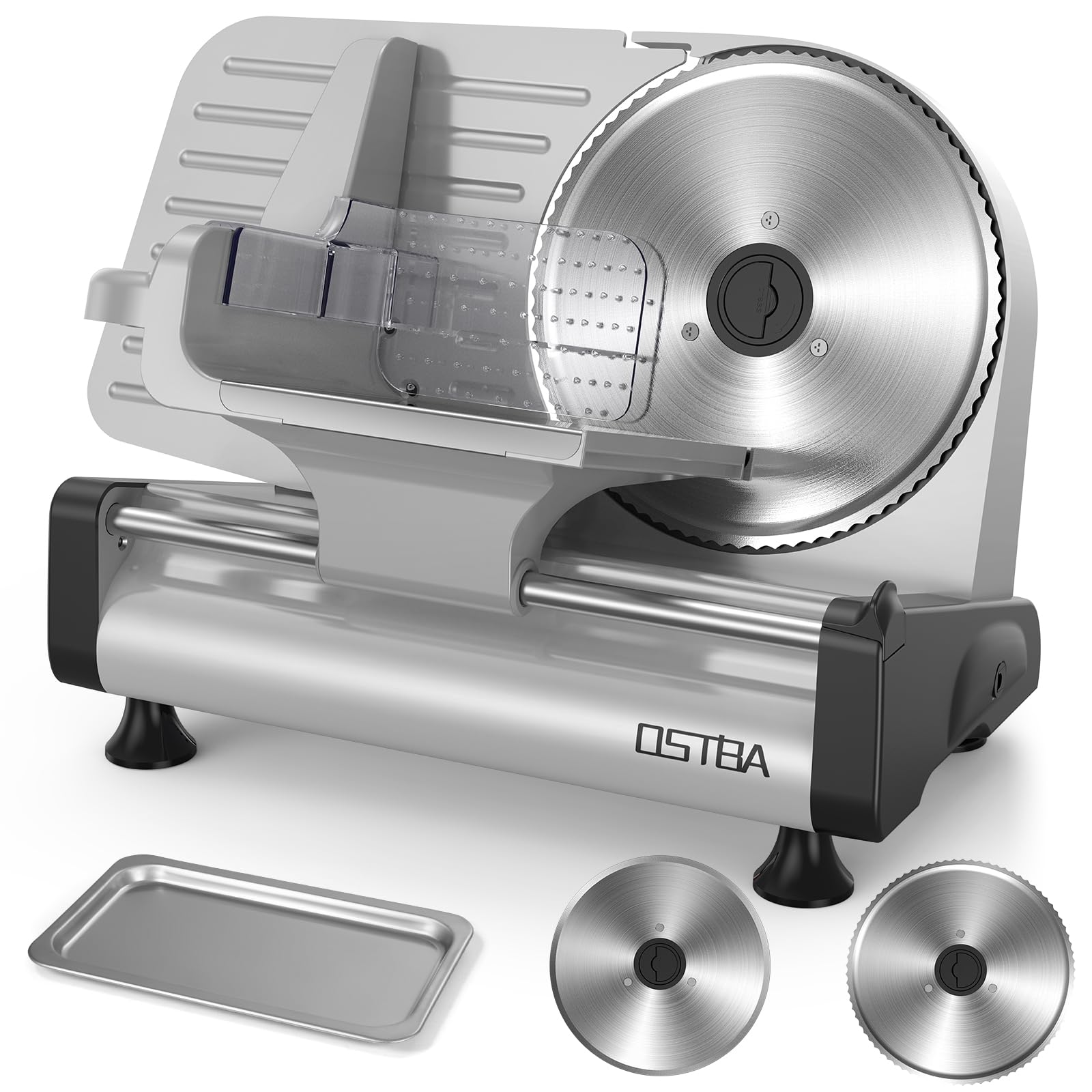
3. OSTBA Meat Slicer, Two 8.7″ Stainless Steel Blades, 200W DC Motor
A wider 8.7-inch blade that gets a full roast through in fewer passes
Blade size is where this one pulls ahead of the 7.5-inch machines. The 8.7-inch stainless blade gives you 16% more diameter than the 7.5-inch discs on the Borlebbi and the FOHERE, and that extra reach means a wide roast or a fat sandwich log clears the edge without you forcing it. You get both a serrated and a smooth blade in the box, so bread and meat each have their own disc. The 200W DC motor runs the same quiet, steady style as the top pick, and the rear rotary knob steers the slice thickness from 0-15mm.
The overall body is also bigger than the two 7.5-inch machines — 18.11 by 11.14 by 12.09 inches, roughly 24% more footprint than the FOHERE’s slim 14.6 by 9.4 by 10.2-inch profile. That extra size is mostly cutting table, and it is what lets the 8.7-inch blade shine. What people rave about most is build quality — the machine feels substantial and steady once it is set down. There is also a food tray to catch slices and an assist hand grip for control, plus a child lock, blade cover, and non-slip suction feet.
Two things to know before you commit. The thickness knob does not lock in place on some units, and a few owners notice it creeping when they press hard, so ease off on the pressure and let the motor do its job. And the plastic food pusher is the one part that occasionally breaks under a heavy hand — if you slice a lot, treat the pusher gently or keep a spare in mind. Beyond those, customers note it slices 30 pounds of meat and 15 pounds of cheese in a session without bogging down.
The cleaning angle: the blade and tray lift off, and the slicing arm rotates aside for the machine’s most awkward spot, which is why cleanup draws as much praise as the slicing itself.
One more thing: this blade is built for cooked and chilled food, not frozen blocks — bring a frozen roast up to a semi-firm state for the cleanest cuts.
Right for you if: you regularly slice a whole ham, a fat roast, or long cured meats and want the blade size to match.
Look elsewhere if: counter space is tight, because this machine takes up noticeably more room than a small 7.5-inch slicer.
4. 10-inch Commercial Meat Slicer 240W 0-13mm Semi-Auto Low Noise
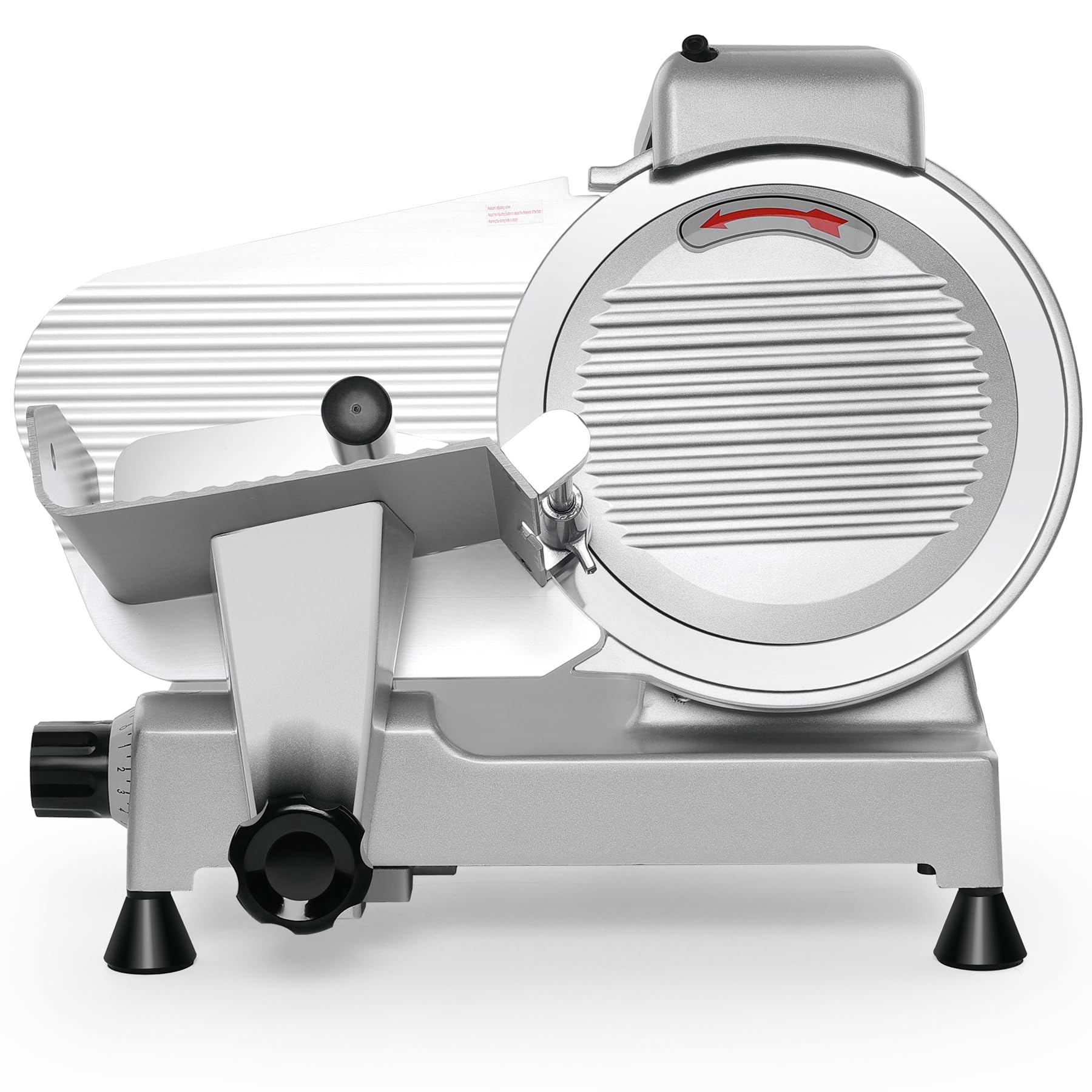
A sharpener built right into the machine, so the blade never goes dull on you
Step into the 10-inch class and the game changes. This Zomagas drives a 10-inch chromium-plated steel blade with a 240W motor, and the blade is nearly the full 18.5 by 16.5 by 15.3 inches of the body’s working face. That size is what lets you take a full roast, a block of cheese, or a loaf of bread in one steady push instead of working in pieces. The chromium-plated edge is designed to hold its sharpness, and the built-in blade sharpener lets you touch the blade up without taking it off the machine — so you are never hunting for a replacement disc.
The semi-auto design keeps the food carriage firmly anchored, with a fixed transparent safety shield, a food pusher, and non-slip rubber feet holding the whole unit steady on the counter. Reviewers point out running this machine for years without a single failure. Slicing performance is the star — one deli buyer says it cuts prime rib like a pro, and the size draws its own praise because it does not take up dramatically more room than an 8-inch model. The body is all-aluminum, which keeps the 30.8-pound machine rigid without making it a permanent fixture you cannot move.
Cleaning is where this pick splits opinion. The blade, blade guard, and food carriage all detach, and the aluminum body wipes clean, but a few owners find the assembly fussier than expected. The other note worth flagging: the included instruction sheet is thin, so give yourself a minute to figure out the safety-shield release before you slice your first roast. Once you have it, setup is quick.
Standout feature: that integrated sharpener is the differentiator here — it means no replacement blades to buy and a consistently sharp edge for years of regular use.
Honest caveat: the manual is minimal, so plan to spend a few extra minutes learning the blade and shield removal before your first slice session.
Buy this if: you want true 10-inch slicing range with a sharpener that keeps the blade working without sending you shopping for replacements.
skip it if: you are looking for the lightest possible machine — this one has the heft and footprint of a serious piece of equipment.
5. Commercial Meat Slicer 10 inch Electric Food Slicer Frozen Meat

340 watts spinning the blade at 1500 RPM, built for tight kitchens
The number that defines this LELOCLE is 1500 RPM — the blade rotates 1500 times per minute, driven by a 340W motor. That speed is what makes frozen meat slice thinner than chilled meat, and it is why people processing Costco bulk meat and cheese to stack the freezer gravitate to it. German imported blade steel is paired with a built-in sharpening stone, and cast aluminum keeps the body rigid. It weighs 31 pounds and measures 16 by 11 by 17 inches — the compact end of the 10-inch class, which is exactly why it fits counters where bigger machines will not.
Thickness runs from 0-12mm (0-0.47 inch), and the knob has a degree scale so you can return to the same setting next time. A suction-cup base holds it to the counter, and an intermittent-function safety design stops it running unexpectedly. The package includes cut-resistant gloves — a real asset on a blade this sharp. Owners cutting prosciutto and Speck report paper-thin slices, and the machine takes up little room while doing it.
The cleaning routine is the trade-off. The front blade cover comes off easily, but reaching the rear blade means unscrewing metal shields, which takes some patience; a small brush helps clear the tight spots. The listed 340W motor and the manual’s 270W figure do not match on the paperwork, which has confused at least one owner, though the machine cuts consistently regardless. And this is not a machine for a whole pork belly sliced lengthwise — the slider is narrow, so large cuts take more passes.
Where it wins: at 1500 RPM and 340W, slicing speed is the headline, and frosty meat feeds through with less drag than on slower machines.
Keep in mind: that fast blade gives no second chances — the included cut-resistant gloves are worth wearing every time.
Strong fit for: anyone in a tight kitchen who wants 10 inches of blade, 340W of power, and a footprint that tucks into a narrow counter.
Not for: people who want a slicer that breaks down for cleaning in a couple of minutes — the rear blade is the fussy spot.
6. ROVSUN 12 inch Commercial Meat Slicer, 500W ETL Certified
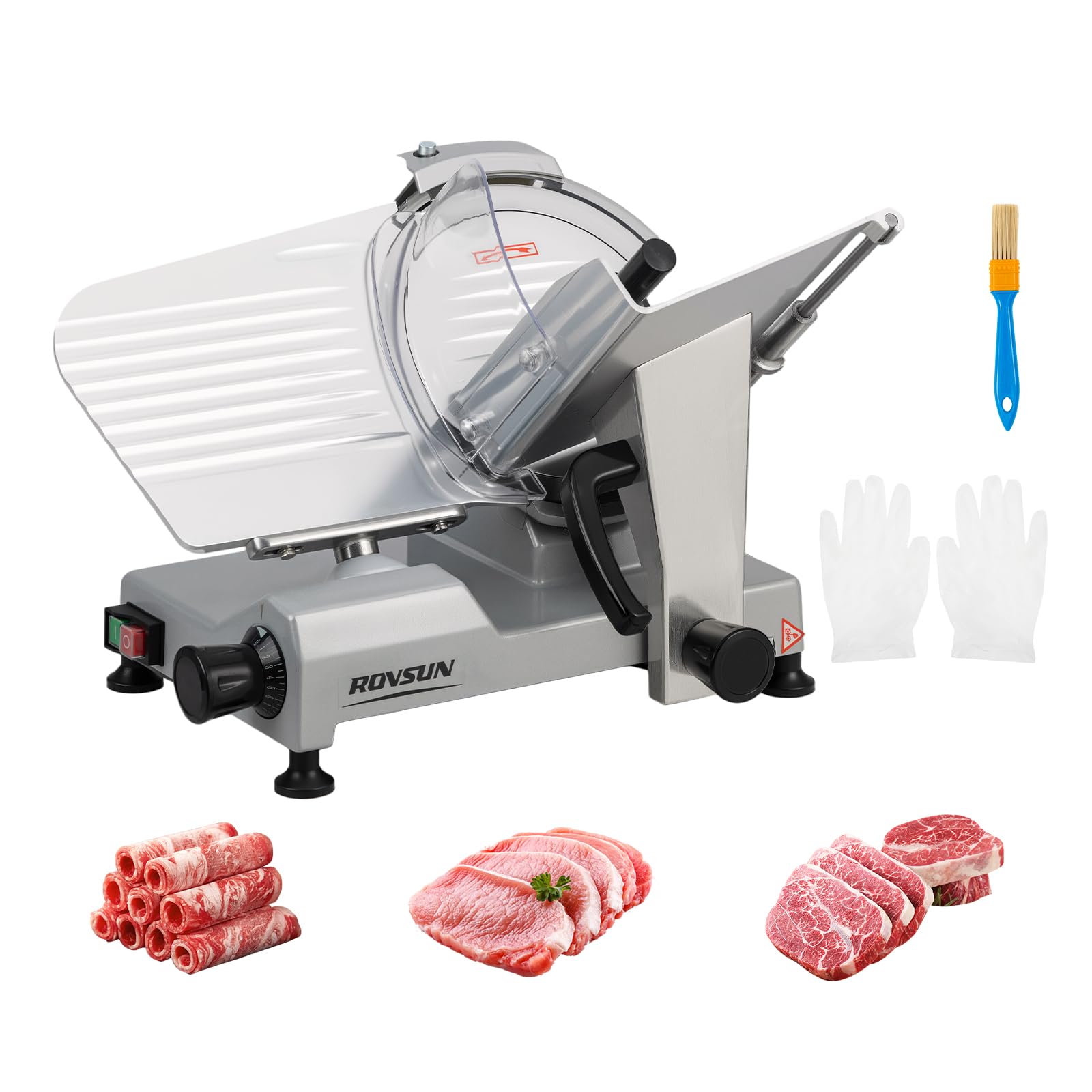
A 500W all-copper motor and a 12-inch blade that make fast work of any roast
This is where the list crosses the line into commercial territory. The ROVSUN packs a 500W all-copper high-speed motor that is rated to cut 50 pieces of food per minute, turning a 12-inch chromium-plated steel blade. The cast aluminum body is built to resist rust and corrosion, and the hidden built-in sharpener keeps the edge sharp without disassembly. Adjustable thickness runs 0-15mm, so you go from paper-thin deli slices to thick slabs without switching machines. ETL certification is on the housing, and there is a fixed transparent shield, a food pusher, and non-slip rubber feet.
For people who process in bulk — homemade bacon, brisket, pork shoulder, coleslaw for a crowd — the speed and blade size earn their keep. Shoppers say it shreds a hundred-person coleslaw batch in under ten minutes, and the 500W motor takes semi-frozen beef without straining. Quality and functionality are the two things owners praise most. The detachable blade and safety shield make cleanup as manageable as a machine this size can be.
The honest weight to carry is cleanup time. Owners note that disassembly for a thorough wash takes longer than slicing did, and one mentions needing a screwdriver to remove the blade disc. There are also nooks and crannies that need attention, especially behind the blade. That is the cost of a 500W motor and a 12-inch blade in a home kitchen, and it is a fair trade if volume matters to you. A few buyers report the sharpener can trap food and remove it, so keep an eye on that compartment.
The volume case: 50 pieces per minute at 500W means a whole pork shoulder for jerky becomes an afternoon job instead of an all-day one.
The reality check: cleaning takes as long as the slicing, so plan for it — this is a machine that rewards a patient setup and a good routine.
Made for you if: you process large batches of meat, or you cook for a crowd and want a 12-inch blade with 500W behind it.
Overkill if: you slice a pound of ham a week — the cleanup effort is heavier than the job requires.
7. BESWOOD 10″ Electric Deli Meat Slicer (Royal Red)
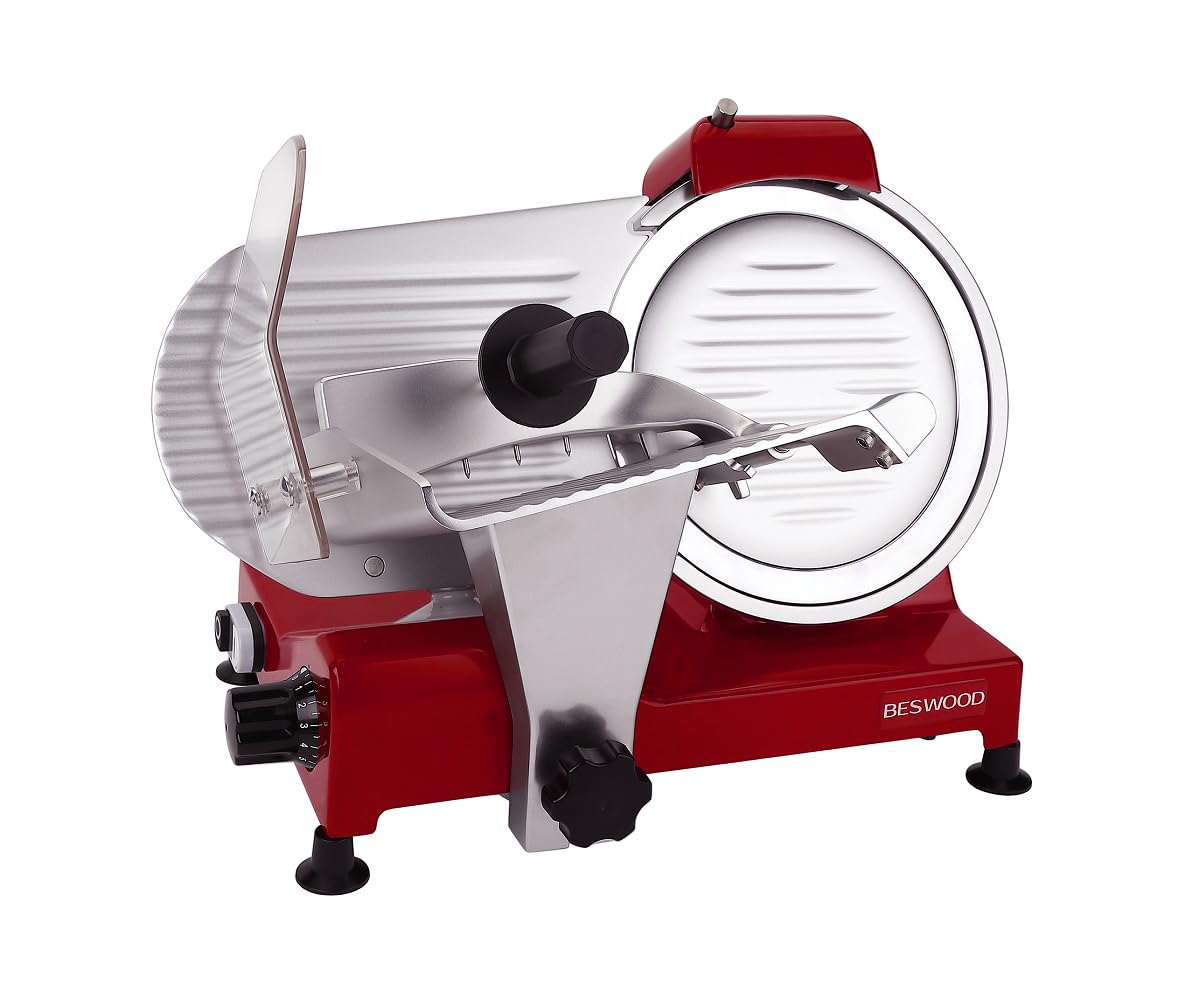
A 240W slicer quiet enough that owners compare it with commercial machines
The BESWOOD is the machine people talk about when they say their slicer is quieter than expected. The 240W motor spins a chromium-plated steel blade with a corrosion-resistant coating, and a double illuminated ON/OFF switch runs at 24V to reduce the power-shock risk — a genuine safety design, not a marketing line. The included serving plate slides out for cleaning, and the whole package arrives with a cleaning brush, food machine oil, and a seal ring oil. ETL approved to USA standards rounds out the safety side.
The slicing quality is what converts people. Slices come out from thick to paper-thin consistently, and owners mention the chromium-plated steel blade aids cleanup. A former deli owner rates the cut quality alongside commercial machines that cost considerably more. The adjustable thickness knob is repeatable, so you can dial the same setting back in the next time. It is a heavy 33-pound machine, and the extra weight is what kills the vibration most slicers carry. Cheese, bacon, lunch meat, and soft-to-sourdough bread all get the same treatment.
The one recurring note is cleanup around the blade edge. The blade is not removable on this model, so it spins during washing; a towel-and-brush method and a bottle brush work best. Owners who slice 15 pounds of cheese in one session still call cleanup easy, but the fixed blade takes more care to wipe around than a removable one. The tray is also a touch short for a full pork belly stretched end to end.
What stands out: It slices as thin and as fast as machines costing twice as much, and it does so quietly. That combination is rare at this blade size.
Where it asks for patience: the non-removable blade is the one cleaning spot that requires a little extra attention and the supplied brush.
Ideal for: anyone who prizes quiet, precise, repeatable thin slicing and does not want to wrestle a blade off for cleaning.
Not the one if: you want every part to lift off and go straight in the dishwasher, because that is not this machine’s design.
8. FOHERE 12 Inch Meat Slicer 370W Commercial Electric Food Deli Slicer
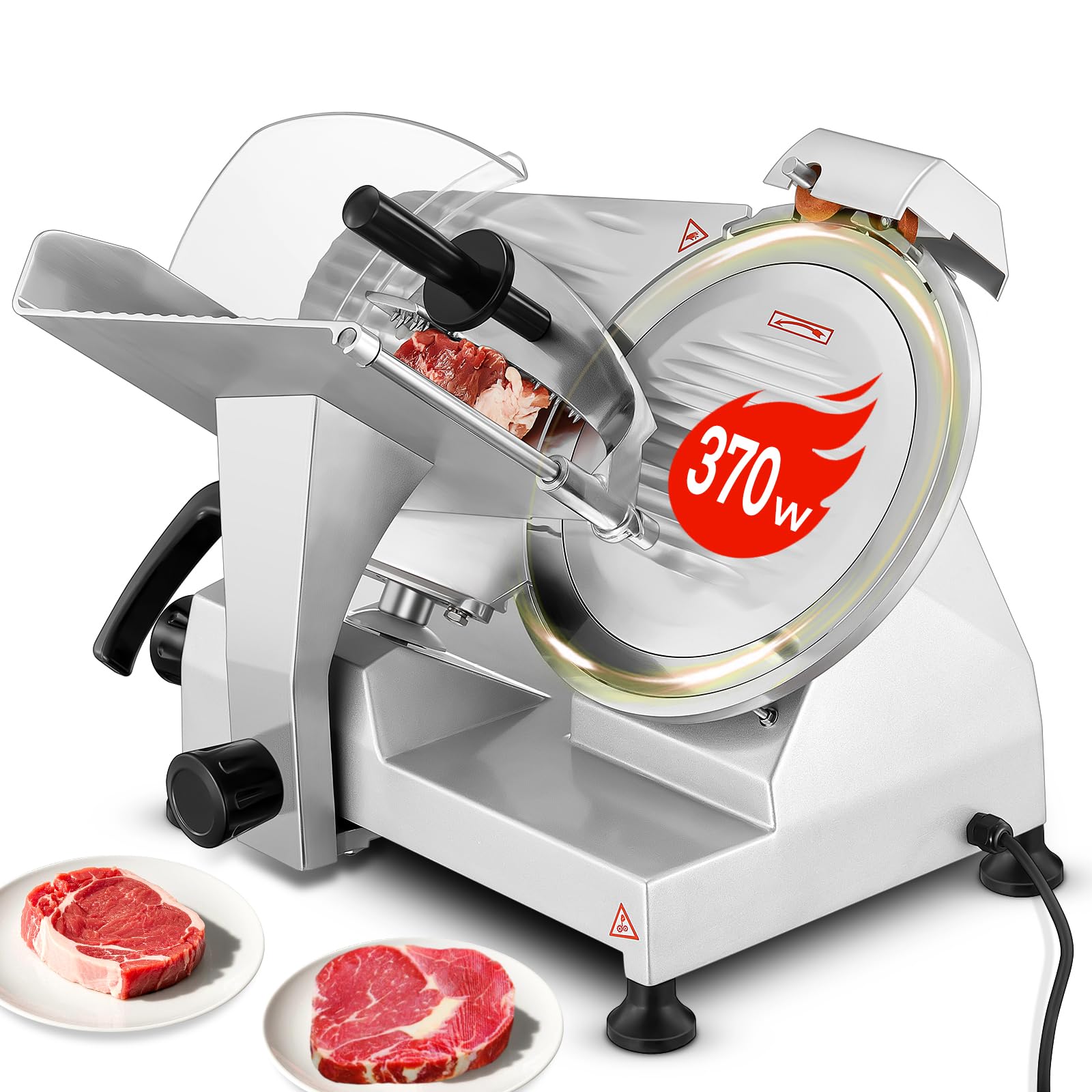
A deli-grade workhorse rated for 120 slices a minute, built for a moving kitchen
This FOHERE is the biggest machine of the three 12-inch slicers here, with a 370W motor driving a 12-inch carbon steel blade at a rate the manufacturer puts at 120 pieces per minute. The 25.19 by 20.67 by 19.68-inch footprint and 51.2-pound weight tell you it is not a countertop-afterthought machine — it is designed to sit in one spot and work. The built-in whetstone keeps that carbon steel blade sharp without removing it, and the thickness knob runs 0-12mm (0-0.47 inch) for anything from a burger patty cut to a thick sandwich slab.
The build quality is what buyers notice first. A food trailer owner uses it daily on deli meats and provolone and reports no issues, calling it “good enough for provolone cheese and all the deli meat we throw at it.” The stainless steel tray wipes clean with a cloth, and the blade, food holder, and food pusher all detach for washing. With the right prep — meat about 75% frozen — it yields clean, consistent cuts and feeds smoothly through a 12-inch blade.
Two things to plan for. First, prep matters: unfrozen fresh meat sticks and makes a mess, so freeze to semi-firm before slicing. Second, blade mounting is tight — the hex screws that hold the 12-inch blade need a 4mm T-handle allen key or a socket adapter, which is worth having on hand before your first disassembly. The blade guard is not easily removable, so cleaning takes some patience, and the included sharpener has a reputation for being finicky on both blade sides.
Where it earns its keep: 370W and 12 inches mean brisket, bacon, and frozen blocks feed through authoritatively, and the machine does not flinch at volume.
Plan ahead: that 51.2-pound frame and tight blade-mounting screws mean you want a dedicated spot and a decent tool kit for maintenance.
Worth it for: anyone running a deli counter, food trailer, or serious home slicer setup where the machine does the same job over and over.
Not the pick if: you want a machine you can lift off the counter and tuck into a cabinet between uses.
9. KWS KitchenWare Station MS-12SL Commercial 420W Electric Meat Slicer
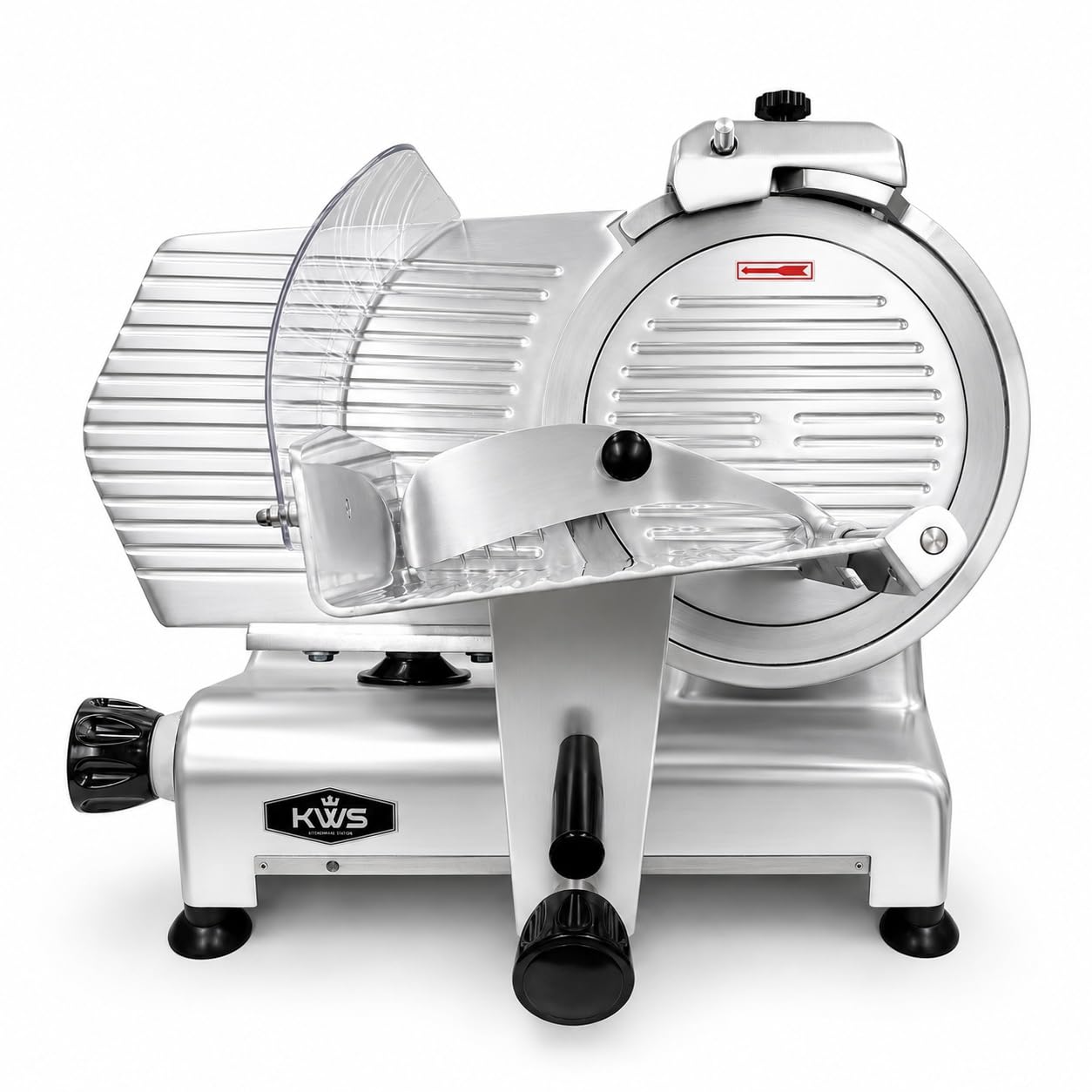
The full restaurant-grade machine, with triple safety locks and 420 watts on tap
This is the machine you buy when you are done with appliance-grade slicers. The KWS MS-12SL runs a 420W motor through a 12-inch 304 stainless steel blade, and it carries both ETL and NSF certifications — the safety and sanitation standards that commercial kitchens require. Triple safety locks mean the machine will not run unless the blade cover, sharpener, and product tray are all locked in place, so a misplaced hand during cleanup does not turn into an accident. The anodized aluminum base resists scratches, stains, and corrosion, which is what separates it from a plain aluminum alloy body over years of use.
On the cutting side, the 0-15mm adjustment covers paper-thin deli slices through thick sandwich cuts, and the built-in dual whetstone sharpener keeps the blade sharp without downtime. The removable 8.5 by 11 by 8-inch product tray lifts off for cleaning and it is spacious enough for a whole roast or half a pork belly. Customers note it handles frozen blocks without issues and makes slicing briskets for sandwiches easy — performance is the quality that earns the most praise, and value for money comes in right behind it. A U.S.-based company backs it with a 1-year limited warranty and replacement parts.
The one genuine trade-off is the weight and clean-down routine. At 60 pounds, this machine lives where you put it — a counter or a sturdy cart, not a cabinet. Disassembly for a deep clean runs around 15 minutes with three screws holding the blade, and the blade is sharp enough that removal tools and cut-resistant gloves are worth using. That is the cost of the commercial build: routine cleaning is a task, but the machine is well-built and quiet while it works.
What it gets right: the triple-lock safety system and ETL plus NSF certifications are what you would want in a machine used daily, and the anodized base is built to hold up over years.
Budget for it: the 60-pound frame needs a real home in the kitchen, and the 15-minute blade-out cleaning routine is part of owning this machine.
For the serious buyer: anyone who wants restaurant-grade slicing, real safety engineering, and a machine built to last rather than replace.
Not for light use: if you slice a couple of pounds a month, the weight and cleaning routine are more machine than the job calls for.
Understanding the Specs
Motor Watts and Why They Matter
Watts are the amount of work the motor can do per second, so a higher number means the blade keeps its speed when it meets resistance. A 200W motor is fine for cooked meat, cheese, and bread, but force a frozen roast through it and the blade will slow. A 340W to 420W motor handles semi-frozen food and long slicing sessions without bogging, and a 500W motor is built for continuous commercial use. Look for a DC motor if quiet operation matters, since DC designs tend to run with less noise than AC at the same wattage.
Blade Diameter and Slice Thickness
The blade diameter (the width of the round cutting disc) sets the largest single cut the machine can take in one pass. A 7.5-inch blade suits sandwich meat and cheese blocks; 8.7 inches gives you a wider cutting face; 10 and 12 inches take whole roasts and frozen blocks. The thickness setting is a separate control — an adjustable knob that moves the food carriage closer to or further from the blade. Nearly every machine here covers the same useful range, from paper-thin slices to a thick cut, so the range is rarely the deciding factor. What matters is whether the knob holds its setting while you slice.
FAQ
Will an automatic meat slicer cut frozen meat?
What blade size do I need for deli-style sandwiches?
How do I keep the blade sharp?
Is a slicer with a removable blade easier to clean?
Are these machines safe for a home with children?
How much counter space does a commercial meat slicer take up?
Can I use one slicer for both meat and bread?
What does semi-automatic mean on a meat slicer?
Do I need to buy replacement blades for these slicers?
Which slicer is best for slicing a whole pork belly or large roast?
How long does a slicer take to set up and clean?
Final Thoughts: The Verdict
For most home kitchens, the automatic meat slicer to beat is the Borlebbi 200W Food Slicer — it holds the top spot because its 200W DC motor runs quiet, its two 7.5-inch blades cover both bread and meat, and its removable parts make cleanup something you will not dread. It also carries the strongest combination of rating and review volume of any machine here, which is why it stays at number one even though a couple of the heavier commercial units cost noticeably more. If you want a wider 8.7-inch blade for bigger cuts, the OSTBA 8.7″ Meat Slicer is the natural step up. And if you are feeding a deli, a food trailer, or a serious home operation, the KWS KitchenWare MS-12SL with its 420W motor, 12-inch blade, and ETL plus NSF certifications is the one to reach for. Whichever you choose, buy the blade size and motor that match the biggest thing you actually plan to slice — that single decision is what keeps the machine in use instead of in a cabinet.
How We Picked
We do not accept paid placement. Every pick is matched to a real buyer and a real use-case; we do not hands-on test units.
Sources & Methodology
Specifications: manufacturer listings and product documentation. Review insights: verified customer reviews, as of September 2026. Pricing: not shown on this page (it changes often); check the current price via the retailer link.
As an Amazon Associate, KitchPrep earns from qualifying purchases. This does not affect which products we feature.
Related Guides
