
Specs are compiled from manufacturer listings and verified buyer reviews and can change over time — please confirm the key details on the product page before buying.
An automatic light switch timer replaces the ordinary flip switch on your wall, so you stop asking “did I turn it off?” It counts down or follows a weekly schedule, so the bathroom exhaust fan stops on its own and the porch light comes on at dusk. Three things decide which one you buy: whether your wall box has a neutral wire (the white return wire many timers need), how long you need the load to run, and if you want a countdown timer or a full seven-day calendar.
I’m Mohammad Maruf — the founder and writer behind KitchPrep. This guide is built by comparing the manufacturers’ published specifications and the patterns across verified customer reviews, so you get each pick’s real strengths and trade-offs instead of marketing spin.
Below you get nine verified in-wall timers split by how they run, what they control, and which wiring they need — plus the neutral-wire trap that quietly kills most DIY installs. The fastest way to sort the market is to know which wiring you already have, and this guide to the best automatic light switch timer options makes that call clear.
Our Picks at a Glance


How To Choose The Best Automatic Light Switch Timer
Start with your wall box, not the product page. An in-wall timer is an electrical device with a fixed set of wires, and if your box does not match what the timer expects, the install stalls before it starts.
Countdown Timer Or Seven-Day Schedule
A countdown timer turns the load on when you press it and shuts it off after a set number of minutes. That is the right tool for a bathroom exhaust fan or a heat lamp. A seven-day programmable timer instead follows clock times you enter — on at 7 p.m., off at 11 p.m. — and that is the right tool for porch lights and seasonal lighting. Pick the behavior that matches the job; a countdown timer cannot follow a calendar, and a schedule timer is overkill for a shower fan.
The Neutral Wire Question
A neutral wire is the white return wire that completes a circuit. Many older wall boxes hold only a hot wire, a load wire, and a ground. Some timers need that neutral to power their internal clock; others are built to run without it by using the ground. Confirm whether your box has a neutral before you order, because this single detail decides half the products on this list.
Amps, Watts, And Load Type
Every timer carries a current rating in amps and a watt rating for the bulbs it can drive. The numbers differ sharply by load: a timer might handle one wattage of LED bulbs, a larger figure for incandescent, and a separate motor rating for a fan. Match the timer’s rating to what you actually want to run, and leave headroom if you plan to swap bulbs later.
Quick Comparison
| Model | Best For | Timer Type | Neutral Required | Key Rating | Amazon |
|---|---|---|---|---|---|
| Lutron Maestro MA-T51MN-LA★ Best Overall | Bathroom and laundry exhaust fans | Countdown, 5–60 min | Yes | 150W LED / 3A fan | Amazon |
| Southwire Woods 7-Day DigitalBest Value | Weekly lighting and pump control | 7-day, 7 settings | Yes | 1800W rated | Amazon |
| UltraPro Daysmart 40954Smart Scheduling | Porch and seasonal lighting | 7-day, sunrise/sunset | Yes | 8 settings | Amazon |
| Eaton PT18M-LA | No-neutral fan and light control | Countdown, 5–60 min | No | 1800W / 15A | Amazon |
| Intermatic EC200WK | Silent bathroom fan shutoff | Countdown, 5–30 min | No | UL listed | Amazon |
| Honeywell Home EconoSWITCH | Outdoor lamp post scheduling | 7-day, 7 programs | Yes | 2400W max / 1 HP | Amazon |
| Leviton DT130-1LW | Shallow-box fan and light swaps | Countdown, 5–30 min | No | 15A / ½ HP fan | Amazon |
| Leviton DT160-1LW | Longer fan, garage, and sauna runs | Countdown, 10–60 min | No | 15A / ½ HP fan | Amazon |
| Honeywell PLS750C1000 | 3-way dusk-to-dawn outdoor control | 7-day, sunrise/sunset | Yes | 29A / 3-way | Amazon |
In‑Depth Reviews
1. Lutron Maestro Countdown Timer Switch (MA-T51MN-LA)
Our pick — over 4.5★ from 850+ verified ratings; the strongest balance of quality and price.
The quiet operator that shuts the fan off while you are already halfway down the hall.
Bathrooms, basements, closets, attics, garages — low-traffic rooms where a light or fan gets left running for hours. That is the exact problem the Maestro solves, and it is why it holds the top spot here at 4.6 stars. You press once to start a countdown, and the rocker panel lets you dial anywhere from 5 to 60 minutes, with dedicated stops at 5, 10, 15, 30, 45, and 60. A one-minute warning fires before the load cuts, so nobody is left in the dark or mid-shower.
The control range is the part that earns its keep. It drives up to 3 amps of a high-efficiency exhaust fan and is rated for 150 watts of LED bulbs, 600 watts of incandescent or halogen, and both magnetic and electronic low-voltage lighting. That matters because the standard trouble call for a bathroom timer is a Panasonic or similar low-amperage fan that other countdown switches cannot handle cleanly. If your wall has a neutral wire, the install is a 15-minute job. Want it on a second switch across the room? Pair it with a Maestro accessory switch (MA-AS, sold separately).
The catch is the price of convenience. It sits near the top of mid-range territory, and if you need more than one you also need a coordinating Claro wallplate, which is sold separately. The other thing to know: there is no schedule mode. This is a countdown device, so it will not turn your porch light on at dusk. Think of it as the fan-and-lower-traffic solution, not a whole-house scheduler — and for that narrow job, it is the one most owners reach for first.
What the Maestro gets right
- Countdown anywhere from 5 to 60 minutes with six preset stops
- Drives a 3A high-efficiency exhaust fan plus 150W of LED bulbs
- Works in single-pole or multi-location setups with an accessory switch
- One-minute warning before the load turns off
Worth knowing before you buy
- Needs a neutral wire and a coordinating Claro wallplate (sold separately)
- No seven-day scheduling — countdown only
Best for: anyone replacing a dumb bathroom or laundry switch and dealing with a low-draw fan that has defeated cheaper timers.
Look elsewhere if: you need dusk-to-dawn porch control — that job belongs to a sunrise/sunset model.
2. Southwire Woods In-Wall 7-Day Digital Timer
A weekly workhorse that never forgets to shut the pump or the porch light off.
This is the cheapest way into calendar control instead of a plain countdown, and it is among the most popular picks in the category. You get up to 7 on/off cycles across a single day, Sat-Sun, or a full 7-day schedule, with Auto, On/Off, and Random modes built in. The randomize function shifts your on/off times by up to 15 minutes, so an empty house still looks lived in. It is 1800W rated (watts, the amount of power it can switch) and runs on a rechargeable battery that keeps your clock and your programs through a power cut.
Flexibility is where this one stands apart. The UltraPro Daysmart carries 8 settings to this unit’s 7, so if raw preset count is your measure, the Daysmart edges ahead. But owners here also drive loads a lighting-only timer would not touch — one 9 p.m. daily off event runs a circulator pump so it never ends up on for 24 hours straight. CFL bulbs are another quiet win: unlike older Intermatic and Leviton timers that made CFLs blink and burn out early, this one runs them cleanly. It needs a four-wire connection and works on single-pole circuits only.
The trade-off is fit and longevity: the body crowds multi-switch boxes, and some units fail around six months. In boxes with multiple switches, the unit’s size works against it, and the warranty story is quieter than the spec sheet suggests — treat it as a solid value pick rather than a forever device. For the money, though, few timers pack this much scheduling into one wall box.
What owners stress most: reliability is the aspect praised most here, with ease of use close behind. The rechargeable battery holding your programs through an outage is the detail that keeps coming up.
The real caveat: multiple-switch boxes can be a tight fit, and some units give out after about six months of service. Budget a little patience for the wiring install.
Reach for this if: you want true seven-day scheduling, randomize mode, and the ability to run CFLs or a small pump without spending premium money.
Pass it over if: you have a crowded multi-gang box or you need a timer that shrugs off decades of use.
3. UltraPro In-Wall Digital Timer Switch (Daysmart 40954)
The porch-light answer for anyone tired of chasing the sunset by hand.
Owners who automate porch and eave lighting tend to report the same relief: the lights come on when it gets dark and go off when they should, without a nightly walk to the switch. Daysmart technology does the tracking for you by adjusting lighting times to sunrise and sunset in your region, so the schedule drifts with the seasons instead of going stale.
It drives LED, CFL, incandescent, and halogen bulbs, and a door in white or light almond hides the programming buttons while doubling as the on/off switch. The large LCD makes the settings and clock easy to read at a glance. Programming is a short job: enter the day, date, auto DST, and one of three geographic locations, then press a single button for “Sunset ON, Midnight OFF.” Many owners finish it in under five minutes.
The main drawback is depth. This switch is noticeably deeper than a standard one, so in a cramped box with multiple wires the install gets fiddly, and one owner’s fix was simply leaving more room in the wall box. It also needs a neutral wire, and the sunset time can be off by a few minutes, though you can nudge it by up to an hour either way. Neither is a dealbreaker for a lighting circuit.
Where it pulls ahead
- Auto-adjusts to local sunrise and sunset — no manual seasonal edits
- One-button “Sunset ON, Midnight OFF” for porch lights
- Replaces single-pole or three-way switches
- Large LCD plus hidden programming door
The honest catches
- Needs a neutral wire in the box
- Deeper body than a standard switch, tight in shallow boxes
- Sunset time can drift by a few minutes, adjustable ±1 hour
Pick this one if: outdoor and seasonal lighting is your mission and you want the schedule to move with the sun automatically.
Think again if: your wall box is shallow or you are running a fan rather than lights — a countdown model suits that load better.
4. Eaton PT18M-LA 1800W 15 Amp 5-Button Minute Timer

For the older house where there is no white wire in sight.
Plenty of homes simply do not have a neutral wire in the switch box, which rules out half the timers on this list. The Eaton PT18M-LA is built for exactly that situation: no neutral required. You get 5/10/15/30/60 minute presets, five selectable group times, and programming modes so you can set your own custom preset. The 1800W, 15-amp rating is generous for lighting. It comes in light almond to blend with existing fixtures, and you can usually match a faceplate without special ordering.
Owners lean on this one for more than bathroom fans — saunas, HVAC duct dampers, and 115V loads all show up in the use cases. The install is genuinely simple: three wire leads about six inches long, wire nuts included, fits a standard box. With two units running clean, the “easy install, easy to use” pattern holds up across the board.
The one thing to understand up front is a design quirk, not a defect: it needs a solid ground to complete its circuit. On an ungrounded two-prong circuit, it will not work, and a couple of owners found that out the hard way until they ran a proper ground. There is also a real note about flush fit — the switch must sit flush with the faceplate, or the buttons will stick. Get those two things right and it performs exactly as advertised.
The button advantage: one press turns it on. Owners switching from multi-click competitors point to that single-press simplicity as the reason they stay with it.
The fit warning: if your house is ungrounded, plan for a wiring fix. And seat the unit perfectly flush, or expect sticky buttons.
Choose it when: you have no neutral wire but want a 15-amp countdown for a fan, sauna, or damper, and you can confirm a working ground.
Avoid it when: your circuit is ungrounded — the timer simply will not complete its electrical path.
5. Intermatic EC200WK Electronic Countdown Timer

A whisper-quiet countdown that handles heaters and fans as happily as bulbs.
The Intermatic EC200WK leans into one word in its own specs: silent. There is no spring click and no motor whine, which makes it a natural fit for a bathroom, a bedroom-adjacent hallway, or any space where you notice a ticking timer. The countdown ranges 5, 10, 15, and 30 minutes, and it manages LED, CFL lights, fans, motors, and heaters — a broader load menu than most pure-light timers. It replaces a single-pole switch and is UL listed for resistive, tungsten, inductive ballast, and electronic ballast loads.
Two owner habits stand out. First, accuracy: the countdown is on the nose, so a 15-minute setting is 15 minutes. Second, longevity — the long-haul reviews describe units that are still going strong after a decade of daily service. Heavier loads are fair game too; owners have wired these to blower-style whole-house fans and let the timer handle the shutoff.
The counterweight is durability. The consistent complaint is lifespan in shorter-lived units, and several buyers report theirs gave out after three to five years. That is a real gap in the record — some run for a decade, some do not — so buy it for the silent operation and heater-friendly rating, and know that durability is the variable you cannot control. One picky buyer found the advertised 30-minute setting actually ran 20 minutes, worth a quick test after install.
Why it earns a spot
- Silent operation with no click or whine
- Handles LED, CFL, fans, motors, and heaters
- UL listed for resistive, tungsten, inductive, and electronic ballast loads
- Countdown accuracy owners describe as spot-on
What to weigh
- Durability is inconsistent — some last years, some far less
- Only 5/10/15/30 minute presets, no seven-day mode
Suits you if: you value silent operation and want a timer that can drive a fan, a heater, or a motor, not just bulbs.
Weigh the alternative if: you need maximum countdown range or a schedule — this is a short-span silent unit.
6. Honeywell Home EconoSWITCH 7-Day Programmable Timer

A flush-mount scheduler built for the lamp post and the seasonal decorations.
This is the timer you install once and then forget, because the EconoSWITCH holds up to 7 programs across a week, each program able to run on a single day or repeat every day. It gives you two operating modes: a manual mode that behaves like a conventional on/off switch, and an automatic mode that follows your schedule. It connects with a single-pole three-wire setup and is rated 2400W max and 1 HP at 120V, so it can drive a real exterior load. The sleek body mounts flush with a standard decorative wallplate (not included).
Owners point to security as the payoff — lamp posts, front entry lights, and outdoor eaves come on in the evening and go off in the morning without being chased by hand. Energy-wise it also does its job: it drives outdoor seasonal lighting on a dedicated line accurately. The design is smart about outages too, retaining time through power cuts, and it works cleanly with CFL bulbs.
Two things to plan for. The display is small and non-backlit, so you may need a flashlight to read it while programming, and the buttons take a firm press. The other is installation safety: the breaker has to be off before you touch the circuit — tripping a live breaker during the install can damage the unit, and for that reason several owners call in an electrician. Nowhere near enough friction to skip it, but know the job before you start.
The reliability story: once set up, owners describe it as dependable, and controlling outdoor eave receptacles from inside the house is the quiet luxury they keep mentioning.
The viewing caveat: a small, non-backlit display is the recurring gripe — reading it in a dim garage or closet takes a light source and a steady hand.
It is for you when: outdoor lamp posts, entry lights, or seasonal displays need a dependable seven-day schedule with real load capacity.
Consider something else when: an easy-to-read display and backlighting are priorities — this one keeps the screen small.
7. Leviton Countdown Timer Switch (DT130-1LW, 5-10-15-30 Min)
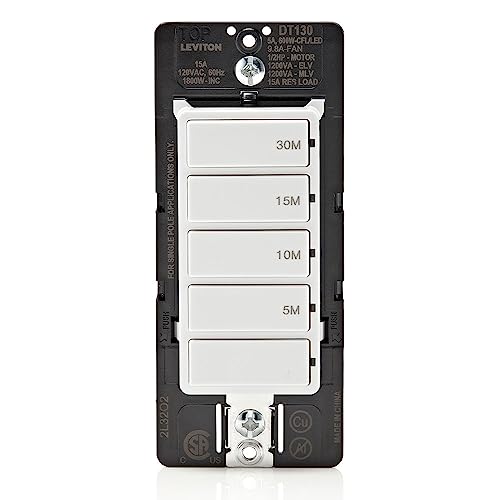
The countdown switch that bends over backward for a tricky wall box.
The standout here is the green flex sleeve, a small design trick that lets this timer work whether or not your box has a neutral wire. No neutral? You wire to ground. Have one? You remove the green sleeve and connect to it. That flexibility is what makes the DT130-1LW so easy to live with, and the numbers back it up: a 15-amp rating (amps, the current it can carry), 600W of LED or CFL bulbs, 1800W incandescent or halogen, 1200VA of MLV/ELV/fluorescent (volt-amps, the load rating for those fixtures), and a ½ HP fan motor rating (horsepower, enough for a typical exhaust fan). Four preset buttons cover 5, 10, 15, and 30 minutes, and the load shuts off automatically when time runs out.
Two black wires can be swapped between line and load, so you cannot get the classic miswire wrong. The shallow body fits neatly into a standard wall box, and the LED indicator shows you the running time as it counts down. Owners mention that build quality and the installation experience are the two things they praise most, and the finish is a genuine point of pride — if you ever want to change the color, DTKIT faceplates come in white, ivory, light almond, gray, black, and brown.
The catch is box size and faceplate availability. Replacing a standard switch usually calls for a slightly larger box, and if your existing setup already occupies a tight space, expect a bit more shuffling. A few owners also note the matching faceplate can be hard to find locally, so order it with the timer rather than making a second trip.
Why owners keep it
- Green flex sleeve handles neutral or no-neutral wiring
- Four presets: 5, 10, 15, and 30 minutes
- Interchangeable line/load wires cut miswire risk
- Shallow design fits standard wall boxes
What to plan around
- Often needs a larger box when replacing a standard switch
- Color-matching faceplate can be hard to source locally
This one clicks with: DIYers facing a shallow or wiring-uncertain box who want a clean four-preset countdown for a bathroom fan.
Not the one for: long 60-minute runs or garage-size loads — that is what the DT160 is built for.
8. Leviton Countdown Timer Switch (DT160-1LW, 10-20-30-60 Min)

Same clever wiring as its siblings, but with the wall-clock time to actually run a fan long.
Where its DT130 sibling caps at 30 minutes, the DT160 stretches to 10, 20, 30, and 60 minutes — the difference between a quick bathroom vent and a proper post-shower or garage-clearing run. A long press on the 60-minute button holds the load on indefinitely. It carries the same specs that make the Leviton line easy to wire: 15A, 600W of LED or CFL, 1800W incandescent or halogen, 1200VA of MLV/ELV/fluorescent, and a ½ HP fan motor rating. The green flex sleeve and the interchangeable line/load black wires appear here too, keeping the install forgiving.
The functionality has clearly clicked with owners. The use cases run broad and practical: bathroom exhaust fans, heat lamps, towel warmers, hot tubs, saunas, attic fans, and garage lighting. On a garage full of LED cans that would otherwise burn all night, the auto-off is a fix people feel in the first week. The LED indicators walk down the remaining time as the switch counts, and under a minute they blink to tell you the end is coming.
The one flaw is the buttons. Owners describe them as working but sitting slightly uneven after a press — a single-spring design that leaves a small aesthetic itch. Functionally it holds; if you are the type to notice an off-kilter button every time you walk past, plan mentally for it. It also has a deep body, so it fits most comfortably in a multi-gang or deep box and can be tight in a smaller one.
The set-and-forget payoff: push one button and the load shuts itself off, which owners say is ideal for kids, bath fans, and forgetful garages alike.
Give the box some room: the deeper body prefers a multi-gang or deep box. In a crowded one, plan on re-stuffing wires.
The right call if: you need 10 to 60 minutes of fan or garage light time and want the flexible green-sleeve wiring.
Choose the DT130 instead if: your run rarely exceeds 30 minutes and you want the smaller box footprint.
9. Honeywell PLS750C1000 Timer Switch with Sunrise Sunset (Single or 3-Way)

The heavy-duty 3-way that handles a whole evening of outdoor light on its own.
This is the most capable pick for 3-way outdoor control, and it earns the premium label on both rating and wiring flexibility. It replaces a 3-way switch and works alongside the existing switch, wiring in with screw terminals. The 29-amp current rating is far above anything else here, built to handle surge loads on resistive, inductive, and capacitive circuits. A backlit display shows your settings, and a capacitor retains the programming through brief outages — no battery to replace.
The scheduling depth is the reason to choose it. The PLS750C1000 runs up to 21 programs, handles weekday and weekend splits, and tracks dusk and dawn by latitude and longitude with offset adjustments, plus an automatic daylight-saving shift. The manual override button lets you flip the lights without disrupting the running program. Owners program it for their region and then, as one buyer put it, let it “automatically turn lights on and off” through the seasons.
The weak point is the install on an existing 3-way. The included instructions for that setup are weak, and the red jumper method can leave the light flickering. The workaround is to connect both wires to the same screw on the second switch, effectively making it single-pole. It also needs a neutral wire, and a load under about 10.5W may not register. One more note: when the daily on/off times invert seasonally, the unit may not self-correct, and the lights can stay on until the next program — a quick manual off fixes it until you adjust the schedule.
What makes it premium
- 29A rating built for surge loads and 3-way circuits
- 21 programs with weekday/weekend scheduling
- Latitude/longitude dusk-to-dawn tracking with offsets and DST
- Capacitor retains programming through brief outages
Where the install bites
- 3-way instructions are weak; the red jumper can cause flicker
- Needs a neutral wire and may miss very low wattage loads
- Seasonal on/off inversions can leave lights on until adjusted
Made for you if: you are controlling outdoor dusk-to-dawn lights on a 3-way circuit and want the deepest scheduling plus the highest current rating here.
Look past it if: you are replacing a simple single-pole bathroom switch — most of this capacity would go unused.
Understanding the Specs
Countdown vs. Seven-Day Programming
A countdown timer (sometimes called a minute timer) counts down from a preset number of minutes once you press it, so it suits a load you turn on deliberately and want off after a while — a bathroom fan, a heat lamp, a basement light. A seven-day programmable timer instead follows clock times you enter onto a weekly calendar, so it suits lights that should switch on and off whether or not anyone is home. Decide which behavior your load needs before you compare specs, because no single timer does both well.
Neutral Wire, Ground, and Installation
A neutral wire is the white return path in a circuit, and it powers the internal clock on many in-wall timers. Some timers require it, some do not, and a few use a flexible sleeve to work with either a neutral or a ground wire. A ground wire is a separate safety path to earth. Check which wires your switch box already holds before ordering, since this single detail decides whether your chosen timer installs in fifteen minutes or sends you back to the store.
Amps, Watts, and Load Type
Every timer lists a current rating in amps alongside watt ratings that differ by bulb type. LED and CFL bulbs usually carry a far lower watt ceiling than incandescent or halogen, and motors show up as a horsepower or amp figure instead. Match the timer to the load you plan to run, and remember that a fan motor and a bank of LED bulbs stress a switch in different ways.
Sunrise/Sunset and 3-Way Compatibility
Sunrise/sunset timers use your location to shift the schedule as the seasons change, which keeps porch lights correct through the year without manual edits. A 3-way timer is built to work with a second switch in a circuit where two locations control the same light. If you have a 3-way setup at the top and bottom of stairs, or two entrances to an outdoor light, confirm the timer supports 3-way wiring before you buy.
FAQ
Does an automatic light switch timer need a neutral wire?
Can I use a light switch timer for a bathroom exhaust fan?
How long do automatic light switch timers typically last?
Can a timer switch control LED bulbs without flickering?
What is the difference between a countdown timer and a seven-day programmable timer?
Will a 3-way timer switch work with my existing second switch?
Can a light switch timer handle outdoor lighting and seasonal displays?
How do I know which watt and amp rating my timer needs?
Does a wall timer switch work with low-voltage or dimmable lighting?
Can I install an automatic light switch timer myself?
Final Thoughts: The Verdict
For most people, the best automatic light switch timer is the Lutron Maestro MA-T51MN-LA, because it pairs a 5-to-60-minute countdown with a 3-amp fan rating that reliably drives the low-draw exhaust fans most timers mishandle. If your boxes lack a neutral wire and you want a fan countdown with no fuss, the Leviton DT160-1LW is the one to reach for. And for dusk-to-dawn porch control on a 3-way circuit, the Honeywell PLS750C1000 carries the deepest scheduling and the highest current rating in the lineup. Match the timer to your load and your wiring, and the switch stops being something you think about.
How We Picked
We do not accept paid placement. Every pick is matched to a real buyer and a real use-case; we do not hands-on test units.
Sources & Methodology
Specifications: manufacturer listings and product documentation. Review insights: verified customer reviews, as of September 2026. Pricing: not shown on this page (it changes often); check the current price via the retailer link.
As an Amazon Associate, KitchPrep earns from qualifying purchases. This does not affect which products we feature.
Related Guides
