
Specs are compiled from manufacturer listings and verified buyer reviews and can change over time — please confirm the key details on the product page before buying.
If you have ever sat at a kitchen table with a bucket of loose change and a stack of paper sleeves, you already know the real question: which machine actually counts right, and which one just jams and lies to you? An automatic coin sorter is a motorized machine that drops your mixed coins onto a spinning disc, flings each one into the correct slot by size, and totals the value on a screen — so you pour, press start, and walk away instead of sorting by hand. The picks below hold up when you feed them dirty, mixed pocket change from a register till, an arcade, or a ten-year jar.
I’m Mohammad Maruf — the founder and writer behind KitchPrep. This guide is built by comparing the manufacturers’ published specifications and the patterns across verified customer reviews, so you get each pick’s real strengths and trade-offs instead of marketing spin.
Three things decide whether you keep a coin sorter or send it back: how many coins the hopper (the open bin you pour coins into) holds, how fast it runs, and whether it can fill the paper wrappers you actually use. Below are picks for every budget and workload, from home jars to busy tills.
Our Picks at a Glance

How To Choose The Best Automatic Coin Sorter
Buying one of these machines is really a math problem about your own pile. Think about how many coins you handle in a single session, then match that number to a hopper that will not force you to stand there refilling it every two minutes.
Match the hopper to your pile, not to the shelf tag
The hopper is the open funnel on top where you pour your change. A 2,000-coin hopper (that is the count of dimes it can hold at once, since dimes are the smallest and pack tightest) suits a five-gallon bucket or a busy till. A smaller 400-coin hopper is fine for a home jar, but you will refill it several times on a big job.
Decide whether you actually need wrapper tubes
Coin wrappers are the paper sleeves banks want coins rolled in. Some machines only drop coins into open trays, which means you sort first and roll by hand later. Others include tube attachments that fill a wrapper automatically and stop when the roll is full. If you are rolling for a bank deposit every week, the tube feature earns its keep; if you just want a dollar total, you can skip it.
Plan for jam clearing before you buy
Every sorter will eventually stop on a bent coin, a foreign coin, or a scrap of debris. What matters is how easy it is to open up and clear. Look for a model with a removable access hatch or drop-in trays you can lift out — models where you need to unscrew the housing to free a stuck dime turn a five-second fix into a twenty-minute project.
Presort your change, even with an automatic machine
The single biggest accuracy trick from real owners is boring but effective: pull out Canadian coins, arcade tokens, bent coins, and pocket lint before you pour. Sorters identify coins by physical size, not by the printed denomination, so an oversized or undersized look-alike will land in the wrong tray and throw off your total.
Quick Comparison
| Model | Best For | Counting Speed | Hopper Capacity | Wrapper Tubes | Amazon |
|---|---|---|---|---|---|
| Cassida C100★ Best Overall | Busy registers and till closing | 250 coins/min | 1,500 coins (dimes) | No (tubes discontinued) | Amazon |
| HK SYSTEMS HK-2DBest Value | Home jars on a budget | 260 coins per minute | 400 coins | Yes (2-row) | Amazon |
| Aneken S121 | Big piles with a color screen | 350 coins per minute | 2,000 coins | Coin wrappers included | Amazon |
| VEVOR USD Coin Counter | Wrapping and counting at once | 300 coins per minute | 2,000 coins | Yes (5 tubes) | Amazon |
| OFFNOVA EC50 | Mixed change including half-dollars | 330 coins per min (210 mixed) | 300-500 coins | Coin trays and wrappers | Amazon |
| Kolibri KCS-2000 | Rolling heavy volumes fast | 220 coins/min | 2,000 coins (dimes) | Yes (tubes included) | Amazon |
| Safetech Viper V395 | Half-dollars and dollar coins | — | — | Yes (tubes included) | Amazon |
In‑Depth Reviews
1. Cassida C100 Electronic Coin Sorter/Counter
Our pick — over 4★ from 3,500+ verified ratings; the strongest balance of quality and price.
The till-closing workhorse that turns an hour of register counting into half an hour.
If your problem is a stack of cash drawers at closing time, this is the machine people keep coming back to. It runs at 250 coins per minute and sorts pennies, nickels, dimes, and quarters into separate bins, with a 1,500-coin dime hopper (so you can dump a full drawer without stopping) and a 900-coin dime drawer underneath. The 7-digit LED display (a big readout that shows the running dollar total for each coin type) lets you watch the value climb without leaning over the machine.
What wins people over is the build quality. It carries the same sort of reputation a lot of mid-tier commercial kitchen gear has around here: not flashy, but it survives daily use. Buyers report it cutting a seven-register till count from over an hour to about 30 minutes, and one owner cleared more than 1,000 mixed coins in under two hours. The machine runs in counting, adding, and batching modes, and the batch range of 0 to 500 coins per denomination means you can preset a stop so a bin never overflows. Press 0 and it runs continuously. A few owners do flag that accuracy wobbles when debris builds up in the dime channel, so a quick brush-out between big runs goes a long way.
Here is the catch, and it is worth reading before you order: the coin tubes that used to ship with the C100 are gone. You get counting and sorting, but rolling into paper wrappers now means doing it by hand or stepping up to the C200. Also worth knowing — it sorts by physical size, not by the printed denomination, so a foreign coin the same size as a quarter lands in the quarter bin. Drop-in trays help you spot the strays before you commit. Then there is the price tag, which sits in the upper mid-range, and the cost of a few dimes misrouted to the penny tray when a batch gets dusty.
Where it earns its spot
- 250 coins per minute with a 1,500-coin dime hopper and a 900-coin dime drawer — a long session runs without constant refills
- Counting, adding, and batching modes with a 0–500 batch range per denomination so bins stop before they overflow
- Drop-in trays lift out for a visual check, which is the easiest way to catch a foreign coin before it skews the count
- Loads of owner mileage: tills that used to eat an hour of counting now close in roughly half the time
What to plan around
- No coin tubes in the box anymore — rolling into wrappers is a separate step
- Trays have to stay clean; debris in the dime channel is the usual cause of a miscount
- At 8.6 pounds it is a counter fixture, not something you tuck back in a cabinet each night
Buy it if: you close registers nightly or run a small business and want one machine that lives on the counter and just works.
Look elsewhere if: wrapping coins into paper rolls is your main goal — this model sorts and counts only.
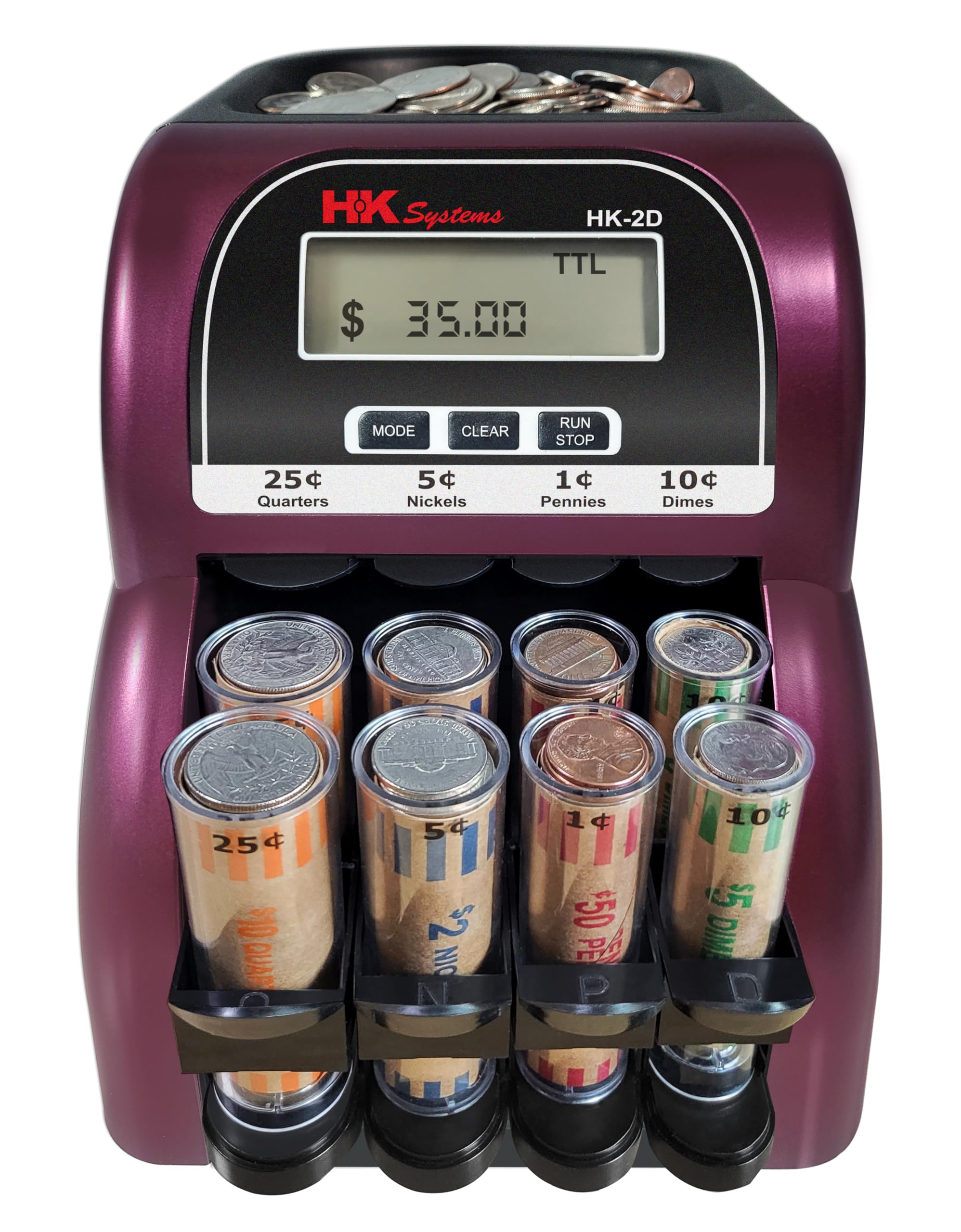
2. HK SYSTEMS HK-2D Digital Coin Counter and Sorter
A plug-and-play counter that fills wrappers two at a time without emptying your wallet.
The HK-2D is the one to grab if you want automatic wrapper filling without the commercial price. It sorts at 260 coins per minute — just ahead of the Cassida C100’s 250 — and its two-row wrapper holder fills one paper sleeve, then the second, then stops on its own. A 400-coin hopper keeps you loading regularly, and the digital display shows both the value of each denomination and the running total of everything that has passed through. It is also the lightest machine here at 4.6 pounds, roughly half the Cassida’s 8.6 pounds, so tucking it away between uses is no chore.
Two operating modes make it flexible: Mode A counts a set number of coins exactly, while Mode B just keeps a running total as you feed it. The Run and Stop buttons do what they say, and the top-loading design means you are not fishing around to get coins in. What wins people over is simply how little there is to learn — the review pages are full of first-time owners describing plug-and-play, and the machine is reliable enough that it beats more expensive units for some buyers. Push up the holder from underneath and a filled wrapper slides right out.
The wrapper caveat: the sleeves bundled in the box have drawn criticism — owners mention the included wrappers giving them trouble, so plan on picking up standard preformed coin wraps instead of relying on the boxed set.
Quarters need patience: a few buyers also mention quarters catching inside, and at least one found the machine jamming on a light feed. Feeding coins a handful at a time, rather than dumping the whole jar at once, is the easy workaround most owners land on.
Reach for this if: you want sorting and automatic wrapper filling in one box at the friendliest price here.
skip it if: you handle huge commercial volumes daily — the 400-coin hopper means more refilling than the big-capacity machines.
3. Aneken Coin Counter & Sorter for U.S. Coins, 3.5-Inch TFT Display
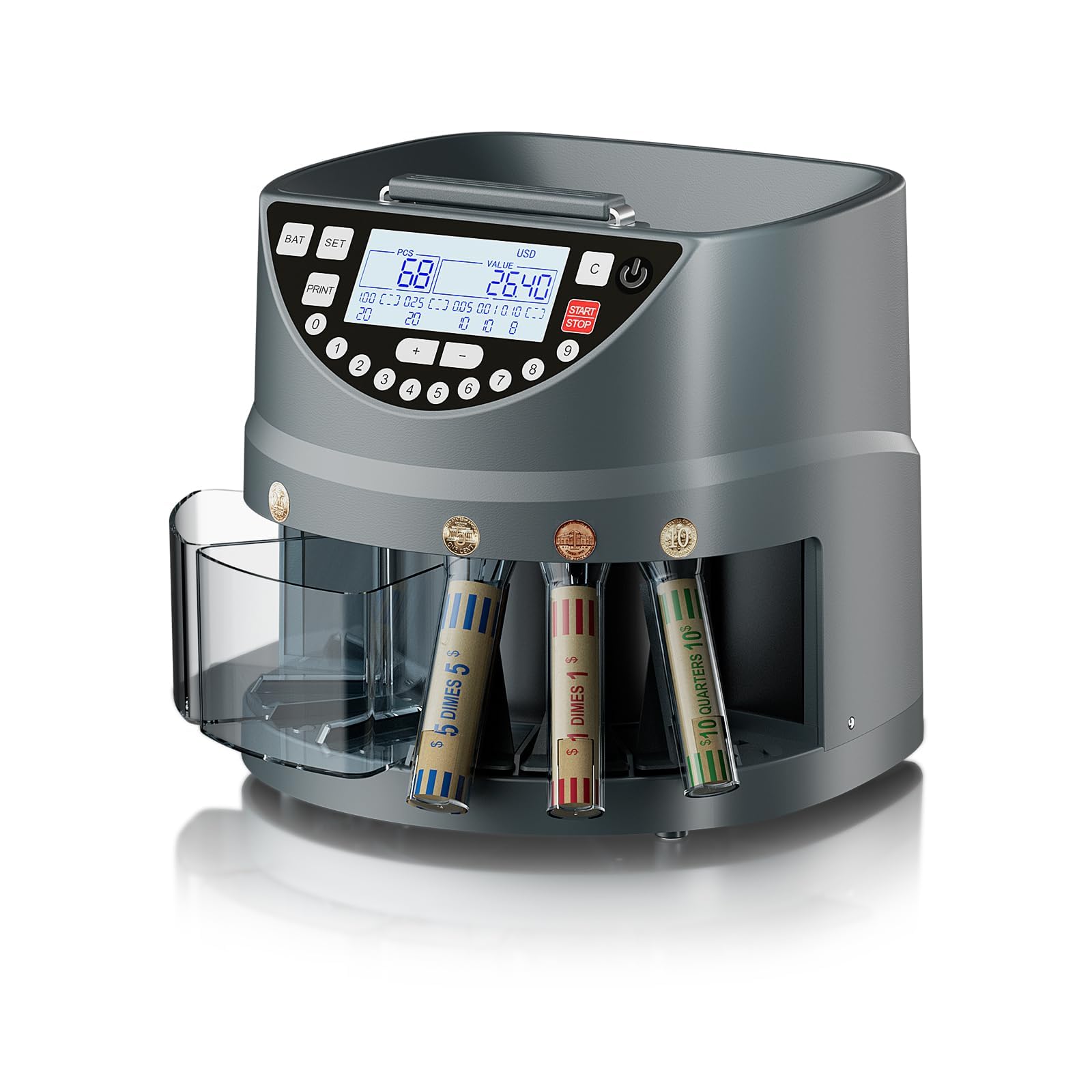
The largest hopper here — pour in a full five-gallon bucket and step back.
Two numbers define this machine, and both are the biggest in the group. The hopper (the open bin you pour coins into) swallows up to 2,000 coins at a time — five times the 400-coin HK-2D — and the sorter runs at 350 coins per minute, the fastest pick on this list and well ahead of the HK-2D’s 260. Put together, that means you can dump a serious pile in one go and have it sorted in a fraction of the time a smaller machine would need. It handles all five common U.S. denominations at once: dollars, quarters, dimes, nickels, and pennies.
The display is where this one feels different from everything else on the shelf. That 3.5-inch TFT screen is a full-color panel, not the monochrome readouts the other machines use, so the per-denomination quantity and dollar value are genuinely easy to read at a glance. You can also set a batch count anywhere from 0 to 999, and the machine stops and powers down on its own after 20 seconds of inactivity to save energy. A 2-year support window is attached to the unit, and the box includes an external display, five coin wrappers, a cleaning brush, a fuse, and the power cord.
Be honest about how this one wants to be fed. Owners describe a machine that runs clean when you go slow and do not overload it, and a recurring gripe is a jam when you push it. Coins can slip behind the tubes or a penny can wander into the dime channel, and a foreign coin lodged deep enough may need a look inside to clear. The machine will not sort half-dollars at all — it is built for the five common denominations only. Feed it in reasonable batches and it earns its keep.
What stands out
- 2,000-coin hopper and 350 coins per minute — the biggest, fastest capacity in this lineup
- 3.5-inch TFT color screen shows quantity and value per denomination in real time
- Batch counting from 0 to 999 with a 20-second auto power-off
- Ships with an external display, coin wrappers, cleaning brush, fuse, and power cord, plus a 2-year support window
Feed it carefully
- Overload it and it jams — the machine works best when you pour steadily, not all at once
- Pennies can end up in the dime channel if coins are not lying flat
- No half-dollar sorting, so mixed collections with 50-cent pieces are out
Best pick if: your change arrives in buckets and you want the largest hopper and fastest feed on the list, with dimes still readable on a color screen.
Think twice if: you need to sort half-dollars or dollar-heavy collections — only the five common denominations are supported.
4. VEVOR USD Coin Counter with LCD Display
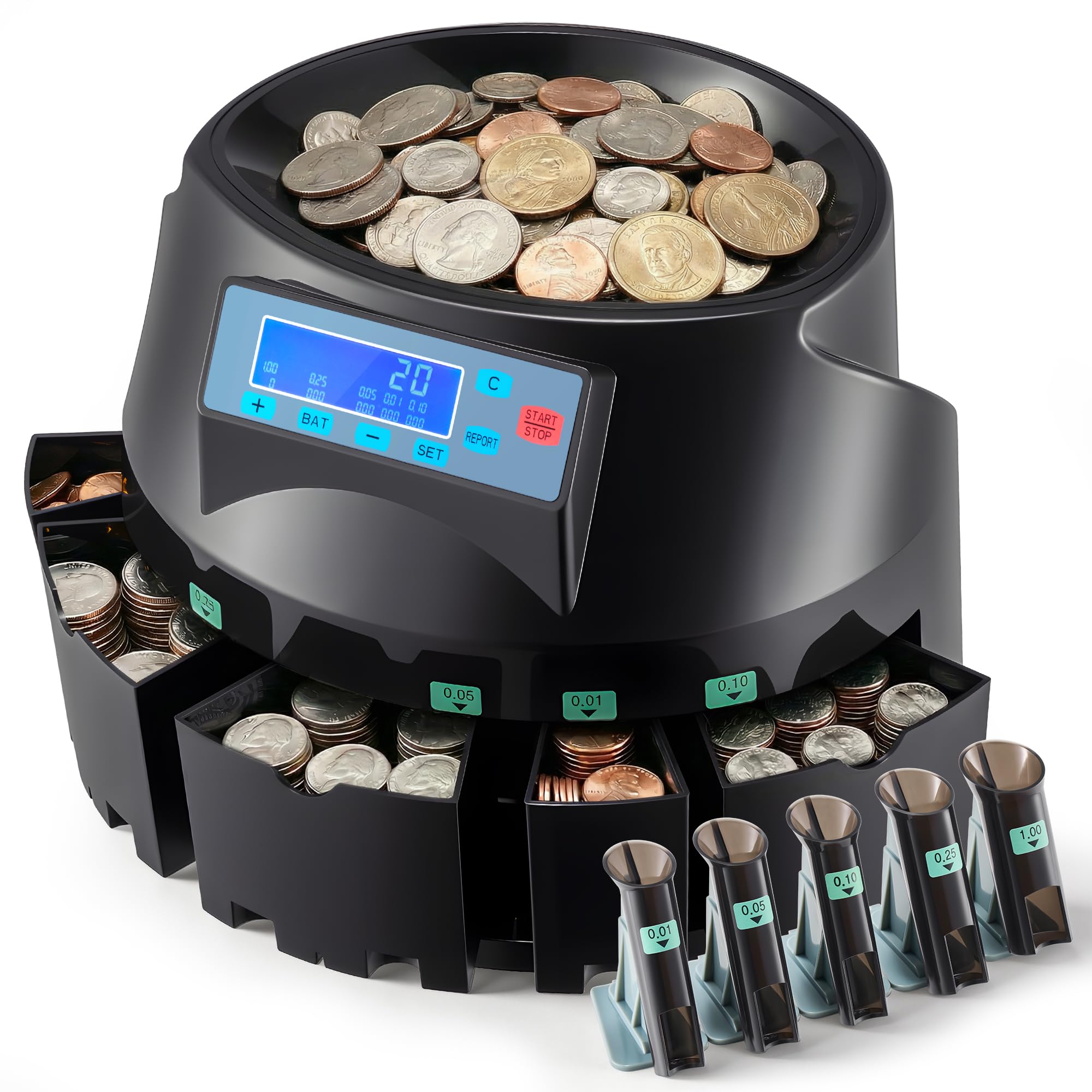
Load the tube, press start, and it fills your paper rolls for you.
If wrapping coins is the part you hate most, this is the machine built around that job. Drop a coin wrapper into one of the roller tubes, and the machine fills it automatically as it sorts — pennies, nickels, dimes, quarters, and dollar coins, all at 300 coins per minute. A coin counter and wrapper machine that does both at once saves you the second pass at the table. It also carries a large 2,000-coin capacity, so you are not stopping to empty bins every few minutes.
A 10-month owner running an arcade bar lights up the case for this one: hundreds of quarters sorted accurately, no jams, and outright rejects — nickels and beat-up coins pushed into the tray rather than counted wrong. Others in high-volume bar settings say it keeps pace while staff handle cash by hand beside it, cutting closing time. One owner recouped the machine’s cost through the fees it saved at a coin-counting kiosk. If you move bulk change, the 300-coin cadence keeps a big job moving without babysitting.
Where it asks you to pay attention is accuracy under messy conditions. The reading gets shakier with coins dumped in bulk: one owner found pennies and dimes mixed in the catch bins, and per-denomination totals that did not match the display total. There is also no paper wrappers in the box, so plan to supply your own. The upside is that the display and controls are simple enough that correcting a jam or re-running a load takes seconds, not a service call.
Built for volume: a 2,000-coin capacity and 300 coins per minute make this one comfortable in a busy bar, restaurant, or arcade where coins come in constantly.
Simplicity helps: owners appreciate that it is genuinely easy to use, with a clean LCD readout and basic buttons — which matters when a whole shift is watching you count.
Watch the accuracy: mixed or heavily loaded runs can produce mismatched totals, so run it in smaller batches if precision really matters to you.
Pick this if: you want to sort and fill coin wrappers in a single pass and deal with a steady flow of quarters from a business.
Skip if: you need bank-grade accuracy on every coin — some owners find the totals slip on large mixed loads, so smaller runs are safer.
5. OFFNOVA Electric Automatic Coin Sorter & Change Counter Machine

One of the few machines here that will handle half-dollar and dollar coins without complaint.
Most of the sorters in this lineup are built strictly for the five common U.S. denominations — penny, nickel, dime, quarter, and dollar. The OFFNOVA goes wider: it also sorts half-dollar coins, which makes it the pick if you have a mixed collection that includes 50-cent pieces the other machines will not touch. It runs at 330 coins per minute when fed a single denomination and 210 per minute on mixed change, and the 300-to-500-coin hopper with 80-to-150-coin trays holds plenty of coins at once.
The display and controls are the sort of thing you figure out without reading the manual — a large LED screen showing a running total in both number and value, per denomination. Counting, adding, and batching modes are all on board, and if a single run exceeds the maximum, the previous records roll into the next total so nothing is lost. Set the batch amount with a single button and the machine handles the stopping for you. A few owners have run 3,000 to 3,200 mixed coins with only a small number of errors.
What it does not do well is fit on a small kitchen counter. It is 9.9 pounds and large — much of the feedback says it is better suited to a business or a cashier station than a home drawer, and some find it noisy. The wrappers are a manual step too: coins do not auto-feed into the sleeves, so you stuff them yourself. If all you have is a single jar of change, this one is overkill. If you are running a till or a shop counter, it earns its place.
Where it shines: half-dollar support separates it from the Aneken S121 and the VEVOR, both of which stop at the five common denominations — so a mixed collection with 50-cent pieces has somewhere to go.
What to expect: it is a business-size machine — 9.9 pounds and bulky — so it wants a counter or a back-office shelf, not a kitchen drawer.
Grab this if: your change includes half-dollars and dollar coins the other sorters ignore, and you run a till or shop counter rather than one home jar.
Pass if: you only have a single jar of quarters and pennies — this is more machine than a home kitchen needs.
6. Kolibri KCS-2000 Professional USD Coin Counter and Wrapper

A business-grade all-rounder that sorts, counts, rolls, and reports — with real support behind it.
The batch feature is its strongest move. You can set a one-touch batch amount for the coin bins and the wrappers at the same time, so one denomination rolls while another fills the bin — no babysitting the stop point. Owners with wrapping to do call it accurate and quick, one noting it cut a 225-coin sorting-and-wrapping job from two or three hours down to about one. And when something goes wrong, Kolibri as a brand carries a USA-based support team with a 1-year warranty backing it up, which is not something every machine here can claim.
Two honest caveats. First, the wrapper tubes have a learning curve — dimes in particular are the trouble spot. A dime that slips out of the bottom slot without a wrapper in place can spill, and one owner chose the machine’s bin-and-tube mix partly to sidestep that. Second, the machine is a big one — one owner described it as larger than a basketball, which is not the kind of thing that fits in a cabinet. If you have the counter space and you want the bells and whistles done properly, it earns its keep.
The case for it
- Sorts, counts, and fills wrappers in one pass with a large 2,000-coin capacity
- One-touch batch setting for both trays and tubes — the feature that saves the most time
- Wrappers auto-fill and stop when full, so you can roll or just count
- Backed by a 1-year warranty and a USA-based support team
The honest trade-offs
- Faster machines exist — this one trades top speed for automatic wrapping convenience
- Dimes are the recurring trouble spot in the wrapper tube; a missing wrapper can spill coins
- Large and bulky — one owner compared its footprint to a basketball, so it wants dedicated shelf space
Settle on this if: you want one machine to count, sort, and roll coins automatically, with a real support line behind it.
Move on if: you need the fastest throughput or a compact footprint — bigger bin capacity rivals and smaller machines both have their place.
7. Safetech Viper V395 Coin Counter, Sorter, and Wrapper

Bring the half-dollar and dollar-coin collections the other machines turn away.
In daily use, the happiest owners say it does exactly what it promises. It arrives with a dust cover for storage and a box of 48 preformed coin wrappers, so you are not scrambling for sleeves on day one. The reinforced internal mechanisms are pitched at frequent use, and long-term customers note running it for months without a jam — they simply fill the bins, let it work, and walk away. It is also the lightest of the big-capacity machines here at 7.63 pounds.
What to watch for is the wrapper-holder alignment. After you reload fresh wrappers, the tube lock can be finicky, and if a tube is misaligned it can spill coins and lose the count mid-run — a matter of checking the seating before you restart. Some owners also find it loud during a long session, and an occasional bin overfill can spill coins if you are not topping up. But with six denominations and a tube system that does the rolling, it is a strong choice for anyone handling mixed collections that include half-dollars.
Who it suits: anyone with a mixed collection that includes half-dollars — that one feature alone pushes it ahead of sorters that only handle the standard five denominations.
Care points: the tube lock alignment needs attention after each reload, and it runs loudly, so it is better suited to a utility counter than a quiet office desk.
Choose this if: half-dollars show up in your change and you want tubes and trays working together with a dust cover thrown in.
Think again if: you want a quiet machine or you dislike fiddling with tube alignment between reloads.
Understanding the Specs
Coins per minute
This is the raw throughput number — how many coins the machine can push past the sensor and into the right slot every minute. A 250 to 300 coins-per-minute sorter will handle a standard drawer or a big jar in reasonable time. Note that some machines list two figures: one for a single denomination, which runs faster, and a slower number for mixed change. The OFFNOVA, for example, runs 330 coins per minute by the same denomination and 210 per minute on mixed change. Speed matters most on the biggest jobs.
Hopper capacity
The hopper is the funnel you pour into. Capacity is usually stated in dimes, because they are the smallest coin and pack the tightest — so a 2,000-coin hopper holds fewer quarters than dimes. A big hopper cuts down on how many times you stand there refilling. A 400-coin model is fine for a home jar; a 2,000-coin machine suits a bucket or a full till drawer where refilling every minute would waste the speed advantage.
Wrapper tubes and trays
Trays are open bins that catch each denomination separately so you can scoop the coins out. Wrapper tubes go a step further — they hold a paper sleeve while the machine fills it and stop when the roll is full. If a bank deposit is your goal, a model with tubes saves you the manual rolling step entirely. If you only want a dollar total, trays alone are enough.
Batch counting
A batch setting tells the machine to stop after a set number per denomination, so a bin never overflows and a wrapper never overfills. The range varies by model — the Cassida C100 allows 0 to 500 per denomination, while the Aneken S121 allows 0 to 999. Press 0 or the lowest setting and most machines keep running continuously. Setting a batch is the single easiest way to leave the machine unattended without cleanup.
FAQ
Can an automatic coin sorter distinguish between U.S. and foreign coins?
Do I need the wrapper tubes, or is sorting into trays enough?
What causes coin sorters to jam, and how do I prevent it?
How do I clear a jam if one happens anyway?
Do these machines sort half-dollars and dollar coins, or only the common four?
How many coins can these machines hold at once?
What is the difference between counting speed for a single denomination and mixed change?
Why do some coin sorters have a batch setting and what does it do?
Are these machines loud enough to bother anyone nearby?
Do I need to clean or maintain the machine between uses?
Final Thoughts: The Verdict
For most people, the best automatic coin sorter here is the Cassida C100. Thousands of ratings at 4.4 stars back up its reputation for surviving years on a counter, and the combination of a 250 coins-per-minute speed, a 1,500-coin dime hopper (the bin that holds coins before sorting), and three operating modes handles a real till-closing job without drama. If you want the biggest hopper and fastest pace, the Aneken S121 at 350 coins per minute and 2,000 coins is the one to grab. And if half-dollars are part of your change, the Safetech Viper V395 is the machine to reach for. If your budget is tight and you just want to stop rolling coins by hand, start with the value pick — the HK SYSTEMS HK-2D — before spending more.
How We Picked
We do not accept paid placement. Every pick is matched to a real buyer and a real use-case; we do not hands-on test units.
Sources & Methodology
Specifications: manufacturer listings and product documentation. Review insights: verified customer reviews, as of September 2026. Pricing: not shown on this page (it changes often); check the current price via the retailer link.
As an Amazon Associate, KitchPrep earns from qualifying purchases. This does not affect which products we feature.
Related Guides
