
Specs are compiled from manufacturer listings and verified buyer reviews and can change over time — please confirm the key details on the product page before buying.
Stripping scrap wire by hand is a slow, finger-aching grind that caps how much copper you can turn in each week. An automatic cable stripping tool changes that math entirely, but the hard part is choosing right — some models shine on thick scrap, others are precision hand tools for panel work, and a few will fight you on thin or solid wire. This guide breaks down nine of the best, so you can match the machine to the wire you actually handle.
I’m Mohammad Maruf — the founder and writer behind KitchPrep. This guide is built by comparing the manufacturers’ published specifications and the patterns across verified customer reviews, so you get each pick’s real strengths and trade-offs instead of marketing spin.
Here is how to weigh motor power, channel count, and wire diameter range to find the right automatic cable stripping tool for your recycling or electrical work, without overpaying for features you won’t use.
Our Picks at a Glance


How To Choose The Best Automatic Cable Stripping Tool
Before you look at any spec, ask yourself one question: are you stripping scrap copper for recycling, or preparing the ends of wires for electrical connections? Those two jobs need very different tools — a bench-top motorized machine for the first, a compact hand-held automatic stripper for the second.
Match Motor Power to Your Feed Volume
A motorized machine’s wattage is the single best clue to how fast it will chew through insulation. A 60W motor handles typical scrap wire with ease, while a 180W motor pulls heavier gauge and tougher plastic sheathing faster. If you are feeding wire for hours, the more powerful motor pays off; for occasional recycling, 60W is plenty.
Check the Wire Diameter Range and Channel Types
Every machine lists a range it can handle, like 0.06″ to 0.98″. That number must cover the thickest cable you scrap, or the machine will jam or fail to cut. Look for the number of feed channels too — 7 channels (some round, some flat) let you swap between wire shapes without constant blade readjustment.
Decide Between Bench Machine and Hand Tool
A hands-free electric machine is the right call for stripping pounds of scrap copper. A spring-loaded automatic hand tool makes more sense for a daily electrician who needs clean, precise terminations on live work. Each belongs in a different tool bag, and the best choice depends entirely on your daily reality.
Quick Comparison
| Model | Best For | Motor Power | Wire Range | Feed Channels | Amazon |
|---|---|---|---|---|---|
| VEVOR Electric Machine★ Best Overall | High-volume scrap recycling | 60W | 0.06″–0.98″ | 7 (6 round, 1 flat) | Amazon |
| VESSEL 3000CBest Value | Electricians on 12 & 10 AWG | — | 0.9–5.5 mm | 5 gauges | Amazon |
| JOKARI Super 4 ProPro Choice | Fast, clean PVC stripping | — | 0.2–6 mm² | Self-adjusting | Amazon |
| KNIPEX EvoStrip | Stranded wire from 8–32 AWG | — | 8–32 AWG | Self-adjusting | Amazon |
| SENDUO Electric Machine | Budget-friendly bench stripping | 25W | 0.04″–0.79″ | Single | Amazon |
| Knipex 12 64 180 | Stripping UF & flat cable | — | 10–18 AWG | Self-adjusting | Amazon |
| Knipex PreciStrip16 | Fine wires 0.08–16 mm² | — | 0.08–16 mm² | Self-adjusting | Amazon |
| Happybuy Electric Machine | Fast heavy-gauge stripping | 180W | 1.5–25 mm | Single feed | Amazon |
| CREWORKS Electric Machine | Wide size range, fast speed | 60W | 0.06″–1.1″ | 7 (round & flat) | Amazon |
In‑Depth Reviews
1. VEVOR Electric Wire Stripping Machine
Our pick — over 4.5★ from 600+ verified ratings; the strongest balance of quality and price.
A 60W bench-top machine that strips scrap copper hands-free at up to 0.98″ diameter.
If you recycle copper regularly, this is the machine that ends the hand-stripping grind. A 60W gear motor (a motor with gears that boost pulling force) drives the feed, so you get the pulling power of a bigger motor in a more compact frame. The hands-free design lets you feed wire continuously, which is exactly what the crowd emphasizes — buyers report finishing a week’s worth of stripping in a single day, and one scrapping veteran says it’s quiet enough to run near a sleeping baby.
It handles wire from 0.06″ (1.5 mm) up to 0.98″ (25 mm) across 7 channels — 6 round plus 1 flat slot. The cast iron body and 65 mn spring steel blade are built to keep working, and hole-size markings mean you do not keep re-adjusting for the same wire. The included gloves and the angle tips in the manual get a first-timer stripping cleanly from the first feed. One owner notes the box should have included an extra knife and nylon nut per the instructions, so check your package.
Value is where this machine makes its case. Owners describe it as paying for itself quickly — one puts it bluntly: “I love this thing! Paid itself off in minutes!!!” For a recycler selling bare bright copper instead of dirty #2, the upgrade pays for the machine fast. Noise gets mixed feedback: most call it quiet, a few find it loud.
Why recyclers flock to it
- 60W motor strips fast without a huge footprint
- 7 channels cover round and flat wire up to 0.98″
- 65 mn spring steel blade resists wear
- Hands-free feeding for continuous work
What to check on arrival
- Missing spare parts reported by a few buyers
- Noise level splits opinion
- Cast iron body is heavy at 15.5 kg
Reach for this if: you strip scrap copper in volume and want hands-free speed with a durable cast iron frame.
Look elsewhere if: you only strip a few wires a week — a hand tool makes more sense at that volume.
2. VESSEL 3000C Automatic Wire Stripper
A spring-loaded hand tool that auto-adjusts for 12 and 10 AWG wire at 5 fixed gauges.
This is the hand tool that lives in a pro’s pouch for repetitive stripping jobs. The spring-loaded jaw opens automatically on squeezed handles, so you never dial in a gauge — the hardened blade does the cutting for braided strand sizes of 0.9, 1.25, 2.0, 3.5, and 5.5 mm. A metal body clip and gauged stop for uniform cutting length round out a tool built for intense daily use.
Owners who strip many 12 & 10 AWG wires (American Wire Gauge, a standard for wire thickness) at once keep this in their rotation. The trade-off, as owners mention, is that the jaws leave a noticeable mark on the wire, and the depth stop is prone to bending — so it is best on wire that is getting terminated, not wire that needs to stay cosmetically perfect. For smaller wires, many owners switch to a different style, keeping this for the heavy gauge where it shines.
Weighing 12.32 ounces, it is built solid and feels substantial in hand — noticeably heavier than lighter plastic-bodied strippers. The soft, injection-moulded handle keeps long sessions comfortable. Replacement blades are available, which extends its life considerably.
The daily-driver strengths
- Automatic action fixes the gauge for you
- Gauged stop gives consistent cut lengths
- Soft handle and metal body for intense use
- Replacement blades available
The honest trade-offs
- Jaws mark the wire — not for cosmetic work
- Depth stop can bend if handled roughly
- Best on 12 & 10 AWG, not small wires
Grab it when: you are an electrician stripping dozens of 12 & 10 AWG wires and want a reliable, budget-friendly automatic tool.
Think twice if: you need pristine wire, or work mostly with small-gauge conductors.
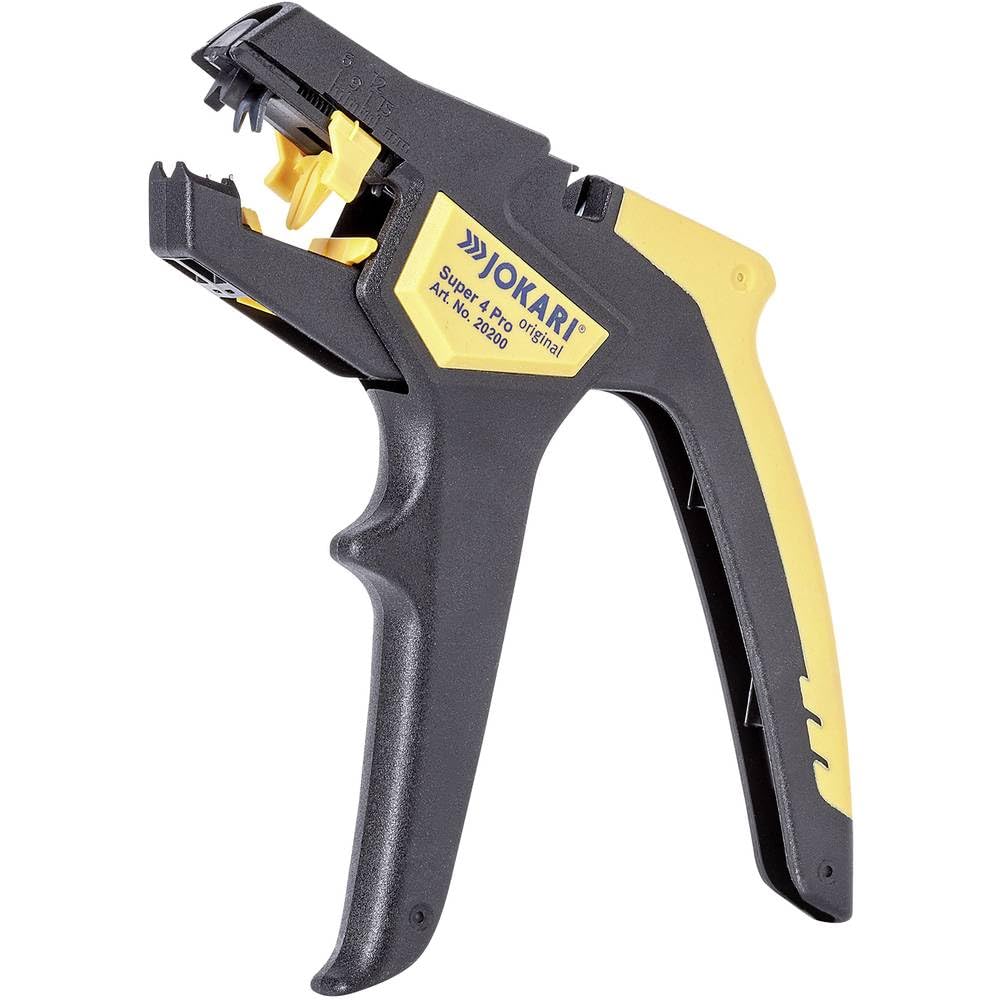
3. JOKARI Original Super 4 Pro Wire Stripper
The self-scanning precision tool that never nicks a copper strand.
A self-adjusting hand tool that delivers nick-free strips on 0.2–6 mm² PVC conductors. An automatic scanning system reads the cable cross-section the moment you squeeze, so there is no adjustment for conductor sizes from 0.2 to 6 mm². The length stop adjusts from 5 to 15 mm, giving you consistent strips for repetitive termination work.
Its cutting width of 1.5 centimeters is a full 50% wider than the KNIPEX EvoStrip’s 1 centimeter — meaning you can strip heavier flexible and solid PVC conductors in one pass without biting into the copper. The ergonomic PVC handle and replaceable blades make it a long-term investment. At just 94 g, it is light enough to forget you are carrying it.
Owners are unqualified in their praise — the review pages sum it up: “Best strippers I’ve ever used” and the German build quality shows in every click. The 2-component grip on the Pro model feels better barehanded, though a buyer notes it is slicker when wearing gloves or working in dusty conditions.
What wins pros over
- Auto-scan means zero gauge setup
- 1.5 cm cutting width handles big PVC cables
- Light at 94 g, easy in a pouch
- Replaceable blades
Who should pass
- 2-component grip is slippery with gloves
- Not designed for scrap-volume recycling
Best for: technicians and electricians who want flawless, nick-free strips on flexible and solid PVC conductors up to 6 mm².
Not for: anyone planning to feed spools of scrap wire through a motorized setup.
4. KNIPEX 12 40 200 EvoStrip Automatic Wire Stripper
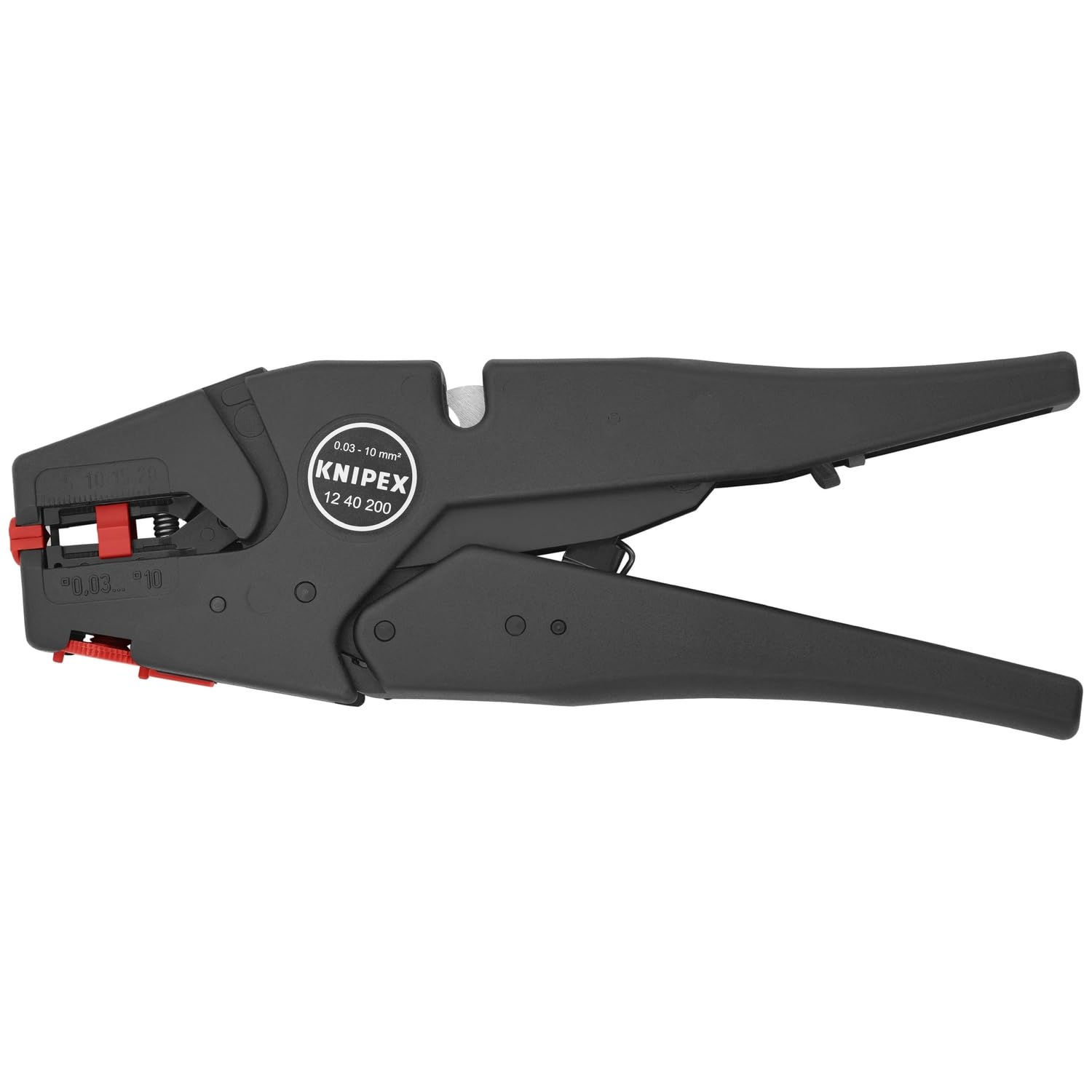
A featherweight 6.88-ounce automatic stripper built for stranded wire speed.
At just 6.88 ounces, this is a full 79% lighter than the VESSEL 3000C’s 12.32 ounces — a difference you feel on a long panel day. The fiberglass-reinforced plastic body keeps it tough while light, and the tool adapts automatically to the cable diameter so it won’t damage the conductor underneath.
The fine adjustment dial is the standout feature: it sets cutting depth precisely for special insulation materials or temperature conditions, and the adjustable length stop runs from 1/8″ to 7/8″ (3.0–22.0 mm) for repetitive work. It handles single, multi, and fine-stranded cables from 8 to 32 AWG, and the built-in cutter handles multi-stranded copper up to 8 AWG.
The catch, as customers note, is that this is a stranded-wire tool. On solid 18 AWG it struggles — the insulation splits on the wire you are using, which can cause a short. One owner who loves it for stranded wire warns it is “not good for thermostat wire.” The blade is special tool steel, oil-hardened and replaceable, and there is a tether attachment point for drop protection.
Where it excels
- Ultra-light 6.88 oz fiberglass body
- Fine-tune dial for depth control
- Cuts multi-stranded up to 8 AWG
- Replaceable tool-steel blades
Where it falls short
- Struggles on solid wire like 18 AWG
- Some find plastic body flimsy
- Red dial can reset in a pouch
Reach for this if: your work is mostly stranded THHN and you want the lightest, fastest automatic stripper on the market.
Look elsewhere if: solid thermostat wire is a staple of your day — this tool will disappoint.
5. SENDUO Automatic Wire Stripper Machine

A 25W budget bench machine that strips 0.04″–0.79″ round wire, ideal for 12/2 and 12/4 scrap.
For a home recycler or small shop, this is the cheapest way to get into motorized stripping. The 25W large motor delivers decent efficiency for its class, and the alloy steel housing keeps it durable on a workbench. It strips round wire from 0.04″ to 0.79″ diameter, covering the common scrap sizes that build up in a garage.
Owners are clear that it excels on the bigger stuff — reviewers point out it does “very well with 12/2 and 12/4” and that the bigger the wire, the better it works. Thin wire can be harder to feed and keep from twisting, which is a universal trait of budget machines. Free replacement blades and a wrench come in the box, so you can keep the edge sharp.
The main cautions: feed the wire at a 10°–20° upward angle and keep the blade from pressing too deep, or you risk nicking the copper core. A few units have arrived dead on arrival, unable to power on — a small risk, but one worth knowing when ordering a budget option with mixed quality feedback.
The value pitch
- Entry-level price for a motorized stripper
- Handles hard and soft cover wires
- Free replacement blades included
- Durable alloy steel body
Know before you buy
- Weak on very thin wire
- Some units arrive unable to power on
- Needs a 10°–20° feed angle for best results
Best for: hobby recyclers and small shops that hit copper scrap piles and want a motorized answer on a budget.
skip it if: you strip mostly fine-gauge wire, where this machine’s feed struggles.
6. Knipex Tools 12 64 180 Self-Adjusting Insulation Strippers
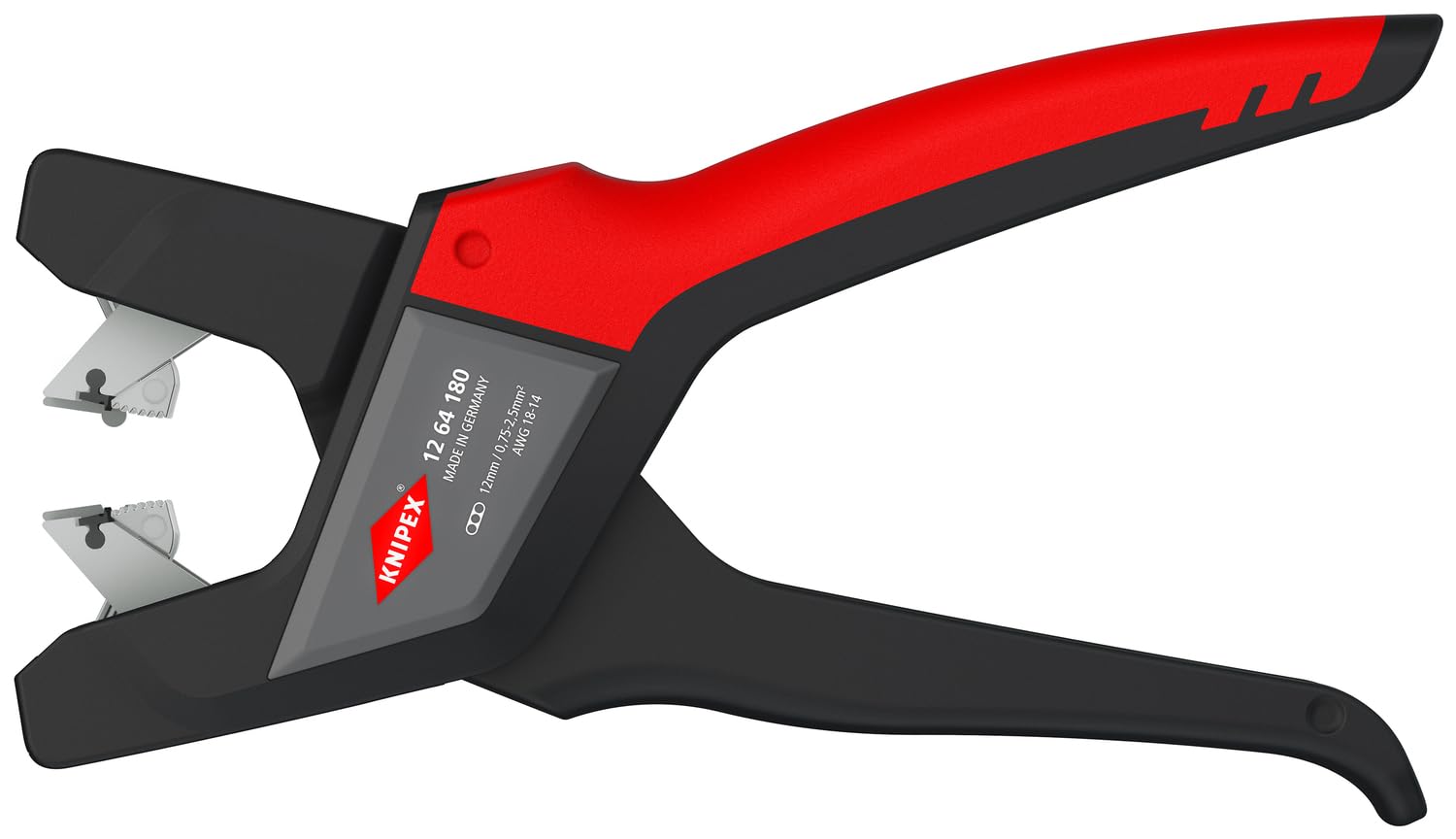
A 4.32-ounce pull-through tool that strips UF and flat cable from 10–18 AWG.
If you work with UF wire and flat cable, this is the specialized tool you have been missing. It strips the outer sheath and the inner conductors in one tool, handling UF and flat cable from 10 to 18 AWG. The front pull-through design means you can strip long runs without working in awkward sections — a major time saver on big jobs.
At 4.32 ounces, it is the lightest hand tool on this list, and the built-in wire looping hole handles conductors up to 12 AWG. Owners who use it daily praise the durability — one electrician dropped it 20 times and it kept working, calling the plastic frame tough. The blade is special tool steel, oil-hardened, and replaceable (part number 12 69 31).
The honest limit: a licensed electrician found it does not fully strip UF wire to bare conductors and still needed a razor for the final step. Others note it is really best for stripping wire ends, not for splitting long runs of Romex in junction boxes. For the right user — someone stripping ends of 14–10 AWG sheath — this is a genuine helper.
Why it earns its place
- Strips UF and flat cable from 10–18 AWG
- Front pull-through handles long runs
- Ultra-light at 4.32 ounces
- Durable through daily drops
The fit note
- May not fully strip UF to bare conductors
- Best for ends, not long Romex splits
Reach for this if: you are a helper or pro who strips UF and flat cable ends all day and wants one light, tough tool.
Look elsewhere if: you need full conductor exposure on long UF runs without a follow-up razor pass.
7. Knipex PreciStrip16 Automatic Insulation Stripper

The parabolic-blade precision instrument for fine wires and solid rounds.
A patented automatism regulates cut depth for nick-free strips on 0.08–16 mm² wires. A patented automatism regulates the depth of the cut, and the parabolic stripping blade makes an exact cut every time. It handles fine wires and solid round cables across a wide capacity range from 0.08 to 16 mm² with just one pair of pliers — no swapping tools for different gauges.
The semi-circular grooved metal holding clamps keep a good grip on the wire, and the neutral point of the automatism can be adjusted in fine steps for special insulation materials or temperature conditions. At 200 g, it feels substantial and precise in hand, a clear step up from cheaper strippers.
The consensus is that it works best on smaller gauges. A buyer who tried it on 14 and 12 gauge found the tip did not have enough force to strip those sizes, while it worked fine on smaller wires. Another found it would not bite on 10 AWG. This is a precision instrument for fine work, not a heavy-gauge brute; expect that in this price range.
Precision strengths
- Patented automatism regulates cut depth
- Parabolic blade gives exact cuts
- One tool covers 0.08–16 mm²
- Adjustable neutral point for special materials
Weight limits
- Struggles on 10–14 AWG thick wires
- Some find plastic construction below Knipex standards
Best for: control panel builders and electronics techs working with fine wires who demand a nick-free cut, backed by a Knipex lifetime warranty.
Not for: anyone stripping 10 AWG or thicker, where this tool loses bite.
8. Happybuy Automatic Electric Wire Stripping Machine
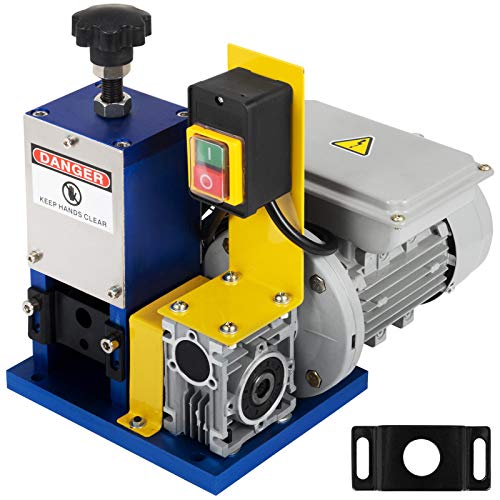
A 180W motorized stripper that feeds heavy scrap at 60 feet per minute.
For serious copper recyclers, wattage is king, and this machine has the highest on the list. The 180W powerful motor drives a gearbox that reaches a fast stripping speed of 60 feet per minute — enough to make short work of a spool of 10 gauge stranded or even 1 gauge aluminum with hard plastic shielding, which shoppers say stripping without problems.
The drill-driven technology, adjustable blades, and rollers fit wire diameters from 1.5 mm (0.05″) up to 25 mm (0.98″). The solid aluminum alloy construction is built for rigorous environments, and the emergency stop button protects you if a wire jams mid-feed. The hands-free design means you feed one end and it pulls the rest through on its own.
Owners describe a modest learning curve — best results come when the safety gate hole sits slightly below the pulley top and the cutting wheel lightly presses the insulation. Press too hard and you cut strands. Once mastered, it is a fast, smooth, quiet machine that pays for itself, especially since scrap yards deduct for unstripped wire.
The power play
- 180W motor — strongest on this list
- 60 ft/min stripping speed
- Handles up to 25 mm wire diameter
- Emergency stop for jam safety
Small print
- Learning curve to avoid cutting strands
- Some find value mixed for the price
Reach for this if: you process heavy-gauge scrap in volume and want the fastest motorized feed available.
Look elsewhere if: your scrap is mostly fine wire under 1.5 mm, which this machine will chew up.
9. CREWORKS Electric Wire Stripper Machine
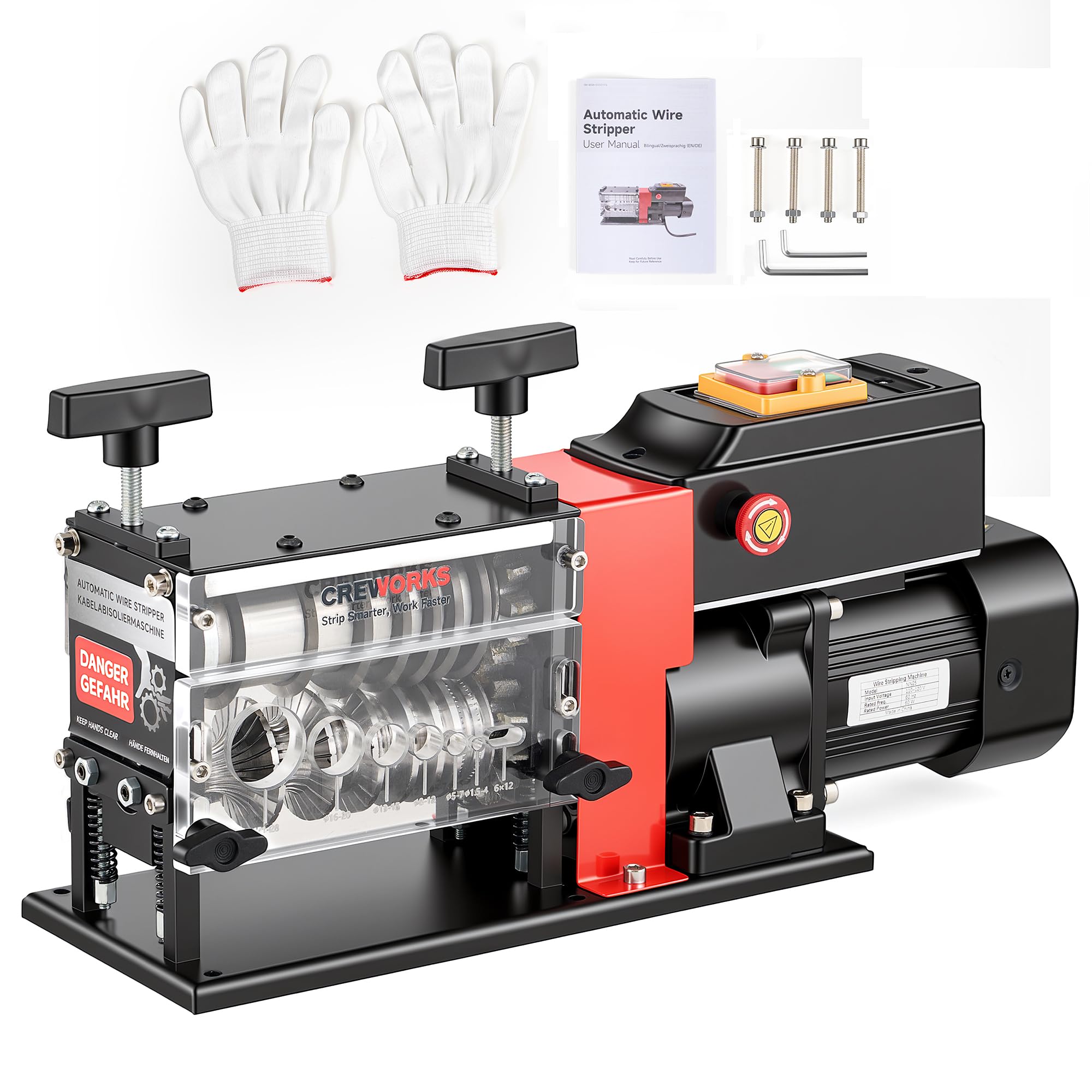
A 7-channel machine covering 0.06″–1.1″ wire, the widest range here.
This machine wins on versatility. Its 7 feed channels handle round and flat cables from 0.06″ to 1.1″ (1.5–28 mm) — the widest span here — covering everything from multi-core electronics to thick automotive wires. A 60W high-speed motor and 7 ultra-sharp blades strip insulation at up to 98.4 ft/min, and the built-in cooling fan keeps it running for hours of continuous work.
The 65Mn spring steel blades cut cleanly every time, and high-friction rollers hold wires firmly so there is no drifting or jamming, even on soft, curved, or thick cables. Setup is genuinely simple: adjust roller height with the top knob, then start with one touch. It ships with the adjustment knob, wrenches, protective gloves, and a user guide with expert stripping tips.
Owners say it works “well on all wire sizes so far” and one stripped 130 ft of mixed copper in 1.5 hours. The main durability caution: a buyer reported the adjusting screw breaking through the metal plate, and reliability is the recurring risk flagged in mixed feedback. For a small home project or medium-volume recycler, though, the range and speed are tough to top.
Why it stands out
- Widest range: 0.06″–1.1″ (1.5–28 mm)
- 98.4 ft/min top stripping speed
- Cooling fan for long sessions
- Complete starter kit with gloves and guide
Watch for
- Adjusting screw can break through metal plate
- Larger wires need practice
Best for: a mixed scrap bin with everything from electronics to automotive cable, where one machine must handle it all.
Consider carefully if: you plan heavy industrial use daily, where the durability feedback gets mixed.
Understanding the Specs
Motor Power (Wattage)
On a motorized bench machine, wattage tells you how hard it pulls. A 60W motor strips typical scrap wire with ease and keeps a compact footprint. A 180W motor pulls heavier gauge and tougher plastic sheathing faster. The higher the wattage, the faster you can feed thick wire without stalling.
Wire Diameter Range
Every machine lists the wire sizes it can grip, shown as inches or millimeters (like 0.06″ to 0.98″). This range must cover your thickest cable, or the machine will jam or fail to cut cleanly. Check the number against your actual scrap pile before buying.
FAQ
Can an automatic wire stripper handle solid wire?
How fast can a motorized wire stripper feed?
Will these tools damage the copper wire inside?
What is the difference between a motorized machine and a hand-held automatic stripper?
Can I strip flat cable with these tools?
How do I set the stripping length for repetitive work?
Are replacement blades available for these strippers?
What does the fine adjustment dial on the KNIPEX EvoStrip do?
Final Thoughts: The Verdict
For the majority of shoppers, the automatic cable stripping tool winner is the VEVOR Electric Wire Stripping Machine because its 60W motor, 7 channels, and cast iron body deliver the best blend of speed, durability, and value for everyday copper recyclers. If you work on stranded wire all day, grab the KNIPEX EvoStrip for its featherlight 6.88-ounce frame. And for the widest wire range from electronics to automotive, the CREWORKS is the one to reach for. The VEVOR is the crowd favorite — its near-5-star average across six hundred-plus owners tells you most buyers get exactly what they hoped for.
How We Picked
We do not accept paid placement. Every pick is matched to a real buyer and a real use-case; we do not hands-on test units.
Sources & Methodology
Specifications: manufacturer listings and product documentation. Review insights: verified customer reviews, as of September 2026. Pricing: not shown on this page (it changes often); check the current price via the retailer link.
As an Amazon Associate, KitchPrep earns from qualifying purchases. This does not affect which products we feature.
Related Guides
