
Specs are compiled from manufacturer listings and verified buyer reviews and can change over time — please confirm the key details on the product page before buying.
If you punch holes in paperwork all day, your wrist already knows the problem: a manual lever punch turns a 200-page bind job into an aching forearm. An electric punch does the pressing for you — you stack the paper, press once, and the motor drives the punches through. The short answer on which to buy: the Swingline 74535 is the best all-round automatic 3-hole punch for most desks, and the GBC 3230 is the heavy-use machine for offices that never stop punching. Everything below explains why, in plain terms.
I’m Mohammad Maruf — the founder and writer behind KitchPrep. This guide is built by comparing the manufacturers’ published specifications and the patterns across verified customer reviews, so you get each pick’s real strengths and trade-offs instead of marketing spin.
Two things decide whether you will love a motorized punch or resent it: how many sheets it swallows in one press and how loud the motor screams while it does. This guide walks through both, plus jam handling and chip cleanup, so you can pick the right automatic 3-hole punch for your desk the first time.
Our Picks at a Glance
How To Choose The Best Automatic 3-Hole Punch
An automatic 3-hole punch is really a small machine with a motor inside instead of a lever on top. You place the paper under the guide, press a button, and the motor drives the punches through the stack. That motor is the whole point — it takes the force off your hand and puts it on a geared mechanism.
Sheet capacity sets your pace
Capacity is the number of pages the machine can punch in a single press. A 24-sheet punch means a 200-page binder takes several presses with a rest in between. A 28 or 30-sheet punch means fewer presses and less time standing there. If you only ever punch a few pages at a time, a smaller capacity is fine. If you build binders or proposals all day, capacity is the spec that decides how long your job takes.
Noise is the spec nobody lists first
Motorized punches make a thump or a grinding sound on every press, and in a shared office that matters more than any brochure admits. Some units run quieter than others, but every electric punch makes some noise. If you sit in an open-plan space or near a phone line, factor the motor sound into your choice.
Jam handling and chip cleanup
Two features separate a pleasant machine from a frustrating one. A reverse function runs the motor backward to walk a stuck sheet back out instead of forcing you to pry it loose. A chip tray catches the little paper dots the punches cut out, so you empty a drawer instead of sweeping confetti off the desk every week. Both are worth having.
2-hole, 3-hole, or both
Standard 3-ring binders use three holes spaced according to the paper size. Some machines also switch to a 2-hole pattern, which suits certain filing systems and ledgers. If you only ever use 3-ring binders, a fixed 3-hole machine is simpler. If you file both ways, an adjustable machine saves you from buying a second punch.
Quick Comparison
| Model | Best For | Sheet Capacity | Operation | Weight | Amazon |
|---|---|---|---|---|---|
| Swingline Electric Hole Puncher 74535★ Best Overall | Everyday office and school punching | 28 sheets | Electric, touch screen | 6.3 pounds | Amazon |
| Officemate Electric 2-3 Hole Punch | Switching between 2-hole and 3-hole filing | 30 sheets | Electric, adjustable | 7.6 pounds | Amazon |
| GBC 3230 Electric Paper Punch | Busy offices running constant bind jobs | 24 sheets | Electric, push button | 12.1 pounds | Amazon |
| Business Source BSN64015 Electric Hole Punch | Home office light-duty filing | 30 sheets | Electric, adjustable | 7 pounds | Amazon |
In‑Depth Reviews
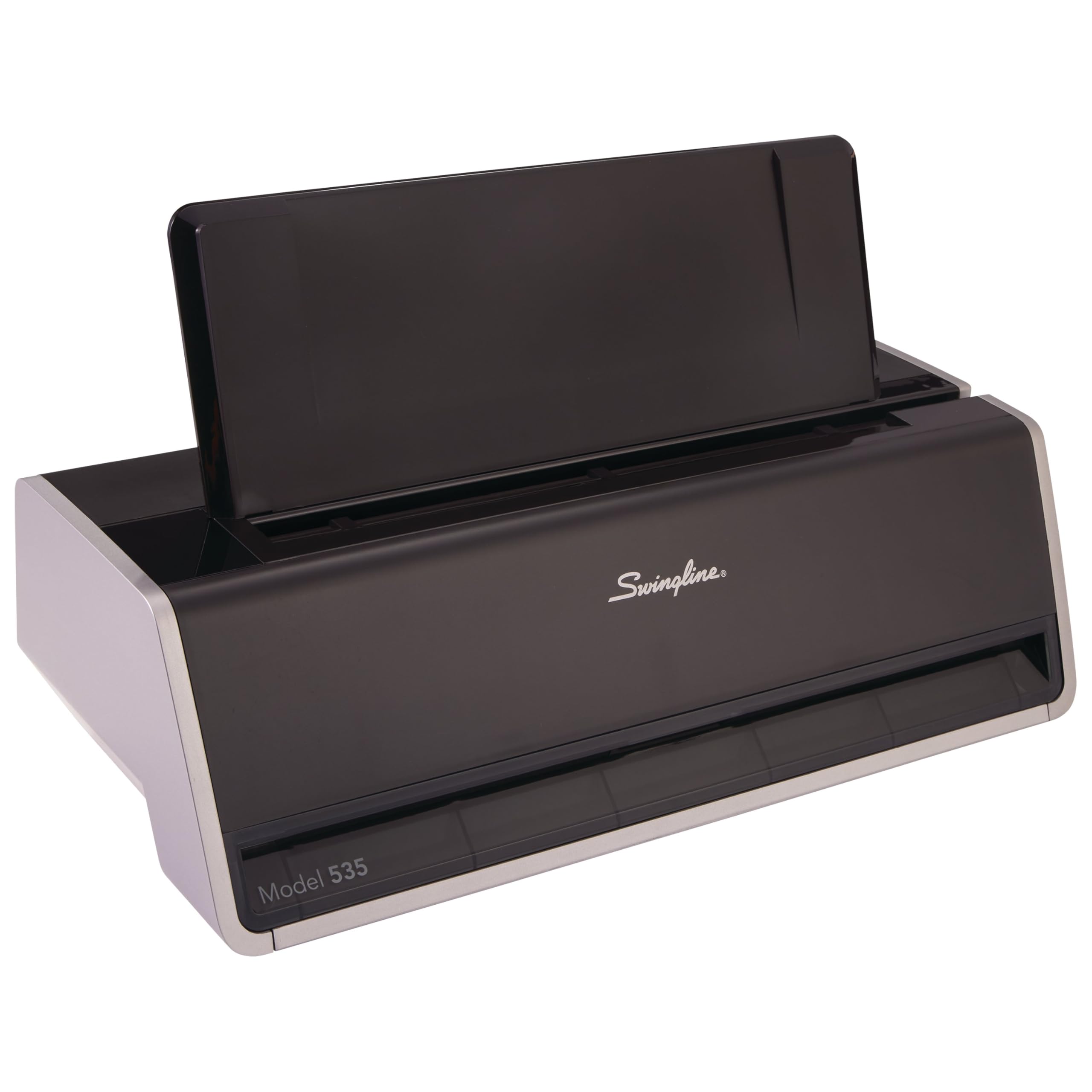
1. Swingline Electric Hole Puncher 74535, 28-Sheet, 3-Hole
Our pick — 4.5★ from 550+ verified ratings; the strongest balance of quality and price.
A 28-sheet electric punch with auto jam reverse and a touch-screen press.
This is the machine to pick if you want a punch that just works every day without drama. It takes 28 sheets per press and cuts 9/32-inch holes — that hole size is the standard 3-ring binder fit, so your pages drop straight into a normal binder. The motor runs an auto jam reverse, which means if a sheet hangs up, the punch walks it back out instead of you wrestling it free.
Operation is a capacitive touch screen — a flat panel you tap rather than a lever you drag down. Owners describe the whole job as smooth and quick, and the built-in vertical paper guide keeps your pages square so the holes line up down a thick stack. What wins people over most is how that guide lines up a run of pages: for a 180-page report punched 20 sheets at a time, the side guide held the alignment dead straight.
Two practical details earn their keep. A plastic chip tray slides out of the base and holds the paper dots until you tip them into a bin, so nothing snows onto your desk. And the whole unit weighs 6.3 pounds, which is portable enough to slide along a desktop but heavy enough to stay put. Compare that to the Officemate below at 7.6 pounds — this one is the easier machine to move when you reorganize a workspace.
Where this punch earns its spot
- 28-sheet capacity clears a full binder in a fraction of the presses a small punch needs
- 9/32-inch holes are the standard binder size, so pages drop straight into a 3-ring folder
- Auto jam reverse walks stuck sheets back out instead of forcing a pry
- Slide-out chip tray keeps the paper dots contained until you empty it
- Touch-screen press is lighter on the hand than any lever
What to weigh before buying
- The 28-sheet rating means very thick stacks still need a second press
- Noise splits opinion among owners — some find it very quiet, others loud
- The cord length is a common note; check your outlet distance before you commit
Made for the daily desk: buy this if you punch binders, reports, or school packets regularly and want the hand strain gone. It is the crowd favorite — 4.5 stars across 500+ owners — on the strength of its 28-sheet capacity, jam reverse, and slide-out chip tray.
The honest limit: a stack past 28 sheets needs a second press, and the motor is not silent — if you share a wall with someone on calls, expect them to hear it.
2. Officemate Electric 2-3 Hole Punch, 30-Sheet, Adjustable
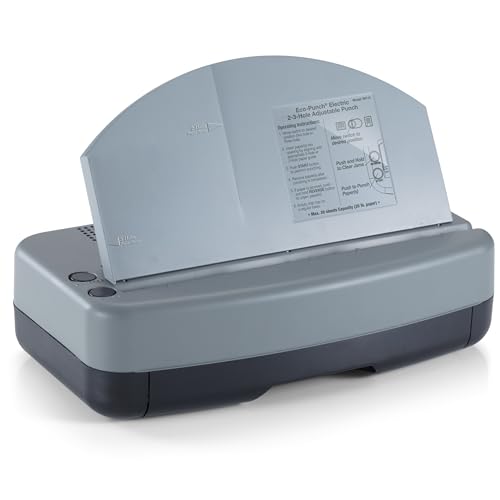
One machine that flips between a 2-hole and a 3-hole pattern at the push of a button, 30 sheets at a go.
If your filing drawer holds both 2-hole ledgers and 3-ring binders, this is the pick that saves you owning two punches. It takes up to 30 sheets per press — two more sheets than the Swingline — and you switch the hole pattern with a button rather than swapping heads. A paper guide lines pages up so the holes land in the same place across a whole run, and a reverse function backs a jammed sheet out the way it came.
The chip tray is high-capacity, and the body is built with recycled plastic components. It weighs 7.6 pounds, so it is the heavier of the two mid-range options here — expect it to sit on one desk rather than travel between rooms. Owners who punch steadily describe it as sturdy and compact for what it does, and the pattern switch is the feature that gets the most good words: flipping between the two punch types is genuinely a one-press job.
Plan around two real trade-offs. The adjustable hole head (the part that lets you switch between 2-hole and 3-hole punching) draws the most mixed feedback, and noise is the top complaint — owners who flag it describe this machine as unusually loud. Also check the 2-hole layout: buyers report it sets the holes 1.25 inches from each edge with none in the center, which suits some binders but not others.
Why it earns the slot: a 30-sheet rating and a one-button 2-hole/3-hole switch make it the most flexible punch in this group, and the reverse function plus oversized chip tray keep a long filing session moving.
The catch to plan for: the motor is loud in a shared space, and the adjustable head is the piece that divides opinion. If you need quiet above all, the fixed-head Swingline is the calmer machine; if you need 2-hole and 3-hole from one unit, this is the one that does it.
Reach for this one if: you file both 2-hole and 3-hole and want a single machine that handles both, with the biggest sheet capacity in the mid-range group.
Look elsewhere if: you work within earshot of colleagues and quiet matters more than the pattern switch — the noise here is the top complaint owners raise.
3. GBC 3230 Electric Paper Punch, 24-Sheet, 2-3 Hole

A 12.1-pound metal-framed electric punch built for constant daily use.
Buy this one if your punch never stops — a school office, a law practice, or a front desk that builds proposals all day. One push of the button punches 24 sheets, a few sheets under the Swingline’s 28 and the Officemate’s 30. It trades that capacity for staying power: the frame is metal and it weighs 12.1 pounds, by far the heaviest of the four, so it stays put on the desk instead of sliding around.
The feature that stands out is the extra-large throat, the open slot where you feed paper. That bigger mouth takes oversized sheets that a standard punch cannot fit, which matters if you work with legal-size or larger documents. A paper alignment guide keeps the holes even, and it adjusts between 2-hole and 3-hole patterns. Owners who run it hard call it reliable and jam-free, and the recurring theme is longevity — buy it once and it stays for years.
What people rave about most is simply that it never jams. The unit reliably handles its stated 24 sheets, and jams only turn up when someone overfills the stack. Two quirks are worth knowing before you commit. The 2-hole alignment leans on a painted line, which owners describe as slightly inconsistent — the 3-hole pattern is the sure thing here. And the machine has been known to stop working until it is shifted onto a flat, solid surface, so give it a firm, level spot rather than a wobbly table.
Why the office keeps buying it
- Metal frame and 12.1-pound build that stands up to constant daily use
- Reliability is what owners praise most — it takes its rated 24 sheets without jamming
- Extra-large throat fits oversized paper a standard punch cannot take
- Push-button operation is about as simple as an electric punch gets
Honest fit notes
- 24-sheet capacity sits below the Swingline and Officemate, so thick stacks need more presses
- Its 20.3-inch length and 8.4-inch height make it a big machine to find room for
- Owners note the 2-hole alignment line is less consistent than the 3-hole pattern
The volume verdict: this is the machine for a busy office that punches hundreds of pages a week and wants one purchase to last years, not one to baby.
The trade you accept: it takes fewer sheets than the mid-range pair and eats more desk space, so it is the wrong pick for a small home setup.
4. Business Source BSN64015 Electric Hole Punch, 30-Sheet
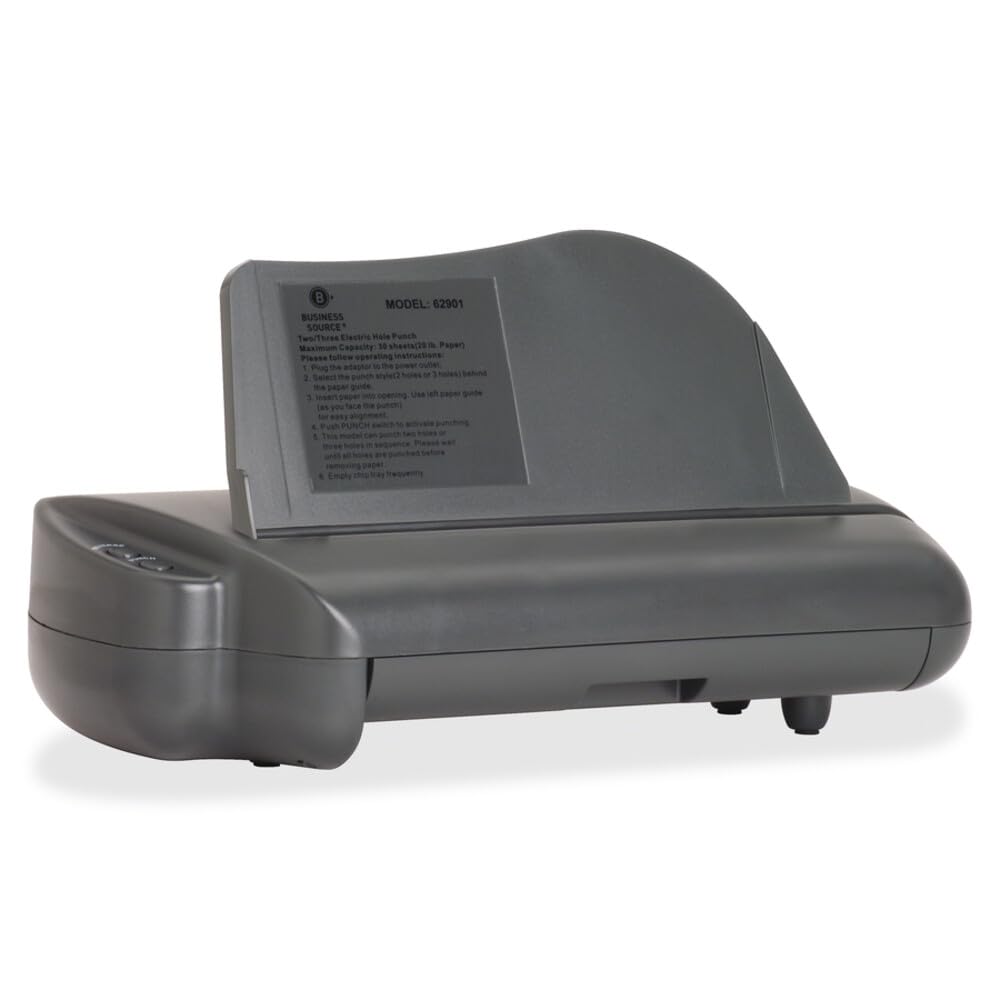
A 30-sheet adjustable 2-hole/3-hole punch for light home-office filing.
A paper guide lines pages up for consistent punches. For someone who files a few documents a week at home, that spec sheet is exactly what you want.
The catch is durability, and it is worth saying plainly rather than hiding. The quality and reliability of this machine are genuinely divided among owners — some swear by it, others have had a unit stop working after early use. There are reports of a loud screech developing after light use, and the recurring lesson is that it wants gentle handling, not paper stacks pushed past its comfort zone. One buyer summed up the frustration of an untimely failure, and the pattern across the low reviews is a machine that asks for care.
When it is running well, owners describe it as working perfectly and being a capable little puncher for a home office — a tad loud, but doing the job. The paper guide and the 30-sheet rating are real, the 2-hole/3-hole switch is handy, and it weighs 7 pounds. Buy it as a light-duty filing helper for a home desk, and it will serve. Ask it to carry an office’s daily volume and the reliability question comes back to bite.
The value read: the 30-sheet capacity and adjustable 2-hole/3-hole head mirror the pricier Officemate on paper, which is why it tempts as the budget pick — at a lighter 7 pounds it is also easy to relocate.
The honest caveat: reliability is the split here, with a share of owners reporting early failure, so this is a machine for occasional home filing rather than the office punch that never rests. If you punch daily, the Swingline or the GBC is the safer long haul.
Right for the light filer: pick this if your punching is a few documents a week at home and the 30-sheet rating and pattern switch cover everything you file.
Not for the busy desk: if the punch runs all day in an office, durability is the open question here — step up to the Swingline for the daily grind.
Understanding the Specs
Sheet Capacity
The capacity number is the most pages the punch can take in one press — 24, 28, or 30, depending on the machine. It is not a suggestion; it is the load the motor is geared for. Push a thicker stack and you risk a jam or a strained motor. Pick capacity by how you actually work: a home filer is fine at the low end, while someone binding 200-page reports wants the higher figure so fewer presses are needed.
Hole Diameter and Pattern
Hole diameter is the width of each punched hole, shown in inches — the Swingline cuts 9/32-inch holes, the standard fit for a 3-ring binder. The pattern is how those holes are arranged, either 3-hole for binders or 2-hole for other filing systems. An adjustable head lets one machine do both; a fixed head does one pattern only. Match this to the binders and files you actually use.
Jam Reverse Function
Reverse is a button that runs the motor backward to walk a stuck sheet out the way it went in. Without it, a jam means prying paper free by hand, which can tear a page or bend the punches. It is among the most useful features on an electric punch, so check for it before you buy.
Chip Tray
Every punched hole drops a small paper dot. The chip tray is the drawer that catches them so they do not spill across your desk. A slide-out, high-capacity tray means you empty it occasionally instead of chasing confetti between jobs — a small feature that decides whether a punch feels tidy or messy day to day.
FAQ
How does an automatic 3-hole punch differ from a manual lever punch?
Will punching 28 or 30 sheets damage the machine?
What hole size do these punches cut, and will it fit a standard binder?
Can these machines punch both 2-hole and 3-hole patterns?
What does the reverse function do on an electric hole punch?
How loud is an electric hole punch during operation?
Do I need a special surface for these machines to work properly?
Which is better for a busy office, the GBC 3230 or the Swingline 74535?
How much desk space will an automatic hole punch take up?
What should I do if my electric punch jams on a thick stack?
Final Thoughts: The Verdict
For most desks, the automatic 3-hole punch winner is the Swingline 74535 because it carries the highest rating in this group at 4.5 stars across 500+ owners, punches 28 sheets per press, and adds a jam reverse and a tidy slide-out chip tray — the balance an everyday office actually wants. If you file both 2-hole and 3-hole and want the biggest capacity, grab the Officemate Electric 2-3 Hole Punch with its 30-sheet rating. And for the office that punches all day and buys once for years, the metal-built GBC 3230 is the machine to reach for. If your punching is light and home-based, the Business Source BSN64015 covers the basics at the lowest tier. The clear nudge: the Swingline holds the top score here and the most owner feedback, so it is the safest first press of the button.
How We Picked
We do not accept paid placement. Every pick is matched to a real buyer and a real use-case; we do not hands-on test units.
Sources & Methodology
Specifications: manufacturer listings and product documentation. Review insights: verified customer reviews, as of September 2026. Pricing: not shown on this page (it changes often); check the current price via the retailer link.
As an Amazon Associate, KitchPrep earns from qualifying purchases. This does not affect which products we feature.
Related Guides
