
Specs are compiled from manufacturer listings and verified buyer reviews and can change over time — please confirm the key details on the product page before buying.
One stray arc while welding on a modern car or truck can turn a simple repair into a replace-every-computer disaster. That is what an auto surge protector prevents: a small box that sits across your battery posts and soaks up dangerous voltage spikes before they reach the ECM (engine control module, the car’s main computer), the TCM (transmission control module), the radio presets, or the ABS module (anti-lock brake controller). This guide covers seven 12-volt units that do exactly that job, from professional welding shields to full EMP-defense boxes, so you can pick the one that matches how you actually use your vehicle.
I’m Mohammad Maruf — the founder and writer behind KitchPrep. This guide is built by comparing the manufacturers’ published specifications and the patterns across verified customer reviews, so you get each pick’s real strengths and trade-offs instead of marketing spin.
The picks below split into two honest jobs: units built to shield electronics during welding and jump-starting, and units built for EMP-style preparedness where you cannot test the result. Read the one that matches your garage. The crowd favorite here — 4.8 stars from hundreds of owners — is the best auto surge protector for anyone who welds on a daily driver.
Our Picks at a Glance


How To Choose The Best Auto Surge Protector
An auto surge protector does one job: it gives excess electrical energy a safe path so it does not travel through your vehicle’s computer modules. The trick is buying the one built for your actual task — welding on steel, jump-starting a dead battery, or preparing for a grid-down event. Here is what to look at first.
Match the unit to the job, not the logo
A welder’s shield and an EMP shield are not the same purchase. A welder’s shield, like the Dent Fix or the Pro-Tec, is built to clamp a high-current arc spike while you have a MIG or spot welder grounded to the frame. An EMP-style box, like the Mini EMP Defender or the Faraday Defense DEFCON, is built and marketed for a completely different threat you cannot reproduce in your driveway. Buy the shield that matches the work you actually do.
Read the amperage and surge rating carefully
The number that separates a serious shield from a checkbox is the surge current rating. Look for a stated Amp figure — the Dent Fix lists 6 A at 600 volts, and the Faraday Defense DEFCON quotes 270,000 Amps total. If the listing only gives you a milliamps number, treat it as a low-draw electronic device, not a heavy-duty welding shield, and read the reviews for what owners actually did with it.
Confirm it works with your battery still connected
The entire convenience of these units is that you do not have to disconnect the battery before welding or jump-starting. The Dent Fix, the Pro-Tec, and the OTC 3386 all state explicitly that the battery stays connected. If a listing does not say that, assume you will still be pulling the negative cable — and remember that disconnecting a modern vehicle’s battery can scramble dashboard settings all by itself.
Check the install wiring before you buy
Most of these units are 2-wire or 3-wire installs that clip or bolt to the battery posts. A 3-wire unit like the Faraday Defense DEFCON adds a chassis ground wire on top of positive and negative, which is a real difference in how the box is meant to be mounted. If you are not handy, budget for someone else to run the wires — one owner’s three-second blinker test confirms full battery and correct install, so it is easy to verify once it is in.
Quick Comparison
| Model | Best For | Voltage | Item Weight | Surge / Current Rating | Amazon |
|---|---|---|---|---|---|
| Dent Fix DF-601 Surge Protector★ Best Overall | Everyday welding on steel | 600 volts | 1.6 pounds | 6 A | Amazon |
| Pro-Tec Surge SuppressorFleet-Ready | All 12V batteries, domestic or foreign | 12 volts | — | 10 milliamps max current | Amazon |
| OTC 3386 Antizap Auto Surge Protector | Protecting fuel, ABS, radio, and air bag circuits | 12 volts | 1.2 pounds | — | Amazon |
| VANAIR – 12-24V Anti ZAP | Fleet and roadside jump-starting | 12-24 volts | — | — | Amazon |
| Mini EMP Defender Vehicle Protection and Surge Shield | Compact 2-wire car or generator install | 12 volts DC | 5 ounces | Over 120,000 Amp rating | Amazon |
| Faraday Defense DEFCON Vehicle | Preparedness-focused 3-wire protection | 12-15 volts DC | — | 270,000 Amps total surge current | Amazon |
| EMP Shield Micro | Bikes, ATVs, boats, and full-size vehicles | 12 volts DC | 0.56 kg | — | Amazon |
In‑Depth Reviews
1. Dent Fix DF-601 Surge Protector
Our pick — over 4.5★ from 250+ verified ratings; the strongest balance of quality and price.
The welding shield that turns a stray arc into a shrug instead of a fried computer.
If you weld on steel with a MIG or spot welder, the Dent Fix DF-601 is the one pros reach for. It clips across your battery posts and works as a sponge for the electrical surge, so sensitive computer modules see nothing they cannot handle. The unit is rated to 600 volts — nearly the highest voltage figure in this entire roundup — and pulls 6 A while it clamps. Unlike the OTC 3386 below with its 12-volt rating, this one is clearly specced for the heavier voltage spikes that a welder can throw at a chassis. The battery also stays connected the whole time, which means no scramble to re-enter radio presets or re-teach the idle every time you pull the ground cable.
The Dent Fix DF-601 earns its spot with the highest voltage rating in this roundup: 600 volts, so it can clamp the sharper spikes a welder pushes into the chassis. It weighs 1.6 pounds in its frame — roughly a third more heft than the OTC 3386 down the list at 1.2 pounds, which is expected given the bigger internals. Buyers report the exact scenario it is built for: “Used it once so far it works, welder lost its ground on rust and didn’t fry anything.” That is the whole promise, and it holds whether you are a weekend welder or a shop pro. It also makes a functional jump-starting shield, since it clamps across the battery just as easily for that use. A lifetime warranty covers the box itself.
The honest limit is signaled right on the product: the 6 A rating means this is a low-draw clamping device, not a generically rated surge bar for every possible application. If your work is strictly electronics-heavy EMP prep rather than welding, one of the EMP-branded units further down fits those expectations better. And if you want a shield that gives you more layout room in the bay, the Vanair further down at 12.5 by 8.5 by 2 inches gives you a slightly wider footprint. But for the actual welding job, the DF-601 delivers what it says on the tin.
The spec that sells it
- 600 volts of clamp headroom — highest voltage rating in this roundup.
- Welds with the battery connected; no dashboard resets after the job.
- 1.6-pound metal build with a lifetime warranty behind the internals.
- Owners mention it surviving fire-truck, customer-vehicle, and weekend steel work.
Where it does not shine
- 6 A rating is built for welding currents, not for generic surge-bar duty.
- It ships as a plain box with an LED — no screen, no amp readout, no guesswork resolution.
Grab it if: you weld on today’s electronically controlled cars and trucks and want the whole job done without pulling the negative cable.
Think twice if: your goal is EMP-style preparedness rather than workshop welding protection — the EMP-branded units further down this list speak that language.
2. Pro-Tec Surge Suppressor
A made-in-the-USA shield that hooks up in seconds and stops the ground-cable ritual.
The Pro-Tec Surge Suppressor lets you leave the battery alone and get on with the job. It works with all 12-volt batteries, it works on domestic and foreign vehicles, and its triple protection design comes with a plain yellow housing and a status light. You connect it, the light tells you the circuit is live, and you weld away without touching the ground cable. Maximum current draw sits at just 10 milliamps (a trickle of electricity), so what it costs you in parasitic drain is effectively nothing — the box is built to watch, not to work against your battery.
Owners describe the install as the best part. The reviews sum it up as a surge protector that lets them weld on vehicles without disconnecting the battery to safeguard the system, and that same easy hook-up crops up over and over. If you have ever shorted a battery cable trying to be quick and careful at the same time, the appeal is real. It carries the Killer Tools name, a brand that keeps appearing on the same toolbox lists year after year. It is a genuine benefit on both a commercial fleet and a personal truck, since the same box works on every 12-volt battery in the yard.
Where you should pause is on the spec sheet. The Pro-Tec advertises a 10 milliamp max current figure — that is the box’s own idle draw, not a surge current rating. If you want a headline Amp rating for the actual surge clamping, look at the Dent Fix at 6 A or the Mini EMP Defender at over 120,000 Amp. The Pro-Tec is quietly about the wiring convenience and the American build, and it does that job well.
Best part: the triple-protection design keeps the battery on the vehicle and shuts down the whole disconnect-reconnect routine that risks more harm than the welding itself.
Fit check: the yellow housing is bright and unmissable in the engine bay, which is either a perk or a color mismatch depending on your taste.
Why it earns its slot: the simplest hook-up in the group and the only unit stating a made-in-the-USA build.
skip it if: you need a published surge-current Amp figure for the welding job — the Pro-Tec leaves that unstated.
3. OTC 3386 Antizap Auto Surge Protector – Voltage Spike Protection, 12 Volt

The technician’s clamp that watches over fuel, ABS, and air bag circuits at once.
OTC built the Antizap to plug straight into the vehicle’s electrical circuit and then sit there deciding what to do with anything over-volt. When a spike comes through, the unit automatically clips it to a level the onboard computers can survive. That matters because the protection list is specific: fuel gauge, ABS brakes, radios, tape and CD players, car alarms, SRS air bags, LED instrumentation, EFI fuel, and climate control systems. If you have ever had one weird dashboard glitch after a weld, this is the box that stops the next one. The design also covers welding arc, MIG, and TIG, so spot welding and stick work are both in scope.
The OTC 3386 Antizap is the lightest box in the roundup below the Dent Fix’s 1.6 pounds — at 12 volts and 1.2 pounds — and just above the 4.3-ounce-feel of the compact Faraday Defense unit further down. Owners describe it as an instant fix for a specific gremlin: an EMI-heavy (electromagnetic interference, electrical noise) 2001 Dodge truck whose torque converter was locking and open up due to voltage surges from headlights, A/C, and alternator was returned to normal as soon as the Antizap went across the battery. That is the kind of electrical noise problem almost no handheld meter can catch. A certified auto technician who used it on the job for years bought one for personal use after retirement.
The one year limited warranty is shorter than the lifetime backing on the Dent Fix, and the voltage ceiling is lower at 12 volts compared to the Dent Fix’s 600 volts. That is not a defect — the two units just watch different parts of the problem, and the OTC is tuned to the 12-volt automotive system exactly. Its value proposition is the breadth of circuits it protects rather than any one headline Amp number.
What makes it stick
- Explicitly protects fuel, ABS, radio, alarm, air bag, LED, EFI, and climate circuits in one small box.
- Handles welding arc, MIG, and TIG — three welding styles covered by one clamp.
- Light enough at 1.2 pounds to keep tucked in a road kit.
Where it taps out
- One year limited warranty rather than a lifetime commitment.
- 12-volt rating is purpose-built for automotive DC, not for HVDC or home-line work.
Reach for this if: you want one small box that watches the widest list of sensitive circuits on a 12-volt vehicle.
Look elsewhere if: you need lifetime warranty coverage or want a shield rated well above 12 volts.
4. VANAIR – 12-24V Anti ZAP

The industrial shield that covers both 12V cars and 24V trucks from one hookup.
The Vanair Anti ZAP is built for the bays that see everything — mechanic shops, fleet yards, and roadside technicians who do not get to pick what shows up. The headline feature is the 12-to-24-volt span. Most auto surge protectors only rate themselves at 12 volts, which means a 24-volt truck is off the plate. The Vanair covers both, and it works with most jump starters and booster packs, so roadside assistance on a frozen morning is the exact scenario it is designed for. It also states protection against voltage spikes and reverse polarity damage — the second one being what saves you when someone hooks the clamps up backwards.
The physical footprint is the other notable detail: 12.5 by 8.5 by 2 inches, which is a wider face than the Dent Fix at 12 by 10 by 3. That extra width in the Vanair layout actually gives you a flatter, less boxy mounting surface if the box is going to live inside a service cab or on a roadside kit shelf. Metal construction and one industrial-style unit round out the spec sheet, and the maker stands behind it with a manufacturer warranty.
The honest caveat — and it comes from the reviews — is a packaging gap. One buyer received theirs with the clamps missing from the box, which is a genuine supply-and-handling miss rather than a design flaw. That kind of thing happens in transit and to any brand. One fleet owner reports using these across multiple vehicles for battery welding work with no ECM damage. If you buy it, open the box and count the pieces before the job starts.
Why it fits fleet bays: the 12-24V span is the differentiator — most picks stop at 12 volts, and a mixed yard can be covered with one SKU.
Unpack first: the very reasonable scare is a set that arrives without its clamps, so confirm what is in the box before a job is on the lift.
Made for: mobile mechanics, roadside techs, and fleet operators who jump both 12V cars and 24V trucks.
Not the fit if: you only need a single-service welding shield for one personal vehicle — the extra voltage range is wasted on a one-truck garage.
5. Mini EMP Defender Vehicle Protection and Surge Shield 12V DC car Protector

A palm-sized EMP box that claims the biggest Amp number in the whole roundup.
The Mini EMP Defender is where the spec sheet gets loud. It carries an over 120,000 Amp rating — bigger than the Faraday Defense DEFCON’s 270,000 Amp figure only once you get to that unit, and bigger by orders of magnitude than the 6 A on the Dent Fix. It also states component testing to meet MIL-STD, RoHS, UL, IP68, ISO, and JASO standards, and it arrives with a 2-wire install plus status indicator lights. Waterproof and offered in the smallest housing of the group at 5 ounces, it is designed to go places a bulkier shield cannot — tight battery trays, under-seat cavities, or on a generator. The 2-wire layout means no chassis ground wire to route, which simplifies the install but also means it relies on battery posts alone.
Owners confirm the small size is the selling point in practice. A Landrover install took around five minutes and reached both battery terminals with the two leads; a generator user attached it with easy-to-follow instructions and likes having the extra protection against solar flares and other situations. The tests are simple to read — both lights blink steadily at the three-second mark to confirm full battery and correct install — and one owner’s non-handy, third-party install still ran about 20 minutes.
The honest question these devices always raise for careful owners is “does it actually work?” The manufacturer claims the standard is met, and owner notes back up the install and the light behavior, but no box in this category can be functionally verified against an EMP event without a lab. If you want verifiability, the welding-rated picks above are the ones you can watch do their job on a real spike. If you want a prepared vehicle with a small, quiet, waterproof box, this one puts in the hours.
Why owners choose it
- Over 120,000 Amp rating — far larger than any welding-rated pick on this list.
- 2-wire install with status lights; a 3-second blink test confirms correct hookup and full battery.
- IP68 waterproof and 5 ounces — fits places a bigger shield cannot.
- MIL-STD, RoHS, UL, IP68, ISO, and JASO component testing stated by the maker.
The fine print
- No chassis ground wire in the 2-wire layout — some riskier installs prefer the 3-wire path.
- Like every EMP-class unit here, real-world effectiveness against an actual event is not testable in your driveway.
Best for: buyers who want the most surge-current punch in the smallest, most weatherproof box they can bolt into a vehicle or portable generator.
Better call if: you want proof you can watch during a spike on a real welding job — the Dent Fix above shows its work.
6. Faraday Defense DEFCON Vehicle – EMP Protection 12 Volt DC for Auto and Truck

A three-wire box built for the EMP conversation rather than the welding bench.
This is where the spec numbers jump again. The Faraday Defense DEFCON quotes 270,000 Amps total surge current and an energy rating above 2,000 Joules total. It runs on 12-15 volts DC with a peak 9 milliamps of idle consumption — so it can sit connected for years without noticeably draining the battery. Turn-on speed is stated under 1 nanosecond, which is roughly how long it takes the box to react once a spike arrives. Wires are 36 inches long and include positive, negative, and ground, which is the 3-wire layout that some careful owners prefer over the 2-wire Mini EMP Defender up above. Overall dimensions are 4.5 by 3.375 by 1.875 inches, so it fits a small under-hood pocket without much fight.
Reviews here tend to be about intention rather than testing. Buyers install it for vehicle EMP and CME-style preparedness, appreciate the easy installation, and openly acknowledge they will only know if it works if the event ever happens. A setup like this is honest in its own way: the buyer is paying for the *chance* of protection in a scenario no owner can verify. The green light and the negligible idle draw get noted, and the 3-wire positive-negative-ground wiring gives you a real chassis path that the 2-wire units skip.
The one caveat worth flagging comes from a buyer who talked to a dealer service manager and was told aftermarket electronic add-ons can complicate manufacturer warranty coverage on some vehicles. That is not a Faraday Defense-specific flaw — it applies to any powered box you bolt to a modern vehicle — but it is the practical question to raise before installing this on a car still under warranty. Do your own homework on your specific vehicle.
The real pull: 270,000 Amps of stated surge handle and a sub-1 nanosecond response time — figures that dwarf the 6 A on the welding-rated Dent Fix.
Straight talk: like every EMP-class unit, there is no test you can run to confirm it works, so buy it for the preparedness posture rather than a measurable result.
Good fit for: buyers who want maximum stated surge numbers and a 3-wire positive-negative-ground install in a compact under-hood package.
Check first if: your vehicle is still under manufacturer warranty — an aftermarket add-on like this may complicate coverage, so confirm with your dealer.
7. EMP Shield Micro – Vehicle EMP Protection 12 Volt DC for Car, Truck, and Motorcycle
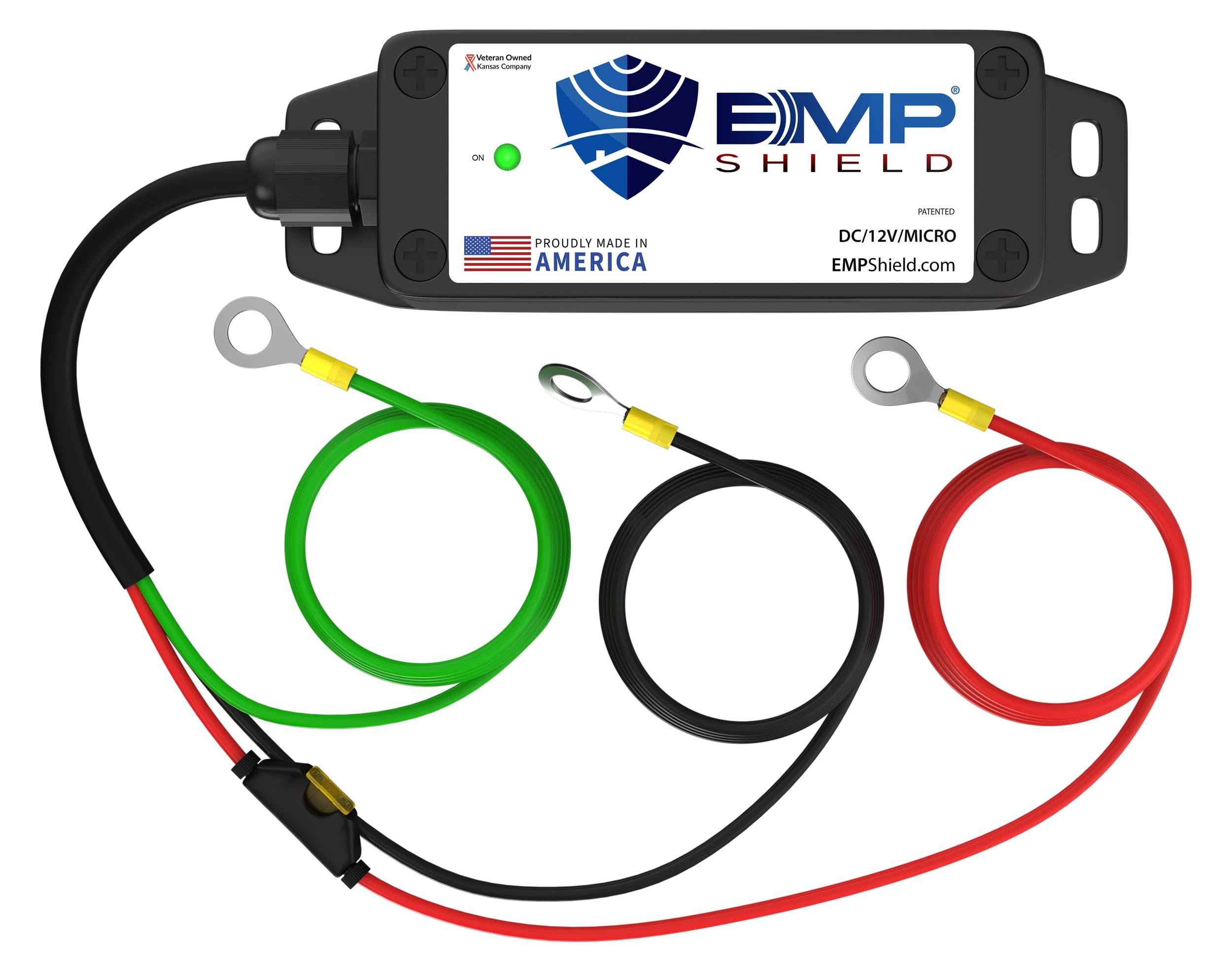
The smallest body in the roundup — sized for whatever you actually ride.
The EMP Shield Micro is the tiny one: 3.2 by 1.12 by 1.06 inches in a stand-alone black housing that weighs 0.56 kilograms. What that physical size opens up is the vehicle list. It is stated for full-size vehicles, motorcycles, ATVs, boats, and 4-wheelers, so a rider with a bike and a truck does not need two separate units. It runs on 12 volts DC and protects against EMP, CME (coronal mass ejection — a sun belch that can disrupt ground electrical systems), and lightning surges. It is the one box in this roundup whose stated coverage list deliberately stretches past four-wheeled automotives.
Installation is the standout experience. Owners describe a black-wire-to-negative, red-to-positive, green-to-chassis-ground wiring pattern that is fully spelled out in the included guide, and the green LED confirms the connection. Most installs run about five to fifteen minutes: pinch the box onto the fuse-box lid with the sticky mount and route the leads. One owner’s run-through was quick enough that the wiring itself took longer than mounting the unit. That is a friendly duty cycle for someone who does not work in a shop for a living.
The mixed signal you need to know about is reliability. Some customers note the green LED stays on and the box has run without loosening or wear over months of periodic checks, while others say they cannot verify the protection outside an actual event. That split is honest. Like every EMP-class unit here, the Micro cannot be functionally proven in your driveway — you are buying the wiring, the built-in LED confirmation, and the confidence that comes with knowing it is installed. If you want a box you can actually watch clamp a spike, the welding-rated Dent Fix up top is the pick for that job.
Good reasons to buy
- Covers cars, trucks, motorcycles, ATVs, boats, and 4-wheelers — the most expansive vehicle list in this roundup.
- Small 3.2 x 1.12 x 1.06 inch housing that hides under a seat, on a fuse box, or behind a fairing.
- Clear 3-wire color-coded install with green LED confirmation.
Honest trade-offs
- Effectiveness against EMP or solar flare is not testable in your driveway, only in a real event.
- The smaller housing is the trade-off — there is simply less internal metal mass than a welding-shield box like the Dent Fix.
Consider it if: you want one compact box that speaks to motorcycles, ATVs, boats, and full-size vehicles alike.
Pick something else if: you weld regularly and need a shield rated for welding surges rather than EMP-style events — the Dent Fix or Pro-Tec fit better.
Understanding the Specs
Voltage rating and why it matters
Voltage is the electrical “pressure” a protector is designed to clamp down. A 12-volt unit is built for the 12V automotive system and the spikes that ride along with it, while the Dent Fix DF-601 lists a 600-volt rating because a welder can push far sharper spikes into the chassis than a jump start ever will. Match the voltage of the unit to the work being done. Welding shields tend to sit higher on this number than plain jump-start shields.
Surge current and clamp time
Surge current is the Amp figure that describes how much energy the box can swallow in a burst before anything downstream notices. The Mini EMP Defender claims over 120,000 Amps, and the Faraday Defense DEFCON quotes 270,000 Amps total, both far above the 6 A stated by the Dent Fix. Clamp time — how fast the box reacts — is measured in nanoseconds at the extreme end, and the DEFCON lists under 1 nanosecond typical. Bigger surge numbers and faster clamp times describe a unit built for a broader event, not a better welding shield.
2-wire versus 3-wire install
The Mini EMP Defender and the EMP Shield Micro run on a 2-wire or straight-to-chassis layout, which means one lead per battery post plus a chassis ground in the Micro’s case. The Faraday Defense DEFCON ships with positive, negative, and ground wires, which is the 3-wire pattern some careful owners prefer because it gives the box a real chassis path. Both layouts work when installed per the included directions. The color code across the group is consistent: red to positive, black to negative, green to chassis.
Current draw when idle
Every unit here sits connected to the battery, so idle consumption matters. The Pro-Tec is described as drawing 10 milliamps at maximum current — effectively nothing. The Faraday Defense DEFCON notes 9 milliamps typical. Numbers in the milliamp range will not drain a healthy car battery overnight, which is why these boxes can live under the hood for months without a trickle charger. Anything in the Amp range at idle would be a different story, so read that spec before you commit.
FAQ
Will an auto surge protector damage my vehicle’s computer if I install it wrong?
Do I need a 12V or a 24V unit for my truck?
Can I weld on my vehicle with the battery still connected if a surge protector is installed?
How long does an auto surge protector last?
Does an auto surge protector drain my battery?
What is the difference between a welding surge protector and an EMP shield?
Can I run one auto surge protector on both a car and a motorcycle?
Will adding an auto surge protector void my vehicle’s factory warranty?
Do I still need to disconnect the battery for jump-starting with one of these installed?
Are the lights on these units reliable indicators that they are working?
Final Thoughts: The Verdict
Across the board, the auto surge protector winner is the Dent Fix DF-601 because it delivers the highest voltage rating in the group at 600 volts and the crowd backing that makes it easy to trust — a 4.8-star reputation from hundreds of owners and a lifetime warranty behind the internals. If you want the widest circuit coverage on a 12-volt system, grab the OTC 3386 Antizap — its protection list is the longest in this roundup. And for the preparedness-minded owner who rides, boats, or drives multiple vehicles, the EMP Shield Micro is the one to reach for thanks to its car, motorcycle, ATV, and boat coverage in the smallest housing here.
How We Picked
We do not accept paid placement. Every pick is matched to a real buyer and a real use-case; we do not hands-on test units.
Sources & Methodology
Specifications: manufacturer listings and product documentation. Review insights: verified customer reviews, as of September 2026. Pricing: not shown on this page (it changes often); check the current price via the retailer link.
As an Amazon Associate, KitchPrep earns from qualifying purchases. This does not affect which products we feature.
Related Guides
