
Specs are compiled from manufacturer listings and verified buyer reviews and can change over time — please confirm the key details on the product page before buying.
If you own a home with a water heater, a washing machine, or any pipe older than a decade, the question is not whether you will see a leak — it is whether you will be home when it happens. An auto shut-off water valve solves exactly that: a sensor sitting on the floor notices water collecting and a motorized valve closes your main supply before a puddle becomes a flooded basement. The picks below are the ones that close reliably, and this guide explains who each one suits.
I’m Mohammad Maruf — the founder and writer behind KitchPrep. This guide is built by comparing the manufacturers’ published specifications and the patterns across verified customer reviews, so you get each pick’s real strengths and trade-offs instead of marketing spin.
You will learn which valve type suits your plumbing, how wireless systems behave in a power outage, and which kits cover a whole house versus a single appliance.
Our Picks at a Glance

How To Choose The Best Auto Shut-Off Water Valve
A leak shutoff system is really three parts working together: a sensor that tastes water, a controller that decides what to do, and a valve that physically stops the flow. Buyers usually get the sensor and controller right and then discover the valve will not fit their pipe. So start at the valve and work backward.
Measure your valve before you shop for an actuator
A retrofit actuator — the type that clamps over the handle you already own — only fits certain ball valves. The Zooz Titan, for example, requires a standard 0.5″ to 1.25″ ball valve, 3″ of clearance from the valve center to each side along the pipe, at least 1.25″ between the valve handle and the pipe, and at least 1″ between the pipe and the wall. If those numbers do not match your setup, an inline replacement valve is the better route.
Decide between an inline valve and a valve robot
An inline kit replaces a section of pipe with its own motorized ball valve, so the installer cuts and reconnects plumbing. A valve robot sits on top of the existing handle and turns it, which means no pipe cutting at all — the Bulldog, for instance, installs over the valve you already have. The trade-off is clearance: robots need room around the handle, inline valves need a plumber.
Count the places water can escape
A water heater pan is one spot. A washing machine supply hose is another. Dishwashers, fridges with ice makers, and bathroom fixtures add more. Controllers differ in how many sensors they accept — the iSpring LS43 accepts up to 8 sensors, while some kits ship with 3 and give you no headroom. More sensor ports means you can protect the whole house later without buying a second controller.
Quick Comparison
| Model | Best For | Valve Type | Pipe Size | Power / Backup | Amazon |
|---|---|---|---|---|---|
| YoLink Kit: Controller + EVO + 3 Sensors + Hub★ Best Overall | Whole-house protection with offline shutoff | Retrofit EVO operator (no pipe cutting) | Existing valve | Battery: 5-yr sensors, 2-yr valve controller | Amazon |
| U.S. Solid Motorized Ball Valve Kit, 3 SensorsBest Value | Budget whole-house inline protection | Inline 304SS motorized ball valve | 3/4″ | Corded electric | Amazon |
| YoLink 0.75″ Brass Ball Valve + Valve ControllerBest Long-Range Signal | Basements and meter pits with weak Wi-Fi | Inline brass motorized ball valve | 3/4″ | 12V adapter + 4 AA backup (~2-yr battery) | Amazon |
| iSpring LS43 Leak Detector System | Expanding coverage up to 8 sensors | Inline 3/4″ NPT shut-off ball valve | 3/4″ NPT | 5V / 1A transformer | Amazon |
| Zooz Z-Wave Long Range 700 Series Titan ZAC36 | Stubborn valves on a Z-Wave network | Retrofit actuator over existing ball valve | 0.5″ – 1.25″ ball valves | Plug-in power supply | Amazon |
| FloodStop Water Heater Leak Detector Kit | Water heater pan protection | Inline motorized ball valve | 3/4″ NPT MIP x FIP | Wall adaptor 115AC/9VDC with battery backup | Amazon |
| EVC200-HCSML The Bulldog Valve Robot | Rigid retrofit for larger ball valves | Retrofit valve robot (no plumbing) | Up to 1.5″ ball valves | 12V AC adapter | Amazon |
| Frizzlife LP365 Smart Water Monitor | Leak detection down to tiny drips | Inline ultrasonic monitor + shutoff valve | 3/4″ and 1″ | Plug-in with AAA batteries included | Amazon |
| FloodStop Washing Machine Leak Detector Kit | Upstairs and second-floor laundry rooms | Inline brass ball valves with motor | 3/4″ 90° | 115AC with 4 AA battery backup | Amazon |
| Moen 900-001 Flo Smart Water Shutoff + 3 Detectors | Whole-home monitoring with usage tracking | Inline smart shutoff with MicroLeak testing | 3/4″ to 1-1/4″ | Corded electric, Wi-Fi required | Amazon |
In‑Depth Reviews
1. YoLink Water Shutoff Kit: Controller + EVO + 3-Pack Sensors + Hub
Our pick — over 4.5★ from 500+ verified ratings; the strongest balance of quality and price.
The kit that keeps closing your main even when the power and the internet are both gone.
Start with the number that decides this whole category: D2D, short for device-to-device pairing. Once your leak sensors and the valve controller are linked directly to each other, they talk without the hub, without your router, and without utility power. Water hits a sensor, the valve shuts. That single behavior is why this bundle takes the top slot — the review pages are full of owners describing exactly that sequence after a real pipe burst, with shutoff landing in seconds. The bundle itself covers 6 pieces: 3 water leak sensors, 1 smart valve controller, 1 EVO valve manipulator, and 1 YoLink hub.
The EVO is the part most people overlook, and it is the reason you never touch a pipe. It clamps over your existing valve handle and turns it mechanically, so there is no cutting, no soldering, and no plumber invoice. The valve controller runs about 2 years on batteries or can be powered directly with the batteries acting as backup — so an outage does not disarm your protection. The leak sensors stretch to up to 5 years of battery life. That is a 2.5x gap in favor of the sensors versus the controller, and it tells you which part you will be swapping first.
Range is the other quiet advantage. YoLink uses LoRa, a low-frequency radio built for distance rather than speed, and the spec sheet claims up to 1/4 mile between devices and the hub. That is why a sensor in a basement, an attic, or a detached storage room still reports. Alerts arrive by SMS, app, and email, with Critical Alerts for iOS users, and each account includes 5 free SMS per month — this kit lands you 30 free SMS across its 5 devices. Alexa, Google Assistant, IFTTT, and Home Assistant all tie in.
What earns the top spot
- Pairs sensors straight to the valve, so shutoff still fires during a power cut or dropped Wi-Fi
- Zero plumbing: the EVO operator mounts over the valve you already have
- Sensor batteries rated up to 5 years, valve controller up to 2 years on battery or direct power
- LoRa radio stretches up to 1/4 mile, which covers basements and outbuildings
- Free SMS, app, and email alerts with no subscription attached
Worth knowing before you buy
- Five devices means one shared SMS allowance — larger homes will want more sensors
- Pairing takes patience: link devices, then give the system a minute to settle
- Install placement matters — avoid standing water and condensation unless the unit is rated for it
Pick this if: you want one box that protects the whole house and keeps working when the grid does not.
Think twice if: your valve handle sits in a cramped cabinet with no room for a clamp-on operator.
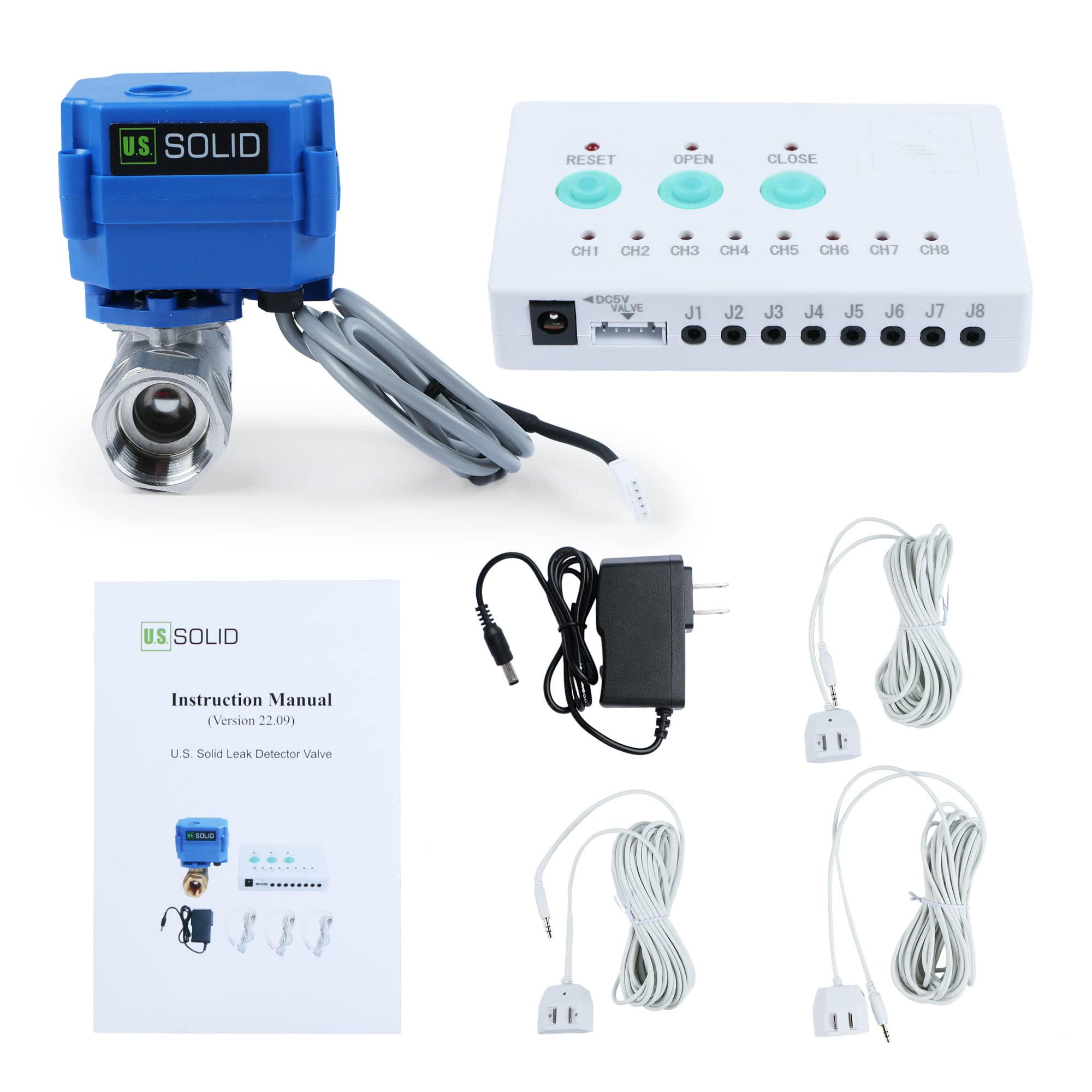
2. U.S. Solid Water Leak Detector with Auto Shut-Off Valve & Sound Alarm, 3/4″ NSF Certified 304SS Motorized Ball Valve with 3 Sensors
A stainless-steel valve, three long-cabled sensors, and a loud alarm for the price of a mid-tier DIY fix.
If you already know your main pipe is 3/4″, this is the most protection per dollar on the list. The valve body is 304 stainless steel and carries an NSF certification for potable water, meaning it is rated to sit on the line you drink from — not a small detail when other brass valves in this category have drawn complaints about exactly that. It also rates IP65, a waterproofing standard that means the housing shrugs off spray and splashes, and the valve is built to a 50,000-hour lifespan figure.
The three sensors are the daily practicality here. Each one runs on a 20 ft cable, so you can drop one behind the laundry sink, one beside the water heater, and one under the dishwasher without buying extensions. Total reach is listed as 20 feet. When water touches a sensor, the controller closes the motorized ball valve and a built-in sound alarm beeps continuously until you clear the leak and reset the system — a deliberate design so a warning never scrolls past unnoticed.
Real-world numbers from the field: buyers report the system isolates the water supply within 4-5 seconds once a sensor gets wet, and one owner who fitted it after installing a new water softener with cheap plastic fittings confirmed it by tripping it twice — once on purpose, once by accident during a pipe modification. Another ran it on a home brewing rig with NPT-to-GHT adapters to auto-stop filling a hot liquor tank. The honest catch is that this is a corded system: the controller needs wall power, so there is no battery backup if the outlet dies. An occasional unit also arrives looking used, so inspect the box on arrival.
Where the money goes: a potable-water-rated stainless valve, three 20 ft sensors, and a sound alarm that keeps beeping until you deal with it — for less than half of what the premium kits cost.
The honest trade: wall power only. A multi-hour outage takes the whole system offline, so this suits homeowners who want dependable everyday protection rather than outage-proof insurance.
Right call for: a 3/4″ main and a buyer who wants stainless, certified, and loud without paying premium money.
Wrong call if: your power goes out often, or your main is an odd pipe size that 3/4″ will not thread onto.
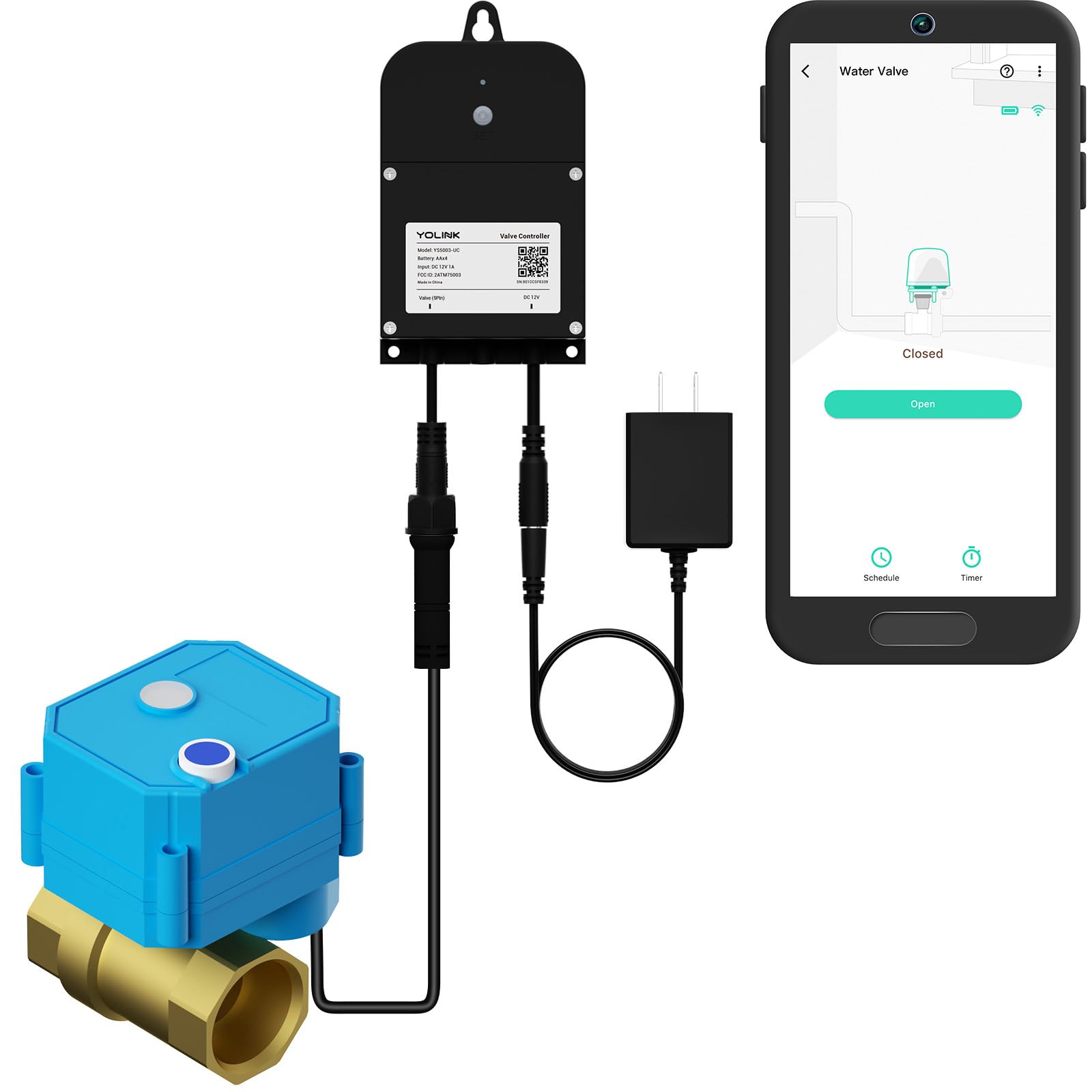
3. YoLink Water Shutoff Kit: 0.75″ Brass Ball Valve + Valve Controller
For the mechanical room at the far end of the property, where Wi-Fi gives up and a brass valve takes over.
Quality is what wins people over here — it is the single most-discussed aspect in the reviews, and the brass body explains why. This is an inline replacement rather than a clamp-on retrofit: the kit ships with a 0.75″ brass motorized ball valve plus the Valve Controller 2, and the same valve family is offered in 1/2″, 3/4″, 1″, and 1-1/4″ if your line runs wider. It pairs with YoLink leak sensors for the same offline D2D behavior as the top pick — the sensors and controller close the valve between themselves with no internet in the loop, so protection continues through a typical outage.
The connectivity spec is the headline: LoRa wireless rated up to 1/4 mile open-air. That is the figure that makes this kit the choice for installs a router cannot reach — basement meter pits, mechanical closets, and outbuildings. Power runs both ways: a 12V adapter for constant operation plus 4 AA alkaline batteries for backup, with battery-only runtime rated up to about 2 years in typical use. App control and alerts work with Alexa, IFTTT, and Home Assistant, but the YoLink Hub is required for every one of those cloud features, so budget for it if you do not own one.
One honest split runs through the reviews, and it is worth taking seriously. Several owners use this on irrigation lines with no concern at all. Others pushed back hard on using the brass model for drinking water, arguing it lacks NSF/ANSI 61 or 372 certification and flagging lead-content worries in brass valves generally. YoLink has since added stainless steel valve options aimed at potable lines. If this valve is going on your main household supply, that stainless variant is the version to seek out. There is also a sensitivity quirk — the sensors are keen enough that steam from a shower has tripped one.
The long-range case: a quarter-mile LoRa link plus a 2-year battery fallback makes this the most dependable pick for a valve that sits nowhere near your router.
Read before you install: this brass body is the model to think carefully about on a potable main line — the stainless YoLink valve is the fit for drinking water.
Reach for this if: your shutoff valve lives in a basement or outbuilding where Wi-Fi dies, and you are plumbing irrigation or a line you can serve with the stainless variant.
Look elsewhere if: you want a certified potable-water valve in brass, or you refuse to buy into a required hub.
4. iSpring LS43 Water Leak Detector Alarm System, Automatic Shut-Off Valve and 2 Detection Sensors

Two sensors in the box, eight slots on the controller — grow the protection as you find the risky spots.
Most kits in this price band lock you into the sensors they ship with. The LS43 does the opposite: the controller accepts up to 8 water detection sensors, and 2 come included. That matters if you are buying for a house with a dishwasher, a washer, a basement, and a couple of bathrooms, because you can move in stages instead of replacing the whole brain later. The valve itself is a 3/4″ NPT automatic shut-off ball valve, paired with a sound-and-light alarm module and a 5V / 1A transformer.
Reliability is the trait owners keep coming back to, and the specifics are telling. A wired sensor sits on the main line while a standalone wireless sensor can go wherever it is needed — one owner parked the wireless unit beside a garage water heater and left the wired one on the main. Real-time phone alerts fire at the same time the indoor alarm sounds, and shutoff lands in seconds. The other strength owners flag is restraint: this system triggers on standing water, not on humidity spikes or rain, so you are not resetting it after every shower.
The trade-off is in the box contents. Two sensors is a starting point, not a whole-house plan, and every extra sensor is another purchase. You also have a 1-year warranty with lifetime support from iSpring rather than a longer manufacturer term — note if you expect this to sit on a pipe for a decade. Physically the controller is compact, at 4.5″ by 1″ by 3″, so it tucks onto a wall beside the valve without a shelf.
Built for: the homeowner who wants to start small and add sensors room by room up to eight.
Skip if: you need outage-proof operation — this controller relies on its 5V transformer and has no battery fallback.
5. Zooz Z-Wave Long Range 700 Series Titan Water Valve Actuator ZAC36

The actuator that muscles a handle nobody has been able to turn by hand in years.
Torque is the reason to pick the Titan over a generic retrofit. The motor is built to open and close even the most stubborn ball valve, and it calibrates to your individual valve on install — stepping up power each cycle until the handle moves, rather than slamming the same force at every valve. Functionality is the aspect owners discuss most by a wide margin, and the pattern holds: the actuator keeps closing the line, even on handles that had gone stiff from years of disuse. It runs on plug-in power and mounts with no tools in a few minutes.
Compatibility is where you need to do homework, and Zooz is refreshingly direct about it. You need a standard 0.5″ to 1.25″ ball valve and real clearance: 3″ from the valve center to each side along the pipe, at least 1.25″ between the handle and the pipe, and at least 1″ between the pipe and the wall. Measure first. On the smart side, the Z-Wave Long Range protocol and Z-Box compatibility are the headline, with SmartThings, Hubitat, Ring Alarm, and Home Assistant all on the supported list — but the hub is sold separately, and if your controller is not on that list, check with Zooz before ordering.
Two real wrinkles show up in owner experience. Connectivity draws mixed feedback — some report a clean pairing with Ring or Home Assistant, others hit friction getting the network to talk to the unit. And the included leak probe has a short cord and a plug that fights its own slot, so it is only useful with the valve sitting close to the floor. The fix is obvious: buy separate wireless leak sensors and let Z-Wave trigger the Titan, which is how the system is meant to run at full strength anyway. Register within 30 days and the manufacturer warranty stretches to 5 years.
Why it beats a generic retrofit
- Calibrates to each valve individually, ramping power up until the handle turns
- Strong enough to close handles that had gone stiff from years of neglect
- Tool-free mount in minutes, and it is rated for outdoor use too
- Works offline with the probe attached directly, no hub needed for basic shutoff
- 5-year extended warranty when registered within 30 days
Where it asks more of you
- Clearance rules are strict — 3″ each side, 1.25″ above the handle, 1″ off the wall
- Hub compatibility is mixed; not every controller pairs smoothly
- The bundled leak probe cord is short and its plug fit is tight
Fits: any Z-Wave home with a 0.5″ to 1.25″ ball valve that has stiffened up, and enough clearance around the handle.
Doesn’t fit: non-Z-Wave setups, tight cabinets that fail the clearance measurements, or anyone expecting the included probe to cover a distant floor.
6. FloodStop Water Heater Leak Detector Kit, 3/4″ NPT MIP x FIP

The original water heater guardian — the sensor sits in the pan, and the valve slams shut.
Buy this one for a specific job: the drain pan under a water heater. The mechanics are refreshingly simple. The sensor rests at the base of the heater, the valves stay open while everything is dry, and the moment water touches that sensor the motorized ball valve closes and an alarm sounds. There is no app to configure, no hub to buy, and no Wi-Fi to drop. The alarm is rated at 87 dB, which carries through a closed basement door.
What makes this kit worth its premium over the lookalikes is what owners have done with it over time. The controller runs a monthly self-test on its own, so you are not the only one checking the system works — and it holds battery backup in case the wall power blinks. The valve and alarm contacts can also be wired into a home security system for remote signalling, which is exactly what some owners did, running the kit at the main with sensor locations spread across the house. Very sensitive is the recurring phrase: a single drop has closed the whole house for some owners, which is the point.
Two things to know. First, the sensors connect in series — a limitation that has owners running extra sensors in parallel to work around it, so plan your sensor layout before you commit. Second, nothing lasts forever on a hot pipe. One long-term owner replaced a unit after a decade when the electronics showed heat damage from an attic install and recommended checking these as they age, especially in hot spaces. Both are maintenance notes, not reasons to choose differently.
Why it earns its keep: a hardwired, hub-free system that self-tests every month, alarms at 87 dB, and has been trusted at the water main for years by owners running expanded sensor networks.
Worth planning around: sensors wire in series, so if you want several rooms covered, decide the arrangement up front rather than discovering the limit halfway through.
Choose it for: a water heater pan, an A/C condensation line, or a main shutoff where you want a wired, alarm-driven system with zero subscription and zero app.
Not the pick if: you need app control and remote shutoff from your phone while travelling.
7. EVC200-HCSML The Bulldog Valve Robot, Z-Wave Water Valve, Valves up to 1.5″

The robot that clamps onto the biggest valves on the list and turns them like they were never stiff.
Watch how it holds on. Where some competitors grip a valve with hose clamps that slip under load, the Bulldog bolts rigidly to the valve body with adjustable pins — a difference that shows up when the motor fires on a valve that has not moved in a decade. The motor is high-torque and toggles open and close in approximately 18 seconds, which is slow enough to avoid hammering the pipes and firm enough that owners describe being unable to stop it by hand. Valve support runs to ¾”, 1″, 1.25″, and 1.5″ ball valves, so it handles mains larger than the 3/4″ units on this list.
The Z-Wave ecosystem is deliberately open. EcoNet, the maker, does not lock you into a proprietary sensor — owners pair it with standard Z-Wave and Zigbee leak sensors from other brands and the automation still fires. SmartThings, Hubitat, Ring, Wink, Nexia, Control4, Universal Devices, and Honeywell all appear on the compatibility list, and it pairs in around 2 minutes with a typical install in 10 to 15. The wireless link is rated up to 30M. There is no plumbing to cut, because the unit mounts over the valve you already own, and a clutch pin and knob give you manual override if you ever need to turn the water back on by hand.
The catch is that this is a component, not a kit. You supply the Z-Wave hub and the leak sensors, which pushes the true cost up, and the included power cord is short enough to constrain where you mount the unit. The screws are Phillips rather than anything tool-free, and some owners wished EcoNet sold its own sensors to match. None of that changes the core verdict: on rigid mounting, motor strength, and open compatibility, this is the valve robot the others get measured against.
The standout: rigid clamp-on mounting and a torque figure that opens and closes stubborn ball valves up to 1.5″, on a motor that completes the swing in about 18 seconds.
Factor into the plan: you are buying the actuator alone — budget separately for a Z-Wave hub and leak sensors, and check the cord length against where you intend to mount it.
Made for: existing SmartThings, Hubitat, or Ring homes with larger ball valves and no appetite for cutting pipe.
Not for: someone who wants a single box containing valve, controller, and sensors, or a valve larger than 1.5″.
8. Frizzlife LP365 Smart Water Monitor and Automatic Shutoff Valve
It does not wait for a puddle — it measures the flow and catches drips you cannot see.
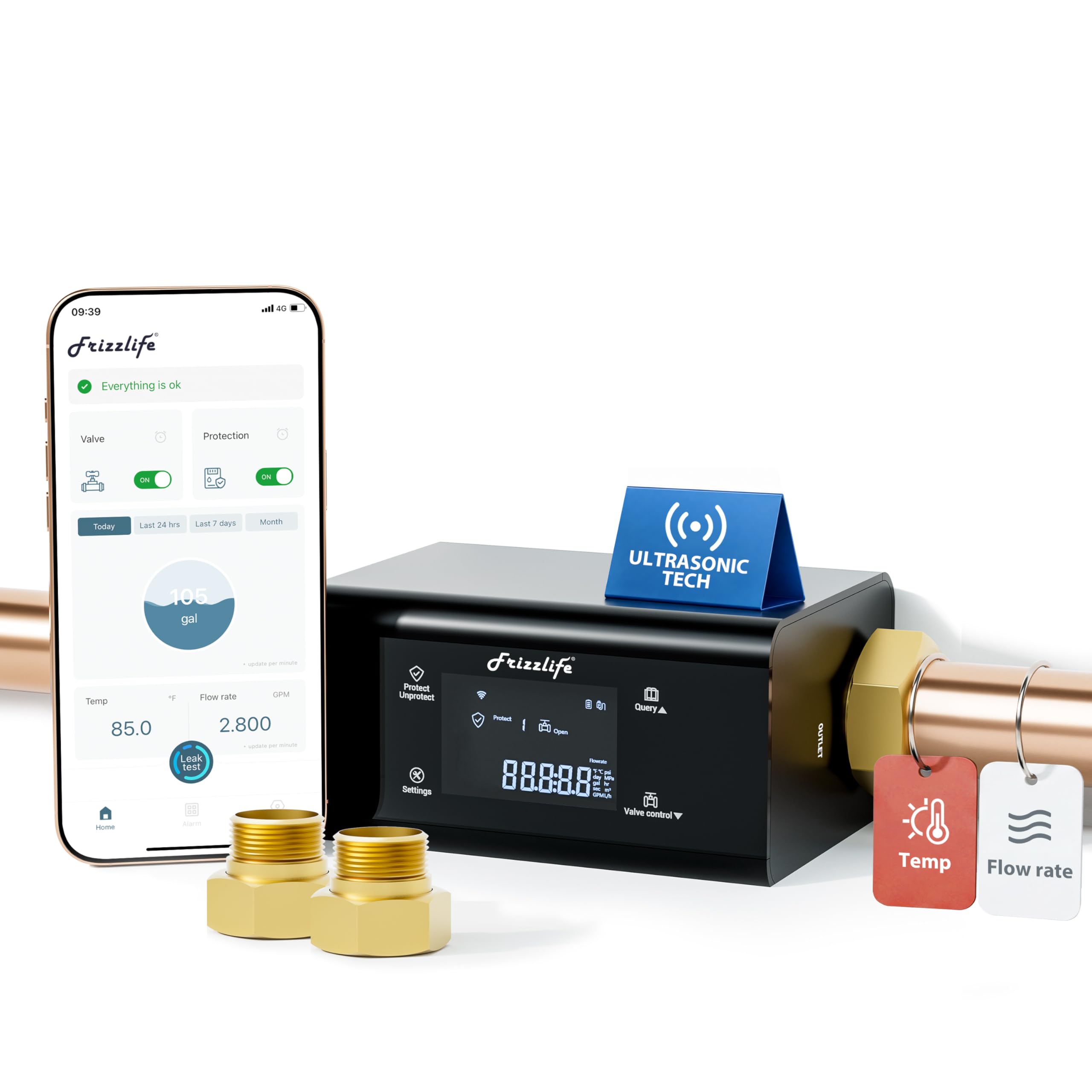
The key spec is 0.01 gpm. That is the smallest flow change the ultrasonic sensor will register, and it is why this system catches problems a floor sensor physically cannot — a hidden drip inside a wall, a slow loss behind a foundation, a running toilet you never noticed. Ultrasonic means it reads flow without a moving part inside the water path, so nothing wears against the stream. The unit is NSF/ANSI 61 and 372 certified, which is the confirmation that it is rated for contact with drinking water, and it fits both 3/4″ and 1″ pipe with the adapters included.
The monitoring side is where this earns its place on a list of shutoff valves. It tracks flow rate and temperature in real time, reports water usage daily and monthly, and surfaces that data in the Smart Life app so you can see what normal looks like for your house — then alerts and closes the valve when usage breaks from the pattern. You can tune the leak thresholds by household size and schedule, which cuts false alarms. Owners mention the flow readings line up closely with their city water meter, which is the benchmark that matters when you are trying to find where the loss is going. The valve takes about 20 seconds to close but seals completely with no weeping afterward.
Two honest notes before you commit. Installation is best left to a plumber on a main line — reviewers recommend it, and the unit needs correct orientation to read properly. The battery backup is also thin: the AAA batteries are included but only sustain the unit briefly, so plan on wall power being the real source. Neither undermines the core feature set, which is simply broader than any floor-sensor kit here.
what separates it
- Ultrasonic sensing down to 0.01 gpm picks up drips no floor pad can feel
- Live flow, temperature, and pressure readouts with daily and monthly usage reports
- Customizable thresholds by family size and schedule reduce nuisance alarms
- NSF/ANSI 61 and 372 certified for contact with drinking water
- Fits 3/4″ and 1″ pipe with adapters included in the box
Before you buy it
- Best installed by a plumber on a main line — this is inline plumbing work
- Battery backup is short-lived; wall power does the real work
- Orientation matters, so it needs planning during install
The right buy if: you have had a mystery leak, a rising water bill, or you simply want to see and understand your usage down to the smallest flow.
Overkill if: you only need a water heater pan monitored and would rather not cut into a main line.
9. FloodStop Washing Machine Leak Detector Kit, 3/4″ 90deg

Built for the one place a leak does the most damage: an upstairs laundry room above finished ceilings.
This kit is single-purpose and does that purpose well. It replaces the hot and cold hoses feeding a washing machine, and closes both valves the instant water touches the sensor. The valves are heavy-duty full-port solid brass ball valves, rated up to 140 PSI working pressure, and because they close slowly over roughly 2 seconds rather than snapping shut, there is no water hammer bang through the pipes — a difference owners call out when comparing this to solenoid-based units. It carries AB1953 and NSF 61 lead-free compliance with ICC-ES listing, and meets IPC, IRC, UPC, and National Plumbing Code of Canada requirements.
Reliability is what the reviews talk about most, and the scenarios behind it explain the premium. It goes in on machines with no floor drain, so a burst hose has nowhere to send the water except the ceiling below. One owner installed it on both an upstairs machine and a rental unit for exactly that reason and confirmed the sensor fires on even a small amount of water. Another reported it correctly catching a real inlet hose gasket leak after installation. The sensor has multiple trip points and the units can be daisy-chained, and there are NO/NC relay outputs if you want to tie the alarm into a home automation system.
Where it draws criticism is the control module, which some owners describe as looking less substantial than the valves it drives. The buttons have been called finicky, and the module takes its power from a wall outlet — if you only have one socket behind the machine, you will need a multi-outlet adapter, since the battery backup is there to ride out outages, not to run the unit. The recommendation to test the sensor every three months is worth writing on the side of the machine. The valves themselves have drawn praise, and one owner reports customer service sending a free replacement valve when needed.
The case for the premium: full-port solid brass valves rated to 140 PSI, slow-closing operation with no pipe bang, and code listings that satisfy an inspector.
Set expectations on: the control module feels lighter than the hardware, and it needs an outlet — plan for a double socket behind the machine or add an adapter.
Pick it for: a second-floor or above-grade laundry room where a hose failure would travel straight into the ceiling below.
Not ideal if: you want app alerts and remote control, or you have only one outlet and no room for an adapter behind the washer.
10. Moen 900-001 Flo by Moen 3/4-Inch Smart Water Shutoff with 920-005 Smart Water Detector, 3-Pack

The system that runs its own test every day and learns what normal water use looks like in your home.
MicroLeak Technology is the feature that justifies the top-of-range position. Every day, the system proactively checks the integrity of your entire water system — including the parts hidden behind walls and under foundations — looking for leaks as small as a drop per minute, like pinhole leaks in a supply line. That is detection you cannot achieve with a floor pad, because the water never reaches a floor you can see. The bundle ships with the 3/4-inch Smart Water Shutoff plus a 3-pack of Flo by Moen Smart Water Detectors, so you also get physical sensors for the spots you already know are vulnerable.
The intelligence builds over time. The shutoff learns your household’s water habits within days and starts flagging anomalies — a toilet that will not stop running, a slow loss overnight — then turns the water off on its own if a threshold breaks. You can also open and close the supply remotely from the app, which is the feature that matters on a long trip. The detectors work as a second layer: place them near the water heater, the laundry, or under a sink, and when used with the shutoff they can trigger the same automatic closure. Model 900-001 fits 3/4-inch to 1-1/4-inch pipe diameter, and it works with Alarm.com, Ring, Google Assistant, and NICE with no separate hub required — only Wi-Fi and standard AC/DC power.
What buyers use it for is telling: the recurring note is protecting a home while away, in case of a pipe burst or a fixture failure that would otherwise run for days. That is the scenario a camera cannot catch but a valve can stop. The honest reservations are on the build and the support line — the shutoff is described as plastic-heavy by some owners, one hit a weak Wi-Fi signal despite a nearby router, and the support line is slow when you need it, with hold times climbing well past two hours for one frustrated caller. The device itself continues to work in that scenario; the app side is what needed attention.
Where the money lands: daily whole-system MicroLeak testing that catches drops per minute, plus three physical detectors and a shutoff that learns your home’s habits.
The trade: it is the priciest full bundle here, leans heavily on Wi-Fi and wall power, and support response times are the weak link when something needs a human.
Built for: a whole-home setup where you travel often and want the system testing the pipes while you are gone, not just watching the floor.
Reconsider if: your router sits far from where the shutoff must be installed, or you expect fast phone support during setup.
Understanding the Specs
Valve Type: Inline Ball Valve vs Retrofit Robot
An inline valve replaces a section of your pipe with its own motorized ball valve — the U.S. Solid, iSpring, FloodStop, Frizzlife, and Moen units all work this way, and installation means cutting into the line. A retrofit robot clamps over the valve handle you already own and simply turns it, which is how the YoLink EVO and the Bulldog operate — no plumbing touched. The question that decides it is clearance: robots need space around the handle, while inline valves need a plumber and an accessible section of pipe.
Wireless Protocol: LoRa, Z-Wave, and Wi-Fi
These three names describe how the sensors talk to the controller, and they behave very differently. LoRa is a long-range, low-power radio that reaches up to 1/4 mile on YoLink kits, which is why it works from a basement or an outbuilding. Z-Wave is a mesh protocol used by the Bulldog and Titan that pairs with hubs like SmartThings, Hubitat, and Ring, and its Long Range variant adds range on supported hubs. Wi-Fi, used by the Moen and Frizzlife systems, reaches your router but depends on your network being up — and the strongest kits add a direct sensor-to-valve link so a dead router does not mean a dead valve.
Pipe Size and the Actuator Clearance Rules
Pipe diameter is the first measurement to take, because a 3/4″ valve will not thread onto a 1″ line without an adapter. Retrofit actuators add a second set of constraints: the Titan needs a standard 0.5″ to 1.25″ ball valve, 3″ of clearance from the valve center to each side along the pipe, at least 1.25″ between the handleand the pipe, and at least 1″ between the pipe and the wall. Measure before buying — a valve that will not physically mount is a return, not a repair.
Battery Backup and Offline Shutoff
Wall power is fine until the day the power cuts, which is often the same storm that bursts a pipe. The kits that keep protecting you carry their own reserve: the YoLink valve controller runs about 2 years on battery with direct power as an alternative, the YoLink 0.75″ brass kit bundles 4 AA batteries for backup alongside its 12V adapter, and the FloodStop kits include battery backup behind their wall adaptors. What matters more than the backup itself is whether the valve can still close on its own — the YoLink D2D pairing means the sensor and valve talk directly, so shutoff fires without a hub, a router, or a live outlet.
FAQ
Will an auto shut-off water valve work if the power goes out during the leak?
Can I install one of these without hiring a plumber?
How long do the batteries last in these leak detection systems?
What pipe size do these shut-off valves fit?
How many leak sensors can one controller handle?
Will a retrofit valve robot close a handle that is hard to turn?
Do I need a smart hub to use a Z-Wave water valve actuator?
What is the difference between a floor sensor and ultrasonic leak detection?
How fast does the valve close once a leak is detected?
Do these systems need a monthly fee or subscription?
Final Thoughts: The Verdict
For most homes, the auto shut-off water valve winner is the YoLink Water Shutoff Kit: Controller + EVO + 3-Pack Sensors + Hub because it closes the valve offline through its direct device-to-device link, installs without cutting a single pipe, and backs that with up to 5 years of sensor battery life — the combination that keeps a home protected through the outage that causes so many leaks in the first place. If budget is the deciding factor and your main line is a standard 3/4″, the U.S. Solid Motorized Ball Valve Kit delivers a stainless, potable-water-rated valve with three 20 ft sensors for a fraction of the premium tier. And if your concern is a hidden drip you cannot see rather than a puddle you can, the Frizzlife LP365 monitors your whole system down to 0.01 gpm and reports the flow data you need to find the loss. Whichever you choose, measure your valve, count your leak-prone spots, and decide upfront if you need the system to survive a power cut — those three answers will point you to the right box faster than any spec sheet.
How We Picked
We do not accept paid placement. Every pick is matched to a real buyer and a real use-case; we do not hands-on test units.
Sources & Methodology
Specifications: manufacturer listings and product documentation. Review insights: verified customer reviews, as of September 2026. Pricing: not shown on this page (it changes often); check the current price via the retailer link.
As an Amazon Associate, KitchPrep earns from qualifying purchases. This does not affect which products we feature.
Related Guides
