
Specs are compiled from manufacturer listings and verified buyer reviews and can change over time — please confirm the key details on the product page before buying.
A self-emptying rain gauge does the one thing a plain tube cannot: it measures every drop and dumps itself, so you never stand outside squinting at a water line again. The catch is that a bad one fails right after the return window closes, which is why this guide separates the units with proven tipping-bucket guts from the ones that quit mid-season.
I’m Mohammad Maruf — the founder and writer behind KitchPrep. This guide is built by comparing the manufacturers’ published specifications and the patterns across verified customer reviews, so you get each pick’s real strengths and trade-offs instead of marketing spin.
Whether you track rainfall for your garden or just like knowing exactly what fell overnight, the right auto rain gauge saves you from manual reads and frozen tubes all year long.
Our Picks at a Glance


How To Choose The Best Auto Rain Gauge
Every automatic rain gauge uses the same clever trick: a small seesaw called a tipping bucket catches water, tips when full, and sends a signal to an indoor display that counts the tips as rainfall. Your job is to find the one whose bucket, sensor, and display actually keep working past the first winter.
The mechanism is everything
A true self-emptying gauge has no standing water to freeze, which is why the best ones survive cold snaps. The trade-off appears in the reviews: a bucket that tips too easily reads high, and one that sticks reads nothing at all. Look for a unit where owners describe consistent totals matching local reports, not just an easy setup.
Wireless range vs. real-world placement
The advertised range — often 100 yards or more — assumes open air with no walls in the way. The reality is that mounting height, metal fences, and distance from the router all cut that number down. Buy for your actual yard layout, and check whether the sensor needs to sit perfectly level to tip correctly.
Freeze claims need a second look
Many listings call themselves “freeze proof,” but the fine print in owner experiences tells a different story. Some units genuinely shrug off ice because the bucket drains itself, while others crack or kill their electronics when temperatures drop below freezing. If you live somewhere cold, weigh the winter reviews far heavier than the marketing line.
Quick Comparison
| Model | Best For | Rainfall Data | Extras | Sensor Power | Amazon |
|---|---|---|---|---|---|
| AcuRite 02446M★ Best Overall | Simple, no-fuss tracking | Day, yesterday, week, month, year | Custom alarm | Wireless | Amazon |
| JMBay Digital GaugeFeature-Rich Pick | Full weather station features | 8 intervals incl. 1hr & 24hr | Thermometer, atomic clock | Wireless | Amazon |
| Asenron Wireless GaugeCompact Console | Compact console users | 8 intervals incl. 7-day | Thermometer, dual alarm | Wireless | Amazon |
| BIUWING Wireless Gauge | Budget-friendly monitoring | 8 intervals incl. total | Thermometer, backlight | Wireless | Amazon |
| La Crosse 724-1415BL | Budget-friendly monitoring | Current, 1hr, 24hr, 7-day, month, year | Temp & humidity | Radio Frequency | Amazon |
| YZDTECH Weather Station | Multi-room monitoring | Rainfall measurement | Barometer, forecast, moon phase | Wireless | Amazon |
| VEVOR 7-in-1 Station | Wi-Fi data logging | Rainfall via 7-in-1 sensor | Wind, solar, SmartLife app | Solar + battery | Amazon |
| Sainlogic Smart Station | AI forecasts & data export | Hourly, daily, monthly precision | 2-year export, phone alerts | Wi-Fi + AAA | Amazon |
| Ambient Weather WS-4000 | Lab-grade accuracy | Haptic rain sensing | Ultrasonic wind, solar | Solar powered | Amazon |
In‑Depth Reviews
1. AcuRite 02446M Self-Emptying Wireless Rain Gauge
Our pick — over 4★ from 7,000+ verified ratings; the strongest balance of quality and price.
The crowd favorite that tracks five running totals without ever asking you to empty a tube.
You get the full picture of your yard’s rainfall from your desk, not the porch — the outdoor collector beams its readings wirelessly to an indoor LCD display you can keep anywhere. The self-emptying tipping-spoon design means zero daily maintenance, and a customizable alarm beeps at you once your set rainfall total hits, which gardeners love for knowing exactly when to hold off watering.
Owners consistently praise the easy setup and the five running totals that cover today, yesterday, the past week, month, and year. The 100-yard wireless range is the headline number, and buyers report it delivers solid signal across a typical yard. The honest trade-off: this is a lightweight unit that needs secure mounting, and the plastic cover can crack in heavy snow, so cold-climate owners who leave it out all winter are rolling the dice.
What wins people over is the “no manual reading needed” factor — it simply works, which is exactly what the top-rated reviews keep circling back to. The calibration does take some fiddling to get right, and a small number of units have arrived needing careful setup to read true. For most homes though, this is the set-and-forget benchmark the cheaper clones are trying to copy.
The Everyday Winner
- Five different running totals on one display
- Audible alarm when your rainfall goal is hit
- 100-yard wireless range covers most properties
The Fine Print
- Needs a secure mount to stay accurate
- Not built for winter outdoor stays in deep snow
Reach for this if: you want a proven, self-emptying gauge that reports to an indoor screen with no daily chores.
Look elsewhere if: you need something that survives a full snowy season outdoors without being brought inside.
2. Digital Rain Gauge Outdoor with Thermometer, JMBay
A console that tracks eight rainfall windows plus indoor and outdoor temperature in one glance.
This one goes beyond rain with a proper indoor display that logs eight different rainfall measurements — now, 1 hour, 24 hours, today, 7 days, month, year, and total — so you can See how a single storm compares to your monthly average. A soft blue backlight stays on for 15 seconds when you hit the Light button, which makes midnight checks genuinely painless.
The physical footprint is larger at 7.1 x 4.3 x 5.1 inches, giving the console room for a cylindrical rainfall graph and a temperature readout alongside the numbers. That extra size brings real value: a WWVB radio-controlled clock and dual alarm with snooze make this feel like a proper weather station for your living room or greenhouse, not just a rain counter.
Here is where honesty matters: reliability is the most-discussed aspect, and owners mention mixed longevity — some units work flawlessly for a season while others stop registering rain after a few months. One owner described a false 10-inch April total followed by May registering nothing at all. If you want the extra features, this delivers them, but treat the long-term durability as the gamble it is.
Maximum visibility: eight measurement windows and a backlit console make this the easiest to read at night, and the thermometer adds real use beyond rainfall.
The honest catch: the reviews split hard on whether the sensor keeps working past one season, so this suits buyers who value features over proven longevity.
3. Wireless Rain Gauge Outdoor, Asenron
A slimmer console that still crams in eight rainfall windows and a temperature readout.
At 4 x 5 x 7 inches, this Asenron unit is the more compact sibling in the same family as the JMBay above, and it tracks the same eight rainfall intervals with a self-emptying system that asks nothing of you between storms. The indoor console shows a cylindrical graph of rainfall alongside live temperature, and a blue backlight lights up for 15 seconds at the press of a button.
Customers note the display is large and easy to read, and the dual alarm clock with snooze plus calendar makes it genuinely useful on a bedside table or office shelf, not just a garden gadget. The WWVB radio time function keeps the clock honest without you ever touching a button.
The consensus splits on reliability the same way most of these do: some reviewers point out it working well, while others describe the sensor stopping after a single rainfall event or a season of use. Mounting also earned honest feedback — finding a level spot in the yard that keeps the unit upright is part of the setup, not an afterthought.
What Shines
- Eight rainfall windows on a clear, large display
- Dual alarm with snooze adds daily utility
- Compact footprint fits small shelves
What to Expect
- Programming the console takes some patience
- Sensor longevity is a coin flip past one season
Who it fits: buyers who want a full-featured console but have a smaller shelf or desk to dedicate to it.
Who should pass: anyone who cannot risk the sensor dying mid-season and needs a proven track record.
4. BIUWING Wireless Rain Gauge Outdoor

The easy-mount option that owners call accurate right up until the day it is not.
BIUWING keeps things simple: the outdoor collector syncs wirelessly to an indoor console showing eight rainfall windows, and the self-emptying design means you never touch it between storms. At 1.21 pounds it is light enough to mount almost anywhere, and the soft blue backlight stays on for 15 seconds when you need a nighttime reading.
The setup earns consistent praise — shoppers say it is easy to assemble and mount, and the early readings match what they expect. For a budget-tier entry, the temperature and rainfall readouts on one screen give you solid value without stepping up to a full weather station.
The recurring note in the review history is durability, plain and simple: the gauge works well for a period measured in months, not years, for a meaningful share of owners. Some describe it working for two months then stopping dead after the return window, which is the exact failure pattern to know before you buy. It is a fair price for what it is, but do not expect a decade of service.
Strong first impression: easy setup and genuinely accurate early readings make this a pleasant entry point.
Plan for replacement: the evidence points to a working life measured in months for some units, so treat it as a budget tool, not a lifetime buy.
5. La Crosse Technology 724-1415BL Wireless Rain Station

A rain station from a name brand that owners say lasts years, not months, before issues.
La Crosse brings something the no-name units lack: a track record. The self-emptying rain bucket uses internal tilting cups, and the indoor base station tracks current, 1-hour, 24-hour, 7-day, month, year, and total rainfall in inches or millimeters. It also adds indoor and outdoor temperature plus humidity, rounding it out beyond a pure rain counter.
What sets this apart is the longevity feedback — repeat buyers specifically note these units work well for a couple of years before giving any trouble, and the same voices warn against cheaper alternatives that fail in months. The clear display and simple sensor pairing get consistent praise, and the dynamic icon shows you at a glance which days had rain.
The recurring caution is physical: the collector is light enough that squirrels or strong wind can tip it, and it must sit perfectly upright to register rain. Buyers also report the unit needs to come inside for winter, as freezing can stop it from working. If you want a brand with responsive support behind it, this is the safer middle ground.
Built for Years
- Multiple rainfall windows plus temperature and humidity
- Buyers report years of service before issues
- Fast, English-speaking customer support
Needs Handling
- Light collector can tip in wind or from animals
- Must stay upright and come inside for winter
Best for: buyers who value brand reliability and plan to bring the unit indoors for the cold months.
Not for: anyone wanting a leave-it-out-all-year gauge in a snowy climate.
6. YZDTECH Digital Wireless Rain Gauge Weather Station
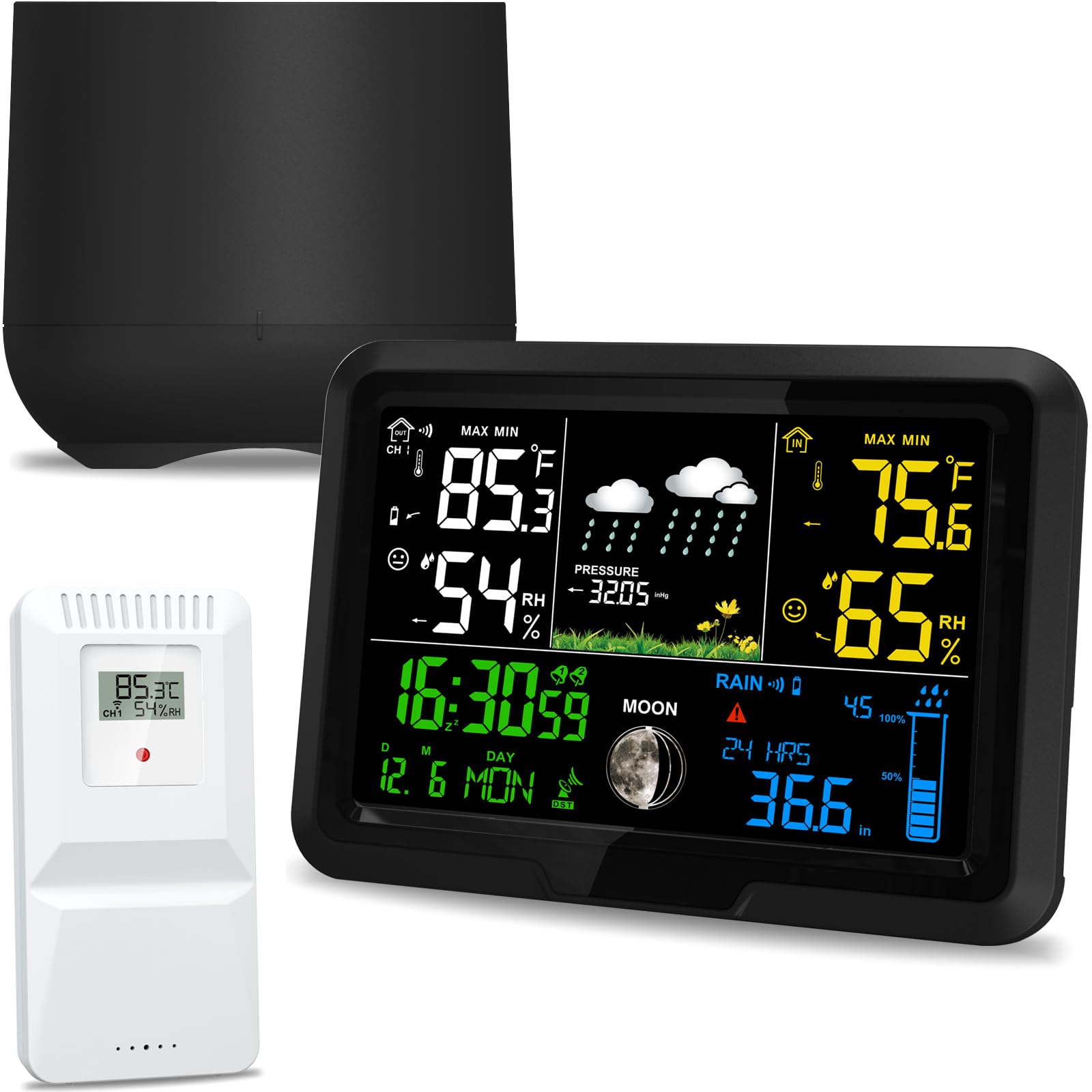
A full-color console with barometer, forecast, and room for three sensors at once.
This YZDTECH station turns your rain tracking into a full home weather hub. The self-emptying rain gauge reports to a full-color LCD with a wide viewing angle, and when plugged into power the backlight adjusts across four brightness levels — a thoughtful touch for low-light rooms. Beyond rain, you get indoor and outdoor temperature, humidity, barometric pressure history, moon phase, and a weather forecast with trend tracking.
The multi-channel design lets you connect up to three sensors to monitor different rooms like a baby room, storage space, or wine cellar, though the box includes only one sensor. The atomic clock with auto daylight-saving means the time stays correct without your input, and the dual alarm with snooze covers mornings.
The screen earns real affection — owners routinely call it easy to read and enjoyable to use. The rain gauge specifically is where opinions split: some report solid performance, while others describe it stopping communication after two to three months, even with fresh batteries and the sensor a few feet away. Support responsiveness varies too, so factor that into your expectations.
Console first, gauge second: the display and multi-room monitoring are the standout reasons to choose this over a dedicated rain gauge.
Know the risk: the rain sensor’s long-term reliability is genuinely mixed, so weigh how much you depend on that one function.
7. VEVOR 7-in-1 Wi-Fi Weather Station
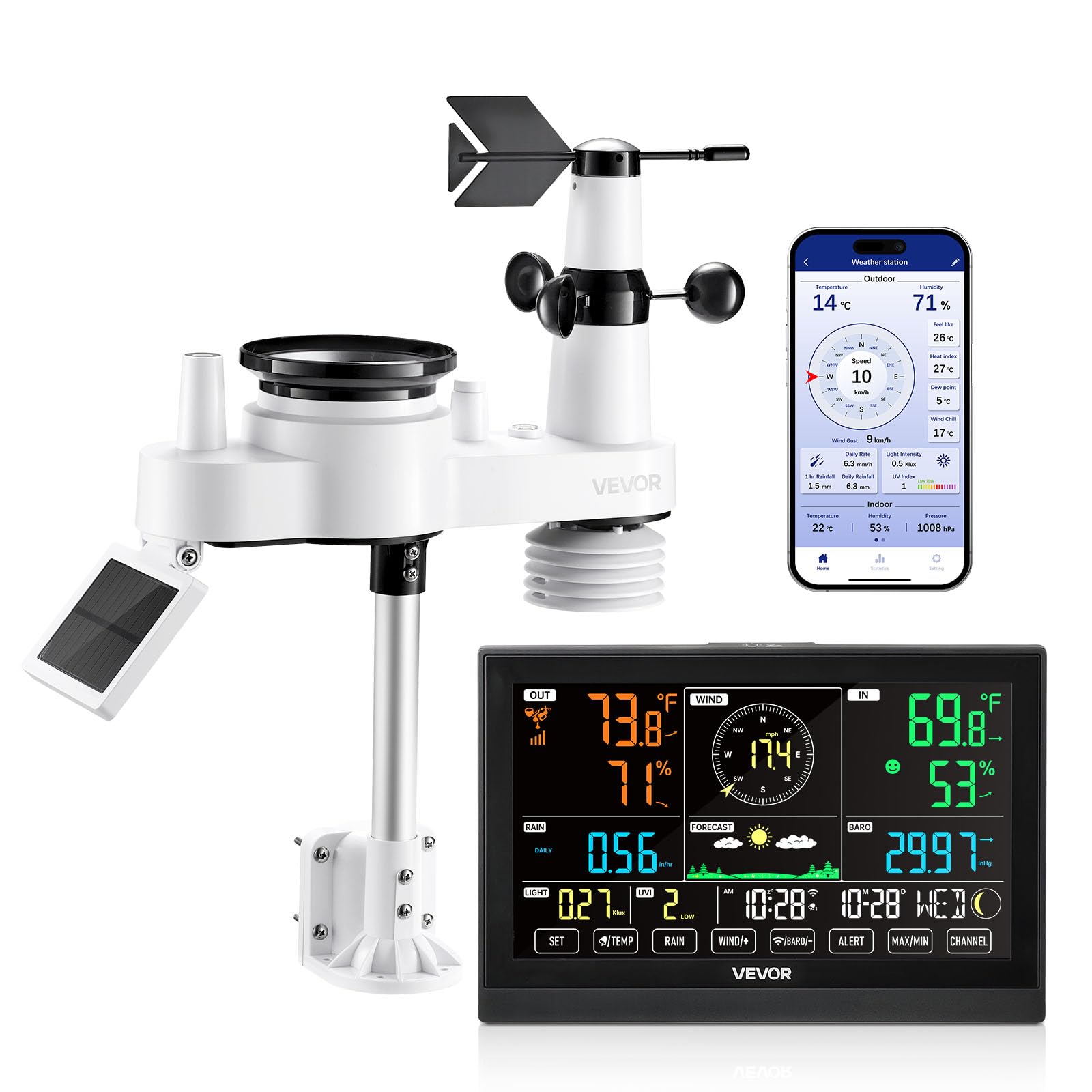
A solar-powered 7-in-1 sensor that pushes live weather to your phone from 492 feet away.
VEVOR packs seven weather measurements into one outdoor sensor — rainfall, temperature, humidity, wind speed and direction, plus sunlight — and sends it all to a 7.5-inch display with four brightness levels. The standout for everyday use is the 492-foot (150 m) transmission distance, so the sensor can live on a rooftop, in a garden, or across a farm while the display stays in your living room.
The solar panel runs the sensor on sunny days while rechargeable NiMH batteries take over at night or in clouds, cutting the chore of battery swaps. The SmartLife app connects on 2.4GHz Wi-Fi and lets you view, store, and share real-time data from anywhere, with no registration or paid plans. Owners mention the rain sensor tests impressively accurate, coming in off by just 0.01 inch in one check.
Owner consensus lands on strong build quality and easy setup, with functionality the most-praised aspect by a wide margin. The honest limits: the display can be hard to read in bright daytime, and the anemometer and vane can freeze up after freezing rain — a real consideration for cold climates.
The Connected Advantage
- 492-foot transmission for distant sensor placement
- Solar panel plus rechargeable batteries reduce upkeep
- App control with no ads or paid tiers
Where It Struggles
- Moving wind parts can freeze after freezing rain
- Daytime screen readability draws mixed feedback
Choose this for: remote monitoring across a large property with phone access to every reading.
Think twice if: you live in a freezing-rain zone and need moving parts to keep spinning all winter.
8. Sainlogic Smart WiFi Weather Station with Rain Gauge
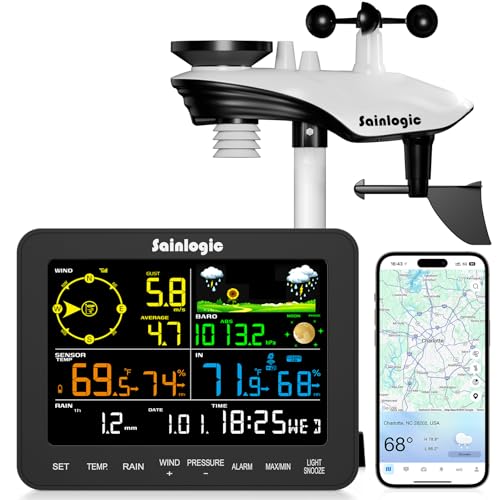
An 8.3-inch high-contrast display with AI forecasts and two years of exportable weather history.
Sainlogic pairs a precision rain monitor with genuinely useful software. The rain gauge claims professional-grade accuracy of ±1mm for rainfall under 15mm and ±7% across the full range up to 9999mm, and the Weatherseed app logs that data hourly, daily, weekly, monthly, and yearly. When the barometer, temperature, or humidity shifts sharply, the app pushes an instant alert to your phone.
The display is the other headline: extra-large bold digits on a high-contrast screen, built specifically so aging eyes can read temperature and humidity without squinting. Owners repeatedly describe it as easy to read from across a room, and the setup draws consistent praise for taking only minutes. The two-year data archive with Excel export is a genuine differentiator for growers and weather enthusiasts who want to spot long-term trends.
Quality is the most-praised aspect in the feedback, with the display close behind. The 2.4GHz-only Wi-Fi and the need to keep the adapter plugged in for full connectivity are the limits to know. Outdoor sensor battery swaps come roughly yearly, and placement on brick homes can take some thought, but the value story here is strong for the feature set.
Serious data tool: the ±1mm rain accuracy and two-year Excel export make this the pick for growers and weather loggers, not casual readers.
One limit: it needs a plugged-in adapter and 2.4GHz Wi-Fi to open up the app features, so plan the console spot accordingly.
9. Ambient Weather WS-4000 Solar Powered Ultrasonic Station

The no-moving-parts flagship where ultrasonic wind and haptic rain sensing eliminate the classic failure points.
Ambient Weather built the WS-4000 around a simple idea: remove the moving parts that break. The rain gauge is haptic — it senses rain without a tipping bucket to stick or jam — and the wind sensors are ultrasonic with zero spinning cups. That design choice directly answers the most common complaint across every other gauge on this list: parts that freeze or fail.
Installation is genuinely tool-free thanks to the compact, all-in-one solar-powered array, and the included color console matches the brand’s higher-tier 2000 and 5000 models. The WH32B indoor sensor adds temperature, humidity, and barometric pressure readings to round out the picture. Owners call it accurate and consistent, with the ultrasonic wind sensors drawing particular praise for precision.
Effectiveness and easy setup are the two most-praised aspects in the feedback, and the lack of moving parts is called out as a real advantage. The honest limits: the Wi-Fi transmitter’s reach has drawn some complaints about data loss at distance, and the price sits firmly at the premium end. Some buyers also note the docs feel rushed. If you want the most durable design and can accept the cost, this is the long-term play.
Built Different
- No moving parts means nothing to freeze or jam
- Tool-free, all-in-one installation
- Precise ultrasonic wind and haptic rain sensing
The Premium Reality
- Wi-Fi reach can disappoint at distance
- Sits at the top of the price range
Splurge for this if: you want the most durable, low-maintenance design and value ultrasonic precision over budget.
Reconsider if: your sensor must sit far from the router, since Wi-Fi range is the weak spot in the feedback.
Understanding the Specs
Self-Emptying vs. Manual Gauges
A self-emptying gauge uses a tipping bucket: water fills one side of a small seesaw, tips it over, and drains out the bottom. Each tip counts as a set amount of rain, and the bucket is always ready for the next drop. A manual tube gauge traps water so you can read the level, but you have to go outside, look at it, and dump it yourself. The automatic version wins on convenience, which is why every pick here is self-emptying.
Wireless Range and Placement
The transmission range in the specs — like 492 feet on the VEVOR or 100 yards on the AcuRite — assumes an open path with no walls, trees, or metal in the way. Real homes cut that distance down fast, and a metal fence can kill the signal entirely. Mount the outdoor sensor high and clear of obstructions, keep it perfectly level so the bucket tips correctly, and you get the most reliable readings.
FAQ
What does self-emptying mean in a rain gauge?
Will an auto rain gauge survive winter outdoors?
How accurate are tipping bucket rain gauges?
Do I need a wireless rain gauge or a full weather station?
How far can the outdoor sensor be from the indoor display?
What causes an auto rain gauge to stop working?
How do I calibrate my rain gauge for accuracy?
Is a solar-powered rain gauge better than a battery one?
What rainfall data should a good gauge show?
Can I check my rain gauge readings from my phone?
Final Thoughts: The Verdict
The best auto rain gauge for most homes is the AcuRite 02446M because it balances proven self-emptying performance with five running totals and a simple setup at an approachable price. If you want a full weather hub with phone alerts and deep data history, the Sainlogic Smart WiFi Station is the one to reach for. And if durability is your top concern and budget allows, the Ambient Weather WS-4000 removes the moving parts that cause most failures in the first place.
How We Picked
We do not accept paid placement. Every pick is matched to a real buyer and a real use-case; we do not hands-on test units.
Sources & Methodology
Specifications: manufacturer listings and product documentation. Review insights: verified customer reviews, as of September 2026. Pricing: not shown on this page (it changes often); check the current price via the retailer link.
As an Amazon Associate, KitchPrep earns from qualifying purchases. This does not affect which products we feature.
Related Guides
