
Specs are compiled from manufacturer listings and verified buyer reviews and can change over time — please confirm the key details on the product page before buying.
If your door never quite latches on its own, the fix is one hinge swap — and the best auto-closing door hinge for most homes is the Cauldham heavy-duty 3-1/2″ spring hinge. It combines a solid steel build, a 12-hole screw pattern that fits standard door cutouts, and the easiest tension adjustment of the whole group.
I’m Mohammad Maruf — the founder and writer behind KitchPrep. This guide is built by comparing the manufacturers’ published specifications and the patterns across verified customer reviews, so you get each pick’s real strengths and trade-offs instead of marketing spin.
Some hinges pop into your old screw holes in minutes, while others need new holes, a chisel, or three units per door. This guide walks through the nine strongest options so you can pick the auto-closing door hinge that matches your door weight and frame without a return trip.
Our Picks at a Glance

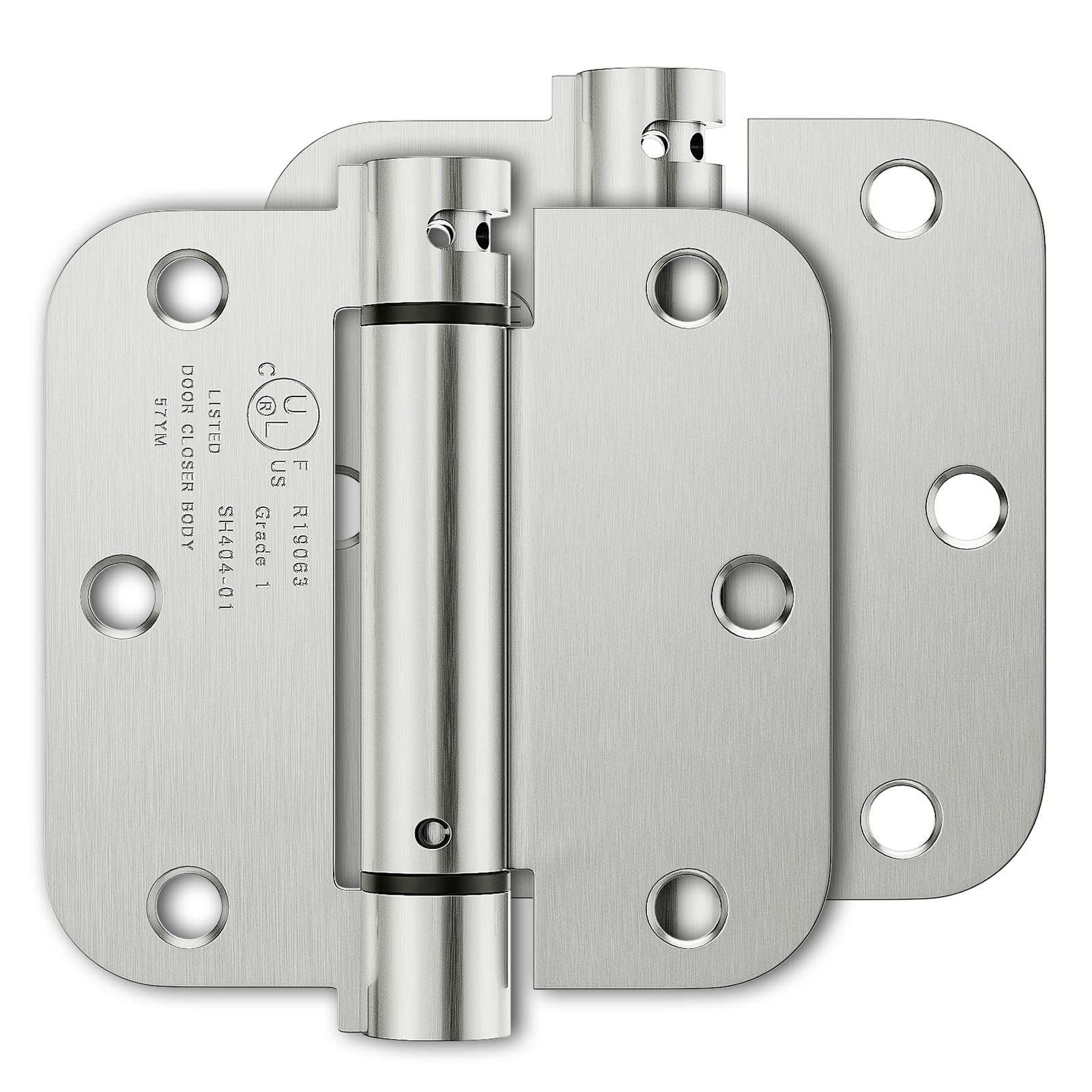

How To Choose The Best Auto-Closing Door Hinge
The single biggest mistake on this job is buying by door size and ignoring the holes. A hinge can measure a perfect 3-1/2 inches and still refuse to fit, because the screw holes sit in a different place than the ones already in your door and frame. Measure your old hinge corner to corner first, then count the holes on one leaf. That number — not the size — decides whether this is a five-minute swap or an afternoon with a chisel.
Count Your Holes Before You Buy Anything
Standard residential hinges almost always use three holes per leaf. Three-and-a-half inch hinges typically carry three holes, while four-inch hinges commonly carry four. The Cauldham pair stands apart here with 12 holes across both leaves — a full four-hole pattern on each side, which is a much easier match on doors that were hung with heavier hardware. If your door has three holes and you buy a four-hole hinge, you are filling and re-drilling, and that is where alignment goes wrong.
Match Hinges To Door Weight, Not Door Size
A taller door is not automatically a heavier door. A hollow-core interior door can weigh less than a solid wood door of the same width, and that difference decides how many spring hinges you install. The HBL’ pair spells the math out clearly: one hinge for doors up to 35 lbs, two hinges for doors up to 70 lbs, and three hinges once you go over 70 lbs. Luxbaro and HOSOM both quote a pair carrying 85 to 100 lbs, with a single hinge good for no more than 40 lbs. Buy to the weight on the door, and the spring does the rest.
Set Tension Once, Then Leave It Alone
Every pick here includes a hex wrench or tension tool, and every one of them lets you dial the closing speed up or down. Too much tension and the door slams into the frame; too little and it drifts open before it latches. The trick most installers miss is that springs settle in. KIW owners describe slow closing right after install that stiffens over the following days, so plan to loosen the pin a notch once the door has broken in rather than cranking it tight on day one.
Quick Comparison
| Model | Best For | Hinge Size | Load Per Pair | Hole Pattern | Amazon |
|---|---|---|---|---|---|
| Cauldham (2 Pack) Heavy-Duty 3-1/2″★ Best Overall | Solid-core and heavy doors | 3-1/2″ x 3-1/2″ | — | 12 holes | Amazon |
| Luxbaro 2 Pack 3.5 InchBest Value | Pantry and light commercial doors | 3.5″ x 3.5″ | 85–100 lbs | — | Amazon |
| Treasem 2 Pack 4 InchBest for Cabinets | Cupboard and light interior doors | 4″ x 4″ | — | 2 holes | Amazon |
| IOQ 4 Inch 5/8″ Radius | Low-profile interior upgrades | 4″ x 4″ | 100 lbs | — | Amazon |
| HOSOM 4 Inch Matte Black | Garage and entry doors | 4″ x 4″ | 85–100 lbs | 4 holes | Amazon |
| KIW 4″ Satin Nickel | High-traffic interior doors | 4″ x 4″ | 60 lbs | 8 holes | Amazon |
| HBL’ 3.5″ Automatic Closer | Wood and metal doors | 3.5″ x 3.5″ | 70 lbs (two hinges) | 2 holes | Amazon |
| goldenwarm 4 Inch Satin Nickel | Exterior and steel doors | 4″ x 4″ | — | — | Amazon |
| Houseables Satin Brass | Garage service and patio doors | 4″ x 4″ | — | 8 holes | Amazon |
In‑Depth Reviews
1. Cauldham (2 Pack) Heavy-Duty 3-1/2″ Self-Closing Spring Door Hinge
Our pick — over 4.5★ from 750+ verified ratings; the strongest balance of quality and price.
A 12-hole, UL-listed 3-1/2″ spring hinge that drops into standard residential cutouts.
Start with the hole count, because that is what makes this pair the easiest match in the group. Each hinge leaf carries a full four-hole pattern for 12 holes across the two-leaf set, so you are far more likely to line up with existing screw positions instead of filling and re-drilling. For comparison, the Treasem 4-inch pair lists a 2-hole count, and matching those to an older four-hole cutout is exactly the job that turns a swap into a rebuild. The hinges come in at 3-1/2 inches by 3-1/2 inches with 5/8″ radius rounded corners, the shape that fits most standard residential door cutouts without any frame modification.
Solid steel construction and a hand-finished satin nickel surface give it the weight and feel of hardware that belongs on a solid-core door, and the UL Listing means it meets the published safety standard for fire-rated doors. Each hinge arrives with No. 9 – 1″ wood mounting screws, a tension adjustment tool, and printed instructions. The closing power adjusts with a hex wrench: you insert the pin and turn it clockwise until the next hole appears, one slot at a time, and heavier doors need that fourth slot. As buyers report, the job runs about three minutes once you know the sequence — “Install in ~3 min: swap hinge, insert pin with hex wrench clockwise until hole appears.”
What wins people over is the sheer build quality, and the functionality follows right behind it in owner feedback — doors that latch shut on their own without anyone thinking about it. The one honest caveat is that a single hinge will not always finish the job on a hollow door. Owners describe one unit moving the door most of the way but not sealing it, and the practical fix is buying two so they pull together. The adjustment process also rewards patience on heavy solid-core doors, where the spring is stiff enough to need real hand strength on the final slots.
Where It Pulls Ahead
- 12-hole pattern across the pair — a 6x hole count versus the Treasem 4-inch set — for a much easier drop-in fit
- UL Listed for fire-rated doors, meeting ANSI/BHMA standards
- Full hardware kit: screws, hex tension tool, and instructions in the box
- Satin nickel over solid steel, rated for interior and exterior doors
The Honest Catch
- One hinge can move a hollow door without fully latching it — plan for a pair
- Heavy solid-core doors need strong hands on the final tension slots
- Instructions read thin on the first pass; the sequence matters more than the paper
Reach for this if: your door is solid-core, exterior, or heavy enough that a cheap hinge would sag — the steel and the UL Listing are built for that load.
Look elsewhere if: you are fixing a featherweight cabinet door, where a smaller hinge does the same job with less hardware to store.
2. Luxbaro 2 Pack Self Closing Door Hinges 3.5 Inch, Adjustable Tension
A 3.5-inch spring hinge rated for 85–100 lb doors per pair, with adjustable tension for a gentle close.
Pantry doors, wardrobes, office doors, and garages are the daily territory here. What sets the Luxbaro pair apart is the stated carrying capacity: a pair handles doors weighing 85 to 100 pounds, and a single hinge holds up to 40 pounds, which is a lot of door for a 3.5-inch hinge. Both left- and right-hand doors work without any special ordering. The spring hinges comply with the UL-certified ANSI Grade 1 standard (a safety and durability rating for door hardware), and the metal surface gets a treatment to resist rust.
Owners count on these for one job above all: keeping a door that drifts open from drifting. The self-closing action means the door swings itself shut after you walk through, so a Roomba does not end up trapped behind it. As buyers put it, the capacity claim is not marketing — “A pair of spring hinges can support doors weighing 85 to 100 pounds.” Swapping them into standard hinge positions goes quickly, and the brushed nickel finish matches existing hardware closely enough that nobody notices the change. Tension dials back too, so you get a gentle close rather than a snap.
The recurring gripe is the fit, and it is worth hearing before you buy. The screw holes do not always match an existing door, and drilling fresh holes while keeping the hinge aligned is genuinely fiddly work. Several owners also found the plate noticeably thicker than what they removed, which meant chiseling or routing the door edge to seat it. If your current hinges are square-cornered and decades old, assume some woodwork is part of the project. That sturdiness rating reads mixed in owner feedback for exactly this reason — strong hardware that expects a little coaxing to sit right.
What the price buys: a genuinely strong 3.5-inch spring hinge with a 100-pound pair rating and full hardware, at a value tier that undercuts most of this list.
What to budget extra for: time at the door. Owners who came from square-cornered originals needed new holes, a flat chisel, and a hammer to close the gap.
Skip the guesswork if: your door is a modern standard cutout and you want the lowest-cost path to a self-closing pantry or wardrobe door.
Pass it by if: you are replacing 20-year-old curved hinges — the depth difference means fresh holes and a router, not a straight swap.
3. Treasem 2 Pack 4 Inch Self Closing Door Hinges, Satin Nickel
A 4-inch satin nickel spring hinge sized for light cupboard and bathroom doors.
These are 4 inch by 4 inch hinges in carbon steel with a satin nickel finish, UL certified and built to ANSI/BHMA standards (industry benchmarks for door hardware). The spring inside is adjustable with the included tension tool, so you control how fast the door swings shut — the listing calls it a slow close, and you can wind it gentle for a soft, consistent landing rather than a snap. Screws and the tension adjuster both ship in the box, so there is no extra trip for hardware. The 4-inch size gives you a bit more leverage on the door than a 3.5-inch hinge, which helps on heavier leaves.
Where this pair shines is light doors. Owners run them on kitchen cupboard doors specifically because the adjustment range lets them dial the close down to a soft touch, and one hinge per lightweight cupboard is usually enough. That is a different use case than the heavy solid-core doors the Cauldham and Luxbaro pairs target, and it is worth knowing which job you are doing before you choose a size. The 4-inch footprint also fits some existing cutouts that a smaller hinge would rattle in.
There is a trade-off worth naming — sturdiness feedback runs mixed. Some owners find the hinges plenty strong, while others report a creak developing after a few days on heavier solid wood doors.
The strong finish: satin nickel over steel with clean edges and a color that blends with existing interior hardware, plus a tension tool that ships in the box.
Who should size up instead: anyone hanging a heavy solid wood door should step to a three-hinge install or a heavier-rated pair rather than asking two of these to do the work.
Best match: kitchen cupboard doors, bathroom doors, and light bedroom doors where you want a soft, adjustable close without a bulky arm mechanism.
Think twice if: your door is a solid slab — owner feedback on sturdiness turns mixed once the load climbs.
4. IOQ 4 Inch Self Closing Door Hinges, 5/8″ Radius Corners Spring Loaded
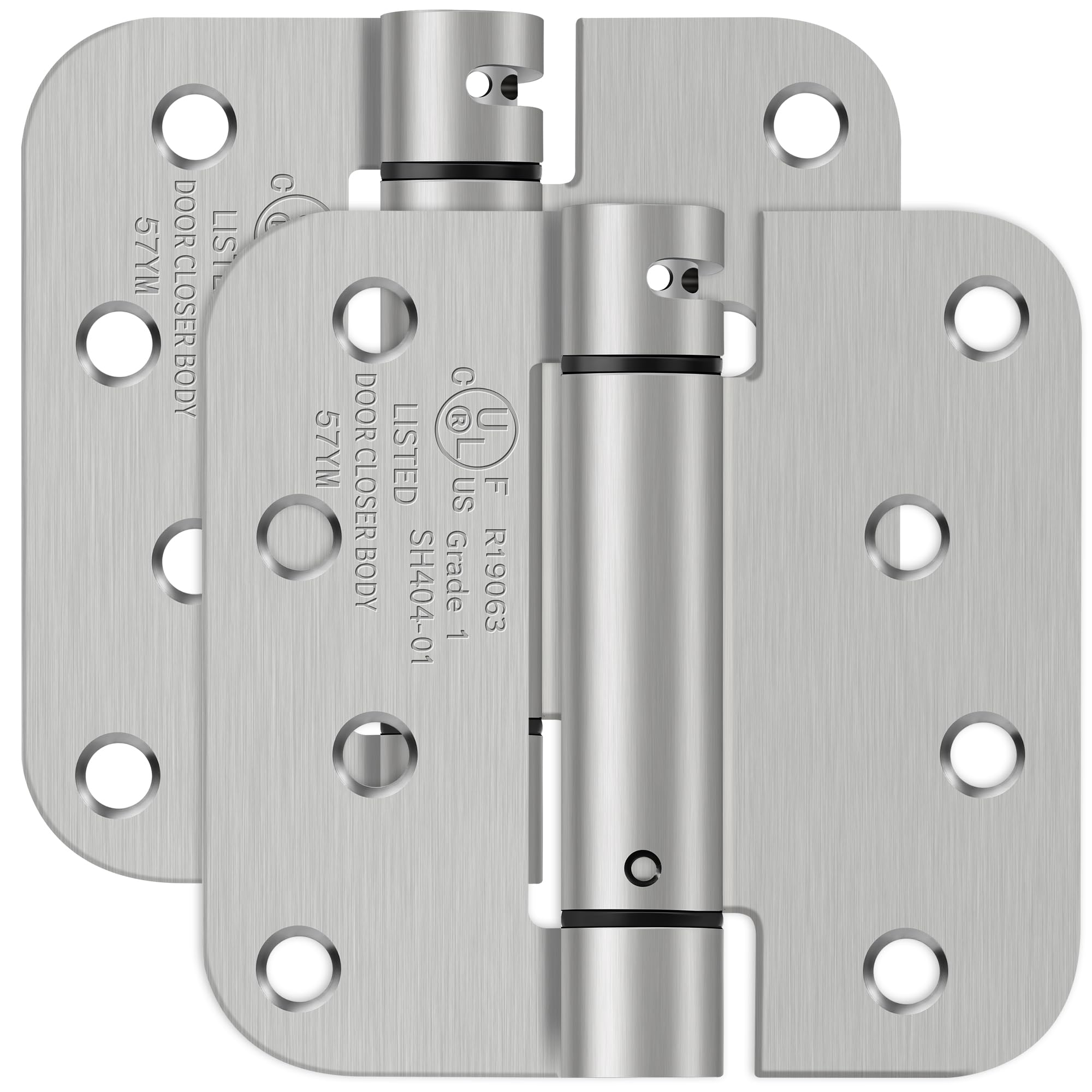
A 4-inch iron hinge with a 5/8″ radius corner and a low-profile body that hides inside the door edge.
The pitch here is straightforward: a 4 inch hinge with a 5/8″ radius corner and 0.1″ thickness, made of iron with a brushed nickel anti-rust finish. Each hinge supports doors up to 40 lbs, and a pair carries up to 100 lbs — for heavier doors the maker suggests a three-hinge install. What buyers keep coming back to is how little the hinge asks of you. Installation and value are the two things owners mention most, and the included kit is unusually complete: two hinges plus a hex wrench, a tension adjustment rod, four tension stopper pins, 16 machine screws, and 16 wood screws.
Adjustment works with a hex wrench on the tension screw, so you set the closing tightness by feel rather than guessing. Owners describe the result as gentle and automatic: “great low profile solution for auto close door.” Another notes the give-and-take of pairing them with different hardware — combining two of these with a ball bearing hinge produced an opening that feels smooth and a close that lands with a soft click rather than a thud. That is the real appeal of this pair: it disappears into the door instead of announcing itself.
One fit warning is worth taking seriously. The holes on this hinge do not always line up with an older cutout, and the plates run a touch thicker than some originals — one buyer had to sand the door down to seat them, and another had to fill and re-drill two door-side holes. The stated weight limit is also worth respecting: the listing quotes a 35-pound maximum weight capacity in the spec sheet even as the description talks up a 100-pound pair. If your door is genuinely heavy, use three hinges or choose a heavier-rated pair.
The real draw: a low-profile hinge with a full installation kit, so nothing else needs buying before you start.
Measure before ordering: confirm your existing hole pattern — the fit is the one place owners hit friction, and a door-side re-drill is possible on older doors.
Worth grabbing for: bathroom and bedroom doors where you want quiet, gentle closing and a hinge that stays out of sight.
Consider stepping up if: your door is at or over the rated single-hinge capacity — plan for three hinges rather than pushing a pair.
5. HOSOM Self Closing Door Hinge 4 Inch Spring Loaded, Matte Black

A 4-inch matte black spring hinge rated for 85–100 lb doors per pair.
The matte black finish is the headline here, and it is what puts this pair on doors where a bare metal hinge would stand out against dark hardware. Underneath, you get 4 inch by 4 inch spring-loaded hinges with a protective coating to stop rust, UL listed to ANSI Grade 1, and a 4-hole pattern that matches common residential cutouts. A pair supports doors of 85 to 100 lbs, and a single hinge handles up to 40 lbs. Both left- and right-handed doors work without a special order.
Functionality is what owners lean on most, and the build quality tracks right behind it. The units sit on standard interior doors and close them smoothly, and the adjustable tension keeps the door from slamming into the trim. Owners running them on garage-to-house doors and entry doors report the door closes reliably under its own spring force, and the included hex wrench lets you set the tension exactly where you want it — closed, or held slightly ajar. Install is a screwdriver job: pull the old hinge, seat the new one, and swap them one at a time so the door never comes off its frame.
The catch on this pair is noise, and it is a genuine split in owner experience. Some owners describe them as very quiet, while others report the door squeaking audibly. A different owner found four hinges on a heavy solid-core garage door still would not fully close, and ran into a defective spring in the first set. On a light hollow door, one of these at medium tension closes the door without latching it — you will want both hinges for a full seal. Giving the pin a light lubrication now and then helps keep the spring quiet.
What it gets right: the matte black finish looks factory-matched against dark door hardware, and the closing tension adjusts freely between a firm close and a gentle one.
The variable: noise and spring consistency split owner reports — a little lubrication on the pin is a cheap preventive move.
Pick it when: your doors are black-hardware matched and you want a near-invisible self-closing hinge on the garage or entry door.
Choose something else if: your door is a heavy solid-core leaf — owners mention four hinges can still struggle to fully close one.
6. KIW Automatic Self-Closing Brushed Nickel Door Hinges Satin 4″ 5/8″ 2 Pack

A 4-inch full-mortise spring hinge tested to 1,000,000 closing cycles and rated for 60 lb doors.
Busy interior doors are the target: bathrooms, laundry rooms, bedrooms, and apartments where a door gets opened and closed all day long. These are 4 inch by 4 inch stainless steel full-mortise hinges with a 2.7mm thickness and 5/8″ radius corners, sitting at 8 holes per pair. That cycle rating — tested for 1,000,000 closing cycles — is the number that separates this pair from the field, and it is backed by UL rating to ANSI Grade 1. The maximum weight capacity is 60 lbs. The kit includes 16 wood screws, an Allen wrench, and two set pins.
Owners run these in exactly the places you would expect a workhorse: office doors, garage doors, and rentals. One replaced a snapped hinge on an office door and called it a good repair despite the corners not matching the original squared set. Another dialed in the tension to keep a garage door closed and stop a dog escaping. The finish reads as heavier and cleaner than the norm, and the closing action lands flush and quiet once tension is set. Functionality is the most-discussed and most-praised part of this pair, which makes sense for a hinge whose whole job is to just work.
Two honest notes before you order. First, the springs on this pair settle in over time — the closing starts slow and the tension stiffens after a few days, so expect to loosen the pin a notch post-break-in. Second, durability and completeness both split owner feedback: some find the hinges super solid, while a few report a spring breaking or a missing pin or Allen wrench in the box. The 60-lb capacity is also below the 85-to-100-lb pair ratings elsewhere on this list, so match it to interior doors rather than a heavy exterior slab.
The stand-out number: a 1,000,000-cycle test rating with UL certification — this is a hinge spec’d to outlast the door it is hung on.
The sizing check: 60 lbs of capacity means this is an interior-door hinge. Heavy exterior doors want a higher-rated pair like the Cauldham or Luxbaro sets.
Strong choice for: interior doors on busy traffic paths where the hinge will get opened and shut thousands of times over its life.
Not the right tool if: you are hanging an exterior steel door — the 60-lb capacity sits under the pair ratings of the heavier picks here.
7. HBL’ 2 Pack Self Closing Door Hinges 3.5″×3.5″, Automatic Door Closer Hinges

A 3.5-inch pair with self-tapping wood screws and steel-door nuts, plus published weight-to-hinge guidance.
Choosing hinge count is usually guesswork. Not here. The HBL’ listing spells out the math in the open: one hinge handles door weight up to 35 lbs, two hinges cover weight up to 70 lbs, and anything over 70 lbs wants three hinges. That is the most transparent sizing guidance on the entire list, and it makes this pair the safest bet if you are unsure how much door you are hanging. The hinges measure 3.5 inches by 3.5 inches with a 5/8″ radius corner and 0.1″ thickness, sized to drop into standard US replacement cutouts, and both left- and right-handed doors work without a swap. UL listed and ANSI Grade 1 certified, with a rust-resistant finish over solid steel.
The wood-or-metal flexibility is what separates it in practice. The box includes two different screw types — self-tapping screws for wood doors and nuts for steel doors — with a note to pre-drill 11/64″ holes when you are working on metal. Owners put it to work in the exact spots this list keeps circling back to: pantry doors that a dog keeps pushing open, toilet room doors that drifted ajar, and a heavy garage door that kids could not close on their own. The matte black powder coat blends into a dark door edge and matches existing black hardware.
The honest caveat here is installation, which splits owner feedback. The 3.5-inch hinge is lighter-duty than a 4-inch pair, so if your door is solid-core or exterior you will want the full two-hinge install — and the listing itself flags that solid-core doors expect more hinges. The barrel is also a touch thicker than a standard hinge to fit the spring inside, so a few owners needed to shave a little trim to get the door to seat cleanly. Once adjusted, though, the door closes smooth and stays put.
The Clear Installation Edge
- Weight-to-hinge guidance in writing: 1 hinge to 35 lbs, 2 hinges to 70 lbs, 3 hinges over 70 lbs
- Two screw types included — taps wood doors, nuts steel doors with a 11/64″ pre-drill
- UL listed ANSI Grade 1 with a rust-resistant powder-coated finish
- Fits standard US cutouts without modifying the frame or door
What To Expect Going In
- The barrel is thicker than a standard hinge — a trim shave may be needed on tight doors
- Lighter-duty 3.5″ build means solid-core doors want the full two-hinge install
- Adjusting level can take some fiddling once hinges are seated
The pick for: anyone who is unsure of hinge count or door material — the included hardware and sizing math cover both wood and steel doors.
Less suited to: heavy solid-core or exterior doors, where you should move up to a 4-inch pair with a higher pair rating.
8. goldenwarm Pack of 2 4 inch Door Hinges Satin Nickel Self-Closing Spring Door Hinges

A 4-inch electroplated iron pair in satin nickel, UL listed and backed by a one-year warranty.
Two things stand out with this pair. The first is durability on the job — this is a hinge that gets used on doors where a rusty or sagging hinge ruins the look. The second is the package: 2 hinges and 32 screws, in a color matched to the hinge finish, plus a hex wrench for adjusting the closing speed. The hinges are 4 inches by 4 inches with 5/8″ radius corners and a 2.7mm thickness, made from electroplated iron with a satin nickel finish. They carry a one-year warranty and meet the requirements of UL’s published safety standards.
Owners put this pair through real use. One has had a set installed for 2.5 years and reports they are still in great shape, with easy install and adjustment to get the tension exactly where they want it. Another solved the classic problem on a high-traffic heavy steel exterior door: two of three hinges swapped, tension set, and the door now closes itself. A garage-to-backyard door passed a pool inspection with these installed. The satin nickel finish sits discreet enough that it just blends into the door.
Functionality and sturdiness are both what owners value most here, and they show up in how the pair handles heavier doors than most. The trade-off is documentation and follow-through. The included instructions are thin, which means the tension setting is more trial-and-error than guided, and one owner needed the springs wound quite tight on a fiberglass exterior door to get a full close — which raises the question of whether that tension holds over the long haul. On lighter interior doors, one hinge of the pair is enough; on heavier, you will want the whole set.
Where it earns its rating: electroplated iron with satin nickel, UL listed, and a one-year warranty make this a pair for exterior doors where rust and sag are the enemy.
The one that will bug you: the instructions skip the detail, so tension setting becomes a test-and-adjust loop until you land on the right wind.
Best fit: exterior steel and fiberglass doors, garage gates, and any door where a long service life and a rust-resistant finish matter more than the lowest cost.
Would not choose for: a door so heavy the pair cannot fully seat it — the listing shows tension needs to be tight on heavier leaves.
9. Houseables Self Closing Door Hinges, Spring Hinge Door Closer, 5/8″ Radius Corner
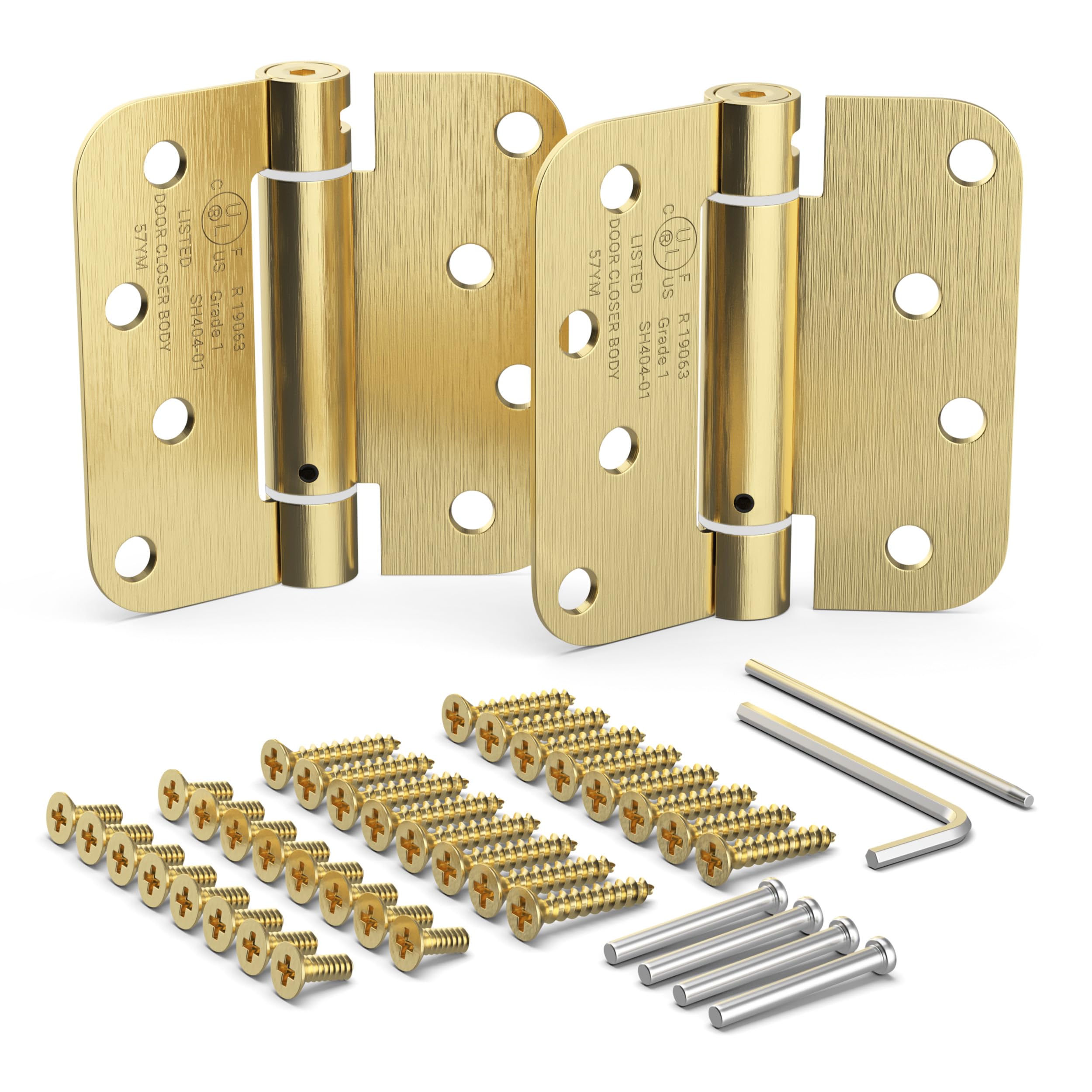
A satin brass finish on an iron hinge with a full eight-hole pattern per pair.
The satin brass finish is the first thing you notice, and it is genuinely uncommon on this list — most spring hinges come in satin nickel, brushed nickel, or matte black. These are 4 inch by 4 inch UL Listed hinges in iron with a satin brass finish, 5/8″ radius corners, and a full eight-hole pattern (four staggered “W” holes per leaf). The kit includes an adjusting hex wrench plus Philips flat head wood screws and Philips flat head machine screws. Adjustable spring tension makes them suitable for the full range of doors, from a front entrance down to a garage door.
Functionality and ease of installation are what owners talk about most. One put them on a three-hinge front door, using the top and bottom positions, and reports the install went quickly and the tension adjusts easily. Another fitted a custom half-door to block dogs, and the lightest tension setting was all it took. The most common use case in reviews is the garage service door — a pair swapped straight in and closing reliably under spring force. Owners say the doors no longer hold themselves open and no longer rattle the windows when they shut.
Two practical notes before you commit. First, the hinge radius on this pair runs slightly larger than some original hardware, so one owner had to sand the door jamb to clear it. Second, the included screws run short for a heavy door, and installing longer ones is the fix — one owner flagged those short screws as the only reason the sturdiness rating came down a notch. Get the tension right on install and this is a hinge most people never think about again.
The one to reach for when: your door hardware is warm-toned and you want a self-closer that matches without going nickel.
Do this before you install: swap the included screws for longer ones on a heavier door, and check the jamb for radius clearance.
Pick it for: brass-toned door hardware where a nickel hinge would clash, or garage service doors that need a reliable self-closing hinge in a durable finish.
Choose a different finish if: you want a factory match with silver or black door hardware — this is the one warm-toned pick here.
Understanding the Specs
Screw Hole Pattern
The number of screw holes on each hinge leaf is the single biggest factor in whether a swap goes fast. A standard residential cutout uses three or four holes per leaf; some heavier hinges use more. If you buy a hinge with a different hole count than the one already in the door, you are filling and re-drilling, which is where alignment slips. Count the holes on one old hinge leaf before you shop, and match the pattern. On this list, Cauldham carries 12 holes across the pair, and Houseables uses a staggered “W” pattern with eight. Hinges with thicker barrels also need the door edge routed slightly, so check the thickness figure — anything over 2.7mm may require trimming the door or jamb.
Weight Capacity and Hinge Count
Spring hinges are load-rated, so the number of hinges you install is dictated by how much the door actually weighs, not how tall it is. Most light interior doors run fine with a single hinge under 40 lbs; a solid-core interior door typically needs two hinges; heavy exterior doors or solid slabs usually want two or three, and manufacturers often recommend using spring hinges at the top and bottom positions while leaving a standard hinge in the middle. When in doubt, use more than one spring hinge. Two hinges pull together for a firmer close, and heavy doors often need that pair to fully latch rather than simply move.
Tension Adjustability
Every spring hinge here ships with a hex wrench or tension tool, and using it correctly is the difference between a quiet close and a slamming door. The tension adjustment rotates the internal spring to change how much force the door feels as it swings shut. Most doors land in the middle range — pick the lower setting first and increase a slot at a time until the door closes cleanly. Springs do settle in over the first few days, so expect to loosen the tension after break-in on heavier doors.
Radius Corners and Size
Door hinges are sold in two main square sizes: 3.5 inches by 3.5 inches and 4 inches by 4 inches. Both fit residential doors, but you should match your old hinge rather than buying a larger one and hoping. The corner radius matters just as much — 5/8″ radius corners are the most common and are what every pick on this list uses, but if your old hinges have square corners, you will likely need to trim the jamb slightly to fit a radius hinge. Check before you order to avoid a return.
FAQ
Will a self-closing hinge fit my existing door and screws?
How many hinges do I need for a heavy door?
What does adjustable tension actually control on the spring?
Can I use self-closing hinges on an exterior or fire-rated door?
Why does my door slam instead of closing gently?
Do I need to take the door off to install self-closing hinges?
Will the finish match my existing door hardware?
How long do self-closinghinges last before the spring wears out?
Do I need three hinges instead of two for a solid core door?
What is the difference between 3.5 inch and 4 inch spring door hinges?
Final Thoughts: The Verdict
For most doors — a solid-core interior, a heavy garage door, an exterior slab — the auto-closing door hinge that earns the top spot is the Cauldham 2 Pack Heavy-Duty 3-1/2″ because the 12-hole pattern, solid steel construction, and 5/8″ radius corners combine to make it the most forgiving drop-in fit on the list, backed by UL Listing for fire-rated doors. If your door is lighter and you want the value tier with a genuinely strong pair rating, the Luxbaro pair carries 85 to 100 lbs and closes factory-gentle once tension is set. And for a busy interior door on a rental or apartment, the KIW pair’s 1,000,000-cycle rating makes it the workhorse pick. Pick by the holes and the door weight, set the tension a slot at a time, and the door will close itself every time you walk through.
How We Picked
We do not accept paid placement. Every pick is matched to a real buyer and a real use-case; we do not hands-on test units.
Sources & Methodology
Specifications: manufacturer listings and product documentation. Review insights: verified customer reviews, as of September 2026. Pricing: not shown on this page (it changes often); check the current price via the retailer link.
As an Amazon Associate, KitchPrep earns from qualifying purchases. This does not affect which products we feature.
Related Guides
