
If rice shows up on your table more nights than not, your rice cooker is basically part of the family. From fast weeknight stir‑fries to weekend sushi rolls and big batches of congee, the right cooker quietly decides whether dinner feels “fine” or truly comforting.
This guide is here to help you choose the best asian rice cooker for your kitchen—one that can handle fluffy jasmine, sticky sushi rice, nutty brown rice and everything in between, without needing you to hover over a pot.
We’ll walk through what really matters in an Asian‑style rice cooker, explain the difference between simple on/off models and smarter fuzzy‑logic machines, then dive into fifteen carefully chosen cookers you can grab on Amazon today—from tiny countertop pandas to big family workhorses and multi‑cookers that do much more than rice.
How to Choose the Best Asian Rice Cooker for Your Kitchen
Before you scroll straight to the product list, it’s worth taking a minute to think about how rice actually fits into your life. That little bit of planning is what keeps you from buying a fancy machine that doesn’t quite match your daily routines.
1. Start with how you really eat rice
Run through a few quick questions:
-
How often is rice on the table?
If you cook once or twice a week, a simple digital or one‑button cooker might be all you need. If rice is a daily staple, investing in a fuzzy‑logic or “neuro fuzzy” model really pays off over the years. -
What kinds of rice do you love?
Short‑grain for sushi, jasmine for Thai and Vietnamese dishes, fragrant basmati, chewy multigrain blends, brown rice or GABA rice—some cookers handle these better than others. Japanese and Korean brands tend to be strongest when it comes to Asian varieties and porridge. -
Do you batch‑cook?
Many Asian households keep rice in “keep warm” mode for hours so anyone can scoop a bowl at any time. If that’s you, look for reliable keep‑warm and good condensation management so the rice doesn’t dry out or go yellow.
2. Choose your cooker type
Most Asian‑style rice cookers fall into three broad families:
-
Simple one‑button cookers
These are the classic cook/warm models many of us grew up with—drop in rinsed rice and water, flip the switch, and walk away. They’re affordable, tough, and brilliant for plain white rice, but offer less control for brown, GABA or specialty grains. -
Micom / fuzzy‑logic cookers
These use a microcomputer to watch temperature changes in the pot and make tiny adjustments throughout the cooking cycle. The result? Better texture across different rice types, plus settings for sushi, porridge, brown, mixed grains and more. -
Multicookers that also do rice
Think Instant Pot: pressure cook, slow cook, yogurt and rice in one device. They’re incredibly versatile and great for small kitchens, but a dedicated Asian rice cooker will usually give you more control over texture.
Once you know which type makes sense, you’re no longer comparing everything to everything—you’re narrowing in on the style that fits your kitchen and habits.
3. Match capacity, household size & footprint
Rice cookers are usually sized by uncooked cups using the smaller Asian “gou” cup (about 3/4 of a US cup). As a rough guide:
- 3–3.5 cup mini cookers – Perfect for one or two people, dorms and tiny kitchens.
- 5.5–6 cup cookers – The sweet spot for many Asian families of 3–5 people.
- 8–10 cup cookers – Best for big families, shared houses, or people who batch‑cook rice.
Before you click “buy”, quickly check:
- Countertop space – These are “leave out” appliances. Measure both footprint and height.
- Where the lid opens – Most lids hinge from the back; make sure they clear any shelves.
- Storage – If you plan to tuck it away between uses, choose a lighter, more compact body.
4. Features that genuinely make rice better
Some extras are marketing. Others you’ll use every single week. Prioritise:
- Fuzzy logic / micom – If you cook different grains or care about perfect texture, this is a big upgrade over basic cook/warm models.
- Dedicated rice settings – Separate programs for white, sushi, jasmine, brown, GABA or porridge take the guesswork out of timing and soak periods.
- Keep warm & extended keep warm – Essential if people eat at different times. Good Asian cookers keep rice moist and tasty for many hours, not dried or crunchy.
- Delay timer – Set rice in the morning and have it ready when you get home from work, or wake up to hot congee.
- Reheat cycle – Gently brings cooled rice back to serving temperature without drying it out.
- Steam tray / multi‑cook options – Great for dumplings, veggies or one‑pot meals on top of your rice.
- Removable inner lid & dew collector – Make deep cleaning easier and stop drips from watering down the top layer of rice.
Features you can usually ignore: smartphone apps you’ll never open, overly cutesy animations, or dozens of preset menus you’ll rarely use.
5. Build quality, inner pot & cleaning
In an Asian household, a rice cooker might be used daily for a decade or more. A little extra quality up front often works out cheaper than buying two or three budget units over the same period.
- Inner pot thickness – Thick, heavy pots (especially from Japanese and Korean brands) spread heat evenly and are more forgiving with water ratios.
-
Nonstick vs stainless vs ceramic
Most cookers use a nonstick coating that makes rice release effortlessly. Ceramic‑coated bowls (like Yum Asia) offer a PFAS‑free option. A few multicookers use bare stainless steel—which is very durable but a bit stickier. - Lid design – Hinged lids with a removable inner plate and steam cap are easier to wash and less likely to drip on your rice.
- Brand track record – Names like Zojirushi, Tiger, Cuckoo, Toshiba and Aroma have been refining rice cookers for decades. That experience shows in everyday details: water lines that make sense, keep‑warm modes that just work, and parts that still feel solid after years of use.
Quick rule of thumb: If rice is central to your cooking, treat the rice cooker like a core appliance, not a gadget. Spend for reliability and texture. If rice is occasional, a simpler digital or one‑button model will be perfectly satisfying.
Quick Comparison: 15 Best Asian Rice Cooker Picks
Here’s a bird’s‑eye view of the fifteen rice cookers we’ll be reviewing. They’re ordered roughly from budget‑ friendly starter models through to premium Japanese “neuro fuzzy” machines.
On smaller screens, swipe left or right to see the full table.
| Model | Type | Capacity | Best match | Amazon |
|---|---|---|---|---|
| Aroma ARC‑914SBD | Budget digital | 4 cups uncooked (8 cooked) | First “real” rice cooker for small households | Amazon |
| Hamilton Beach 37518 | Multi‑cooker | 4 cups uncooked (8 cooked) | Rice, grains & hot cereal on a budget | Amazon |
| COMFEE’ 12‑Cup Rice Cooker | Multifunction fuzzy | 6 cups uncooked (12 cooked) | Budget‑friendly fuzzy logic for families | Amazon |
| CUCKOO CR‑0655F | Korean fuzzy | 6 cups uncooked (12 cooked) | Sticky, Korean‑style white rice on a budget | Amazon |
| CUCKOO CR‑0675FW | Korean fuzzy | 6 cups uncooked (12 cooked) | Busy families that keep rice warm all day | Amazon |
| CUCKOO CR‑0632F | Korean fuzzy | 6 cups uncooked (12 cooked) | GABA, multigrain & long keep‑warm | Amazon |
| Toshiba Mini 3‑Cup | Mini fuzzy | 3 cups uncooked (up to 6 cooked) | Small homes, studios & office kitchens | Amazon |
| Instant Pot Duo Plus 6‑Qt | 9‑in‑1 multicooker | 6‑quart pot | Rice plus pressure cooking, soups & more | Amazon |
| Yum Asia Panda | Compact fuzzy | 3.5 cups uncooked | Small households wanting premium texture | Amazon |
| Tiger JBV‑A10U Tacook | Micom + steamer | 5.5 cups uncooked | One‑pot dinners: rice plus main at once | Amazon |
| Tiger JAZ‑A18U‑FH | One‑button classic | 10 cups uncooked | Families who just want lots of plain rice | Amazon |
| Zojirushi NS‑RPC18FJ | One‑touch | 10 cups uncooked | Simple, reliable Japanese cooker for big pots | Amazon |
| Toshiba TRCS01 6‑Cup | Micom / fuzzy | 6 cups uncooked (12 cooked) | Best value for mixed Asian & Western meals | Amazon |
| Zojirushi NS‑TSC10 | Micom / fuzzy | 5.5 cups uncooked | Do‑it‑all Japanese cooker with steaming tray | Amazon |
| Zojirushi NS‑ZCC10 Neuro Fuzzy | Premium neuro fuzzy | 5.5 cups uncooked | Rice‑obsessed households & sushi lovers | Amazon |
In‑Depth Reviews: 15 Strong Asian Rice Cookers
Now let’s zoom in on each cooker. We’ll start with budget‑friendly options and climb steadily into the premium Japanese and Korean machines so you can match performance, capacity and price to how you actually cook.
1. Aroma ARC‑914SBD – Tiny Price, Real Upgrade Over a Pot

If you’ve never owned a dedicated rice cooker and you’re tired of babysitting a pot on the stove, this little Aroma is a gentle but meaningful upgrade. It’s inexpensive, compact and gives you proper one‑touch programs for white and brown rice, plus a steam tray for dumplings or vegetables.
Why it punches above its price
- Sensor‑logic cooking automatically adjusts heat so rice comes out fluffy, not scorched.
- Flash Rice mode shaves down the cook time when you forgot to start the rice.
- Steam tray included so you can steam veggies or frozen dumplings while rice bubbles away below.
- 15‑hour delay timer makes weeknight dinners or make‑ahead lunches much easier.
Good to know
- The nonstick pot is on the thinner side—treat it gently and avoid metal utensils to prevent scratches.
- The included rice cup is a 3/4‑cup “gou”; the water lines are calibrated to that, not a US cup.
- Capacity is ideal for 1–3 people; larger families will want something in the 5.5–6‑cup range.
Ideal for: first‑time rice cooker owners, smaller households, and anyone who wants simple, reliable rice without spending much.
2. Hamilton Beach 37518 – Rice, Grains & Hot Cereal Workhorse

Hamilton Beach’s compact cooker is aimed at people who want more than just rice. It handles white rice, whole grains and hot cereal, and it comes with a clever basket that works as both a steamer and a rinsing colander. Think quinoa, oats and steamed fish as much as jasmine rice.
Where it shines
- Simple preset buttons for white rice, whole grains and hot cereal—great if you’re new to rice cookers.
- Steam/rinse basket lets you rinse rice properly, then use the same insert to steam veggies or seafood.
- Countdown timer & auto warm so you always know how long is left and never accidentally overcook.
- Ceramic‑coated pot is PFAS‑free and dishwasher‑safe, which is rare at this price.
Trade‑offs
- It cooks a bit slower than more powerful Asian brands—plan on a little extra time for brown rice and grains.
- Programs are less specialised; you won’t find sushi, GABA or porridge modes here.
- Texture tends to be a touch drier than what Japanese and Korean cookers produce, which some people actually prefer.
Ideal for: people who want one small appliance for rice, oats and grains, and who lean toward a slightly drier rice texture.
3. COMFEE’ 12‑Cup – Versatile, Family‑Friendly & Surprisingly Smart

COMFEE’s 6‑cup (12 cups cooked) machine is where fuzzy‑logic brains start to show up at an accessible price. Between the 11 cooking programs and the built‑in handle, it’s a very easy cooker to live with for busy families who eat rice most days.
Why people love it
- Fuzzy logic control senses moisture and adjusts time and temperature for consistently fluffy rice.
- 11 programs covering white, brown and sushi rice, plus pasta, soup, stew and sauté.
- Large capacity but compact footprint, helped by the neat top handle for carrying or storage.
- Removable lid parts and nonstick pot make hand‑washing quick and painless.
Things to keep in mind
- The “quick” rice program is around 30 minutes—not Instant‑Pot fast, but better texture than cheap cookers.
- Condensation can drip when you open the lid; keep a cloth handy or open it slowly over the sink.
- The interface is icon‑heavy. It’s simple once you’ve used it a few times, but you may glance at the manual initially.
Ideal for: families wanting fuzzy‑logic quality and lots of versatility without paying premium Japanese prices.
4. CUCKOO CR‑0655F – Classic Korean‑Style Rice on a Budget

CUCKOO is to many Korean households what Zojirushi is to Japanese ones: the default rice cooker brand. The CR‑0655F brings that DNA into a compact, affordable model that still uses fuzzy logic and offers multiple menu options for everyday Asian cooking.
Standout strengths
- 9 cooking modes for white (glutinous) rice, brown, porridge, steam and multi‑cook dishes.
- My Mode setting lets you tweak soaking and cooking times to dial in your perfect texture.
- Excellent keep‑warm that holds rice soft and moist for hours without burning the bottom.
- Compact footprint for a 6‑cup cooker, making it easy to leave out on the counter.
Less ideal bits
- Water‑level markings on the dark inner pot can be hard to see; many people simply use the finger‑knuckle method.
- No steamer basket is included, so steaming dumplings or veggies needs a separate setup.
- The lid pops open quite firmly—keep a hand on it so the cooker doesn’t rock back.
Ideal for: smaller families or couples who prefer Korean‑style sticky white rice and want a trusted brand without going high‑end.
5. CUCKOO CR‑0675FW – Everyday Workhorse with Auto Clean

The CR‑0675FW is like a slightly more grown‑up cousin of the 0655F. You still get CUCKOO’s dependable fuzzy logic for white and brown rice, but with a sleeker design, quick‑cook options and a handy self‑clean setting that blasts the interior with steam.
Why it’s great for families
- Quick white‑rice program that can have rice ready in under 30 minutes in many cases.
- Timer + keep‑warm make it easy to have hot rice available across different mealtimes.
- Self‑clean mode uses steam to loosen residue from the lid and steam path.
- Lightweight body is easier to move or store than some heavier Japanese cookers.
Worth noting
- The nonstick pot is durable but still needs plastic utensils—no metal spoons if you want it to last.
- The fuzzy‑logic system isn’t as advanced as CUCKOO’s top‑end models, but that’s reflected in the price.
- When you press the lid‑release button, the lid springs up quite energetically—catch it with your other hand.
Ideal for: busy households that cook rice almost daily and want a user‑friendly Korean cooker they don’t have to fuss over.
6. CUCKOO CR‑0632F – GABA & Multigrain Specialist

If you’re serious about brown rice, GABA rice or multigrain blends, the CR‑0632F is one of CUCKOO’s best mid‑range options. It’s designed as a true everyday Korean family cooker with presets that actually correspond to how people in rice‑first households cook.
What stands out
- 9 menu programs covering white, GABA, multigrain/brown, porridge and slow cook options.
- Excellent keep‑warm that can hold rice in good condition for up to a couple of days if needed.
- Detachable inner lid and excess‑water tray make deep cleaning straightforward.
- Compact but capable – the 6‑cup capacity feeds a typical family without dominating the counter.
Minor compromises
- The touch‑panel buttons can feel a bit stiff and benefit from pressing with a firm finger.
- Learning the menu labels takes a moment; once you find your go‑tos, you’ll probably stick to 2–3 programs.
- As with many Asian cookers, the English manual is detailed but dense—worth reading once, though.
Ideal for: health‑minded rice lovers who cook brown, GABA or multigrain rice alongside classic white.
7. Toshiba Mini 3‑Cup – Compact Fuzzy Logic That Travels Well

Toshiba’s mini cooker is aimed squarely at singles, couples and small kitchens. It still packs full fuzzy‑logic brains and a surprisingly rich set of programs into a tiny footprint that’s easy to carry by the integrated handle or store in a cupboard.
Why it’s easy to live with
- Eight cooking functions including white, quick, brown, mixed grain, porridge, slow cook, cake and egg.
- Fuzzy logic control quietly adjusts the cook so even tiny 1‑cup batches come out well.
- 24‑hour delay timer and a keep‑warm/reheat mode that’s perfect for solo mealtimes.
- Removable steam vent and inner lid keep lingering smells and starch build‑up under control.
Potential downsides
- Like many fuzzy cookers, a full white‑rice cycle takes around 45–50 minutes—worth it for the texture, but not ultra fast.
- Capacity tops out at about 6 cups cooked; if you entertain often, consider a 5.5‑ or 6‑cup model instead.
- The nonstick pot is excellent, but you won’t get the crispy “okoge” bottom crust some people enjoy.
Ideal for: one or two people, studio apartments, office kitchens and anyone who wants high‑quality rice from a genuinely small machine.
8. Instant Pot Duo Plus 9‑in‑1 – For Rice and Everything Else

Strictly speaking, the Duo Plus is a pressure multicooker, not a traditional Asian rice cooker—but it earns a spot here because many households want one appliance that can do both rice and main dishes. Used well, it does an impressively good job with white and brown rice while also handling stews, beans and yogurt.
Where it excels
- 9 cooking functions including pressure cook, slow cook, sauté, rice, yogurt, sous vide and steam.
- 15 smart programs take the edge off learning pressure cooking from scratch.
- Stainless‑steel inner pot is durable, easy to scrub and happy to sear meats before cooking rice or stews.
- Rice results improve once you dial in ratios—many owners report perfectly fluffy rice in about 15 minutes of cook time.
Rice‑specific limitations
- There’s less nuance than a dedicated Japanese or Korean cooker; you won’t find separate sushi, porridge or GABA modes.
- The sauté mode can struggle to hold high heat with lots of food in the pot, so browning large batches takes patience.
- The interface is busier than a rice‑only machine; non‑techy cooks may prefer a simpler panel.
Ideal for: small kitchens and gadget lovers who want one appliance that pressure cooks, slow cooks and still turns out very good rice once you learn it.
9. Yum Asia Panda – Cute Mini, Seriously Good Rice

Don’t let the kawaii exterior fool you: Panda is a serious little cooker. Yum Asia built it around a thick ceramic “Ninja” bowl and a seven‑phase fuzzy‑logic algorithm, and it has quietly become a favourite in independent tests for people who cook smaller amounts of rice but still care deeply about texture.
Why enthusiasts rave about it
- Advanced fuzzy‑logic profile optimised specifically for white, short‑grain/sushi and brown rice.
- 3D heating wraps the bowl in heat from all sides, reducing hotspots and gumminess.
- Ceramic‑coated inner bowl is PFAS‑free, very nonstick and clearly marked with water lines.
- Extra functions include porridge, steam, slow cook and cake for surprisingly varied one‑pot cooking.
Things to be aware of
- The bowl is thick and tough but ceramic—drop it and it can chip, and replacements aren’t cheap.
- The LED interface is bright but not the most intuitive; expect a short learning curve with the “Smart Button” layout.
- Capacity maxes out at about three Japanese cups; great for 1–3 people, not ideal for big gatherings.
Ideal for: couples and small households who want near‑restaurant rice quality from a compact, cute machine.
10. Tiger JBV‑A10U – Tacook System for Rice + Main Dish
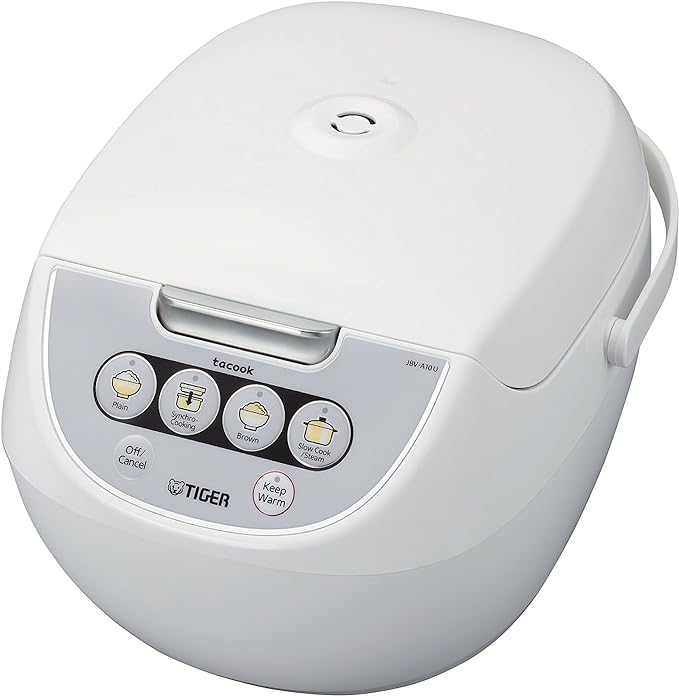
Tiger’s tacook system is brilliant: you cook rice in the bowl while a tray above steams your main dish in the rising heat. Done right, you plate up perfectly cooked rice with salmon, chicken, tofu or veggies in one shot, without flavour transfer into the rice.
Why it simplifies dinner
- Four core programs (plain rice, brown rice, slow cook and steam) keep the interface friendly.
- Tacook tray lets you cook a main and rice together, timed to finish at the same moment.
- Micom control adjusts cooking time for different rice types and amounts.
- Keep‑warm up to 12 hours means no rushing to the table the second rice finishes.
Limitations
- There’s no visible countdown timer—just a light that changes when rice switches to warm, so impatient diners may ask “is it done yet?” a lot.
- The exterior is light plastic; it’s sturdy in practice but doesn’t feel as premium as high‑end Zojirushi.
- For very rice‑focused households, you might eventually want more specialised programs than the four here.
Ideal for: busy families, students and anyone who loves the idea of one‑button, one‑pot rice bowl dinners.
11. Tiger JAZ‑A18U – 10‑Cup One‑Button Rice Tank
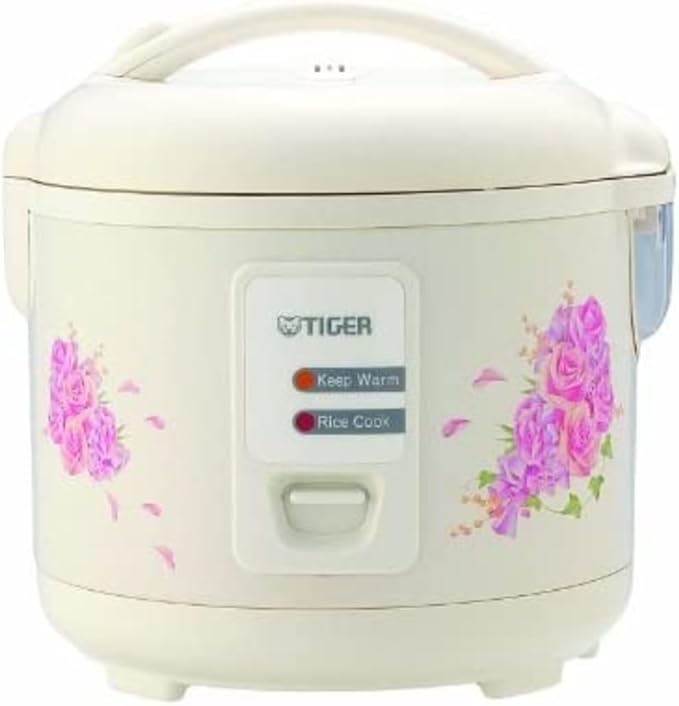
This is the kind of simple, big Tiger cooker you’ll see in multi‑generation households across Asia. There’s no computer, no menu system—just a lever that cooks rice and then flips to keep‑warm. For many families, that’s all they want and need.
What it does well
- Huge capacity easily handles rice for big families, potlucks and meal prep.
- Dead‑simple controls – plug it in, press the switch, and walk away.
- Nonstick inner pot is easy to scoop from and clean, especially if you rinse rice properly first.
- Retractable power cord keeps the counter tidy when you’re not using it.
Where it shows its age
- There’s no “off” button—when it’s plugged in it’s either warming or cooking, so you unplug it to fully shut down.
- Texture control is all about water ratio and soak time; there are no fuzzy‑logic smarts to rescue you.
- The floral design is charmingly old‑school, but not everyone wants that look in a modern kitchen.
Ideal for: big rice‑loving families and anyone who wants a tough, no‑nonsense cooker that simply makes a lot of white rice quickly.
12. Zojirushi NS‑RPC18FJ – One‑Touch Japanese Reliability

Think of the NS‑RPC18FJ as the polished Japanese version of a classic one‑button cooker. It’s built around a triple‑heater system that warms from the bottom, sides and lid, giving more even results than many cheaper cook/warm units while staying very easy to use.
Why it’s so popular long‑term
- One‑touch operation – add rinsed rice and water, close the lid, press cook. That’s it.
- Triple‑heater design helps cook large 8–10 cup batches evenly.
- Lock‑tight lid keeps steam and moisture where they belong; the dew collector catches condensation.
- Nonstick pan & removable inner lid make everyday cleaning very quick.
What you don’t get
- No dedicated brown, sushi or porridge programs—you can cook them, but you’ll need to experiment with water ratios.
- No delay timer or reheat mode; if those are important, look at micom models later in this list.
- It takes up a fair chunk of counter space; check dimensions if your kitchen is tight.
Ideal for: larger families who mostly eat white rice and want Japanese build quality without paying for a full fuzzy‑logic system.
13. Toshiba TRCS01 – Best Balance of Price, Features & Rice

The TRCS01 is one of the strongest “middle lane” choices in this whole guide. It uses a 3D heating system and fuzzy‑logic control to deliver consistently excellent rice, but it stays more affordable than the premium Zojirushi machines and keeps the interface nice and straightforward.
Highlights
- Seven rice and grain programs including white, mixed, brown, multigrain, porridge and quick.
- 3D heating and six‑step cooking for even texture from top to bottom of the pot.
- Two delay timers so you can schedule rice for both breakfast porridge and dinner.
- Solid build quality with a thick nonstick inner pot and removable steam cap for cleaning.
Trade‑offs
- Full white‑rice cycles take about 45–50 minutes; the quick cycle is faster but slightly less perfect.
- The included steam tray is plastic; it works well but some people would prefer stainless steel.
- It has a larger footprint than mini cookers; best on a dedicated corner of the counter.
Ideal for: households that eat lots of rice and want near‑premium texture and features without jumping to the very top price tier.
14. Zojirushi NS‑TSC10 – Micom Rice Cooker With Extras

The NS‑TSC10 is many people’s first “serious” Japanese rice cooker. It uses microcomputer‑controlled fuzzy logic to adjust cooking based on rice type and quantity, and it adds a steaming basket and even cake‑baking capability on top of the usual white and brown rice modes.
What makes it special
- Multiple white‑rice textures plus brown, mixed, sweet, porridge and quick‑cook settings.
- Automatic keep‑warm, extended warm and reheat modes that protect texture over many hours.
- Retractable power cord and easy‑clean stainless exterior that still looks good years later.
- Included steam tray lets you steam veggies or dumplings while the rice cooks below.
Minor drawbacks
- Cook times are on the longer side—plan on close to an hour for many white‑rice cycles and more for brown.
- The musical chime is charming at first; you can switch it to beeps, but you can’t turn it completely silent.
- It’s not quite as nuanced or customisable as the Neuro Fuzzy flagship, though many households will never miss those extras.
Ideal for: families who cook rice several times a week and want Zojirushi reliability plus a useful set of steaming and porridge features.
15. Zojirushi NS‑ZCC10 Neuro Fuzzy – Gold Standard for Asian Rice
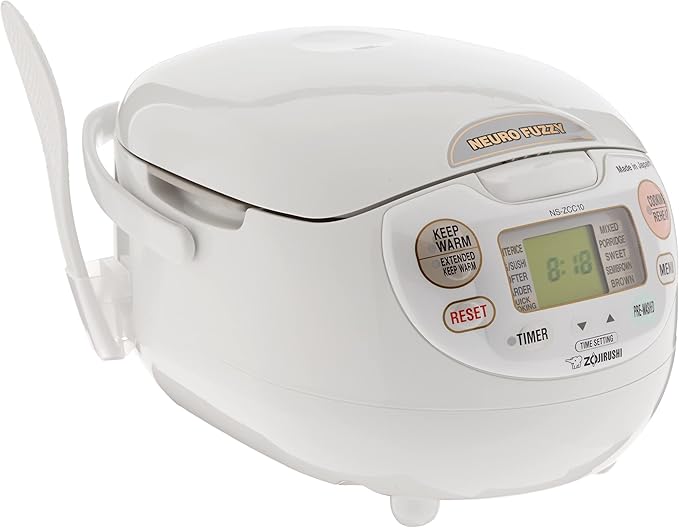
If there’s one cooker in this list that rice nerds point to as “the one”, it’s the NS‑ZCC10. Zojirushi’s Neuro Fuzzy technology constantly adjusts heat and timing throughout the cycle, and the result is rice with remarkable consistency and control across white, sushi, brown and porridge settings.
Why it’s worth the splurge
- Advanced Neuro Fuzzy logic that fine‑tunes cooking based on feedback from the pot.
- Extensive menu options including multiple white‑rice textures, brown, semi‑brown, sweet and porridge.
- Thick spherical inner pan promotes exceptionally even heating and is easy to handle with its side grips.
- Excellent keep‑warm and reheat functions that keep rice tasting freshly cooked for days, not hours.
Reasons to pause
- It’s the priciest cooker here; if you only eat rice occasionally, you won’t tap into its full value.
- Full cycles (especially brown and mixed rice) are leisurely—this cooker cares more about texture than speed.
- The design is more functional than sleek; it looks like what it is: a serious Japanese rice cooker.
Ideal for: households where rice is on the table almost every day, sushi fans, and anyone who wants to “set and forget” perfect rice for the next decade.
Why Asian‑Style Rice Cookers Taste Different (and How to Use Them)
If you’ve only ever cooked rice in a pot or a basic cook/warm machine, an Asian fuzzy‑logic cooker can feel almost magical. But there’s real science and smart design behind that fluffy, glossy bowl of rice.
Fuzzy logic vs. simple cook/warm
- Simple cookers heat until the thermostat senses that all free water has boiled off, then flip to keep‑warm. They’re cheap and reliable, but easily give you under‑ or over‑done grains if your ratios are off.
- Micom and fuzzy‑logic cookers monitor temperature changes in finer detail. They can soak the rice, bring it up to a precise simmer, hold that temperature, then rest and steam the rice at the end.
- Neuro fuzzy cookers go further, adjusting the pattern on the fly depending on how much rice is in the pot, what type it is, and how quickly the temperature is changing.
That extra intelligence is what lets you choose “soft” or “firm” white rice, or get plump, separate grains of brown rice without chewing through chalky centres. It’s also why these machines take longer—they’re running a carefully staged cooking curve rather than just boiling water as hard as they can.
Tips for restaurant‑quality rice at home
- Rinse properly – Wash rice in several changes of water until it’s mostly clear. This removes excess starch and gives you cleaner flavour and better texture.
- Use the cooker’s cup and lines – Most bowls are calibrated to the included “gou” cup. If you switch to US cups, ignore the lines and follow the ratio on your rice bag instead.
- Let it rest – When the cooker beeps, give the rice 5–10 minutes on warm before opening. This final steam makes a big difference.
- Fluff from the edges – Use the paddle to gently turn the rice from the sides toward the centre to release steam without mashing the grains.
- Respect keep‑warm – For the best flavour, aim to eat white rice within 12–24 hours on warm, even if your cooker can go longer.
Once you get used to letting the cooker handle the science, you’ll wonder why you ever watched a pot—especially when you start planning meals around having perfect rice always ready to scoop.
FAQ: Asian Rice Cookers, Answered
Is a fuzzy‑logic rice cooker really worth the extra money?
How big of a rice cooker should I buy?
Can these cookers handle jasmine, basmati and sushi rice?
How long can I safely leave rice on “keep warm”?
Do I still need a separate steamer if my rice cooker has a tray?
Is a multicooker like the Instant Pot as good as a dedicated Asian rice cooker?
Final Thoughts: Choosing Your Best Asian Rice Cooker
When you get the right rice cooker, it quietly upgrades a lot of meals: weekday stir‑fries, curries, sushi nights, Korean BBQ spreads, lazy leftover lunches and comforting bowls of congee when someone’s under the weather.
Here’s a quick way to narrow down this list of fifteen into a short personal shortlist:
- Want the absolute best rice, budget allowing? Go straight to Zojirushi NS‑ZCC10. If you’d like something a little more affordable but still premium, look at Zojirushi NS‑TSC10 or Toshiba TRCS01.
- Love Korean‑style rice and GABA or multigrain? Focus on the CUCKOO trio: CR‑0632F, CR‑0675FW or CR‑0655F depending on your budget.
- Cooking for one or two in a small space? Check out the compact fuzzy‑logic options: Yum Asia Panda and Toshiba Mini 3‑Cup.
- Need easy one‑pot meals? Tiger JBV‑A10U tacook lets you cook rice and a main together, while the Instant Pot Duo Plus covers rice and pressure‑cooked stews in one appliance.
- Shopping on a tighter budget? Start with Aroma ARC‑914SBD, Hamilton Beach 37518 or COMFEE’ 12‑Cup and then see if it’s worth stretching to a fuzzy‑logic model.
- Want simple, big‑batch reliability? Look at the classic cook/warm machines: Tiger JAZ‑A18U or Zojirushi NS‑RPC18FJ.
Any of the cookers above can become your best asian rice cooker once you match its strengths—capacity, programs, budget and style—to your own kitchen. Measure your space, think about how often you really eat rice, decide how much control you want over texture, and then pick the machine you’ll feel happy leaving out on your counter every day.
Do that, and the hardest part of dinner becomes choosing what delicious thing to serve on top of your perfect bowl of rice.
