
If you love the idea of homemade bread, pillow‑soft rolls, or cakes that don’t come from a box, a stand mixer quietly becomes the MVP of your kitchen. It turns “I should bake more” into “Wow, that was easy” by doing the hard mixing and kneading while you get on with the fun parts.
This guide is built to help you choose a best affordable stand mixer that actually fits your life: strong enough to tackle dough, compact enough for real‑world counters, and simple enough that you’ll actually use it on busy weeknights—not just on holidays.
We’ll walk through the features that matter (and the ones that are just marketing fluff), talk honestly about where budget mixers shine and where they struggle, and then review fifteen stand mixers you can order on Amazon right now— from ultra‑compact 3‑quart cuties to family‑size 6‑quart workhorses.
In this article
How to Choose the Best Affordable Stand Mixer for Your Kitchen
Before you fall in love with a particular color or deal, it helps to be brutally honest about how you cook and bake. A little planning here prevents you from buying something that looks cute on the counter but struggles with the recipes you actually make.
1. Start with how you really bake (and cook)
Ask yourself a few quick questions:
-
What do you make most often?
If you mostly whip cream, make boxed cake mixes, or mix brownies, you can absolutely live with a lighter‑duty mixer. Compact models and hand/stand combos will feel like a huge upgrade from a whisk. -
How serious are you about bread and pizza?
Yeast dough is the “stress test” for any mixer. If you’re kneading weekly, look for a stronger motor (500W+), metal gears or a DC motor, and bowls in the 4.8–6 quart range. If you only make a loaf at the holidays, almost any stand mixer here can handle it with a bit of patience. -
How big are your batches?
Some of the mixers below are perfect for a couple or single baker but feel cramped if you’re trying to feed a big family or do holiday cookie marathons. Think about your biggest, messiest baking day—not just everyday use.
2. Decide what mixer type actually fits your life
Most budget‑friendly mixers fall into three main buckets:
- Compact stand mixers – These look like “mini KitchenAid” machines with a fixed bowl on a stand. They’re fantastic for small kitchens, light to medium baking, and anyone tired of holding a hand mixer for ten minutes.
- Hand/stand combos – The mixer pops off the stand to become a regular hand mixer. You get hands‑free mixing for batters plus the flexibility of a handheld tool for quick jobs, usually at the lowest price point.
- Full‑size affordable stands – Bigger bowls (4.8–6 quarts), beefier motors, and more stable bases. These are the best options if you bake weekly, especially bread and pizza.
Once you know which type fits your habits and space, it’s much easier to compare apples to apples instead of getting lost in wattage numbers and color options.
3. Match bowl size, footprint, and storage
For stand mixers, capacity and footprint matter just as much as raw power:
- 2.9–3.2 quarts – Ideal for one or two people, small kitchens, and light baking.
- 3.5–4 quarts – A sweet spot for casual families: enough room for standard cake recipes and cookie batches.
- 4.8–6 quarts – Best for bread bakers, batch cooking, and households that regularly bake for a crowd.
Before you buy, grab a tape measure and check:
- Counter space and height – Especially under cabinets; tilt‑head mixers need room to open.
- Where you’ll store it – A mixer that lives on the counter gets used far more than one buried in a cabinet.
- Bowl shape – Taller, narrower bowls (common on 5–6 qt models) are great for dough but may be awkward for tiny batches.
4. Features that genuinely help (vs. marketing fluff)
On affordable mixers, a few thoughtful features matter more than fancy extras:
- Planetary mixing – The beater travels around the bowl rather than just spinning in place. That means fewer dry streaks and less scraping.
- Multiple attachments – At minimum you want a whisk, flat beater, and dough hook. Some also include spatulas or egg separators.
- Speed range you’ll actually use – Six to ten speeds is plenty. What matters is a gentle “stir” speed and a strong top speed for whipping.
- Splash guard – A simple but underrated upgrade that keeps flour and sugar from decorating your backsplash.
- Double dough hooks or spiral hooks – These can make kneading faster and gentler on motors compared with simple “C” hooks.
- Timer and auto‑shutoff – Found on a few models here, great for hands‑off kneading or whipping.
Things you can usually ignore: huge preset menus, built‑in recipes, or app control. On a stand mixer, thoughtful mechanics matters far more than smart‑home tricks.
5. Build quality, motor type, and noise
Budget mixers have improved a lot in recent years, but there are still meaningful differences:
- AC vs. DC motors – All the mixers on this list use AC motors, which are affordable and perfectly capable for home baking. DC motors (found on some pricier machines) can offer smoother, quieter torque at lower wattage, but they’re less common at this price point.
- Plastic vs. metal housings – Plastic bodies keep weight and cost down. Full‑metal housings (like some FOHERE models) feel more premium and shed heat better.
- Noise and vibration – Suction cups help, but if you’re sensitive to noise, look for mixers that call out lower decibel ratings or quieter operation.
If you expect your mixer to serve as a long‑term baking partner, it’s worth leaning toward better construction, even if that means stepping up a price bracket within the affordable range.
Quick Comparison: Fifteen Best Affordable Stand Mixer Picks
Here’s a bird’s‑eye view of the fifteen mixers we’ll be reviewing. Skim this table to spot the models that match your budget, bowl size, and style, then jump down to their full reviews.
On smaller screens, swipe left or right to see the full table.
| Model | Type | Capacity | Best match | Amazon |
|---|---|---|---|---|
| Holstein 5‑Speed Hand & Stand | Hand/stand combo | 2.9 qt | Ultra‑budget light baking | Amazon |
| OVENTE 3.5 qt | Compact stand | 3.5 qt | Small kitchens, stylish setup | Amazon |
| Hamilton Beach Classic 64655 | Hand/stand combo | 4 qt | Occasional bakers, tight budgets | Amazon |
| Vikaluz 2‑in‑1 3.2 qt | Compact stand | 3.2 qt | Tiny batches, beginner‑friendly | Amazon |
| CKEMU Compact Stand Mixer | Compact stand | 3.5 qt | Beginner bakers, 1–2 people | Amazon |
| DASH Everyday 3 qt | Compact stand | 3 qt | First apartments, small batch baking | Amazon |
| Kitchen in the Box 3.2 qt | Compact stand | 3.2 qt | Light to moderate everyday baking | Amazon |
| Martha Stewart 5.3 qt | Stand | 5.3 qt | Budget bread & everyday baking | Amazon |
| KOCHSTELLE 6.8 qt | Stand | 6.8 qt | Bigger‑batch “serious” baking | Amazon |
| FOHERE All‑Metal 5.8 qt | Stand | 5.8 qt | Families and frequent dough makers | Amazon |
| Plum Chef Dual‑Bowl 5.5+4.5 qt | Stand | 4.5 & 5.5 qt | Dual‑bowl mixing flexibility | Amazon |
| Amazon Basics 5.3 qt | Stand | 5.3 qt | Simple, familiar‑brand bread & baking | Amazon |
| VIVOHOME 6 qt | Stand | 6 qt | Big batches in a compact footprint | Amazon |
| CUSIMAX 5 qt Digital | Stand | 5 qt | Timer‑driven, hands‑off mixing | Amazon |
| Aifeel Dual‑Bowl 8.5+6 qt | Stand | 6 & 8.5 qt | Best dual‑bowl value pick | Amazon |
In‑Depth Reviews: Fifteen Strong Budget Stand Mixers
Now let’s zoom in on each mixer. Use these reviews to match real‑world strengths—like dough handling, noise, bowl size, or footprint—to what matters most in your kitchen.
1. Holstein 5‑Speed Hand & Stand Mixer – Cheapest Hands‑Free Upgrade
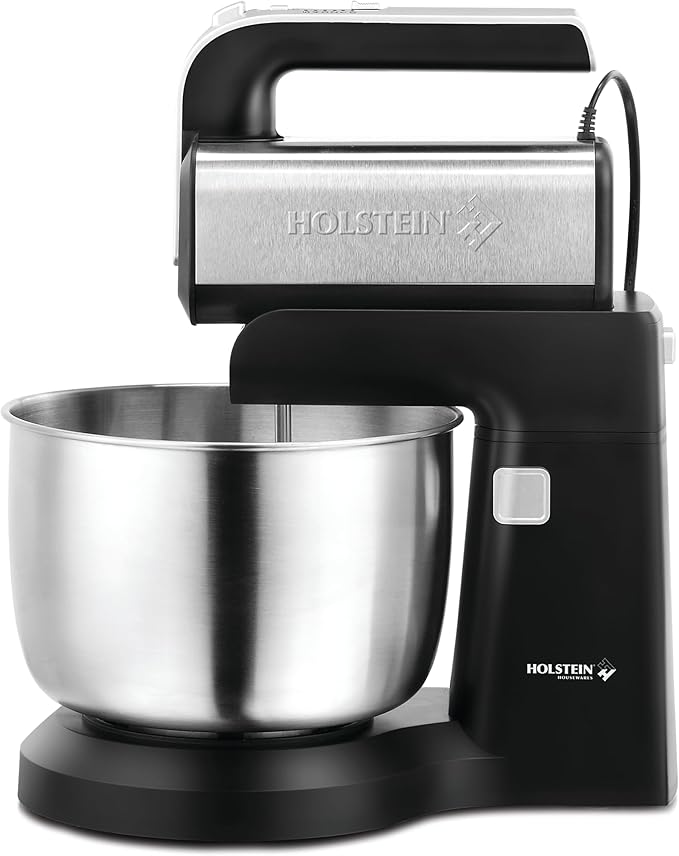
Holstein’s 5‑speed hand and stand mixer is the most affordable way on this list to get your hands free while batter comes together. The detachable hand mixer locks onto a compact stand with a 2.9‑quart stainless bowl that rotates as you mix, so you can add ingredients or tidy the counter instead of holding a whisk.
The 250‑watt motor and five speeds plus turbo are well‑suited to whipped cream, cake mixes, boxed brownies, and lighter cookie dough. The whole unit is lightweight and easy to stash in a cabinet, which is a big plus if you’re working with limited space or strength.
Why you’ll like it
- True 2‑in‑1 design: detach the mixer for quick jobs or lock it onto the stand for hands‑free mixing.
- Small, rotating bowl is perfect for single cakes, frostings, and everyday batters.
- Very lightweight and easy to move, ideal for seniors or small kitchens.
Good to know
- The 2.9‑quart bowl is too small for big batches or holiday baking marathons.
- At this price, build quality is basic—some users report the tilt button or bowl‑turning mechanism wearing out over time.
- The 250‑watt motor is not designed for frequent heavy bread dough; keep it for lighter recipes.
Ideal for: first‑time bakers, students, and anyone who wants an entry‑level mixer for light batters and whipped toppings without spending much.
2. OVENTE 3.5‑Quart – Simple Mini Mixer for Small Batches

The OVENTE 3.5‑quart stand mixer is for the baker who wants something compact and no‑fuss without spending much. With a 250‑watt motor, 5 speeds, and a stainless bowl, it covers the everyday basics while still fitting in small spaces and lighter hands.
Owners use it for whipping cream, light batters, small loaves, and weekly desserts without dominating the counter. It ships with a dough hook and two egg beaters, which covers most everyday mixing jobs at this price.
Why it stands out
- 5‑speed dial covers gentle folding through vigorous whipping.
- 3.5‑quart stainless bowl is a practical size for 1–3 people without wasting ingredients.
- Lightweight and easy to store in a small kitchen.
Good to know
- It’s still a compact mixer: don’t expect it to knead multiple loaves of stiff bread dough in one go.
- At 250 watts, it works best with lighter batters rather than dense dough.
- Very delicate recipes like meringues can take a little longer than on a full‑size pro mixer—plan a few extra minutes.
Ideal for: singles and couples who bake occasionally and want an inexpensive, no‑frills mixer for modest‑size batches.
3. Hamilton Beach Classic 4‑Quart – Flexible Hand‑and‑Stand Workhorse

Hamilton Beach’s Classic 64655 has been around for years for a reason. It’s a 290‑watt hand mixer that locks into a stand with a 4‑quart stainless bowl and “Shift & Stir” lever to move the bowl side‑to‑side as you mix. In practice, that means you can whip cream or cake batter hands‑free, then pop the mixer off the stand to mash potatoes in a saucepan.
Long‑term owners often comment that it’s lighter and less intimidating than big bowl‑lift machines, yet capable enough for most home cooking: cakes, quick breads, meringues, mashed potatoes, and even occasional bread dough if you keep batches modest and time reasonable.
What shines
- True flexibility: use it as a stand mixer or detach for quick hand‑mixer jobs.
- 4‑quart bowl is a comfortable middle ground for families—much roomier than mini mixers.
- Includes beaters, dough hooks, and whisk, all dishwasher‑safe along with the bowl.
Good to know
- The beaters don’t scrape the very bottom of the bowl; you’ll still use a spatula now and then.
- Like most combo mixers, it’s not meant for weekly heavy bread dough or giant batches.
- You manually slide the bowl under the beaters using the lever; it’s easy but not completely “set and forget.”
Ideal for: casual home cooks who mostly make cakes, cookies, and mashed potatoes but want something more stable and flexible than a simple hand mixer.
4. Vikaluz 2‑in‑1 3.2‑Quart – Tiny Footprint, Auto‑Rotating Bowl

This Vikaluz mixer is all about squeezing mixer convenience into a very small kitchen. It pairs a 3.2‑quart bowl with a 250‑watt motor, 5 speeds, and a tilt‑head, auto‑rotating‑bowl design aimed at first‑time bakers.
For quick cupcakes, whipped cream, or beating eggs, it feels nimble and easy to use. The auto‑rotating bowl helps ingredients get pulled in evenly without you having to scrape the sides as often.
Why it’s tempting
- Auto‑rotating bowl is a nice touch rarely seen at this price and size.
- Very compact body—easy to leave out without sacrificing much counter space.
- Beginner‑friendly controls with dough hook and beater included.
Good to know
- The build is on the lighter, plasticky side, as expected at this price.
- It’s a newer, lower‑review‑count listing, so long‑term durability data is still thin.
- It’s not a bread machine: stiff dough can bog it down, so keep it for lighter mixing and smaller quantities.
Ideal for: very small kitchens, light bakers, and as a starter mixer for people who want to experiment with baking without jumping straight into a heavy machine.
5. CKEMU Compact 3.5‑Quart – Tiny but Surprisingly Capable
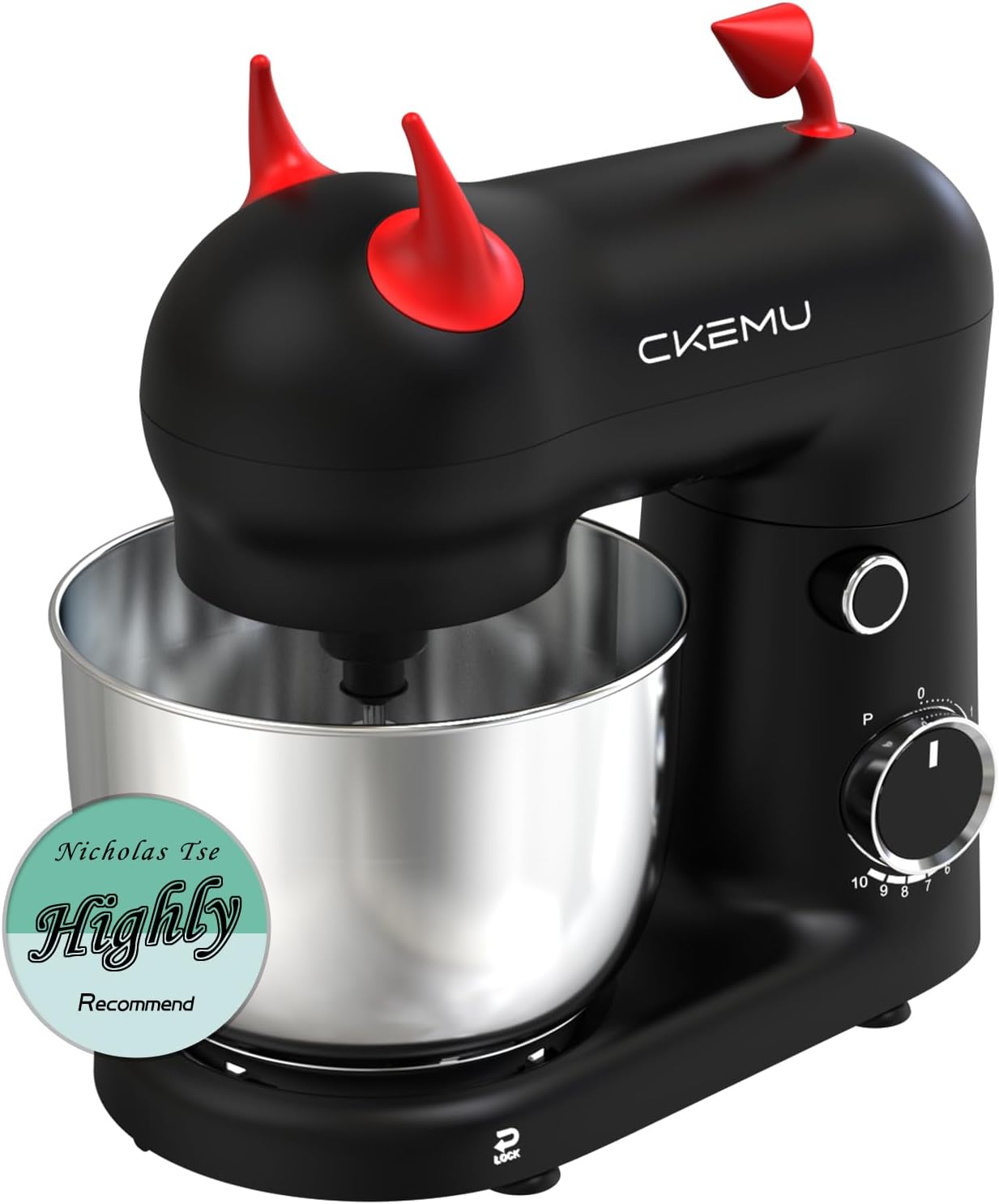
This CKEMU mixer hits a sweet spot for a small kitchen: a 3.5‑quart stainless bowl, a 300‑watt motor, and multi‑speed control in a compact, space‑saving body.
In real‑world use, it handles cakes, cookies, mashed potatoes, and occasional small doughs well. Many owners buy it as a “starter mixer” precisely because it’s so small and easy to pull out.
Why people love it
- 3.5‑quart stainless bowl is just big enough for family desserts without taking over the kitchen.
- Multi‑speed control gives real range for everything from whipping cream to kneading soft dough.
- Comes with dishwasher‑safe attachments and bowl.
Good to know
- For very stiff dough (bagels, dense whole‑grain breads), the motor will struggle if you overload it.
- Like most minis, filling the bowl close to the top will cause splatter—stay comfortably below “max” for best results.
- The housing is plastic; it feels sturdy for the price but not like a heirloom metal mixer.
Ideal for: small households, new bakers, and anyone who wants a light, compact mixer that still feels like a “real” stand mixer for everyday recipes.
6. DASH Everyday 3‑Quart – Adorable Mixer for Light Baking

Dash’s Everyday Stand Mixer is the one that makes people say “aww” when they walk into the kitchen. It weighs under 5 pounds, stands just over 10 inches tall, and comes in cheerful retro colors. Under the cute shell is a 250‑watt motor, six speeds, and a 3‑quart stainless bowl that locks onto the base.
Think of it as a hands‑free upgrade from a basic hand mixer. It’s fantastic for whipped cream, buttercream, pancake batter, box cakes, and small cookie batches. Suction feet keep it anchored, and the tilt‑head makes scraping and adding ingredients easy.
Highlights
- Ultra‑compact and lightweight—perfect for tiny kitchens and dorms.
- Six simple speeds that cover most everyday mixing tasks.
- Bowl and attachments are dishwasher‑safe, making cleanup painless.
Good to know
- It can handle only modest amounts of thick cookie dough or bread before the motor warms up.
- The small bowl means large cookie or bread recipes need to be halved or mixed in batches.
- Some users find the lowest speed still a bit brisk for very delicate folding.
Ideal for: beginner bakers, kids learning to bake with supervision, and anyone who wants something charming and functional for lighter, smaller‑scale baking.
7. Kitchen in the Box 3.2‑Quart – Lightweight Mini That Punches Above Its Size

This 3.2‑quart Kitchen in the Box mixer is the “little honey” that shows up constantly in real‑world reviews. Weighing about 7 pounds with four strong suction cups, it’s easy to move yet sits solidly when mixing. The 300‑watt motor and six speeds are generous for its size.
Owners happily use it for cakes, pancake batter, frosting, and even regular bread dough—as long as they respect its limits. Several people have run small home baking side‑hustles with this machine before eventually upgrading, which says a lot for something in this price bracket.
Why it deserves a look
- Very compact but strong enough for typical home baking tasks.
- Transparent splash lid and tilt‑head design keep mess down and access easy.
- Customer support and warranties are well‑reviewed; replacements are common if something fails early.
Good to know
- The full 3.2‑quart capacity isn’t usable for messy mixes—you’ll want to stay closer to half to two‑thirds full.
- If you’re running dozens of batches back‑to‑back (for a business), the motor will eventually overheat and need a rest.
- Like other minis, it can wobble a little on very thick doughs, though the suction cups keep it in place.
Ideal for: couples, retirees, and new bakers who want a light mixer that can genuinely handle weekly cookies, cakes, and the occasional loaf of bread.
8. Martha Stewart 5.3‑Quart – Budget Dough Specialist

Martha Stewart’s 5.3‑quart mixer pairs a polished stainless bowl with 12 speed settings, a dough hook, flat beater, and whisk, so it covers dough, batter, and whipping without needing extra attachments.
In day‑to‑day use, the 5.3‑quart bowl handles dough, cake batter, and up to about nine dozen cookies’ worth of mixing in one go. The tilt‑head design gives easy access for adding ingredients or scraping down the bowl, and a removable splash shield helps keep the counter clean.
Where it shines
- 12‑speed dial gives fine control from gentle folding to thick dough.
- 5.3‑quart bowl makes it easy to scale up cookie recipes or bread dough.
- Heavy‑duty base and ergonomic bowl handle add stability and easy pouring.
Good to know
- It’s a newer listing on Amazon, so long‑term reliability data is still limited.
- Single dough hook, not a double‑hook design, so very stiff two‑loaf doughs may take longer.
- Being an Amazon‑exclusive line, availability can shift over time.
Ideal for: home bakers who make bread and cookies regularly, want a bigger bowl, and like the reassurance of a well‑known household name.
9. KOCHSTELLE 6.8‑Quart – Planetary Mixer for Serious Home Bakers

KOCHSTELLE’s 6.8‑quart stand mixer aims squarely at the “I bake a lot, but I’m not paying for a prestige brand” crowd. With a 660‑watt motor, 6 speeds plus pulse, and true planetary mixing, it has more in common with mid‑range big‑name mixers than with many budget options.
The large 6.5‑liter bowl handles dense doughs, cakes, pastries, and big batches without much fuss. The stainless bowl comes with a full set of stainless attachments: balloon whisk, dough hook, and mixing paddle.
Why it’s compelling
- 6.8‑quart capacity is generous for family baking or batch cooking, still compact on the counter.
- Planetary mixing gives fine, even texture in batters and frostings with minimal scraping.
- Non‑slip base helps keep it stable while kneading or whisking.
Good to know
- Attachments are lighter than on premium brands; with heavy use they may eventually need replacing.
- Like any tall bowl mixer, very small quantities (one egg white, a half‑cup of cream) can sit below the whisk unless you tip the bowl.
- Brand recognition isn’t as strong as legacy names, so long‑term parts availability is less certain.
Ideal for: bakers who work from scratch regularly—cookies, cakes, and moderate bread baking—and want pro‑style performance without the pro‑level price tag.
10. FOHERE 5.8‑Quart All‑Metal – Heavy Dough on a Budget

If you’re serious about dough but not about spending several hundred dollars, FOHERE’s 5.8‑quart all‑metal mixer deserves attention. A 600‑watt motor, sturdy metal housing, and large stainless bowl put it near the top of this list for raw capability.
The spiral S‑shaped dough hook contacts more of the dough at once than a classic “C” hook, which helps it knead bread and pizza more efficiently. Users routinely push it through multi‑loaf batches and big cookie recipes, noting that it stays put on its suction cups and runs cooler than many plastic‑bodied peers.
What makes it different
- All‑metal housing feels more substantial and sheds heat better than thin plastic shells.
- 5.8‑quart bowl easily fits large batches—think several loaves or 9 dozen cookies in one go.
- Spiral dough hook and planetary motion give thorough kneading when recipes stay within capacity.
Good to know
- As with many budget stands, the whisk doesn’t always hit the very bottom of the bowl; occasional scraping helps.
- It’s bigger and heavier than the compact mixers—plan a permanent home on the counter if possible.
- Noise level is noticeable at high speeds, though normal for a mixer in this power range.
Ideal for: families of four or more, bread‑and‑pizza households, and budget‑conscious bakers who want a “real” dough machine without branded‑icon pricing.
11. Plum Chef Dual‑Bowl 5.5+4.5‑Quart – Two Bowls, One Mixer

The Plum Chef dual‑bowl mixer pairs a 350‑watt, high‑torque motor with 360° planetary mixing and two nestable stainless bowls: a 5.5‑quart for big batches and a 4.5‑quart for smaller portions, both fitting on the same base.
It handles pizza and bread dough, cookies, and whipped cream across its 12 speed levels, and runs quietly (rated under 60 dB) with overheating protection for longer mixing sessions.
Why it’s a sweet spot
- Two nestable bowls cover both big family batches and small desserts without buying a second mixer.
- 12‑speed planetary mixing minimizes dry pockets and covers dough through whipped cream.
- Includes dough hook, flat beater, whisk, and a splash guard, all dishwasher‑safe.
Good to know
- It’s a newer listing with limited review history, so long‑term durability is still being proven.
- Very stiff doughs should be kept to smaller batches to avoid over‑working the motor.
- Warranty support comes directly from the brand rather than a large established manufacturer.
Ideal for: home bakers who cook from scratch weekly and want the flexibility of two bowl sizes on one base.
12. Amazon Basics 5.3‑Quart – Simple Tilt‑Head Mixer That Handles Dough
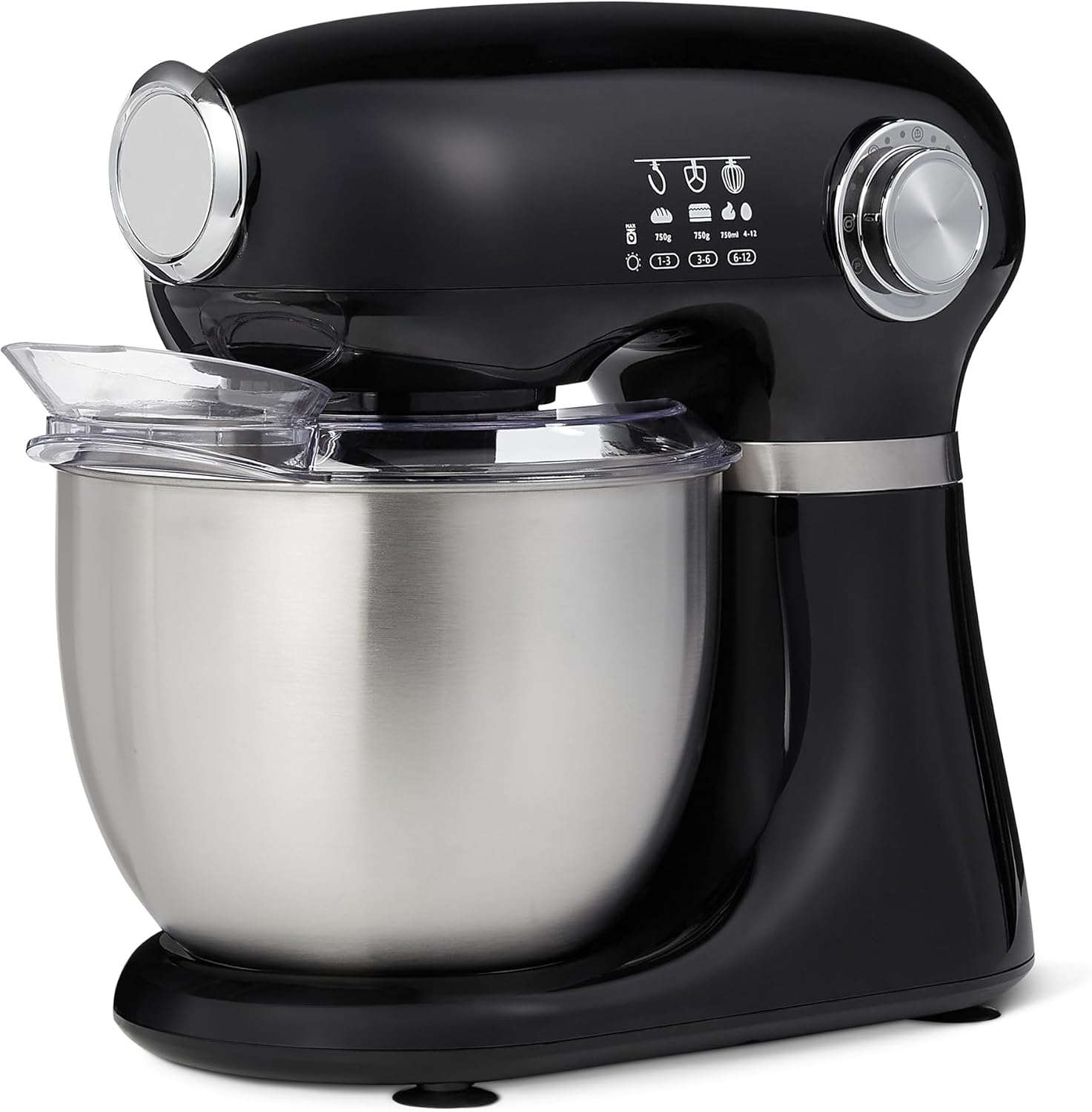
Amazon Basics’ stand mixer keeps things simple: a 350‑watt motor, 12 speed settings with pulse, and a 5.3‑quart stainless bowl sized for a 3–4 person household. Die‑cast dough hook and beater plus a stainless whisk cover the core mixing jobs.
Owners use it for bread dough, cookie dough, and everyday cakes. The tilt‑head design with a transparent anti‑splash lid makes it easy to add ingredients or swap attachments, and stronger suction feet help keep it steady while running.
Why it’s special
- 12‑speed dial plus pulse covers everything from delicate whipping to dough kneading.
- 5.3‑quart bowl is ideal for most families: big enough for bread, not so big for everyday cakes.
- Backed by the Amazon Basics name, which tends to mean straightforward returns and support.
Good to know
- Top housing is plastic; treat it with some care to avoid cosmetic damage or cracks.
- No accessory hub—this is a pure mixer, not a multi‑tool platform for grinders or pasta rollers.
- Review count is still modest, so treat long‑term durability claims cautiously.
Ideal for: regular home bread bakers and cooks who want a straightforward, familiar‑brand mixer without premium pricing.
13. VIVOHOME 6‑Quart – Big Bowl for Family‑Size Batches

If you like to bake in bulk, VIVOHOME’s 6‑quart mixer is worth a look. It pairs a 660‑watt pure‑copper motor and 10‑speed planetary mixing with a 6‑quart bowl rated for up to about three loaves of bread or 2.2 lbs of flour at once.
It ships with a stainless whisk, aluminum dough hook, and beater, plus a splash guard with a pouring hole and an egg‑yolk separator. Reviewers highlight how well it handles family‑size bread dough and large cake batches, and it’s one of the better‑reviewed mixers in this list with thousands of ratings behind it.
What it does well
- 6‑quart bowl is perfect for big batches of rolls, cookies, or pizza dough.
- Thousands of verified reviews give unusually strong confidence for a budget mixer.
- Suction‑cup base keeps it steady even under heavier mixing loads.
Good to know
- Attachments and bowl feel lighter and less “luxury” than high‑end brands.
- For very demanding dough (like long kneads to a windowpane), plan rest breaks so the motor can cool.
- It’s a larger machine, so measure your counter and cabinet clearance before buying.
Ideal for: families who batch‑cook, meal prep, or bake for events; anyone who wants a big‑bowl mixer with a strong review track record.
14. CUSIMAX 5‑Quart Digital – Set‑and‑Forget Mixer with Built‑In Timer

The standout feature on CUSIMAX’s 5‑quart mixer is right on the front: a digital control panel with an integrated 15‑minute timer. Instead of guessing how long your dough has been kneading, you set the time, pick one of eight speeds, and let the 650‑watt motor do its thing while you prep the rest of the recipe.
In real kitchens, that timer is genuinely useful. Bakers use it to whip cream for exactly the right time, knead dough without hovering, and avoid over‑mixing cake batter. The 5‑quart bowl hits the sweet spot for most families, and the machine feels reassuringly substantial on the counter.
Why it’s a smart upgrade
- Digital timer takes the guesswork out of kneading and whipping.
- 650‑watt motor offers plenty of power for heavy cookie dough and standard bread recipes.
- Modern, compact design looks more premium than the price tag suggests.
Good to know
- The top can vibrate a bit with very stiff dough; suction cups keep the base anchored.
- Some parts are not rated dishwasher‑safe—double‑check the manual if you prefer machine washing.
- Digital controls are great once you learn them, but there’s a small learning curve compared with a simple knob.
Ideal for: home bakers who love precision and convenience—especially anyone who tends to forget to set a separate timer when kneading or whipping.
15. Aifeel Dual‑Bowl 8.5+6‑Quart – Most Mixer for the Money

If you want one mixer to do almost everything on a budget, this is the one to beat. Aifeel’s dual‑bowl 7‑in‑1 machine includes an 8.5‑quart stainless bowl and a 6‑quart stainless bowl that nest together for storage, plus attachments for a meat grinder, pasta roller, and sausage kit alongside the usual dough hook, whisk, and beater.
Owners use the two bowls for keeping wet and dry ingredients separate, or for prepping vegetables in one while mixing in the other. Overheating protection and anti‑slip suction feet help it hold steady during longer mixing sessions.
Why it tops the list
- Two generously sized stainless bowls included; the nesting design saves real storage space.
- 7‑in‑1 attachment set (meat grinder, pasta roller, sausage kit) adds versatility beyond basic mixing.
- Five‑year brand guarantee is unusually long for a budget mixer.
Good to know
- Only 5 speed settings, so control is less granular than mixers with 10–12 speeds.
- The maker suggests capping continuous runs around 9 minutes to avoid overheating.
- At this size, it’s overkill if you only bake a few times a year.
Ideal for: most home bakers who want a single mixer that can grow with them—from casual cakes to regular bread and holiday baking—without jumping into premium‑brand pricing.
Motor Power, Bowl Size & What They Mean in Real‑World Mixing
On stand mixers, wattage and capacity can look like random numbers until you start pushing dough around. Here’s how to translate the specs on these fifteen mixers into what they’ll actually feel like in your kitchen.
How much motor power do you really need?
-
250–300 watts (Holstein, OVENTE, CKEMU, Kitchen in the Box 3.2 qt)
Great for whipped cream, meringues, cake batter, and lighter cookie dough. They can knead soft bread in small batches, but you shouldn’t expect them to crank out multiple dense loaves every weekend. -
350–500 watts (Vikaluz, Martha Stewart, Plum Chef dual‑bowl)
This is where general‑purpose baking becomes comfortable. You can handle standard bread recipes, pizza dough, and big cookie batches as long as you respect capacity and avoid running on top speed for long periods. -
600–660 watts (FOHERE 5.8 qt, KOCHSTELLE, VIVOHOME, CUSIMAX)
These are your heavy hitters. They’re better suited to frequent dough work and larger batches, though gears and build quality still matter. Think of them as being able to do what smaller mixers can do, just with a bit more headroom.
Remember: higher wattage doesn’t automatically equal better mixing. Planetary motion, gear design, and how you use the speeds all play a role. A well‑designed lower‑wattage motor can outperform a noisy 600‑watt one that’s geared poorly.
Tips for getting better results from any mixer
- Start low, then build speed. Always begin at the lowest speed when adding dry ingredients to avoid flour explosions.
- Don’t overfill the bowl. Staying at or below two‑thirds full is kinder to the motor and gives better mixing, especially with dough.
- Use the right attachment. Dough hook for bread and pizza, beater for cookies and cakes, whisk for creams and meringues—swapping is worth it.
- Give the motor breaks. On affordable mixers, long kneads are best broken into a few shorter bursts with rests in between.
- Scrape strategically. Even good planetary mixers benefit from a quick scrape of the bottom and sides once or twice per mix.
Treat your mixer as a partner, not a superhero. When you stay inside its comfort zone, even a modestly powered model can produce better bread, cakes, and cookies than you might expect.
FAQ: Budget‑Friendly Stand Mixers, Answered
Can an affordable mixer really handle bread dough?
How long should a budget stand mixer last?
What attachments do I actually need?
Should I pick a hand/stand combo or a true stand mixer?
Are these mixers very loud?
Final Thoughts: Choosing Your Best Affordable Stand Mixer Partner
A good stand mixer doesn’t just save your wrists—it quietly unlocks recipes you might have avoided before. Suddenly kneading dough, whipping cream, and creaming butter for cookies become “hands‑off” jobs while you measure, tidy, or sip coffee on the sidelines.
Here’s a simple way to turn this whole guide into a clear decision:
-
On the tightest budget and mostly light baking?
Look at the ultra‑cheap Holstein hand/stand mixer, the compact Dash Everyday 3‑quart, or the flexible Hamilton Beach Classic combo. -
Small kitchen, small household, but you bake often?
Go for compact stands like the OVENTE 3.5‑quart, Kitchen in the Box 3.2‑quart, or CKEMU Compact 3.5‑quart. They’re easy to lift yet capable enough for weekly desserts. -
Want real dough power without a premium price tag?
Check out Martha Stewart’s 5.3‑quart, the all‑metal FOHERE 5.8‑quart, or the KOCHSTELLE 6.8‑quart. They’re built with dough in mind while still staying very wallet‑friendly. -
Craving a KitchenAid‑style experience for less?
Focus on the Plum Chef dual‑bowl, the familiar‑brand Amazon Basics 5.3‑quart, and the timer‑equipped CUSIMAX 5‑quart. They offer planetary mixing, stronger motors, and a more premium feel. -
Want one “do‑almost‑everything” mixer for years to come?
Make the Aifeel dual‑bowl 8.5+6‑quart your default shortlist pick, with the VIVOHOME 6‑quart alongside it if you regularly bake for a crowd.
Any of the fifteen mixers above can easily become your best affordable stand mixer once you match its strengths to your batch sizes, dough habits, and storage space.
Measure your counter, think honestly about how often you really bake, and pick the mixer that feels easy to pull out and fun to use. From there, it’s just a matter of adding flour, sugar, and a little time—your new favorite baking partner will handle the rest.
