
If you’ve ever priced out high-end juicers and thought, “Nope, that’s a car payment,” you’re in the right place. You don’t need a $300 machine to enjoy fresh juice every morning—you just need something smart, sturdy, and easy enough to use that you’ll actually keep it on your counter.
This guide is here to help you find a Best Affordable Juicer without feeling like you’ve compromised on health or convenience. We’ll focus on compact, sub‑$60 machines that still deliver real performance: models that can handle carrots and celery without choking, slow juicers that squeeze every drop from leafy greens, plus a dedicated citrus press for orange‑juice lovers.
By the end, you’ll know exactly which style of juicer fits your routine, and which of these sixteen options deserves to be your go‑to best affordable juicer for weekday greens, weekend brunch, or a full-on juice cleanse reboot.
We’ll pull in what long‑time owners are saying, not just what the product pages promise—so you can skip hours of scrolling reviews and go straight to the short list that makes sense for your kitchen, your goals, and your budget.
In this article
- How to choose a budget juicer that suits your habits.
- Quick comparison table of sixteen wallet‑friendly picks.
- In‑depth reviews of each juicer, with real‑world pros and cons.
- Centrifugal vs. slow juicers and how motor power affects results.
- Answers to common juicing questions, plus final buying tips.
How to Choose the Best Affordable Juicer for Your Kitchen
With juicers, “affordable” can mean anything from a tiny citrus press to a surprisingly serious slow masticating machine. Before you click Add to Cart, spend a couple of minutes thinking through how you’ll actually use yours— because the right $40 juicer can feel better than the wrong $200 one.
1. Start with why you want to juice
Different goals point to different styles of machine. Ask yourself:
-
Are you after daily health habits or occasional treats?
If you just want weekend orange juice or the odd carrot‑apple blend, a compact centrifugal or citrus juicer will feel fast and fun—no need to overbuy. -
Planning green juices or cleanses?
If you’re juicing leafy veggies, celery, ginger, or wheatgrass several times a week, a slow masticating juicer pays off with more juice and less foam from the same produce. -
How many people are you serving?
Single‑serve folks can live happily with mini machines and smaller pulp bins. Families or couples doing bigger batches will appreciate wider feed chutes and larger jugs.
2. Pick your juicer type (and know the trade‑offs)
Most of the models in this guide fall into three buckets:
- Centrifugal juicers – These use a fast‑spinning metal basket to shred produce and fling juice outwards. They’re loud but quick, great for hard produce like carrots, apples and beets, and they usually have wide feed chutes for minimal chopping.
- Slow (masticating) juicers – These use an auger to crush produce at low speed. They’re quieter, excel at leafy greens, and often give drier pulp and longer‑lasting juice with less foam, but they’re typically slower and use narrower chutes that need more prep.
- Citrus juicers – Designed just for oranges, lemons, limes and grapefruits. If you mainly dream of fresh OJ and lemonade, these are compact, low‑mess, and far more efficient for citrus than multi‑purpose machines.
None of these is “best” in a vacuum. The trick is matching the type to your actual produce. A hardcore celery‑juice routine will quickly expose the limits of a tiny centrifugal, while a slow juicer is overkill if you only squeeze lemons for weekend cocktails.
3. Think about speed, yield, and noise
Every juicer balances these three differently. Centrifugal models win on raw speed, slow juicers win on quiet and yield, and citrus presses win on low effort for oranges and lemons.
- Speed: Centrifugal machines can turn a pile of produce into juice in under a minute.
- Yield: Slow juicers and the better centrifugal models leave relatively dry pulp, especially with firm fruits.
- Noise: Slow juicers and citrus units tend to be much quieter—friendlier for small apartments or early mornings.
If you’re rushing out the door, fast beats perfectly optimized. If you’re investing in organic greens, getting an extra glass of juice from the same basket of produce can matter more than saving 30 seconds.
4. Look at feed‑chute size and cleanup, not just wattage
Manufacturer pages love bragging about motor power, but in real kitchens, two things affect how often you use your juicer: how much chopping you have to do and how annoying it is to clean.
- Feed‑chute size: A 3–5 inch chute can take whole apples, chunks of beet, or half oranges; smaller chutes on minis and some slow juicers work best with pre‑cut produce.
- Parts count: Simpler is better. A few well‑designed pieces that lock together intuitively will get used far more than a jigsaw puzzle of gaskets and lids.
- Dishwasher friendliness: Most of the picks below have dishwasher‑safe parts; filters usually last longer if you hand‑wash them with the included brush.
- Pulp bin access: If you plan on big batches, a larger, easy‑to‑dump pulp container is worth prioritizing.
5. Be realistic about budget and expectations
The juicers in this guide all sit in the ultra‑competitive budget range, roughly $25–$60. At this price, you’re trading some things—expect more plastic than metal, slightly wetter pulp than premium models, and occasionally a unit that arrives with a defect and needs returning.
The good news: many of these machines punch well above their price once you understand their sweet spots. Some are fantastic for one or two people, others quietly rival mid‑range brands on performance, just with fewer luxury touches. The reviews below call out where each model shines and where it asks for a little patience.
6. Decide how much “fuss” you’re okay with
Some people love the meditative ritual of cutting produce, feeding a slow juicer, and composting the pulp. Others want to slam whole apples into a chute, press a button, and be done. Neither is wrong—you just want your machine to match your personality.
- Low‑fuss types: Look at wide‑mouth centrifugals, the Magic Bullet Mini, and simple citrus presses.
- Tinkerers & juice nerds: Gravitate toward slow masticating models like Aeitto, Brecious, VVAKAM, or EUHOMY.
- Space‑conscious minimalists: Compact vertical designs and horizontal slow juicers that tuck into a cabinet are ideal.
Quick Comparison: Sixteen Best Affordable Juicer Picks
Here’s a bird’s‑eye view of the sixteen under‑$60 juicers we’ll be reviewing. They’re ordered from lowest price to highest so you can quickly see what “spending a little more” actually buys you.
On smaller screens, swipe or scroll sideways to see the full table.
| Model | Type | Feed / Size | Best match | Amazon |
|---|---|---|---|---|
| LEBENLANG Electric Citrus Juicer | Citrus | 24 oz jug, 2 cones | Orange & lemon lovers, brunch | Amazon |
| Elite Gourmet EJX600 | Slow / masticating | Tall chute, 16 oz cup | Solo juicers & tiny kitchens | Amazon |
| GDOR 800W Juicer Machine | Centrifugal | 3" wide chute | Fast weekday juicing on a budget | Amazon |
| Fullstar 400W Compact Juicer | Centrifugal | 3" wide chute | Beginner‑friendly everyday juicer | Amazon |
| EUHOMY Cold Press Juicer | Slow / masticating | 5.5" chute, 60 oz hopper | Hands‑off, batch juicing fans | Amazon |
| Juilist 3" Wide Mouth Juicer | Centrifugal | 3" wide chute | Entry‑level power users | Amazon |
| VVAKAM Cold Press Juicer | Slow / masticating | 4.4" wide chute | Quiet juice for 1–2 people | Amazon |
| HOUSNAT 800W Centrifugal Juicer | Centrifugal | 65 mm chute | Family batches & meal prep | Amazon |
| Floisdace 5" Cold Press Juicer | Slow / masticating | 5" chute, 50 oz hopper | Juice cleanses on a budget | Amazon |
| Qcen 500W Centrifugal (Black) | Centrifugal | 3" wide chute | First juicer for most households | Amazon |
| Qcen 500W Centrifugal (Silver) | Centrifugal | 3" wide chute | Stainless look on a budget | Amazon |
| Hamilton Beach HealthSmart 67501 | Centrifugal | 2.4" chute, compact body | Light juicing & small counters | Amazon |
| Aeitto Classic Horizontal Juicer | Slow / masticating | Horizontal auger | Quiet, nutrient‑focused juicing | Amazon |
| Qcen 800W Centrifugal | Centrifugal | 3" wide chute | Hard‑produce powerhouse | Amazon |
| Magic Bullet Mini Juicer | Centrifugal mini | 2" chute + 16 oz cup | Single‑serve, travel‑friendly juicing | Amazon |
| Brecious Slow Masticating Juicer | Slow / masticating | Compact vertical design | Quiet, nutrient‑dense juices | Amazon |
In‑Depth Reviews: Sixteen Affordable Juicers That Actually Deliver
Now let’s zoom in on each model. We’ll walk from the least expensive up, so you can see where spending a little more buys you better yield, quieter operation, or easier cleanup. Use these reviews to match real‑world strengths to what actually matters in your kitchen.
1. LEBENLANG Electric Citrus Juicer – Fresh OJ Without the Fuss

If all you really want is proper orange or lemon juice—not green shots, not beet blends—the LEBENLANG citrus juicer is a simple, surprisingly capable way to get there. It uses a motorized reamer that spins in both directions, so it squeezes more out of each half without you having to wrestle the fruit.
You get two cone sizes that snap on and off in seconds: the larger one for oranges and grapefruit, the smaller one for limes and lemons. The 24 oz jug is plenty for several glasses at once, and because it’s see‑through with measure marks, it works well for recipes too.
Why you’ll like it
- Purpose‑built for citrus: It extracts an impressive amount of juice with very little effort on your part.
- Quiet and compact: Much quieter than centrifugal juicers and small enough to live in a cabinet or on the counter.
- Low‑mess design: The integrated jug and spout make it easy to pour without sticky drips everywhere.
Good to know
- It’s strictly for citrus—you can’t use it for carrots, apples, or leafy greens.
- The 40 W motor is designed for juice, not heavy grinding; don’t push down like you’re arm‑wrestling it.
- Like most citrus presses, the strainer benefits from a quick rinse between big batches.
Ideal for: orange‑juice‑every‑weekend households, lemonade lovers, and anyone who wants fresh citrus without committing to a larger juicer.
2. Elite Gourmet EJX600 – Tiny Slow Juicer for One

The Elite Gourmet EJX600 is one of the most approachable slow juicers in this price range. At just 12" tall with a narrow footprint, it disappears on a crowded counter yet still uses a proper auger to squeeze produce at a gentle 70 RPM. That slower speed means less foam, less heat, and smoother juice than you’d expect from something this small.
Real‑world owners consistently comment on how easy it is to assemble and clean—there are only a few parts, and they lock together intuitively. It shines when you’re making a glass or two at a time for one or two people instead of huge batches.
Why it stands out
- Space saver: Perfect for studio apartments, dorms, or RVs where every inch of counter space is precious.
- Slow‑juice quality: Handles leafy greens, celery, and ginger better than most cheap centrifugals.
- Minimal parts: Only three removable pieces plus the auger, so teardown and rinsing are quick.
Good to know
- The narrow chute means you should chop harder produce into smaller pieces to avoid jams.
- Output is sized for one or two servings—big families will want something larger.
- A tiny amount of fine pulp often passes through; a secondary strainer fixes that if you like super‑clear juice.
Ideal for: solo juicers, people easing into slow juicing, and anyone who wants a compact machine they’ll actually leave out.
3. GDOR 800W Juicer Machine – Big Power, Small Footprint

GDOR’s 800W juicer is a classic “plug it in and go” centrifugal machine. The 3" feed chute swallows whole small apples and thick carrot sticks, so you can dump in produce without much prep. Dual‑speed control lets you switch between softer fruits and tougher vegetables with a quick twist of the dial.
Owners like that the machine is more compact than many 800 W competitors, yet strong enough to chew through dense produce when used correctly. The included juice jug has a built‑in foam separator, which helps if you’re not a fan of frothy juice straight out of the spout.
Why you’ll like it
- Serious punch for the price: 800 W is plenty for hard vegetables when you avoid over‑packing the chute.
- Quick assembly: Parts are clearly marked and snap into place in a few seconds once you’ve done it once or twice.
- Compost‑friendly: The pulp bin is easy to empty if you want to compost or repurpose the fiber.
Good to know
- Like most budget centrifugals, it’s on the louder side—more “blender” than whisper quiet.
- The motor can shut down if you push very hard produce too fast; pausing and feeding more slowly avoids this.
- The supplied brush is a bit small; many users grab a second brush to make filter scrubbing easier.
Ideal for: people who want fast carrot‑apple juices, are okay with some noise, and prefer quick results over ultra‑fine juice texture.
4. Fullstar Compact 400W Juicer – Everyday Juice on a Tight Budget
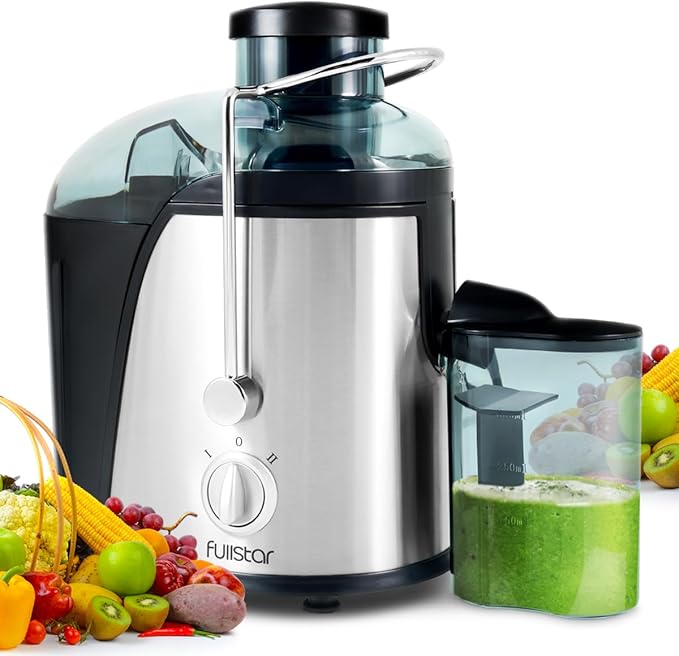
Fullstar has quietly built a reputation for well‑priced kitchen gadgets, and this 400 W juicer fits that pattern. It’s a simple two‑speed centrifugal machine with a 3" feeding chute, so you can drop in larger chunks of produce instead of carefully dicing everything.
What owners highlight most is how approachable it feels: the safety lock is obvious, the controls are simple, and the parts are lightweight enough to carry to the sink with one hand. It’s not trying to be a professional machine— it’s trying to be the juicer you’ll happily grab three times a week.
Highlights
- Good yield for the wattage: Efficient on oranges, apples, cucumbers and softer veggies.
- Stable base: Suction feet keep it from wandering across the counter, even at full speed.
- Easy maintenance: Most parts are dishwasher‑safe; hand‑washing the filter with the brush extends its life.
Good to know
- With very hard vegetables (big beet chunks, huge carrots) you’ll get better results using smaller pieces.
- The plastic body keeps it light but doesn’t feel as “premium” as all‑metal machines.
- Like most budget juicers, you’ll still want to rinse and wash right after use to prevent staining and buildup.
Ideal for: first‑time juicers, renters, and anyone who wants a straightforward machine for a couple of glasses a day.
5. EUHOMY Cold Press Juicer – Big Chute, Big Hopper, Small Price

Most slow juicers force you to cut everything into short sticks. EUHOMY’s design leans the other way: a 5.5" feed chute and 60 oz hopper that can take whole apples or a pile of chopped produce and slowly work through it while you do something else nearby.
The integrated hopper and screen make assembly almost foolproof, and many owners call out how unexpectedly easy it is to clean for a cold‑press unit—especially if you rinse it right after juicing. The auger and double‑layer filter do a good job of separating juice from pulp with less foam than a centrifugal juicer.
Why it’s compelling
- Huge feed chute: Great for people who hate chopping or want to load whole fruits at once.
- High stated juice yield: The seven‑segment auger and slow speed squeeze a lot out of produce.
- Thoughtful reverse function: Helps clear stringy bits without disassembling mid‑session.
Good to know
- A handful of users report DOA units or motors that never powered up—check yours as soon as it arrives.
- Very fibrous roots like turmeric can dull the blade; keep those to occasional use.
- It’s physically larger than many others here, so measure your counter or cabinet height before buying.
Ideal for: people who batch‑juice for the fridge, want slow‑juicer quality, and don’t mind a slightly larger footprint to get it.
6. Juilist 3" Wide Mouth Juicer – Surprisingly Rugged Starter Workhorse

Juilist’s wide‑mouth juicer is a good example of budget tech done right. On paper, it boasts up to 800 W of peak power, a 3" feed chute, three speed settings, and a visible window so you can keep an eye on the filter and pulp. In practice, what stands out is how hard people push it—bags of carrots, whole stalks of celery—and how well it holds up when they respect its limits.
Users consistently praise two things: the amount of juice extracted for the price, and how straightforward it is to disassemble and clean. Pulp usually comes out fairly dry for a centrifugal juicer, and suction cups help hold it steady on the counter, even when you’re feeding hard produce.
Highlights
- Fast throughput: Can rip through big bags of carrots, celery, or apples in a few minutes.
- Three speed options: Lets you baby softer fruits and crank through dense veggies as needed.
- Good value build: Feels sturdier than many cheap “no name” juicers at this price.
Good to know
- Pulp is not as dry as premium machines—if you’re obsessive, you can re‑run it once.
- The pulp container and juice jug have slightly awkward shapes that splash a bit when washing.
- As with all high‑speed units, it’s not the right pick if you’re super sensitive to noise.
Ideal for: beginners who plan to juice often, want solid power and a wide chute, but aren’t ready to jump to pro pricing.
7. VVAKAM Cold Press Juicer – Wide Chute, Quiet Operation

VVAKAM takes the “slow but easy” approach seriously. Its 250 W motor drives a low‑speed auger through a generous 4.4" feed chute, so you can load large chunks—or in some cases whole fruits—without tedious prep. Owners routinely mention how dry the pulp feels and how smooth the juice is compared with cheaper high‑speed machines.
The integrated design is also friendly to people who hate fiddly gadgets: there are only a handful of pieces, and they rinse clean quickly if you don’t let the pulp dry on. A built‑in safety switch stops the motor if the lid is opened, which is reassuring in busy family kitchens.
Why it’s a standout slow juicer
- High juice yield: Pulp comes out impressively dry for the price, especially with carrots and apples.
- Quiet enough for mornings: The motor hums under 60 dB, more like a fan than a blender.
- Reverse function: Quickly clears out stringy bits without disassembly.
Good to know
- Like other budget slow juicers, a few units have reported early failures—use the warranty window.
- Very fibrous celery can clog if you push too fast; alternating with firm produce (like apples) helps.
- Juice flows slowly by design; this is about quality, not instant output.
Ideal for: people who want green juices and mixed vegetable blends most days, value quiet operation, and don’t mind a slightly slower process.
8. HOUSNAT 800W Centrifugal Juicer – Big Batches, Simple Controls
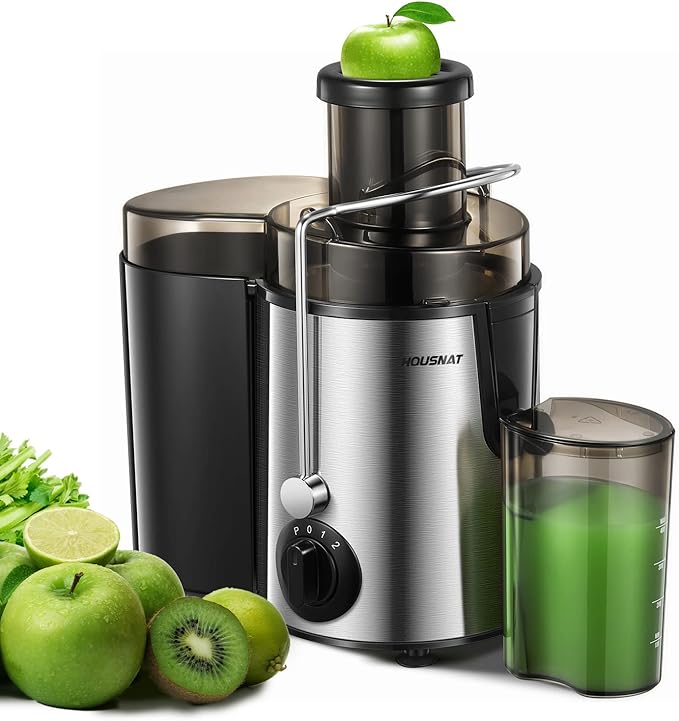
HOUSNAT’s juicer brings a bit more “family scale” to the table without breaking the bank. The 65 mm feed chute can take medium apples whole and chunky carrots with only minimal trimming, while the 1.6 L pulp bin lets you juice several glasses before you have to stop and empty anything.
The three‑speed control is genuinely useful: a gentle setting for oranges and berries, a standard mode for most everyday juicing, and a momentary “P” setting that blasts through the last bits when you’re finishing a batch. Many owners note how dry the pulp is and how quick the machine is to break down for cleaning despite its size.
What makes it family‑friendly
- Large pulp container: Fewer trips to the trash or compost when you’re juicing for several people.
- Decent foam control: The included froth guard in the jug saves you from skimming off foam by hand.
- Balanced footprint: Big enough to feel substantial, small enough to leave on a countertop.
Good to know
- A small number of users report out‑of‑box defects; test all speeds during the return window.
- The high‑speed setting is loud—as you’d expect with an 800 W centrifugal motor.
- Be sure to angle the juice cup properly under the spout; one common complaint is small spills if it’s misaligned.
Ideal for: busy homes doing multiple glasses or meal‑prep batches, where speed matters more than absolute quiet or ultra‑fine juice.
9. Floisdace 5" Cold Press Juicer – Self‑Feeding Slow Workhorse
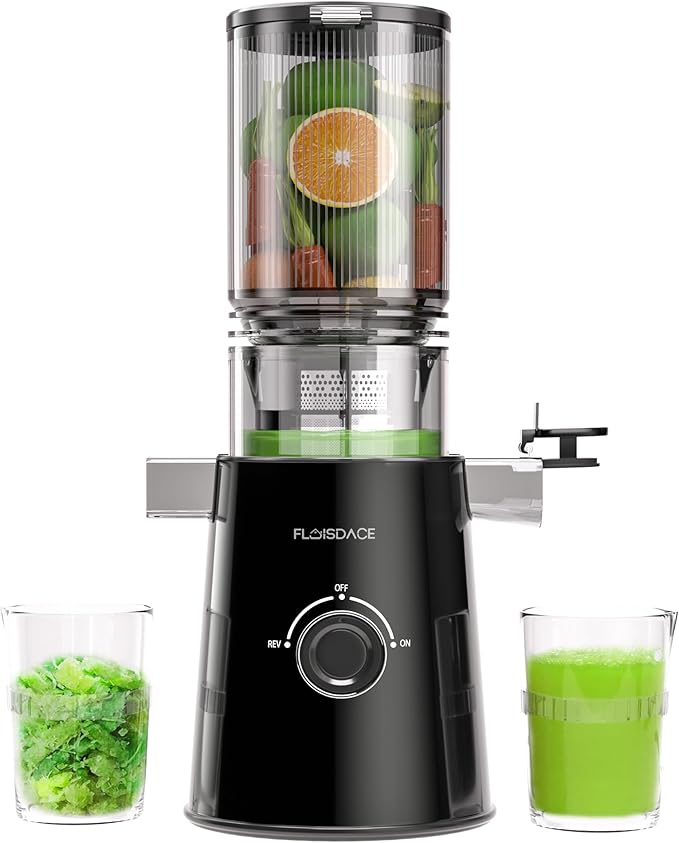
Floisdace aims squarely at people who want cold‑press juice without the scary price tag. This model uses a beefy 350 W motor, a 5" wide feed chute, and a large 50 oz hopper to handle whole fruits and veggies with minimal prep. Marketing claims a very high juice purity and yield, and owner photos suggest it does a respectable job, especially with firm ingredients.
The stainless‑steel outer shell feels a notch more premium than basic plastic‑only designs, and the three‑piece assembly keeps setup from feeling overwhelming. Once you get the hang of aligning the hopper and lock marks, it takes seconds to break down and rinse.
Why it’s appealing
- Self‑feeding feel: The large hopper lets you load a bunch of produce and let the auger do the work.
- Sturdy presence: Heavier build helps it feel planted and reduces wobble.
- Safety‑first design: The motor won’t run unless the cover is properly locked, protecting curious hands.
Good to know
- Some buyers find the initial assembly a bit confusing; the guide marks are important.
- Pulp can come out a bit wetter with very soft fruit—alternating with carrots or apples helps squeeze more out.
- Like other budget slow juicers, long‑term durability is good but not commercial‑grade; don’t run it nonstop for hours.
Ideal for: budget‑conscious juice‑cleanse fans and households that want to prep several bottles of cold‑press juice at once.
10. Qcen 500W Centrifugal (Black) – Amazon‑Favorite Starter

The Qcen 500 W juicer has become a bit of a go‑to entry point into juicing. It’s widely sold, fairly refined for the price, and powerful enough to feel fast without being as intimidating as the 800 W beasts. The 3" wide mouth feed chute reduces prep time, and two speeds let you tune the spin for soft or hard produce.
Reviewers consistently describe it as easy to set up, easy to use, and “good enough” in the best way: it juices quickly, cleanup is straightforward, and it doesn’t take over the whole kitchen. Some even mention prepping a week’s worth of juice into mason jars in one session.
Highlights
- Fast extraction: Great for quick morning juices when you’re short on time.
- Balanced power: 500 W is strong enough for carrots and beets when you don’t overstuff the chute.
- Simple cleaning: Detachable parts and an included brush make post‑juice cleanup manageable.
Good to know
- It’s loud—most users compare it to a blender in full swing.
- The plastic outer shell feels a bit “budget” even though performance is solid.
- As with all centrifugals, juice separates faster in the fridge; a quick shake fixes it.
Ideal for: anyone buying their very first juicer who wants a proven, widely‑reviewed model that doesn’t feel finicky.
11. Qcen 500W Centrifugal (Silver) – Same Guts, Sleeker Finish

This silver Qcen variant is essentially the same machine as the black 500 W model, wrapped in a stainless‑look shell that blends more naturally with metal appliances. Under the hood you still get a 500 W motor, a 3" chute, dual speeds, locking arm, and overload protection.
Owners like that it looks more expensive than it is, which matters if your juicer lives out on the counter. The performance story is the same: quick juicing, decent yield, and a filter basket that cleans up easily if you don’t let pulp harden on it.
Why pick this version
- Stainless aesthetic: Matches a lot of modern kitchens better than glossy black plastic.
- Trusted platform: Same core design that has earned thousands of positive reviews across Qcen models.
- Easy part removal: A quick twist and lift removes the basket when it’s time to wash.
Good to know
- A few users report missing accessories (like pushers) from third‑party sellers—check your box.
- It’s still a centrifugal juicer, so it won’t match slow juicers on leafy‑green efficiency.
- As with similar units, very low‑water ingredients (like pure ginger) aren’t ideal alone.
Ideal for: people who want the Qcen 500 W experience but prefer a silver finish that disappears next to stainless appliances.
12. Hamilton Beach HealthSmart 67501 – Trusted Name, Tiny Footprint

Hamilton Beach builds some of the most recognizable entry‑level juicers, and the HealthSmart 67501 is their compact, no‑nonsense option. A 400 W motor spins a stainless basket fast enough to handle everyday fruits and softer veggies, while the 2.4" round chute cuts prep time roughly in half compared with older skinny designs.
Reviewers like how easy it is to live with: a simple on/off switch, parts that go straight into the dishwasher, and a body slim enough to tuck into a cabinet or leave in a corner without dominating the space. Juice quality is solid for lighter use, especially with apples, oranges, and cucumbers.
Why you’ll appreciate it
- Big brand support: Replacement parts and support are easier to find than with many generic models.
- Genuinely compact: Great for small kitchens or as a secondary juicer for lighter tasks.
- Dishwasher‑friendly parts: The filter, lid, and pulp bin all tolerate top‑rack cleaning well.
Good to know
- The 400 W motor can struggle or overheat with frequent large batches of very hard veggies.
- Some owners notice it’s not ideal for beets and thick carrots—cutting smaller pieces helps.
- Because of the smaller chute, prep isn’t quite as effortless as with 3–5" designs.
Ideal for: light to moderate juicing, brand‑loyal Hamilton Beach fans, and anyone who wants a very compact centrifugal model.
13. Aeitto Classic Horizontal Juicer – Calm, Controlled Cold‑Press

Aeitto focuses heavily on slow juicers, and this classic horizontal model borrows ideas from more expensive brands. Instead of brute force, it relies on a 150 W motor and a carefully shaped auger that crushes produce slowly at around 85–110 RPM. Three modes—Soft, Hard, and Reverse—make it easy to dial in settings for oranges versus carrots.
Horizontal juicers like this tend to be easier to feed with long items such as celery or kale stems, and they’re often quieter than vertical designs. Owners praise the juice quality and relatively low oxidation: juices stay vibrant and separate more slowly in the fridge than typical high‑speed results.
Why it feels “premium” for the price
- Triple‑mode control: Soft and Hard modes really do change how it tackles different textures.
- Quiet motor: Advertised under 60 dB, it’s easy to use while others are sleeping.
- One‑button disassembly: A single release makes teardown faster than it looks at first glance.
Good to know
- As a horizontal design, it takes more side‑to‑side counter space than compact vertical units.
- Some users wish the pulp outlet were larger; very big batches may require occasional pause and cleanup.
- There’s a learning curve to cutting produce into pieces that feed smoothly without overpacking the auger.
Ideal for: people prioritizing juice quality over speed, especially those juicing leafy greens, celery, and mixed veggie blends most days.
14. Qcen 800W Centrifugal – When You Want Sheer Speed

The 800 W Qcen is what you reach for when you care more about speed than anything else. It uses the same basic design language as the 500 W models—wide chute, stainless finish, dual speeds—but with extra muscle behind the blade so it can chew through thick beets and dense carrots with less bogging down.
Because of the extra power, it’s especially well‑suited to big weekend batches or households where multiple people are juicing daily. As always, the trade‑offs are more noise and a little more vibration, but owners report that the machine stays stable as long as it’s on a flat surface and you don’t overpower the food pusher.
Why you’ll like it
- Excellent for hard veg: Carrot‑ginger and beet‑apple blends are its comfort zone.
- Fast output: Great for people who want juice for several jars in very little time.
- Familiar, simple controls: No complicated menus—just off, low, and high.
Good to know
- The motor is powerful enough that you should avoid pushing metal utensils or hard seeds anywhere near the chute.
- It’s loud—plan on a “blender‑like” sound for 30–60 seconds per batch.
- Like other centrifugals, juice is best consumed soon after making for peak flavor and nutrients.
Ideal for: carrot‑and‑beet lovers, families, and anyone who values raw power and speed above ultra‑quiet operation.
15. Magic Bullet Mini Juicer – Single‑Serve, Travel‑Friendly Juice

If you’re a fan of the Magic Bullet blenders, this mini juicer will feel instantly familiar. It’s built around a compact 400 W base, a small yet efficient metal basket, and a smart 16 oz cup that slides directly under the spout so you can juice and go without dirtying extra dishes.
Owners rave about how little space it takes and how quick cleanup is—especially for people juicing just for themselves. The silicone spout cap helps catch drips, and the parts are light enough that washing them doesn’t feel like a workout. It’s not meant for huge batches, but that’s the point: it’s for quick, fresh juice without drama.
Why it’s lovable
- Tiny footprint: Easy to leave on the counter, stash in a pantry, or travel with for extended stays.
- Thoughtful extras: The included cup with to‑go lid makes it simple to bring juice to work or the gym.
- Surprisingly capable: Handles carrots and beets when cut appropriately, not just soft fruits.
Good to know
- The smaller pulp bin means you’ll empty it more often if you’re juicing multiple cups.
- Some users notice temporary staining of the clear plastic with colorful produce, though it usually fades after drying.
- The 2" chute needs a bit more chopping than the big 3–5" models.
Ideal for: single‑serve juicing, RV and tiny‑home kitchens, and anyone who wants minimal cleanup and built‑in portability.
16. Brecious Slow Masticating Juicer – Quiet, High‑Yield Favorite

Brecious sits at the very top of our price range, but it brings features that usually cost much more: a quiet low‑speed motor, two different speed modes for soft and hard ingredients, a three‑stage filter for smooth juice, and a quick one‑touch disassembly system for cleaning.
What stands out in user feedback is how often people mention using it daily without it feeling like a chore. Juices come out with very fine pulp, the auger handles leafy greens and celery well when you cut them appropriately, and the whole machine feels more “polished” than many peers in this bracket.
Why it feels like a step up
- High juice yield: The multi‑stage filter and slow RPM squeeze a lot out of greens and roots.
- Quiet operation: Under 60 dB, easy to use early in the morning without waking the whole house.
- Safety‑oriented design: No exposed blades and a narrow feed chute make it kid‑friendly with supervision.
Good to know
- The smaller feed chute means more chopping than on wide‑mouth cold‑press designs.
- The plastic neck needs gentle handling; pressing down with excessive force can stress it over time.
- As with other slow juicers, speed is not the selling point—this is about juice quality.
Ideal for: health‑focused households that juice frequently and want a calm, refined slow juicer without breaking three figures.
Power, Speed & Juicer Types: What Really Matters
Juicer marketing loves big wattage numbers and fancy buzzwords. In practice, a well‑designed 150 W slow juicer can beat a cheap 800 W centrifugal for yield on leafy greens, and a modest citrus press can outrun both for oranges. Here’s how to think about power and type without getting overwhelmed by specs.
Centrifugal vs. slow vs. citrus at a glance
-
Centrifugal juicers
Great for: hard fruits and veggies (carrots, apples, beets, celery).
Pros: very fast, wide feed chutes, simple controls.
Trade‑offs: louder, more foam, juice separates faster in the fridge. -
Slow (masticating) juicers
Great for: leafy greens, celery, mixed veggie juices, ginger shots.
Pros: higher yield, less foam, quieter, better for storing juice.
Trade‑offs: slower, typically narrower chutes, more parts to clean. -
Citrus juicers
Great for: oranges, lemons, limes, grapefruits only.
Pros: super simple, low mess, very compact, fast for citrus.
Trade‑offs: can’t handle anything that isn’t citrus.
If you mostly drink carrot‑apple juice and want it now, a centrifugal model like Qcen, Juilist, GDOR, Fullstar or HOUSNAT makes the most sense. If your glass is usually green, a slow juicer such as Elite, EUHOMY, VVAKAM, Aeitto, Floisdace or Brecious will reward your patience with smoother, denser juice and drier pulp.
How much wattage do you really need?
- 40–100 W: Small citrus presses and compact slow juicers. Perfectly fine for citrus or gentle cold‑pressing.
- 150–250 W: Most budget slow juicers. Enough torque to crush produce slowly without cooking it.
- 400–500 W: Lighter centrifugals and mini juicers. Good for everyday mixed juices in modest batches.
- 800 W: High‑powered centrifugals for people who juice dense veg often and want speed above all else.
Higher wattage doesn’t automatically mean “better”—it just means the motor can spin faster or handle more load without stalling. Design matters just as much: a well‑shaped auger or basket can turn modest power into excellent performance, while a poorly designed filter wastes energy and produce.
Tips to get better juice from any machine
- Alternate soft and hard produce: Follow leafy greens or citrus with carrots, apples, or cucumber to push everything through.
- Don’t rush the feed: Especially on centrifugals, jamming produce in too fast can reduce yield and stress the motor.
- Prep smart: Remove large pits, trim very woody ends, and cut stringy celery into shorter lengths.
- Clean right away: A 60‑second rinse immediately after use can cut your scrubbing time in half.
- Use the right container: For longer storage, glass jars with tight lids help juice stay fresh longer in the fridge.
Once you understand how your particular machine behaves, you’ll get far better results from it—no matter what the wattage number on the box says.
FAQ: Affordable Juicers, Answered
Is a cheap juicer really worth it, or will I just replace it?
Should I choose a centrifugal or a slow masticating juicer first?
Can these budget juicers handle daily use?
How annoying is cleanup, really?
Do I lose all the fiber when I juice?
What’s a realistic budget for my first juicer?
Final Thoughts: Choosing Your Best Affordable Juicer Partner
A juicer is one of those appliances that quietly changes your routine when you get it right. Suddenly it’s easier to use up produce, easier to sneak veggies into your day, and easier to enjoy genuinely fresh juice without mystery ingredients or added sugar.
Here’s a quick way to turn this whole guide into a clear decision:
-
Only care about citrus?
Pick the LEBENLANG electric citrus juicer. It’s compact, quiet, and far more efficient than hand‑squeezing. -
Want a simple, low‑cost way to try juicing?
Start with a centrifugal like Fullstar 400W, Qcen 500W, or GDOR 800W. They’re fast, approachable, and great for carrot‑apple basics. -
Serious about green juice and cleanses?
Look toward slow juicers such as Elite EJX600, EUHOMY, VVAKAM, or Brecious. They’re slower but give you smoother, denser juice and better yield from greens. -
Need to juice for several people at once?
Check out HOUSNAT 800W, Qcen 800W, or the larger‑chute slow options from Floisdace and EUHOMY. -
Short on counter space or always on the go?
The Magic Bullet Mini Juicer and Elite EJX600 are purpose‑built for compact kitchens and single‑serve routines.
Any of the sixteen models above can become your best affordable juicer once you match its strengths—speed, yield, quietness, or simplicity—to your own habits and kitchen space.
Measure your counter, be honest about how often you’ll really juice, and choose the style that feels easiest to use on your busiest days. Do that, and you’ll be a lot more likely to keep that juicer out, keep using it, and keep pouring yourself glasses of fresh juice that taste far better than anything from a carton.
