
Specs are compiled from manufacturer listings and verified buyer reviews and can change over time — please confirm the key details on the product page before buying.
If your rubber RV roof is bubbling, peeling at the edges, or dripping water onto the dinette after a storm, the fix is almost never a new roof. It is a glue formulated for EPDM membrane, not a generic construction tube. This guide covers eight products that meet that bar, from self-leveling lap sealants that flow into every vent seam to one-gallon bonding adhesives that hold a whole membrane to plywood decking.
I’m Mohammad Maruf — the founder and writer behind KitchPrep. This guide is built by comparing the manufacturers’ published specifications and the patterns across verified customer reviews, so you get each pick’s real strengths and trade-offs instead of marketing spin.
You will see exactly which product handles which job, how much surface each one covers, and where the honest limits sit. Every pick here is formulated for EPDM rubber.
Our Picks at a Glance


How To Choose The Best Adhesive for Rubber Roofing
Rubber roofing is EPDM — a synthetic rubber sheet that stretches and shrinks with every hot afternoon and cold night. Your adhesive has to move with it, or the bond gives up within a season. That rules out most “all-purpose” adhesive tubes.
Lap sealant versus bonding adhesive
These are not competing products; they solve two separate problems. A lap sealant is a self-leveling liquid you squeeze along roof details — vents, skylights, AC units, seams — where it flows out flat and cures into a waterproof bead. A bonding adhesive is a one-gallon pail of glue you roll or brush across large flat areas to glue the rubber membrane itself down to plywood or OSB decking.
Most RV owners end up needing both at some point. If your complaint is a leak at a vent, buy lap sealant. If your complaint is a bubble or a flap of loose membrane, buy bonding adhesive.
Check the compatibility line before anything else
Every product on this list is made for rubber roofing, but the fine print still matters. Some formulas cover EPDM, TPO, PVC, and Hypalon membranes plus wood and concrete. Others are built strictly for EPDM and TPO and should never touch metal or fiberglass. Read that line first: careful application cannot fix a glue meant for another surface.
Do the math on coverage
Lap sealant coverage is given per tube, and bonding adhesive coverage is given per gallon. A typical 30 ft RV usually needs about 4 tubes of lap sealant for detail work, while one gallon of bonding adhesive covers roughly 160 square feet of membrane. Buy short and you will reorder mid-repair.
Plan around cure time and weather
Some of these products set within 30 minutes and cure fully in 24 hours. Others give you around 10 minutes of working time. A few can be applied in wet conditions or even underwater. Match that to your weather window: for afternoon rain, pick the fast-setting or wet-application formulas.
Quick Comparison
| Model | Best For | Type | Coverage | Compatible Surfaces | Amazon |
|---|---|---|---|---|---|
| Liquid Rubber RV Lap Sealant 4 Pack★ Best Overall | Vents, skylights and AC seams | Self-leveling lap sealant | About 22 linear ft per 10 oz tube | EPDM, TPO, fiberglass, metal, aluminum, PVC, ABS | Amazon |
| WELLUCK 4PC Self Leveling RV Roof SealantFastest Set | Fast repairs in bad weather | Self-leveling lap sealant | — | EPDM, TPO, aluminum, brass, steel, glass, mortar, wood, PVC, TPV | Amazon |
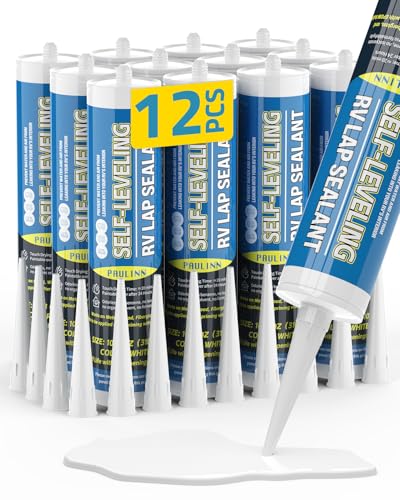
| PAULINN RV Roof Sealant 12 PackBulk Kit | Full roof detail work in one order | Self-leveling lap sealant | — | EPDM, metal, wood, concrete, fiberglass | Amazon |
| Dicor Alpha 8010 Universal RV Roof Adhesive | Gluing membrane to decking | Water-based bonding adhesive | 160-200 sq ft per gallon | Rubber roofing | Amazon |
| RecPro RV Rubber Roof Adhesive 8010 | Roller application over large areas | Water-based bonding adhesive | 160-200 sq ft per gallon | Rubber roofing | Amazon |
| Dicor 901BA-1 Water-Based RV Roof Bonding Adhesive | EPDM and TPO membrane projects | Water-based bonding adhesive | About 160 sq ft per gallon | EPDM and TPO only | Amazon |
| Alpha Systems 8011 Acrylic Bonding Adhesive | Odor-sensitive indoor-adjacent work | Acrylic water-based adhesive | — | EPDM, TPO, PVC, Hypalon, wood, plywood, fiberboard, concrete | Amazon |
| Geocel GC55103 4500 Roof Bonding Sealant 24 Pack | Big projects and wet-weather sealing | Lap adhesive and edge sealant in one | — | EPDM membranes, tapes, patches | Amazon |
In‑Depth Reviews
1. Liquid Rubber RV Lap Sealant, Self-Leveling Roof Sealer, White, 4 Pack
Our pick — over 4.5★ from 650+ verified ratings; the strongest balance of quality and price.
The four-tube kit that turns a leaky vent seam into a flat, water-shedding bead
Liquid Rubber’s lap sealant does one thing and does it well: it flows. Each 10 oz tube covers approximately 22 linear feet at a 5/16 inch bead, and a typical 30 ft RV usually needs about 4 tubes — which is exactly what comes in this box. That math is why it takes the top spot on a list built for people who want one order to finish the job.
Where it shines is horizontal roof detail work. Vents, skylights, AC units, antenna mounts and roof seams all get that smooth, waterproof seal, and the cured bead stays flexible so it moves with your rig through temperature swings and road vibration. It bonds to EPDM, TPO, fiberglass, metal, aluminum, PVC and ABS when the surface is properly prepared. The one non-negotiable: it will not stick to silicone, and any existing silicone has to come off completely first. Clean, dry surfaces only.
Where the reputation comes from: the thing that wins people over is sheer effectiveness — the seal simply works, and stopping leaks is what buyers keep coming back to. Sealing performance sits right behind it, and the self-leveling flow that makes the job fast draws its own following.
The honest catch: consistency is the one recurring note in the reviews, with some owners finding it adheres beautifully and others reporting it does not stick properly or drips during application. Two rules prevent most of that: never use it on vertical surfaces or sidewalls, and never use it to fill open gaps or cracks. It is a detail sealant, not a gap filler.
Go with this if: your roof has leaks or worn seals around vents, skylights, AC units or seams on flat surfaces, and you want a kit sized to finish a whole rig in one pass.
Keep looking if: your problem is a loose flap of membrane or a vertical edge — this flows by design and belongs on the flat.
2. WELLUCK 4PC Self Leveling RV Roof Sealant Lap, White Flexible Repair Caulking Rubber EPDM Sealant
Ten minutes of working time and a wet-weather window most caulks will not give you
WELLUCK built this one around speed and weather tolerance. The hybrid butyl rubber and polyisobutylene formula gives you 10 minutes of working time and cures in 24 hours, and it holds across a 0 to 104°F range — so a cold morning job and a hot afternoon job both behave the same way. It arrives in a compact package, 4.72 x 3.15 x 1.57 inches, which makes it easy to stash in a rig’s storage bay. As a point of comparison, the Liquid Rubber kit above lists a much larger 12 x 4 x 4 inch packaged footprint for the same tube count.
The surfaces list is unusually long for a lap sealant: EPDM and TPO sheeting plus aluminum, brass, steel, glass, mortar, wood, PVC and TPV. Anything other than EPDM rubber can go on without primer, which saves a step when you are patching around a metal vent flange or a wood frame. It is also low odor and low VOC.
What buyers keep coming back to
- Sets fast enough to seal around an active leak rather than wait for a dry day
- The runny consistency is the appeal, not a flaw — it levels out flatter than thicker caulks
- Low odor and low VOC make indoor-adjacent and small-space work far less unpleasant
Worth knowing before you order
- Coverage runs short of expectation — one buyer’s advice is to “Get at least the 2 pack. Works very well but doesn’t go as far as you think it does. Very liquidy”
- Adhesion draws split opinions, with some reporting it sticks well and others saying it does not stick at all
- Long-term durability on a sun-baked roof is still an open question in the review pages
Reach for this when: you are sealing EPDM seams or patching mixed surfaces and want a quick grab that copes with whatever the forecast throws at you.
Look elsewhere when: you need to cover a lot of linear feet — this side of the market punishes under-ordering.
3. PAULINN RV Roof Sealant 12 Packs, Self Leveling Lap Sealant White, Rubber Roof EPDM
Twelve tubes, one weekend, and a camper roof that stops dripping
This is the quantity play — 12 tubes against the 4 in the Liquid Rubber and WELLUCK packs, a three-to-one gap that matters if you are resealing a whole rig or working through a project camper with several bad seams. Full cure lands at 24 hours, with the surface setting enough to handle in 30 minutes. The formula can go on in dry or wet conditions between 40 and 104°F, and it holds up against RV travel vibration — no falling off, shrinking, cracking or yellowing once it is cured, according to the maker.
Adhesion covers EPDM, metal, wood, concrete and fiberglass, and it works in a standard glass glue gun. The instruction that catches people out is the EPDM line: on EPDM it needs to be applied after priming with EPDM Rubber. Skip that and you are relying on hope rather than chemistry.
Owner feedback backs the practicality of it. A camper buyer who replaced two plumbing vents described it as going on easily and smoothing out great. Another ran 4 tubes across a 20 ft roof and noted the texture was right and it cures up nicely, drying bright white. The formula is also odorless and non-toxic, which the maker lists as safe for indoor and outdoor use around people and pets.
Where it outperforms: sealing performance is what buyers praise most here, with quality close behind — the fact that it simply stops leaks, including one owner’s skylight seal, is the whole story. Adhesion and leak prevention both land firmly in positive territory.
The realistic ceiling: this is sized for standard repairs, not heavy-duty or industrial work, and it will need reapplication over time. Expect it to solve roof-seam and detail leaks reliably; do not expect one application to be the last word forever.
Suits you if: you have a long list of seams, vents and edges to work through and would rather not reorder halfway through the job.
Wrong pick if: you are touching up one small area — a single-tube approach leaves less sitting in the garage.
4. Dicor Alpha 8010 Universal RV Roof Adhesive, Camper & Trailer Roof Glue, 1 Gallon

A big-area glue that gets stronger with age instead of letting go
This is the one-gallon bonding adhesive you buy when a whole sheet of rubber needs to come down onto decking, not a detail bead. Coverage runs 160-200 square feet per gallon, the bond grows stronger and more tenacious with age, and the cured glue stays flexible so the membrane can expand and contract through the seasons without tearing the bond loose. It is an acrylic water-based formula, so cleanup is with water rather than solvent.
Owners describe it as super sticky once it starts to dry, and the practical reports back that up — one buyer replaced the roof on a slideout with it and called it amazing glue. It also gets used well beyond RVs, with one owner bonding EPDM rubber pool liner to plywood and old liner, noting the glue stays fluid for 3+ minutes so you can adjust before it grabs. The leftover doesn’t dry out for months, and there is no solvent smell to work around.
Why it earns the roller label
- Water-based acrylic cleanup means no solvent fumes in a closed shop
- The bond strengthens over time rather than weakening, so an early wobble is not a failure
- Stays flexible to absorb the membrane’s own expansion and contraction
The two things to plan for
- Instructions are not included in the box and the website is not much help, so budget time to research the method first
- It works with the right technique — one detailed write-up covers plywood with a 3/8 inch nap roller, then a thin layer on the EPDM, rolled back in sections. Skip the technique and you risk a weak bond.
Take this route if: you are gluing a full membrane and want coverage, no solvent smell, and a bond that ages well.
Think twice if: you want a product that holds your hand — you will be hunting for the application method yourself.
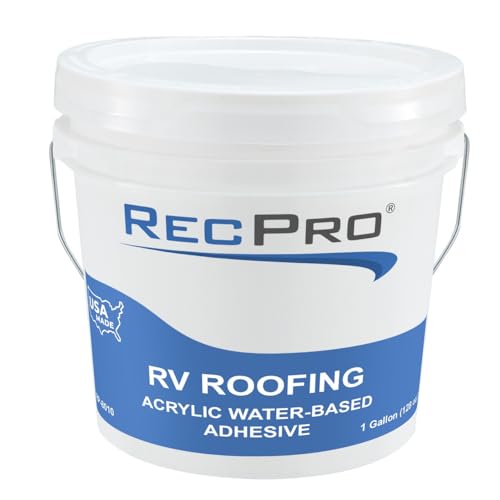
5. RecPro RV Rubber Roof Adhesive 8010 Water-Based Glue, 1 Gallon
The gallon that rewards patience — wait for clear, then it grabs for good
RecPro’s 8010 covers the same ground as the Alpha gallon above, 160-200 square feet per gallon at 8-10 mil on one side, and goes down either by roll coating or by brush. It is a modified acrylic water-based glue, cures in 30 minutes, and is made in the USA.
The technique that separates a great result from a frustrating one is watching the color. The adhesive should be allowed to turn fully clear before you bond the rubber roofing to the plywood. Bond while it is still white and the membrane slips around; let it go clear and the grab is strong. One owner’s method is to mix with a paint paddle once the can is opened, then apply with a roller — it went down very good and held well.
Cleanup is easy as long as you are expecting it. The same reviewer suggests gloves for that reason, while another found a brush easier than a roller and describes the finished bond as super sticky and effectively permanent. Note that this adhesive cures in 30 minutes, a much faster window than the 24-hour full cure on the lap sealants above.
Consensus read: effectiveness is what carries this gallon — it simply does the job. Ease of use follows, and the fact that it cleans up with water keeps the project moving.
The variable to manage: drying time splits the room. Some find it tacks up nicely in 5-10 minutes; others find it dries too fast for comfort on a warm day. Work in small sections and you sidestep most of that.
Fits your project if: you want a brush-or-roller adhesive with a short cure, water cleanup, and a bond that holds a membrane down for the long run.
Better to skip if: you prefer a slow, forgiving adhesive you can reposition for a long time.
6. Dicor 901BA-1 Water-Based RV Roof Bonding Adhesive, 1 Gallon

Narrow compatibility, deep expertise — the specialist gallon for EPDM and TPO roofs
Dicor makes one thing clear up front: this adhesive is made for EPDM and TPO only, and it is not for metal, fiberglass, or membrane-to-membrane applications. If your project falls outside that, stop here. If it is inside those lines, you are buying from a company that specializes in RV roofing, and the coverage sits at about 160 square feet per gallon in a water-based, environmentally friendly formula.
The technique owners converge on is patience. One project bonded EPDM roofing to a 5th wheel and needed two coats because the first soaked in — initial adhesion felt weak, but it held firmly after curing and survived a Florida trip. A separate water-based EPDM project found the formula forgiving for a first roof job, since it allows you to adjust creases before it sets; that roof was still attached after six months. The manufacturer’s own installation video is the reference several owners point to over random online tutorials.
Where it delivers: quality is the phrase reviewers reach for — it is regarded as a serious, high-grade roofing glue rather than a general-purpose one.
Be honest about the risk: adhesion is the single most-discussed topic on this listing, and it splits receivers and skeptics — some report it does its job, others say it does not adhere at all and needs time to set up. Pair that with a shipping quirk where the can sometimes arrives dented, and the takeaway is simple: this is a product for someone willing to prep carefully and give it curing time, not for someone bonding in a rush. Half a gallon left over is also a common outcome, so a smaller container would suit touch-up work better.
The right buyer here: an EPDM or TPO project where you will do two coats, allow full cure, and value a brand that lives in this category.
Not your gallon if: you are working with metal, fiberglass, or gluing membrane to membrane.
7. Alpha Systems 8011 Acrylic Water Based Bonding Adhesive, 1 Gallon

Odorless enough to work with, tenacious enough to hold a membrane through a windstorm
Alpha Systems 8011 is an acrylic water-based bonding adhesive with a very low VOC count and zero odor, which means no special safety requirements for application — a real advantage if you are working in an enclosed space or anywhere fumes would be a problem. The bond itself is tenacious and wide-ranging: EPDM, TPO, PVC and Hypalon membranes on one side, and wood, plywood, fiberboard, polyisocyanurate, gypsum and concrete decking on the other. Flexibility is built in so the membrane can expand and contract after it is attached.
The drying time is deliberately moderate rather than fast, which suits work where you do not need a rapid solution and would rather have a moment to position the material. Owners apply it successfully to reattach and reseal roof membranes, and cleanup is with water.
What sticks out is how it performs under real load. One reviewer noted holding a rubber roof down in 45 mph winds with plenty left over. Others describe it as thick and durable when used as directed, working much like a contact adhesive once you follow the directions. Note the straightforward warning that comes with a bonding adhesive of this type: it is easy to work with but messy, and the manufacturer holds no liability for membrane damage caused by another brand’s sealants, adhesives or tapes.
Why it stands out
- Zero odor and very low VOC — no special ventilation requirements during application
- Bonds to an unusually broad list of membranes and decking substrates
- Moderate drying time gives you room to position the membrane before it locks
Small print to note
- Working with it is messy, and water is your only cleanup tool
- You need to follow the directions closely — this behaves like a contact adhesive, not a forgiving general-purpose glue
Worth it when: you want a low-odor, broad-compatibility adhesive for reattaching or resealing a membrane to a wood or concrete deck.
Pass on it if: you plan to apply in a hurry — the moderate dry time and contact-style technique want a patient hand.
8. 24-Pack of 10 Oz. Geocel GC55103 Black 4500 Roof Bonding Sealant

One tube that is both the adhesive and the edge sealant, and it cures in the rain
Geocel 4500 does the work of two products in one tube — it acts as a lap adhesive and a scrim edge sealant, so you do not need a separate glue and finish sealant for the same repair. It applies, adheres and cures in wet conditions, remains flexible once set, and is built for EPDM membranes, tapes and patches. It also ships in black, which makes it useful anywhere white would look out of place.
The 24-pack of 10 oz tubes is a bulk kit aimed at people who expect to be back on the roof more than once. Owners describe it as thick but self-leveling, easy to run through a caulking gun, and effective at filling voids and gaps. It skins over fast, which is why one buyer saw a persistent chimney flashing leak stop after the very first rain, and another stopped an RV leak immediately while applying it in pouring rain. Once cured it stays flexible and resists UV and temperature swings, with owners reporting no cracking, shrinking or lifting.
What makes it stand out: sealing performance is where it shines most, with adhesion close behind and durability holding its own — a permanent, watertight membrane is the outcome buyers describe, and it keeps working on roofs, shingles, masonry and metal flashing.
A dry-time caveat: the formula is thicker and slower to firm up than some buyers expect, and it is overly drippy for anything beyond a flat surface. The recurring advice is simple: keep it to horizontal work and do not try to use it on anything remotely vertical.
Choose this when: you are sealing EPDM lap edges or patches in poor conditions and want a single tube that handles bonding and sealing in one pass.
Look elsewhere when: your work is on sidewalls or any angled surface — this one wants to be flat.
Understanding the Specs
Coverage per tube or per gallon
Lap sealants are measured in linear feet per tube. Liquid Rubber’s numbers are a good reference point: 10 oz covers roughly 22 linear feet at a 5/16 inch bead, and a typical 30 ft RV usually needs about 4 tubes. Bonding adhesives are measured in square feet per gallon instead — Dicor Alpha’s 8010 and RecPro’s 8010 both list 160-200 square feet per gallon, while Dicor’s 901BA-1 covers about 160 square feet per gallon. A larger bead or thicker roller coat cuts those numbers.
Cure time, working time and surface prep
Working time is how long you can adjust the material before it grabs. WELLUCK gives around 10 minutes; Liquid Rubber’s lap sealant flows for as long as it takes to level. Full cure is the longer clock — 24 hours for most lap sealants on this list, 30 minutes for the RecPro bonding adhesive. Surface prep decides whether any of it works: silicone must come off completely, some formulas go on wet or damp only, and PAULINN needs EPDM primer on EPDM.
FAQ
Can I use a generic hardware-store adhesive on an EPDM rubber roof?
What is the difference between lap sealant and bonding adhesive for rubber roofing?
How much lap sealant do I need for a 30 foot RV?
Will these adhesives stick to a TPO roof or only EPDM?
Do I need to remove old silicone before applying rubber roof adhesive?
Can I apply rubber roof sealant in the rain or on a wet surface?
How long does rubber roof adhesive take to cure?
Does rubber roof adhesive need a primer before use?
Will rubber roof adhesive work on a vertical surface or sidewall?
How much bonding adhesive does a full roof replacement take?
Final Thoughts: The Verdict
For most people searching for the best adhesive for rubber roofing, the Liquid Rubber RV Lap Sealant 4 Pack is the one to buy first, because it is sized to finish a 30 ft roof in a single order and it does the detail work that causes almost every leak. If you are working in bad weather or mixing surfaces, the WELLUCK 4PC Self Leveling RV Roof Sealant sets in around 10 minutes and covers a wider surface list. For a loose membrane rather than a leaking seam, the Dicor Alpha 8010 bonds a full sheet down at 160-200 square feet per gallon.
The one nudge worth giving: if your roof has more than a couple of problem areas, buying the bulk kit up front costs less frustration than reordering mid-repair. And whatever you choose, remove the old silicone first — no formula on this list will bond over it.
How We Picked
We do not accept paid placement. Every pick is matched to a real buyer and a real use-case; we do not hands-on test units.
Sources & Methodology
Specifications: manufacturer listings and product documentation. Review insights: verified customer reviews, as of September 2026. Pricing: not shown on this page (it changes often); check the current price via the retailer link.
As an Amazon Associate, KitchPrep earns from qualifying purchases. This does not affect which products we feature.
Related Guides
