
Specs are compiled from manufacturer listings and verified buyer reviews and can change over time — please confirm the key details on the product page before buying.
Whether you’re regluing a few porcelain tiles that fell into the pool or tackling a hollow-sounding floor that rocks underfoot, the wrong adhesive turns a weekend job into a recurring headache. The good news is that you don’t need to be a tiler to make a rock-solid fix last for years.
I’m Mohammad Maruf — the founder and writer behind KitchPrep. This guide is built by comparing the manufacturers’ published specifications and the patterns across verified customer reviews, so you get each pick’s real strengths and trade-offs instead of marketing spin.
Below, you will find the best Adhesive for Porcelain Tiles, ranked by real-world longevity, application ease, and the honest stories owners share about what actually sticks.
Our Picks at a Glance


How To Choose The Right Adhesive for Porcelain Tiles
Every fix starts with one question: are you laying fresh tile onto a clean surface, or are you trying to rebond a loose tile that is already in place? These are two different jobs that call for two different kinds of product.
Powdered thin-set mortars for new installs
If you are setting brand-new porcelain tile on a wall, floor, or pool, you want a dry cement powder you mix with water into a paste. They bite hard into the tile back and the substrate together, and several are explicitly rated for wet and submerged spots.
Liquid repair adhesives for re-bonding
When a tile has popped loose but you do not want to rip up the floor, you need a liquid that flows through drilled holes and fills the hollow gap underneath. These set in about a day, so you walk on the floor again quickly.
Coverage and working time matter more than you think
A dusty powder tub might quote a tiny square footage, while a 50-pound bag covers a whole bathroom. Before buying, measure your repair area and check how fast the mix sets, since some products harden in minutes, leaving zero time to adjust the tile.
Quick Comparison
| Model | Best For | Weight | Form | Full Cure | Amazon |
|---|---|---|---|---|---|
| E-Z Patch Thinset Pool Tile Cement★ Best Overall | Small underwater tile repairs | 3 pounds | Powder | 1 day | Amazon |
| Pool Patch Setting Repair KitQuick Cure Value | Quick pool & spa fixes | 3 pounds | Powder | A few hours | Amazon |
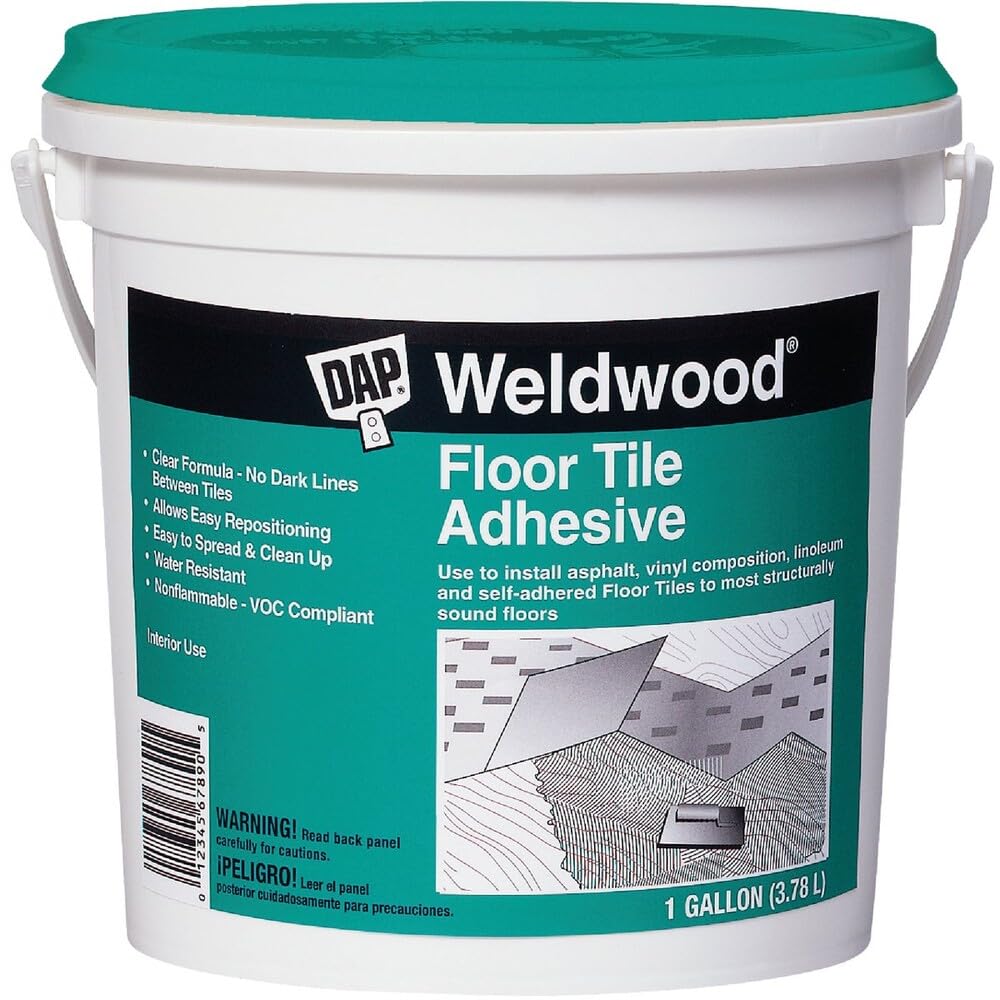
| DAP Floor Tile AdhesiveDry-Install Pick | Loose floor tile regluing | 8.5 pounds | Liquid | 24 hours | Amazon |
| PAREXLANKO Glue Paste | Interior damp wall tiles | 3 kg | Paste | — | Amazon |
| Fix-A-Floor Original Gallon | Hollow floor tiles | 8.9 pounds | Liquid | 24 hours | Amazon |
| Fix-A-Floor with Syringe | Precise grout-line injection | 8.7 pounds | Liquid | 24 hours | Amazon |
| LATICRETE 254 Platinum Mortar | Pool & large-format tile | 50 pounds | Powder | — | Amazon |
| Ardex X 77 Microtec Mortar | Walls & high-traffic floors | 40 pounds | Powder | — | Amazon |
In‑Depth Reviews
1. E-Z Patch Thinset Pool Tile Cement (EZP-132)
Our pick — over 4.5★ from 300+ verified ratings; the strongest balance of quality and price.
The 3-pound cement that makes a first-time DIYer sound like a pool pro.
The thing everyone raves about is how well this cement actually holds tile in place — the top praise from owners is effectiveness, and the proof shows in the work. A first-time tiler reports that tiles reglued to an indoor resistance pool are still holding firm. The mix sets fast and stays solid underwater after just a 1-day cure, so you are not waiting a week to refill.
Because it is a powder you mix yourself, working in small batches is the trick — the quick set time means a big bucket can harden before you finish spreading it. One non-DIYer replaced 72 pool tiles after a winter freeze and saved significantly versus a professional quote. At 3 pounds in a pail, it is a fraction of the heft of the 50-pound bag further down this list, making it the right scale for a repair rather than a whole new install.
Owners consistently describe the directions as good and the process easy, with plenty left over even after covering a 3-foot statue repair. The honest catch is value: some buyers find a 3-pound tub pricey for the amount you get, so it suits fixing ten or twenty tiles, not an entire floor.
What wins people over
- Sets fast and solid underwater in a single day
- Easy mix with clear directions for first-timers
- Compatible with porcelain and ceramic tile
Before you buy
- Small 3 lb tub — not meant for large floors
- Quick set leaves little time for adjustments
Reach for it if: you have loose porcelain or ceramic tile around a pool, fountain, or spa and want a proven, easy underwater fix.
Think twice if: you are tiling a whole room — you will need the larger bagged mortars below.
2. Pool Patch Pool Tile Adhesive Repair Kit (3 lb)
A pro-formulated thinset that cures in hours, not days, so the pool is back in action fast.
What sets this kit apart is the speed of the cure — it takes only a few hours to dry after application rather than a full 24. The 3-pound tub of waterproof Portland cement covers about 6 square feet at a 1/4-inch thickness, and the maker positions it for setting waterline and cap tiles during repair, renovation, or new construction.
Buyers report it works well under water, so there is no need to drain the pool to make the repair. Common praise is that the adhesive acts as its own grout, meaning you only need one material for the job, and the immediate grab stops tiles from slipping while they set. An 81-year-old owner finished a multi-tile job easily after watching DIY videos, with great-looking results.
The recurring downside is the mixing guidance — there are no printed quantities for the water-to-powder ratio or installation temperature limits, so first-timers have to gauge it by feel. Still, the long-term results speak loudly: “A year later the tiles are still glued down” is the review pages’ recurring verdict for spa tiles set with this kit.
Fast-track fix: if you want a pool or spa back in service the same day you mix, this is the one — a few hours to dry beats waiting overnight on most alternatives.
The fit note: confident DIYers will breeze through it; someone wanting exact mixing instructions printed on the tub may find it a bit loose on guidance.
3. DAP Floor Tile Adhesive (1 Gal, Clear)
A clear liquid glue that handles the niche job of regluing loose, water-damaged floor tiles.
Unlike every powder in this list, this DAP comes ready in a 1-gallon pail as a clear liquid that weighs 8.5 pounds. At 8.5 pounds, it is 2.8 times heavier than the 3-pound tubs above, signaling it targets larger floor repairs. Owners mention a detailed reglue process works well: lift the tile, spread adhesive, wait 55 minutes until clear, roll back, and cure 24 hours.
Adhesion is what wins owners over here — the glue “sticks well and so far none of the tiles have popped up.” It is compatible with ceramic, porcelain, and engineered wood, giving it a wider reach than pool-specific options if your loosened tiles are in a dry area of the home.
The honest trade-off is drying time, the aspect buyers mention most negatively. Owners note it takes days to dry fully, not the 24 hours printed on the label, so it is not a same-day solution. One specific complaint stands out as a fit warning: “This product seems to expand as it dries causing the tile rise,” even with weight holding it down — an occasional issue, not the norm, but worth knowing for perfectly flat finishes.
Where it shines
- Ready to use — no mixing powder and water
- Clear finish that vanishes under the tile
- Works on ceramic, porcelain, and engineered wood
Where it stumbles
- Drying takes days for some owners, not 24 hours
- Can expand as it cures, lifting tiles on flat jobs
Grab this for: regluing a handful of loose or water-damaged tiles where you want a no-mix liquid and can wait days for a dry cure.
Skip it for: pool or underwater tile — that is what the waterproof cements above are built for.
4. PAREXLANKO Glue Paste for Bathroom & Kitchen Tiles (3 kg)
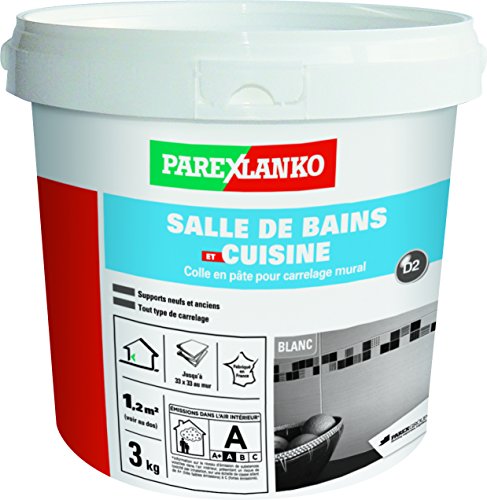
A ready-mixed white paste aimed squarely at porcelain stoneware walls in damp rooms.
This one skips the mixing entirely — it arrives as a paste in a bucket, listed for interior walls in damp rooms like bathrooms and kitchens. The maker states it suits porcelain stoneware, stretched stoneware, enamelled stoneware, limestone, terracotta, earthenware, and glass paste over new or old surfaces, so it is a flexible choice if you are dealing with more than just one tile type.
The consistency is the selling point for wall work: a paste grabs immediately and holds heavy stoneware in place while you level it, which is harder to achieve with a runny liquid. Reviews in several languages land on the same verdict — the glue genuinely holds, with tiles still in place after years.
This bucket weighs 3 kg and comes as a single tub, and the honest warning is delivery condition rather than the product itself: one buyer received a tub that had leaked in transit, though the glue inside still worked fine. If your project is a full wall rather than a spot repair, factor in that this is a smaller quantity than bagged mortars.
For damp interior walls: if you are setting stoneware or porcelain wall tile in a bathroom and want a no-mix paste, this is the straightforward answer.
Check first: confirm the tub arrives sealed — the occasional shipping leak is the one real complaint to watch for.
5. The Original Fix-A-Floor Loose Tile Repair Adhesive (1 Gal)
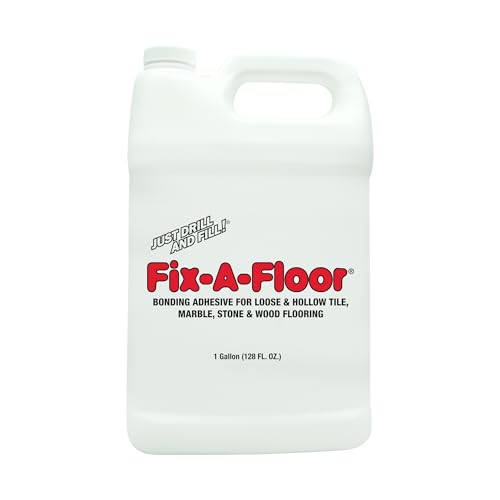
The drill-and-fill system that fixes hollow porcelain floors without pulling up a single tile.
Fix-A-Floor attacks a totally different problem than the cements above: it re-bonds loose and hollow tiles that are already down. The method is to drill small holes through the grout, inject this liquid copolymer, and let it flow under the tile to fill the void, then weight it for 24 hours. Owners fixed hollow 12×24 porcelain kitchen tiles this way, reporting a solid floor without removal or a pro crew.
This is the crowd favorite by volume, racking up over 900 ratings — far more than any other product here — and the dominant verdict is effectiveness for loose floor tiles. One owner covered 80 square feet of loose 18×18 tiles with a slow squeeze technique, preferring it to removal and re-setting. The maker’s extra-strength formula bonds permanently without drying or cracking, working on tile, porcelain, ceramic, marble, stone, and wood.
The famous trade-off is the mess. The consistency runs thin, the rear seals on the tubes can leak, and some owners swear the delivery mechanism is the weak link — the common workaround is to skip the caulk gun and use a 30ml syringe with a 14-gauge tip for clean, precise injection. A general contractor cautions it is not for tile set over mortar beds where the adhesive only reaches the first combed rib, so it shines on solid subfloors rather than floated installations.
Why it wins fans
- Saves entire floors from costly removal and re-tiling
- Fills hollow areas through tiny drilled holes
- 24-hour cure gets the room back in service fast
The messy side
- Tubes can leak from the rear seal
- Runny consistency — needs slow, careful squeezing
Choose this when: tiles sound hollow or rock underfoot and you want to save the whole floor in a weekend.
Who it is not for: anyone with tile bonded to a thick mortar bed, where reach is too shallow to work.
6. Fix-A-Floor Loose Tile Adhesive with Syringe Applicator (1 Gal)
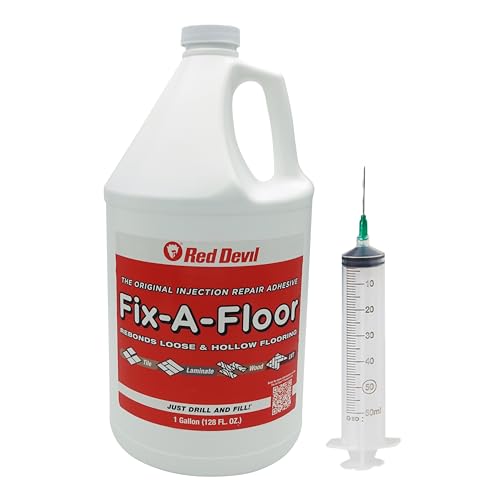
The same drill-and-fill formula, now bundled with the syringe tip owners kept asking for.
Fix-A-Floor clearly listened to the feedback on its sibling product: this 8.7-pound gallon jug comes with a syringe applicator included, solving the messy tube problem owners hit with the original. The formula is the same extra-strength copolymer that re-bonds loose and hollow porcelain, ceramic, marble, stone, and engineered wood, with a full cure in 24 hours.
The syringe earns mixed love in practice. It is excellent for narrow grout lines where a wide tip would never fit, and one owner fixed seven 24-by-24-inch tiles with loose sides using it. But squeezing the syringe by hand takes real strength — the clever trick shared across reviews is to load the syringe into a caulk gun and pull the trigger, which makes the flow far easier to control.
The product is honestly a mixed bag on effectiveness and value — some call it a lifesaver that saved thousands, while others found it slow and product-hungry, using 8 tubes for roughly 12 loose tiles. The maker’s own note that it is not recommended for floating floors is the key fit warning. It suits solid subfloors where the adhesive can actually reach down and grab.
Best for precise lines: when your hollow tiles sit on narrow grout joints, the included syringe places adhesive exactly where it belongs.
Plan for patience: this is a slow, hands-on repair that rewards a careful approach and heavy weights during the 24-hour cure.
7. LATICRETE 254 Platinum Multipurpose Thin-Set Mortar (50 lb)

A 50-pound professional-grade mortar with anti-microbial protection for serious porcelain installs.
When the job is a full installation rather than a spot repair, this LATICRETE bag is the one the pros reach for — it carries a stellar 4.6-star score across its ratings. The maker builds in anti-microbial technology to protect the treated surface, a rare extra that matters in damp spots like showers and pools. It is ideal for thin porcelain tile and large-format thin porcelain panels, which ordinary mortars struggle to support.
The adhesion here is exceptional, and owners found their repaired pool surface indistinguishable from the original. It bonds incredibly to exterior glue plywood and concrete and is rated superior for exterior and submerged applications, so it is a legitimate choice for pool tile where lesser products wash out. Because it is white, one pool owner did not worry about grout haze showing through the tile.
At 50 pounds this bag is the heavyweight of the list, and the honest trade-off is workability — it dries very fast, so you have to pre-cut everything and work quickly, especially alone. One owner calls it pricey but worth it, and the verdict is unanimous on quality.
Built for the big jobs
- Anti-microbial protection built in
- Handles large-format thin porcelain panels
- Superior for exterior and submerged work
Expect this
- Dries very fast — pre-cut all tile first
- 50 lb bag is heavy to haul around
Bring this home for: a whole floor, shower, or pool retile in large or thin porcelain, where bond strength decides everything.
skip it if: you only need to stick a few tiles back — this quantity dwarfs a repair.
8. Ardex X 77 Microtec Polymer-Modified Thinset Mortar (40 lb)
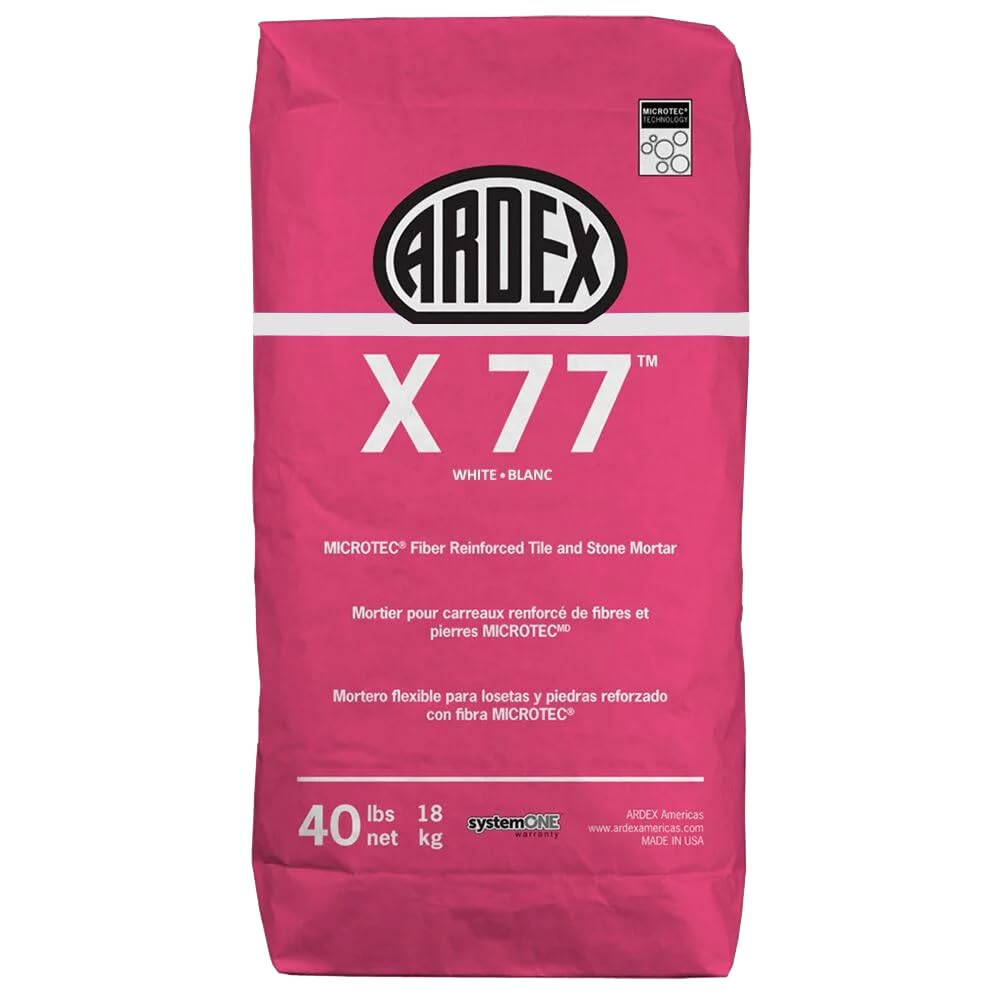
A polymer and microfiber-reinforced mortar that stays workable long enough to think while you tile.
Ardex X 77 is engineered with microtec technology, premium polymers, and microfiber reinforcement for flexibility, and that recipe earns it the highest star score in the entire list. Owners single out its extended open time as the differentiator — “easy to use, not rushing because of material drying up too soon” captures the common sentiment. That extra working window is gold on a wall, where you need time to level each tile before it locks.
The maker designed it for porcelain, mosaic, ceramic, marble, granite, glass, quarry tile, and most natural stone on floors and walls, including high-traffic commercial areas, balconies, patios, and terraces. The creamy consistency resists efflorescence, the white chalky residue that can bloom on fresh tile, and trowels on smoothly with excellent coverage. Wall installers report it holds tile firmly on a vertical surface, letting them adjust without fighting gravity.
The catch is scale — at 40 pounds, a full bag is overkill for a 17-square-foot DIY bathroom wall, and the box is heavy enough to feel unwieldy. One unusual complaint about a ceiling install failing is the outlier, not the pattern, and runs opposite to the wall success stories. If your project is room-sized, this is a superb choice.
The patient tiler’s choice: the long open time gives you breathing room to set heavy porcelain on walls level and true.
Right-size the bag: buy this for a full wall or floor — a 40 lb bag overwhelms a tiny repair.
Understanding the Specs
Cure Time vs. Drying Time
Every adhesive sets in two stages. The quick grab happens in minutes, but the full cure — when the bond reaches its final strength and can handle water — takes anywhere from a few hours to a full day or more. Check the label honestly: pool cements often cure underwater in a day, while some liquids take days despite the printed 24-hour figure.
Powder, Paste, or Liquid
A dry powder you mix with water is the classic thin-set mortar, ideal for fresh installs and wet areas. A ready paste skips mixing and suits damp interior walls. A liquid in a jug is the repair specialist, flowing through drilled holes to rebond hollow tiles that are already down. Match the form to the job and you will not go wrong.
FAQ
Can I use adhesive for porcelain tiles underwater in a pool?
What is the difference between thin-set mortar and liquid repair adhesive?
How long should I wait before walking on a newly glued porcelain tile?
Will adhesive for porcelain tiles work on large-format thin panels?
Why does my tile keep rising as the adhesive dries?
How much area will a 3-pound tub of tile cement cover?
Can I grout over adhesive for porcelain tiles?
Is adhesive for porcelain tiles safe to use on a shower wall?
Final Thoughts: The Verdict
For most owners, the adhesive for porcelain tiles winner is the E-Z Patch Thinset because it is the proven, easy underwater fix that even a first-timer can nail. If you have hollow floor tiles you want to save without demolition, grab the Fix-A-Floor Original. And for a full new install in large or thin porcelain, the LATICRETE 254 Platinum is the one serious tilers reach for.
How We Picked
We do not accept paid placement. Every pick is matched to a real buyer and a real use-case; we do not hands-on test units.
Sources & Methodology
Specifications: manufacturer listings and product documentation. Review insights: verified customer reviews, as of September 2026. Pricing: not shown on this page (it changes often); check the current price via the retailer link.
As an Amazon Associate, KitchPrep earns from qualifying purchases. This does not affect which products we feature.
Related Guides
