
Specs are compiled from manufacturer listings and verified buyer reviews and can change over time — please confirm the key details on the product page before buying.
Marble is the tricky one. Marble is heavy, usually polished, and often wet, and most general-purpose construction glue fails on a glossy stone face. A marble adhesive has to grab fast, hold without yellowing or cracking, and survive bathroom and kitchen steam and splashes.
I’m Mohammad Maruf — the founder and writer behind KitchPrep. This guide is built by comparing the manufacturers’ published specifications and the patterns across verified customer reviews, so you get each pick’s real strengths and trade-offs instead of marketing spin.
These picks ship as six-packs of cartridges, single syringes, and quarts you mix by hand, so the format matters as much as the formula. The picks below cover wet-area bonding, invisible seam repair, and re-bonding a hollow tile without pulling your floor apart, which is what most people actually need from a strong adhesive for marble.
Our Picks at a Glance

How To Choose The Best Adhesive for Marble
Marble is calcium-based, so it reacts to acids, and its polished face leaves almost no surface for glue to bite into.
Match the adhesive to the job, not the label
A cartridge adhesive that sets in minutes is the right tool for hanging a mirror or bonding a backsplash. A two-part resin that cures rock-hard is the right tool for a cracked countertop edge or a visible seam you want to disappear. Using one where you need the other is the most common mistake.
Check what the manufacturer actually lists as a compatible surface
Adhesive makers publish a compatibility list, and “marble” needs to appear on it. A product marketed for vinyl plank flooring might still list marble among its approved surfaces — but only if the data sheet says so.
Think about colour before you squeeze
A clear or light-tan adhesive disappears against pale stone. A darkened repair stands out on white marble forever. If the crack will be visible, choose the formula that dries clear or takes a tint.
Quick Comparison
| Model | Best For | Form | Cure Time | Size | Amazon |
|---|---|---|---|---|---|
| Loctite PL530 Mirror, Marble and Granite★ Best Overall | Mirrors and backsplashes | Cartridge gel | 48 hours | 10 fl oz (6-pack) | Amazon |
| HIMG Glue Adhesive for Granite, Marble, StoneBest for Small Repairs | Small crack repairs | Syringe strip | 5 minutes | 30 g | Amazon |
| Tenax Tixo XE Knife Grade Stone Adhesive | Seams and lamination | Mixable liquid | — | 32 fl oz | Amazon |
| ROBERTS Universal Resilient Flooring Adhesive | Glue-down floors over marble | Liquid | — | 1 Gal. (3.78 L) | Amazon |
| CHIYU Kintsugi Repair Kit | Decorative stone repair | Two-part epoxy | 72 hours | 240 g kit | Amazon |
| Loctite Power Grab Ultimate crisp | Wet and non-porous surfaces | Tube gel | 24 hours | 2.7 fl oz (6-pack) | Amazon |
| Fix-A-Floor Loose Tile Repair Adhesive | Re-bonding hollow floor tiles | Liquid | 24 hours | 1 Gallon | Amazon |
In‑Depth Reviews
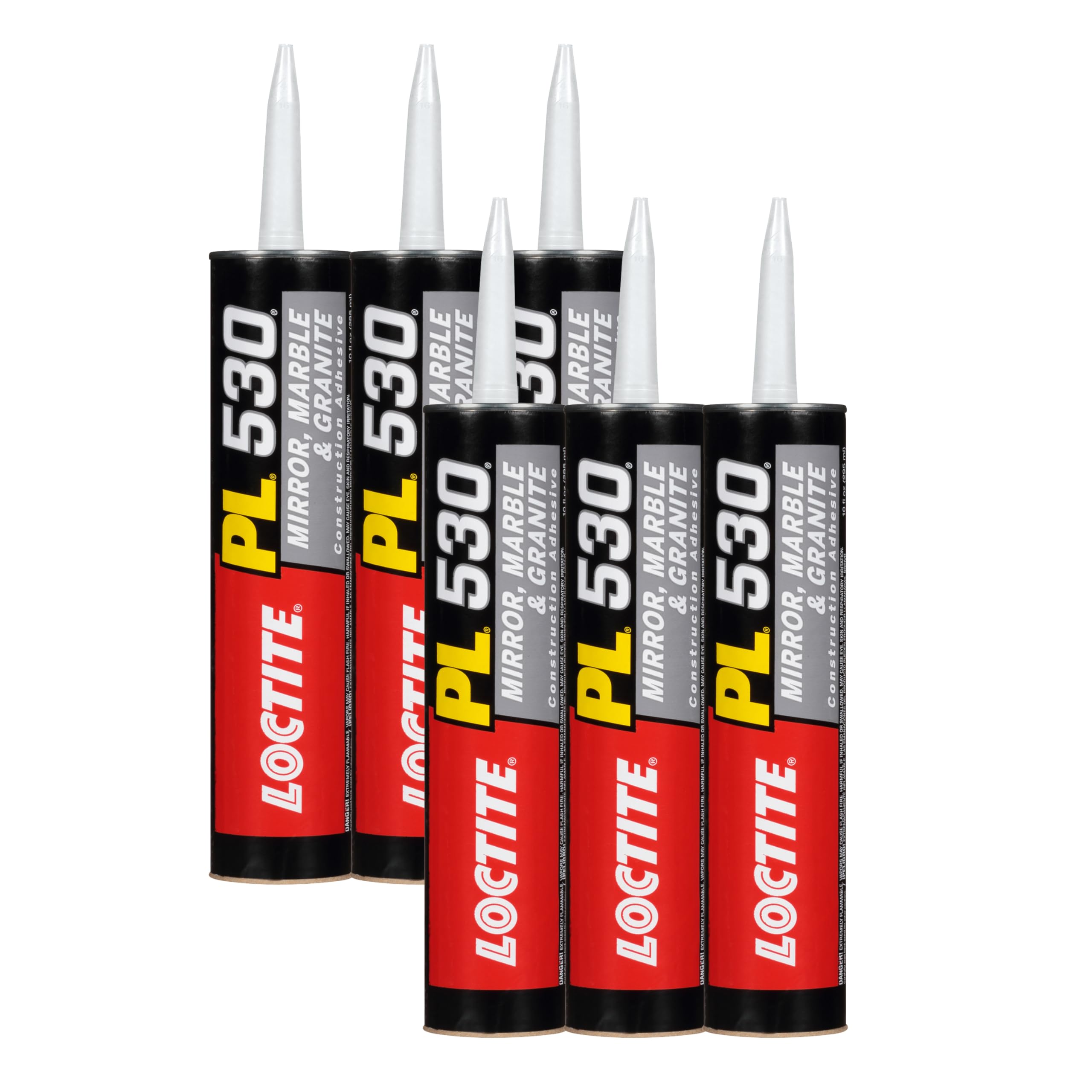
1. Loctite PL530 Mirror, Marble and Granite Construction Adhesive, Light Tan, 10 fl oz Cartridge, 6 Pack
Our pick — over 4.5★ from 350+ verified ratings; the strongest balance of quality and price.
The one adhesive here actually engineered for marble, mirrors and granite, not borrowed from the flooring aisle.
Marble needs an adhesive designed around it, and this Loctite build is named for the stone. It sets in 15 minutes and reaches full cure in 48 hours, which means you can position a heavy mirror, hold it briefly, and walk away confident it will not slide. The gel formula stays put instead of running down a vertical face, which is exactly what a kitchen or bath backsplash demands.
The namesake advantage is wet-area performance. Loctite formulated this to bond in wet and humid conditions, so a shower-adjacent panel or a backsplash behind a sink is inside its comfort zone rather than a gamble. It carries a low-VOC (volatile organic compound — the solvent that off-gasses into your room) rating that meets federal and state guidelines, which matters when you are glueing inside a small bathroom. Buyers report they used it for installing industrial size mirrors and it was great, with adhesion holding and drying within 24-48 hours.
The six-pack is the practical catch worth understanding. You get six 10-ounce cartridges weighing 6.5 pounds total, so this is a bulk buy for someone with several jobs or repeat projects — not a single-mirror purchase. In a direct comparison against the ROBERTS flooring adhesive, this Loctite is the lighter of the two at 6.5 pounds versus 8.4 pounds. If you only need one cartridge, the format is working against you.
What makes it the top pick
- Engineered specifically for bonding mirrors, marble and granite in kitchens and baths
- Sets in 15 minutes and fully cures in 48 hours, so a mirror is not sliding overnight
- Formulated to bond even in wet and humid areas for lasting adhesion
- Low-VOC formula that meets strict federal and state guidelines
- Six 10 fl oz cartridges, so a multi-project season costs less per tube
Where it falls short
- Comes only as a 6-pack, so a single-mirror buyer pays for five spares
- The full 48-hour cure means you must keep the piece braced far longer than the 15-minute set implies
- Solvent-based, so it wants ventilation while you work
Reach for this if: you are hanging a mirror, bonding a backsplash, or working anywhere a sink or shower splashes.
Look elsewhere if: you need one tube for one small repair — a single-use format serves you better.
2. HIMG Glue Adhesive for Granite, Marble, Stone, Corian, Quartz, Porcelain, Ceramic – 2 Part SCA
Syringe-fed, two-part glue that is designed to close a crack in a countertop or threshold in minutes.
You get a syringe strip holding 30 grams of two-part acrylic (a glue that hardens when two liquids mix) that cures in 5 minutes. That makes it the fastest-acting product on this list, so it suits a small, visible chip or a broken marble table edge. It is also non-toxic and odorless, and the maker describes it as an alternative to epoxy that will not yellow over time — a real concern on white stone, where a yellowing repair looks worse than the original crack.
Buyers who fixed small damage report the outcome they paid for. One buyer summed it up plainly: “It did the job, fixed a crack in kitchen marble.” Another repaired a cracked marble shelf and reported it bonds quickly while still allowing time to wipe off the excess and wash hands before it grabs.
The honest catch is consistency. The syringe applicator is the weak link — it can clog, and one buyer described a threshold repair where the bond did not hold and the adhesive also darkened the area around the crack, making it more obvious. Read the instructions closely and use less than you think you need, because the same reviewer who succeeded noted they used too much when half would have sufficed.
What works: a 30-gram syringe that cures in 5 minutes, a non-yellowing clear/yellow finish, and enough capacity to store and reuse on the next small break.
What to expect: the applicator is the failure point. Clear the tip fully before you start and practise the squeeze on scrap first.
The short version: the fastest-setting fix here for visible countertop cracks and chips, and the right size for repairs that do not need a cartridge.
Different job required: a load-bearing bond or a large structural repair needs a cartridge or a mixable resin — this is a spot repair tool.
3. Tenax Tixo XE Transparent Polyester Mastic – Knife Grade Stone Adhesive for Granite, Marble & Natural Stone
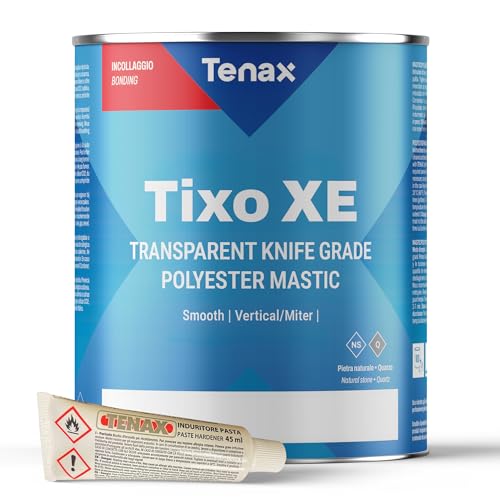
The fabricator-grade quart that lets you tint the glue to match the stone before it sets.
This is the pick for anyone joining marble to marble — laminating a countertop edge, setting a seam, or filling a broken slab — rather than glueing marble to a wall. It is a knife-grade polyester mastic, meaning it is thick enough to hold its shape on a vertical edge without sagging, and it comes as a 32-fluid-ounce quart with a hardener. What wins people over is the colour control: you can blend the resin to match the stone before applying, and the maker says it hardens faster than epoxy.
A countertop fabricator used it on broken Cristallo quartzite in three pieces and found it dried fully transparent with a tinting kit that takes a natural golden hue and polishes out cleanly. The highest-praised quality on this one is its overall quality, followed by durability — and a buyer who fabricated a marble shower niche surround noted a 15-20 minute cure that turned strong.
Two things to know before you buy. The colour is genuinely mixed — it takes a tint beautifully, yet it can trend yellow in the can over time, so check your batch before you rely on a clear finish. And it is not easy to use, with a few buyers describing it as awkward to work. It is a professional resin at a hobbyist-friendly size, so expect a learning curve.
Where it earns its place
- Tintable resin lets you match the seam colour to the stone instead of settling for a visible line
- Knife-grade viscosity holds on a vertical edge without running
- Hardens faster than epoxy for shorter working windows
- A full 32 fl oz quart with hardener covers real fabrication work, not just a single chip
The fine print
- Needs mixing with a hardener, so there is more prep than a squeeze-and-go cartridge
- Colour sits between clear and yellow, so test on offcut stone first if a pure-clear finish matters
- A few buyers find it finicky to work with
For the seam-setter: if your job is joining two pieces of stone and hiding the line, this gives you tint control and a thick bead that stays where you put it.
Not your pick if: you want a no-mixing, single-squeeze repair — the HIMG syringe is the easier route for a quick fix.
4. ROBERTS Universal Resilient Flooring & Vinyl-Backed Carpet Tile Adhesive – 1 Gal. (3.78 L)

A gallon of solvent-free floor adhesive that happens to list marble among the surfaces it can bond to.
Read the compatibility line carefully and this becomes a marble-relevant pick, because ROBERTS lists properly prepared concrete, flooring-grade plywood, steel, marble and terrazzo among the surfaces it will bond to. The job it is built for is glue-down luxury vinyl plank, vinyl tile and vinyl-backed carpet tile, in both residential and commercial settings. It is an acrylic latex, solvent-free, pressure-sensitive adhesive at 8.4 pounds for the gallon, and it is treated with Microban product protection to help fight stain growth that degrades the bond.
Where it shines is toughness under heat. A camper owner gluing carpet to walls and ceiling reported the bond held up past 115°F with no lifting or bubbling. The bigger picture is more mixed on adhesion and dry time — some users find it grips vinyl beautifully and dries clear enough that chalk lines stay visible, while others find it slow to fully dry over low spots. Timing is the most-discussed aspect on this one, so plan around it rather than assume.
One cleanup rule is non-negotiable. Clean spills and tools with water immediately, because once this dries, cleanup becomes nearly impossible even with lacquer thinner. Also note the marble reference is about bonding over a prepared marble substrate, not glueing a heavy marble slab to a wall — those are different jobs. The ROBERTS is also the heavier of the two against the Loctite PL530 at 8.4 pounds versus 6.5 pounds, which matters if you are carrying a pail around a jobsite.
Project fit: the gallon format and Microban protection suit whole-room glue-down work where a small cartridge would run out in a corner.
Timing note: budget extra drying time on uneven subfloors — a few users find low spots stay tacky for hours.
Suits the floor installer: if you are laying vinyl plank or carpet tile over a prepared surface that includes marble, one gallon covers the room.
Look past it if: you just need one small marble repair — the volume and slow dry here are out of proportion to the job.
5. CHIYU Kintsugi Repair Kit: Modern Repair Kit – Gold Glue

The one product here that turns a broken marble object into a gold-veined feature instead of hiding the damage.
Kintsugi is the Japanese craft of repairing a break with gold so the crack becomes part of the piece rather than a flaw, and this kit is built to do exactly that. The glue itself is a transparent two-part epoxy designed for the technique, and the maker lists marble among the materials it suits, alongside ceramic, glass, wood and concrete. You get enough to repair 8 to 10 medium-sized broken items, with instructions in English plus five more languages downloadable by QR code. It is food contact safe and the repaired result is dishwasher safe.
Buyers consistently rate its effectiveness as the standout — the gold finish is what draws people in, and the repaired pieces hold up. It works best when the break is a clean separation you can press together, letting the gold line define the seam — one buyer chose to leave a slight crevice rather than fill the crack flush, so more gold shows and the repair history reads as intentional.
The learning curve is real. It takes some artistry, the kit ships with only one pair of gloves, and a second pair of hands helps with larger pieces. One note on the epoxy clay for filling big chips: it can feel gritty and difficult to blend. Budget the full 72-hour cure before the piece goes back into service.
Why it stands apart
- A food contact safe and dishwasher safe finish, unusual for a decorative repair adhesive
- Enough resin and powder to repair 8 to 10 medium-sized broken marble or ceramic objects
- Marble is explicitly listed among the suitable materials
- Works as a filler for missing pieces, not just a crack sealer
Before you start
- A steep learning curve — expect a couple of practice pieces
- Only one pair of gloves in the box; a second person helps with awkward shapes
- The full 72-hour cure keeps the item out of use for three days
Choose it when: the broken piece has sentimental or visual value and you would rather showcase the repair than conceal it.
Skip the technique if: you need an invisible mend — the gold is the whole point, so a clear seam adhesive serves that goal better.
6. Loctite Power Grab Ultimate crisp Construction Adhesive, 2.7 fl oz Tube, 6 Pack
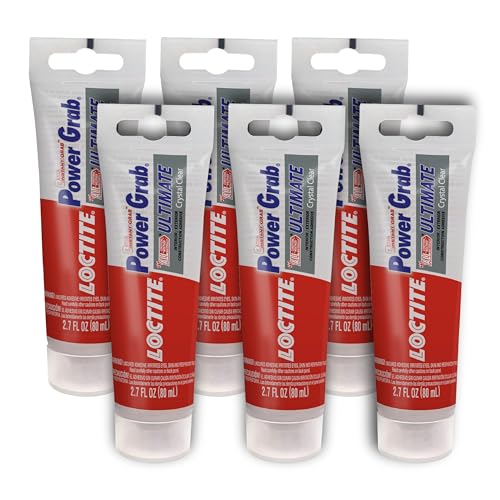
Clear, grippy and built for the jobs where both surfaces are slick or damp and bracing is a nuisance.
Marble and glass are the classic problem pair — both non-porous and hard to grip. This Loctite formula is designed for that exact situation: it will bond two non-porous surfaces and works on wet surfaces, with a clear finish that stays clear and a 10-minute set followed by a 24-hour cure. It lists marble among its compatible materials alongside brick, ceramic, concrete, glass, porcelain, stone and wood, and it is waterproof with resistance from 40°F to 104°F, so a backsplash or exterior panel is within reach.
What buyers like most is the working window. The gel lets you nudge a piece into position before it grabs, which is the opposite of a grab-and-pray adhesive — one buyer mounted a clear bathroom wall plate, used painter’s tape to hold it while curing, and reported it stayed put and blended in. The instant grab also reduces the clamping and bracing a job requires, which is the whole appeal of the Power Grab line.
The catch is shelf life. Several owners mention the tube drying out quickly even with the cap on, effectively making it a single-use tube once opened. One noted it hardened and lost working time, an experience likely tied to an old stock tube. The six-pack format helps here — you can rotate through tubes and only open what the job in front of you needs.
The draw: a clear, waterproof, repositionable adhesive that bonds the two hardest surfaces to glue — marble and glass — and holds from 40°F to 104°F.
The reality check: open tubes do not keep. Plan your jobs around the tube you are opening, not the pack you bought.
Good match if: you are mounting stone or glass to a slick wall and want time to adjust before the bond locks.
Not the one for you if: you want to open a tube now and finish a job next month — this dries out once opened.
7. The Original Fix-A-Floor Loose Tile Repair Adhesive – 1 Gallon Jug
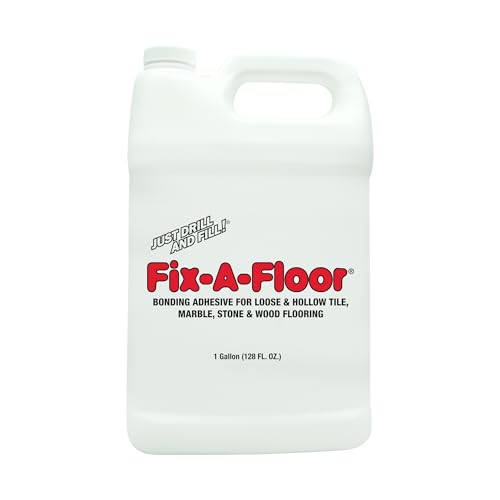
Drill a small hole, inject, weight it down — the no-removal route to a floor that stopped creaking.
Fix-A-Floor solves a very specific problem: a marble, stone or porcelain floor tile that has come loose from its subfloor and now sounds hollow underfoot. Rather than ripping the tile out, you drill small holes through the grout line or the tile, inject this self-leveling liquid underneath, and let it flow into the void. It is a non-toxic CoPolymer formula that stays workable and does not dry out or crack, and the maker says it maintains a permanent bond. Full cure is 24 hours. The gallon brings 8.9 pounds of product and covers a large floor repair job.
What this one does best is answer whether a repair actually holds. Customers note re-bonding hollow 12×24 porcelain tiles after a wax ring leak and fixing roughly 80 square feet of loose 18×18 tile with a 1/8-inch air gap. The recurring instruction across the good results is the same: squeeze the caulking gun slowly so you do not break the tile loose, and let the adhesive dry for weeks before re-grouting.
The trade-offs are honest ones. The formula is very runny, more like thin glue than a thick gel, which makes it prone to draining out of large cavities before it sets and means two tubes may only handle four tiles. The rear seal on the tubes can leak, so some DIYers switch to a 30ml syringe with a 14g blunt tip instead of the included needle attachment. It is a small-repair tool, not a whole-floor rebuild — a professional repairer would pull the tile and reset it for a mortar-based floor.
Why it earns a spot
- Re-bonds loose and hollow tiles, marble and stone without removal or replacement
- Self-leveling and non-toxic, so it flows into the void and cures in 24 hours
- DIY-friendly with a drill and a caulking gun, no specialist tools required
- Full gallon covers a large floor or many small repairs across a room
The known quirks
- Very runny — large cavities can drain it before it sets, so small repairs suit it best
- Seal can leak on some tubes; the suggested fix is a 30ml syringe and 14g blunt tip
- Larger mortar-set floors may need the tile removed instead
Right for the hollow-tile owner: a loose tile with an air gap underneath is exactly the problem this was designed for.
Think twice if: the tile is bedded on mortar rather than sitting on an attached backer — a full removal repair may serve you better.
Understanding the Specs
Viscosity: Why Thick or Thin Changes Everything
Viscosity is how runny the glue is when you squeeze it. A high-viscosity adhesive like a knife-grade mastic holds its shape on a vertical edge and stays where you put it, which is why it is the choice for a seam. A very runny, self-leveling formula flows into a void under a floor tile, but it will also drain out of a large empty cavity before it sets. Match the thickness to the shape of the space you are filling, not to the strength rating.
Cure Time Versus Set Time
Set time is how long until the adhesive grabs and the piece stops moving — Loctite PL530 sets in 15 minutes, HIMG cures in 5, and Loctite Power Grab sets in 10. Cure time is when the bond reaches full strength: 48 hours, 24 hours and 72 hours across these picks. A short set time does not mean you can load the joint early; plan on leaving weight or bracing in place for the full stated cure, which can run up to three days for the Kintsugi epoxy.
FAQ
Will these adhesives work on polished marble?
Which adhesive is best for a marble crack in a countertop?
Can I use these adhesives in a wet area like a shower or backsplash?
How long before I can put weight on a marble repair?
Will adhesive stain or discolour my marble?
Can I use a floor adhesive to bond marble to a wall?
What is the difference between an epoxy and a polyester mastic for stone?
Do I need a caulking gun for these adhesives?
Can adhesive fix a hollow-sounding marble floor tile without removing it?
Are these adhesives safe for food-contact surfaces like marble countertops?
Final Thoughts: The Verdict
For most buyers, the adhesive for marble winner is the Loctite PL530 because it is actually engineered for marble, mirrors and granite and is formulated to bond in wet and humid areas — the two things a kitchen or bath job demands. If you are filling a small countertop crack, reach for the HIMG and its 5-minute cure. And if the job is a seam that needs to disappear into the stone, the Tenax Tixo XE gives you tintable, knife-grade control the cartridges cannot match.
Start with whichever format matches your repair — a cartridge for walls and mirrors, a syringe for a chip, a quart for a seam, and a gallon for a floor. Match the tool to the shape of the job and the marble will hold.
How We Picked
We do not accept paid placement. Every pick is matched to a real buyer and a real use-case; we do not hands-on test units.
Sources & Methodology
Specifications: manufacturer listings and product documentation. Review insights: verified customer reviews, as of September 2026. Pricing: not shown on this page (it changes often); check the current price via the retailer link.
As an Amazon Associate, KitchPrep earns from qualifying purchases. This does not affect which products we feature.
Related Guides
