
Specs are compiled from manufacturer listings and verified buyer reviews and can change over time — please confirm the key details on the product page before buying.
If you are laying engineered hardwood and want the boards to stay quiet and tight, the glue you squeeze into the tongue-and-groove joint matters more than almost anything else. This guide narrows the field to three floor-rated adhesives that actually work on engineered hardwood, and it tells you plainly which one fits your job.
I’m Mohammad Maruf — the founder and writer behind KitchPrep. This guide is built by comparing the manufacturers’ published specifications and the patterns across verified customer reviews, so you get each pick’s real strengths and trade-offs instead of marketing spin.
You will see which bottle suits a full floating install, which one you spread under a glue-down floor, and which one rescues a floor that already creaks. If you want the short answer, the strongest all-round pick for a normal engineered hardwood install is the Titebond Tongue & Groove Flooring Glue, a crowd favorite that holds 4.5 stars across 100+ ratings and is built to bond a floating floor without water sneaking into the joint. adhesive for engineered hardwood flooring.
Our Picks at a Glance

How To Choose The Best Adhesive for Engineered Hardwood Flooring
The first thing to settle is how your floor is going down, because that single decision rules out half the bottles on the shelf. A floating floor gets glued board-to-board at the tongue and groove; a glue-down floor gets adhesive spread across the whole subfloor; and a floor that already pops and creaks needs a repair adhesive injected through a small hole.
Match the glue to the install method
For a floating engineered floor you want a glue that spreads into the groove fast and grabs in minutes, so a board cannot slide out of line while you work. For a glue-down install you want a trowel-grade floor adhesive that you can comb out across the subfloor and that gives you a slower grab so you have time to set each board. For a hollow-spot repair you want a thin repair adhesive that flows through a tiny drilled hole and fills the empty space under the plank.
Check the water resistance and the cleanup
Engineered hardwood hates standing water, so a glue rated for water resistance helps protect the joint from a kitchen spill or a damp mop. A Type II water-resistance rating is the label to look for on the bottle. Just as important is how the glue cleans up: some wash off with soap and water while they are still wet, and others need a solvent like mineral spirits.
Know your open time and your coverage
Open time is the window between spreading the glue and losing your ability to nudge the board into place. A short open time means the board locks down quickly; a longer one lowers your stress on a big run. Coverage is usually quoted as linear feet at a certain bead size, so do the math on your room before you order, because running out mid-row is the worst way to spend an afternoon.
Quick Comparison
| Model | Best For | Format | Cure Time | Weight | Amazon |
|---|---|---|---|---|---|
| Titebond Tongue & Groove Flooring Glue #2104 (6 bottles)★ Best Overall | Floating engineered floors | 6 x 16 oz bottles | 24 hours | — | Amazon |
| ARDEX Henry, WW Company 12235 1171N Floor Adhesive, 1 Gallon | Glue-down over a subfloor | 1 gallon pail | Sets fast, dries slowly | 13 pounds | Amazon |
| 32 Fl Oz. Professional Wood Floor Repair Adhesive 2 Pack | Fixing hollow spots and squeaks | 2 x 32 fl oz | Several days to firm up | 3 pounds | Amazon |
In‑Depth Reviews
1. Titebond Tongue & Groove Flooring Glue #2104 (6 bottles)
Our pick — 4.5★ from 100+ verified ratings; the strongest balance of quality and price.
Six 16 oz bottles of fast-setting PVA glue for gluing floating engineered boards tongue to groove.
If your engineered floor is going down as a floating floor, this is the pick that fits the job best. You get six 16-ounce bottles of liquid PVA glue, and each bottle is rated to cover roughly 200 linear feet at a 1/8″ bead. That number is the one to plan around. It tells you how far one bottle stretches along the tongue-and-groove joint before you crack open the next one.
What wins people over is the value and the speed working together. The glue carries a Type II water-resistance rating, which is the label that says the joint is built to shrug off normal household moisture rather than drink it in. It also spreads fast in the groove and sets in minutes, so boards lock together before they can drift. Buyers report “Used 5 bottles for 1100 sq ft. No bottle problems. Glue is strong, sets fast. Oil finish engineered hardwood in open floor plan incl. kitchen. Zero worry about water seeping into tongue and groove. Very happy.”
The catch to plan for is repositioning time. Once this glue grabs, it grabs, and you have only about four to five minutes to adjust a board before it needs a crowbar to come back out, so dry-lay your floor first. The full cure time is 24 hours. Note that it comes as six separate bottles rather than one big jug, which is 6 bottles versus the 2 bottles in the repair kit below — more bottles, but each one is smaller and easier to hold along a long wall run.
What the bottle delivers
- Six 16 oz bottles, each covering about 200 linear feet at a 1/8″ bead
- Type II water resistance protects the joint from everyday spills and damp mops
- Sets in minutes, so boards lock down fast on a floating engineered install
- Full cure time of 24 hours, so you know when the floor is truly set
What to work around
- Only 4-5 minutes to reposition a board before it needs a crowbar
- Ease of use gets mixed feedback, so dry-lay the floor before you glue
- Thickens at the bottom of the bottle, so transfer the last of it between bottles
Your match if: you are gluing down a floating engineered or laminate floor and want a fast-setting, water-resistant joint.
Think twice if: you need a slow-setting glue that gives you time to slide boards around, because this one grabs in minutes.
2. ARDEX Henry, WW Company 12235 1171N Floor Adhesive, 1 Gallon
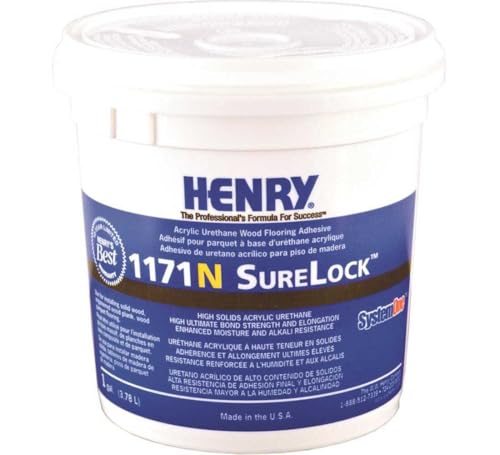
A 1-gallon trowel-grade pail that grabs slowly, so you can set each 3/4″ plank before it locks.
Here is the contrast that matters most if you are spreading glue across a whole subfloor instead of gluing board to board. This pail earns its place because it sets up slower, and a slower grab means less stress while you are pressing a 3/4″ plank down into a bed of adhesive. It arrives as a single 1-gallon pail weighing 13 pounds.
Weight is where this one sits squarely above the repair kit in the lineup. At 13 pounds it carries the load, and it is 13 pounds versus the 3 pounds of the repair adhesive below. That gap tells you the two bottles are built for completely different jobs, not that one is somehow worse. The heavy pail is a spread-it-wide floor adhesive; the light kit is a squeeze-it-into-a-hole repair fluid.
Cleanup is a real selling point here. Mess washes off with soap and water while it is still wet, and mineral spirits take care of any adhesive slips once it sets. The recurring gripe is the smell — this glue contains naphtha, so you will want a fan and open windows while you work, and sturdy rubber gloves rather than thin latex. As owners mention, “Sets up slower for less stress in gluing down 3/4″ hardwood flooring.”
Where it earns its keep: a slower grab and soap-and-water cleanup make it a calmer choice for spreading adhesive across a subfloor and setting wide planks one at a time.
The honest caveat: the naphtha smell is strong enough that a ventilated room and proper gloves are not optional — plan for airflow before you open the pail.
Reach for this if: you are gluing engineered or solid hardwood down over a subfloor and want time to position each board.
Look elsewhere if: you are working in a sealed room where you cannot get a fan going, or you want a glue you squeeze into a joint rather than trowel out.
3. 32 Fl Oz. Professional Wood Floor Repair Adhesive 2 Pack

A 2 x 32 fl oz injectable fluid that fills the voids under a popping, creaking plank.
This is the one for a floor that is already down and misbehaving rather than one you are installing today. It is built on the idea that a major cause of popping and hollow spots in engineered wood floors is adhesive voids — empty gaps left between the plank and the subfloor. You drill a small hole, inject this fluid into the gap, and it fills the space so the board stops flexing and the cracking noise stops with it.
The packaging tells the story of what kind of job this is. You get two 32-ounce containers and a light 3-pound kit, which is 2 bottles versus the 6 bottles in the Titebond box above. Fewer, larger containers suit a repair you squeeze through a hole far better than a row of small bottles does.
Where buyers get caught out is quantity and patience. A large hollow area can drink nearly a whole bottle in one spot, and the glue can take several days to firm up, so give it time before you decide it failed. As customers note, “Large area (~15″x15″) used nearly whole bottle; smaller spots used less. Took several days to firm up.” One practical tip from the review pages: rather than drawing the thick fluid up into the syringe, pull the plunger out and pour the solution in. An occasional bottle does arrive with dried glue on the inside walls, so inspect the containers when they land.
The whole point of it: it fills the adhesive voids under an existing engineered floor, which is what stops the hollow pop and the crack sound in the first place.
Set your expectations: a big void can swallow a whole bottle in one area and the fix can take several days to firm up, so buy more than you think you need and do not judge it on day one.
Choose this when: your engineered floor is already installed, popping, and creaking, and you want to fix the hollow spots without pulling up boards.
skip it if: you are laying a new floating floor, because a repair fluid is the wrong tool for gluing fresh boards together.
Understanding the Specs
Type II Water Resistance
This is a rating on the bottle that says how well the glue stands up to moisture once it has cured. Engineered hardwood swells and cups when water gets into its edges, so a joint sealed with a water-resistant glue is better protected against a kitchen spill or a damp mop. On a floating install, where the boards are only joined at the tongue and groove, that sealed joint is the main line of defense.
Open Time vs Full Cure Time
Open time is how long you have to nudge a board into position after you spread the glue — a short window means you must work fast and dry-lay the floor first. Full cure time is when the glue reaches its final strength, which is a longer wait. These two numbers are not the same thing, and mixing them up is how people end up forcing a board that has already locked down.
Coverage Per Bottle
Coverage is quoted as linear feet at a set bead size, which is the length of joint one bottle can fill. It is the number that decides how many bottles you buy, and running short in the middle of a row is a real problem because a half-glued board will eventually squeak. Measure the total length of your floor’s joints, then divide by the per-bottle coverage before you order.
Void-Filling Adhesives
A repair adhesive is a different product from an install glue. Its job is to flow through a small drilled hole and fill the empty gap between a plank and the subfloor that is causing a hollow pop. These glues tend to be thinner, they come in larger containers, and they can take several days to firm up because they are curing in a closed cavity rather than in open air.
FAQ
What kind of adhesive do I need for a floating engineered hardwood floor?
How much adhesive will I need for my engineered hardwood floor?
Can I use a repair adhesive to install a new engineered hardwood floor?
Why does my engineered hardwood floor pop and creak?
Do I need ventilation when using floor adhesive?
How long before I can walk on my glued engineered hardwood floor?
Is Titebond better than a cheaper local flooring glue?
What is the difference between an install glue and a repair adhesive?
How do I clean up floor adhesive if it gets on the boards?
Why did my repair adhesive not stop the cracking sound the first time?
Final Thoughts: The Verdict
For most people laying an engineered hardwood floor, the winner is the Titebond Tongue & Groove Flooring Glue because it spreads fast into the groove, carries a Type II water-resistance rating to protect the joint, and sets in minutes so your boards stay put. If you are gluing planks down over a subfloor and want a slower grab with soap-and-water cleanup, reach for the ARDEX Henry 12235 1171N Floor Adhesive. And for a floor that is already installed and popping, the 32 Fl Oz. Professional Wood Floor Repair Adhesive 2 Pack is the one built to fill those hidden voids.
How We Picked
We do not accept paid placement. Every pick is matched to a real buyer and a real use-case; we do not hands-on test units.
Sources & Methodology
Specifications: manufacturer listings and product documentation. Review insights: verified customer reviews, as of September 2026. Pricing: not shown on this page (it changes often); check the current price via the retailer link.
As an Amazon Associate, KitchPrep earns from qualifying purchases. This does not affect which products we feature.
Related Guides
