
Specs are compiled from manufacturer listings and verified buyer reviews and can change over time — please confirm the key details on the product page before buying.
If your recordings sound hollow and boxy no matter how good your microphone is, the problem is almost never the gear — it’s the bare walls around you. Acoustic panels stop sound waves from bouncing off drywall and smearing your voice, your drums and your mixes. Wood-slat and high-density felt panels win here because they tame echo without covering your walls in foam. Most home studio shopping is a trade-off between how much sound you soak up and how good the wall looks on camera.
I’m Mohammad Maruf — the founder and writer behind KitchPrep. This guide is built by comparing the manufacturers’ published specifications and the patterns across verified customer reviews, so you get each pick’s real strengths and trade-offs instead of marketing spin.
Panels are only half the job — placement, thickness and coverage do the rest, and each pick below is sized for a real room. Read on for the acoustic panels for home studio setups that dry up echo without wrecking your space.
Our Picks at a Glance


How To Choose The Best Acoustic Panels for Home Studio
Panels only absorb the reflections that hit them, so placement decides how much they help. So before you click buy, work out which surfaces are shouting back at you and how much wall you can realistically cover.
Absorption versus soundproofing
Almost every listing says “soundproof” and almost none of them are. Panels soak up the echo bouncing around inside the room so your mic hears a cleaner voice. They do not stop noise escaping through the door. If your actual problem is a neighbour or traffic noise, panels are the wrong tool.
Coverage, thickness and density
Thicker and denser panels handle more low-mid reflection. Thin decorative felt tames the bright slap echo; a 2-inch panel grabs more. Read the coverage figure on the box — a wood slat set that covers about 33 sq.ft. and a pyramid foam pack covering 36 sq.ft. get you very different amounts of treated wall.
Mounting and the rental problem
Self-adhesive backs are fast but permanent-ish; removable sticky strips leave no marks. Foam panels that ship with no adhesive backing let you choose tape, spray glue or hook-and-loop. Think about the ceiling and corners too — those are where echo builds up most.
Quick Comparison
| Model | Best For | Coverage | Panel Thickness | Pack Size | Amazon |
|---|---|---|---|---|---|
| NeatiEase Wood Panels★ Best Overall | Statement wall that also kills echo | 33 sq.ft. | — | 4 panels | Amazon |
| TONOR Dual-Layer PanelsMost Polished | Peel-and-stick treatment for renters | Approximately 4400 square inches | 0.72 inches | 4 panels | Amazon |
| Art3d Fluted Wood Slat PanelBest Looking | Small office or booth with a designer look | 23.3 sq.ft | 0.01 inches | 2 panels | Amazon |
| UMIACOUSTICS Fiberglass Panels | Mixing and mastering reflection control | 432 square feet | 2 inches | 4 panels | Amazon |
| 6 Pack Wood Look Panels | Budget-friendly podcaster accent wall | — | — | 6 panels | Amazon |
| AudioSilk ROOM KIT | Renter-treated project studio | — | 0.4 inches | 4 panels | Amazon |
| Olanglab Acoustic Wall Panels | Large-room value coverage | 77.35 square feet | 0.31 inches | 10 panels | Amazon |
| 36 Pack Pyramid Foam Panels | Cheap first treatment for a spare room | 36 square feet | 2 inches | 36 panels | Amazon |
In‑Depth Reviews
1. NeatiEase Wood Panels for Wall, 4-Piece 96″ x 12.6″ Soundproof Wood Slat Wall Panel (Teak)
Our pick — over 4.5★ from 550+ verified ratings; the strongest balance of quality and price.
Four teak slats that turn a blank wall into a treated, camera-ready backdrop
If your mic is picking up a hollow ring off a blank wall, this is the upgrade that fixes both the sound and the shot. The four 96″ x 12.6″ panels in this set cover about 33 sq.ft., and each one is built from MDF with a high-density polyester fiber core — MDF is the rigid backing board, polyester fiber is the soft material doing the absorbing. You can run the slats horizontally or vertically and cut them to any shape, so odd corners and sloped ceilings are not a problem. Screws or superglue both work, and the panels go just as happily on a ceiling as on a side wall.
What wins people over is the look, and it is not close. Owners consistently describe the teak finish as warm and cherry-like with a convincing veneer, and the end result reads like a designer install rather than a DIY one. Buyers use them to frame a mirror, build a full accent wall, or finish a basement remodel. Mounting with black drywall screws handles slightly wavy walls, and cutting is clean with no chipping. The set weight lands at 19.96 kg, which is substantial enough that this is a two-person, one-drill job rather than a solo afternoon hang.
Understand this is not real wood slats — it is a wood-look veneer, and the listing says so plainly. Expect a strong factory odor from the start; the recurring note is that it fades over weeks, not minutes. Glass-thin panel edges demand a little care during the cut. And one honest caveat on durability: corners can arrive dented, and the wood is stapled to its backing — if you cut a section where the staples stop, that piece needs glue to stay put.
What Owners Rave About
- 33 sq.ft. of coverage from just four panels — a fast way to treat a big wall
- Looks genuinely high-end; the warm cherry-like teak finish improve the whole room
- Cuts cleanly with no chipping, and mounts horizontally, vertically or on the ceiling
Where It Falls Short
- Heavy at 19.96 kg — plan for two people and a drill
- Wood-look veneer, not solid wood, and it off-gasses for the first stretch
- Cut sections away from the staples need glue to hold
Reach for this if: you want one wall that absorbs echo and looks like a magazine spread — the crowd favorite at 4.6 stars across 500+ ratings.
Look elsewhere if: you rent and cannot commit screws or glue to a landlord’s drywall.
2. TONOR Dual-Layer Thickened Acoustic Wall Panels, 4 Pack 47.2″x23.6″x0.72″
A two-layer core that soaks up echo without a single screw or tube of glue
If you want panels up on a rented wall before lunch, this is the one. Each of the four panels measures 47.2 x 23.6 x 0.72 inches, and the padded back means you peel and stick — no tape, no adhesive to buy separately. That gives you around 4,400 square inches of covered wall per pack, since each full panel carries roughly 1,100 square inches. Four panels in a single box is what makes the coverage figure land.
The double-layer core is the whole pitch here. Instead of one soft sheet, you get two layers of thickened material that work together to disperse echo and noise, and the panel is finished in 100% high-density polyester fiber — a felt-like textile rather than bare foam. It is rated safe to have around family, comes in a classic stripe pattern that reads as wall decor rather than studio kit, and the reinforced corner protectors at least give it a fighting chance in the post.
Where owners get stuck is putting a set of these up in an odd room. The panels are square-edged, so unless your wall is dead flat, seams can show and light between them. That is the trade-off of a modular peel-and-stick: it is clean in a tidy rectangle and fussy over a doorway or around an outlet. Pair that with a soft thin body and you get excellent mid and high absorption — the part the ear finds annoying — but no meaningful bass control.
Pick this if: being able to tear it out of a rental without spackle is worth more to you than perfect panel-to-panel alignment.
Think twice if: you need to wrap a plumb-perfect room with zero visible seams.
3. Art3d 2-Pack Fluted Acoustic Wood Slat Wall Panel, 47.2 x 23.6 Inch, Walnut
Two oversized walnut flutes that make a small booth look like a paid studio hour
Two panels may sound like a token amount, and honestly for a full wall you will be buying more than one pack. What you get in a single pack is 23.3 sq.ft of coverage from two 47.2″ x 23.6″ fluted walnut panels. That is a genuinely large format — roughly 1,114 square inches each — so two of them can dress a small office corner or one narrow booth wall. The panels measure a hair under half a foot longer than the pyramid foam tiles, and the comparison is stark if you are pacing a wall: the Art3d panel at 47.2″L x 23.6″W is about 3.9 times the face area of a 12″L x 12″W foam tile, so you hang far fewer pieces for the same footprint.
They are made from quality MDF with a high-density polyester fiber core and low TVOC levels — TVOC is the catch-all for the volatile compounds that make new synthetic materials smell “new.” The 12.4-pound pack makes this a one-person job. Cutting to clear outlets is done with a circular saw and a jig saw at 45 degrees, and once mounted, buyers report the echo in a small room just goes quiet, with video calls picking up a clean voice. The 4.5-star score across 900+ ratings reflects a product that has clearly stuck with a lot of office and bedroom setups.
The handling warning: the fluted wood is stapled to a backing board, and any cut section where the staples stop will fall away from its base — glue it back or you will have loose slats. Wear gloves; the fluted profile has edges sharp enough to nick skin.
The installation reality: this is not a peel-and-stick. Plan on a saw, a level and a helper, or pay someone. The reward is that a treated wall finally looks like a design decision rather than damage control.
Best suited to: a designer-led small office or podcast corner where looks carry as much weight as the absorption.
Not the one for: a first-timer hoping to stick a set on the wall in five minutes with no tools.
4. 4 Pack Acoustic Panels 23.6″x11.8″ Soundproof Fiberglass Panel, Black
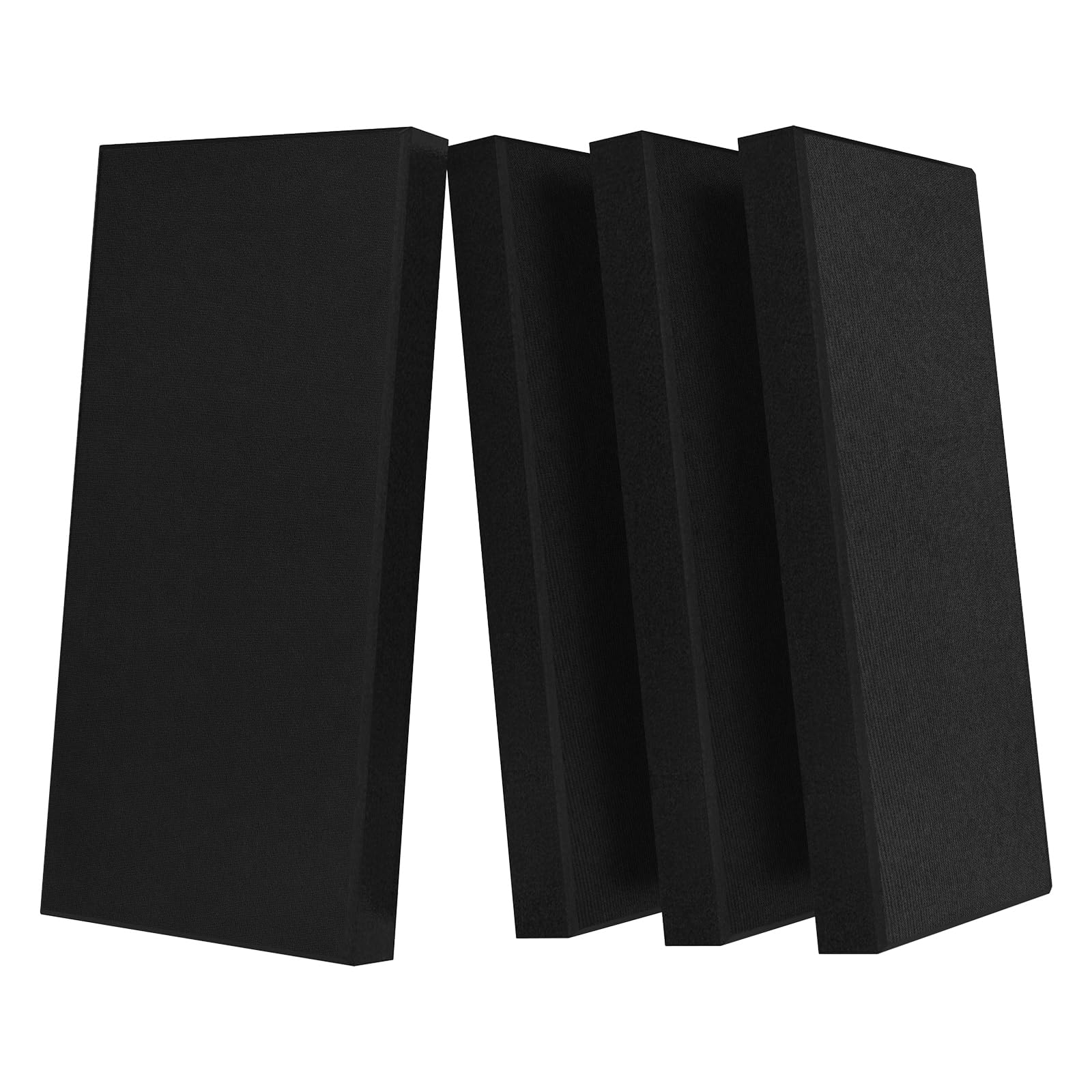
Real 2-inch fiberglass with a metal bracket system — the mixing-room pick
These panels pack a 2-inch fiberglass core wrapped in 100% high-density polyester fabric. Fiberglass is the denser, more absorbent material used in professional rooms, and the listing rates the inner fiberglass E0 for environmental emissions — a lower-emission grade than standard yellow fiberglass. The 2-inch thickness is a real advantage over thin decorative felt, because more material depth means more of the mid frequencies that make a voice sound harsh get soaked up instead of bounced back.
The mounting system is where these stand apart. Instead of adhesive, you get a metal template and brackets with powder-coated metal pins, and the panels are removable — you hang them, and you can take them down again without wrecking the wall. Owners describe the fit and alignment as superior to flimsier wire-and-sawtooth hangers found on competing panels. Putting up eight took about an hour using the included template, and there was no odor from the start, which matters in a small treated room.
That said, the hardware story is only half a story. The brackets are primarily leveled for vertical mounting, and the included plastic wall anchors are described as weak and prone to stripping in drywall. The fix that experienced owners land on is simple: supply your own anchors and screws, use just the top bracket for each panel, and leave a small air gap behind the panel for better low-end performance. Treat the supplied anchors as a courtesy, not a solution.
Why Studio Folks Like Them
- Genuine 2-inch fiberglass with a high-density fabric wrap — more absorption than thin foam
- Removable bracket system, so panels come off cleanly for repositioning
- No odor on arrival and a template that makes alignment repeatable
The Honest Catch
- Buy your own wall anchors and screws — the included plastic ones strip easily
- Brackets are set up for vertical hangs; ceiling mounting takes some improvisation
- Four panels is a starting grid, not a full-room treatment
The match for you if: you want first-reflection absorption behind your desk and a system you can re-hang as your room changes.
Not for: a rental wall you cannot drill into at all.
5. 6 Pack Acoustic Panels, 47.2″ x 23.6″ Sound Proof Panels, Walnut Color
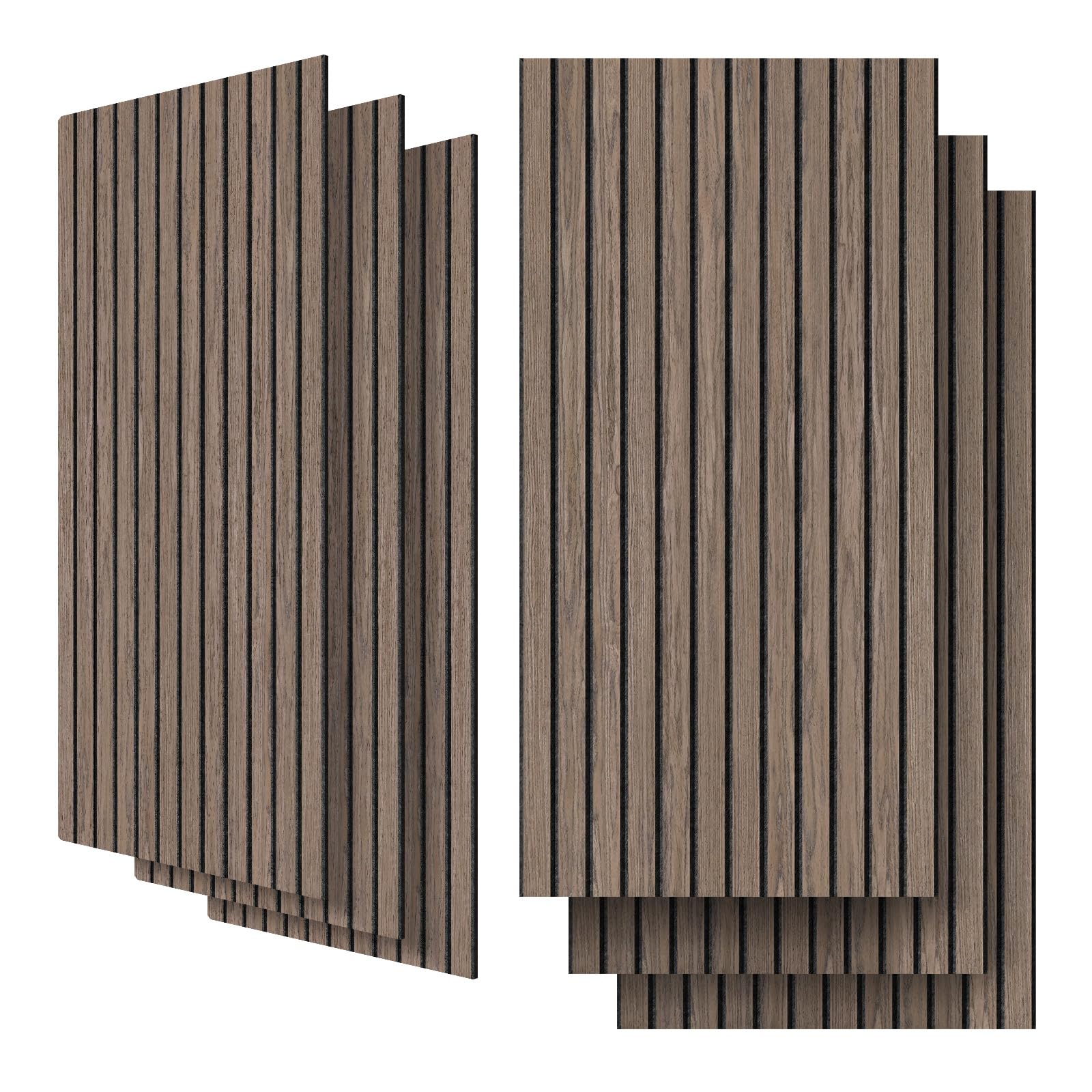
Six large walnut-look panels that fake the designer wall on a starter budget
Six panels at 47.2″ x 23.6″ each gives you serious wall coverage for the money — roughly 4,461 square inches per panel, and about 26,763 square inches across the pack. That figure is the reason this set exists: you are buying visual coverage first and absorption second. The surface is a wood-look veneer over a 100% polyester fiber core, and the listing is upfront that it is not genuine wood slats. The upside of that construction is that it stays flexible and bendable, cuts with a utility knife and weighs 22.1 pounds for all six.
Owners treat these as an aesthetic choice, and the honest read is they work best that way. The panel reduces echo and softens audio transmission rather than blocking sound — the phrase that keeps coming up is that it is not soundproofing, just a genuine improvement. Mounting is forgiving: 18-gauge brad nails at the corners and seams hold well, and many owners use nothing more than heavy-duty hook-and-loop strips, which have held panels up for months with no sag.
Two things to steel yourself for. The black felt backing sheds dust during the cut and can throw splinters, so cut outside or over a drop cloth and swap your utility blade as it dulls. And set expectations on the look: it is a veneer, not wood, so it reads as “pretty good” rather than “premium” up close. For a podcast studio or a background wall on a tight budget, that is a fair trade for the coverage you get.
Right choice when: you want a big treated-looking wall on a starter budget and you are OK with veneer, not timber.
skip it if: your goal is to actually block noise from leaving the room — these reduce echo, not transmission.
6. Acoustic Panels, 4 Pack ROOM KIT, Large, 46″ x 23″, Natural

The no-damage option: studio-grade absorption that comes off the wall clean
Renting a space should not mean living with a fluttery room. These four 45.7″ x 22.8″ x 0.4″ panels are built from post-consumer recycled PET — reclaimed plastic bottles spun into felt — with an NRC rating of up to 0.91. NRC, or Noise Reduction Coefficient, is the industry scale for how much sound a material absorbs, where higher is better. A 0.91 rating puts this close to the top of the consumer scale. The construction is a clean, thin slab with no chemical smell and no foam to puff up, so the panels arrive flat and stay flat.
The details owners appreciate are the ones that matter in a real room. Four of these are enough to noticeably tighten a project studio or a spare bedroom, and they go up on removable command-style strips, which means the wall underneath survives. They can also be repositioned as your setup changes. The panels come in a range of modern colors, and buyers mention mixing and matching to design the wall rather than just covering it.
The honest caveat is bass. These are thin, lightweight panels, and thin absorption panels do not do much for low-frequency boom — that is a physics limit, not a flaw. Owners note they tame flutter echo and mid reflection beautifully while leaving bass to bass traps. The recycled fiber also leaves a small air gap for best performance, and this panel arrives with no hardware included, so the sticky strips are on you to source.
The standout spec: an NRC of up to 0.91 on a 0.4-inch panel — thin enough to hug the wall, absorbent enough to clean up a bright room.
The trade-off: no mounting hardware in the box, and no real low-frequency control — pair it with corner treatment if you record bass-heavy material.
Perfect for: the renter or first-time studio owner who needs real acoustic improvement with a clean exit.
Wrong pick for: anyone who needs to stop noise from reaching the neighbours — this absorbs, it does not block.
7. Olanglab Acoustic Wall Panels, 10 Pack, 48″ x 24″, Plain Light Beige
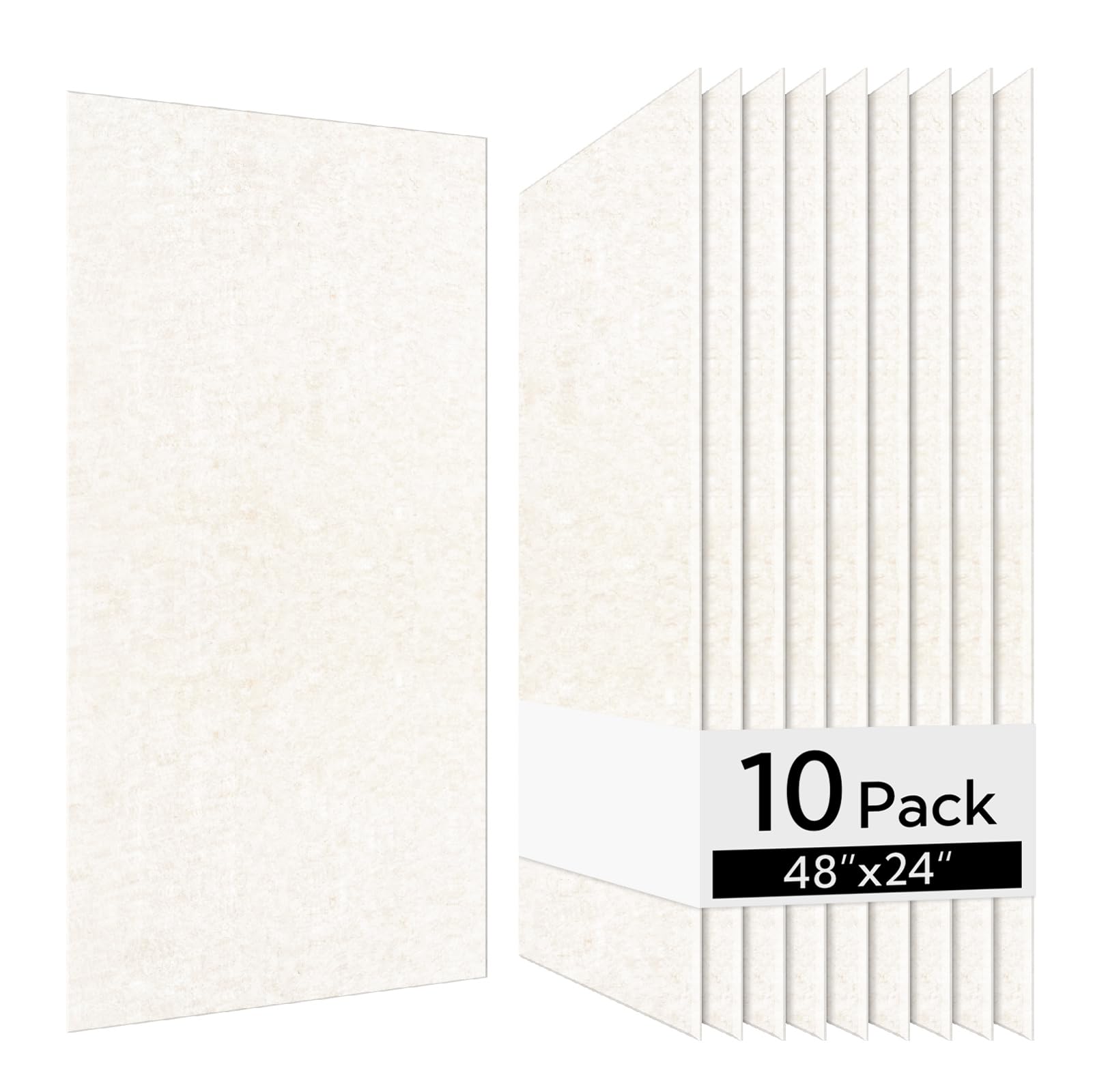
Ten big beige slabs that cover a whole wall in one order
Ten panels is a different scale of job. This pack covers a total of 77.35 square feet, and each panel measures 47″ x 23″ x 0.31″ — roughly 1,081 square inches per panel. Where the pyramid foam pack gets you 36 square feet across 36 tiles, this pack gets you more than double that treated area from just ten pieces, and it hangs the same order of magnitude quicker because each panel covers far more wall.
The material is recycled PET felt — reclaimed plastic spun into a soft, dense textile — which gives the wall a muted, pliable feel and cuts cleanly by scoring with a utility knife. The panels have a subtle slot design and a soft, calming color that reads as decor first, which is exactly how owners use them. They adhere with double-sided mounting tape onto drywall and hold well, though there is a brief chemical odor for a couple of days that fades. For a home studio needing a believable background wall, this is the coverage-to-effort ratio that wins. The 4.4-star score across 160+ ratings backs the everyday experience.
So what is the honest limitation? Sound absorption outright. Buyers who came expecting full noise blocking found that the panels soften echo without silencing a bouncing bass line, because again the physics cap what any 0.31-inch panel can do. There is also no adhesive included in the box, so budget for tape or spray glue before your panels show up. Treat it as a decorative absorber for a large room — not as a soundproof wall.
What It Gets Right
- 77.35 square feet of coverage from ten panels — enough to treat a substantial wall in one go
- Recycled PET felt is soft, pliable and easy to score and cut with a utility knife
- Muted beige tones read as wall decor, not as studio equipment
Honest Downsides
- No adhesive or hardware included — you supply the mounting method
- At 0.31 inches thick it takes the edge off echo, not the volume of sound in the room
- Slight factory smell on unboxing that fades within a few days
Grab this if: you have a big empty wall to treat and want maximum coverage from the fewest panels.
Look elsewhere if: you need soundproofing rather than echo control, or you want hardware in the box.
8. 36 Pack Pyramid Acoustic Foam Panels, 12″ x 12″ x 2″, Black

Thirty-six little pyramids — the classic cheap way to soften a room
This is the foam-tile starting point, and it is worth understanding what you are getting. Each tile is 12″ x 12″ x 2″ and the pack covers up to 36 square feet. The 2-inch profile is thicker than most budget tiles, and the 30 kg/m³ density is what keeps the pyramids holding a firm shape instead of collapsing against the wall. The 3D pyramid surface exists to increase exposed surface area — more jagged face equals more chances for a sound wave to hit material and die. Weight of the set lands at just 0.06 kg, so these ship feather-light and go up with almost nothing.
They work, in the specific way foam works. Owners mention that they tame echo and reflections in a converted bedroom or home office — one owner swapped wetting and sunning tips before landing on the honest verdict that a good usable pack can still be a useful one. Foam is best at the high and mid frequencies: vocals, cymbals, the bright harshness that makes a small room sound clinical. It is not the answer for deep bass, and it is not soundproofing.
The real watch-out is quality consistency. The recurring complaint is compressed, flattened or misshapen tiles, particularly on refill orders. Some owners inflate 30% fully on their own, while others need massaging; a hairdryer tends to beat soaking for reviving the flattest ones. Buy promptly, inspect the pack immediately and test-inflate across a full 24-48 hours before installing, so a bad batch means a return, not a half-finished wall. And this batch’s packaging is vacuum-rolled, which makes repacking a return a real chore.
Earn your place if: you have a spare bedroom, a modest budget and a first treatment project, and you are OK dealing with foam’s variability.
Look past it if: you need consistency — the design-led felt and wood picks will hold shape better than any foam tile.
Understanding the Specs
NRC Rating and Absorption
NRC stands for Noise Reduction Coefficient — a 0-to-1 scale for how much sound a material soaks up instead of reflecting. A panel rated toward 0.9 absorbs almost everything that hits it in the mid and high range. If a listing gives you no NRC figure at all, judge by thickness and density instead: thicker and denser material absorbs more.
Foam vs Felt vs Fiberglass
These are three different animals. Pyramid foam is light and cheap and best at high frequencies. Recycled PET felt is denser, comes flat with no puff-up wait and handles more of the mid range. Fiberglass panels are the heaviest hitter of the three for critical listening. None of them block sound from leaving the room — that is a job for added mass and sealing, not absorption.
FAQ
Can acoustic panels actually soundproof my home studio?
How many acoustic panels do I need for a small studio room?
What is the difference between acoustic panels and soundproofing foam?
Will acoustic panels help for recording vocals at home?
Do thick foam panels absorb more sound than thin decorative panels?
How do I hang acoustic panels on a wall without damage?
Are acoustic panels safe indoors with the family around?
Can acoustic panels reduce bass or low-frequency rumble?
How long do acoustic panels last before I need to replace them?
Should I put acoustic panels on the wall or the ceiling first?
Final Thoughts: The Verdict
For most people, the acoustic panels for home studio winner is the NeatiEase Wood Panels for Wall because it is the only pick here that hides echo and upgrades the look of the room at the same time — 33 square feet of coverage from four panels, no hardware headaches, no mattress-wall aesthetic. If your priority is critical mixing rather than looks, take the UMIACOUSTICS 2-inch Fiberglass Panels, because real fiberglass and a removable bracket system outperform decorative felt wherever reflections actually matter. And if you are treating a large rental room on a tight budget, the AudioSilk ROOM KIT is the one to reach for: it peels off clean, and the no-damage exit is the whole point for a renter. Placement beats volume: a few panels on the right reflection points will fix your room faster than a wall full of the wrong ones.
How We Picked
We do not accept paid placement. Every pick is matched to a real buyer and a real use-case; we do not hands-on test units.
Sources & Methodology
Specifications: manufacturer listings and product documentation. Review insights: verified customer reviews, as of September 2026. Pricing: not shown on this page (it changes often); check the current price via the retailer link.
As an Amazon Associate, KitchPrep earns from qualifying purchases. This does not affect which products we feature.
Related Guides
