
A cutting board is the one kitchen tool you touch every single day—even on “I’m not really cooking” days. And when that board is the right kind of acacia, prep suddenly feels smoother: your knife glides, your counter stays cleaner, and your ingredients stop skating around like they’re auditioning for a cooking show.
Acacia is a sweet spot wood for a lot of homes. It’s naturally dense, beautifully grained, and tends to look like a centerpiece even when it’s doing un-glamorous work (raw chicken, sticky fruit, the whole mess). But not all boards are built the same. Thickness, grain direction, feet, grooves, handles, and even the finish can make the difference between “love it for years” and “why is this thing wobbling and smelling weird?”
This guide to the Best Acacia Cutting Boards pulls together 15 popular Amazon picks—end‑grain butcher blocks, three‑board sets with stands, extra‑large carving boards, and compact daily drivers. I looked closely at what owners keep praising (and complaining about), then translated that into simple, practical buying advice so you can choose once and feel done.
How to Choose the Best Acacia Cutting Boards for Your Kitchen
If you’ve ever bought a “nice looking” wooden board that later warped, got funky-smelling, or turned into a slippery skating rink on your countertop, you already know the truth: a cutting board isn’t just wood—it’s design, construction, and care all working together.
1. Start with what you cut most
This sounds obvious, but it’s the fastest way to choose wisely:
- Mostly vegetables + herbs: prioritize a stable board with a smooth surface and easy lift handles.
- Meat, poultry, and juicy fruit: you want a deeper groove (a “moat”) that actually holds liquid, not a decorative notch.
- Bread + pastries: look for a flatter surface without a groove interrupting your slicing (or a reversible board with a flat side).
- Charcuterie + hosting: compartments, finger grips, and presentation-friendly shape matter more than raw size.
2. Understand grain: end‑grain vs edge‑grain (this is the “secret sauce”)
Most acacia boards in this list fall into two construction styles:
- Edge‑grain: wood fibers run along the board. These boards are often lighter, easier to lift, and more affordable. They’re fantastic everyday boards—as long as you keep them dry and oiled.
- End‑grain: wood fibers face upward like a bundle of straws. This can feel “self‑healing” because the knife slides between fibers rather than severing them. The result is often a softer cutting feel and excellent long‑term durability—but end‑grain boards are typically heavier and demand consistent care.
3. Size matters—but so does “washability”
A board can be “perfect” until you try to clean it. Before you buy, imagine your end-of-day routine:
- Extra‑large boards (like 24×18) are dreamy for big prep and carving… and a chore if your sink is small.
- Medium boards (around 16×12) are the daily sweet spot for most households—big enough to prep a meal, small enough to handle easily.
- Small boards are not “worse.” They’re just specialized: quick fruit, garlic, a sandwich, or a cheese board.
If you hate fuss, choose a board you can comfortably lift with wet hands, rinse, towel dry, and stand upright. If you love cooking and have the space, bigger boards can feel like a luxury countertop upgrade.
4. Look for stability features (this is where many boards win or lose)
Wobble and slipping are the two most common real‑world complaints. Here’s what actually helps:
- Rubber feet: excellent on stone countertops and glossy surfaces; also helps airflow while drying.
- Finger grips / side handles: makes flipping and moving the board safer (especially when heavy).
- Weight + thickness: thicker boards naturally stay put and resist warping—if the wood is properly seasoned and constructed.
5. Juice groove depth and placement (don’t get fooled by a “pretty” groove)
A groove should be deep enough to catch liquid from meat, watermelon, tomatoes, and citrus—without overflowing onto your counter. If you carve or slice juicy foods often, prioritize a continuous groove with clean corners. If you mainly chop dry veg, a flat side can be easier to scrape and transfer into a pan.
6. Maintenance reality check (this decides your long-term happiness)
Wood boards are simple… but they are not “set-and-forget.” The boards that last are the ones treated like a tool:
- Wash fast: warm water + mild soap, then rinse. Don’t soak.
- Dry immediately: towel dry, then air dry upright so both sides breathe.
- Oil regularly: food‑grade mineral oil (or board butter) keeps fibers hydrated and helps prevent cracking.
- Avoid dishwashers: heat + water + detergent is a brutal combo for wood.
If you’re thinking, “I will not do any of that,” your best move is a set of multiple smaller boards so each one has time to dry thoroughly. That’s why several of the sets below are such smart everyday picks.
Quick Comparison: 15 Best Acacia Cutting Boards Picks
Here’s the fast scan. Use it to spot the board that matches your cooking style and countertop space, then jump to the review for the “real life” details that don’t show up neatly in a spec list.
On smaller screens, swipe or scroll sideways to see the full table.
| Board | Construction | Size focus | Best match | Amazon |
|---|---|---|---|---|
| WALDWERK Cutting Board Set (3‑pc + stand) | 3‑board set | Small / medium / large | Most kitchens that want “one set that does it all” | Amazon |
| Ironwood Gourmet Large End Grain Prep Station (14×20) | End‑grain | Large prep + carving | Serious home cooks who want a “forever” board feel | Amazon |
| Ironwood Gourmet Square Charleston End Grain (14″) | End‑grain | Compact pro block | Chef-style chopping without a giant footprint | Amazon |
| Non‑Toxic FSC Acacia Set (3‑pc + stand + compartments) | 3‑board set | Daily prep + serving | Eco‑minded kitchens that love organization features | Amazon |
| Kikcoin Acacia Set (3‑pc + holder + compartments) | 3‑board set | Prep + tidy staging | People who want built‑in “prep bowls” on the board | Amazon |
| Roshtia 6‑Piece Acacia Boards (14×10) | 6‑pack | Multi‑station | Busy households, gifting, or craft/engraving use | Amazon |
| Extra Large 24×18 Reversible Board (Juice Groove) | Edge‑grain | XL butcher block | Brisket, ribs, big meal prep—space permitting | Amazon |
| Sonder Los Angeles “Winsome” (16×12×1.5) | Thick block | Prep + charcuterie | Hosts who want compartments that look intentional | Amazon |
| Sonder Los Angeles Doheny Duo (2‑pc) | Set | Small‑task daily | Counter‑space savers who still want “nice boards” | Amazon |
| Acacia Board Set w/ Holder (3‑pc + stand) | 3‑board set | Everyday set | People who want a display‑friendly holder on counter | Amazon |
| ROYAL CRAFT WOOD Acacia Set (3‑pc) | 3‑board set | Classic sizes | Daily meal prep with handles + deep grooves | Amazon |
| Acacia Set w/ Handles (3‑pc, larger top board) | 3‑board set | Big‑board trio | Cross‑contamination control without baby‑sized boards | Amazon |
| 20‑Inch Thick Reversible Board (Deep Groove) | Thick slab | Long carving | People who want a heavy, stable board that stays put | Amazon |
| Organic Acacia Set (3‑pc, budget‑leaning) | 3‑board set | Starter set | Small kitchens that want a simple, lightweight trio | Amazon |
| WALDWERK Cutting Board Set (Second‑Set Option) | 3‑board set | Duplicate set | Two prep zones (or gifting a matching set) | Amazon |
In‑Depth Reviews: 15 Standout Acacia Cutting Boards
Now we’re getting into the fun part: what these boards feel like in a real kitchen—how stable they are, whether grooves actually work, which finishes age nicely, and which “little” details (handles, feet, stands) end up mattering more than you’d expect.
1. WALDWERK Cutting Board Set – A Daily‑Driver Trio That Feels Thought Through

If you want one purchase that instantly upgrades your entire prep routine, this WALDWERK set is a confident place to start. You get three boards in useful sizes plus a stand that encourages the single biggest “wood-board habit” that keeps boards healthy: drying them upright so both faces breathe. That sounds small, but it’s exactly the kind of habit that prevents mystery smells, moisture cupping, and that “why is it wobbling?” moment.
Owners tend to rave about two things: the look (it reads like a premium countertop accessory) and the stability. Multiple reviews call out that the boards stay put—especially on stone counters—thanks to anti‑slip design details. The groove is practical for everyday slicing and carving, and the set format is a silent hero for food safety: use one board for raw proteins and another for produce, then let them dry separately.
Why you’ll like it
- Set logic is excellent – small for quick jobs, medium for daily chopping, large for meal prep and carving.
- Stand encourages proper drying – easier to maintain and more likely to stay flat over time.
- Feels stable during use – anti‑slip features show up in real‑world feedback, not just marketing.
- Clean workflow – the groove helps with juicy foods without forcing every task onto a “moat” side.
Good to know
- Some owners mention an initial odor; it typically fades with a wash and a few days of open-air drying.
- The stand is great, but like any accessory, treat it gently—some users have fixed minor stand loosening easily.
- This is a “real wood” tool: oiling periodically is what keeps it looking rich instead of dry and pale.
Ideal for: most kitchens that want an attractive, functional set that makes good habits (drying, rotating, separating foods) easy.
2. Ironwood Gourmet Large End Grain Prep Station (14×20) – The “Knife Treat” Board

This is the board you buy when you want prep to feel… expensive. End‑grain boards have a distinct cutting sensation: slightly softer under the blade, more “buttery,” and often kinder to your knife edges. That’s the magic of fibers facing upward—your knife is parting grain instead of slicing across it. For people who sharpen their own knives (or love Japanese steel), this feel can be wildly satisfying.
The 14×20 footprint hits a sweet spot: large enough to chop in zones (onion pile here, herbs there, chicken there), but not so enormous that it turns into an unmovable countertop monument. It also doubles beautifully as a serving slab for gatherings. The tradeoff is weight and responsibility: end‑grain boards last when you keep up with oiling and avoid soaking. Treat it like a tool, and it rewards you like one.
Why it stands out
- End‑grain cutting feel – many cooks prefer it for smoother chopping and long-term surface durability.
- Great prep footprint – roomy without requiring a full island-sized counter.
- Heirloom vibe – it looks like a “forever kitchen” piece when maintained.
- Versatile – prep station, carving surface, and serving platform in one.
Good to know
- End‑grain boards demand regular oiling; neglect is what causes drying, cracking, and rough spots.
- Heavier than edge‑grain—amazing on the counter, less fun to lift for quick rinses.
- Some buyers report cosmetic variation in grain and color; that’s normal with real acacia.
Ideal for: frequent cooks who want a premium end‑grain feel and have the habits (or willingness) to maintain a serious wooden board.
3. Ironwood Gourmet Square Charleston End Grain (14″) – Compact, Pro‑Style Chopping

If the big 14×20 board feels like “a commitment,” this 14‑inch square is the smarter end‑grain entry point. It gives you that same end‑grain knife feel, but in a footprint that fits most counters and doesn’t bully your sink area. It’s the kind of board that becomes the default—your onion board, your herb board, your “I’m making dinner for real” board.
Here’s the expert angle: a square end‑grain board encourages better knife technique. You have room to rock-chop without your pile sliding off the edge, and the thickness keeps it stable. Several long reviews note that with proper oiling, the surface stays smooth and scratches can look more like gentle patina than damage. The flipside is quality control variance some owners mention—if you receive a board with glue marks or finish oddities, it’s worth addressing early (exchange, or a gentle sand + re‑oil if you’re handy).
What it does well
- End‑grain benefits in a manageable size – premium feel without a massive board.
- Stable platform – thickness and weight reduce sliding during fast chopping.
- Looks like furniture – especially after a proper oiling routine.
- Great “one-board household” option – if you don’t need a full set.
Good to know
- Some buyers have noted finish/adhesive imperfections; check yours immediately on arrival.
- Like all end‑grain boards, it prefers upright drying and consistent oiling.
- If your kitchen is very small, the square footprint can still feel substantial.
Ideal for: cooks who want a pro-style end‑grain board without going full butcher-block huge.
4. FSC Acacia Cutting Board Set (3‑pc + Stand + Compartments) – Organized, Giftable, Counter‑Friendly

This set is built for the person who wants boards that look tidy and behave tidily. The standout feature is the serving/prep compartments, which act like little staging zones: chopped garlic here, lemon wedges there, nuts and olives for a snack board over there. If you’ve ever dirtied three tiny ramekins just to keep ingredients separated, you’ll understand why this design gets love.
It’s also the kind of set people keep on the counter. The stand keeps the boards vertical (great for drying), and the different sizes make it easy to separate tasks: produce on one, raw meat on another, bread or cheese on the third. Owners commonly mention that the boards feel sturdy without being ridiculously heavy—and yes, the surface will scratch because it’s wood. The more important signal is whether it warps or splits; early feedback tends to focus more on “looks great and works great” than structural regret.
Highlights
- Built‑in compartments – keeps prep organized and serving boards looking intentional.
- Stand encourages airflow – helps boards dry evenly and stay fresher.
- Good task separation – three sizes makes clean workflows easier (and safer).
- Presentation‑ready – this set naturally doubles as a hosting piece.
Good to know
- Wood will show knife marks—especially with dull knives; that’s normal, not failure.
- Compartments are amazing for dry items but can be fussier to clean after sticky foods.
- Like all wood: hand wash, towel dry, and oil occasionally for best longevity.
Ideal for: neat-prep cooks and entertainers who love built-in organization and a display stand that keeps boards accessible.
5. Kikcoin Wood Cutting Boards Set (3‑pc + Holder + Compartments) – The “Mise en Place” Shortcut

Kikcoin’s set is a practical “kitchen workflow” design: one side is a normal cutting surface, and the other side includes compartments that turn the board into a prep station. This is one of those features you don’t know you’ll love until you use it—especially for taco night, stir-fry, salads, or holiday snacking where you want ingredients grouped and ready without cluttering your counter.
Reviewers often highlight that the boards feel like real, dense wood with a pleasing thickness—not paper-thin—and that the juice groove does its job. A few also mention a clever corner drain detail for controlled pouring. Here’s the expert note: compartment boards shine when you treat them like a system. Chop on the flat side. Flip to the compartment side when you’re assembling or serving. That one habit keeps cleanup easy and avoids packing gunk into the cutouts.
Why it’s useful
- Compartments reduce clutter – fewer bowls, cleaner counter, smoother cooking rhythm.
- Multiple sizes – scale up for meal prep or down for quick snacks.
- Feels sturdy – thickness hits a nice balance of stability without being a back-breaker.
- Great for serving – the compartment side is naturally charcuterie-friendly.
Good to know
- Do not dishwasher wood; hand wash only and avoid soaking to prevent swelling and warping.
- Compartments add cleaning time if you use them for sticky foods—use a brush, not an abrasive pad.
- Like most acacia, color variation is normal; each set will look a little different.
Ideal for: cooks who like organized prep (mise en place) and want boards that pull double duty as serving trays.
6. Roshtia 6‑Piece Acacia Board Set (14×10) – When You Want “A Board for Everything”

A six‑pack of boards is a different strategy—and for the right home, it’s genius. Instead of one “perfect” board doing everything, you get redundancy: one board for raw meat, one for fruit, one for bread, one for dog treats, one for crafting, one for guests… you get the idea. That’s not just convenient—it’s also a sneaky way to reduce cross‑contamination stress because you can assign roles and keep them consistent.
Real-world feedback is mixed in a predictable way: many buyers love them for engraving, gifting, and light-to-medium kitchen use; others report quality variation (warping, splitting, inconsistent grain). Here’s the pro takeaway: bulk-board sets are best when you’re comfortable inspecting and sorting. If you want absolute consistency and “heirloom” construction, choose a premium single board or a higher-end set. If you want quantity and flexibility, this format can make your kitchen flow smoother.
Why people buy it
- Six boards = fewer bottlenecks – multiple cooks, multiple tasks, multiple foods.
- Great for gifting and extras – handy for housewarmings, engraving, or setting up a new kitchen.
- Easy to rotate – boards dry faster when you’re not reusing the same wet surface constantly.
- Simple, classic shape – works for cutting or serving.
Good to know
- Bulk sets can have variability—inspect for flatness and cracks immediately on arrival.
- These tend to be thinner than “chef block” boards, so they’ll show wear sooner under heavy chopping.
- If you want one “wow” board for a countertop display, this isn’t that category.
Ideal for: households that want multiple boards in rotation, gifting/crafting use, or a “separate board for separate foods” workflow.
7. Extra Large 24×18 Acacia Board – The “Finally, I Have Space” Upgrade
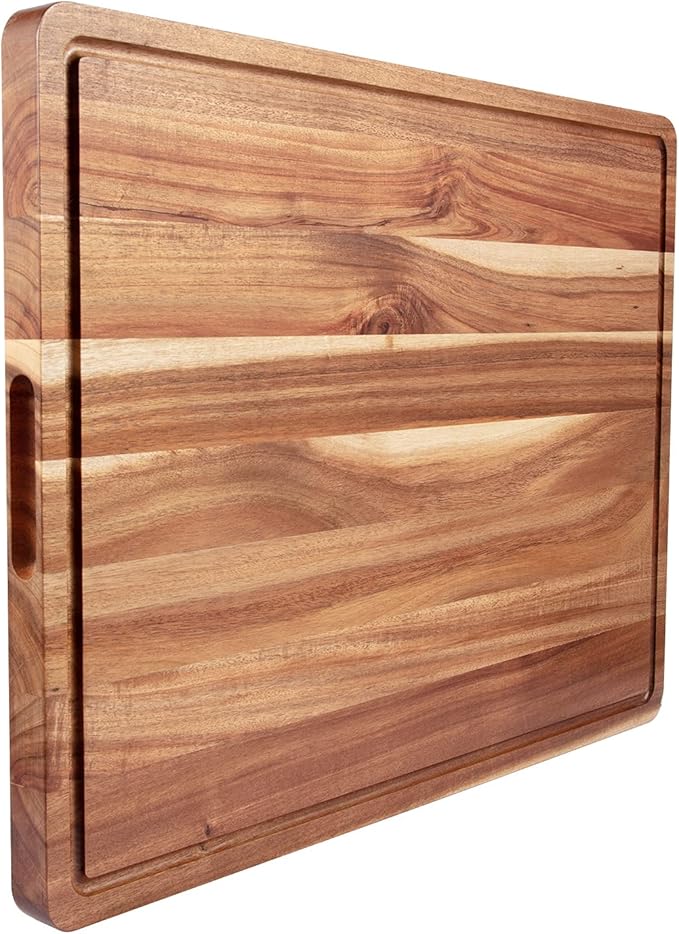
There’s a reason people get emotional in reviews about a truly large cutting board: it changes your posture, your pace, and your entire prep flow. A 24×18 board gives you room to break down a brisket, prep vegetables for a crowd, or stage ingredients without stacking. It’s also large enough for two people to work side-by-side—one chopping, one trimming—without elbowing each other into chaos.
The honest tradeoff is practicality. Owners love the work surface and the look, but a board this size can be awkward to wash (many mention it doesn’t fit comfortably in some sinks). A few reviews note occasional issues like splitting, wobble, or shallow handholds, which is why this category benefits from a simple pro move: use a thin non‑slip mat under it, and oil it early and often. Large boards don’t “forgive” neglect because there’s more surface area to dry out unevenly.
Why you’ll love it
- Massive prep area – less crowding, fewer spills, better knife control.
- Great for carving – the groove helps capture juices from big roasts and fruit.
- Feels premium on the counter – it looks like a serious kitchen tool.
- Two‑person friendly – ideal for holiday cooking and batch prep.
Good to know
- Cleaning can be awkward in small sinks; plan for wipe-down + quick rinse technique.
- Some buyers report flatness variation; a thin rubber mat solves most slipping/wobble issues.
- Large boards need consistent oiling so they don’t dry unevenly over time.
Ideal for: cooks who prep large cuts, meal-prep big batches, or host often—and have the counter/sink setup to handle an XL board.
8. Sonder Los Angeles “Winsome” (16×12×1.5) – Prep Board Meets Charcuterie Board

Sonder’s “Winsome” board is what happens when a prep board is designed by someone who also hosts. It’s thick and stable, has finger grips for easy lifting, and includes a signature “well” that works brilliantly for both cooking and serving: pile chopped herbs, stash garlic cloves, hold crackers, catch olives—whatever your routine demands.
The reason this design feels special is that it doesn’t look like a gimmick. The compartment is integrated into the board’s geometry in a way that still gives you a clean cutting surface. And the size is dialed-in: big enough for serious meal prep, but not so huge that it dominates a modest kitchen. Owner feedback tends to emphasize “workhorse” stability and the joy of having one board that does weekday prep and weekend entertaining without a costume change.
Why it’s a standout
- Smart compartment design – useful for prep and for serving without looking cluttered.
- Thick, stable feel – stays put during chopping and feels substantial.
- Two‑sided versatility – groove side for juicy tasks, flat side when you want a clean plane.
- Giftable – presentation and packaging make it feel like a true upgrade item.
Good to know
- Thicker boards take longer to dry; always stand upright after towel drying.
- Any compartment adds a little cleaning detail—use a soft brush for corners.
- Like all acacia: oiling every few weeks keeps color deep and surface protected.
Ideal for: cooks who want one beautiful board that transitions from meal prep to serving without switching tools.
9. Sonder Los Angeles Doheny Duo (2‑pc) – The “Always the Right Size” Pair

For many kitchens, a two‑board setup is the most realistic “wood board upgrade.” You get the flexibility of separate boards (meat vs produce, garlic vs fruit) without taking over your counter space. These sizes are specifically great for daily life: big enough to chop comfortably, small enough to rinse and dry quickly—meaning you’ll actually use them.
Owners highlight the stable feel and the thoughtful design: a groove on one side, a flat surface on the other, plus grips that make lifting and flipping safe. The rubber feet that some buyers mention are a practical bonus because airflow matters: boards that dry evenly are boards that stay flatter longer. It’s also an easy gift set because it feels polished, not like “random boards thrown in a box.”
Why it’s so livable
- Right-sized for real kitchens – practical daily boards you’ll reach for constantly.
- Two-board workflow – cleaner prep and less cross‑contamination stress.
- Reversible surfaces – groove side for juicy tasks, flat side for easy scraping.
- Feels premium – a small set that doesn’t feel “small-time.”
Good to know
- Smaller boards can be overused—rotate and let them fully dry to avoid lingering odors.
- Some customers report occasional shipping/handling issues; inspect immediately on arrival.
- Still requires hand washing and periodic oiling like any wood board.
Ideal for: apartments, smaller counters, or anyone who wants a simple two-board system that looks upscale and cleans easily.
10. Acacia Board Set with Holder (3‑pc) – Pretty Enough to Leave Out, Practical Enough to Use Daily

This style of set appeals to people who don’t like clutter: three boards that live neatly in a holder, always within reach. Reviewers frequently mention the boards are “too pretty to use” (which is the best compliment a wooden board can get) and that the sizes cover most daily kitchen tasks without feeling redundant. One side has a groove to catch liquids, while the other stays smooth for clean scraping and bread slicing.
Here’s the real-world caveat: because the boards are designed to display, some versions don’t emphasize rubber feet. A few owners mention slipping or movement, which is easy to solve with a thin drawer liner underneath. Another review flagged a stand arriving damaged—so inspect the holder and boards when they arrive. When everything arrives intact, this is a very satisfying “set it on the counter and use it constantly” pick.
Why it’s a great set
- Holder keeps things tidy – easy storage and faster drying than flat stacking.
- Useful size variety – small tasks, daily chopping, and meal prep all covered.
- Two-surface flexibility – groove side for messy tasks; flat side for clean slicing.
- Lightweight feel – easier to handle than thick butcher-block slabs.
Good to know
- Some users want more stability; a non-slip mat solves it instantly.
- Wood “softness” perceptions vary—knife marks are normal, but deep gouging suggests dull knives or hard cutting.
- Maintenance instructions aren’t always detailed; plan to oil periodically.
Ideal for: anyone who wants boards that look great on the counter and make it easy to stay organized and dry boards properly.
11. ROYAL CRAFT WOOD Acacia Set (3‑pc) – Simple, Solid, and Easy to Reach For

This is the “no drama” set: three classic sizes, built-in handles, and juice grooves that keep your counter calmer during messy prep. Owners who use them daily tend to appreciate the practical sizing—grab the small board for a lemon, the medium for onions, the large for carving or bigger prep—and the comfort of having options without needing a dedicated board collection.
One of the most valuable review insights is psychological: many buyers who complain about wooden boards typically treat them like plastic—soaking, leaving wet, never oiling. The satisfied long-term owners are the ones who hand wash, air dry, and condition occasionally. So think of this set as a good “starter wood board system.” If you can commit to basic care, these boards can feel like a meaningful upgrade from plastic without feeling precious.
What works well
- Three useful sizes – reduces “wrong board” frustration and speeds up prep.
- Handles help – safer lifting and easier transfer of chopped ingredients.
- Grooves keep counters cleaner – especially for fruit, tomatoes, and carving.
- Good daily feel – a set you can actually use constantly without babying.
Good to know
- Some boxes have a “new wood” odor—wash, dry, and let air out before first use.
- The largest board may feel modest if you frequently carve big roasts or meal prep for a crowd.
- As with all wood: periodic oiling is what keeps boards from drying out long-term.
Ideal for: families and daily cooks who want an easy 3‑board setup with handles and grooves, without overthinking design extras.
12. Acacia 3‑Piece Set with Handles – Larger Top Board for Real Meal Prep

Some sets are “three small boards pretending to be a set.” This one is different because the top board is meaningfully larger—big enough to handle multi-ingredient prep without constant scraping and clearing. That matters if you cook actual meals (not just snacks) and want a board that can hold a pile of chopped veg without turning your counter into a spill zone.
The integrated/hidden handle design is also underrated. Handles that sit flush are easier to clean and look nicer on the counter, yet still give you that secure lift when you’re moving chopped ingredients to a pan. The deep grooves are a bonus for meats and fruit. For longevity, treat the set like a system: use the big board for heavy prep, the middle for daily tasks, the small for quick jobs. Rotating boards reduces moisture stress and extends life.
Why it’s a strong pick
- Large top board – better for meal prep than many “3-piece” sets.
- Handle design – easier lifting without clunky protrusions.
- Grooves that matter – useful for juicy cutting and carving tasks.
- Good kitchen workflow – multiple boards makes separation and drying easier.
Good to know
- If you want rubber feet, you may need to add a non-slip mat underneath.
- Heavier boards are more stable but take more effort to wash and dry.
- Like any wood set, it rewards consistent oiling and upright drying.
Ideal for: cooks who want a 3‑board system where the “largest” board is actually large enough to matter.
13. 20‑Inch Thick Acacia Board (1.5″) – Heavy, Stable, and Carving‑Friendly

If slipping boards drive you crazy, thickness is your friend. A 1.5‑inch board feels planted. It doesn’t flex. It doesn’t skitter. It makes chopping feel more controlled because the board isn’t “responding” to your knife. Owners who love this style often talk about how professional it feels—like upgrading from a flimsy plastic sheet to a real prep station.
That said, thick boards can expose quality issues faster: if the wood selection or seasoning is inconsistent, you may see cracks or unevenness. Some buyers mention receiving sapwood-heavy pieces or needing to address imperfections. Here’s the expert move: inspect edges, corners, and flatness right away. If it’s solid, you’ve got a board that can serve as a stable daily workhorse and a satisfying carving board with a deep groove for juices.
Why it’s loved
- Stays put – thickness and weight improve stability during chopping.
- Carving-friendly – deep groove helps contain juices from roasts and fruit.
- Reversible – groove side for messy tasks, flat side for clean slicing.
- Countertop presence – looks like a serious tool, not a disposable accessory.
Good to know
- Heavier boards require more effort to wash and dry properly.
- Quality can vary; inspect for cracks and flatness immediately on arrival.
- Some surfaces may stain if not oiled; a conditioning routine keeps it looking rich.
Ideal for: anyone who wants a stable carving and chopping platform and doesn’t mind a heavier board for a sturdier feel.
14. Organic Acacia Set (3‑pc) – Lightweight, Simple, and Easy to Store

If you’re moving away from plastic and want a simple acacia set that doesn’t feel precious, this style of 3‑piece trio is a popular entry point. The boards tend to be lighter, which makes them easy to rinse, dry, and hang or tuck away—ideal for small kitchens where you can’t leave big slabs out full time. Some reviewers even mention accidental dishwasher runs that didn’t destroy them, but let’s be clear: that’s luck, not a recommended plan.
A common theme in feedback is finish and wear: because these boards are lighter, they may show gouges sooner and benefit from a little more TLC (oiling, gentle cleaning, and avoiding prolonged water contact). The upside is convenience. If you want “grab a board, chop, rinse, done” without wrestling a heavy block, this category can be exactly right—especially when you’re building better habits around drying and rotating boards.
Why it’s worth it
- Lightweight and easy – great for small sinks and quick cleanup.
- Three-board workflow – simple separation for different foods and tasks.
- Good starter set – a practical step up from plastic without intimidation.
- Easy to store – hangable, stackable, and not bulky.
Good to know
- May show gouges sooner than thicker boards; sharp knives + proper technique help.
- Some buyers report occasional cracking in shipping—inspect immediately.
- Oil and dry routines matter more with lighter boards.
Ideal for: first-time wood board buyers, small kitchens, and anyone who wants lightweight boards they can store easily.
15. WALDWERK Cutting Board Set – A Matching “Backup Set” for Two‑Station Kitchens
This is the same WALDWERK set as the top pick—but I’m calling it out again for a specific kind of buyer: the household where two people cook at once, or where you want dedicated zones (one set lives near the stove, another near the sink or grill). A second matching set also makes gifting easy if you’re helping someone build a “real kitchen” from scratch.
If you’ve ever hosted and thought, “I wish I had another clean board right now,” you already understand why duplicates can be practical. When boards are in heavy rotation, having a second set also reduces moisture stress—each board gets more time to fully dry between uses, which supports long-term stability.
Why it makes sense
- Two-station cooking – smoother workflow when multiple people prep at once.
- Faster drying rotation – less chance of lingering moisture and odors.
- Great gift strategy – matching set for someone moving or upgrading their kitchen.
- Consistency – once you love a set, duplicates eliminate guesswork.
Good to know
- If you only cook occasionally, one set is plenty—don’t overbuy.
- Two sets take more storage space; measure your counter or cabinet zone first.
- Maintenance still matters: oil and dry routines keep both sets looking great.
Ideal for: multi-cook households, frequent hosts, or anyone who wants a matching backup set to keep their prep flow smooth.
How Acacia Cutting Boards Age (and Why Grain & Thickness Matter)
Wood boards aren’t “fragile,” but they are alive in the sense that they respond to moisture and airflow. The boards that last aren’t necessarily the most expensive—they’re the ones that match your habits and dry evenly after use.
What grain, thickness & design really change
- End‑grain vs edge‑grain changes cutting feel and how quickly the surface shows marks. End‑grain can feel gentler and more “forgiving.”
- Thickness helps resist warping. Thicker boards tend to stay flatter—assuming they’re properly made and cared for.
- Feet and stands increase airflow. Boards that dry from both sides are less likely to cup or develop odors.
- Grooves protect your counter, but they also add edges where moisture can linger if you don’t dry thoroughly.
If you take one practical takeaway: airflow is everything. The simplest way to keep a board stable is to towel dry it and store it upright so both faces dry at the same rate.
Simple habits that keep boards looking new
- Oil before the first heavy use – even if it arrives “pre-oiled,” a light conditioning helps seal fibers evenly.
- Deodorize naturally – for onion/garlic odors, scrub with coarse salt + lemon, then rinse and dry.
- Don’t panic about knife marks – shallow marks are normal; oiling can visually soften them.
- Fix slipping fast – a thin non-slip drawer liner under the board is a near-universal solution.
- Repair minor roughness – high-grit sanding (very lightly) + re-oiling can restore the surface.
Once you treat your board like a tool—wash, dry, air out, oil occasionally—you’ll stop thinking about it and just enjoy how much nicer prep feels.
FAQ: Acacia Cutting Boards, Answered
Are wooden cutting boards sanitary?
End‑grain or edge‑grain: which should I choose?
How often should I oil an acacia cutting board?
Can I cut raw meat on a wooden board?
My board slides or wobbles—do I have to return it?
What’s the #1 mistake that ruins wooden boards?
Final Thoughts: Picking the Best Acacia Cutting Boards for You
The perfect board isn’t the fanciest one. It’s the one that matches your kitchen and your habits—size you’ll actually use, stability you’ll appreciate, and maintenance you can realistically keep up with.
Here’s a quick decision shortcut:
- Want the easiest “one-and-done” set for most homes? Start with the WALDWERK Cutting Board Set. It’s balanced, display-friendly, and encourages proper drying.
- Want a true upgrade feel under the knife? Go end‑grain with the Ironwood Gourmet 14×20 End Grain Prep Station or the Ironwood Square End Grain.
- Love tidy prep and serving boards that look intentional? Pick a compartment-friendly design like Sonder Winsome or the Kikcoin set.
- Need maximum surface area for big meats and batch prep? The 24×18 Extra Large Board is the “finally, I have space” move—just be sure your sink setup can handle it.
- Want a simple starter set for small kitchens? The 3‑piece organic set is lightweight and easy to store, especially if you’re building good drying habits.
Any of these options can become your Best Acacia Cutting Boards choice once you match the board to your space, your cooking frequency, and your real-life cleanup style. Pick the size you’ll actually use, add a simple oiling routine, and you’ll feel the upgrade every time you prep dinner.
