
Specs are compiled from manufacturer listings and verified buyer reviews and can change over time — please confirm the key details on the product page before buying.
Will an 8-inch jointer flatten a twisted board on the first pass, or will you spend a weekend fighting the tables? Every machine here shares one thing: a full 8-inch cutting width. But they split hard on cutterhead type, table material, and how much alignment work lands on you after the crate opens. From carbide insert counts to bed length, here is what actually matters so you pick the machine that matches your shop and your patience.
I’m Mohammad Maruf — the founder and writer behind KitchPrep. This guide is built by comparing the manufacturers’ published specifications and the patterns across verified customer reviews, so you get each pick’s real strengths and trade-offs instead of marketing spin.
You do not need to be a machinist to joint a board flat, but you do need to know which specs separate a machine you dial in once from one you re-truce with every weekend. A spiral cutterhead with four-sided inserts, cast iron tables, and a motor that holds speed through hard maple are the three things worth paying attention to, so let’s look at the picks that deliver them.
Our Picks at a Glance


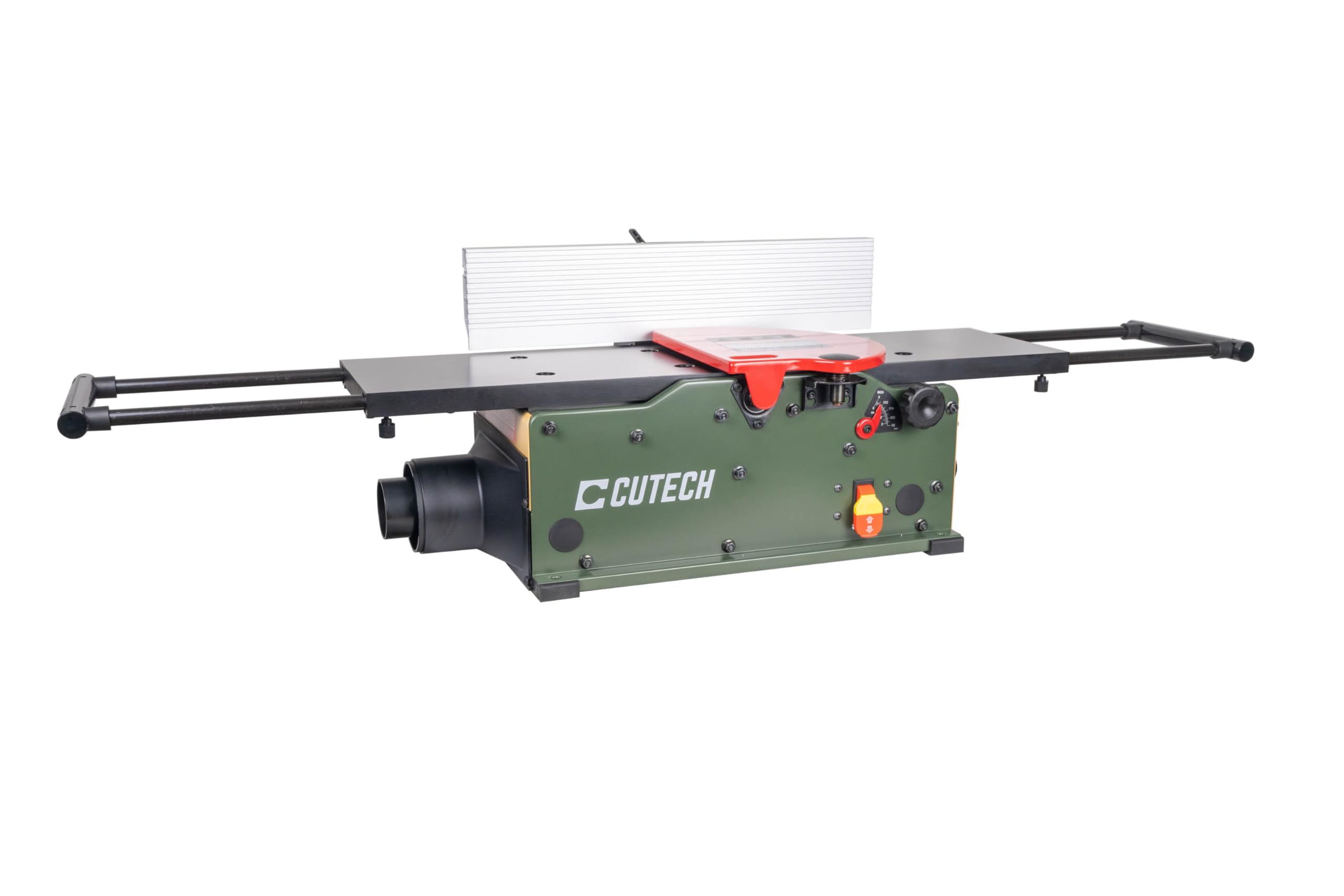
How To Choose The Best 8 Inch Jointer
An 8 inch jointer earns its floor space by flattening the face of a board and squaring the edge, so your planer can thickness it to a consistent result. The cutting width — 8 inches here — sets the widest board you can joint in a single pass, and the cutterhead type sets how often you stop to sharpen or rotate edges. Those two choices drive everything else.
Spiral Or Helical Cutterheads With Carbide Inserts
A spiral or helical cutterhead holds rows of small carbide inserts (tiny square cutting tips that snap into the head) instead of long straight knives. Each insert has multiple indexed edges, so when one corner dulls you rotate it 90 degrees for a fresh edge instead of sharpening or resetting a whole knife. Carbide inserts also shear the wood at a slight angle, which usually means a quieter cut and less tear-out on figured grain.
Table Material And Bed Length
Cast iron tables resist flex and hold their coplanar alignment (meaning the infeed and outfeed tables sit in one flat plane) better than aluminum, but they add serious weight. Bed length decides whether a long board gets full support through the cut or dives off the end. A benchtop machine with a shorter bed handles boards in the three-to-four-foot range well; a full-length floor jointer with 70-plus inches of total table is what keeps an eight-foot board running flat.
Motor, Depth Of Cut, And Dust Collection
Amperage and horsepower set how much material you can peel per pass without the motor bogging down in hard stock. A benchtop unit typically removes up to 1/8 inch per pass and asks for shallow feeds on wide hardwood; a bigger machine with more power takes heavier cuts more easily. Every jointer here needs dust collection — a 4-inch port pairs with a shop collector, while smaller benchtop ports connect to a shop vac.
Quick Comparison
| Model | Best For | Cutting Width | Cutterhead / Inserts | Motor | Amazon |
|---|---|---|---|---|---|
| Wahuda Tools 50160CC-WHD★ Best Overall | Small-shop budget start | 6 inch | Spiral, 4-sided carbide tips | 10 amp, 120V, 12,000 RPM | Amazon |
| WEN JT833HAlso Great | Best Overall | 8 inch | Spiral, 16 staggered HSS blades | 10 amp | Amazon |
| Cutech 40180HBBest Value | Teflon-coated value pick | 8 inch | Spiral, 16 TC inserts, 6 rows | 10 amp | Amazon |
| Cutech 40180HI | Cast iron benchtop step-up | 8 inch | Spiral, 16 TC inserts, 6 rows | 10 amp, 120V, 1200W | Amazon |
| JET JWJ-8HH-BLK | Full-size floor jointer | 8 inch | Helical, 36 four-sided carbide inserts | 2 HP, 5,500 RPM no load | Amazon |
| Powermatic 60HH | Serious shop long-bed work | 8 inch | Helical, 54 four-sided carbide inserts | 2 HP, 20 A, 230V | Amazon |
| Powermatic PJ-882HH | Premium parallelogram precision | 8 inch | Helical, 54 four-sided knife inserts | 2 HP, 230V | Amazon |
In‑Depth Reviews
1. Wahuda Tools 6-Inch Benchtop Wood Jointer with Spiral Cutterhead
Our pick — over 4★ from 500+ verified ratings; the strongest balance of quality and price.
The starter machine for tight-space hobbyists who mostly joint narrow stock.
Wahuda’s 6-inch benchtop is not a full 8-inch jointer, so this is the entry point for the reader who wants the format without the width. It ships with a spiral cutterhead and four-sided carbide inserts, a 120V motor with a fixed 12,000 RPM, and adjustable cast iron tables that fold out to support longer pieces. The fence tilts from 90 to 135 degrees. You can edge, joint, flatten, or taper. The package includes 16 four-sided 15x15x2.5mm carbide cutters with a 30-degree bevel, and the manufacturer touts a smoother cut from the four-sided edge design. At 56.2 pounds it is the lightest machine in this lineup.
What lands best is the quality-to-fuss ratio. Buyers describe it as smooth and accurate on hardwood and softwood, quiet compared to comparable Porter Cable and Delta machines, and delivering no snipe when the tables are dialed. The cast iron tables and adjustable bed hold a real flat surface once leveled, and the whole thing packs down to a footprint that fits a garage bench. Most reviewers point out the cut quality justifies the price.
The honest truth is this machine asks patience. Table alignment can take a full afternoon or longer, and a few shoppers say that a stripped adjustment screw or a broken handle arrives in transit — though customer service has repeatedly stepped in with replacement parts or a whole new unit. Buyers also regularly note that they wish they had bought the 8-inch model instead. If you mostly edge narrow boards and rarely need to flatten wide hardwood, the 6-inch version is fine. If you are already planning wide work, buy with that 8-inch regret in mind.
Where it earns its keep: the quiet, accurate cut on a small, mobile footprint — great for the woodworker who joints edges more than faces.
Start here if: you want a first jointer in a small shop and your stock is mostly narrow.
Go bigger if: wide hardwood is in your future — the recurring regret among 6-inch owners is not sizing up.
2. WEN JT833H 10-Amp 8-Inch Spiral Benchtop Jointer with Extendable Table
The benchtop that buys you 8-inch board width on a 6-inch jointer budget.
If you want 8-inch face jointing without giving up most of your bench, this is the machine to beat. Its 33-by-8-inch table runs long stock with support arms that extend out to 51 inches, so a four-foot board gets real backing instead of tipping off the edge. The fence measures 19-3/4 by 4-1/4 inches and bevels to 45 degrees. The spiral cutterhead spins 16 staggered HSS blades (high-speed steel — a hard, edge-holding tool steel) for a fine finish, and the machine removes anywhere from zero to 1/8 inch of material in a single pass.
You get a smooth finish without paying floor-model money: cast iron tables, a depth-of-cut scale, and two push blocks all come in the box. A pair of 2-1/2 and 4-inch dust ports means you can hook up a shop vac or a full collector. It runs quiet enough for a garage shop, and the depth-of-cut scale is easy to read once the tables are set. Buyers report running thousands of board feet of cherry, maple, and white oak through the carbide-swapped head. One put it plainly: the jointer replaced its original blades with carbide and “processed ~2000 bdft cherry, maple, white oak.”
The honest catch is setup patience. The fence arrives flimsy on some units and wants constant re-checking, and the tables can sit bowed or cupped on the aluminum version, which takes a slow round of four-screw adjustment to true up. The controls are plastic and the extension supports feel thin compared to a cast iron machine. None of that stops it from cutting square once it’s dialed — it just means budget an afternoon before the first board.
The case for the money
- 8-inch cutting width at benchtop pricing
- 33-inch table with arms that reach 51 inches for long boards
- 16-blade spiral head cuts smooth with less tear-out
- Two dust ports and push blocks included
- Quiet enough for a home shop
What to plan around
- Tables can arrive bowed and need truing
- Fence feels flimsy and needs frequent attention
- Plastic knobs and height mechanism feel light
- Short bed limits very long stock without custom support
Settle in for this one if: you want real 8-inch capacity on a bench and will spend the setup time to get it flat.
Pass it by if: you expect perfect tables out of the crate — this one asks you to dial it in first.
3. Cutech 40180HB 8-Inch Spiral Cutterhead Benchtop Jointer with Teflon-Coated Aluminum Tables
The lightweight table you can actually slide across a bench yourself.
For a hobbyist who joints boards on a mobile stand, the aluminum build here is the draw. The cutterhead runs six rows of two-sided inserts, and Cutech argues the non-cutting edge stops the insert from skewing while planing, which is the design choice behind its precision claim.
What people rave about is how little fuss the machine carries out of the crate. Factory setup lands with coplanar tables and a square fence, the 19-5/8-inch fence hits quick stops at 90 and 135 degrees with solid detents, and the depth-of-cut pointer gives a clear read every pass. The two-sided inserts also pull less current than a comparable four-sided setup, per Cutech’s own comparison, which is a real gift if you are running off a shared garage circuit. It joints 1/4-inch bookmatched veneers cleanly and handles boards up to about four feet.
The trade-off is scale. Three-inch boards come off needing extra sanding compared to thinner stock, and a scarf joint can fail on this class of benchtop. The table is light because it is aluminum, not cast iron, so heavier stock feels less planted under a deep cut. And the 16-inch depth capacity means longer boards will want support at both ends.
Where it shines: a smooth, accurate cut straight from the factory with fast fence stops — rare for the price band.
Where it bows out: the aluminum table flexes under aggressive cuts, so treat it as a light-to-medium stock machine.
Reach for this if: your shop is a corner of a garage and you want smooth cuts without hauling cast iron.
Look elsewhere if: you mostly feed wide hardwood and need a table that stays dead flat under load.
4. Cutech 40180HI 8-Inch Spiral Cutterhead Benchtop Jointer with Cast Iron Tables
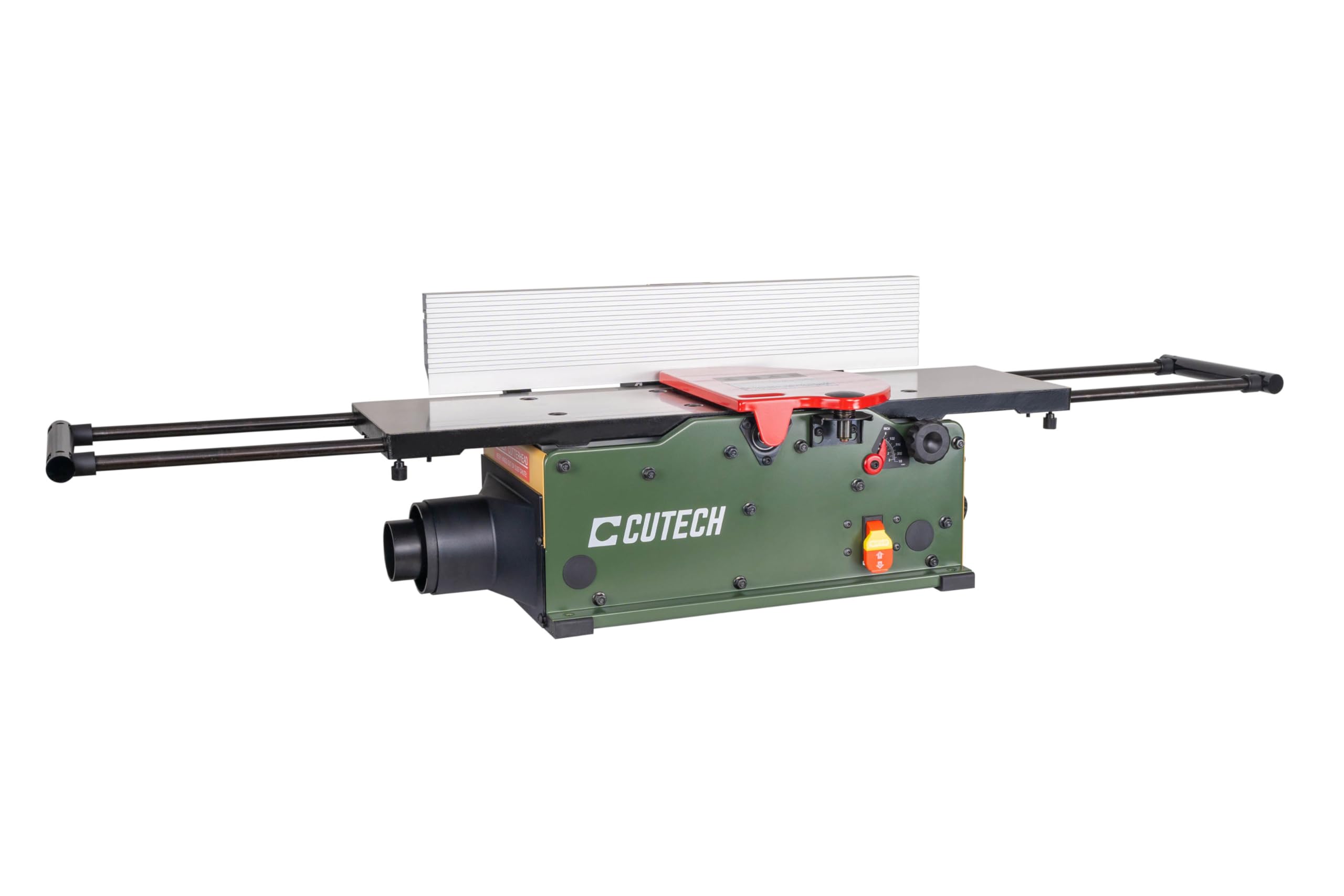
Cast iron stability in a benchtop frame, with fence brackets that cure the wobble.
Cast iron tables give every cut a more planted feel, and this 82.8-pound machine is the one Cutech buyers point to when they want that without a floor jointer’s footprint. Like the smaller Cutech above, it packs a six-row spiral cutterhead with staggered tungsten carbide inserts and the same two-sided, non-skewing insert design, but here it sits on cast iron rather than aluminum. The fence stretches to 24 inches with quick stops at 90 and 135 degrees. A patented set of 7-3/8-inch enhancement brackets stabilizes both fence ends — the fix for the “fence too flimsy” complaint that haunts this class.
Setup is short and clean. Hardware arrives pre-installed, the instruction sheet is clear, and most buyers are making shavings in about 45 minutes. The additional guide post under the elevation control keeps the tables parallel, so depth changes track straight instead of drifting. Pick up a nail or a staple in reclaimed stock and you rotate the chipped insert rather than resharpen the whole head. It handles pine, oak, and maple with smooth, true cuts, and it weighs enough that the machine stays put while you push a board through.
Two things to know before you commit. This is a loud tool — the 12,000 RPM universal motor is a hearing-protection-required machine, same as any benchtop in this class. And the fence alignment takes some patience; some buyers find the brackets fiddly to bring dead square. Neither keeps it from working well once set, but both are real parts of owning it.
Standout strengths
- Cast iron tables hold flat through heavy cuts
- 82.8 pounds of ballast — the machine does not walk
- 24-inch fence with stabilizing end brackets
- Parallel table design keeps depth changes true
- Six-row spiral head with rotatable inserts
Worth knowing
- 12,000 RPM motor demands ear protection
- Fence alignment takes some finesse
- Heavier than an aluminum-table benchtop
- Needs a dedicated dust setup to stay clean
Buy it for: the cast iron table feel without giving up bench-shop space.
Think twice if: you hate the sound of a universal motor at full speed — this one is loud.
5. JET JWJ-8HH-BLK 8-Inch Jointer, Helical Cutterhead

A full-size floor jointer with a table that will not let a long board sag.
This is where the benchtop list ends and serious shop furniture begins. The two-way table runs 70-7/8 inches overall — 34-11/16 inches on the infeed and outfeed each — so an eight-foot board rides flat through the cut instead of diving off the end. The fence measures 40-1/2 inches and tilts 45 to 135 degrees with positive stops at 45 and 90 degrees, and the depth of cut tops out at 1/8 inch per pass. A 4-inch dust port pairs with a collector rated 400 CFM or higher, so you’ll need a real dust system rather than a shop vac.
What holds up under heavy use is the table coating. JET’s black performance coating cuts friction by up to 50% versus bare cast iron, per the manufacturer, and needs no waxing — so you skip the weekly paste-wax ritual the benchtop machines demand. The helical head packs 36 four-sided carbide inserts across four rows, spinning at 5,500 RPM no load, and each insert indexes 90 degrees for a fresh edge. A magnetic control panel adds a shutoff layer beside the base-mounted On/Off switch. The 2 HP motor arrives corded for step-up to 230V if you have it, and the package includes the stand, fence, two push blocks, two star-point screwdrivers, five spare inserts, and a 5-year warranty.
The caveats are structural. Assembly is a two-person job — the machine ships at 405 pounds and the bed is heavy enough that owners mention needing a helper once the fence is off. The adjustment wheels can drag, and the instruction manual is thin enough that several buyers leaned on assembled photos to fill the gaps. Crating quality is inconsistent — some units arrive with dents and scratches in transit — and JET ships the machine unwired, so you finish the electrical connection yourself. None of that changes the cut quality, which lands smooth and flat on poplar and handles brittle ash without tear-out.
Why the floor jointer wins
- 70-7/8-inch table supports long stock without dead ends
- 36 four-sided carbide inserts index 90 degrees for fresh edges
- Low-friction coating cuts drag and skips the wax routine
- 40-1/2-inch tilting fence with positive stops
- Backed by a 5-year warranty
Before you order
- 405 pounds — plan for a two-person setup
- Ships unwired, you finish the electrical
- Adjustment wheels can feel stiff
- Manual leaves gaps for beginners
Built for you if: you run boards longer than four feet and want a floor jointer that stays put for years.
Overkill if: your stock never exceeds bench length — the table alone outweighs the average garage bench.
6. Powermatic 60HH 8-Inch Jointer, Helical Cutterhead

Dovetailed ways and a 54-insert helical head aimed at the working shop.
The headline number is the cutterhead: 54 four-sided carbide inserts shear the wood for a quieter, smoother finish than a straight-knife head. The table sits on dovetailed ways (precision-machined slides that lock the tables in alignment) and stretches extra long for workpiece support, while a handwheel-driven worm gear tilts the fence smoothly to any angle. The adjustment lever gives you quick infeed positioning and fine depth tuning in one motion, and the magnetic push blocks store on the machine so they are always within reach when you need them. The 2 HP motor runs on 230V single phase and pulls 20 amps. A non-mar fence insert protects the table during adjustments.
What buyers call out is the cut quality and physical presence. The beds arrive dead flat after shipping, the fence aligns to a preset 90 degrees, and the helical head leaves no snipe and a glass-smooth finish on hard maple, walnut, and cherry. The dust collection design works with a real collector, and the whole machine — 489 pounds — stays planted while you work. The five-year warranty covers manufacturing defects.
Two honest notes. The machine is genuinely loud — wear ear protection, especially if your shop is small and the jointer sits close to your bench. The infeed and outfeed tables can arrive not coplanar and take significant time to calibrate; most buyers get them flat and then stay there, but budget an evening for it. The mobile base and power-off switch have also drawn some flak for a three-wheel design that feels less stable than the machine deserves.
The craft point: dovetailed ways and a 54-insert head put this in the “calibrate once, run for years” class rather than the “adjust every session” class of benchtop machines.
Made for: the dedicated shop that wants heavy metal and a five-year warranty backing it.
Not for you if: your workspace has 120V only — this runs on 230V and needs a matching circuit.
7. Powermatic PJ-882HH 8-Inch Parallelogram Jointer, Helical Cutterhead

The parallelogram design that keeps the tables close to the cutter at every depth.
Parallelogram jointers solve a specific problem: keeping the infeed table close to the cutterhead as you change depth, so the gap does not widen and let stock dip. This machine’s table measures 8 by 82 inches of precision-ground cast iron, the fence tilts on a handwheel-operated worm gear, and a 1/8-inch depth limiter knob caps each pass for safety. The helical cutterhead carries 54 four-sided knife inserts that run quieter than a traditional head, and a high-mount switch keeps controls in easy reach. At 610 pounds it is the heaviest machine in this lineup, and it comes with a five-year warranty against manufacturing defects. Two 2 HP versions of that story, actually — the seller has listed it at 3 HP on some orders, and buyers suggest confirming the motor rating with the seller directly before purchase.
What buyers consistently praise is the finish and the table. Cast iron is well-milled, cuts land at 90 degrees straight off the fence with no snipe, and the worm gear crank gives smooth fence adjustments. Table length and fence setup are called out as key strengths — enough bed to support a long board properly, and enough fence to keep the edge square. The five-year warranty covers manufacturing defects, and customers note the tables hold alignment for years.
The honest drawbacks are alignment effort and customer service responsiveness. The outfeed table sometimes arrives 0.025 inch off at maximum adjustment, and getting the tables coplanar takes a real time investment — several buyers reported spending a full weekend dialing it in. A few found the Powermatic support line slow to reach and got faster help elsewhere. This is a premium tool that expects a buyer willing to do precision calibration work, not a plug-and-play benchtop.
Where the parallelogram pays off
- 8 x 82-inch precision-ground cast iron table
- 54 four-sided knife inserts run quiet and cut clean
- Worm gear handwheel tilts the fence smoothly
- 1/8-inch depth limiter for safe, measured passes
- Five-year warranty on a 610-pound machine
The honest math
- Table alignment can take a weekend to nail
- Customer service can be slow to respond
- Pulley set screw has been known to come loose early
- Sold at 2 HP on Amazon but 3 HP from some sellers
Worth the setup time if: you want parallelogram precision and can commit to the calibration work.
Not your machine if: you want a jointer that cuts true out of the crate — this one earns its precision.
Understanding the Specs
Cutting Width and Bed Length
Cutting width is the widest board you can flatten in a single pass. An 8-inch head handles a glue-up or a wide plank without flip-flopping the stock; a 12-inch head handles the widest benchtop work but eats more bench space. Bed length decides support: a 33-inch benchtop table like the WEN’s handles boards up to about four feet with its support arms extended, while a full-size floor jointer’s 70-plus-inch table keeps an eight-foot board flat the whole way through. Match bed length to your longest routine board: a 33-inch benchtop table supports about four feet, while a 70-inch floor table handles eight.
Cutterhead Type and Insert Count
Spiral and helical cutterheads hold rows of small carbide inserts rather than long straight knives. Inserts have multiple indexed edges, so a dull corner rotates to a fresh edge instead of triggering a full re-sharpening session. The insert geometry matters too: two-sided inserts are designed to resist skewing while planing, which is why Cutech rates its precision above a four-sided design. Insert count scales with head size — a 16-insert head on an 8-inch benchtop, a 24-insert head on a 12-inch benchtop, and a 54-insert head on a Powermatic 8-inch floor model are all normal for their width. More inserts generally mean a smoother finish and less tear-out, but they also mean more edges to rotate over time.
FAQ
Can a benchtop 8 inch jointer flatten a board as well as a floor model?
What is the difference between a spiral cutterhead and a helical cutterhead?
How often do I need to rotate or replace the carbide inserts?
Do I need 230V power for an 8 inch jointer?
What depth of cut can I take in one pass?
Can I run a benchtop jointer on a shop vac instead of a dust collector?
Will a cast iron table rust in a humid garage?
What size dust port do I need and how does it affect performance?
Is the fence angle range on an 8 inch jointer important?
Final Thoughts: The Verdict
For the best combination of 8-inch capacity, smooth spiral-head cuts, and a price that makes sense for a home shop, buy the WEN JT833H — it carries a full 8-inch cutting width with room for a four-foot board across its extendable support arms. If cast iron stability is what you’re after without a floor footprint, the Cutech 40180HI pairs a 24-inch fence and 82.8-pound frame in a benchtop package. And if wide panels or long stock are routine, the Cutech 401120HI-IF steps to a 12-inch head, while the JET JWJ-8HH-BLK stakes its claim on a 70-7/8-inch table that keeps an eight-foot board dead flat from start to finish.
How We Picked
We do not accept paid placement. Every pick is matched to a real buyer and a real use-case; we do not hands-on test units.
Sources & Methodology
Specifications: manufacturer listings and product documentation. Review insights: verified customer reviews, as of September 2026. Pricing: not shown on this page (it changes often); check the current price via the retailer link.
As an Amazon Associate, KitchPrep earns from qualifying purchases. This does not affect which products we feature.
Related Guides
