
Specs are compiled from manufacturer listings and verified buyer reviews and can change over time — please confirm the key details on the product page before buying.
You are cutting trim, baseboard, or crown molding, and a full-size 10- or 12-inch miter saw feels like hauling a boat anchor to the job site. A 7 1/4 inch miter saw solves that: it is lighter, cheaper, and easier to carry, but you give up some cutting width. The real choice is between a battery-powered model for freedom and a corded one for constant power, plus how you prefer to see your cut line.
I’m Mohammad Maruf — the founder and writer behind KitchPrep. This guide is built by comparing the manufacturers’ published specifications and the patterns across verified customer reviews, so you get each pick’s real strengths and trade-offs instead of marketing spin.
If you need a cordless saw for the jobsite, look for one that shares batteries with your other tools. If you need a corded workhorse for the garage, you get steady power and no battery anxiety. This breakdown of the 7 1/4 inch miter saw field sorts the portable powerhouses from the shop-bound bench dwellers.
Our Picks at a Glance


How To Choose The Best 7 1/4 Inch Miter Saw
Before you buy, know that this size saw puts mobility first. A 10-inch saw cuts wider boards, but it usually weighs more and takes up more bench space. The 7-1/4-inch class trades that capacity for a tool that moves easily between rooms or rides in a trunk without complaint.
Sliding vs. Fixed: What You Can Crosscut
This is the biggest fork in the road. A fixed (non-sliding) saw drops straight down, so your maximum crosscut width is limited by the blade size. A sliding saw pulls forward like a radial arm, which nearly doubles the width of material you can cut in one pass—useful for cutting 2×6 or 2×8 boards flat.
Corded vs. Cordless: Runtime vs. Constant Power
If you work near an outlet all day, a corded model gives you consistent power and zero battery anxiety. If you are on a roof, a ladder, or a jobsite without power, cordless freedom wins—but you need to check the battery platform. A saw that shares batteries with your other tools is far more practical than one that forces a new charger and pack into your kit.
Cut Line Visibility: Laser, Light, or Nothing
The cut line indicator is what stops you from making crooked cuts on expensive trim. Lasers cast a red line, but LED shadow lines project an actual dark shadow of the blade kerf—the slot the blade cuts, so you see exactly where the cut will land, which many users find more accurate. Some budget saws skip this feature entirely, leaving you to eyeball the cut.
Quick Comparison
| Model | Best For | Power Source | Max Miter Angle | Weight | Amazon |
|---|---|---|---|---|---|
| DEWALT DCS361M1★ Best Overall | Jobsite portability + accuracy | Cordless 20V Max | 48 degrees | 31.6 lbs | Amazon |
| RYOBI TS1144Best Value | Budget corded first saw | Corded 9 Amp | 45 degrees | 19 lbs | Amazon |
| CRAFTSMAN CMCS714M1Best Runtime | All-day battery + sliding cuts | Cordless V20 | 90 degrees | 21.8 lbs | Amazon |
| RYOBI P553 | Portable trim & molding | Cordless 18V ONE+ | 45 degrees | 19 lbs | Amazon |
| VEVOR J0XL-DU04-185 | Value sliding cuts | Cordless 18.5V | 45 degrees | 23.2 lbs | Amazon |
| SKIL MS6306-00 | Fast cuts + expandable angles | Corded 10 Amp | 50 degrees | 31 lbs | Amazon |
| RYOBI PBT01B | Long runtime 2×10 cuts | Cordless 18V ONE+ | 45 degrees | 30.2 lbs | Amazon |
| WORX WX845L.9 | Large crosscuts + dado slots | Cordless 20V Power Share | 90 degrees | — | Amazon |
| BOSCH GCM18V-07SN | Pro-grade portability | Cordless 18V PROFACTOR | 45 degrees | 26 lbs | Amazon |
In‑Depth Reviews
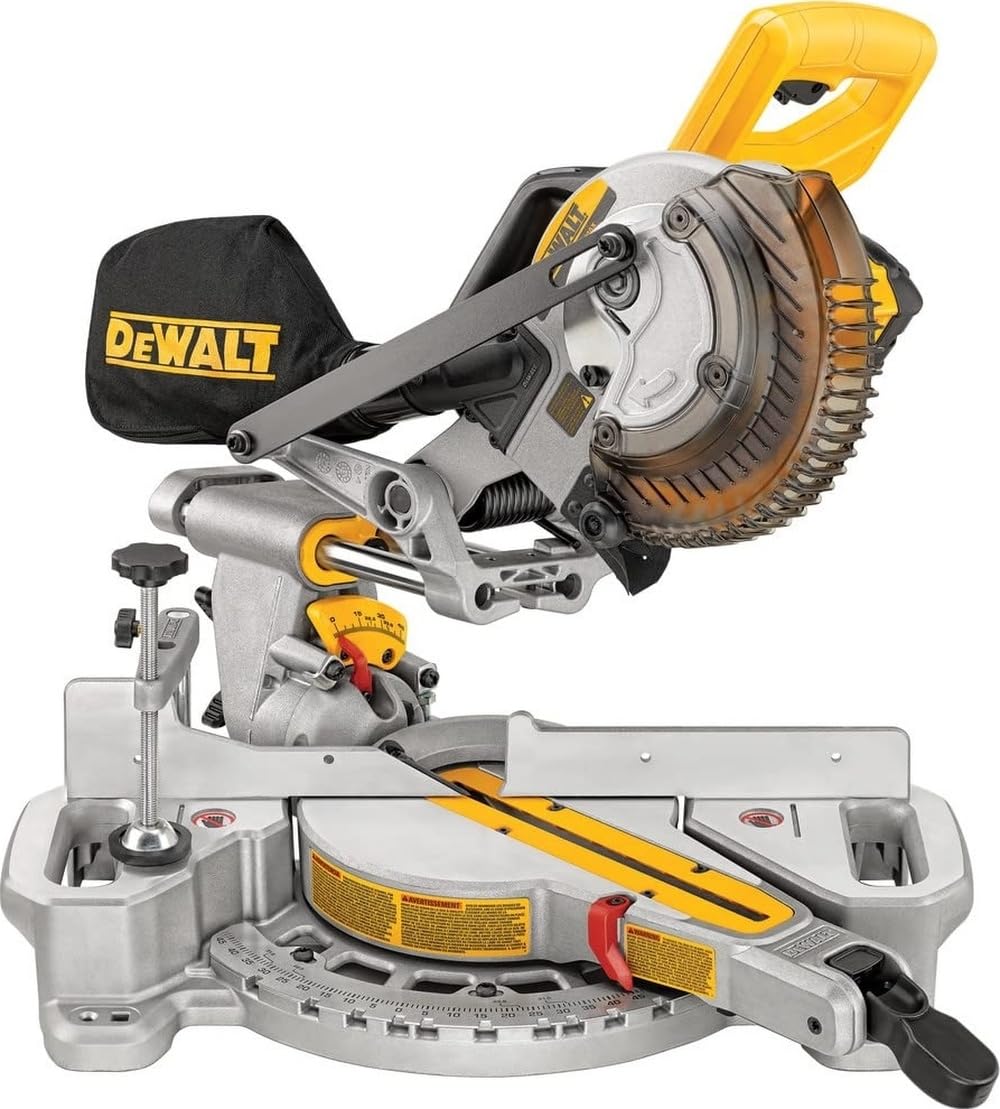
1. DEWALT 20V MAX 7-1/4-Inch Miter Saw (DCS361M1)
Our pick — over 4.5★ from 800+ verified ratings; the strongest balance of quality and price.
The shop-grade accuracy that leaves the extension cord in the truck.
You get precise angle control here that other cordless saws often skip. The stainless steel miter detent plate (a metal plate with preset stopping points) gives you 11 positive stops—well-defined click-in points at common angles so you can set 15, 22.5, 30, or 45 degrees without squinting at a scale. The oversized bevel scale works with the cam lock miter handle to let you swing and lock angles quickly.
Battery life is the headline. With the included DCB204 20V Max pack, it averages 183 cuts through 2×4 pine or 275 cuts of 3-1/4-inch pine baseboard on a single charge. That is enough for a full day of trim work without swapping batteries. The integrated cut line cross-cut positioning system uses a light to show your cut line, and buyers report it is very accurate—the non-laser light is a favorite feature.
The compact frame weighs in at 31.6 lbs, which is light for a miter saw but still the heaviest cordless in this lineup. Size and portability are the traits owners praise most. Owners mention they have used it on a number of projects with great results, with the only real knock being the material clamp, which a few find a bit flimsy—though functional enough for normal use.
Where it shines
- Hundreds of cuts per charge—183 in 2×4 pine or 275 in baseboard
- Lighted cut line indicator is accurate with no laser to drift
- 11 positive stops on the miter plate speed up common angles
What to know
- Only works with 4Ah or larger batteries, so older 2Ah packs won’t fit the bill
- At 31.6 lbs it is not the lightest option here
- Material clamp feels less sturdy than the rest of the saw
Reach for this if: you want a cordless saw that cuts trim all day on one charge without losing accuracy.
Look elsewhere if: you already own compact 2Ah batteries—this saw needs the bigger 4Ah DCB204 class pack to run.
2. RYOBI 9 Amp Corded 7-1/4 in. Compound Miter Saw (TS1144)
A first saw that turns a 75-year-old beginner into a confident cutter by afternoon.
The 9-amp motor draws little enough to run on a standard 15-amp garage circuit without tripping breakers. One owner in a detached shop with only a single 15-amp circuit confirms it runs fine on that setup—so you will not trip breakers the way a bigger 15-amp saw might. It crosscuts, miters, and bevels, giving you the full range of compound cuts for baseboard and casing work. The whole unit weighs just 19 lbs, which makes it noticeably lighter than the DEWALT above and easy to carry to small jobs.
It cuts 2x4s just fine, and the enjoyment owners get from it is the top praise. One buyer who started as a total novice found that after one afternoon she felt like a pro with cross cuts, miter cuts, and bevel cuts. The trade-off for the low price is the lack of a laser guide—it is a nice lightweight unit, but there is no red line to show the cut path.
The recurring gripe is cutting thicker trim: the motor body can stop the cut before finishing 2-1/4-inch trim, so that is a task for a larger saw. Dust collection is another weak spot, as the vacuum port clogs easily. For small and big projects alike, it delivers clean and accurate cuts, which is why it earns its keep.
Our take: The 9-amp draw suits a 15-amp garage circuit, and at 19 lbs it goes where bigger saws cannot. The lack of a laser guide and trouble with 2-1/4-inch trim mean it is best for standard baseboard and smaller stock rather than heavy crown.
3. CRAFTSMAN V20 Cordless Sliding Miter Saw (CMCS714M1)
The sliding rail you want with battery life that runs all day on one charge.
This is the sliding saw for people who hate stopping to swap batteries. On a single charge of the included 4.0Ah V20 pack, it makes up to 585 cuts in 3-1/4-inch MDF baseboard (a type of engineered wood board)—customers note it cuts all day and still has juice left. The 3,800 RPM motor handles 2x dimensional lumber, hardwoods, baseboard, and trim, and the slide action gives you an 8-inch crosscut at 90 degrees, which is wider than any non-sliding 7-1/4-inch saw can manage.
The LED cut line positioning system casts a shadow to mark your line, and owners describe it as a perfect cut line indicator. Nine casted miter detent stops (click-in points at preset angles) let you set common angles fast, and the 20V battery platform means it shares packs with the rest of the CRAFTSMAN V20 lineup. It also nests 3-5/8-inch crown and cuts 3-1/2-inch baseboards vertically, so it is genuinely capable on trim.
The honest limit shows up on thick stock. Owners find it struggles on wood 3 inches or thicker because the motor housing hits the workpiece and there is no height adjustment. The clamp can also block 45-degree cuts and needs a screwdriver to move out of the way. Performance is the aspect owners praise most, with cut quality close behind.
What wins people over
- Runs all day—up to 585 cuts per charge in MDF baseboard
- Sliding rail opens an 8-inch crosscut at 90 degrees
- Quiet enough to use at night, per owner reports
Watch for
- Motor housing hits wood 3 inches or thicker—no height adjust
- Clamp can interfere with 45° cuts until moved
- Instruction manual is hard to follow
Best suited to: the DIY homeowner who wants a sliding, cordless saw that powers through a full day of baseboard and casing.
Not for: the professional contractor cutting thick stock daily—it is built for home jobs, not constant pro use.
4. RYOBI ONE+ 18V Cordless Sliding Compound Miter Saw (PBT01B)

Pulls forward like a chop saw twice its size, yet runs all day on one 18V pack.
The sliding mechanism is the whole story here. RYOBI claims a top-tier 2×10 crosscut capacity (meaning a board that is 2 inches thick and 10 inches wide), so you can lay a 2×10 flat and slice through it in a single pull—something a fixed 7-1/4-inch saw simply cannot do. The rails slide smoothly, and owners have remodeled entire houses with this one saw without problems. One user sums it up: the addition of the sliding function is where the value lives, handling about 80% of typical mitering needs.
Runtime is outsized for an 18V tool. RYOBI rates it at up to 800 cuts per charge, and that holds up in practice—a finish-trim installer reports using it all day on a single 18V battery. It makes short work of 5-1/4-inch base and handles bigger stock too. Since it is part of the ONE+ family, it works with any of the 260+ RYOBI ONE+ 18V tools and any ONE+ battery you already own.
The catch is the single bevel (the blade tilts only one direction). So for compound cuts, you lay the workpiece flat and angle the saw. Owners note it is super light for a chop saw—a big benefit for carrying it up stairs or out to a truck. Functionality is what owners praise most, with quality close behind.
The verdict: For cutting trim, baseboard, and molding, the sliding action plus 800 cuts per charge makes it the best runtime-per-pound value in this list. Single-bevel only is the trade-off for that light weight.
5. BOSCH PROFACTOR 18V 7-1/4 In. Single-Bevel Slide Miter Saw (GCM18V-07SN)

Pro-grade trim cutting with a precisely centered slide that feels like a much bigger saw.
The Biturbo brushless motor is the engineering story. A brushless motor uses electronics instead of carbon brushes, which means more power and longer life. This is a brushless high-performance motor and drive-train system designed to pull extra power from Bosch’s core18V high-power batteries (sold separately). The payoff is pro capacity in a tool that weighs just 26 lbs tool-only, with a carry handle that makes it genuinely mobile. Owners who replaced heavier Hitachi saws report it is light, accurate, and easy to move around the shop.
The precisely centered sliding bars are what set it apart mechanically—the saw glides forward with very smooth, easy action. It delivers an 8-1/4-inch crosscut and nests 3-3/4-inch crown with a 45-degree left cut against the fence (the vertical back plate that guides your wood). The tall fence design supports taller material for accurate cuts, and it is dust-extraction ready with a bag included or a vacuum hookup. It shares the same 7-1/4-inch blades as a circular saw, which is handy.
Because it is a single bevel, it handles most trim work but will not tilt both directions for complex crown. Owners find it runs strong even on an 8Ah battery and praise its precision and quiet operation. Quality is the aspect owners praise most, with the light weight a close second—one calls it great for common trim installs.
Bottom line: Bosch builds this for pros who need a mobile saw without giving up accuracy. The smooth slide and 26-lb weight beat the heavier DEWALT, but you pay more and must supply your own batteries—the bare tool ships without a pack.
6. SKIL 10 Amp 7-1/4″ Single Bevel Miter Saw (MS6306-00)

A corded compact that spins fast enough to make you forget it is not a 10-inch.
The 10-amp motor delivers up to 4,800 RPM (revolutions per minute—how fast the blade spins), which is the fastest spin in this roundup—speed that translates to clean, quick cuts in baseboards, casing, and quarter rounds. The compact fixed rail system shrinks the saw’s footprint so you can park it flush against a wall or in a tight corner of a crowded garage. It weighs under 25 lbs per the manufacturer, and the whole tool carries easily.
The LED shadow line is the feature owners rave about. It projects a dark shadow of the blade kerf (the slot the blade cuts), which is more accurate than a laser for showing exactly where the cut will land. One owner who installed about 900 sq ft of engineered hardwood flooring and baseboard found the saw was definitely up to the task with accurate cuts every time. Another calls the shadow line a revelation.
The expansive miter capacity is the differentiator: it swings from 0 to 47 degrees left and 0 to 50 degrees right, with detents at 0, 15, 22.5, 31.6, and 45 degrees on each side. That beats the standard 45-degree cap on most rivals. It crosscuts up to 2×10 at 0 degrees and nests 3-1/2-inch crown. Quality and value for money are the top owner praises.
Why it impresses
- 4,800 RPM top speed for fast, clean cuts
- Miter swings wider—50° right, 47° left
- LED shadow line is far more accurate than a laser
Keep in mind
- Corded only—no battery option for remote spots
- Single bevel, so no left/right tilt
- Stand (SRS0001) is sold separately
Grab this if: you work near an outlet and want the fastest, widest-angle 7-1/4 corded saw for the money.
Pass if: you need cordless freedom—this one stays plugged in, and the stand costs extra.
7. RYOBI 18V Cordless 7-1/4 in. Compound Miter Saw (P553)

The lightweight cordless that handles home reno tasks without needing an outlet nearby.
Portability is the core strength—owners consistently describe it as light, compact, and easy to move and store. It runs on standard RYOBI 18V ONE+ batteries, so if you already own that platform, you can drop in any existing pack (battery and charger are sold separately here). It cuts 2x4s easily and is ideal for picture frames, molding, and trim, and because there is no cord, you can work anywhere.
The versatility for smaller jobs is exactly what owners praise most. It handles home renovation tasks well, though for larger pieces you may need to make double cuts since there is no sliding rail to widen the crosscut. It is small enough for limited spaces—a big plus for apartment balconies or crowded workshops.
Quality is the most-discussed aspect, and it is genuinely mixed: reviewers point out the build is better than the older version, but the stock blade is a weak point—rough cuts with wood flying until it gets swapped for a 60-tooth blade (a fix) for smoothness. There is no laser or light included, and the dust bag is unpopular enough that owners suggest hooking it directly to a shop vac instead.
Our read: This is a light-duty saw for people already in the RYOBI ONE+ ecosystem who need portability above all. Budget for a better blade, and know that larger stock requires two passes.
8. VEVOR Sliding Compound Miter Saw, 7-1/4 inch, DC 18.5V Cordless
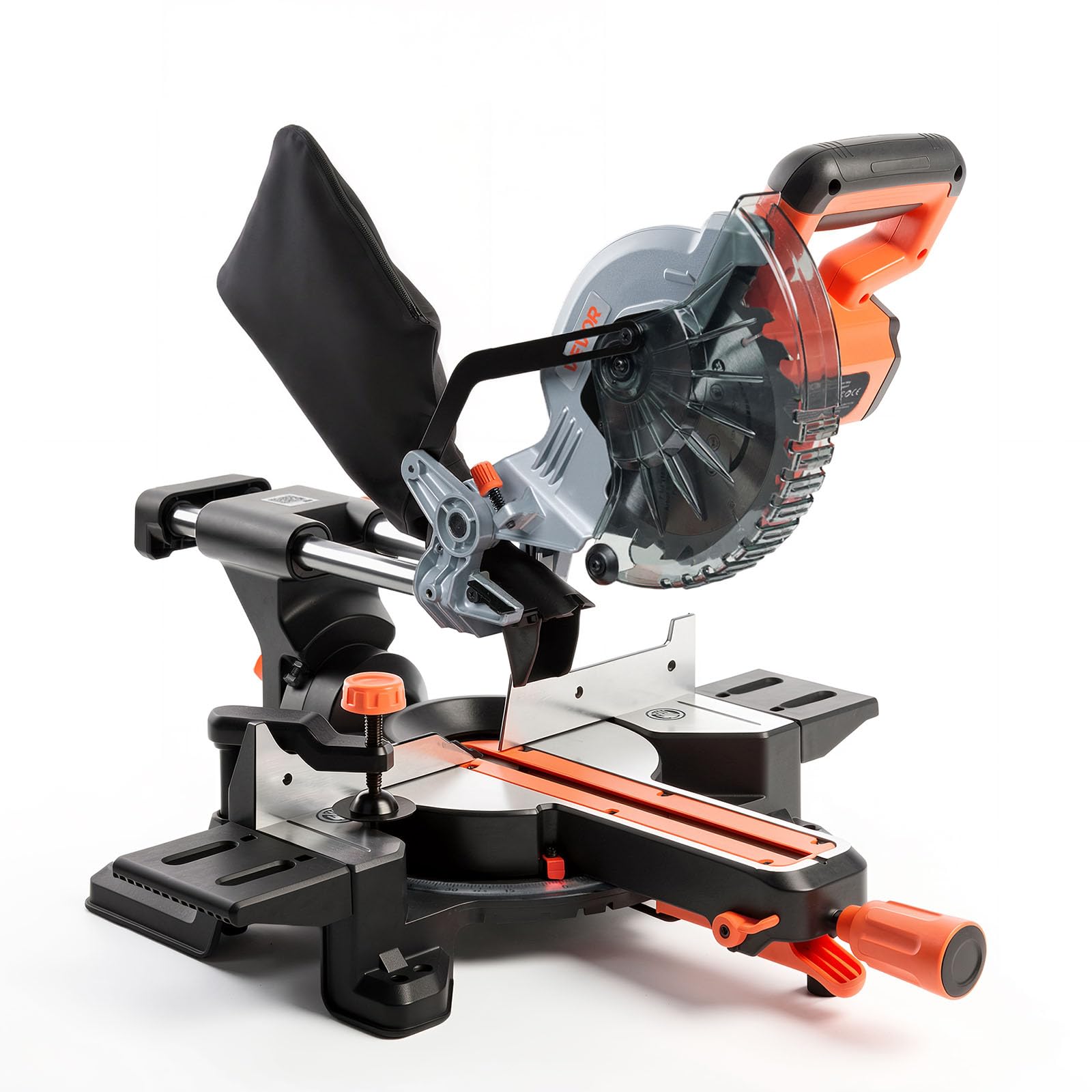
A sliding cordless that handles nail-embedded wood and thick stock without flinching.
The cutting capacity here is the headline: up to 9.25 x 2.05 inches at 3,800 RPM, designed to cut thick wood, composites, plastics, and even nail-embedded wood with clean, controlled results. Owners confirm it works well with treated 6×6 materials, which is impressive for a 7-1/4-inch blade. The blade brake (which stops the spinning blade fast after a cut) is a genuine safety plus that owners single out.
The LED shadow guide marks the cutting path on the workpiece, and it supports bevel and miter cuts with a 0.1-degree scale that adjusts smoothly up to ±45 degrees. The quick-lock miter system and extended handle make angle changes fast and secure. Quality is the aspect owners praise most by a wide margin, with value for money second—one owner notes it feels solid and could replace both a miter and table saw for hobbyist use.
The honest trade-offs: adjustability and the blade guard earn mixed feedback, with owners noting plastic knobs may wear over time and the blade install being more difficult than ideal. The dust bag is small, and at 23.2 lbs it is heavier than the RYOBI cordless options. For home and hobby use it is a strong value, but owners agree it is not pro-grade.
In short: Beginners and hobbyists get a sliding cordless with real cutting power and quick blade brake for a budget price. The plastic parts and finicky blade changes remind you where the savings come from.
9. WORX Nitro Cordless Sliding Compound Miter Saw, 20V 7-1/4-Inch (WX845L.9)

The bare-tool nitro saw that slices 2×6 and 2×8 boards in one smooth pull.
The sliding blade housing gives this Worx an 8-1/4-inch maximum cutting capacity, so you can crosscut large boards like 2×6 or 2×8 in a single slice—owners confirm it handles them easily. The work-holding clamp is built in with a lever that secures the workpiece on both sides of the blade, a feature that adds stability for longer cuts. Extension wings help support long materials on either side, which is rare at this size.
The shadow line cut uses a light to mark the cutting path for accuracy, and the adjustable knob bevels the blade up to 45 degrees for compound cuts (combining an angled head with a tilted blade). It also has a depth adjustment for cutting dado slots (flat-bottomed grooves in wood)—a feature most miter saws simply do not offer. The miter detents click into common angles, and the included 40T TCT blade (a 40-tooth, tungsten-carbide-tipped blade, ready for hardwood) is ready to run from the start.
This is a bare tool, so battery and charger are sold separately; WORX recommends Power Share PRO batteries (the WA3012 4.0Ah or WA3571 5.0Ah) for optimal run time. Owners describe it as lightweight and battery-powered with no power loss compared to corded models, plus no extension cord needed. Quality and cutting performance are the top owner praises. The minor gripes are a sticker miter scale that can peel and a lack of mounting holes for add-on fences.
Final word: For cutting large stock on a cordless platform, the 8-1/4-inch capacity and dado depth adjustment make it the most versatile bare tool here. Plan to buy a Power Share PRO battery to get the advertised run time.
Understanding the Specs
Blade Size and Crosscut Capacity
The 7-1/4-inch blade keeps the saw light but caps crosscut width at roughly 2×6 on fixed models. A fixed saw crosscuts only about 2×4 to 2×6 boards laid flat. A sliding saw pulls the blade forward to roughly double the crosscut width in one pass. For wide trim or framing lumber, prioritize a sliding model over blade-size differences.
Miter vs. Bevel Angles
Miter rotates the saw head left or right across the fence for picture-frame and baseboard-corner angles. Bevel tilts the blade sideways for angled cuts. A single-bevel saw tilts one way only; a compound saw combines miter and bevel for crown molding. Check the degree range: most stop at 45, but premium models push to 48 or even 50 degrees for tighter corner work.
FAQ
What can you cut with a 7-1/4 inch miter saw that you cannot with a 10-inch?
Does a 7-1/4 inch miter saw share blades with a circular saw?
Why does a sliding miter saw cost more than a fixed one?
How many cuts can you get on one battery charge?
Is a laser guide better than an LED shadow line?
What is the difference between a single bevel and a compound miter saw?
Can you cut crown molding with a 7-1/4 inch miter saw?
Should I choose corded or cordless for a 7-1/4 inch miter saw?
Why do some 7-1/4 inch miter saws list a blade length of 4 inches?
How much bench space does a 7-1/4 inch miter saw need?
Final Thoughts: The Verdict
For most buyers, the best 7 1/4 inch miter saw overall is the DEWALT DCS361M1—it pairs hundreds of cuts per charge with the accuracy of 11 positive stops and a lighted cut line, all in a 31.6-lb frame. If you want a sliding cordless that runs all day without stopping, the {“@context”: “https://schema.org”, “@graph”: [{“@type”: “ItemList”, “name”: “9 Best 7 1/4 Inch Miter Saw”, “url”: “https://kitchprep.com/best-7-1-4-inch-miter-saw/”, “numberOfItems”: 9, “itemListElement”: [{“@type”: “ListItem”, “position”: 1, “name”: “DEWALT 20V MAX 7-1/4-Inch Miter Saw (DCS361M1)”, “url”: “https://kitchprep.com/best-7-1-4-inch-miter-saw/#product-1”}, {“@type”: “ListItem”, “position”: 2, “name”: “RYOBI 9 Amp Corded 7-1/4 in. Compound Miter Saw (TS1144)”, “url”: “https://kitchprep.com/best-7-1-4-inch-miter-saw/#product-2”}, {“@type”: “ListItem”, “position”: 3, “name”: “CRAFTSMAN V20 Cordless Sliding Miter Saw (CMCS714M1)”, “url”: “https://kitchprep.com/best-7-1-4-inch-miter-saw/#product-3”}, {“@type”: “ListItem”, “position”: 4, “name”: “RYOBI ONE+ 18V Cordless Sliding Compound Miter Saw (PBT01B)”, “url”: “https://kitchprep.com/best-7-1-4-inch-miter-saw/#product-4”}, {“@type”: “ListItem”, “position”: 5, “name”: “BOSCH PROFACTOR 18V 7-1/4 In. Single-Bevel Slide Miter Saw (GCM18V-07SN)”, “url”: “https://kitchprep.com/best-7-1-4-inch-miter-saw/#product-5”}, {“@type”: “ListItem”, “position”: 6, “name”: “SKIL 10 Amp 7-1/4\” Single Bevel Miter Saw (MS6306-00)”, “url”: “https://kitchprep.com/best-7-1-4-inch-miter-saw/#product-6”}, {“@type”: “ListItem”, “position”: 7, “name”: “RYOBI 18V Cordless 7-1/4 in. Compound Miter Saw (P553)”, “url”: “https://kitchprep.com/best-7-1-4-inch-miter-saw/#product-7”}, {“@type”: “ListItem”, “position”: 8, “name”: “VEVOR Sliding Compound Miter Saw, 7-1/4 inch, DC 18.5V Cordless”, “url”: “https://kitchprep.com/best-7-1-4-inch-miter-saw/#product-8”}, {“@type”: “ListItem”, “position”: 9, “name”: “WORX Nitro Cordless Sliding Compound Miter Saw, 20V 7-1/4-Inch (WX845L.9)”, “url”: “https://kitchprep.com/best-7-1-4-inch-miter-saw/#product-9”}]}, {“@type”: “Product”, “position”: 1, “name”: “DEWALT 20V MAX 7-1/4-Inch Miter Saw (DCS361M1)”, “image”: “https://m.media-amazon.com/images/I/61mOHH9Ed2L.jpg”, “brand”: {“@type”: “Brand”, “name”: “DEWALT”}, “url”: “https://www.amazon.com/dp/B00X52TZYM/?tag=kpmaruf-20”, “offers”: {“@type”: “Offer”, “url”: “https://www.amazon.com/dp/B00X52TZYM/?tag=kpmaruf-20”}}, {“@type”: “Product”, “position”: 2, “name”: “RYOBI 9 Amp Corded 7-1/4 in. Compound Miter Saw (TS1144)”, “image”: “https://m.media-amazon.com/images/I/51sz3SdfgrL.jpg”, “brand”: {“@type”: “Brand”, “name”: “RYOBI”}, “url”: “https://www.amazon.com/dp/B081NXMKZP/?tag=kpmaruf-20”, “offers”: {“@type”: “Offer”, “url”: “https://www.amazon.com/dp/B081NXMKZP/?tag=kpmaruf-20”}}, {“@type”: “Product”, “position”: 3, “name”: “CRAFTSMAN V20 Cordless Sliding Miter Saw (CMCS714M1)”, “image”: “https://m.media-amazon.com/images/I/61xCX5XnXWS.jpg”, “brand”: {“@type”: “Brand”, “name”: “CRAFTSMAN”}, “url”: “https://www.amazon.com/dp/B07LFPYPCQ/?tag=kpmaruf-20”, “offers”: {“@type”: “Offer”, “url”: “https://www.amazon.com/dp/B07LFPYPCQ/?tag=kpmaruf-20”}}, {“@type”: “Product”, “position”: 4, “name”: “RYOBI ONE+ 18V Cordless Sliding Compound Miter Saw (PBT01B)”, “image”: “https://m.media-amazon.com/images/I/61rE0aaz+nL.jpg”, “brand”: {“@type”: “Brand”, “name”: “RYOBI”}, “url”: “https://www.amazon.com/dp/B09SNK2SBL/?tag=kpmaruf-20”, “offers”: {“@type”: “Offer”, “url”: “https://www.amazon.com/dp/B09SNK2SBL/?tag=kpmaruf-20”}}, {“@type”: “Product”, “position”: 5, “name”: “BOSCH PROFACTOR 18V 7-1/4 In. Single-Bevel Slide Miter Saw (GCM18V-07SN)”, “image”: “https://m.media-amazon.com/images/I/61GWUoFH48L.jpg”, “brand”: {“@type”: “Brand”, “name”: “BOSCH”}, “url”: “https://www.amazon.com/dp/B0BCXG16GG/?tag=kpmaruf-20”, “offers”: {“@type”: “Offer”, “url”: “https://www.amazon.com/dp/B0BCXG16GG/?tag=kpmaruf-20”}}, {“@type”: “Product”, “position”: 6, “name”: “SKIL 10 Amp 7-1/4\” Single Bevel Miter Saw (MS6306-00)”, “image”: “https://m.media-amazon.com/images/I/515mAsGIQ0L.jpg”, “brand”: {“@type”: “Brand”, “name”: “SKIL”}, “url”: “https://www.amazon.com/dp/B0DHS3PP4J/?tag=kpmaruf-20”, “offers”: {“@type”: “Offer”, “url”: “https://www.amazon.com/dp/B0DHS3PP4J/?tag=kpmaruf-20”}}, {“@type”: “Product”, “position”: 7, “name”: “RYOBI 18V Cordless 7-1/4 in. Compound Miter Saw (P553)”, “image”: “https://m.media-amazon.com/images/I/41DCFQNi53L.jpg”, “brand”: {“@type”: “Brand”, “name”: “RYOBI”}, “url”: “https://www.amazon.com/dp/B081LNF6VF/?tag=kpmaruf-20”, “offers”: {“@type”: “Offer”, “url”: “https://www.amazon.com/dp/B081LNF6VF/?tag=kpmaruf-20”}}, {“@type”: “Product”, “position”: 8, “name”: “VEVOR Sliding Compound Miter Saw, 7-1/4 inch, DC 18.5V Cordless”, “image”: “https://m.media-amazon.com/images/I/71GdAeRrPDL.jpg”, “brand”: {“@type”: “Brand”, “name”: “VEVOR”}, “url”: “https://www.amazon.com/dp/B0H6HWZV6H/?tag=kpmaruf-20”, “offers”: {“@type”: “Offer”, “url”: “https://www.amazon.com/dp/B0H6HWZV6H/?tag=kpmaruf-20”}}, {“@type”: “Product”, “position”: 9, “name”: “WORX Nitro Cordless Sliding Compound Miter Saw, 20V 7-1/4-Inch (WX845L.9)”, “image”: “https://m.media-amazon.com/images/I/71RgI3Ysg8S.jpg”, “brand”: {“@type”: “Brand”, “name”: “WORX”}, “url”: “https://www.amazon.com/dp/B08L43DNNK/?tag=kpmaruf-20”, “offers”: {“@type”: “Offer”, “url”: “https://www.amazon.com/dp/B08L43DNNK/?tag=kpmaruf-20”}}, {“@type”: “FAQPage”, “mainEntity”: [{“@type”: “Question”, “name”: “What can you cut with a 7-1/4 inch miter saw that you cannot with a 10-inch?”, “acceptedAnswer”: {“@type”: “Answer”, “text”: “In terms of width, very little—a 10-inch saw cuts wider boards. What the 7-1/4-inch wins on is weight and portability. Most of these weigh under 32 lbs, so you can carry them up stairs, into attics, or out to a truck easily. For trim, baseboard, casing, and molding, the smaller blade handles all of it.”}}, {“@type”: “Question”, “name”: “Does a 7-1/4 inch miter saw share blades with a circular saw?”, “acceptedAnswer”: {“@type”: “Answer”, “text”: “Yes. Both use a 7-1/4-inch round blade, and the BOSCH GCM18V-07SN is explicitly noted by owners as sharing blades with their circular saw. That means one blade purchase serves two tools, and you can use a fine-tooth blade on the miter saw for cleaner trim cuts.”}}, {“@type”: “Question”, “name”: “Why does a sliding miter saw cost more than a fixed one?”, “acceptedAnswer”: {“@type”: “Answer”, “text”: “A sliding saw adds rails and a carriage mechanism that let the blade pull forward, widening your crosscut capacity—the RYOBI PBT01B, for example, crosscuts a 2×10 in one pass. The extra mechanical complexity costs more to build and is why sliding models sit at a higher price tier than fixed saws.”}}, {“@type”: “Question”, “name”: “How many cuts can you get on one battery charge?”, “acceptedAnswer”: {“@type”: “Answer”, “text”: “It varies by battery and material. The DEWALT DCS361M1 averages 183 cuts of 2×4 pine on its 20V Max pack. The CRAFTSMAN CMCS714M1 makes up to 585 cuts in 3-1/4-inch MDF baseboard on one charge. The RYOBI PBT01B claims up to 800 cuts per charge. Heavier or thicker stock drains the battery faster.”}}, {“@type”: “Question”, “name”: “Is a laser guide better than an LED shadow line?”, “acceptedAnswer”: {“@type”: “Answer”, “text”: “Most owners find the LED shadow line more accurate. A laser projects a red line that can drift out of calibration over time. An LED shadow line casts an actual dark shadow of the blade kerf, showing exactly where the cut will land. SKIL owners describe the shadow line as accurate every time, and DEWALT owners praise the non-laser light.”}}, {“@type”: “Question”, “name”: “What is the difference between a single bevel and a compound miter saw?”, “acceptedAnswer”: {“@type”: “Answer”, “text”: “A single-bevel saw tilts its blade in one direction only, usually left. A compound saw allows both a miter angle (head rotating) and a bevel angle (blade tilting), which you combine for cutting crown molding. If you install crown or do complex trim work, compound capability matters. For basic baseboard and picture frames, single bevel is usually enough.”}}, {“@type”: “Question”, “name”: “Can you cut crown molding with a 7-1/4 inch miter saw?”, “acceptedAnswer”: {“@type”: “Answer”, “text”: “Yes. Several models in this list are explicitly designed for it. The DEWALT DCS361M1 and CRAFTSMAN CMCS714M1 both nest 3-5/8-inch crown molding (meaning you can position the molding against the fence and blade to make the cut). The BOSCH GCM18V-07SN nests 3-3/4-inch crown with a 45-degree left cut against the fence. Check the nested crown spec before buying.”}}, {“@type”: “Question”, “name”: “Should I choose corded or cordless for a 7-1/4 inch miter saw?”, “acceptedAnswer”: {“@type”: “Answer”, “text”: “Ask where you will use it most. If you work near outlets and want maximum power with zero battery worry, a corded model like the SKIL MS6306-00 is cheaper and always ready. If you work on roofs, ladders, or remote jobsites, a cordless saw like the DEWALT DCS361M1 or CRAFTSMAN CMCS714M1 frees you from extension cords, as long as you have spare batteries.”}}, {“@type”: “Question”, “name”: “Why do some 7-1/4 inch miter saws list a blade length of 4 inches?”, “acceptedAnswer”: {“@type”: “Answer”, “text”: “That is a data-entry quirk in some listings that we flagged during research. The actual physical blade size is 7-1/4 inches, which is confirmed by the model name and the purpose of the tool. If you are ever unsure, check the manufacturer part number against the brand’s official site.”}}, {“@type”: “Question”, “name”: “How much bench space does a 7-1/4 inch miter saw need?”, “acceptedAnswer”: {“@type”: “Answer”, “text”: “Less than you might think. Fixed saws are the most compact. The SKIL MS6306-00 uses a fixed compact rail system designed to minimize the benchtop-to-wall footprint so you can work flush against walls. The RYOBI P553 is small enough for limited spaces. The BOSCH GCM18V-07SN stores easily under a bench, per owners.”}}]}]}
Related Guides
