
Specs are compiled from manufacturer listings and verified buyer reviews and can change over time — please confirm the key details on the product page before buying.
The hardest part of buying a 6-inch random orbital sander is not the brand name — it is figuring out if you need air power or a cord, and how big an orbit your work actually calls for. Get those two calls right and the rest is easy. This guide walks you through the nine 6-inch sanders worth a serious look, names who each one is built for, and points out the honest trade-off you will live with on every pick.
I’m Mohammad Maruf — the founder and writer behind KitchPrep. This guide is built by comparing the manufacturers’ published specifications and the patterns across verified customer reviews, so you get each pick’s real strengths and trade-offs instead of marketing spin.
Every sander below takes a true 6-inch disc, so the paper fits either way, and the sorting job is really about orbit size, motor type, and dust control. The crowd favorite holds 4.7 stars across 150+ ratings. That is the short version. What follows is a clear, plain-English breakdown of the best 6 inch random orbital sander.
Our Picks at a Glance


How To Choose The Best 6 Inch Random Orbital Sander
Three things decide whether a 6-inch random orbital sander feels like a bargain or a burden: how big the orbit is, what spins it, and where the dust goes. Get all three matched to your job and almost every sander here will do right by you.
Orbit size controls how aggressively it cuts
The orbit, or eccentricity, is how far the pad swings off-center each rotation. A 5mm orbit removes stock noticeably faster than a 1/8-inch orbit, so it is the right choice for stripping paint, flattening glue lines, and heavy material removal. A small 1/8-inch orbit leaves fewer swirl marks and gives you a finish that is ready for stain or clear coat sooner. If you do both jobs, a 5mm machine with a variable speed dial is the more flexible place to start.
Air or corded electric changes everything downstream
Air-powered sanders are compact, light in the hand, and free of cords, but they need a real compressor behind them — several of these units pull 5 CFM or more, and a small tank will have you pausing to let the pressure rebuild. Corded electric sanders plug into a wall and run all day without a compressor, which is why they dominate home shops and garages. The trade-off is a cord and a little more weight in the body.
Dust collection is what you feel after the job
A through-the-pad system pulls dust up through the paper and the backing pad itself, which keeps far more of it out of the air than a plain exhaust port. Whichever style you pick, check that the port matches the hose you already own — many units ship with a dust connector or hose, and some run a non-standard port that needs an adapter.
Quick Comparison
| Model | Best For | Max Speed | Orbit / Stroke | Weight | Amazon |
|---|---|---|---|---|---|
| Chicago Pneumatic CP870★ Best Overall | Body shops stripping panels fast | 10,000 rpm | Rotary or random orbital | 4.3 lb | Amazon |
| Astro 300SPQuiet Value | Quiet air sanding on a budget | 9,000 rpm | Dual action | 16 oz | Amazon |
| MAXXT MOS350CV2-5.0Smooth Operator | Low-vibration electric work | 10,000 rpm | 5.0mm | 2.8 lb | Amazon |
| BUCKTOOL BK150VS | Woodworkers who want both pad sizes | 10,000 rpm | 5mm | — | Amazon |
| VEVOR R7313 | Budget entry into 6-inch electric sanding | 10,000 rpm | 5mm | 4.4 lb | Amazon |
| Ingersoll Rand 4151 | High-speed air finishing | 12,000 rpm | 3/16-inch | 1.9 lb | Amazon |
| MAXXT R7308 | Bread-board and furniture detail work | 10,000 rpm | 350W EC motor | — | Amazon |
| Makita BO6030 | Swirl-free finishing on cabinet work | 10,000 OPM | 1/8-inch | 2.4 kg | Amazon |
| Festool ETS EC150/5 EQ-Plus | All-day finishing in a pro shop | 12,000 rpm | 5 mm | 2.5 lb | Amazon |
In‑Depth Reviews
1. Chicago Pneumatic CP870-6 Inch Air Random/Rotary Sander
Our pick — over 4.5★ from 250+ verified ratings; the strongest balance of quality and price.
The air-powered workhorse that chews through a bumper while a finishing sander is still warming up.
If you work in a body shop — or you strip and repaint panels in your own garage — the CP870 is the pick that earns its place at the top of this list. It runs on shop air and switches between rotary mode for aggressive cutting and random orbital mode for blending, a trick most electric sanders here simply cannot do. It spins at a free speed of 10,000 RPM, which is a measure of how fast the pad turns with nothing pressing against it, so you get real cutting power the moment you touch the panel.
The reason pros reach for this machine is raw strip speed. Buyers report it stripping bumpers and hoods in about 30 minutes where a finishing DA needed 1.5 to 2 hours. As one of those owners put it: “In high-end Porsche/Audi shop. Has Hutchins & Snap-On finishing DA sanders. This beast strips bumpers/hoods faster: 30 min vs 1.5-2 hrs. Worth price. Plans to use on ’72 Nova.” A commercial sign shop replaced a unit that had run longer than a year, then bought three more.
In the hand it behaves very differently from the corded electrics below. An owner running a 5-foot Craftsman tank had to pause on big jobs, and another noted that water can work its way into the line and spray out at the tool — a simple water and oil separator on the compressor solves that. The other consideration: this sander has no built-in vacuum port, so you supply your own dust control. If your shop is set up around a compressor and a vacuum line already, that is a non-issue.
Where it wins
- Rotary and random orbital modes in one tool, so it strips and blends without a second sander
- 4.3 pounds with an insulated grip and a lock-off throttle that stops accidental starts
- A power regulator and 10,000 RPM free speed give you precise control on filler and paint edges
- All-metal body with an air speed dial — owners comparing it to cheap throwaway sanders single out the feel
What to weigh first
- Needs a large compressor: it pulls about 5 CFM, and a small tank forces you to stop and rebuild pressure
- No vacuum port — dust control is on you
- An occasional unit puts water through the line without a separator fitted
Buy it if: you already own a serious compressor and want one tool that strips panels fast and blends filler cleanly.
Think twice if: you are working out of a small garage tank, where the air demand will have you waiting between passes.
2. Astro 300SP 6-Inch DAQ Random Orbital Sander
A featherweight air sander that runs quieter than most, for shops that care about noise as much as speed.
The 300SP is the air sander you choose when you want the compact feel of a pneumatic tool without the whole shop hearing it. A built-in silencer and motor insulation are the reason it runs quiet, and an internal regulator gives you positive speed control at the tool rather than back at the compressor. It turns at 9000 RPM — a touch below the Chicago Pneumatic’s 10,000 RPM above, which makes it the calmer, more controllable of the two air units for finish work on filler and metal prep.
What builds confidence here is longevity against price. It held up far longer than a much more expensive American-made unit that quit after only days. The one recurring gripe is an internal air leak that some units develop; the more expensive brand leaked too, so it reads as a quirk of the format rather than a reason to walk away. At 16 ounces it is the lightest 6-inch sander in this whole lineup, so long sessions on vertical panels are far less tiring than with a heavy corded body.
Here is the catch, and it is worth checking before you buy: this sander needs high CFM to run properly, and a hobby-grade compressor will not keep up. It also feels a little heavier in the hand than some similar units once the air fitting is attached, and the internal regulator takes a moment to dial in. Neither is a deal-breaker — it is a matter of matching the tool to the air supply you actually own, not the one you plan to buy someday.
Best fit: auto-body techs and metal prep work where a light, quiet air tool matters more than maximizing RPM.
Before you commit: confirm your compressor can sustain the CFM this sander demands, or it will bog down under load.
Reach for this if: you want proven durability and quiet running at a modest price and already have the air supply to feed it.
Look elsewhere if: you are sanding in a home garage on a small compressor, where the air demand will stall the pad.
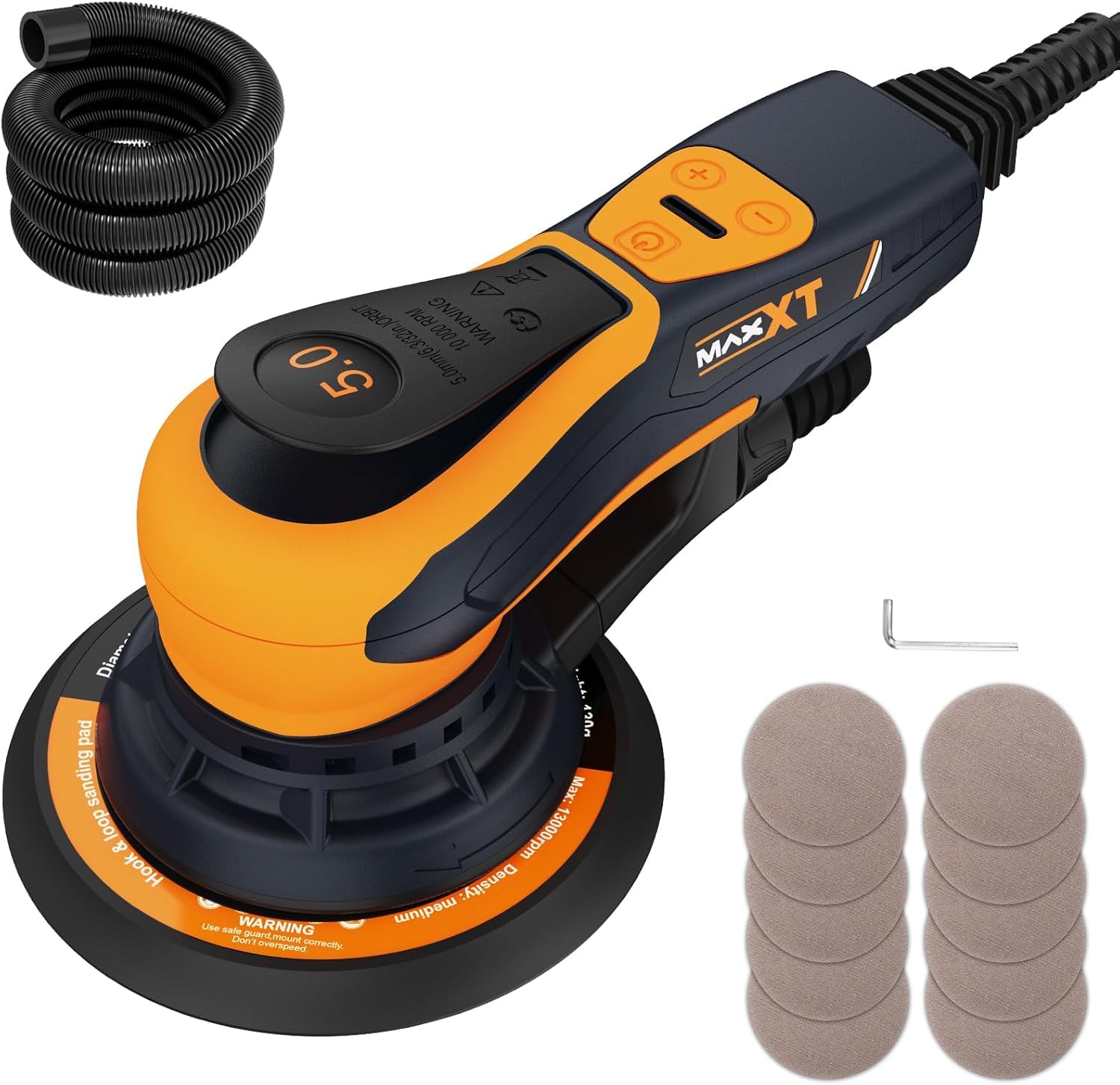
3. MAXXT MOS350CV2 5mm Random Orbit Sander 350W Brushless
The corded electric that does the work of a premium sander while your hands stay fresh all afternoon.
For anyone moving up from a basic palm sander, this is the electric that makes the upgrade obvious. A brushless motor puts out 350W with low vibration and keeps noise to 83 decibels — roughly the level of a normal conversation held a few feet away — so you can sand for hours without your hands buzzing afterward. The 5.0mm eccentricity means the pad swings wide on every rotation, which is exactly the aggressive cut you want for stripping finish, flattening glue lines, and working large panels quickly.
The dust story is where this machine surprises people. Owners rate its dust collection as comparable to far more expensive sanders, and much of that depends on an under-pad fan that pulls debris away efficiently. It connects straight to a vacuum cleaner through a standard 35mm port, or you can run the 1-meter flexible hose that comes in the box. You also get a 6-inch backing plate, ten sheets of abrasive paper, and a long 16.5-foot cable — enough reach to work a big table without hunting for an extension cord.
The controls are genuinely convenient. You switch between two modes and fine-tune across six speed levels with the plus and minus buttons, giving you fine control on delicate surfaces and full power for heavy removal. A quick-stop electronic brake halts the pad in two seconds, so the tool does not spin on when you set it down. Two things to know honestly: the included vacuum hose is thin plastic and some owners find the shop-vac adapter fiddly, and a handful of units have failed — one fell over after roughly an hour of use, another gave out around the one-year mark. That is a small slice of a large, happy owner base, but it is real enough to mention.
The honest read: for most buyers this is a lot of sander for the money, and the six-speed dial plus 2-second brake make it easy to live with. The factory hose is the weak link — plan on a shop-vac adapter if you already own a vac.
Perfect for: woodworkers and DIY refinishers who want brushless power, low vibration, and real dust control without premium-tier spending.
Go another way if: you need a tool you can lean on commercially for years without a hiccup.
4. BUCKTOOL BK150VS 6-Inch Random Orbital Sander
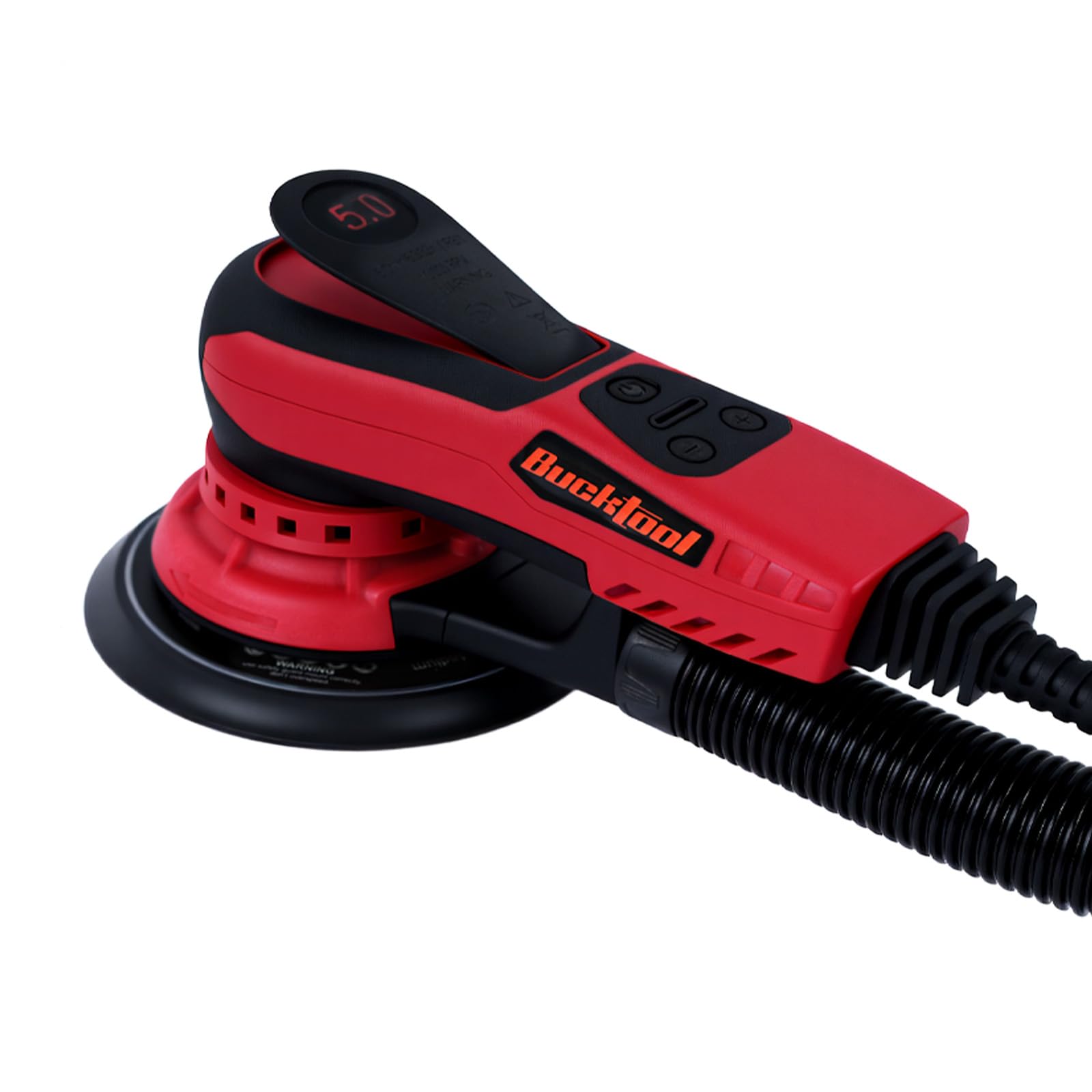
One backing pad that runs both 5-inch and 6-inch discs, so you never buy a second sander to change size.
The clever thing about the BK150VS is the pad itself. The included 6-inch backing pad accepts both 5-inch and 6-inch sanding configurations, so you can run a big disc for flattening wide panels and drop to a smaller paper when you want to work into tighter spots — no second machine required. A 1/2HP 3.0 Amp brushless motor drives a 5mm orbit, and the variable speed runs from 4000 to 10,000 OPM, meaning you get both the aggressive removal for rough stock and the slow, controlled cut for a fine finish.
What makes it pleasant to use over a long session is the one-hand push switch and the light body. You also get four sanding discs in 80, 120, 180, and 220 grit, enough to walk a project from coarse stock removal to finish-ready surface without a separate order. A 35-year woodworker ranked it the best electric variable speed sander he had owned, capturing about 95% of the dust with a shop vacuum. The same owner found the vibrations manageable at low and mid speeds — helpful, because a few buyers do note it vibrates more than they expected at the top end.
Two honest notes. There is no way to disconnect the vacuum hose at the tool without undoing two screws, which owners flag as an annoyance if you swap between dust extraction and free sanding. And one unit stopped turning on after 50 to 100 hours of work — it was replaced through Amazon, and the performance before that point was smooth and consistent. For most home woodworkers this is a well-rounded tool; just go in knowing the hose fitting is a fixed feature rather than a quick-release.
What earns its place
- 35-year woodworker rated it the best electric variable speed sander he has used
- One pad runs both 5-inch and 6-inch discs, so you flex the tool instead of the shelf
- Four included discs from 80 to 220 grit cover a full job start to finish
Small snags to expect
- Vacuum hose removes only after undoing two screws — not a quick pop-off
- Vibration climbs at the highest speed setting, so ease off for long passes
Pick this one if: you want one sander that handles both pad sizes and you are tired of ordering a new machine for every disc size.
Leave it if: you need a tool to survive industrial-level hours.
5. VEVOR R7313 350W Brushless Random Orbital Sander 6-Inch
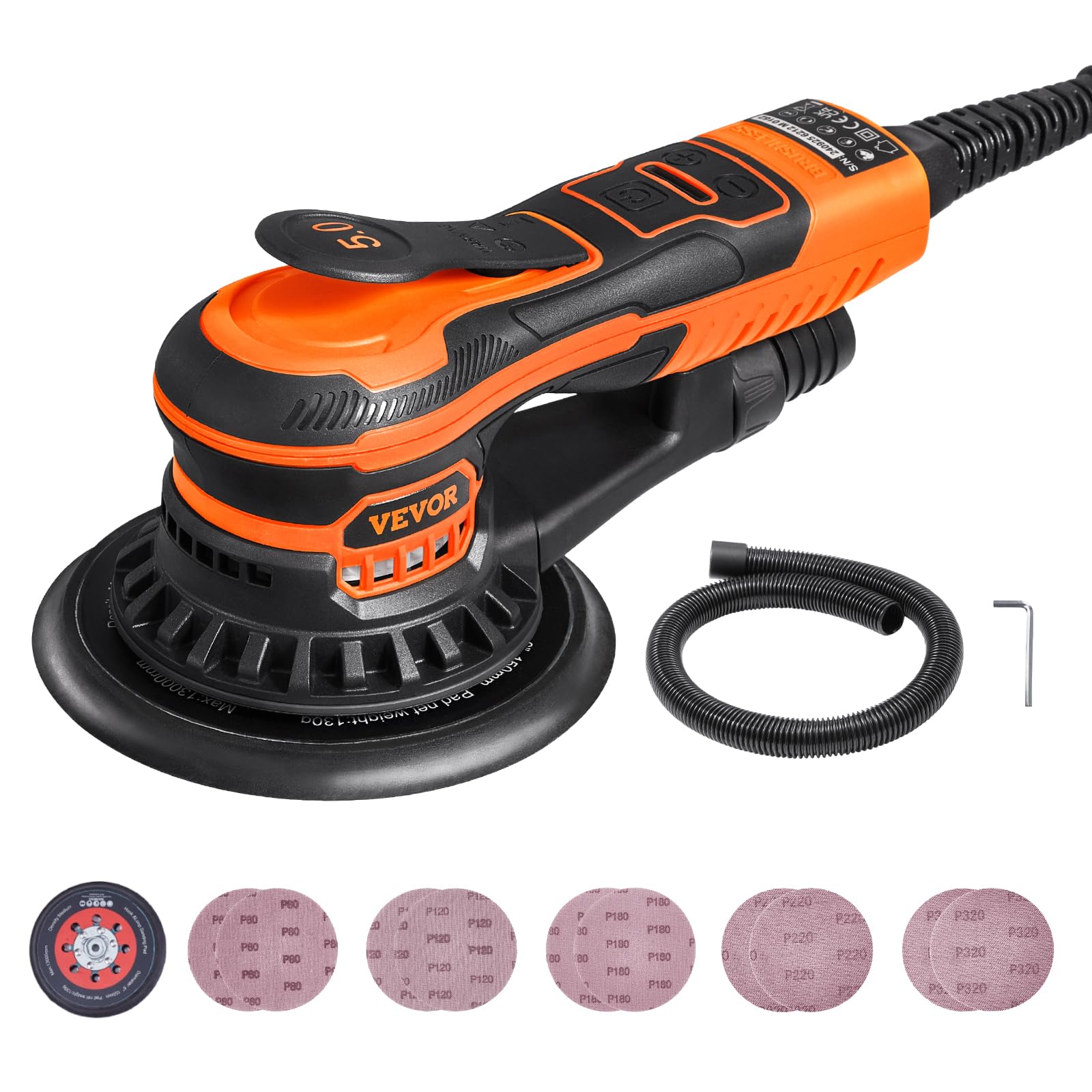
The entry-level electric that gives you brushless power and six speeds without a premium-tier outlay.
This is the sander for the home woodworker who wants to feel a real upgrade from a cheap palm sander but is not ready to spend like a pro shop. The brushless motor puts out 350W, runs quietly and efficiently, and turns the pad at up to 10,000 RPM. Six speeds range from 4000 to 10,000 RPM, so you can go gentle on a delicate surface or open it up for fast material removal. A 5mm orbit adds to the cutting power, the same wide swing the MAXXT above uses to flatten panels quickly.
An instant-stop function is a nice safety touch — release the handle and the rotation halts, which keeps the pad from skidding across your work as you set the tool down. The dust connector and hose let you hook up a vacuum cleaner for collection, and you get ten sheets of paper spanning 80 through 320 grit in a mix of two each. The body is designed to be held with either hand, and owners find it light and comfortable with low vibration that cuts hand fatigue over long stretches. For the money, several buyers call it a big step up from a palm sander in both removal speed and how little it tires your hands.
The trade-offs are honest ones. Dust collection is just okay — one owner found it still coats the work like a common five-inch sander unless you pair it with a screen abrasive and a shop vacuum, and the paper overhang past the pad can tear discs more often. Durability is the bigger question mark: the push handle on one unit broke, and it died on its original owner not long after. It is a comfortable, capable starter tool — treat the handle gently and run it for projects, not production.
The value verdict: a solid way to try a 6-inch brushless sander for the first time, and a genuine upgrade over the vibrating palm sanders most people start with.
Manage your expectations: the handle is the weak point and the dust port benefits from a shop-vac adapter, so it is best suited to occasional projects.
Good match for: a first 6-inch sander on a budget, run for home projects rather than all-day duty.
Not your tool if: you need a daily-use machine that shrugs off heavy wear.
6. Ingersoll Rand 4151 6-Inch Random Orbital Air Sander
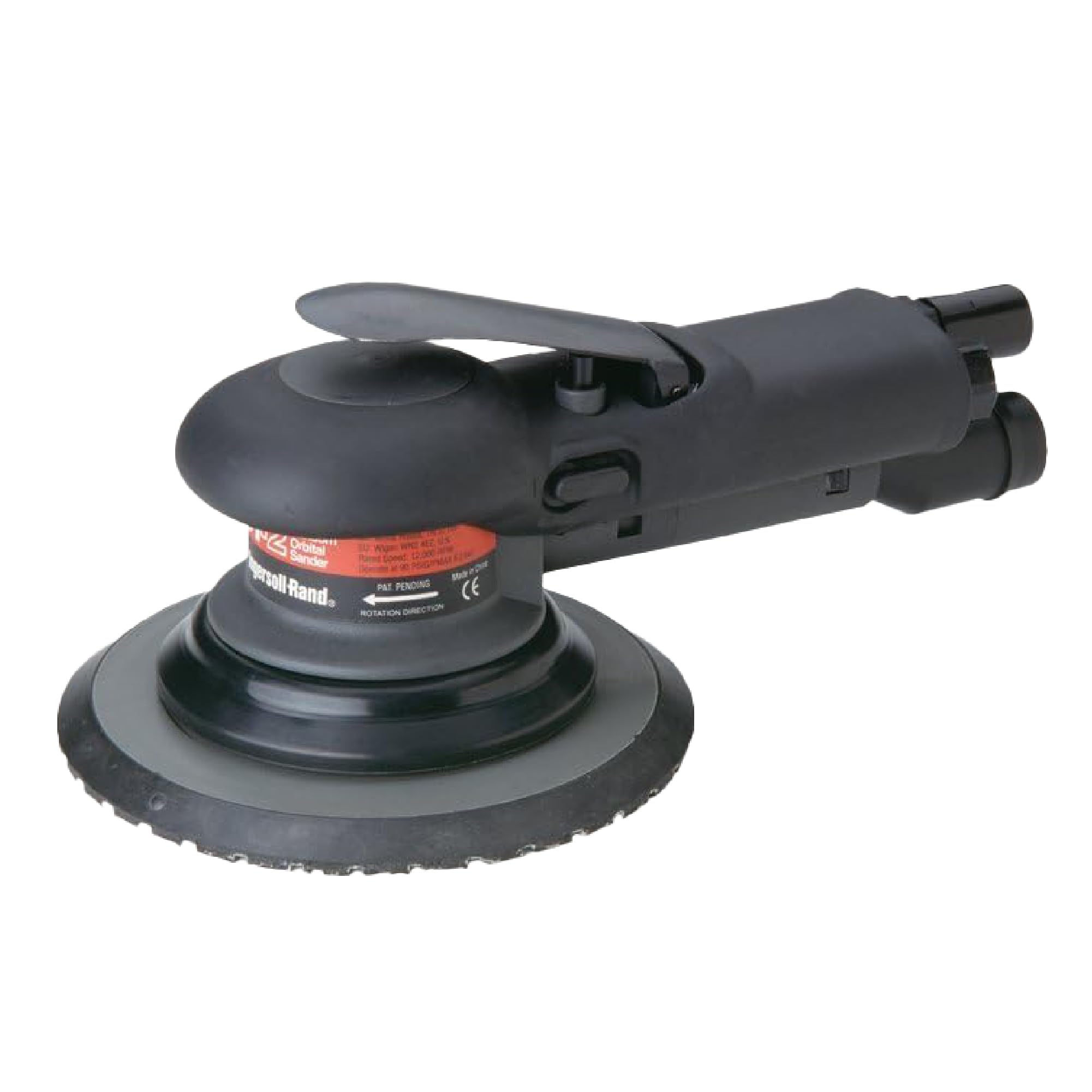
A light, quiet air sander built for swirl-free paint prep and crash-repair deadlines.
The 4151 is the air unit for finishers who care about a clean surface as much as speed. It runs a 12,000 RPM motor with a 3/16-inch orbit — a smaller swing than the 5mm machines here, which is exactly why it leaves a swirl-free finish rather than a fast, aggressive cut. It weighs just 1.9 pounds and sits in your hand like a small block, so reaching into tight spots on a door jamb is far easier than with a bulky corded electric. It runs quiet and smooth, which owners consistently point out.
Pros treat this like a precision tool. Owners rank it right alongside far pricier Snap-on and National Detroit units in how it performs, and its small body lets it get into places a full-size sander simply cannot reach. There is a smart tip worth repeating from the field: if you run it without the vacuum attachment, buy a cheap spare pad, because bare discs can scuff the screws and rivets around the pad. It needs at least 8 CFM and around 12 CFM under load, so your compressor will cycle more with this tool than with a smaller sander — factor that in if noise and air supply are tight.
Where it falls short of the electrics is dust control. Its vacuum system uses an 8-hole pattern with a larger port, and 6-inch PSA paper in that hole layout is harder to source than the common pattern; for woodworking, an electric sander generally pulls dust better. It is also a fairly plastic-feeling body next to the all-metal Chicago Pneumatic. That said, for body-shop work and paint prep it does the job well, and the value is strong for a tool of this caliber. Keep in mind you may want a separate pad if you skip vacuum hookup.
Why finishers like it
- Small, 1.9-pound body reaches tight spaces a corded sander cannot
- 12,000 RPM motor with a small 3/16-inch orbit lays down a swirl-free finish
- Quiet, low-vibration, and holds its own against far more expensive brand names
Where it asks more of you
- Vacuum setup uses an 8-hole pattern with a larger port, and matching PSA paper is harder to find
- Needs a strong compressor — 8 CFM minimum, around 12 CFM under load
- Plastic body feels less substantial than all-metal pneumatic units
Suited to: auto-body techs and finishers who want a light, quiet air sander that leaves a clean surface and can rival premium brands in the hand.
skip it if: your main job is woodworking dust extraction, where a corded electric does better.
7. MAXXT R7308 6-Inch Electric Orbital Sander with 10 Sandpapers
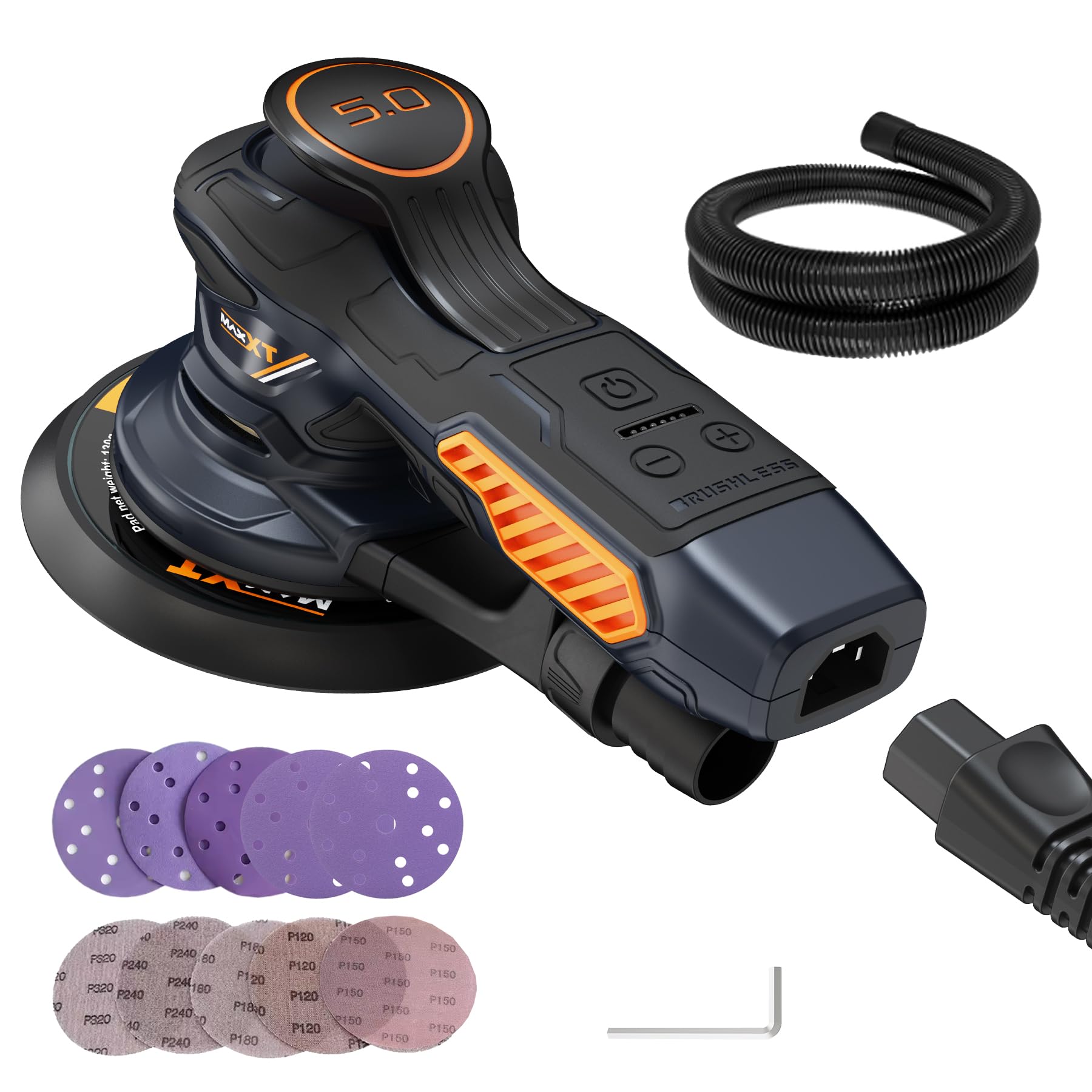
A 350W electric that a five-year Mirka user called every bit as good in the hand.
This one is aimed at the woodworker who wants pro-level results on furniture, bread boards, and refinishing jobs without paying a premium-brand price. A 350W brushless EC motor drives the pad from 4000 to 10,000 RPM across two speed settings, and the electronic motor design is built to run efficiently for long stretches. An instant pad braking system stops the disc during high-speed operation, protecting the workpiece from a stray scuff if you lose your grip.
A five-year Mirka orbital user said this sander “performs just as well as the Mirka and doesn’t feel inferior in any way.” Another buyer needed real muscle to clear 60-grit sanding marks off bread boards after a drum sander, and this machine did it, which is exactly the “fine sander on a budget” job it is built for. Ten sanding discs are included so you can start work the day it arrives, and owners note effective dust management when you tape the included hose to a shop-vac hose.
Two practical details to weigh. The included components list is the body itself, so plan your abrasive and hose setup around that, and the dust hose taps into a vacuum with a little DIY, as one owner described taping it to their shop vac. There is also a detachable power cord, which helps if you store the tool in a tight cabinet or want a longer run. Weighing the strong owner response against a few reports of extra vibration at speed, this is a comfortable, sturdy performer — the kind of tool you can justify over a pro-priced sander if you are willing to set up your own dust connection.
Worth knowing: a long-time Mirka owner rated the finish equal to the brand he used for five years, and the controls run smooth with minimal vibration on most jobs. A few buyers notice more vibration than they would like, so ease the speed down for fine work.
The right call for: DIY woodworkers and small shops who want near-pro performance on furniture and boards without paying for a name.
Look past it if: you want a turnkey dust setup, since the included hose is minimal and asks for a little adapting.
8. Makita BO6030 6-Inch Random Orbit Sander

The finishing sander for cabinet work, with a small orbit that leaves almost no swirl.
If your goal is a surface that is ready for stain the moment you stop, the BO6030 is the machine to reach for. Its 1/8-inch orbit is a small swing, and that is deliberate — it sands more gently than the 5mm units here, which is why it leaves a swirl-free finish. A variable speed dial runs from 4,000 to 10,000 OPM so you can match the sanding speed to the job, slow for delicate veneers and faster for shaping. A 2.7A single-stage motor keeps the center of gravity right over the pad, which gives it better balance in the hand than the bigger two-stage BO6040 model.
The dust system is the standout detail. It pulls debris through the pad itself rather than blowing it out a side port, and paired with a shop vacuum and the right hose, owners mention near-zero dust left on the surface. Put it against a nine-year-old sander it replaced and the difference is obvious — quieter, far less vibration, and a much cleaner work area. It runs through both Festool paper and standard 8-hole paper, so you are not locked into one abrasive line. A 35-year cabinetmaker rated it 99% swirl-free.
Two honest points. It is a heftier tool than a typical five-inch sander, with more metal in the construction — owners describe it as noticeably heavier than a palm sander, though several say they prefer that solidity. And there is a backing-pad cost to plan for: customers note the pads wearing out in around three months of use and costing roughly forty dollars each to replace, so factor in a spare now and then. The rear rubberized handle keeps vibration down, and the sanding pad accepts the standard hook-and-loop discs that are easy to swap.
What sets it up top
- 1/8-inch orbit leaves a swirl-free surface, proven 99% clean on cabinet grading by a career woodworker
- Through-the-pad dust collection leaves near-zero residue with the right vacuum hose
- Runs both Festool paper and standard 8-hole paper, so you are not tied to one abrasive brand
Plan around these
- Backing pads wear out in roughly three months and cost about forty dollars to replace
- Noticeably heavier than a five-inch sander, and the smaller orbit cuts more slowly on big jobs
Right for you if: finishing quality is the priority and you sand a lot of flat cabinet panels, where the swirl-free orbit pays off.
Weigh the extras if: pad replacements every few months would add up for you.
9. Festool 576339 ETS EC150/5 EQ-Plus 6-Inch Random Orbital Sander

The premium finisher that a weary shop reaches for when the work just has to be done right.
This is the top of the tree, and it earns the spot on feel and finish rather than on price. The ETS EC150 weighs 2.5 pounds — lighter than most of the sanders here, including the air units — thanks to a compact body and an EC (electronically commutated) brushless motor that turns up to 12,000 RPM. Stepless speed pre-selection holds a constant speed even when you press harder into the work, so the pad does not slow down under load. A 5mm sanding stroke combines with that speed to remove material quickly when you want it.
The comfort is what owners notice first, and it holds up over long sessions. A Vibration Control System keeps the tool smooth enough that a full day on a big job does not leave your hands numb or buzzing — which matters when you are sanding dozens of square feet. The dust extraction is superb, so the work stays clean, and the pad brake with a carbide tip stops the disc almost the moment you release the switch. Owners also point out a handy detail: unlike some corded sanders, this one does not speed up when the airflow from a vacuum changes, which keeps your cut consistent.
The one honest caveat is the backing pad. Valcro on the pad wears out within months on some units and stops holding discs regardless of the paper brand, so a protection pad is a smart add-on to extend its life. Beyond that, a tungsten-carbide-tipped brake and 3-year warranty back up the build. If you want premium finishes and can live with caring for the pad, this is the one that a custom-woodworks shop said they will keep buying from here on out.
The bottom line: at 2.5 pounds with a 5mm stroke and near-zero vibration, this is the sander you buy once and stop thinking about.
Keep in mind: the sanding pad velcro is the part that wears, so add a protection pad from day one.
For the pro and serious hobbyist: a premium tool that pays back in smoothness, dust control, and finishes that need little cleanup.
Not for the occasional user: if you sand a few boards a year, a mid-range electric delivers most of the result for far less.
Understanding the Specs
Orbit and stroke size
The orbit, or stroke, is how far the pad swings off center with each rotation, and it is the number that decides how the sander behaves. A 5mm orbit cuts fast and flattens panels quickly, which is what you want for stripping and rough stock. A smaller 1/8-inch orbit like the Makita’s leaves a swirl-free surface that is ready for finish sooner. If you only buy one sander, a 5mm machine with a variable speed dial lets you dial back the aggression for fine work.
Power source and air demand
Air sanders are light and compact but demand a compressor that can supply enough CFM — several of these pull around 5 CFM, and some need 8 CFM minimum with 12 CFM under load, so a small tank will have you pausing to rebuild pressure. Corded electric sanders plug into a wall and run as long as you need, which is why they suit home shops and garages. The trade-off is a cord and a slightly heavier body, but no air supply to manage.
FAQ
Will a 6 inch random orbital sander work with standard 6 inch discs?
Do I need a big compressor to run an air random orbital sander?
Is a 5mm orbit better than a 1/8 inch orbit?
Can I use a 6 inch sander for polishing as well as sanding?
What does the dust collection rating actually mean?
How long do the backing pads last before they need replacing?
Is a brushless motor sander better than a standard one?
Can I run a 6 inch random orbital sander on the same circuit as a shop vacuum?
What grit paper do I start with on a 6 inch orbital sander?
Are air sanders quieter and lighter than corded electric ones?
Final Thoughts: The Verdict
For most people, the best 6 inch random orbital sander winner is the Chicago Pneumatic CP870 because it is the only pick that switches between rotary strippingand random orbital blending, turning at 10,000 RPM with a lock-off throttle and insulated grip — the combination that lets you strip a panel fast and blend filler cleanly without a second tool. The catch is real: it needs a large compressor and has no vacuum port, so it only makes sense if your shop already runs on air. If you would rather plug into a wall, grab the MAXXT MOS350CV2 — a 350W brushless electric with a 5.0mm orbit, six speed levels, a 2-second brake, and dust collection owners rate against far pricier machines. And for cabinet-grade finishing where swirl marks matter most, the Makita BO6030 is the one to reach for, with its swirl-free 1/8-inch orbit and through-the-pad dust system. Shop by your power source first, your orbit second, and the right sander falls into place.
How We Picked
We do not accept paid placement. Every pick is matched to a real buyer and a real use-case; we do not hands-on test units.
Sources & Methodology
Specifications: manufacturer listings and product documentation. Review insights: verified customer reviews, as of September 2026. Pricing: not shown on this page (it changes often); check the current price via the retailer link.
As an Amazon Associate, KitchPrep earns from qualifying purchases. This does not affect which products we feature.
Related Guides
