
Specs are compiled from manufacturer listings and verified buyer reviews and can change over time — please confirm the key details on the product page before buying.
You want a doorbell that watches your porch and records everything, but you do not want another monthly bill. That is the entire point of the picks below: every one of them stores footage locally or on a free plan, so nothing stops recording when a card expires. The real split between these eight is power source and connection type, and that choice decides whether setup takes five minutes or an afternoon.
I’m Mohammad Maruf — the founder and writer behind KitchPrep. This guide is built by comparing the manufacturers’ published specifications and the patterns across verified customer reviews, so you get each pick’s real strengths and trade-offs instead of marketing spin.
You will see which models need existing doorbell wiring, which run on a rechargeable battery pack, and where each one falls short. This is a shortlist of the 5g doorbell camera without a subscription for anyone tired of rental fees.
Our Picks at a Glance
How To Choose The Best 5G Doorbell Camera Without a Subscription
Almost every frustrated doorbell owner made the same mistake: they bought on camera specs and only later discovered the feature they wanted most sat behind a paywall. Work backwards instead. Decide first where your recordings will live, then how the doorbell gets power, and only then pick the camera.
Storage has to be decided before anything else
Local storage means the video sits on hardware you own — a microSD card inside the doorbell, a memory card inside an indoor monitor, or a base station plugged into your router. The upside is that recording keeps working whether or not anyone pays a company every month. The trade-off is that you handle the card, and that card has a capacity ceiling written on the box. A 256GB card holds far more than an 8GB built-in chip, but neither one bills you for the privilege.
Wired or battery changes your whole week
A hardwired doorbell reuses your existing doorbell wiring and never needs a charge — but if your house has no wiring at that spot, the install becomes an electrician job. A battery doorbell mounts anywhere with no wires at all, and you trade that freedom for a recharge cycle. Some models let you do both: run on battery first, then add hardwired power later to keep it topped up.
The two Wi-Fi bands do different jobs
The 5GHz band is the faster, shorter-range one. It moves big video files to your phone quickly, which is why clip loading feels snappy on it. The 2.4GHz band reaches further through walls and metal doors but sends data more slowly. Dual-band doorbells try both, and the good ones hold a stable connection on whichever one reaches them. If your porch is a long way from the router, that reach matters more than raw speed.
Quick Comparison
| Model | Best For | Video Resolution | Power Source | Storage Without a Fee | Amazon |
|---|---|---|---|---|---|
| REOLINK Video Doorbell + 256GB microSD Bundle★ Best Overall | Set-and-forget porch coverage | 1080p HD | Wired | 256GB microSD included | Amazon |
| youkey Dual Camera Doorbell DB312Most Versatile | Head-to-toe view on a battery | 2K FHD | 6400mAh battery or wired | 8GB built-in eMMC | Amazon |
| Aqara Doorbell Camera G400Best for Apple Homes | Apple Home and PoE setups | 2K HD | PoE or 8–24V AC/DC | microSD up to 512GB plus NAS backup | Amazon |
| REOLINK Video Doorbell WiFi 2K Wired | Wide view on existing wiring | 2K HD | Wired 12–24VAC or DC 24V | microSD local recording | Amazon |
| WYZE Duo Cam Doorbell | Two-lens package watching | 2K | Removable battery pack or hardwired | microSD up to 512GB | Amazon |
| WUUK 2K Doorbell Camera | Renting or no existing wiring | 2K | 5200mAh battery or 8–24VAC | 32GB in the Homebase | Amazon |
| WISDOM VIEW Wireless Doorbell System | Renters wanting a screen indoors | 1080P | 5000 mAh battery, no wiring | TF card stored in the monitor | Amazon |
In‑Depth Reviews
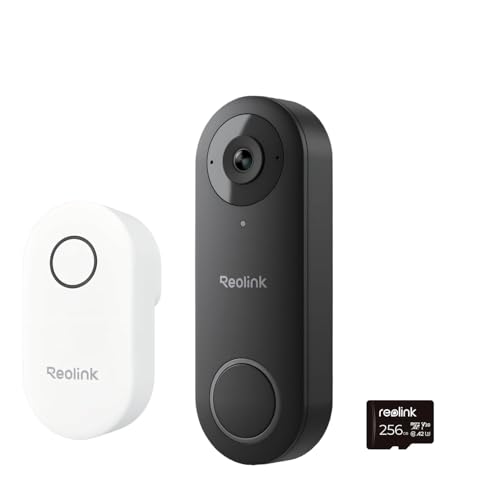
1. REOLINK Video Doorbell Camera with 256GB microSD Card Bundle, Wired Video Doorbell, 5Ghz/2.4Ghz WiFi, 256GB SD Card for Local Storage, Chime Included
Our pick — over 4.5★ from 100+ verified ratings; the strongest balance of quality and price.
The bundle that solves storage before you open the box.
Some doorbells make you buy the card separately and then guess which one works. This one arrives with a 256GB microSD card already in the kit, alongside the doorbell and a plug-in Reolink Chime V2. That card is what makes “no subscription” real rather than theoretical — weeks of footage sit on hardware you own, and nobody can switch off your recording over a lapsed payment. It is a wired unit, so it draws power from your existing doorbell wiring instead of a battery you have to remember.
What wins people over here is the build and the weather resistance. The camera shoots 1080p HD that stays readable in daylight and in the dark, and the housing is built to shrug off rain and heat at the front door. Audio goes both ways, so you can talk to a courier without opening up. The app pushes notifications promptly and loads clips without much fuss, though clip loading is the weakest part of the experience — reviewers who measured it note that clips can load slowly even on a fast connection.
The recurring annoyance is the mechanical chime interface, which simply does not work for many buyers. Reolink worked around that by including the wireless plug-in chime, so you still get an audible ring indoors — just from the plug-in unit rather than your old wall chime. The fish-eye lens is another adjustment: it captures a very wide view, which looks distorted on first glance until you get used to it.
Why it takes the top spot
- The 256GB card is included, so local storage works from day one with no add-on purchase.
- Wired power means no charging cycle and no battery to replace down the line.
- 1080p HD video with night vision that holds up after dark.
- The included Chime V2 handles indoor alerts when the mechanical chime interface does not cooperate.
Where it asks for patience
- The mechanical chime interface fails for a lot of buyers — you lean on the plug-in chime instead.
- Wide fish-eye distortion takes a few days to get used to.
- Clips can load slowly in the app even on fast internet.
Reach for this if: you have working doorbell wiring, you want the storage question answered from the start, and you would rather never think about charging a battery.
Look elsewhere if: your old wall chime has to ring, since the mechanical interface is a common miss here.
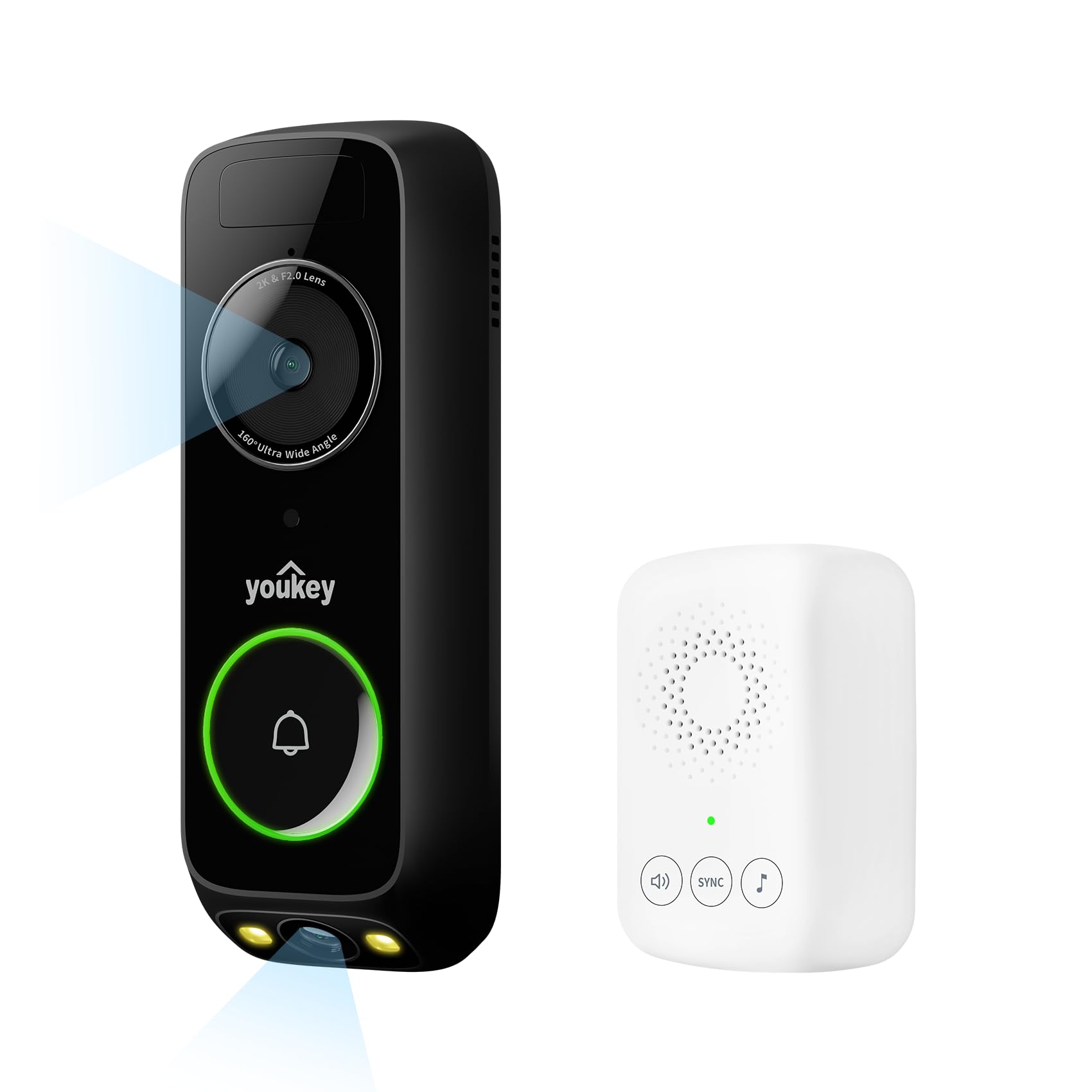
2. youkey Dual Camera Wireless Video Doorbell — Head-to-Toe View, 2K FHD Battery Doorbell with Local Storage No Monthly Fee, Package Detection, 5Ghz WiFi, Works with Alexa & Google Assistant, DB312
Two lenses on one doorbell, so parcels and faces both stay in frame.
Most doorbells ask one camera to cover both a visitor’s face and the box they left at your feet, which usually means one of the two gets cropped. This one splits the job: a top camera covers 158 degrees and a bottom camera covers 120 degrees, so the pair captures visitors head-to-toe and keeps an eye on what is sitting on the step. It records in 2K with WDR, which balances out harsh sun and deep shade in the same frame, and adds color night vision for after dark.
The storage setup is genuinely subscription-free. An 8GB chip soldered inside the unit holds the events — the maker says up to 60 days of footage — with optional cloud and an optional youkey H310 backup. Power comes from a 6400mAh rechargeable battery, and the maker’s lab testing puts that at up to 180 days per charge based on 20 events a day of about 15 seconds each. Real-world numbers run shorter — a battery drain to empty in nine days shows up in the review pages, and owner reports trend well below the lab figure.
The honest catch is motion detection, which is the most-discussed topic in the reviews for good reason. Most buyers do get clear pictures and simple Alexa pairing, and install is quick over Bluetooth, but the detection range is the part that splits opinion. It also runs on 5GHz along with 2.4GHz, so clip loading is quick when the signal cooperates.
The dual-lens payoff: you get two views at once, so you can see both a visitor’s face and the package at their feet. The top lens covers 158° and the bottom lens covers 120°, both on a 2K sensor (2560×1440 pixels, sharper than 1080p). WDR (wide dynamic range, which balances bright and dark areas) keeps details visible in harsh sunlight or shadow, and color night vision means you see color instead of black-and-white after dark.
The detection caveat: owners regularly report the motion sensor waking only at close range, and the false-alert volume is the loudest complaint in the review pages. If your porch is deep or your street is busy, budget time in the app tuning the zones down.
The short version: the hardware value is strong — two cameras, 2K video, 8GB of built-in storage and a 6400mAh battery, with no monthly fee anywhere in the chain.
Know before you buy: the motion detection is the weak link, so expect some app tuning before the alerts calm down.
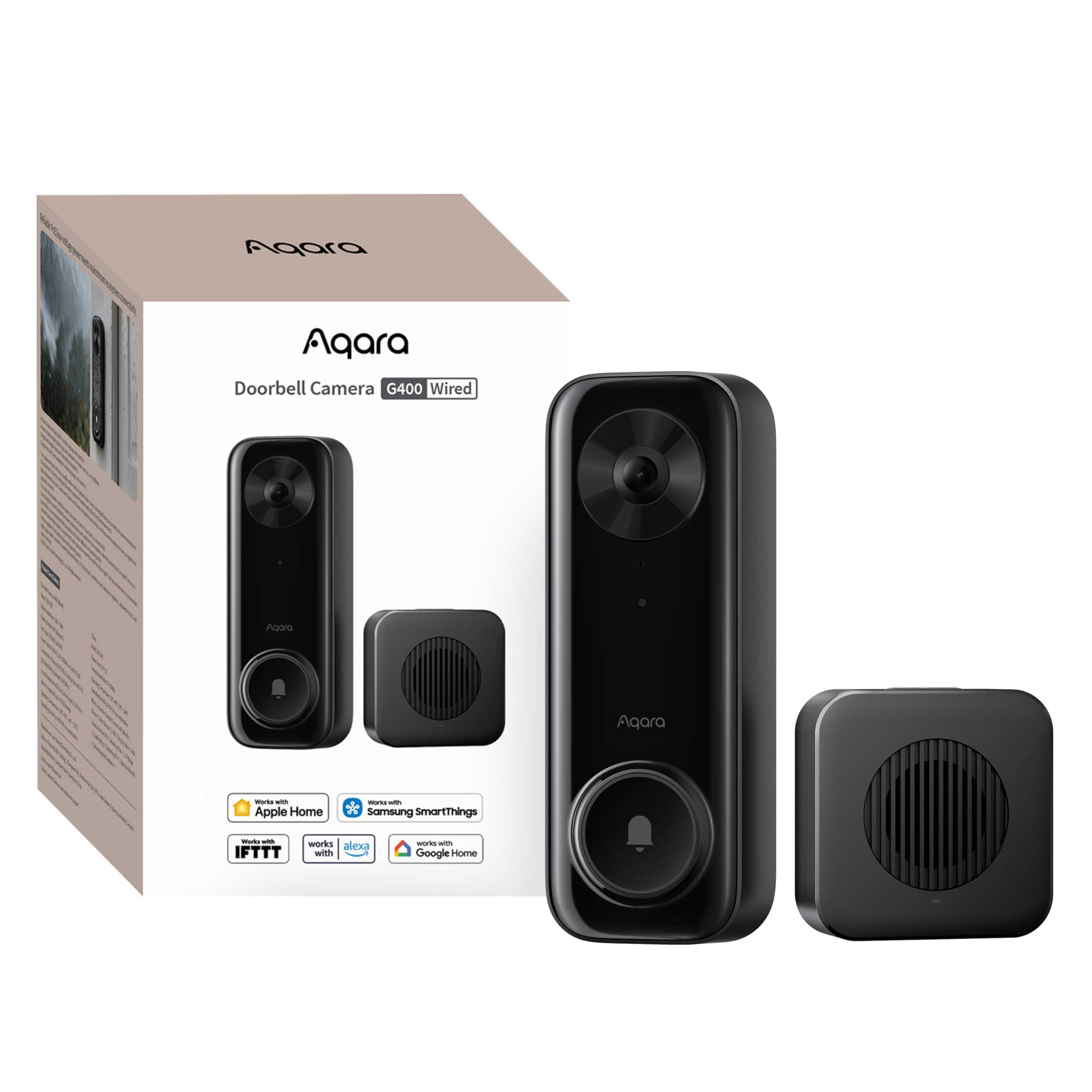
3. Aqara Doorbell Camera G400 with Chime, Wired/PoE, HomeKit Secure Video, IP65
The rare doorbell that speaks Apple Home, Alexa, Google, and PoE.
If your smart home runs on Apple, this doorbell fits right in. It supports HomeKit Secure Video, which records and sends notifications through your Apple devices with encryption. It also works with Alexa, Google Assistant, and SmartThings. For advanced setups, it goes further than most: RTSP and ONVIF (two standard ways for cameras to share video with other software) let you send footage to an NVR (network video recorder) or a Blue Iris setup. A PoE connection (power and data over one Ethernet cable) skips Wi-Fi entirely if you have that wiring. It is IP65 rated, meaning it is sealed against dust and water spray, so it handles wind and rain at your door.
Video is 2K HD at a 165-degree field of view in a 3:4 aspect ratio, which gives you a taller vertical slice of the porch than the wide 16:9 shape most doorbells use. A note on Apple: when connected to HomeKit, the resolution drops to 1200p, and that limitation also applies in the Aqara Home app when both platforms run at once. Night vision uses 940nm infrared LEDs, which are essentially invisible to the eye, so the camera lights up the dark without announcing itself. Onboard AI handles person recognition and zone intrusion locally, so detection stays in your own hardware rather than a server.
Setup is the part that trips people up. A review that goes the furthest into the weeds notes that the doorbell needs a transformer rated at 1 amp or more, or pairing fails outright — a real wiring requirement. An Aqara server outage blocked pairing entirely for another owner. One recurring note is mounting: the included angled mount is not steep enough for every doorway, and the backplate’s Ethernet entry is tight for standard unshielded Cat6. IP65 still means an outdoor-safe build, and PoE runs have been reported as rock solid once installed. Night vision gets mixed notes, with bright areas sometimes washing out.
Where it earns its keep: it works with more systems than most doorbells — HomeKit Secure Video, Alexa, Google Assistant, SmartThings, RTSP, ONVIF, and PoE all in one unit. That means it fits into a serious smart home instead of locking you into one app. The 165° view in a 3:4 shape (taller than wide) shows more of your porch from top to bottom than a typical wide-angle camera.
Pick it for: Apple Home homes, PoE owners, and anyone running RTSP into a NAS or NVR who wants a doorbell that plays by pro-grade rules.
Loop in the requirements first: the 1-amp transformer and stiff angled mount matter more here than almost any other doorbell on this list — get the wiring right or the pairing never finishes.
4. REOLINK Video Doorbell WiFi 2K Wired Camera, 4:3 Wide View Outdoor Camera

A 4:3 frame on a hardwired body, with no subscription in sight.
Think of a traditional widescreen camera view: wide and short, cutting off anything low or high. This doorbell uses a 4:3 shape at 180 degrees instead, which is squarer and shows more of the vertical scene. Packages at the step and faces at the door fall inside the frame together, and a 15-degree wedge kit lets you angle the camera toward whatever it is you actually want to watch. It is a wired unit running on 12–24VAC or DC 24V via your existing doorbell wiring.
Video is 2K with HDR and 3D DNR — noise reduction that cleans up grain in dim conditions — plus distortion correction to tame the wide-lens bend. Audio is two-way, so you can hear and speak through the built-in mic and speaker, and there are preset voice replies for when you are busy. The included Chime V2 plugs into any wall socket and lets you pick from ten ringtones and set the volume, which is a nice way to guarantee the alert always reaches you.
Setup is where this model gets complicated. The strength is clear: Reolink’s local recording, the free Rich Notification plan, and microSD storage keep your subscription at zero forever. The friction is in the connection and the field of view. One installer who ran the unit for months found it dropping off Wi-Fi until the router was rebooted. There is also a note that the wide lens is roughly 90 degrees horizontally despite the 180-degree spec, so the view is tall but not especially deep. An included angled mount is called out as unsuitable for walls without a vertical tilt. Get past those and daily use is solid: sharp 2K day and night video, reliable local recording, and a free 25-image-per-day notification plan.
What lands the win: the 2K sensor, HDR and 3D DNR clean up grain in low light, and the 4:3 180-degree frame shows package and visitor in one shot. Local microSD storage and the free notification plan lock the running cost at nothing.
Where it asks for patience: the wide lens is roughly 90 degrees horizontally, the angled mount is not built for every wall, and one long-term installer hit a Wi-Fi connection drop that needed a router reboot to clear.
Built for: hardwired porches where you want a taller 4:3 view and zero subscription, plus a wireless chime on any wall socket.
One caveat: if your wall needs a steep angle or your router runs 5GHz-only in a weak spot, plan for a little trial and error.
5. WYZE Video Doorbell Wireless Duo Cam Doorbell Camera WWI-Fi Chime, 2K HD
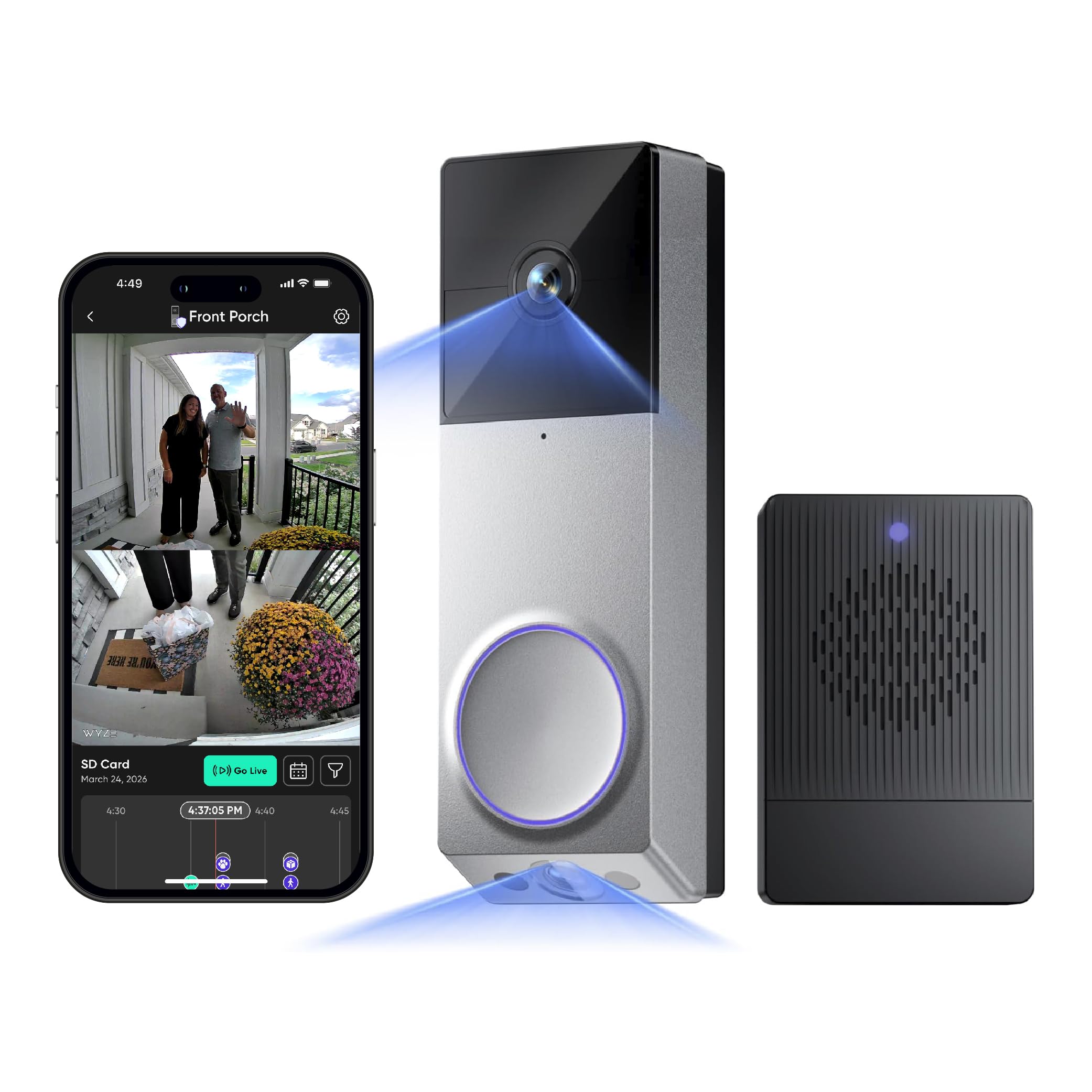
One camera watches your visitors, the other watches your doorstep.
That split is the whole idea: a top camera for faces and a bottom camera aimed down at the doorstep, so a delivery gets its own view rather than sitting in the corner of a wide shot. Video is 2K on both, and the starlight sensor pulls color out of low light so night footage is not just murky gray. The unit is IP65 rated, meaning dust and water spray are covered, and it runs on a removable battery pack the maker rates for up to six months on one charge.
Install is genuinely tool-free — the mount uses adhesive, so no drilling and no wires. The included Wi-Fi chime pushes the ring into any room, so you can hear a visitor even from a far corner of the house. A plug-in power option is available too: give it hardwired power and a microSD card, and 24/7 local recording turns on for continuous coverage rather than event clips. Amazon Alexa, Google Assistant and IFTTT all connect, and two-way audio works through the Wyze app’s talk button.
The reviews split hard on one point, and it is worth being explicit about it. Video quality, setup, and night vision are the areas buyers praise most consistently — sharp 2K, fast install, and a view that shows most of the yard. But attachment to the cloud service is where things turn: without a paid Cam Plus plan, one review found that only a single event image is accessible, with no video playback even on a card. Others put battery life lower than the six-month claim — one review gives a real-world figure closer to monthly charging. In practice, the free path works, but you may find yourself weighing the paid plan once you’ve used the free option for a while.
The dual-lens selling point: two 2K cameras, one aimed at faces and one at the doorstep, plus a starlight sensor for color night vision and IP65 weather sealing — that combination is rare at this tier.
Best for: buyers who want the visitor view and the package view in a single doorbell, with a tool-free adhesive install and a wireless chime indoors.
Facing the trade-off: the free tier and the paid tier matter more here than most — read the fine print on free-plan clip playback before you commit.
6. WUUK 2K Doorbell Camera, Video Doorbell Wireless/Wired

The one with a base station that holds the footage for you.
Instead of jamming storage into the doorbell, WUUK runs it through a Homebase that plugs into your router over Ethernet and carries 32GB of built-in memory — WUUK puts that at up to 365 days of video. That base also acts as a hub for up to 8 WUUK cameras, so a doorbell and some outdoor cameras can live on one system instead of one app per device. The footage is encrypted and kept on local hardware, which keeps it out of a cloud account you don’t own.
You have two power options. Its 5200mAh battery is rated about 3 months between charges, and WUUK states the doorbell works down to -4°F. Or you can tap into your existing 8–24VAC wiring and skip charging altogether. Install is quick — the maker’s own instructions put it at around 5 minutes — and setup settles into a simple Bluetooth-style pairing with the base. The only part that trips people up is the order: base first, then phone, then doorbell. Works with Alexa, Google Home, and IFTTT.
Detection is a highlight: advanced radar and PIR sensors work alongside human recognition to tell near objects from far ones, which cuts false alerts at a busy street. On the daily-use side, buyers report fast streaming even on 4G, clear 2K footage day and night, and one owner confirmed no false positives at all on default settings. The catches are physical: the doorbell is bulky, the wireless link to the base gets shaky beyond roughly 25 feet, and video can start a beat late after a press. A lens fogging issue shows up in one review, but that owner had it replaced free under warranty.
top-tier anchor: the 32GB of storage on the Homebase holds about a year of footage, encrypted and local, so you avoid monthly fees. The base can also carry up to 8 WUUK cameras on one network, letting you expand coverage later.
Fixable drawbacks: the doorbell is bulky, the wireless range to the base tapers off past about 25 feet, and clips can open with a short delay.
Great fit for: houses that want to grow into a multi-camera system later, and rentals or doorways lacking existing wiring that still want local storage from the start.
Worth measuring first: if the base lives further than roughly 25 feet from the door, expect the wireless link to struggle.
7. Wireless Smart Video Doorbell System, 7″ Touchscreen Display, 1080P Video Doorbell Camera with Motion Detection, 2-Way Audio, Local Storage No Subscription, Easy Install Without Wiring

A doorbell that rings the whole house and shows you who’s there on a screen, no subscription consulted.
Everyone who has fiddled with a smart-home app while a stranger waits at the door knows the drill. This kit removes that step: a 7-inch 1080P touchscreen monitor sits indoors, and it handles answering, monitoring, and door open up on its own. When someone presses the bell, the monitor treats it like a phone call — accept or reject the same way you would on a handset. The 1080P camera on the door and the screen indoors both work with a 160-degree wide-angle lens on the camera, and motion detection pings your phone and the monitor within about 5 meters.
Installation is as light as it gets: no wiring, no drilling, and the maker places it at about 5 minutes on the clock. The 5000 mAh battery powers the doorbell, and a 5000 mAh battery also lives in the monitor. The kit handles both Wi-Fi bands (2.4GHz and 5GHz) and the maker rates the effective signal distance at up to 60 meters in open space. Audio goes both ways, day and night switching is automatic, and events land on a TF card held in the monitor — so even if the doorbell is damaged, the recordings are not.
The catches are worth knowing. The monitor runs out of charge after only a few hours when off its dock, which limits how long you can carry it around the house — plan to leave it plugged in. Signal through metal doors drops noticeably, which the maker is honest about in the specs. A 1080P camera has less fine detail than a 2K one, so faces at long distance show less texture. And while the doorbell itself is a battery unit, having a spare pack on hand is worth it, since the doorbell has to come down to charge. What you pay for here is convenience: the screen makes the whole system easier for anyone who is not keen on phone apps.
The system’s headline: a 7-inch touchscreen that rings like a phone call, plus 160° camera angle and 5-meter motion detection — all with no subscription anywhere and events stored on the monitor’s TF card.
Reach for this: renters, anyone who cannot drill, households with less tech-comfortable family members, and anyone who would rather see the visitor on a screen than dig out a phone.
Handle with planning: the monitor needs topping up on its dock after a few hours of use, and metal doors weaken the signal — mount accordingly.
Understanding the Specs
Connectivity: What 5G Means on a Doorbell
Two different things get called “5G” on these products, so it helps to know which one is written on the box. The first is 5GHz Wi-Fi — the faster, shorter-range Wi-Fi band, which many doorbells list alongside 2.4GHz as “dual-band.” It moves big video files quickly, so clips load easily and live view feels snappy. The second is 5G cellular, which uses a mobile network instead of your home Wi-Fi — today, that mode is mostly found on battery doorbells marketed as cellular models, and it usually costs more because it takes its own data plan. For most homes, the practical question is not 5G versus 4G, it is whether the doorbell connects to your Wi-Fi reliably. If your porch is in a good Wi-Fi spot, dual-band 5GHz/2.4GHz does everything you need. If it is out of range and you cannot move the router, cellular is the fallback — but note that a cellular plan is its own monthly cost.
Storage: Where Recordings Live When You Don’t Pay
Local storage simply means the video lives on hardware you own instead of a cloud account you rent. You will see it offered in a few forms: a microSD card slotted into the doorbell, built-in chip memory soldered inside the camera, an SD card inside a base station or indoor monitor, or an NVR/hub hooked to your network. The storage path matters for two reasons. First, capacity: a 256GB card holds far more events than an 8GB built-in chip, and cards are cheap to swap if you want more. Second, reliability: an SD card or NVR has no monthly bill to fail, but it can be forgotten, corrupted, or capacity-limited. Built-in storage takes that risk away entirely, but you cannot upgrade the card later. Whichever you choose, confirm that the free local path includes actual video playback, not just event images — some models do more on the paid plan than the free one.
FAQ
Do these doorbells really work without paying a monthly fee?
Will a wireless doorbell work if my porch has no existing wiring?
Is a 2K doorbell camera noticeably better than a 1080p one?
How long does the battery really last on a wireless video doorbell?
Does the MEANING of 5G change for doorbell cameras?
Will these doorbell cameras work with Alexa, Google Home, or Apple HomeKit?
Do I need a microSD card for my doorbell to work without a subscription?
Can I replace my old doorbell with one of these and keep my wiring?
Why does my doorbell camera miss people close to the door?
How much of my porch will these cameras actually show?
Final Thoughts: The Verdict
If you have working doorbell wiring and you want the storage question solved before the box even opens, the REOLINK Video Doorbell with 256GB microSD Bundle is the pick — a 1080p wired camera with the 256GB card and plug-in chime already in the kit, so no subscription and no charging cycle. If your porch has no wiring and you want a wire-free install with head-to-toe coverage, the REOLINK Battery Video Doorbell (2nd Gen) brings a 1:1 square frame and up to 10 months of battery life. And for renters or anyone who would rather answer the door on a screen than a phone, the WISDOM VIEW Wireless Doorbell System rings the house and keeps every recording on the monitor’s TF card. One honest nudge before you click: set a thirty-minute window to check your Wi-Fi reach at the door and whether wiring already lives there — those two answers will cut this list down to the one doorbell that actually fits your house.
How We Picked
We do not accept paid placement. Every pick is matched to a real buyer and a real use-case; we do not hands-on test units.
Sources & Methodology
Specifications: manufacturer listings and product documentation. Review insights: verified customer reviews, as of September 2026. Pricing: not shown on this page (it changes often); check the current price via the retailer link.
As an Amazon Associate, KitchPrep earns from qualifying purchases. This does not affect which products we feature.
Related Guides
