
Specs are compiled from manufacturer listings and verified buyer reviews and can change over time — please confirm the key details on the product page before buying.
When the power goes out, you want a generator that starts instantly and uses fuel efficiently, not one that drains your tank. A 5000W inverter generator (a portable unit that produces clean, stable power for sensitive electronics) fits the middle ground: it can run your fridge, a few lights, and a window AC, yet it’s still small enough to toss in the truck for camping.
I’m Mohammad Maruf — the founder and writer behind KitchPrep. This guide is built by comparing the manufacturers’ published specifications and the patterns across verified customer reviews, so you get each pick’s real strengths and trade-offs instead of marketing spin.
Inverter generators differ from older models by producing clean, stable power that’s safe for laptops and phones, all at a quieter hum. choosing the best 5000w inverter generator means weighing runtime, noise, fuel flexibility, and how easily you can move it.
Our Picks at a Glance

How To Choose The Best 5000W Inverter Generator
Match the machine to your real job. A weekend camper needs a different unit than someone powering a home through a hurricane. Your first question isn’t “which is best” — it’s “what will I plug into it, and for how long?”
Starting Watts vs. Running Watts
Every motor-driven appliance needs a surge of power to start, then less to keep running. A fridge might pull 800 watts steadily, but needs double that for the first second. Look at the peak or starting watt number to cover those surges — a 5000W inverter typically handles 3900 to 5100 running watts, which covers the essentials.
Fuel Choice: Gasoline, Propane, or Both
Gasoline gives you maximum power output and is everywhere in an emergency, but it goes stale in storage. Propane never goes bad and burns cleaner, which is why dual-fuel models are so popular. You’re trading a small drop in wattage for a fuel that sits on a shelf for years. Some premium units add natural gas, giving you a third option that can run indefinitely on a home line.
Noise and Runtime Reality
An inverter’s claim to fame is a quiet hum — most here sit between 52 and 62 dBA, which is roughly the level of a normal conversation. That quiet comes with an eco mode that slows the engine to match your load. A bigger gas tank stretched over an efficient engine is what gets you the 18-plus hour runtimes that matter for overnight outages.
Quick Comparison
| Model | Best For | Running Watts | Noise (dBA) | Fuel Type | Amazon |
|---|---|---|---|---|---|
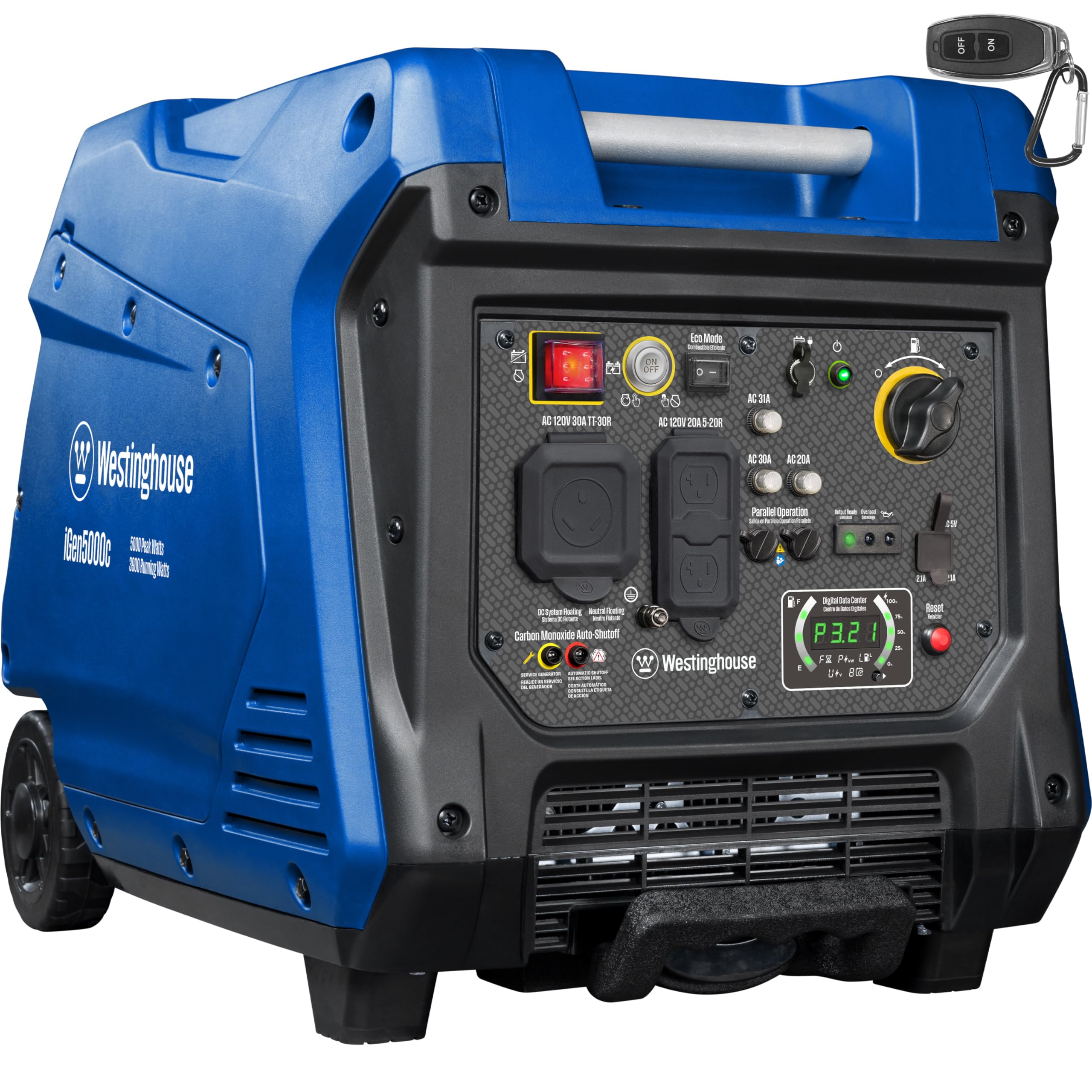
| Westinghouse iGen5000c★ Best Overall | Remote start & home backup | 3900W | 52 dBA | Gasoline | Amazon |
| WEN DF680iXBest Value | Dual fuel value | 5100W (gas) | Surprisingly quiet | Gas & Propane | Amazon |
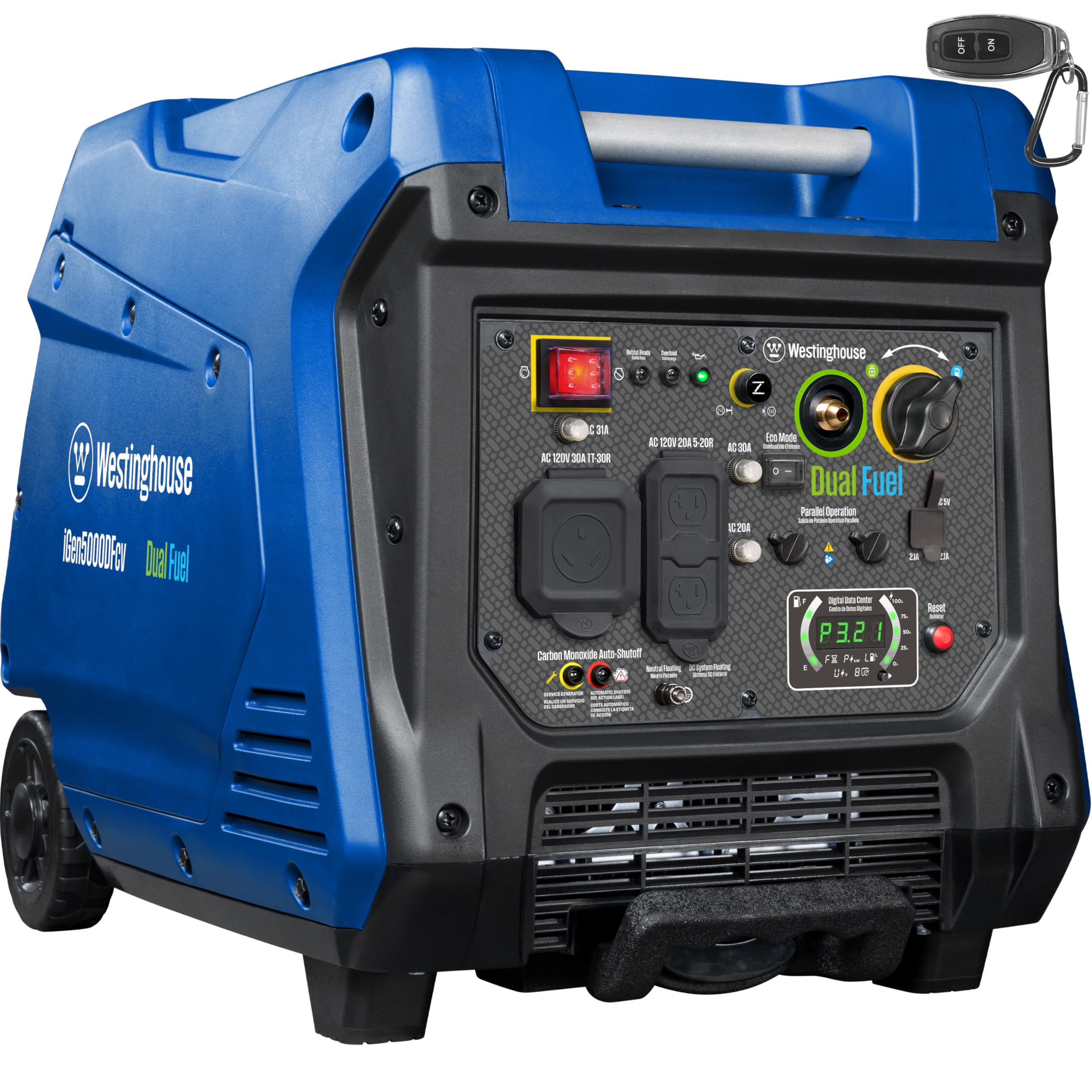
| Westinghouse iGen5000DFcvCompact Pick | RV camping & dual fuel | 3900W | 52 dBA | Gas & Propane | Amazon |
| GENMAX GM5500i | Ultra quiet jobsite power | 5000W | 60 dBA | Gasoline | Amazon |
| Generac iQ5200 DF | Tech features & dual fuel | 3900W (gas) | Quiet operation | Gas & Propane | Amazon |
| A-iPower SUA7600iED | High-output dual fuel | 6100W (gas) | 62 dBA | Gas & Propane | Amazon |
| maXpeedingrods MXR6000GT | App-driven remote control | 5000W | 63-65 dB | Gasoline | Amazon |
| DuroMax XP11000iH | Whole-home heavy lifting | 9000W | Quiet for size | Gas & Propane | Amazon |
| Gidrox GNV | Tri-fuel whole-home backup | — | 62-65 dB | Gas, LPG & NG | Amazon |
| Pulsar PGD105TiSCO | Tri-fuel high capacity | 8500W (gas) | 62 dB | Gas, LPG & NG | Amazon |
In-Depth Reviews
1. Westinghouse iGen5000c
Our pick — over 4.5★ from 300+ verified ratings; the strongest balance of quality and price.
Start it from the couch with the key fob, and the hum stays low enough to sleep through.
The defining trick here is the remote electric start with auto choke, bundled with a key fob, so you can fire up 3900 rated watts from inside the house during a storm without walking out in the rain. The same unit gives you 5000 peak watts at less than 3% THD, which is clean enough for laptops and phones without worry. It earns the top spot because owners consistently describe the experience as easy — the digital display rotates through fuel level, output, remaining runtime, and lifetime hours.
The crowd favorite among nearly three hundred owners holds a 4.6-star average, with Owners consistently highlight the remote start as the standout feature they didn’t realize they needed.. It also carries an RV-ready TT-30R 30-amp outlet plus two USB ports, and the 3.4-gallon tank stretches to an 18-hour runtime at its quiet 52 dBA floor. Buyers report it runs quieter than a comparable Champion and regulates load better, with one noting “333hrs zero issues; quiet, fuel-efficient, well-built, easy oil changes.”
At 105.8 pounds, it’s 31% heavier than the dual-fuel Westinghouse below, so the telescoping handle is essential. Owners also note the eco mode ramps up slowly when a big load like an AC or microwave kicks on, and the plastic case can scratch. The CO sensor and automatic low-oil shutdown give you layers of protection, and the 3-year limited service warranty backs the purchase.
What wins people over
- Remote fob start with auto choke is genuinely easy
- 18-hour runtime on a 3.4-gallon tank
- Quiet 52 dBA operation protects your ears
- Parallel capable for doubling output later
What to weigh
- 105.8 lb unit is heavy without its handle
- Eco mode responds slowly to sudden big loads
- Gas-only — no propane option here
Your best bet if: you want the convenience of starting from inside the house and value quiet, fuel-sipping operation for home backup.
Think twice if: you need propane flexibility or plan to lift it into a truck bed often — the 105.8-pound weight is real.
2. WEN DF680iX
The dual-fuel workhorse that runs a 15,000 BTU AC on propane and stays quiet doing it.
What makes this the value standout is its 224cc dual-fuel engine that runs on gasoline (6800 surge watts, 5100 rated watts) or propane (6000 surge, 4500 rated), giving you the flexibility to switch fuels depending on what’s available. It goes a step further than most with a bonded-neutral 240V configuration providing low-power Level 2 charging for battery and hybrid electric vehicles — a feature you rarely see near this price tier. Starting is electric with a pull-cord backup, and a tool-free LPG quick connector plus a six-foot regulator hose mean propane hookup takes seconds.
Performance is the most-discussed strength here, and for good reason — owners describe a 40-pound tank lasting 28-30 hours in Texas heat while running an AC unit. The WEN Watchdog CO Shutdown Sensor automatically kills the engine if carbon monoxide builds up, and the fuel shutoff runs the carburetor dry before stopping, which cuts down on gummed-up fuel lines. It arrived with onboard wheels, a telescoping pull handle, an L14-30R 120V/240V receptacle, a TT-30R RV receptacle, and two 5V USB ports.
You can run both A/Cs, a stove fan, and lights on a 30A (30-amp) circuit using propane from 25 feet away, but check the fit first: this unit won’t slide under some RV storage compartments, so a truck bed might be its home. One owner who ran it daily for a year on propane calls it reliable and quiet, noting it runs a washer but not a dryer. Some owners mention reliability issues, though not everyone, so staying on top of oil and air filter changes is more critical here than on other models.
Flexibility first: gasoline and propane plus 240V EV charging in one rolling package, backed by a 3-year warranty.
Fit note: a minority report reliability trouble under heavy daily use — treat it as a seasonal tool, not a commercial machine.
3. Westinghouse iGen5000DFcv
The dual-fuel sibling of our top pick sheds 25 pounds while keeping the 52 dBA whisper.
If you own an RV and want Westinghouse’s proven 5000 peak watts (the maximum power it can briefly deliver) but worry about weight, this is your pick: at 80.5 pounds, it’s much easier to move than the 105.8-pound gas-only model above, using the same telescoping handle and wheel kit. It runs on gas or propane with a simple recoil start (pull-cord), giving you the same 3900 rated watts (continuous power) and 18-hour runtime on a 3.4-gallon tank, with the same quiet 52 dBA (decibel) floor. Its 25.4-inch length and 20.1-inch height mean it fits tighter in storage bays, so measure before you buy.
Owners praise the easy pull start that fires on the second pull and the dual-fuel option for emergencies when one fuel runs dry. One camper reports running 3.5 days on a single 100-pound propane tank, calling it quiet enough that “you will sleep like a bay” (sic). The RV-ready TT-30R 30-amp outlet plus two USB ports cover the essentials, and the CO sensor with automatic shutdown adds a safety layer.
The catch is the lack of electric start — you’re relying on the recoil pull, which owners say starts reliably but won’t help anyone with limited grip strength. The front control faceplate arrived with a small 1/8-inch gap on some units, a cosmetic quibble that owners didn’t bother returning over. For travel trailer use, one owner powered a 50A RV through an adapter with the AC and lights drawing only 25% load, so there’s real headroom.
RV balance: this is the lightest dual-fuel Westinghouse in this list, and the propane quick-connect (a hose that snaps on without tools) makes hookup easy.
Who skips it: anyone who expects push-button starting — this one is pull-cord only, though it starts on the second pull.
4. GENMAX GM5500i

A 60-decibel hum with 5500 peak watts powers band events and whole-home essentials alike.
The GENMAX leads with a 120/240V volt selector switch, letting you run 5000 rated watts on a single 120V circuit or split it across 240V appliances — rare flexibility at this weight class. Its runtime sound of 60 decibels sits on the quiet side for the output, and the eco mode automatically adjusts engine speed to conserve fuel and cut noise further. Starting is dual — manual or electric — with an integrated Off/Run/Choke knob that simplifies the startup routine to one motion.
The 3.9-gallon fuel tank with a gauge delivers up to 10 hours of runtime, and the suitcase design with a telescoping handle makes it mobile for campgrounds and construction sites. Customers note it starts immediately and is very quiet for its size, with one band operator finding it ideal for event power. The CO Detect shutdown sensor handles the carbon monoxide safety concern automatically.
Who should think twice: at 127.8 pounds, owners call it heavy to lift even with the wheeled mobility. The reviews carry some strong outlier experiences, including a trailer electrical incident, so inspecting your RV wiring and maintaining proper clearance matters. The 3-year warranty with free lifetime technical support is a point in its favor, though one owner noted the initial support contact was difficult before it improved.
What stands out
- 120V/240V selector switch broadens appliance options
- 60 dBA runtime keeps events and campsites friendly
- 10-hour runtime on a 3.9-gallon tank
- Dual electric and recoil start
Consider carefully
- 127.8 lb — one of the heaviest units here
- Outlier reports of electrical strain on trailers
- No dual-fuel option — gasoline only
Reach for it when: you need 240V output or event-quiet operation with wheels to roll it to the jobsite.
Pass if: you want propane capability or need to regularly heft it into a vehicle — this one is heavy.
5. Generac iQ5200 DF
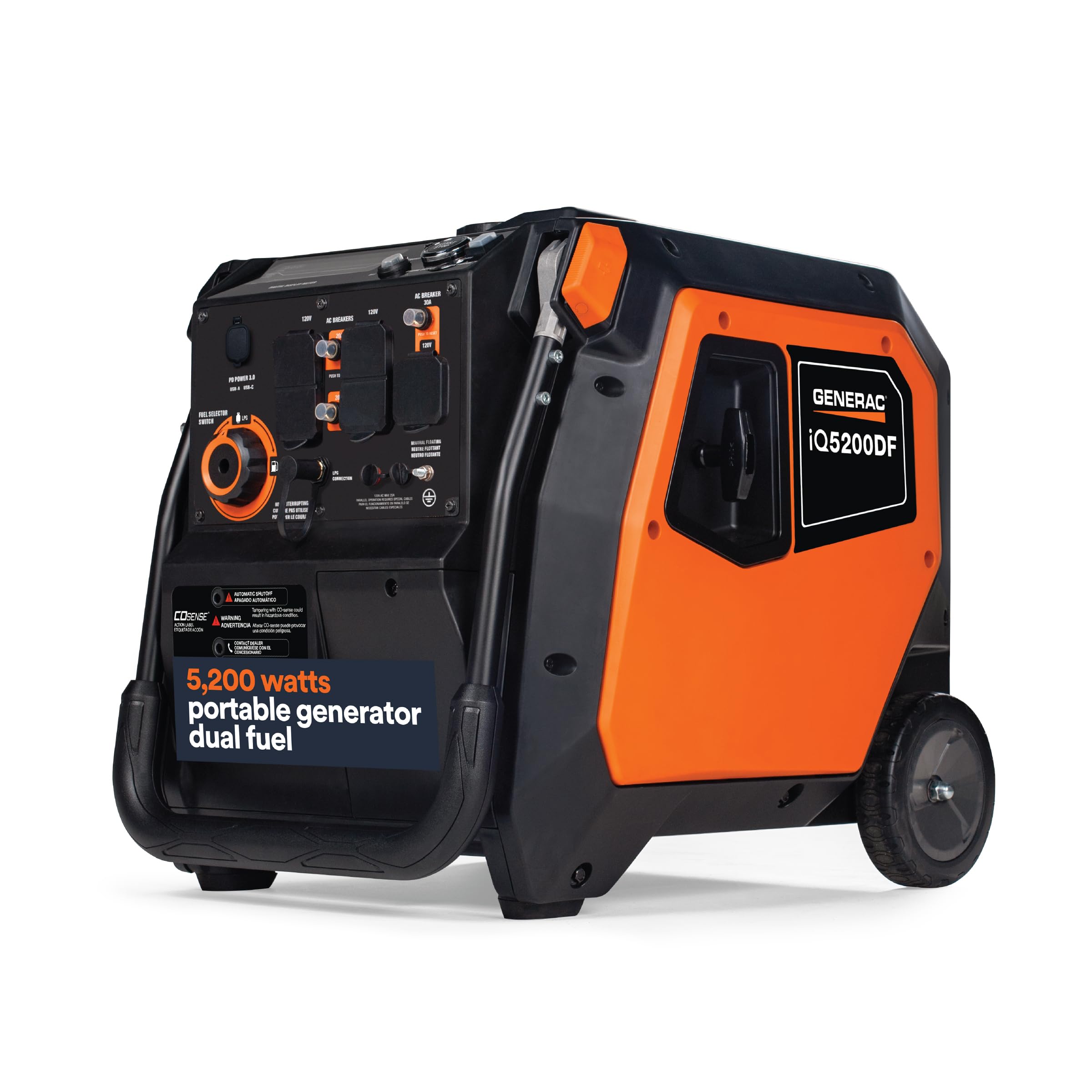
Generac’s clean-sheet inverter runs 15 hours on gas at quarter load and starts from a button.
What sets the Generac apart is its intelligent LED display showing real-time power output and fuel level, paired with both USB-A and USB-C ports — the modern touch many rivals lack. The dual-fuel setup gives you 3,900 running watts on gas or 3,500 on propane with a simpler switch, and the economy mode stretches a gas tank to 15 hours at 25% load. The push-button electric start with an included 12V battery eliminates pull-cord struggle entirely.
Owners repeatedly praise its quiet operation, with one 57-year-old noting they can lift it solo despite the 107-pound weight. The COsense technology automatically shuts the unit down if dangerous CO levels build up nearby, and the included spark arrestor supports use in parks. It carries a 120V 30A L5-30R outlet for RV draws plus two 120V 20A GFCI outlets, so a 40-foot camper runs without issue, according to owners.
Parallel capability lets you connect two iQ5200 DF units with an optional kit to reach up to 7,800 running watts, which is the scalability path if you might grow your needs. The 3-year residential warranty and first oil change at 20 hours, then every 100 hours or annually, keep maintenance predictable. A couple of owners hit a fuel-leak issue early on, which is the kind of variance you watch for in the first few runs — the included tool kit and funnel make that break-in inspection straightforward.
Clean-sheet design: that USB-C port and real-time display show Generac built this for the modern era of power needs.
Watch early on: a small number of owners reported fuel leaks on arrival — inspect fittings before the first start.
6. A-iPower SUA7600iED

Auto-switching Fuel Sense tech runs 21.2 combined hours by hopping from propane to gas.
The headline feature here is Fuel Sense Technology, which automatically switches from propane to gasoline when the propane runs dry, for a combined runtime of up to 21.2 hours at 25% load. The 322cc OHV engine delivers a substantial 7,600 starting watts and 6,100 running watts on gas, or 6,900 starting and 5,500 running on propane — output that reaches well beyond the 5000W class. Sound sits as low as 62 dB, and the telescoping handle with flat-free wheels keeps the 130-pound unit mobile.
Reviewers point out it starts on the first pull and runs up to 14 continuous hours on a single tank, powering a mini fridge to an AC unit. The low-idle technology adjusts engine speed to the load, and the clean power output under 3% THD protects laptops, TVs, and sensitive power tools from dirty electricity. The 3.6-gallon tank helps that extended runtime, and the inverter idle-down cuts fuel and noise when demand drops.
The trade-offs are about brute size — at 130 pounds it’s among the heaviest mid-range units, and some owners found it louder than expected even in eco mode versus a Honda when standing close. That noise fades to barely audible from inside a trailer, making it acceptable for remote camping. One owner reported a stuck float causing a fuel leak early on, which a simple carburetor drain and tap fixed, and the EPA & CARB compliance makes it legal in all 50 states.
Why it’s a powerhouse
- Fuel Sense auto-switch hits 21.2 combined hours
- 7,600 surge watts handles big simultaneous loads
- 62 dB noise floor with eco mode
- EPA & CARB compliant nationwide
What to expect
- 130 lb requires the handle and good wheels
- Louder than premium rivals at close range
- A few units need a carburetor fix on arrival
Choose this for: the auto fuel-switching convenience and surge capacity that runs a whole home’s worth of appliances.
Skip it for: tight campsites where neighbors are close — it’s quiet from inside a rig but audible up close.
7. maXpeedingrods MXR6000GT
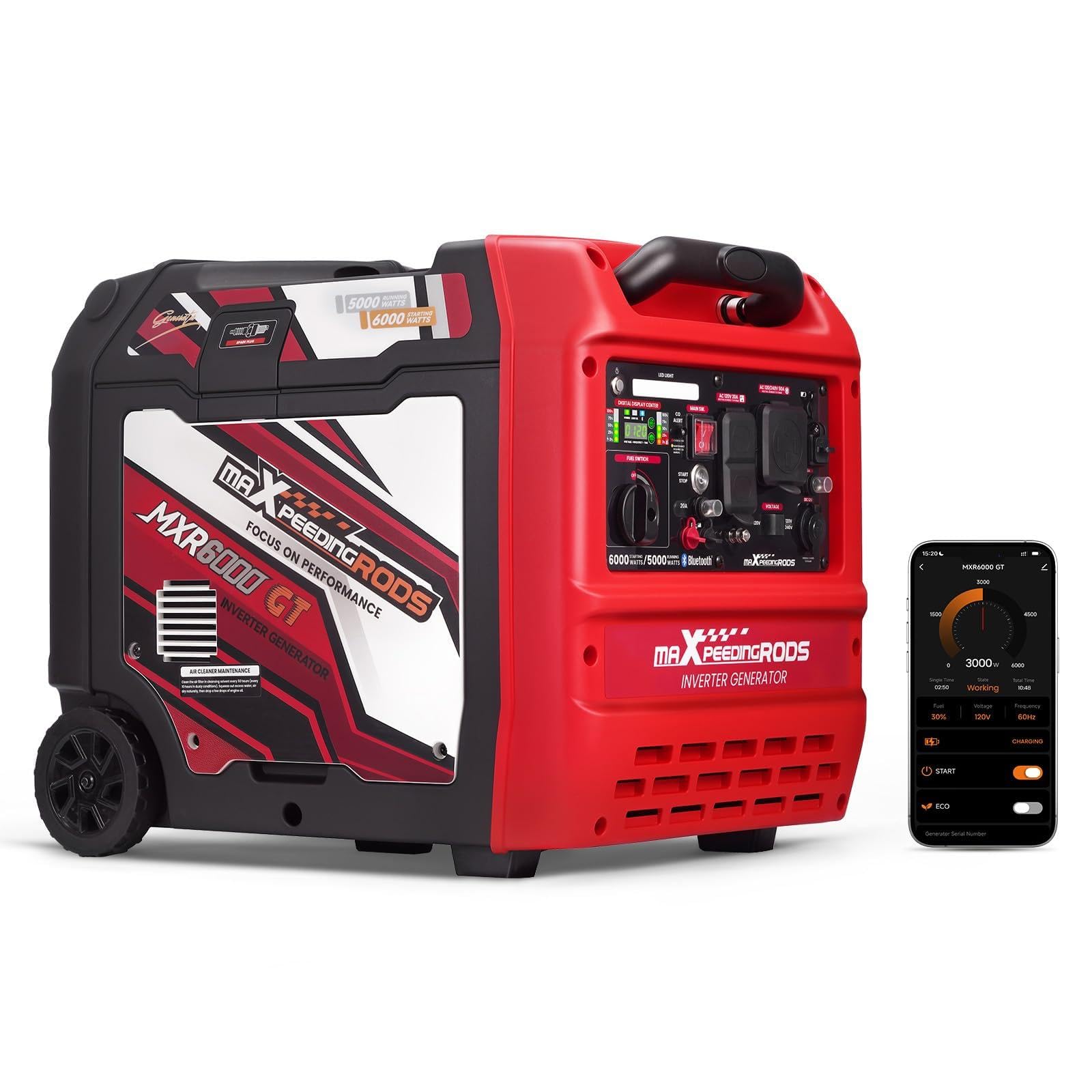
Start and monitor this 5000-watt runner from your phone, then roll it on never-flat wheels.
If you like controlling gear from your phone, this generator is for you: the Bluetooth app lets you start and stop it remotely and watch voltage, frequency, fuel level, load power, and runtime in real time, all powered by a 224cc OHV (overhead valve) engine. It delivers 6000W starting watts (the surge to start motors) and 5000W running watts on gasoline, with dual voltage output that switches between 120V and 240V so you can power standard household devices or larger appliances. The built-in LED light on the control panel is a handy touch when the power goes out at night.
The portability story is strong — wheels and a telescopic handle make it easy to move, and at roughly 53 pounds it’s one of the lightest full-powered units here. Shoppers say it runs a 3,500W RV AC perfectly and handles a grinder or hairdryer without strain. The electric start has a backup path: when the built-in lithium battery is low, plugging external power into the charging port delivers instant one-click startup and recharges the battery.
The recurring thread in owner feedback is that the app can be buggy, and the electric choke tied to battery power means a fully dead battery can prevent starting even with the pull cord until you jump-start it. Noise runs 63-65 dB at 20 feet, louder than the claimed 53-55, so adjust expectations. Customer service earns consistent praise, including a replacement battery shipped from China with a wiring diagram when one failed.
App-first appeal: remote start, live load readings, and 240V switching make this the most connected unit in the lineup.
Reliability watch: the electronic choke dependency on battery health is the Achilles heel — keep that lithium pack topped up.
8. DuroMax XP11000iH
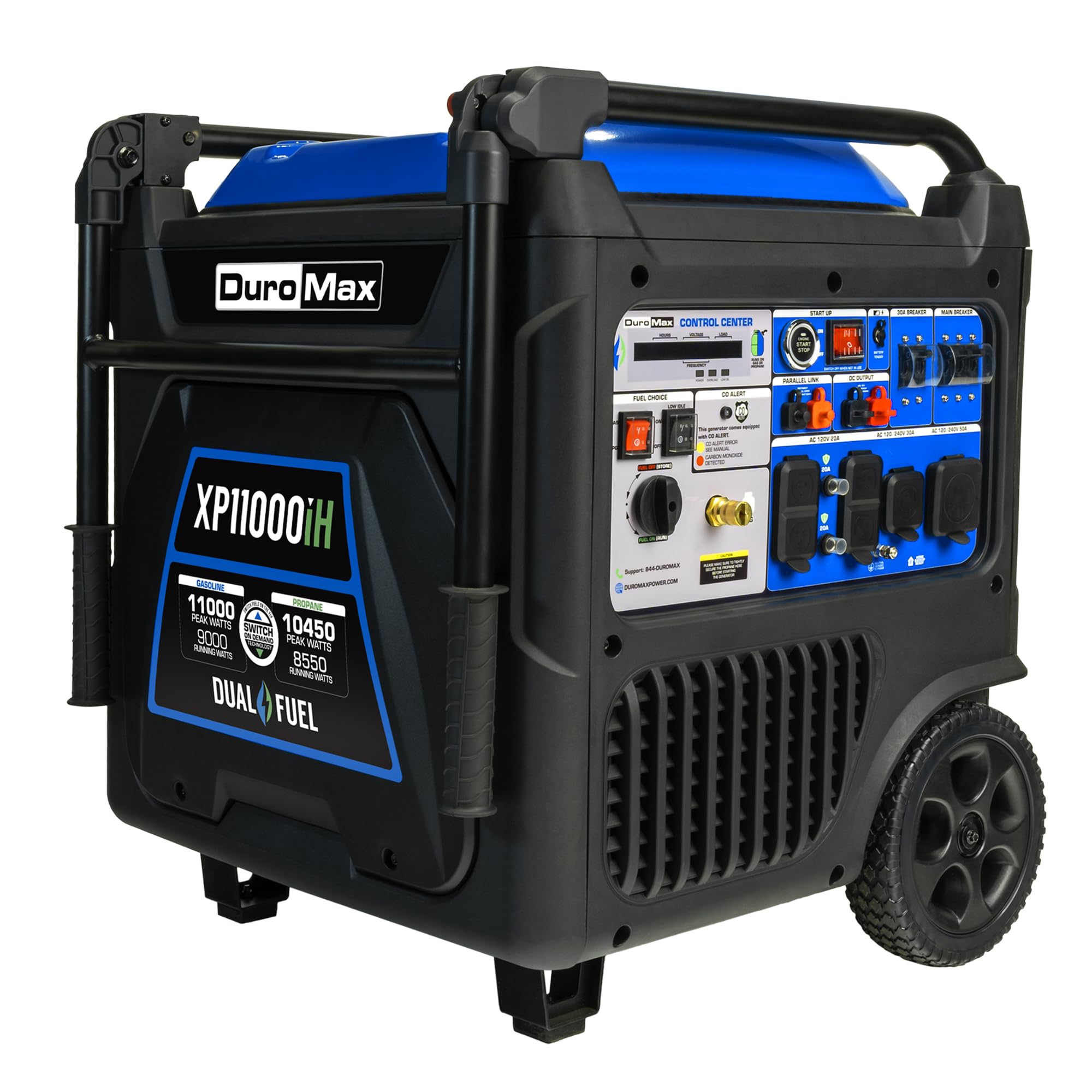
Half the noise of a 13kW open-frame, with an 11,000-watt wallop that idles down to save fuel.
This is the serious home-backup machine, delivering 11,000 peak watts and 9,000 running watts from a 459cc engine on gasoline or propane. Its automatic transfer switch outlet connects directly to a compatible ATS, turning it into whole-house power when the grid fails. The inverter idle-down feature is the fuel-efficiency secret — owners describe it as half as loud as their old 13kW generator, with the engine slowing automatically to match the load.
Remote start comes standard with the included remote control, and the battery tender keeps the starter battery charged and ready between outages. Parallel capability lets you pair two units to double output to 22,000 peak watts and 18,000 running watts, giving a clear growth path. Buyers report it powers a 50-amp travel trailer with two AC units plus TVs without issue, and the over-7-gallon tank lasts all night with the AC running.
At 216 pounds, this is not a roll-into-the-truck generator — it needs a hand cart and a sturdy loading plan, with owners flagging delivery left at the door as a theft risk. The 50-hertz frequency spec is worth confirming for your region, and the oil dipstick access drew a gripe from one owner. Part availability drew one sharp criticism, with a starting cup backordered over two months, so plan for routine maintenance parts ahead of storm season.
Whole-home muscle
- 9,000 running watts powers ACs and well pumps
- ATS port makes transfer switch hookup simple
- Remote start with battery tender
- Parallel capable to 22,000 watts
Logistics first
- 216 lb — a hand cart is mandatory
- Parts availability lagged in one case
- Check the 50 Hz spec against your needs
Pick this when: an outage must not interrupt a household with central AC, a well pump, and multiple circuits.
Not for: occasional campers — this heft and capacity serve a stationary home role.
9. Gidrox GNV

Gasoline, propane, and natural gas in one machine — with an 8.7-gallon tank for 21-hour hauls.
True tri-fuel freedom defines this unit — gasoline, propane, and natural gas are all on tap with an innovative dial-start system that lets you switch fuels in seconds without tools. The oversized 8.7-gallon tank supports up to 21 hours of backup runtime, making it a genuine multi-day outage companion. A bundled NG and LPG hose kit valued at arrives in the box, so you’re connected for emergency power without a second hardware store run.
At 11,000W peak with pure sine wave output under 3% THD, owners describe utility-grade power that runs 5-ton central AC units alongside high-end MacBooks. The fully enclosed design and eco mode keep operation a whisper-quiet 62-65 dB — quieter than a normal conversation, by the maker’s spec. A dedicated ATS port plus a 50A 14-50R outlet for luxury RVs and a 30A L14-30R 240V outlet for whole-house backup round out the power hub, with all outlets behind waterproof rubber covers with GFCI protection.
Push-button electric start, plus remote and manual backup, gets you running in seconds, and it’s backed by a 3-year limited warranty. Owners appreciate details like oil drain tubing and a carburetor bowl drain (a valve that lets you empty the fuel bowl for storage) that make maintenance genuinely easier. One owner reports real-world output softens above 5,500 watts with high fuel consumption at full draw, so plan your continuous load around the 5000W sustained rating, not the 6000W peak. Since this model is new, long-term reliability is still unproven, so weigh that before buying.
Fuel flexibility king: dial between three fuels and run 21 hours on the big tank — the definition of prepared.
Know the limit: sustained output is happiest under 5,500 watts; treat the 11,000 figure as surge headroom.
10. Pulsar PGD105TiSCO

A 458cc tri-fuel giant that ran a 3,000-square-foot home through Hurricane Beryl on natural gas.
The Pulsar is the highest-capacity tri-fuel option here, running gasoline (10,500 peak watts, 8,500 running), propane (9,500 peak, 8,000 running), or natural gas (8,400 peak, 6,800 running) from a 458cc OHV engine. The 6.9-gallon tank supports up to 9 hours of continuous operation at half load, and the remote start with included fob makes firing it up from inside the house straightforward. Its outlet spread is the most complete in this list — four GFCI 120V outlets, a 120V/240V L14-30R, and a 120V/240V L14-50R for 50-amp luxury RVs.
Real-world proof comes from a Hurricane Beryl owner who powered an entire 3,000-square-foot home with two air conditioners totaling 5 tons (with soft starts) through natural gas. The same owner praised the no-assembly setup, easy oil drain tube, and smooth remote start, calling it quiet for its class. The digital control center displays hours, voltage, load, and frequency, and the 62 dB sound rating keeps it conversation-level.
The honest read: this machine divides owners. The peak experience is outstanding whole-home capability, but a frustrating minority hit unit failures after break-in, often traced to a defective fuel selector valve. At 247 pounds, it’s the heaviest unit here by a wide margin, so plan for permanent or seasonal placement rather than frequent moves. EPA and CARB compliance means it’s street-legal in all 50 states, and the included 10W-30 motor oil, hoses, and wrenches get you started immediately.
Hurricane-grade output
- 8,500 running watts on gas runs whole homes
- 50A L14-50R outlet for big RVs
- Tri-fuel with natural gas for unlimited outage runs
- Remote start fob included
Size and variance
- 247 lb — the heaviest machine on the list
- Mixed reliability reports, often fuel-selector related
- Natural gas output drops to 6,800 running watts
Built for: the homeowner who wants natural gas whole-house backup with enough surge to start two central ACs.
Not the one if: you need to move it regularly or you want an established long-term track record — this model’s reliability story is still being written.
Understanding the Specs
What “Inverter” Actually Means
An inverter generator converts the engine’s raw power into clean, stable electricity using electronics rather than feeding it straight to your appliances. That process produces under 3% THD — meaning less distortion in the power wave — which is safe for laptops, phones, TVs, and medical devices. Open-frame generators without inverter tech can send power spikes that damage sensitive electronics over time.
THD: The Electronics Safety Number
Total Harmonic Distortion (THD) measures how much the power wave deviates from a perfect sine wave. Under 3% THD is the threshold you see on every unit in this list, and it’s the number that tells you whether your phone charger and laptop are safe to plug in. Generators without inverter technology often exceed 5-6% THD, which is fine for power tools but risky for electronics.
FAQ
Will a 5000W inverter generator run a whole house?
What is the difference between starting watts and running watts?
How long will a 5000W inverter generator run on a tank of gas?
Is a dual fuel or tri-fuel generator worth the extra cost?
Can I run a generator inside my garage or house?
What is a CO sensor or CO watchdog shutdown?
How quiet is 52 dBA really?
Do I need a generator that is parallel capable?
Why is this 5000W inverter generator so heavy?
Can a 5000W inverter generator charge an electric vehicle?
Final Thoughts: The Verdict
For most buyers, the best 5000w inverter generator is the Westinghouse iGen5000c because it bundles remote start, an 18-hour runtime, and a quiet 52 dBA hum into a package with proven owner satisfaction. If you want propane flexibility for storage stability, grab the WEN DF680iX — its dual-fuel engine and EV-friendly 240V output give you the most capability for the money. And for whole-home backup where central AC is non-negotiable, the DuroMax XP11000iH delivers 9,000 running watts with remote start and transfer-switch readiness.
How We Picked
We do not accept paid placement. Every pick is matched to a real buyer and a real use-case; we do not hands-on test units.
Sources & Methodology
Specifications: manufacturer listings and product documentation. Review insights: verified customer reviews, as of September 2026. Pricing: not shown on this page (it changes often); check the current price via the retailer link.
As an Amazon Associate, KitchPrep earns from qualifying purchases. This does not affect which products we feature.
Related Guides
