
Specs are compiled from manufacturer listings and verified buyer reviews and can change over time — please confirm the key details on the product page before buying.
Almost nobody gets the full 400 watts printed on the box — and that is the single most important thing to know before you buy. A 400W solar panel is rated in a laboratory under perfect light, so real-world output depends on your angle to the sun, the heat of the day, shade, cable length, and how much your power station will even accept. This guide covers eleven genuinely portable 400-watt-class panels, explains what each one is actually good at, and tells you plainly which buyers should pick which.
I’m Mohammad Maruf — the founder and writer behind KitchPrep. This guide is built by comparing the manufacturers’ published specifications and the patterns across verified customer reviews, so you get each pick’s real strengths and trade-offs instead of marketing spin.
A note on the matching: this list accepts panels in the same 380-to-420-watt class rather than one exact figure, because the nearest same-type panel serves the same job. Here is what that means for shopping the 400w solar panel category without getting fooled by lab numbers.
Our Picks at a Glance


How To Choose The Best 400W Solar Panel
The right 400W panel is not the one with the biggest number on the label. It is the one whose open-circuit voltage your power station accepts, whose folded weight you can carry, and whose angle you can actually aim at the sun. Work through these four checks in order and the choice narrows to one or two panels.
Match the open-circuit voltage to your power station first
Open-circuit voltage is the voltage a panel pushes out with nothing connected to it — the number that decides whether your power station can take the panel at all. If the panel’s open-circuit voltage runs higher than your station’s maximum input voltage, the station simply refuses it. Check the limit on your battery box before you check anything else on the panel.
Understand why you will rarely see the full rated watts
A panel’s rating comes from a standard test in ideal conditions. In the real world you lose output to heat, haze, a flat angle, and long thin cables. Buyers of these panels routinely report a portion of the rated figure rather than all of it, and that is normal behavior, not a fault. Panels with N-type cells and higher efficiency ratings tend to hold their output better when the day gets hot.
Decide how much weight you are willing to carry
Folded size and carry weight separate these panels far more than wattage does. A 22-pound blanket you will actually haul to the campsite beats a heavier folding unit that stays in the garage. If one person sets up and takes down the panel, the lower-weight and lower-fold models win on real use.
Check the connectors and the cable you get in the box
MC4 is the standard solar connector, and most of these panels include an adapter bundle that covers XT60, Anderson, and the common DC barrel sizes. A longer built-in cable saves you buying an extension. If your power station needs a specific plug, confirm the included adapter list before ordering.
Quick Comparison
| Model | Best For | Rated Power | Carry Weight | Waterproof Rating | Amazon |
|---|---|---|---|---|---|
| EF ECOFLOW 400W Portable Solar Panel★ Best Overall | Power-station owners who want a big matching panel | 400W | 35.3 lb | IP68 (main body) | Amazon |
| DOKIO 400W 31V MonocrystallineBest Value | Yard, shed, and greenhouse builds that stay put | 400W | 49.4 lb | Weather-resistant glass and frame | Amazon |
| FarmLite 400W Portable Solar PanelTop Performer | Cold-weather and off-grid backup use | 400W | 20 lb | Not listed | Amazon |
| LVYUAN 400W Portable Solar Panel | Campers who pack tight and want adapter variety | 400W | 22 lb | IP64 | Amazon |
| MHPOWOS 400W Foldable Solar Panel (HY-SP-003) | Buyers who want many connector types in the box | 400W | Not listed | IP67 | Amazon |
| Greenmagic Portable 400W Solar Panel | RV owners who set up and fold down daily | 400W | 21.5 lb | IP65 (junction box excluded) | Amazon |
| TWELSEAVAN 400W Foldable Solar Panel | Campsites far from the power station | 400W | 22 lb | IP65 | Amazon |
| MHPOWOS 400W Bifacial Portable Solar Panel | Ground setups on a reflective surface | 400W | 19.7 lb | IP68 | Amazon |
| Renogy 400W Portable Solar Panel | Suitcase-style hauling and quick 60-second setup | 400W | 30.2 lb | IP67 | Amazon |
| RENOGY REGO 400W Portable Solar Panel | Packing a big panel into the smallest space | 400W | 16.09 lb | IP65 | Amazon |
| Anker SOLIX PS400 Portable Solar Panel | Owners who want four tilt angles built in | 400W | 35.1 lb | IP67 | Amazon |
In‑Depth Reviews
1. EF ECOFLOW 400W Portable Solar Panel, Foldable & Durable
Our pick — over 4★ from 300+ verified ratings; the strongest balance of quality and price.
The big-brand foldable that turns a garage wall into a solar array.
For anyone already running an EcoFlow power station, this is the panel that speaks the same language. It is a 400-watt monocrystalline folding panel with an MC4 connector, a rated efficiency of 23%, and a waterproof rating of IP68 on the main body — meaning dust and water cannot get into the panel itself. The junction box and connection points are the exception and should not be submerged.
Portability is the reason it earns the top spot. At 35.3 pounds it folds into its own adjustable kickstand case and travels with you. Owners lean it against a garage wall and simply run the cable inside; as one happy buyer put it, that trick makes for a much simpler setup, and the same owner reports pulling 365 watts into a Delta Pro. That is the pattern across the reviews — real output lands in the 350-to-360-watt range into a matching station rather than the full 400.
The honest limit is the 35.3-pound carry weight. This is the heaviest pick that still folds, and the folding frame that makes it sturdy is also what makes it a two-hand lift. If you want a panel you hoist onto a camper roof alone every evening, the weight will be the recurring gripe — treat it as a stay-put panel that folds, not a backpacking panel.
Why this one leads the list
- 400W monocrystalline build with a 23% rated efficiency and MPPT-friendly output
- IP68 on the main body, so rain and dust are not a concern for the panel itself
- Strong output into matching stations — owners commonly see mid-350-watt figures in good sun
- Folds into its own adjustable kickstand case for storage and travel
What you accept going in
- 35.3 pounds makes it a two-hand lift for most people
- Full 400 watts is a lab figure — expect a portion of it in real daylight
- The included cable is short enough that some owners buy a longer one for yard placement
Reach for this if: you want a single large folding panel that pairs cleanly with a matching power station and stays mostly in one spot.
Look elsewhere if: you need a panel light enough to carry up a ladder or out to a remote campsite on your own.
2. DOKIO 400W 31V Monocrystalline Solar Panel for 12V/24V Systems
One rigid panel that replaces four and wires up in minutes.
If your solar lives on a shed, a greenhouse, or a fixed rack in the yard, this is the shape you want. It is a 400-watt monocrystalline panel with tempered glass and an aluminum frame, and it puts out 31 volts of direct current through 9.84-foot MC4 leads — long enough that many buyers skip buying an extension cable at all. Fewer joints means fewer points to go wrong.
This is also where the weight conversation gets real. The DOKIO tips the scale at 49.4 pounds, and next to the LVYUAN folding blanket at 22 pounds it is more than double the carry. It is designed to be mounted, not lugged, and a single person can still handle it because the pre-drilled holes line up with common Z-brackets and tilt mounts. Buyers report one panel peaking past 330 watts on a cold January day in New York, and two wired in series pushing 838 watts into a power station.
What makes it the value pick is how much hardware you stop buying. One 400-watt unit means no branch connectors, no four-panel wiring harness, and no hunting down a fourth mounting bracket. The framing is built for rain and splashes rather than submersion, so plan a raised mount rather than a puddle. Expect a portion of the rated watts in real light, as with every panel here.
Why it earns the value slot: tempered glass, an aluminum frame, and 9.84-foot factory leads turn a four-panel build into a one-panel one.
The trade you make: at 49.4 pounds it is a mount-and-leave panel — buy it planning to leave it in place.
This is your panel if: the installation is permanent, on a roof, rack, or shed where one big glass panel beats four small ones.
Think again if: you need to move it between campsites, because it is the heaviest pick in this group.
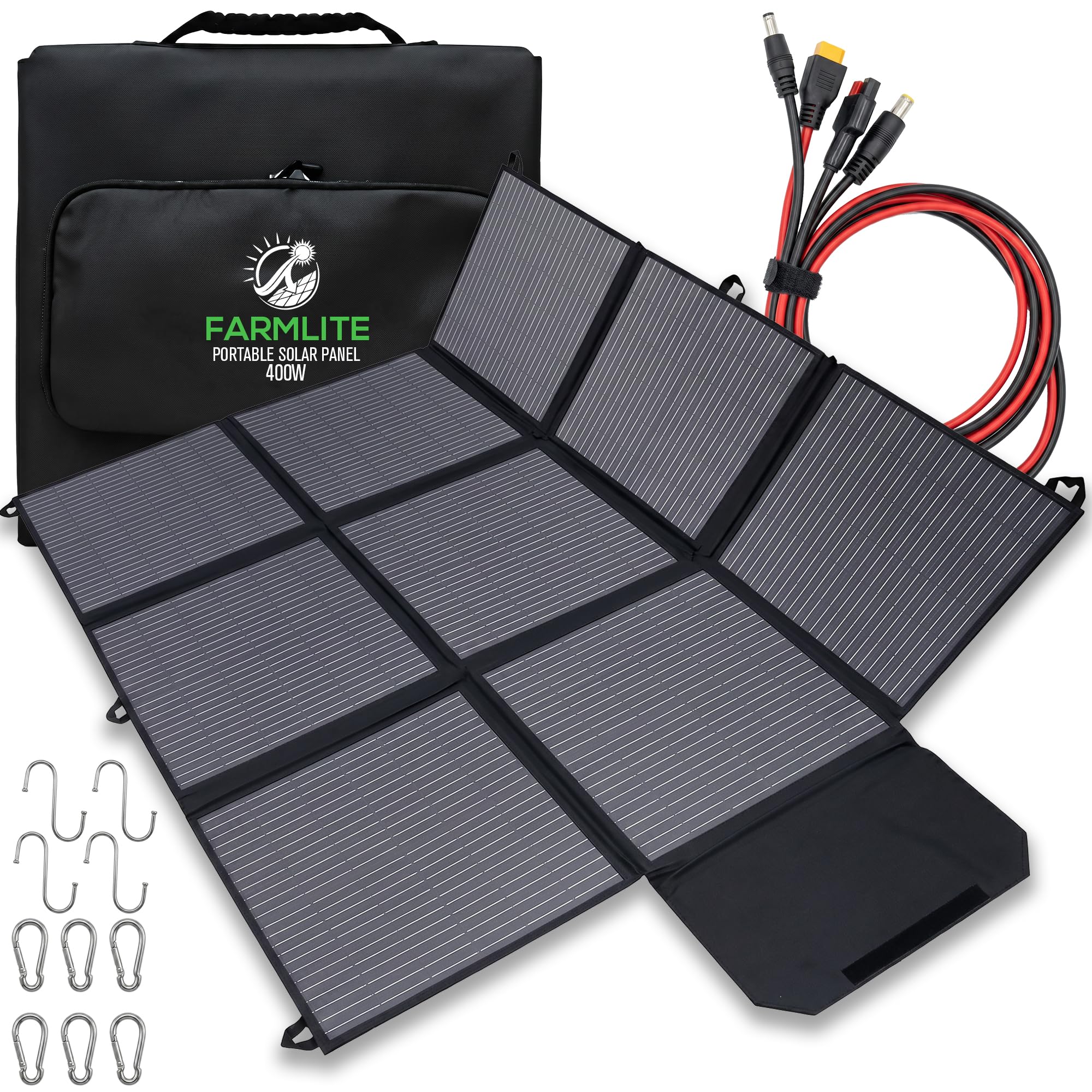
3. FarmLite 400W Portable Solar Panel with 25% Efficiency
The cold-weather blanket that keeps working when the thermometer dives.
Temperature is what separates this panel from the pack. FarmLite rates its operating range from -20°F to 140°F — a working span well past what most folding panels publish. On a deer lease in January or a cabin in the mountains, that spread is the difference between a panel that produces and one that sits idle. It is a 400-watt N-type blanket at 20 pounds, and it comes with its mounting hardware in the box.
Weight is where it wins against the big names. At 20 pounds it is the lightest full-size folding blanket here apart from the Renogy REGO, and it goes up on its own without a second set of hands. The reviews back the build too: it survives being set out in a storm, and owners run everything from a chicken-coop door to a battery bank on it.
The catch is that the reviewer pool is still small. This is one of the newest entries on the list, so long-term durability is unproven compared to the Renogy and Anker panels that have been through years of field use. If you are ordering for a climate that swings hard, the temperature rating is a real advantage; if you want a decade of documented reliability behind your purchase, a longer-established brand is the safer call.
The standout fact: a -20°F to 140°F operating range puts it in a different class for anyone charging batteries through a real winter.
Fair warning: the review base is thin, so you are buying on spec and reputation rather than a long track record.
Buy it if: your installation sees genuine cold, and you want a lighter blanket than the Anker or EcoFlow at a similar size.
skip it if: you want a panel with years of reviews behind it — Renogy and Anker win on that front.
4. LVYUAN 400W Portable Solar Panel, 36V Foldable Blanket IP64
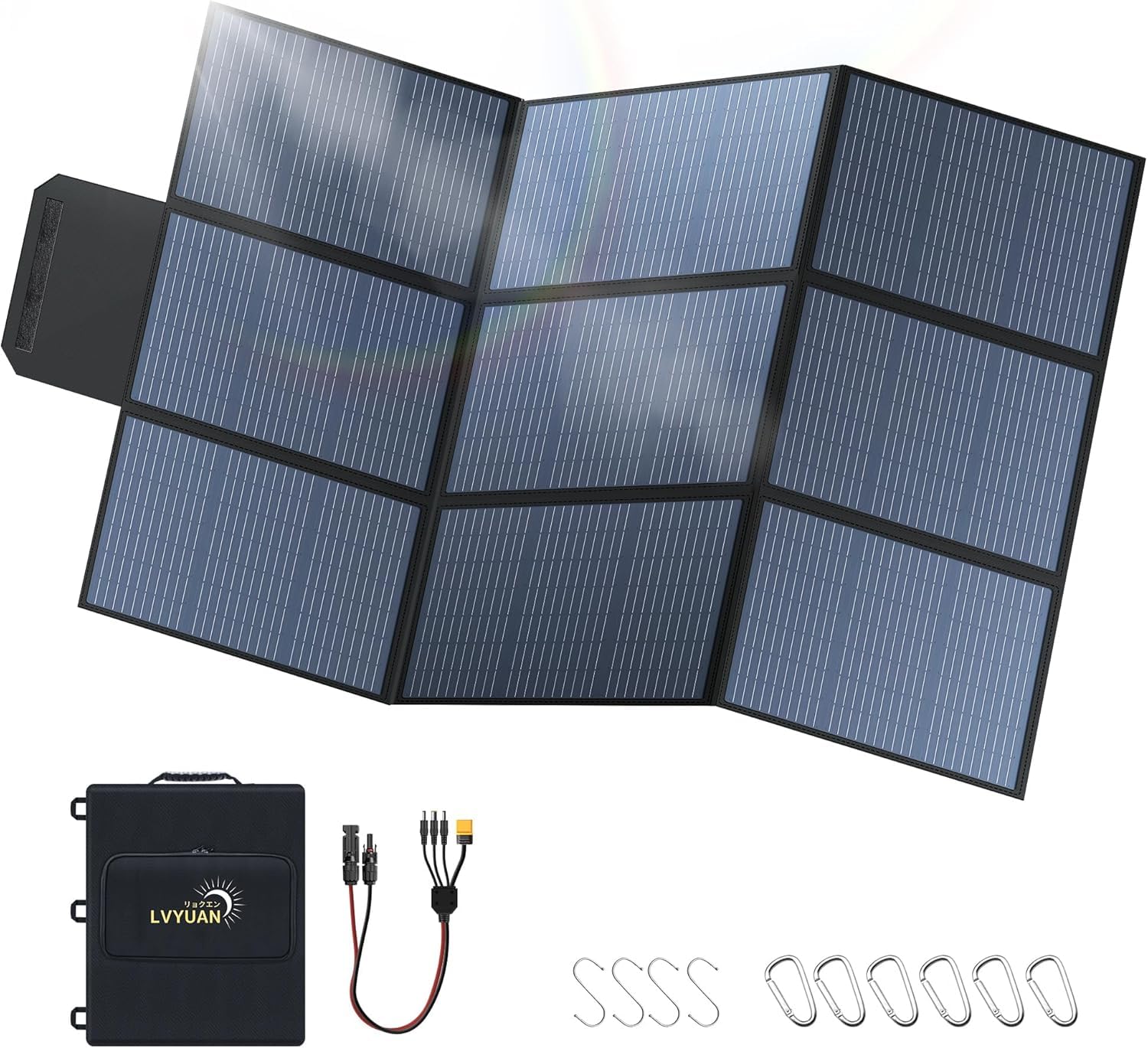
A folding blanket that packs down tight and speaks to almost any station.
Here is the panel you throw in the trunk and forget about until you need it. LVYUAN’s centripetal inward-folding design shrinks the whole 400-watt blanket down to 19.5 by 23.6 by 2.36 inches, which is the sort of folded footprint you can slot between a cooler and a duffel. Unfolded it spreads to 84.6 by 57 inches, and six carabiners plus four S-hooks let you hang it off a backpack or a fence rail.
Where it pulls ahead of the heavier picks is in the adapter bundle. It ships with MC4 output cables plus a spread of adapters — XT60, DC5521, DC5525, and DC7909 — so you are far less likely to be stuck hunting for the right plug on the road. The 36-volt output feeds most portable stations straight from the start, and the rated efficiency tops out at 23% on P-PERC monocrystalline cells.
The limiting factor is the voltage window. LVYUAN is clear that this panel is not designed for power stations that rely on proprietary charging technology, and the panel’s own voltage has to sit within your station’s accepted range. Buyers who paired it with a matching 24-volt system and an MPPT controller report close to 398 watts in full sun at the right angle, while a few working flat on the ground saw far less. Angle it, and it delivers.
The packability angle: the inward-folding design plus six carabiners makes it the easiest blanket here to stow and hang anywhere.
The voltage caveat: check your power station accepts the panel’s voltage range before ordering — proprietary stations can refuse it.
Pick this one if: you bounce between campsites and want a blanket that folds small and connects to almost anything.
Move on if: you run a station with a locked-down charging protocol — this panel may not talk to it.
5. MHPOWOS 400W Foldable Portable Solar Panel with 4 Kickstands
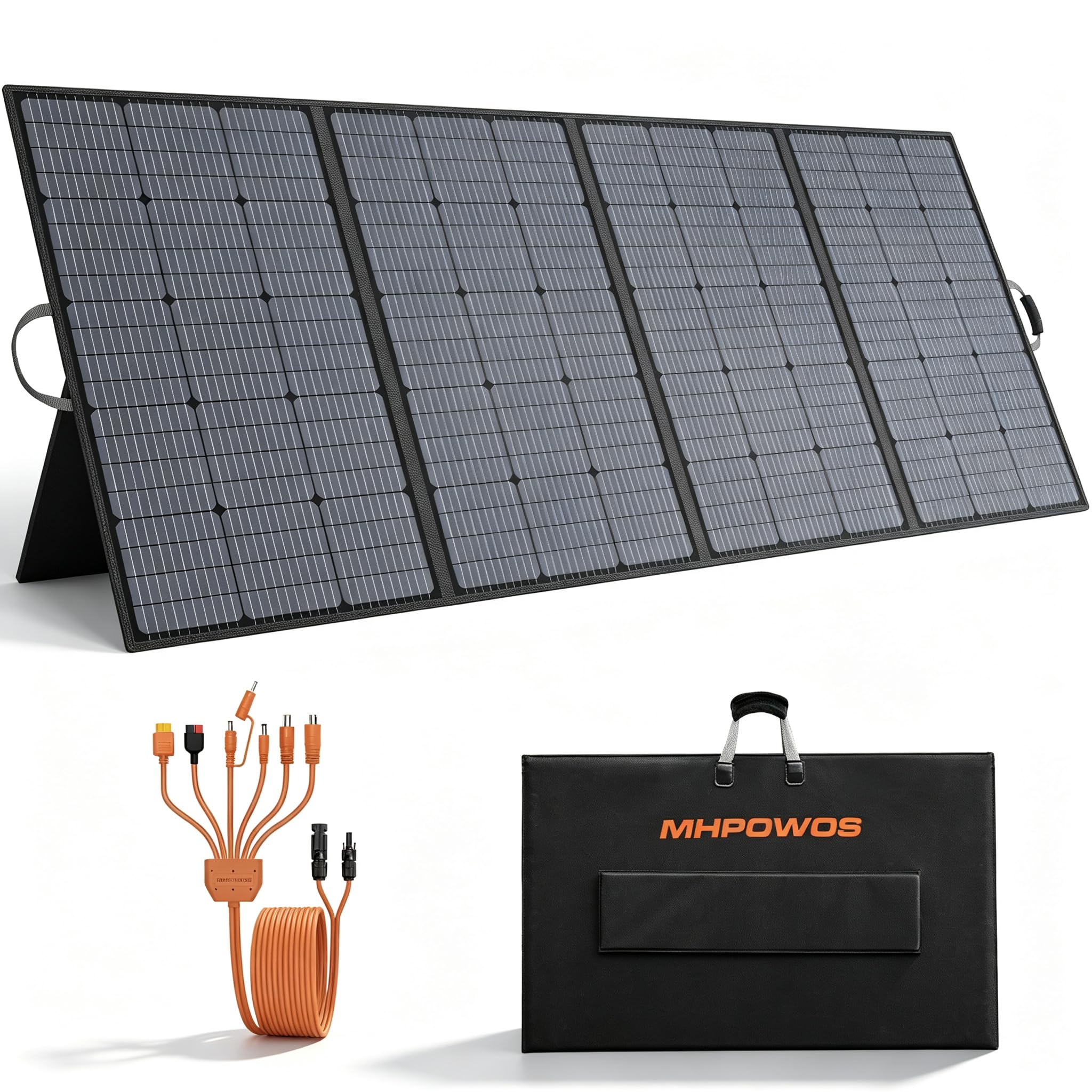
Four kickstands and seven adapters make this the pick for fiddlers.
The headline here is the angle control. Four incorporated kickstands let you set the panel to face the sun at any point in the day without propping it on a rock, and the 23.5% efficient A+ monocrystalline cells do the rest. Add an IP67 waterproof and dustproof rating — meaning it shrugs off rain and dust — and you have a camping panel built for real outdoor abuse.
The connector bundle is the second big draw. The panel ships with a solar extension cable feeding Anderson, XT60, DC7909, DC5521, DC8020, DC5525, and DC35135 — effectively every common plug a portable station uses. Owners mention seeing 352 watts with only two of the four folded sections pointed at the sun, which is why this one carries the best-display label. It is light enough to handle solo and folds to a compact 37 by 23 by 2.75 inches.
The weak spot is the support legs. A couple of customers note the kickstands feel flimsy and may not survive rough handling over several seasons, so treat them gently and tie the panel down in wind. Pair it with a power station whose input limit is at least 400 watts or you will cap the output before the panel does.
What buyers praise most: the build quality earns the strongest reactions, with buyers describing these as heavy-duty canvas panels that arrive double-boxed with foam padding.
The soft spot: the adjustable legs are the part to cosset — a few owners find them light for the load they carry.
You’ll want this if: you like fine-tuning the angle and want one panel that connects to every station you own.
Think twice if: the panel will live permanently in high wind, where the light kickstands need extra staking.
6. Greenmagic Portable 400W Solar Panel, 39V Foldable with 4 Kickstands
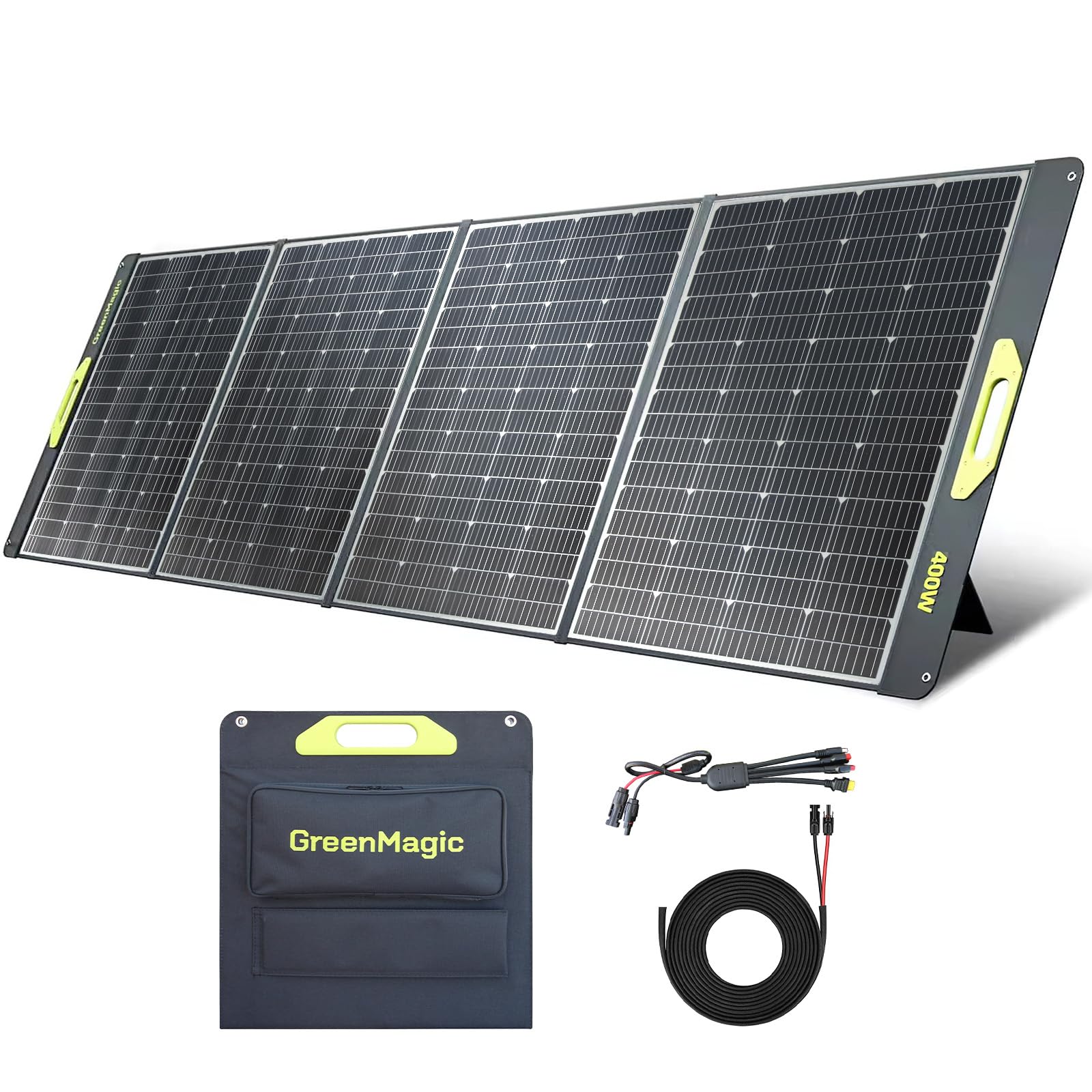
The lightweight blanket RV owners fold up every single evening.
Greenmagic’s blanket weighs 21.5 pounds and folds down to a quarter of its open size — 32.09 by 31.30 by 1.97 inches — with a rubber handle sized for carrying like a briefcase. The monocrystalline cells run a conversion efficiency between 21.5% and 23.5%. Workers who leave it on a work-site hooked to a Bluetti keeping a cooler running report it handles the job day in and day out.
Compatibility is genuinely broad. The built-in MC4 cable pairs with most solar generators, and the panel supports both parallel and series wiring, so you can stack two later for double the output. Owners stacking two of these pulled 480 to 580 watts through parallel kits, and the included parallel MC4 kit means you have the parts on hand for the upgrade from day one.
The honest caveat is that IP65 covers splashes only — the junction box is not waterproof and should not be soaked or left in rain. Housing it under a tarp or in a dry spot when weather turns solves it. Real-world output sits below the rated figure as it does with every folding panel, so plan around a partial percentage in good sun.
Why RV owners like it: 21.5 pounds and a quarter-size fold make daily set-up and pack-down practical for one person.
The warning label: it is IP65 — splash-proof only — so the junction box needs cover when the weather turns.
Choose this for: frequent moves where a panel gets folded and stowed several times a week.
Pass on it for: an exposed roof mount where rain hits it directly — the junction box needs protection.
7. TWELSEAVAN 400W Foldable Solar Panel with 8-in-1 MC4 Converter
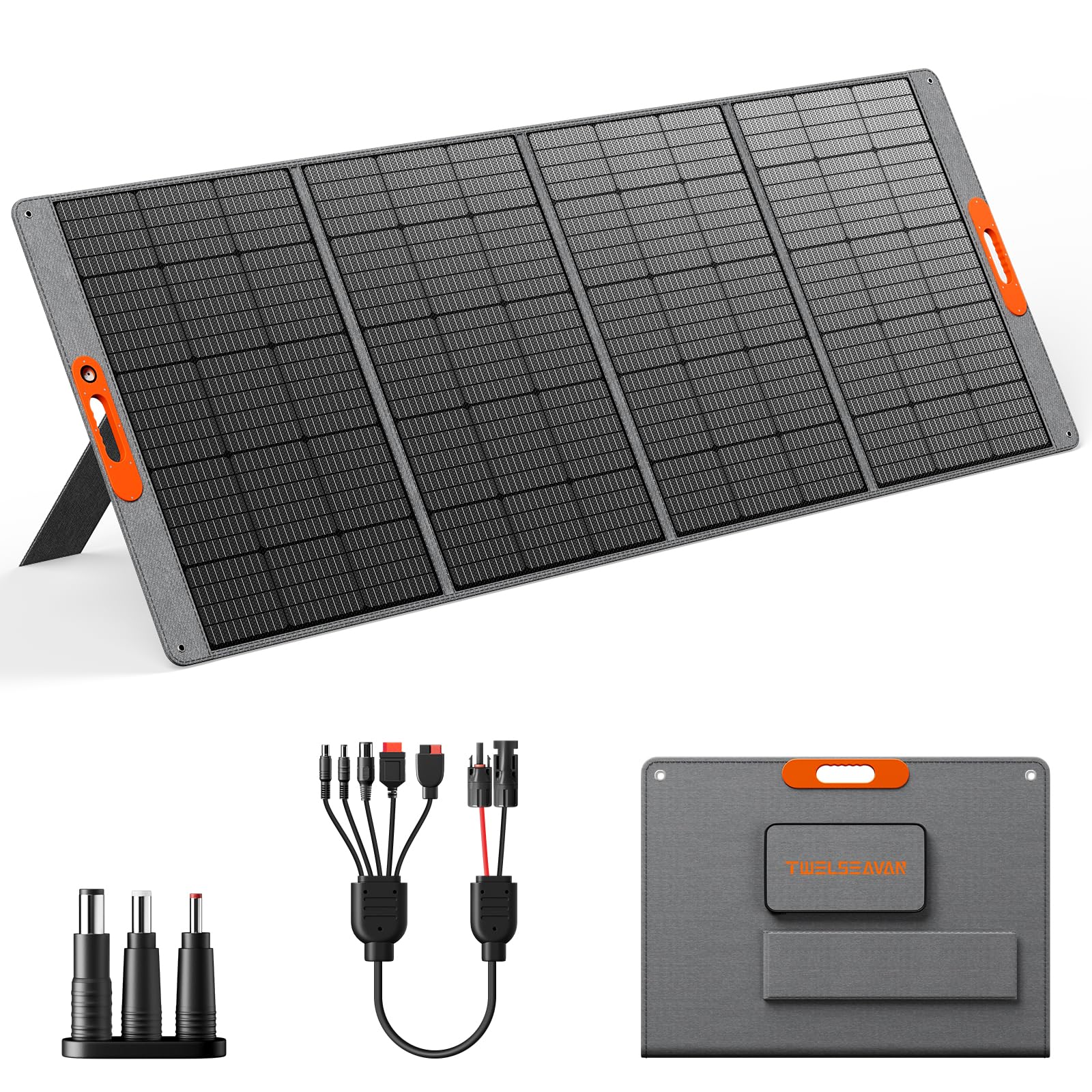
The panel built to keep charging from two hundred feet away.
What sets this one apart is charging distance, and that is unusual. Buyers run it through a 200-foot 10-AWG MC4 cable and still pull 300 watts in full sun — enough to charge a power station parked far from the campsite edge. The 24% efficient A+ monocrystalline cells do that with an ETFE laminated case rated for over 95% light transmission, and the whole panel tips the scale at just 22 pounds with a folded size of 26 by 35.5 inches.
The open-circuit voltage of 46.9 volts is the spec that decides your compatibility. TWELSEAVAN points out plainly that this number rules out small portable power stations whose maximum input voltage sits lower than that. If your station accepts 46.9 volts or more, you are clear to use the panel straight from the box with the included 5-in-1 MC4 connector cable and three DC adapters. This is also the panel buyers turn to for a Ford van roof or a Pecron 3600 station, where it hit 367 watts in Boston outside peak summer.
The honest downside is that a few buyers saw 275 watts instead of 400 on a hot day with the panel propped and the angle off. That follows the pattern here — the panel does not fail, the conditions do. Mount it aimed at the sun, keep the cable run short if you can, and the difference shrinks.
The reason to pick it: 24% efficiency at 22 pounds is exceptional, and the long cable runs let you position the panel where the sun actually is.
The compatibility trap: the 46.9-volt open-circuit voltage will not suit every small power station — check before you buy.
Order this if: your power station sits far from where the sun lands, and you need a long cable run without losing output.
Avoid it if: your station’s maximum input voltage runs below 46.9 volts — it will refuse the panel.
8. MHPOWOS 400W Bifacial Portable Solar Panel, N-Type 16BB
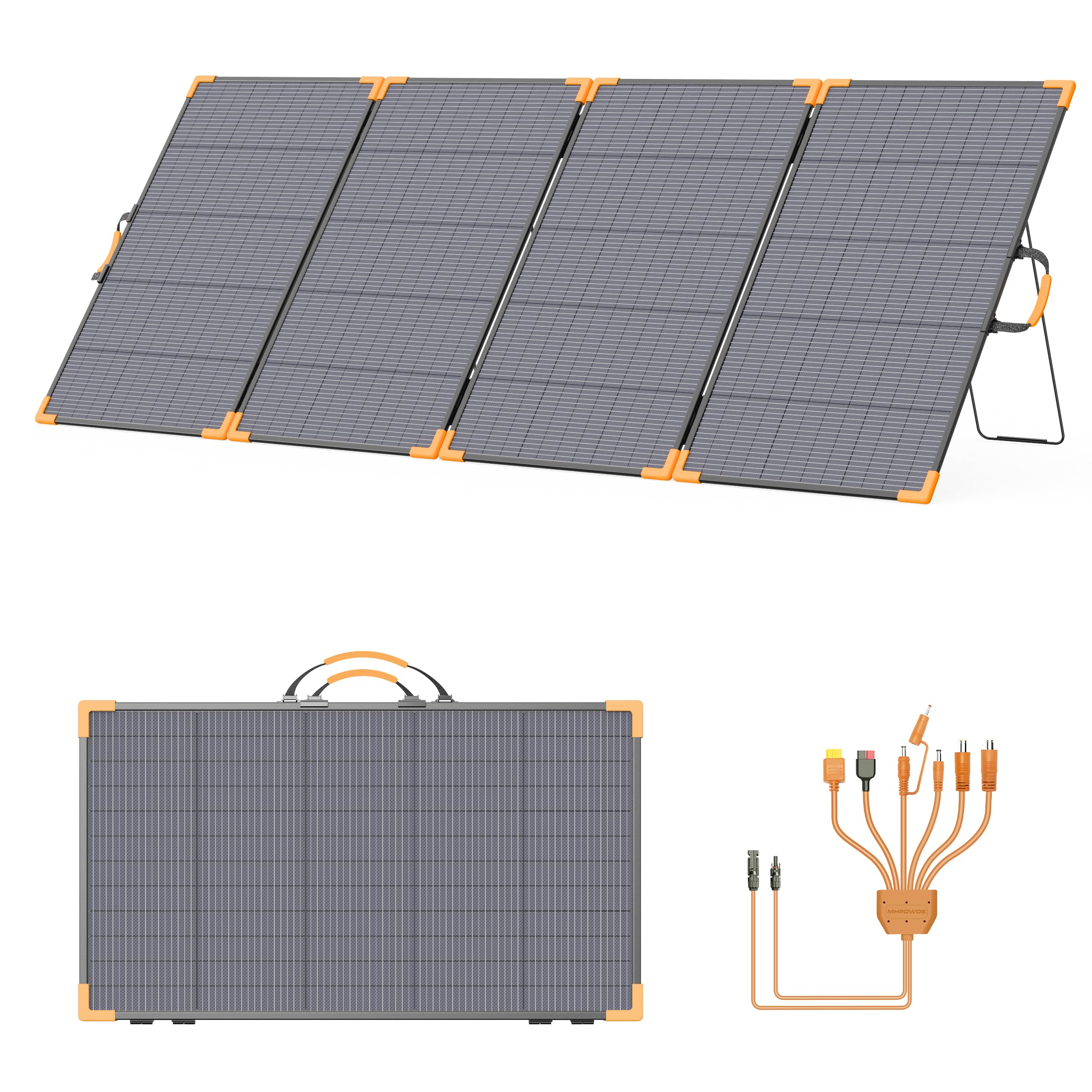
The one that catches light off the ground as well as the sky.
Bifacial is the feature that makes this panel different, and it is worth explaining plain. This panel collects sunlight on both its front and back faces, so when it sits on a light-colored surface — a tarp, sand, or snow — the back face catches reflected light too. MHPOWOS claims up to 20% more energy than a single-sided panel, a figure that holds up best when the panel is off the ground and the back side is exposed. Coverage sits at 25% efficiency, with ETFE monocrystalline cells.
The portability numbers are strong. At 19.7 pounds (about 8.95kg) it is lighter than most 400-watt blankets — the maker notes it is 35% lighter than traditional rigid panels of the same rating — and the folded dimensions come in at 22.4 by 38.3 by 2.8 inches. An integrated 30-to-60-degree adjustable support and three reinforced brackets let it stand on its own on any flat surface, and the included 7-in-1 solar cable covers DC7909, DC8020, XT60, DC5521, DC5525, DC35135, and Anderson fittings for maximum device coverage.
The trade-off to know about is heat: the bifacial design and aluminium frame absorb warmth, and a couple of Arizona buyers saw output drop. Solar cells lose efficiency as they warm up, and the bifacial design with its aluminium frame catches more sun than most — which is why a couple of buyers in Arizona’s heat noticed the frame absorbing warmth and pulling output down. Angle it for airflow and expect your best numbers in cooler, brighter weather.
Where it shines: the IP68 waterproof rating and the 19.7-pound weight make it the lightest fully-weatherproof folding panel here.
The heat note: bifacial panels collect extra sun on the frame, so give it airflow and expect your best output in cooler, brighter weather.
Buy it when: the panel will sit on a reflective surface and you want to squeeze extra production from ground reflection.
Choose something else if: you will always place it flat on dark asphalt, where the bifacial back side earns nothing extra.
9. Renogy 400W Portable Solar Panel, Suitcase Style

The one that folds into a suitcase and sets up in a minute.
Renogy has been building solar longer than most of the names here, and it shows in the frame. This is a 400-watt suitcase-style foldable with fiberglass reinforcement and an ETFE coating, built to survive rough terrain and harsh weather. It hits 23% efficiency and lands a 3-year material and workmanship warranty — longer than most of the foldables on this list. It sets up in about 60 seconds with no tools, thanks to rust-proof kickstands.
Where it beats the LVYUAN and Greenmagic picks is in partial shade. Renogy wires the sections in parallel, so a shadow over one panel does not shut down the whole array the way it would with a series build. That matters on a tree-lined campsite: in overcast Seattle conditions, owners still see 200 watts and up, and 300 watts or more under full cloud. The IP67 panel rating and IP68 connectors let it sit outside through rain.
The weight is the catch — 30.2 pounds folded into 27.9 by 33.7 by 3.2 inches. It is lighter than the DOKIO’s 49.4 pounds but heavier than the lighter blankets from Greenmagic and the Renogy REGO. That said, the suitcase handle and shoulder-carry feel make it easier to move than the raw number suggests. It supports parallel wiring for expansion later.
Why pros rate it: the fiberglass-and-ETFE build and the 3-year warranty are more than most foldables here offer.
The weight to plan for: 30.2 pounds is a two-hand carry for most — lighter than the DOKIO, heavier than the lighter blankets.
Reach for this if: you want a suitcase-style panel with a longer warranty and a proven brand behind it.
Go lighter if: every ounce matters, because the Greenmagic and Renogy REGO blankets cut several pounds off this build.
10. RENOGY REGO 400W Portable Solar Panel, N-Type 25% High Efficiency

A 400-watt blanket that folds smaller than a school backpack.
Packing size is where this panel rewrites the rulebook. Renogy’s patented 16-fold compression turns a full 400-watt panel into something smaller than a standard backpack, and at just 16.09 pounds it is the lightest pick here. The N-type cells and 16BB technology keep 25% efficiency while running cooler in heat — a higher temperature coefficient means output holds steadier when the sun is baking. Powered through common MC4 connectors, it folds into a blanket you can slide behind the driver’s seat.
Owners single out the small folded size for a stow-away, and the reviews back the heat performance. One buyer, charging an Anker SOLIX C1000 in Phoenix heat, reported 350 to 370 watts and noted it beat a comparable Anker PS400 blanket in the same conditions. Another, working into an Anker SOLIX C2000 Gen 2, ran a miter saw where other panels faltered. It outputs through a 118-inch (3-metre) cable and supports 12V and 24V batteries on top of power stations.
The compromise is the blanket build itself. A blanket that folds 16 times has more creases, more surface area exposed to heat, and less rigidity than a suitcase panel, so it wants a smooth, dry, flat space and a light touch. In real high-heat field use a hotspot can develop, and the panel needs to breathe rather than sit on hot pavement.
Why backpackers and van-lifers pick it: 16.09 pounds and a backpack-sized fold make it the most portable panel here by a wide margin.
The honest caveat: the 16-fold blanket is less rigid than a suitcase panel — it wants a smooth, dry, flat spot.
Pick it if: storage space is your hardest constraint and you want 400 watts in the smallest possible footprint.
Look past it if: your setup is a fixed rack where a stiff suitcase panel works better.
11. Anker SOLIX PS400 Portable Solar Panel, 400W

Built-in tilt control for anyone who chases the sun across the sky.
Four preset angles — 30°, 40°, 50°, and 80° — are what make this panel stand out. Instead of propping it on a rock to chase the sun, you set the built-in kickstand to the exact tilt the moment calls for. That matters because a panel off-angle loses output fast, and Anker’s design lets you lock the best angle in seconds. The monocrystalline cells run up to 23% conversion efficiency, and the panel carries an IP67 waterproof rating for rain and dust.
The connection setup is thoughtful and stable. Anker ships two 9.8-foot MC4 cables and a MC4-to-XT60 converter, so you are covered whether your station wants plain MC4 or the XT60 plug. The MC4 connection holds high conductivity with minimal energy loss compared to XT60 connectors. At 35.1 pounds it is a two-hand panel; it is not a cabin-carry item, but it folds reasonably and stores neatly between stops.
Where the honest reader should hedge is output. Anker’s panel produces solid watts in good sun — one owner reports 344 watts from a first test — but a portion of the rated figure is what to expect. Check your power station’s maximum input voltage against the 57.6-volt open-circuit rating before ordering. The 57.6-volt figure suits larger stations and rules out the smallest camping batteries.
The headline feature: four preset tilt angles (30°, 40°, 50°, 80°) let you nail the sun’s angle without hunting for a prop.
The weight to plan for: at 35.1 pounds it is a two-hand panel — stable on the ground, not a one-arm lift onto a roof.
You’ll want this if: you set up on the ground, tilt control matters, and your station can accept the 57.6-volt rating.
Steer clear if: you carry your power station by hand — this panel is heavier than its footprint suggests.
Understanding the Specs
Rated power versus real-world output
The 400-watt figure on the label is a standard-test number, measured under ideal lab light and temperature. In daylight you should expect a portion of it — heat, haze, angle, and cable run all shave watts off the top. Foldable panels commonly report somewhere around 70% to 90% of rated output in strong sun, and tilting toward the sun is the single biggest lever you control. The rated number still matters: it tells you the ceiling you are working with, and it makes panels comparable on paper.
Efficiency and cell type
Conversion efficiency measures how much of the sunlight hitting the panel becomes electricity, and the picks here run between 21.5% and 25%. N-type cells tend to hold output better in heat because their temperature coefficient is lower, meaning output drops less as the panel warms. Bifacial panels add a second light-collecting face on the back, which earns extra output when the panel sits over a bright, reflective surface. Higher efficiency generally means more power per square foot, which is why the compact picks tend to score highest here.
FAQ
Why does my 400W solar panel only put out 300 watts?
Will a 400W solar panel charge my power station?
What does open-circuit voltage mean on a solar panel?
Is a bifacial solar panel better than a standard one?
How much does a 400W portable solar panel weigh?
Can I use a 400W solar panel in the rain?
How long do 400W portable solar panels last?
How many 400W solar panels do I need for a camping trip?
What connectors do these 400W solar panels use?
Can I run a rigid and a folding 400W panel together?
Final Thoughts: The Verdict
For most readers shopping the 400w solar panel category, the winner is the EF ECOFLOW 400W Portable Solar Panel — it earns its place with an IP68 main body, a 23% efficient monocrystalline build, and a real-world output that sits in the mid-350-watt range when you match it to a station of the same family. If you want the lightest 400W blanket you can carry solo, grab the RENOGY REGO 400W — 16.09 pounds and a fold smaller than a backpack make it a genuine travel panel rather than a stay-at-home one. And for a fixed yard, shed, or greenhouse build where the panel never moves, the DOKIO 400W 31V Monocrystalline is the one to reach for, because one 400-watt glass panel replaces four small ones and shortens the wiring job.
Two things to remember before you order. First, check your power station’s maximum input voltage — a panel with a higher open-circuit voltage than your station accepts will not work no matter how good the panel is. Second, expect a portion of the rated watts in real light, not the whole number. Buy the panel whose folded weight, packed size, and open-circuit voltage match your station and your setup, then tilt it toward the sun.
How We Picked
We do not accept paid placement. Every pick is matched to a real buyer and a real use-case; we do not hands-on test units.
Sources & Methodology
Specifications: manufacturer listings and product documentation. Review insights: verified customer reviews, as of September 2026. Pricing: not shown on this page (it changes often); check the current price via the retailer link.
As an Amazon Associate, KitchPrep earns from qualifying purchases. This does not affect which products we feature.
Related Guides
