
Specs are compiled from manufacturer listings and verified buyer reviews and can change over time — please confirm the key details on the product page before buying.
If you are shopping for a 220V air compressor, the best all-round pick here is the NorthStar 20-gallon vertical unit. It pairs a 5.0 CFM rating at 90 PSI (cubic feet per minute — the volume of air it pushes out while running) with a dual-voltage motor you can leave on 115V or rewire to 230V later. That flexibility matters, because most “220V” confusion in this category is not about power — it is about whether the compressor shows up ready to plug into a standard household outlet or waiting for a dedicated line.
I’m Mohammad Maruf — the founder and writer behind KitchPrep. This guide is built by comparing the manufacturers’ published specifications and the patterns across verified customer reviews, so you get each pick’s real strengths and trade-offs instead of marketing spin.
A 220V compressor can mean two very different machines depending on what you fill with it, so the list below separates shop-air tanks from high-pressure PCP fill stations before you spend a dollar. Every pick here is judged on CFM at 90 PSI, tank size, voltage wiring, and the real complaints buyers repeat, which is exactly how you end up with the right 220v air compressor.
Our Picks at a Glance

How To Choose The Best 220V Air Compressor
The most common mistake in this category is assuming “220V” means the same thing on every listing. It does not. Some units arrive wired for 115V and can be switched over to 230V by a qualified electrician, while others are factory-set for 220V or 230V and will not run at all on a standard wall outlet.
Check the wiring before you check the specs
Look for a dual-voltage motor first. The NorthStar and Campbell Hausfeld VT6290 both list dual-voltage operation, which means the compressor can run on 115V from the start and be rewired to 230V later if you add a dedicated circuit. A fixed 220V unit like the California Air Tools models needs that outlet from day one, so confirm you have one before ordering.
Match CFM to the tool, not the tank
CFM (cubic feet per minute) is the volume of air a compressor can push at a given pressure. A framing nailer may only need a few CFM, while a die grinder or spray gun pulls far more. Match the compressor’s CFM at 90 PSI to your hungriest tool, and the tank gallons become secondary — they only buy you more run time before the motor kicks back on.
Decide between shop air and high-pressure fill
If you are filling PCP air rifle tanks, paintball cylinders, or scuba bottles, you are shopping a completely different machine. Those compressors run at 4500 PSI and are built around small motors and moisture separation, so their CFM figures do not compare to a garage compressor at all. Do not buy a shop compressor to fill a PCP tank, and do not buy a PCP pump to run an impact wrench.
Quick Comparison
| Model | Best For | Tank Size | Air Delivery | Voltage | Amazon |
|---|---|---|---|---|---|
| NorthStar 20-Gallon Single-Stage★ Best Overall | Weekend garage and home shop | 20 gallons | 5.0 CFM @ 90 PSI | 115V/230V dual | Amazon |
| TUXING 4500Psi PCP CompressorTop Value Fill Pump | Filling PCP rifles and paintball tanks | 0.5 liters | Up to 4500 PSI | 110V/220V or 12V DC | Amazon |
| Greteefor PCP Air Compressor 4500 PSIBest Auto-Stop | Portable field filling with auto-stop | 1.5L cylinder max | Up to 4500 PSI | 110V/220V or 12V DC | Amazon |
| California Air Tools 15020C-22060 | Noise-sensitive shops and trailers | 15 gallons | 6.4 CFM | 220V | Amazon |
| SMACO PCP Air Compressor 4500 PSI | Filling scuba and PCP tanks at home | Up to 2L | 11 L/min | 110V/220V or 12V DC | Amazon |
| California Air Tools 10020C-22060 | Quiet tool work in a small garage | 10 gallons | 6.40 CFM @ 40 PSI / 5.30 CFM @ 90 PSI | 220V | Amazon |
| Campbell Hausfeld VT6290 | Rolling shop compressor with dual voltage | 20 gallons | 6.5 CFM @ 40 PSI / 5.5 CFM @ 90 PSI | 120V or 240V dual | Amazon |
| Campbell Hausfeld 60-Gallon 2-Stage | Serious workshop grinding and sanding | 60 gallons | 7.6 SCFM @ 90 PSI | 230V | Amazon |
| VEVOR 80-Gallon Stationary | Industrial and production air supply | 80 gallons | 15.5 SCFM @ 90 PSI | 220V / 60Hz single-phase | Amazon |
In‑Depth Reviews
1. NorthStar Single-Stage Air Compressor, 20-Gallon, 2 HP, 5.0 CFM
Our pick — 4.5★ from 80+ verified ratings; the strongest balance of quality and price.
The vertical 20-gallon that runs quiet enough for a weekend garage and pulls just 7.5 amps.
This is the compressor for someone who wants real shop air without rewiring the house on day one. It ships wired for 115V with a 6ft cord and plug, so it works on a standard outlet straight out of the crate. When you are ready, a qualified electrician can rewire it for 230V — and here is why that matters: at 230V the motor draws 7.5 amps, while the much smaller TUXING PCP pump next on this list pulls 42 amps on its own circuit. That is a 5.6x gap in current draw between two very different machines.
The headline number is 5.0 CFM at 90 PSI, with 6.0 CFM at 40 PSI. In plain terms, CFM at 90 PSI is how much air the unit can keep feeding while a tool is running, so 5.0 CFM covers most impact wrenches, ratchets, and nailers without the motor gasping. The 2-cylinder cast iron pump and 2 HP induction motor sit behind that rating. Buyers consistently call out how manageable the sound is for a machine this size.
What wins people over is the raw performance for the footprint — it holds 130 PSI, keeps pressure in the tank when switched off, and the bottom drain valve is reachable without tipping the unit over. The wrinkle-finish build and wrinkle of assembly complaints are absent here too; setup is screwing on the filters and adding oil. As a two-year owner put it: “Have had 2 yrs now. 0 issues. Not very loud at all.”
Where It Earns Its Keep
- 5.0 CFM at 90 PSI feeds impact wrenches and ratchets without the motor catching up constantly.
- Ships 115V-plug-ready and can be rewired to 230V, so it fits whichever outlet you have.
- Bottom-mounted drain valve is reachable without tipping the tank.
- Holds tank pressure for a week between uses, so no slow overnight bleed-down.
The Fine Print Worth Knowing
- At 198 pounds the vertical tank is not a one-person carry — plan its spot before it arrives.
- Oil is not included, so budget for a bottle before first startup.
- Rewiring to 230V is a qualified-electrician job, not a plug swap.
Best match for: the home or garage shop that wants dual-voltage flexibility and a 20-gallon tank that will not dominate the floor.
Think twice if: you need a compressor you can lift onto a truck bed alone — the 198-pound weight says leave it in place.
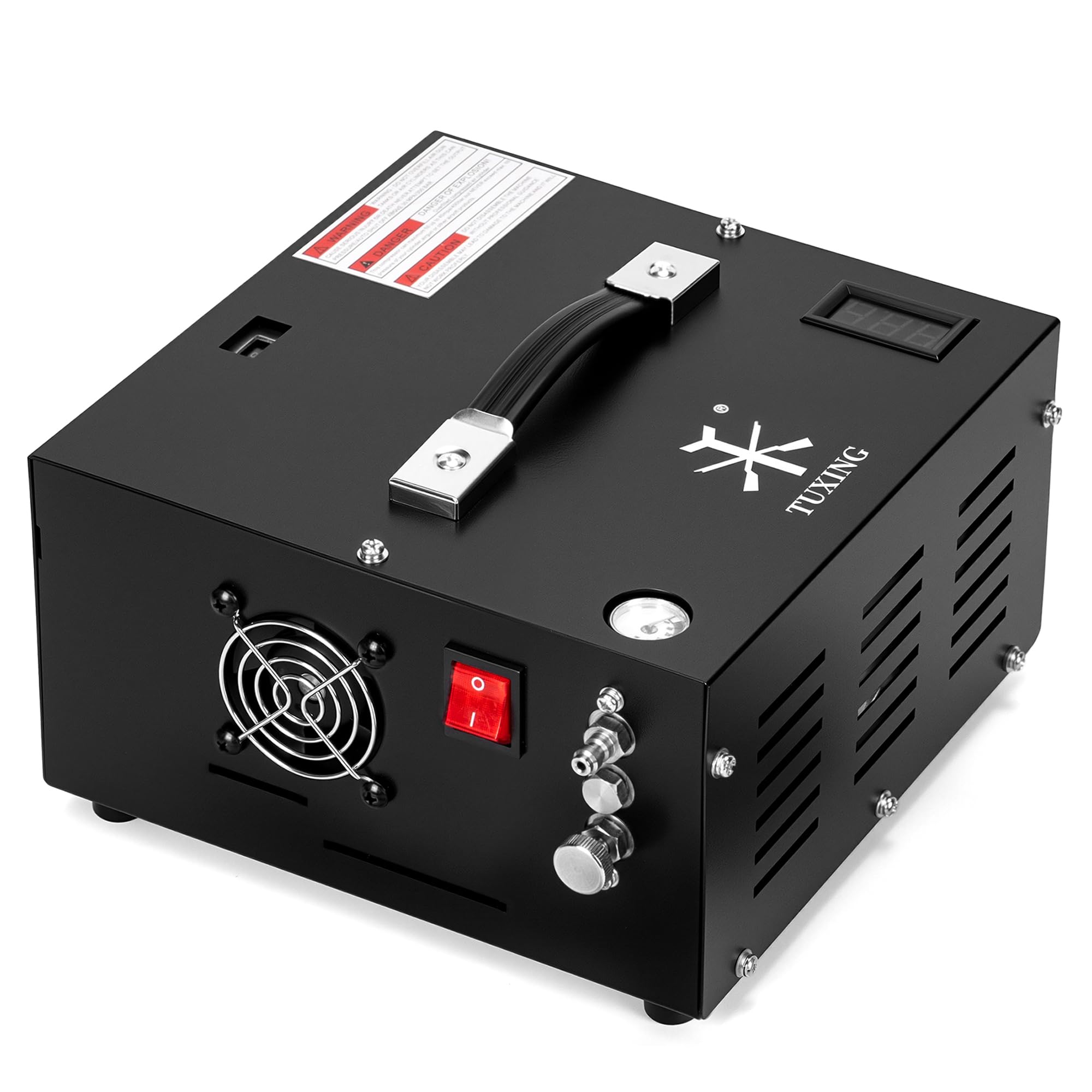
2. TUXING 4500Psi PCP Air Compressor, Built-in Adapter Portable Air Compressor
A 7 kg bench-top pump that pushes a PCP tank to 300 bar without oil or water lines.
The TUXING answers a question the garage compressors above cannot: how do you fill a 4500 PSI air rifle tank at home without a compressor the size of a refrigerator? Its 250W brushless motor drives pressure up to 4500 PSI / 300 Bar / 30 MPa, and it takes roughly 20 minutes to fill a 0.5L tank from empty to 300 bar. From 200 bar to 300 bar, that drops to about 8 minutes.
The dual-power design is the practical part. You get a voltage-switchable 110V/220V AC converter for the garage plus a 12V DC car cable for the range or field, so you can top off a tank wherever you parked. At 12.2″L x 10.23″W x 10.23″H it stores on a shelf. Compare that to the NorthStar above at 23″L x 22″W x 43″H, and the footprint difference is dramatic — this is the one you tuck away, that is the one you park in a corner.
Reliability is the theme that keeps this unit recommended among PCP shooters, and the fill-time numbers back it up. Buyers report: “Filled 500cc Seneca.357 1000→3000 PSI in ~10 min.” There is no oil to change and no water pump to connect, which removes the maintenance chores that older high-pressure pumps demanded. The trade-off is honest and worth naming: owners describe the cooling fan running loud, and a handful report the shaft between gearbox and pump failing over time, so treat the duty cycle with respect and let it cool between fills.
The short version: pick this if your goal is filling PCP rifles, paintball tanks, or HPA cylinders and you want a portable unit that works in the garage or off a car battery.
Be realistic about: the fan noise and the recommended cylinder volume cap of no more than 1L — this is not a scuba-filling machine.
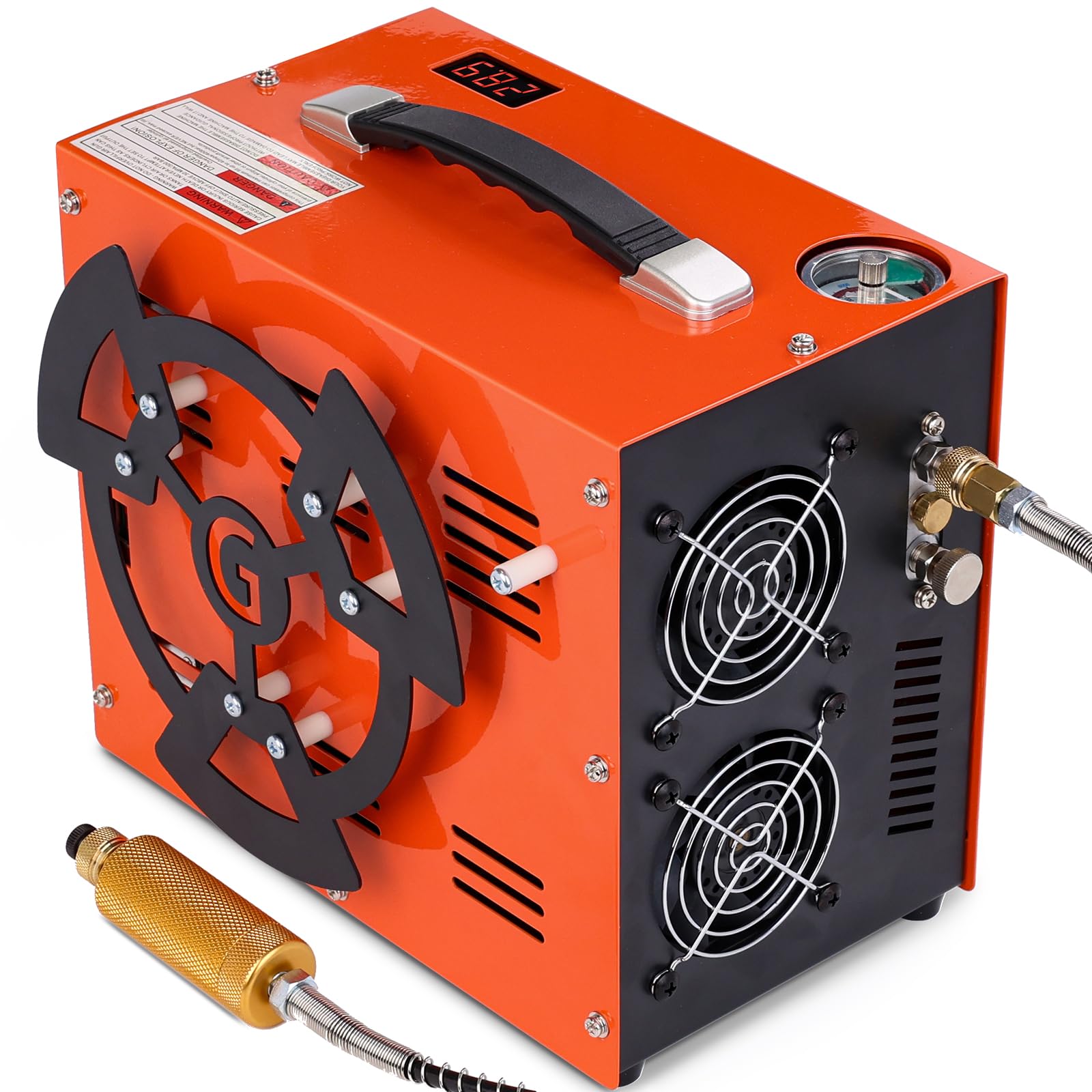
3. PCP Air Compressor, 4500 PSI / 30 MPa, 350W Motor, Auto Stop, 12V DC or 110V / 220V AC
Set the pressure, walk away, and let the auto-stop cut the motor when the tank is full.
Anyone who has hand-pumped a PCP rifle knows the appeal of this one. It runs a 350W compression system up to 4500 PSI / 30 MPa, and the built-in 600W converter handles 110V–220V AC or 12V DC vehicle power without a separate power brick. That means one machine covering the garage outlet and the truck battery with nothing extra to pack.
The feature that separates it from the TUXING is automatic pressure management. You preset your target fill pressure, and the compressor stops on its own when it gets there — no watching a gauge for ten minutes. Temperature monitoring, thermal shutdown, and over-pressure safeguards are built in for repeated filling sessions. An internal oil-water separation system plus an inline sponge filter works to keep moisture out of the air going into your tank, and the 8mm quick-connect fitting matches most PCP and paintball setups.
The honest read is that this is a newer listing with a smaller following, so the long-term track record is thinner than the bigger brands. It is also the entry point into PCP filling rather than a heavy-duty answer — the manufacturer recommends air cylinders up to 1.5L (90ci), and for scuba breathing air you would need an external certified filtration system. One important setup note most buyers miss: the converter is factory-set to 110V, so if you are running it on a 220V source you must flip the voltage selector before you start. Get that right, and 16 pounds and a 12″L x 8.8″W x 5.9″H body make it easy to carry to the range.
Where it shines: the auto-stop does the watching for you, and the built-in converter means no extra box between the pump and your wall outlet. Buyers consistently mention how much simpler this is than a hand pump.
The honest caveat: the recommended cylinder ceiling is 1.5L, so anyone filling larger tanks should look at the SMACO or the shop compressors instead. Report a fast speed, with a 3000 PSI tube filled in roughly 4-7 minutes, and larger bottles like a Hatsan Blitz taking 10-15 minutes.
Good fit when: you fill a PCP rifle or paintball tank and want the motor to shut itself off at your set pressure.
Pass on it if: your filling needs go beyond small cylinders — the 1.5L recommendation is a hard ceiling worth respecting.
4. California Air Tools 15020C-22060 Ultra Quiet and Oil-Free 2.0 HP 15.0-Gallon Steel Tank Air Compressor

A 15-gallon oil-free tank built for people who cannot stand compressor racket.
Quiet is the entire point of this machine, and owners mention it plainly: running at less than 70 decibels, close to the level of a normal conversation. That is the reason to choose it over the NorthStar or the Campbell Hausfeld VT6290 — if your compressor shares walls with living space, work area, or a trailer where you sleep, the sound difference is the whole purchase. A 2.0 HP motor pushes 6.4 CFM through the 15-gallon steel tank and fills it to 120 PSI in about two minutes.
There is also a real electrical reason to pick a 220V unit here. Running on 220 volts rather than 115 volts halves the current the motor pulls for the same output, which is why owners running these in enclosed race trailers choose the 220V version over a 115V setup. The oil-free pump is another advantage: no oil changes, and no oil misting into the air line, which matters if you are spraying finish or running air tools where cleanliness counts.
Here is the catch you need to catch early. This unit is a 220 volt compressor and ships that way — it will not plug into a standard household outlet, and one buyer learned that only after ordering. If you do not already have a 220V outlet, factor in the cost of adding one before you buy, because no amount of quiet matters if it will not start. At 90 pounds and 28″L x 31″W x 31″H, it is manageable for one person to reposition, especially with the wheels and mufflers adding assembly time that takes only minutes.
What you are paying for: near-silent operation at under 70 decibels, oil-free maintenance, and 6.4 CFM through a 15-gallon tank that fills to 120 PSI in roughly two minutes.
What to double-check: the 220V factory wiring. This one demands the dedicated outlet before it will run, unlike the dual-voltage NorthStar that ships 115V-ready.
Reach for this if: noise is your biggest problem and you already have a 220V circuit to feed it.
Look elsewhere if: you are not ready to install a 220V outlet — the dual-voltage NorthStar gives you the same quiet temperament with more wiring freedom.
5. SMACO PCP Air Compressor 4500 PSI High Pressure Air Compressor Auto-Stop
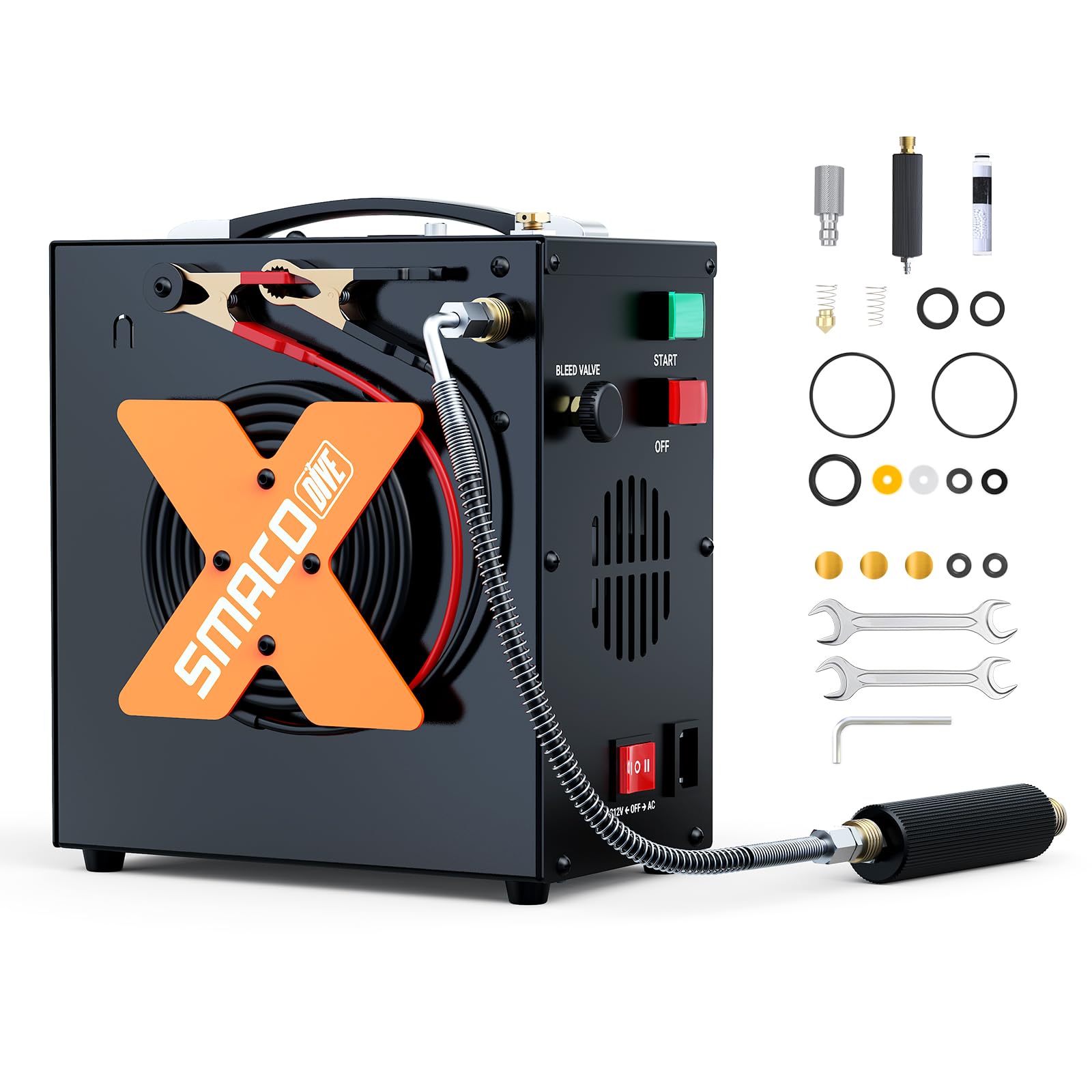
The 21.4-pound high-pressure pump that fills scuba and PCP tanks without a water line.
Where the TUXING aims at shaving weight and the Greteefor aims at packing a converter, this one aims at capability. It runs a 250W motor up to 4500 PSI / 30 MPa and pushes air at 11 L/min, which means it will pressurize tanks that smaller PCP pumps simply will not touch. The maker’s own test numbers tell the story: a 0.5L container from 0 PSI to 3000 PSI takes 11 minutes, a 1L container takes 26 minutes, and a 2L container takes 46 minutes.
The built-in high-power cooling fans are the design choice that sets this apart from oil-and-water-cooled competitors. Instead of connecting an external water pump, you get fans doing the cooling work, which keeps the whole process clean and means no hoses to drag out. There is a two-pointer pressure gauge — one needle for real-time pressure, one for your set point — and the machine shuts off automatically when your preset pressure is reached. The engine spins up to 2700 r/min, and the 8mm inflatable interface fits most air guns, paintball, and scuba tanks.
Two honest notes before you buy. First, this is a machine that needs breathing room in its duty cycle — the maker specifies 10-15 minutes of cool-down after 25 minutes of work, and owners who respect that schedule get the most out of it. Second, if you are filling scuba tanks for breathing air, you will want the external inline filtration setup, because the built-in separation is not a substitute. Filling a 1L tank takes about 35 minutes in real-world use, and it runs on 110V/220V AC or a running car battery via clamp — the car must stay running, it is not a battery-internal unit.
Why Divers And Shooters Pick It
- Fills up to 2L tanks at 11 L/min, a capability the smaller PCP pumps do not have.
- Built-in cooling fans eliminate the water pump and its hoses entirely.
- Two-pointer gauge with auto shut-off means you set a pressure and walk away.
- At 21.4 pounds and 9.5″L x 5.6″W x 10″H it is a carry-out unit, not a fixture.
What Owners Wish You Knew
- It draws from 12V or 110V/220V AC only — there is no internal battery, and the car must be running for vehicle power.
- It is loud in operation; the noise is a common theme in reviews.
- Large scuba fills still need an external filtration setup beyond the built-in separator.
The verdict: this is the pick when your fill needs are bigger — scuba tanks, large PCP reservoirs, and anything past what a portable 0.5L-rated pump handles.
One caution: budget for cool-down time. Twenty-five minutes of work means a 10-15 minute break, so a full 2L fill is a project, not a quick top-off.
6. California Air Tools 10020C-22060 2.0 HP Ultra Quiet and Oil-Free Air Compressor, 10 Gallon Steel Tank with Wheels

A 10-gallon wheeled tank rated at 70 decibels — the quiet compressor for a tight garage.
If the 15-gallon California Air Tools is more tank than your space allows, this is the smaller sibling with the same low-noise personality. It is rated at 70 decibels, a level low enough to run in a garage or a home shop without needing ear protection, and its 2.0 HP motor spins at only 1680 RPM. Lower RPM is the quiet trick here — the motor turns slower than a typical direct-drive unit, so it generates less noise and less wear. Air delivery is 6.40 CFM at 40 PSI and 5.30 CFM at 90 PSI.
The pump itself earns the ultra-quiet tag honestly. It is an oil-free dual piston design with a listed life cycle of over 3000 hours, and because there is no oil, there is no oil to top off, no oil to mist into your lines, and cleaner air feeding your tools. The 10-gallon steel tank rolls on wheels, and the Easy Start Valve reduces the surge of current the motor needs to kick on — helpful in colder shops and on circuits that are shared with other equipment.
What buyers appreciate most is the pressure retention. Customers note it goes right up to pressure and holds it, so it will not cycle itself awake in the middle of the night just to top off a slow leak. One heads-up from the long-term ownership reports: the oil-free aluminum heads do run hot, and reviewers point out the manufacturer’s duty-cycle guidance is not brightly published, so plan on a roughly 70/30 work-to-rest pattern rather than continuous running. Assembly is simple, wheels and feet going on with a #3 Phillips screwdriver.
Solid choice when: you want a genuinely quiet compressor for a one- or two-car garage and you run tools lightly rather than nonstop.
Downside to weigh: the 10-gallon tank runs out faster than the 15- or 20-gallon units under heavy load, and the oil-free heads want a real break between work cycles.
Who it suits: the home shop that values noise reduction and easy rolling over maximum air storage.
skip it if: you are running die grinders or sanders for long stretches — step up to the 15-gallon or 20-gallon models to keep up.
7. Campbell Hausfeld 20-Gallon Air Compressor, 2 HP, 135 PSI, VT6290

A USA-made 20-gallon roller that runs on 120V at 15A or 240V at 7.5A.
Here is a compressor that solves the voltage question by simply offering both. The dual-voltage 2 HP motor runs on 120V at 15 amps or 240V at 7.5 amps, single-phase, so you can start on a standard outlet and switch to 240V later without buying a new machine. The airflow figures are 6.5 CFM at 40 PSI, 5.5 CFM at 90 PSI, and 4.8 CFM at 135 PSI. That 135 PSI ceiling is higher than the NorthStar’s, which helps with stubborn fasteners and pressure-hungry tools.
The pump is the part that lasts. It is a heavy-duty two-cylinder cast-iron design, oil-lubricated and rated for up to 5,000 hours of service based on its B-10 bearing rating. Plain English: the bearing life numbers suggest the pump is built for years of steady shop use, not occasional tinkering. The 20-gallon horizontal ASME-code tank stores air for the gaps between tool use, and a handle plus 10-inch semi-pneumatic wheels make it movable — a genuine advantage over the fixed vertical tanks. A fully enclosed metal belt guard covers the moving drive parts, and the 80/20 duty cycle means 8 minutes running to 2 minutes resting.
The catch is shipping. These units are heavy and freight-handled, and reports of delivery damage — bent discharge tubes, detached filters, a busted gauge — come up often enough that you should inspect the crate before you sign. Campbell Hausfeld has a track record of sending free replacement parts when that happens, so it is a nuisance rather than a dead end. You also supply your own oil and couplers, which is normal at this level but worth knowing before the box lands. Published noise sits in the 82-85 dBA range, noticeably louder than either California Air Tools unit above.
What Makes It A Keeper
- Runs on 120V or 240V, so you are not locked into one circuit.
- Cast-iron two-cylinder oil-lubricated pump rated for up to 5,000 hours of service.
- 20-gallon ASME tank with a 135 PSI ceiling for tougher tools.
- Handle and 10-inch wheels make it more movable than a stationary vertical unit.
Things To Sort Before It Arrives
- Shipping damage is common enough to inspect the crate before you accept delivery.
- Oil and quick-connect couplers are not included.
- At 82-85 dBA it is louder than the oil-free California Air Tools models.
Pick this when: you want dual-voltage wiring freedom plus a longer-lived cast-iron pump and you are comfortable ordering freight.
Know before you order: inspect the crate on arrival — the carrier handling shows up in the reviews, not the machine itself.
8. Campbell Hausfeld 60-Gallon 2-Stage Air Compressor, 175 PSI, 230V
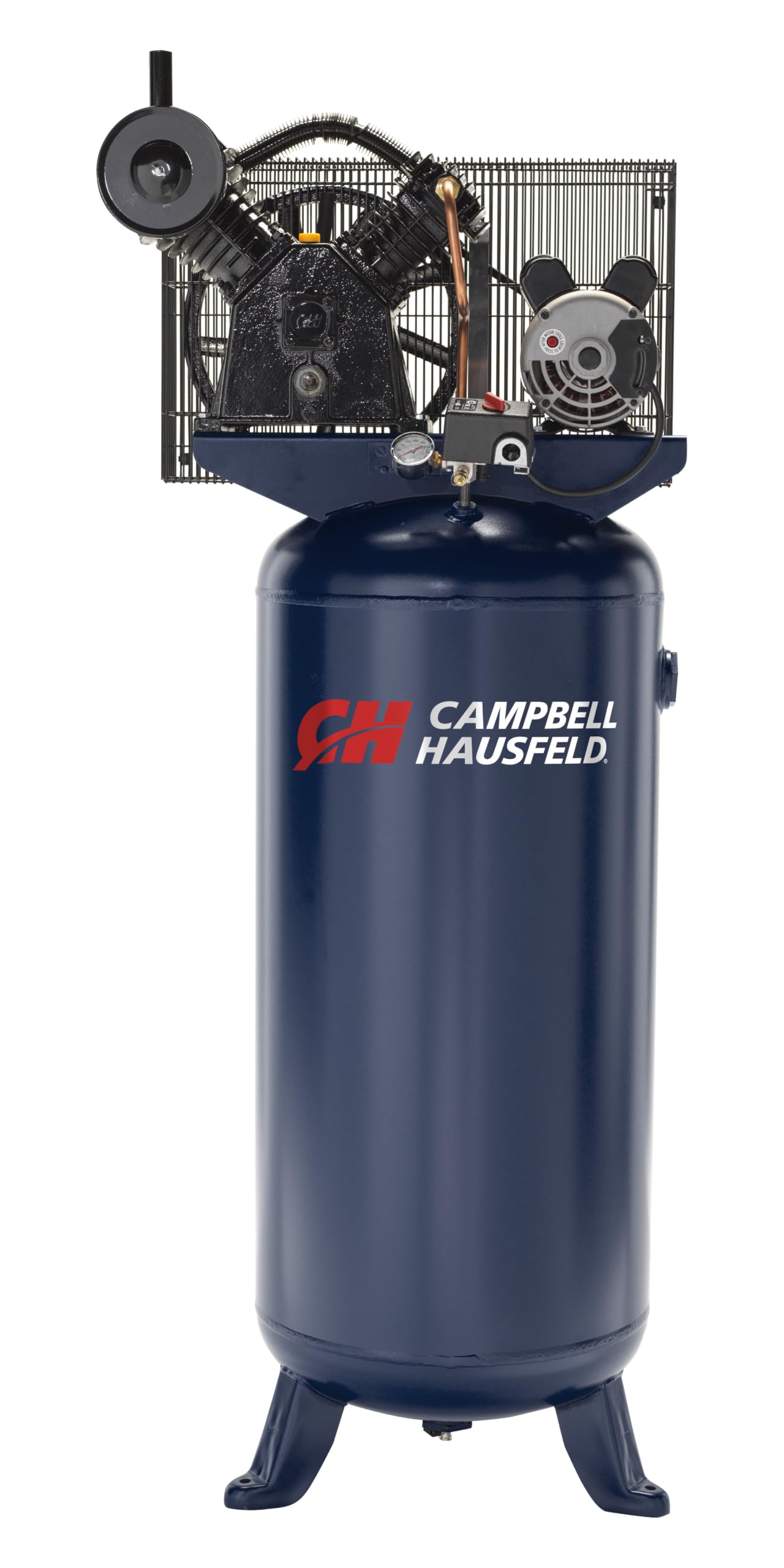
The 60-gallon two-stage that keeps sanders and grinders fed without dropping pressure.
This is the point where a compressor stops being a garage accessory and starts being shop infrastructure. The two-stage cast-iron pump is oil-lubricated and rated for up to 10,000 hours of pump life based on its B-10 bearing rating — roughly double the service figure of the VT6290’s single-stage pump. Air delivery runs 7.6 SCFM at 90 PSI and 6.9 SCFM at 175 PSI, and that 175 PSI ceiling is the highest on this list outside the high-pressure fill pumps.
What that CFM figure buys you is continuity. With 7.6 SCFM at 90 PSI, this compressor can run an air sander or a die grinder without the motor chasing a falling tank pressure every thirty seconds. Buyers running air sanders on this unit report it holds 100 PSI without dropping, which is the whole reason to buy a two-stage machine over a single-stage. The 60-gallon vertical ASME tank stores serious reserve capacity in a 23 x 23-inch footprint, and the 3.7 running HP induction motor is built for longer run times across sanding, grinding, paint spraying, nailing, and bolting.
Two things prospective owners should plan around. First, this machine requires a dedicated 230/240V electrical supply — it ships with a 115V cord in some cases but shoppers say rewiring the motor to 230V per the instructions and running it on a 30A dual-pole breaker with 8/2 wire. Second, and this one catches people out: the unit is heavy and top-heavy enough that it moves if it is not bolted down, and buyers report notable vibration transmitted through the floor. Set it on a stable concrete pad and anchor it. The weight is real — plan for help moving it into place.
The standout: 7.6 SCFM at 90 PSI and up to 10,000 hours of rated pump life make this the compressor that keeps serious shop tools fed for the long haul.
The honest trade-off: it is heavy, it wants a dedicated 230V circuit and a bolted-down install, and the vibration is noticeable enough that floor anchoring is not optional.
Built for: the workshop that runs sanders, grinders, and spray guns regularly and wants two-stage capacity without stepping up to an 80-gallon stationary unit.
Not for: anyone who needs a portable or occasional-use compressor — the dedicated circuit and weight make it a permanent fixture.
9. VEVOR 80 Gallon Air Compressor, 145PSI Oil Free Stationary Compressor Tank, 6.5HP 15.5SCFM@90 PSI

An 80-gallon oil-free tank pushing 15.5 SCFM — the highest air delivery in this lineup.
If your shop runs multiple tools or you do full-scale paint jobs, this is the compressor that will not leave you waiting. Its 6.5 HP oil-free motor drives air delivery up to 15.5 SCFM at 90 PSI — more than double the 7.6 SCFM of the two-stage Campbell Hausfeld above, and roughly three times the 5.0 CFM of the NorthStar. That volume is why owners mention painting an entire car without dropping below 120 PSI. At 145 PSI maximum, it holds pressure through long spraying sessions and finishes a full inflation in just 6 minutes.
The 80-gallon capacity is the other half of the story. That much storage means the compressor has time to recover between heavy demands, so the motor is not constantly restarting and you are not pausing mid-job. The tank is built from high-strength cold-rolled steel plate, and the oil-free design means no oil mist in your air lines and no oil changes to track. It is rated at 86 dB, which is loud but expected for a machine this size.
What you should know before committing: this is a stationary unit at 264.6 pounds, and it requires 220V/60Hz single-phase power with a dedicated supply — customers note it draws 18 amps. Several owners also note the factory output fittings are two 1/4 NPT ports, which are too small for heavy blasting; the mod to 1/2 NPT is straightforward but worth planning for. The most serious recurring report is a weld leak discovered on first pressurization, so run a leak check before trusting it with a full load. On the plus side, the oil-free design runs quieter than oil-pump models of comparable size, and reviewers point out no water accumulation in the lines or tank.
Why Production Shops Want It
- 15.5 SCFM at 90 PSI keeps multiple tools and full paint jobs supplied without pressure drop.
- 80-gallon cold-rolled steel tank means long intervals between motor cycles.
- Oil-free operation eliminates oil changes and oil mist in your air lines.
- Fills completely in about 6 minutes and holds above 120 PSI during extended spraying.
What To Plan Around
- At 264.6 pounds it is a permanent installation, not a mobile unit.
- Needs a dedicated 220V/60Hz single-phase circuit — shoppers say an 18-amp draw.
- Factory 1/4 NPT outlets are undersized for heavy blasting and want upgrading.
Best for: auto body work, production shops, and anyone who needs a constant, high-volume air supply for hours at a time.
Know the risk: inspect it thoroughly on arrival and check for tank weld leaks before relying on it — that is the one flaw that has surfaced in owner reports.
Understanding the Specs
CFM At 90 PSI: The Number That Decides Your Tools
CFM stands for cubic feet per minute — the volume of air the compressor can push out while running. Tools are rated by how much CFM they need at a given pressure, and 90 PSI is the standard reference point. If your compressor delivers less CFM than your tool needs, the tool stalls or runs weak. Compare the 5.0 CFM at 90 PSI of the NorthStar against the 15.5 SCFM at 90 PSI of the VEVOR 80-gallon, and you see why tank size and CFM belong together in the decision — a big tank just buys time between motor cycles, while CFM determines whether you can run the tool continuously at all.
Dual Voltage Versus Fixed 220V
Voltage is where the most buying mistakes happen. A dual-voltage motor like the NorthStar’s or the Campbell Hausfeld VT6290’s can be wired to run on 115V or 230V, giving flexibility depending on your outlet. A fixed 220V or 230V unit needs that dedicated circuit from the start. Running a motor at 220V rather than 115V lowers the current draw for the same output, which is why 220V suits longer run times and heavier tools. Confirm your outlet before you order: a fixed 220V compressor will not start on a standard household socket.
FAQ
Do I need a dedicated 220V outlet for a 220V air compressor?
What does CFM at 90 PSI actually mean for picking a compressor?
Can I run a 220V air compressor on 110V power?
Is a 20-gallon tank enough for running an impact wrench?
What is the difference between a shop air compressor and a PCP air compressor?
How long can I run a 220V air compressor before it needs to cool down?
Is an oil-free air compressor better than an oil-lubricated one?
Can a 220V air compressor fill a scuba tank?
Why does a 220V compressor draw fewer amps than a 115V one?
Do I need to bolt a large 220V compressor to the floor?
What size tank do I need for painting a car?
Final Thoughts: The Verdict
For most home and garage buyers, the 220v air compressor winner is the NorthStar 20-Gallon because its dual 115V/230V motor, 5.0 CFM at 90 PSI, and 20-gallon vertical tank cover weekend tool work without forcing a wiring project on day one. If you need a PCP or scuba fill pump instead of shop air, the TUXING 4500Psi is the portable value pick, and the SMACO is the one to reach for when your tanks run up to 2L. And if you are setting up a serious production shop, the VEVOR 80-Gallon gives you the most air delivery in this lineup at 15.5 SCFM.
How We Picked
We do not accept paid placement. Every pick is matched to a real buyer and a real use-case; we do not hands-on test units.
Sources & Methodology
Specifications: manufacturer listings and product documentation. Review insights: verified customer reviews, as of September 2026. Pricing: not shown on this page (it changes often); check the current price via the retailer link.
As an Amazon Associate, KitchPrep earns from qualifying purchases. This does not affect which products we feature.
Related Guides
