
Specs are compiled from manufacturer listings and verified buyer reviews and can change over time — please confirm the key details on the product page before buying.
Here is the honest starting point: a power station rated at around 2000 Wh of stored energy is the size that keeps a full-size fridge cold overnight and still has charge left for your modem and lights. Anything smaller quits in the middle of the night. The picks below all sit in that real 1,843-to-2,106 Wh band, and each one earns its place for a slightly different job — whole-home backup, RV life, silent camping, or jobsite hauling.
I’m Mohammad Maruf — the founder and writer behind KitchPrep. This guide is built by comparing the manufacturers’ published specifications and the patterns across verified customer reviews, so you get each pick’s real strengths and trade-offs instead of marketing spin.
The practical dividing line is simple: buy the one whose recharge speed and outlet layout fit how you will really use a 2000 wh power station.
Our Picks at a Glance

How To Choose The Best 2000 Wh Power Station
Shopping in this tier is different from buying a pocket phone bank. You are paying for stored energy measured in watt-hours — the total pool of power the battery holds — plus the muscle of the inverter, the part that flips that stored DC power into the AC wall-type current your fridge and microwave expect. Get the watt-hours and the inverter’s continuous watts right for your household and everything else is detail.
Match usable energy to what you must keep running
Start with your fridge. A typical dual-door fridge sips somewhere near 120 W while the compressor runs, and the units here carry between 1,843 Wh and 2,106 Wh of storage, which is the tier that gets a fridge through an overnight outage without a scramble. If you also want the modem, a few lamps, and a laptop alive, make sure your pick has enough outlets to run them at once without unplugging the fridge. Standby draw quietly drains the pool even when nothing is on, so a low idle figure — one pick here sips just 6 W at idle — stretches the same capacity noticeably further.
Read the chemistry before the capacity number
LiFePO4 (lithium iron phosphate) is the cell type that holds up to thousands of charge-and-drain rounds and resists heat better than older lithium-ion NMC packs, which is why most picks here use it. The cycle rating on the box tells you roughly how many full charges the battery takes before it fades to about 80 percent health — some units here are rated to 1,000 cycles, others to 10,000. If you plan to cycle the station daily as a home backup, the cycle rating is the single most important figure on the spec sheet. If it is a storm-season tool that sits idle most of the year, capacity and recharge speed matter more than cycle life.
Recharge speed decides whether it is ready in time
A power station is only as good as its refill rate. Wall charging here ranges from roughly one hour to about three-and-a-half hours to reach 80 percent, and solar topping-up can take several hours longer depending on how many watts of panels you add. If you are preparing for a storm on short notice, pick the fastest AC charging you can afford. If you are off-grid and rely on the sun, look at the maximum solar input the unit accepts — the higher the ceiling, the fewer panels you need to buy.
Quick Comparison
| Model | Best For | Capacity | Rated Output | Battery Chemistry | Amazon |
|---|---|---|---|---|---|
| Anker SOLIX C2000 Gen 2★ Best Overall | Whole-home backup and RV life | 2,048Wh | 2,400W (4,000W peak) | LiFePO4 | Amazon |
| AFERIY P280Best Fast-Charging | Fast wall and dual-solar charging | 2048Wh | 2800W | LiFePO4 | Amazon |
| DJI Power 2000Quietest at Night | Quiet overnight RV power | 2048Wh | 3000W | LFP | Amazon |
| ALLWEI 2400W | Automatic home outage switching | 2048Wh | 2400W (3600W lifting) | LiFePO4 | Amazon |
| GRECELL 2400W | Outlet-heavy workshops | 1843.2Wh | 2400W | LiFePO4 | Amazon |
| GROWATT INFINITY 2000 Pro | Cold-weather off-grid camps | 2048Wh | 2400W | LFP | Amazon |
| Jackery Explorer 2000 v2 | Lightweight carry and camping | 2042Wh | 2200W | LiFePO4 | Amazon |
| OUKITEL P2001 Pro | High-wattage tools on the move | 2048Wh | 3200W | LiFePO4 | Amazon |
| Anker SOLIX S2000 | Long fridge runtime in tight spaces | 2,010Wh | 1,500W (3,000W peak) | LiFePO4 | Amazon |
| Generac GB2000 | Pass-through home backup | 2,106Wh | 1,600W (3,200W peak) | Lithium-ion NMC | Amazon |
| BLUETTI Elite 200 V2 | Longest battery lifespan | 2073.6Wh | 2600W (3900W lifting) | LiFePO4 | Amazon |
| EF ECOFLOW DELTA 3 Max | Fastest full recharge | 2048Wh | 2400W (3400W X-Boost) | LiFePO4 | Amazon |
In‑Depth Reviews
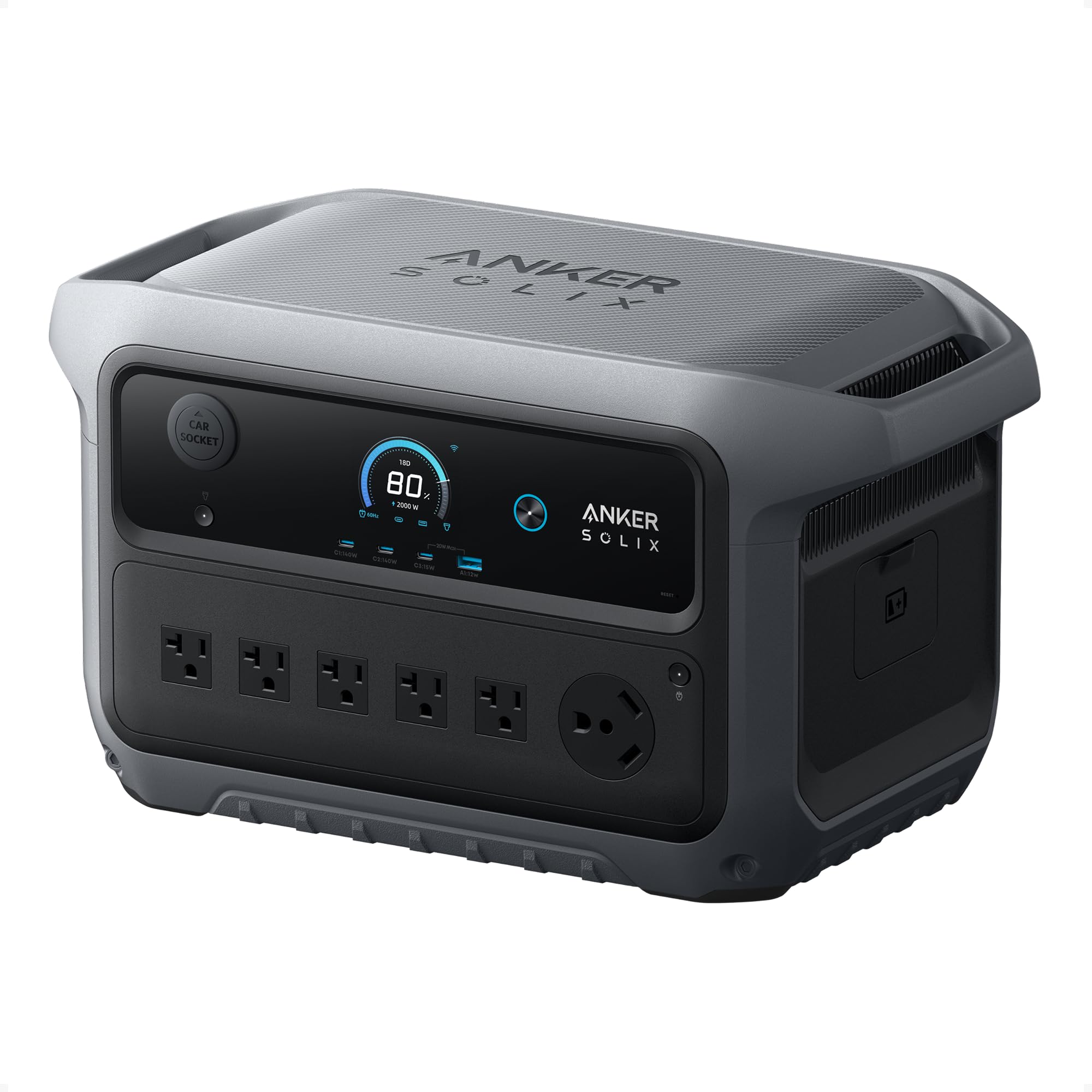
1. Anker SOLIX C2000 Gen 2 Portable Power Station
Our pick — over 4.5★ from 650+ verified ratings; the strongest balance of quality and price.
The fastest-refilling 2kWh station here — full in under an hour.
The C2000 Gen 2 is the pick when a storm is two days out and you want backup ready before the clouds arrive. It stores 2,048Wh in a LiFePO4 battery (lithium iron phosphate, the chemistry that tolerates thousands of recharge rounds), and it accepts six different recharge paths — AC wall, solar, alternator, car, generator, and AC-plus-solar combined. On wall power it goes from empty to 100 percent in 58 minutes. That speed is what separates it from the slower mid-tier units below, several of which need two to three hours to top off.
What it can actually run is the part buyers care about. At only 9W of idle draw, it powers a dual-door fridge for up to 32 hours on a single fill, and if you bolt on the expansion battery to reach 4kWh, that stretches to 64 hours. Rated output is 2,400W with a 4,000W peak, which is enough to start a window air conditioner or an RV A/C rather than just a fan. Camper owners run one alongside an alternator charger and rooftop solar and never touch shore power all season. Remote karaoke and outdoor weekends draw it down slowly — roughly 70 percent still showing after four hours of running, with an RV fridge, fans, and pumps lasting a three-day trip and finishing with about a quarter charge left. Charging from 27 percent back to full took one hour ten minutes on a standard household circuit.
Owners also use it as a desk-side UPS (uninterruptible power supply, the mode that instantly takes over when the wall goes dead) for a modem, router, and PC setup. The recurring note there is that pure-UPS duty will drain it in six to ten hours and one firmware update briefly dropped AC output — worth knowing if you plan to park servers on it. The other honest catch is price of entry: it is not the cheapest pick here, and Anker’s extended battery ecosystem costs extra. But at 18.9 kilograms — about 41.7 pounds — it shares a chassis with the AC and car outlets facing front, which is a small thing that makes daily use far less annoying.
What owners rave about
- Full charge in 58 minutes on AC — the fastest wall refill among the mid-range picks here.
- Six recharge routes including an 800W alternator charger that refills in three hours from the car.
- 9W idle draw keeps more of the 2,048Wh actually usable.
- Expandable to 4kWh for double the fridge runtime.
Where it asks patience
- Running it purely as a PC/modem UPS drains it in 6-10 hours, so it is a backup, not a wall replacement.
- Expansion batteries and the alternator charger are sold separately, so true 4kWh costs more than the sticker suggests.
- One reviewer noted that a firmware update knocked AC output offline — worth updating during a calm week, not during a storm.
Buy if: you want a storm-ready 2kWh backup that refills in under an hour and can grow to 4kWh later.
Think twice if: you need the absolute longest battery lifespan — the BLUETTI and Anker S2000 below both push cycle counts higher.
2. AFERIY P280 Portable Power Station 2800W
A 2800W inverter that refills from empty to 80 percent in 38 minutes.
For a homeowner who wants serious firepower without premium-tier pricing, the P280 is the value story of this list. It carries a 2048Wh LiFePO4 battery (lithium iron phosphate, the long-wearing cell type) and pushes it through a 2800W inverter, and it does both with a 1800W AC input that reaches 80 percent in 38 minutes. That matches the C2000 above on output and beats it on top-end wattage — 2800W rated here against 2,400W on the Anker — while leaving room in the budget for the optional expansion batteries, which take capacity all the way to 10.24kWh for multi-day whole-home backup.
The outlet layout is the giveaway that this was built for RV and jobsite use: it includes a NEMA TT-30 outlet, the round 30-amp plug RV parks use for shore power, plus dual solar inputs for DIY panel arrays. The UPS mode flips over in under 10 milliseconds, fast enough to keep critical gear alive through an outage, and it runs a true pure sine wave on both input and output — meaning the AC it makes is shaped like wall power, which protects laptops, TVs, and medical gear from the choppy waveform cheap inverters produce. Owners using it as a pellet-smoker power source report a hot grill startup pulling about 130W and idle running near 30W, with four separate single-hour high-heat cooks burning roughly a fifth of the battery.
Independent reviews back it up on the basics: recharge from wall in under two hours, and running a fridge, hot plate, air fryer, and phone chargers across a three-day camping trip starting at 100 percent and finishing near 29 percent — cool to the touch and barely audible the whole time. Where it takes work is utility and weight. There is no physical dial to slow the AC charge rate, so rate control happens through the required app, and that app wants a laundry list of device permissions. It also tips 44 pounds, which most users will want to move on a cart. One unit out of the pack had trouble charging past the mid-90s and generated a burned smell that support would not pursue — a single case against a stack of satisfied owners, but a reminder to test your charger during the return window.
Where it wins: highest peak output of the mid-tier picks at 5,600W, dual solar inputs, and 10.24kWh expansion ceiling make it the widest-ranging station in this group.
Where it asks a trade: 44 pounds is real weight, and the app-only charge control plus broad permission requests may bother buyers who prefer physical controls.
Reach for this if: you want maximum wattage and expandability at a mid-range outlay, especially for RV or pellet-grill duty.
Look elsewhere if: you want hands-off control with no app or plan to carry it up stairs.
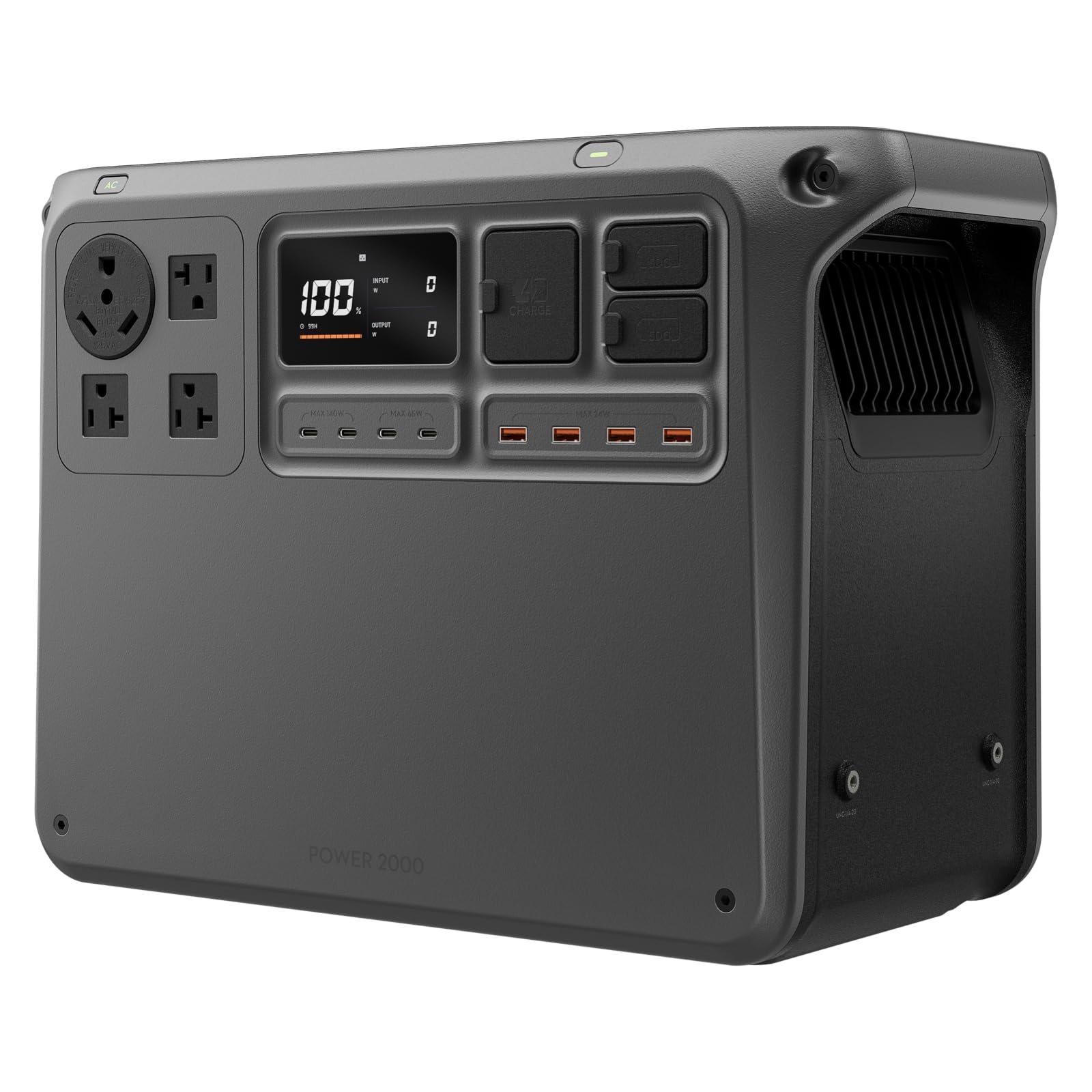
3. DJI Power 2000 Portable Power Station
A 3,000W powerhouse that runs as quiet as a whisper.
The DJI Power 2000 leads on a spec almost nobody thinks about until the first night: noise. It runs as low as 30 dB, roughly the level of a library, which is why RV owners love it for sleeping beside a charging phone and a pair of fans. Around that silence sits a genuinely strong unit — 3,000W of stable output from a 2048Wh LFP (lithium iron phosphate) battery, with a smart BMS (battery management system, the onboard computer governing charge and heat) and a flame-retardant housing that keeps it safe when weather turns rough. It also switches to battery in 10 milliseconds, which DJI notes is twice as fast as its Power 1000 sibling.
Where it goes beyond the pack is port count and app control. Fifteen ports include dual full SDC outlets — DJI’s own fast-charge standard — plus four USB-C, four USB-A, and four AC. It connects to the DJI Home app without needing a dongle, so you can check status from inside the RV. Owners replacing gas generators for small business use say the Power 2000 runs power tools and electric winches with 4,500W of inrush current and delivers that without oil changes, fuel leaks, or noise. A mobile DJ set running an Opus Quad, monitors, and audio interface for a six-hour pool session consumed only about a quarter of the battery.
The honest caveat is ecosystem lock-in. The SDC ports and the solar charging modules are proprietary, and DJI’s own peripherals have been subject to long back-order stretches that leave the fast-charging path stalled. MPPT (maximum power point tracking, the chip that squeezes the most watts from panels) and car charging modules are not built in, so solar setup requires an additional DJI adapter. There is no wheel kit either, and at 21.72 kilograms it is a two-handed lift. Weight and expansion accessories are the costs of a very quiet, very powerful, very DJI-shaped machine.
Standout detail: 30 dB noise level and 15 ports — including dual SDC connectors — make it the most companionable 2kWh unit for closed spaces.
The fine print to know: solar and car charging require DJI extra modules that have been slow to restock, and the SDC connectors only accept DJI accessories.
Pick this if: sleeping next to your power station is non-negotiable and you already trust the DJI accessory ecosystem.
Skip if: you want a plug-and-play solar path with generic panels — the DJI adapter requirement will slow you down.
4. ALLWEI 2400W LiFePO4 Power Station
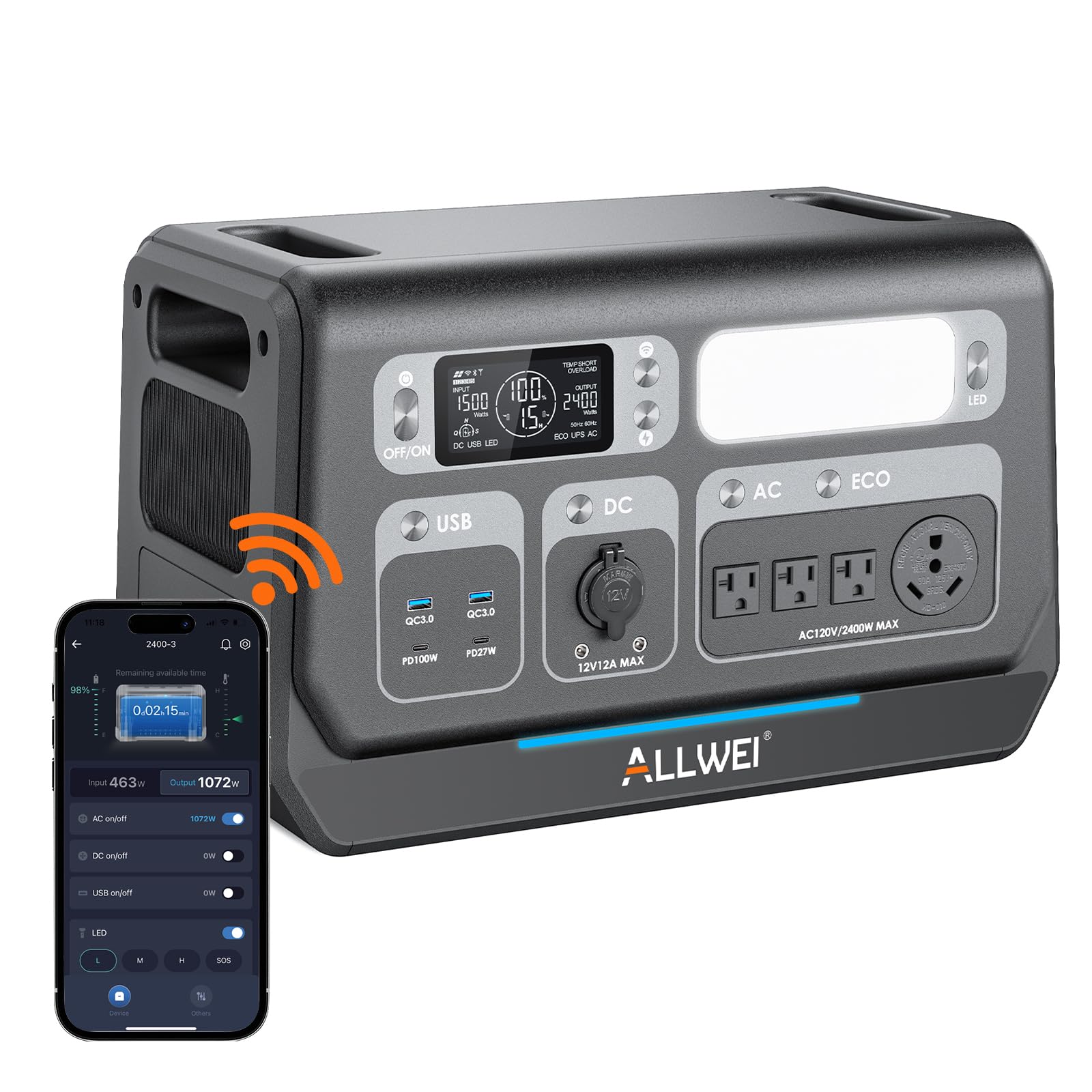
The one that wakes your fridge up on its own when the grid dies.
For travelers and people who leave a second home for weeks at a time, the ALLWEI’s headline feature is its ATS — that is automatic transfer switch, and it means the station reactivates itself after an outage without you pushing a button. A refrigerator, a fish tank pump, a home security system: all keep running while you are away. Under the hood sits a 2048Wh LiFePO4 battery with a 2400W pure sine wave inverter that pushes up to 3600W for a moment when big appliances kick on, plus built-in BMS and MPPT (the chip that pulls maximum wattage from solar panels without damaging them).
Two numbers stand out. First, expansion to 10,240Wh via the ALLWEI SGR-B200 PRO add-on battery — that is a substantial leap for a mid-tier chassis. Second, recharge speed: the AC input goes 0–80 percent in 45 minutes and hits full in 1.5 hours, putting it in the same neighborhood as the fastest units on this page. Owners running outdoor party lights on one charge called it compact, simple to transport, and quick to top up, and one buyer mentioned it mirrored a smaller system reliably enough to run a full second purchase order.
The catch worth naming is service experience. A single owner reported an intermittent shutoff and a warranty process that required paying return shipping, and felt the outgoing watt display was misleading near the bottom of the charge. It is one data point against a broad field of satisfied users — but the takeaway is real: keep your proof of purchase and confirm the seller’s return terms before relying on this as your only outage backup. Physical footprint is also not tiny at 51 pounds, so this is a place-and-leave-it station rather than a haul-everywhere one.
Reasons owners single it out
- ATS auto-restart means no manual intervention after an outage — ideal for unoccupied homes.
- 0-80% in 45 minutes, full in 1.5 hours on AC.
- Expandable to 10,240Wh with the separate B200 PRO battery.
- Pure sine wave output and 3600W lifting for appliance startup surges.
Where buyers hit friction
- Warranty handling has drawn complaints, including one buyer asked to pay return shipping.
- 51 pounds — this is not a station you carry up staircases.
- At least one owner found the outgoing-watt display inaccurate near the end of the charge.
Good fit for: part-time residents who need a station to re-arm itself while they are away.
Less ideal if: you want a featherweight carry or the smoothest warranty experience above all else.
5. GRECELL 2400W Solar Generator
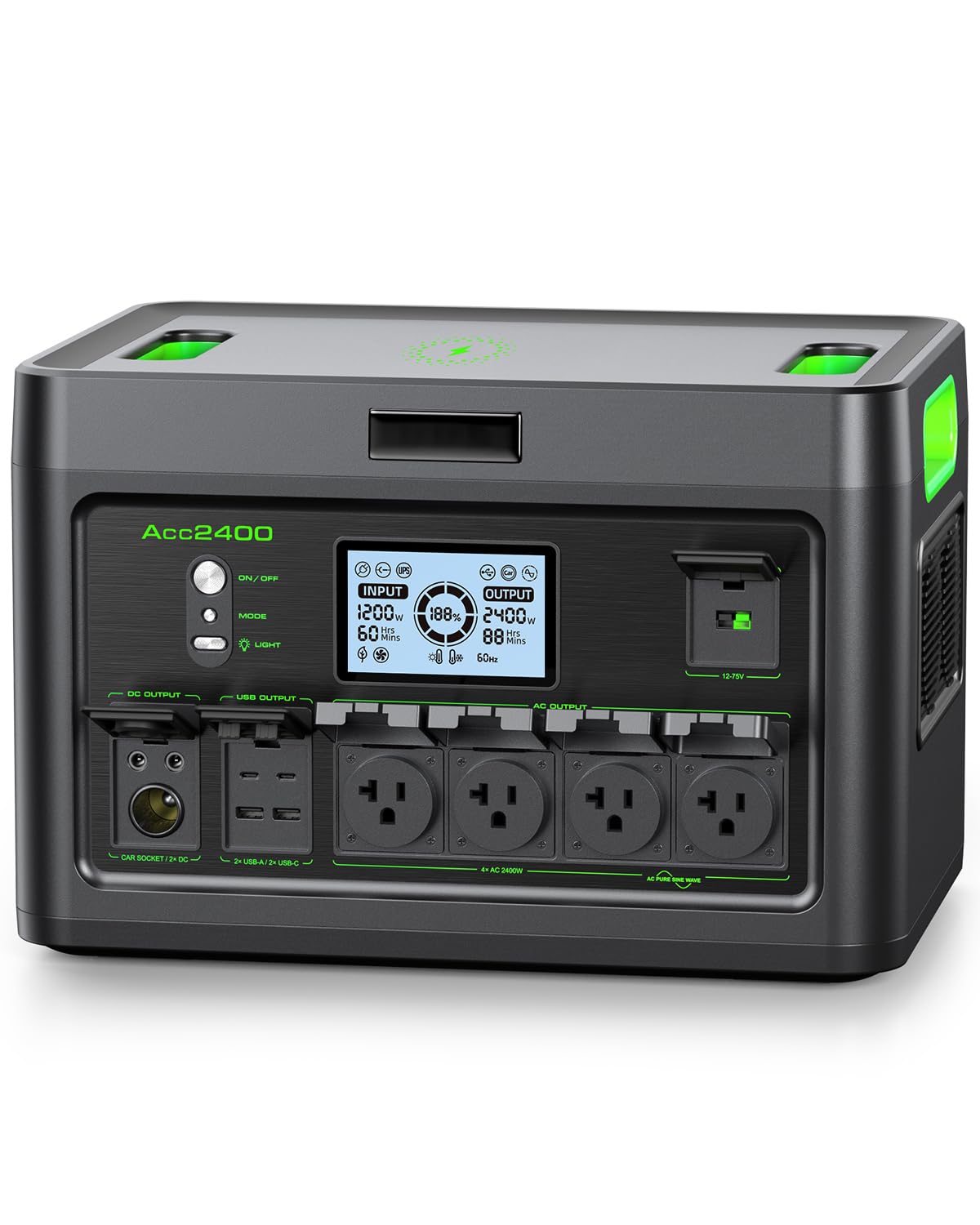
Twelve ports and a wireless charger pad built into the top.
The GRECELL aims squarely at the “there is never enough outlets” problem. Twelve output ports cover four 2400W AC plugs, two 100W USB-C PD ports for fast laptops, two 18W Quick Charge USB-A ports, DC sockets, a 12V car port, and a 10W wireless charging pad on top. With 1843.2Wh of LiFePO4 storage and a 2400W inverter running pure sine wave output, it handles a fridge, workstation, and coffee maker at the same time without cords fighting each other. Recharge is unusually quick — an AC adapter refills it in roughly 1.6 to 2.5 hours, no power brick needed, and combining AC with 800W of solar input can finish the job in as little as 1.8 hours.
One design choice is subtle but smart: a slow-charging mode that trades speed for battery longevity, useful if you cycle the station daily. Automotive-grade LiFePO4 cells are rated for 3500+ cycles, and the built-in BMS watches for overcharging, over-discharging, short circuits, and temperature extremes. Smart cooling fans are designed to boost heat dissipation efficiency, which matters under heavy loads when the inverter is working hardest. Owners running a fridge backup during outages report it holds charge well, recharges fast, and works simply by plugging appliances in — no setup fuss. A subwoofer-heavy TV-and-speakers rig ran about four hours before needing a top-up.
The recurring honest note is the wireless charging pad. At least a couple of buyers found it did not work consistently, so treat it as a bonus rather than a reason to buy. It is also heavier than several 2kWh rivals at 55.5 pounds and less expandable than the AFERIY or ALLWEI — no expansion batteries here. If you have plenty of small devices that need plugging in, though, this is the most outlet-dense station on the page.
Buying logic: the 12-port layout plus a 12V car outlet and wireless pad make it uniquely suited to a workstation or small workshop where many gadgets live.
Real limitation: the wireless charging pad is unreliable enough that you should not count on it, and there is no path to expand capacity later.
Worth owning if: you need one box to plug in everything — fridge, laptop, lights, tools — without swapping cords.
Pass on it if: you want a future expansion battery or a station you can lift one-handed.
6. GROWATT INFINITY 2000 Pro with 200W Solar Panel
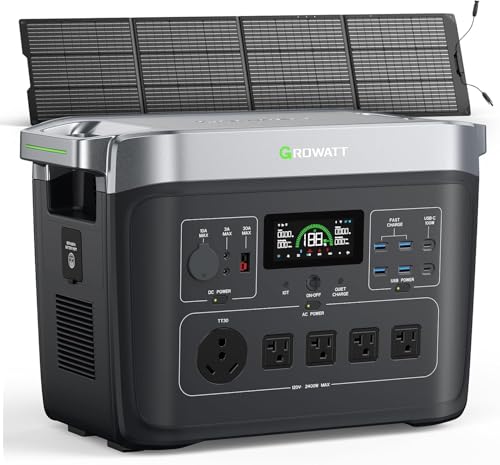
A bundled solar starter that keeps running when things freeze.
Winter campers and off-grid cabins have a specific problem: most battery stations stop cooperating when the temperature drops. The GROWATT INFINITY 2000 Pro carries Cold Start technology rated to -22°F, which keeps power flowing when other units go quiet. Inside is a 2048Wh LFP battery (lithium iron phosphate) rated for 4000+ cycles and pegged at a 10-year lifespan, feeding a 2400W AC output through 15 ports including standard RV connections. And unlike the standalone units above, this one arrives with a 200W solar panel in the box, so you can start harvesting sun the day it lands.
Real-world owners have pushed it further than the marketing claims suggest. Running a home office off-grid — computer, four monitors, shop lights, and a fridge — on daily solar top-ups is normal for these buyers. One long-term user reports running a diesel heater for a week per charge, powering power-tool batteries, and running all four 20-amp AC outlets at once without tripping anything. It accepts solar input up to 1200W, so a couple of series panels can deliver a serious charging stream. That is meaningful for anyone planning to move away from wall charging entirely.
The catch worth knowing is cable compatibility and customer service responsiveness. The 2000 Pro wants positive on the third pin of its XT60i solar connector — the opposite of some stock cables — so using the stock 14AWG cable can lead to returns until you sort it out. One owner solved it by soldering a 10AWG XT60i-to-MC4 cable, and another reported a unit that threw overload errors and had a DC port press into the case. Those are single cases against a mostly happy field, but they suggest testing the solar hookup and the DC port carefully during the return period. At 78 pounds this is the heaviest pick here — a station-and-panel kit that wants a permanent spot.
What you get: a 2,048Wh station plus a 200W panel in one box, cold-rated to -22°F, with solar input ceiling at 1200W.
Watch out for: XT60i polarity needing the positive lead on the third pin, and 78 pounds meaning permanent placement, not hauling.
Built for you if: you live somewhere cold, want a bundled solar starter, and are comfortable with basic cable DIY.
Move on if: you want a plug-and-play solar kit with no polarity surprises or customer-service waiting.
7. Jackery Explorer 2000 v2 Portable Power Station

A 2kWh station you can actually pick up without grunting.
The Jackery Explorer 2000 v2 makes its case on a number that shopping sites rarely highlight: 39.5 pounds. That is lighter than most other units in its class, and Jackery states it is also smaller than typical 2kWh LiFePO4 stations. It achieves that with CTB (Cell-to-Body) construction, a build technique borrowed from electric vehicles that sandwiches the battery cells directly into the chassis instead of packing them in a separate frame. The payoff is a station that a 69-year-old can move and a camper can load without a hand truck. Capacity sits at 2042Wh with a 2200W AC output across three AC ports, plus a USB-C PD 100W port for charging laptops at full speed.
Recharge speed is competitive: 0–80 percent in 66 minutes on AC, full charge in 102 minutes via the Emergency Super Charging mode in the app, or about 6 hours from 400W of solar panels. A silent charging mode drops the fan to 30 dB — quieter than most appliances — so you can top it up overnight without hearing it. The UPS side is one of the more rigorously certified here: Jackery states the unit passed UL1778 testing for uninterruptible power systems with a 20 ms switch time, and buyers have leaned on it accordingly. Off-grid owners in Belize run their Wi-Fi and internet through it when storms cut power, and one report describes a fridge running for 21.3 hours on a single charge during a 30-hour outage — enough to save the contents.
Two honest notes. An electrical engineer testing one unit found the usable capacity lower than the rated 2042Wh once idle draw was factored in — the math pointed to inefficiency rather than a bad battery, but the takeaway is that any station loses some capacity to standby consumption. A second recurring gripe is the app: Bluetooth connections can be flaky, and solar barrel ports on the side flex inward slightly, which suggests care is wise when plugging and unplugging solar cables. Neither is a deal-breaker at this price tier, but they are the reasons the Explorer is a strong pick rather than a perfect one.
What buyers praise most
- 39.5 lb weight and CTB build make this the easiest 2kWh station to move in this group.
- 0-80% in 66 minutes and a silent charging mode at 30 dB.
- UL1778-certified UPS with 20 ms switch time — the most rigorously tested UPS on this page.
- Fridge runtime of over 21 hours in real owner reports.
Caveats to weigh
- Idle power loss can bring real-world capacity below the rated 2042Wh.
- App and Bluetooth connection glitches have been a repeated owner complaint.
- Solar barrel ports flex under cable insertion, so use a light touch.
Leans toward: campers, older buyers, and anyone who moves their power station rather than parks it.
Could disappoint: users who want rock-solid app control — the connection has been inconsistent.
8. OUKITEL P2001 Pro Power Station with 200W Solar Panel
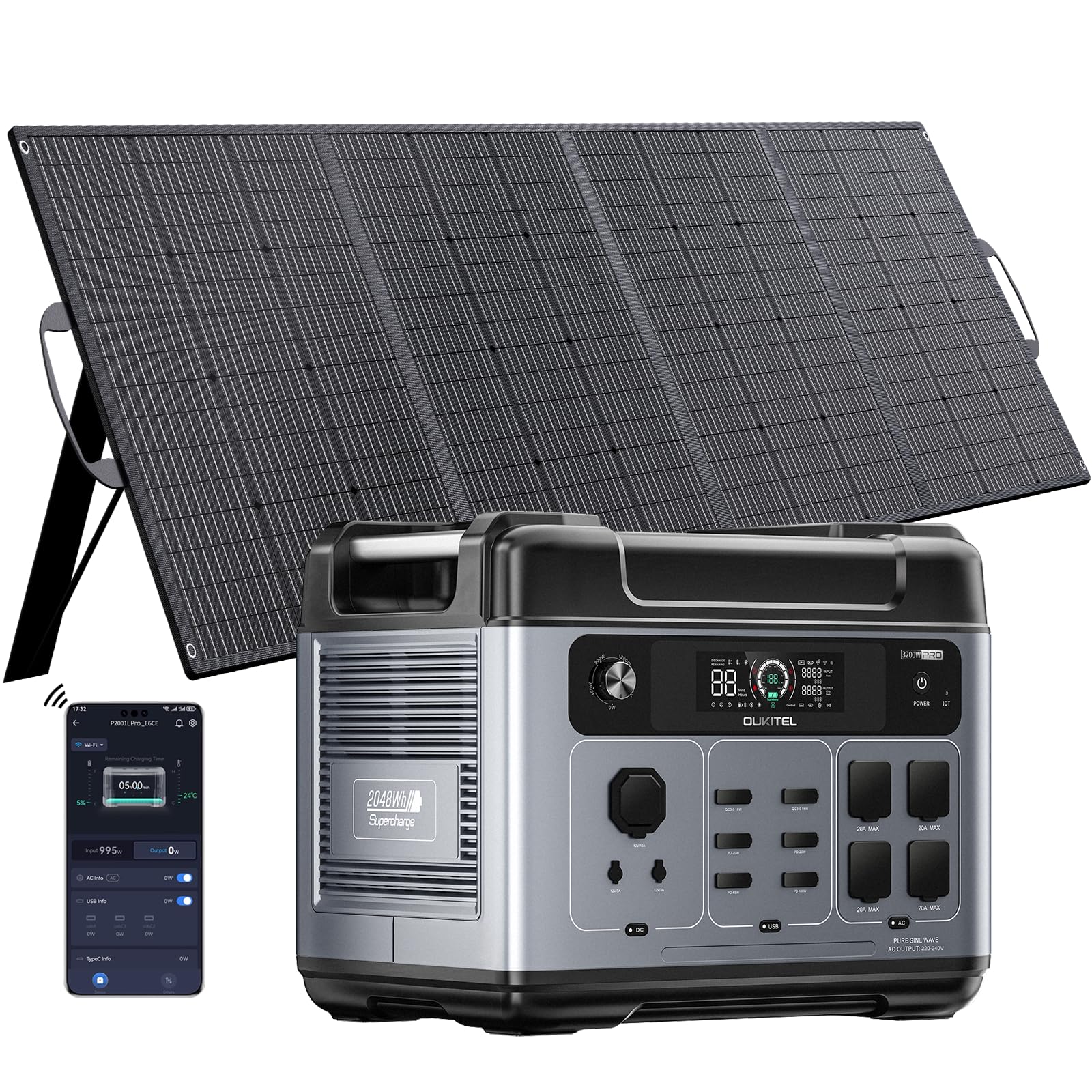
3,200W of output and 2048Wh capacity with the panel thrown in.
If you have high-draw tools that need serious wattage, the OUKITEL P2001 Pro answers with 3200W of rated output — the highest continuous figure on this list. That rating means it can push electric kettles, hair dryers, and shop vacuums that would trip a smaller inverter, and it does so from a 2048Wh LiFePO4 battery rated for over 4000 cycles, or roughly a 15-year lifespan per OUKITEL. Recharge is fast too: 1800W AC input gets you 0-80 percent in an hour and full in 1.5 hours, and combining AC plus solar up to 2800W finishes an 80 percent recharge in only 50 minutes. A 200W portable solar panel is bundled, so you get a full off-grid kit from the start.
The unit is also compact for what it delivers — OUKITEL states it is 23 percent lighter and smaller than conventional units in the same capacity tier — and at 50 pounds it is closer to the Jackery’s manageable range than the heavier GROWATT. The UPS function switches in 5 to 8 milliseconds, keeping sensitive electronics alive through a brownout, and the app connects over Bluetooth or WiFi to let you monitor and toggle output remotely. A mobile detailing business owner reports the P2001 Pro running vacuums, pressure washers, and an air compressor with no issues — the kind of load that would kill a weaker unit.
There are two honest caveats. First, the included solar panel is a cloth-style folding panel and the manufacturer instructs keeping it dry, so it is not weatherproof in the way rigid metal panels are — it works fine, but shelter it. Second, the app requires a 2.4GHz WiFi network even when you want to use Bluetooth, which has blocked at least one buyer from connecting at all. That person simply ran the station without the app. The one strongly negative review on record involves a defective unit and a rocky return process with the seller, which is worth confirming against current seller policies before purchase. Most buyers report the unit performing exactly as advertised.
Its edge: 3200W output, 4000+ cycle LiFePO4 battery, and a bundled 200W panel make it the standout power-to-size pick at this price band.
Its trade-off: app setup wants 2.4GHz WiFi even for Bluetooth use, and the folding panel is not weatherproof.
Strong option for: buyers who need to run high-wattage tools and want an off-grid panel kit included.
Not for: anyone who refuses to run a 2.4GHz WiFi network for app control or needs a rigid weatherproof panel.
9. Anker SOLIX S2000 Portable Power Station
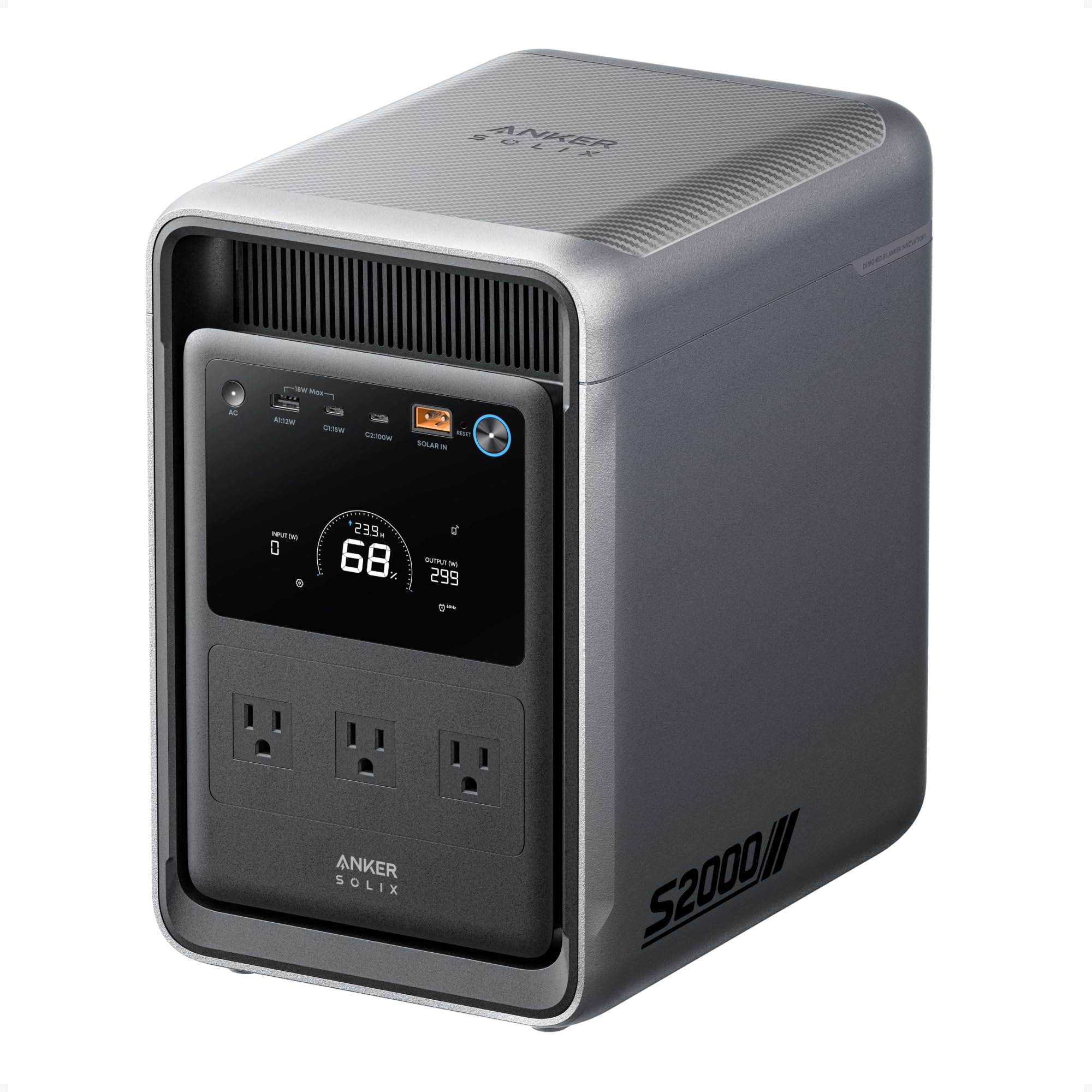
Ten thousand charge cycles, a 35-hour fridge run, and just 35.7 pounds.
The S2000 is the smallest and lightest 2kWh station on this page — 35.7 pounds in a chassis measuring 8.2 by 11.1 by 12.7 inches — and it earns the title with two standout specs. First, the LFP battery (lithium iron phosphate) is rated to 10,000 charge cycles, which Anker translates to about a 15-year lifespan; that is a substantially longer rating than the 3,500-to-6,000 cycles of most rivals here. Second, thanks to a 6W idle draw and higher internal efficiency, it can run a dual-door fridge for up to 35 hours per charge, longer than most 2kWh systems. Its 1,500W continuous output with 3,000W peak is enough to keep nearly every home essential running.
Owners have validated the fridge claim from several angles: one ran a full-size fridge nearly 30 hours with 20 percent battery left, and another ran an older unit 27 hours on a full charge in real overnight backup duty. A third reported powering a window AC for an hour, dropping only to about 80 percent. The eight outlets are split front and rear — an unusual design that lets you plug always-on appliances into the back while keeping daily devices up front for a tidier setup — and Jackery-competitor-style UPS duty is fast at under 10 milliseconds. Six recharge paths cover wall, solar up to 400W, an alternator charger, and more.
The honest caveat is that the S2000 has fewer expansion options than its bigger C2000 sibling: no extended-battery support, no cigarette lighter input, and a 400W solar input ceiling that is lower than the C2000’s. Owners also note the fan is noisy during high-wattage charging, and some report a burn-off smell during the first charge that fades afterward. At 35.7 pounds with a well-shaped handle, this is the station to pick if you value refrigerator runtime, long battery life, and portability over expandability.
The case for it
- 10,000-cycle LFP battery — the longest-rated lifespan on this page.
- Up to 35 hours of fridge runtime, helped by a 6W idle draw.
- 35.7 pounds in a 8.2 x 11.1 x 12.7 inch chassis — smallest 2kWh station here.
- Under-10ms UPS makes it a real replacement for a desktop UPS.
Where you compromise
- No expansion battery support and no 12V cigarette lighter input.
- 400W solar input ceiling is lower than its C2000 sibling.
- Fan noise during high-wattage charging has been a repeated note.
Right for: apartment dwellers and small-home owners who need maximum fridge runtime and long battery life without weighing themselves down.
Wrong for: buyers planning to grow capacity with expansion batteries — this one stays at 2,010Wh.
10. Generac GB2000 Portable Power Station

Rated runtimes listed by the maker — 15 fridge hours, 45 CPAP hours.
The Generac GB2000 is the odd one out on this list in a useful way: it uses lithium-ion NMC cells rather than LiFePO4 (the more common modern chemistry), which delivers a slightly higher energy density and a rated 1,000-cycle life to 80 percent. That is a shorter cycle buffer than the LiFePO4 picks above, which is worth knowing if you intend to discharge and recharge daily. The 2,106Wh capacity feeds a 1,600W continuous and 3,200W peak inverter. Generac also publishes exact runtime estimates: a fridge at roughly 120W for 15 hours, a CPAP at around 40W for 45 hours, a 50-inch TV for 16.4 hours, and a 1,000W coffee maker for 1.8 hours. Those figures are the reason a lot of first-time buyers choose this unit.
Two features get recurring praise. First, pass-through power — the station can charge while discharging, so you can keep it plugged into the wall and run appliances off it without a break. Second, the outlet count: ten outputs including a Qi wireless charging pad on top, three 120V AC plugs, two USB-C at 65W each, andtwo USB-A at 15.5W each. At 48.8 pounds with a 4.7-inch multi-color display showing live wattage and runtime, it is easy to read at a glance. Buyers running a Dyson fan, iPads, and WiFi for 14 hours report using only 15-20 percent of battery, which is a genuinely efficient result.
Where the GB2000 shows its age is speed. Wall input takes 3.3 hours to reach 80 percent — roughly three times slower than the fastest units on this page — and solar input caps at 468W from the built-in MPPT controller. The parallel-ready feature is nice, since two units can combine into 4,212Wh and 3,200W continuous via a separately sold 30A Parallel Kit, but that accessory does not come in the box. Some owners have reported units that would not charge at all, and value-per-watt is more modest here than with the newer LiFePO4 competition. This is a good station for buyers who want Generac’s brand history, pass-through simplicity, and wireless charging — not for anyone chasing the longest cycle life or fastest recharge.
Real strengths: maker-published runtimes for common appliances, pass-through charging, ten outputs with wireless pad, and a well-organized 4.7-inch display.
The honest limits: 1,000-cycle NMC battery is a shorter lifespan than the LiFePO4 picks, 3.3-hour recharge is slow, and the parallel kit is a separate purchase.
Best matched to: buyers who want published runtime numbers, a widely known generator brand, and wireless charging convenience.
Better choices exist if: you plan to cycle the battery hard daily, or you want the fastest recharge in the list.
11. BLUETTI Elite 200 V2 Portable Power Station

A 6,000-cycle cell that pushes 3,900W in lifting mode.
If you want to run hair dryers and induction cooktops without a trip to a coin-op laundry, the Elite 200 V2 is where this list tops out on raw output. It carries a 2073.6Wh LiFePO4 battery with 2600W of continuous AC and 3900W of “lifting” output — a burst mode that lets the inverter briefly feed high-inrush appliances like fridges and cooking gear. BLUETTI is also the only unit here that supports dual AC and DC fast charging simultaneously, reaching 0–80 percent in just 50 minutes, while a single AC charge tops out at 1 hour. It runs an unusually low standby draw — around 10W — which means more of the 2073.6Wh actually reaches your appliances.
what separates it from every other pick is the battery rating. BLUETTI pegs the cell at over 6,000 charge cycles, which it describes as up to a 17-year lifespan in ordinary use. Only the Anker S2000 above approaches that number. Meanwhile the power delivery remains practical: owners have run an induction cooktop, an air fryer, a pressure cooker, and a toaster oven — sometimes two air fryers at once — plus a fridge, freezer, and full office setup, all from the same unit. A month-long tester reported the unit handled an iron, hair dryer, shop vac, and portable AC with headroom, then recharged from solar via 130W panels in series. In an off-grid cabin setting, the same unit trickle-charged a stalled 12V battery bank through a snowstorm to bring a critical system back online.
The trade-off is weight and setup friction. At 53.4 pounds the Elite 200 V2 is heavier than the Jackery or Anker S2000, so it is best on a cart or with two hands. Owners note the hold-to-power buttons prevent accidental battery drain, but the buttons themselves are small. A few users have mentioned occasional state-of-charge calibration quirks, where the battery readout needed a full charge/discharge cycle to settle back to normal. And the app is required for the more advanced charging modes — three profiles including a Turbo, Standard, and Silent setting. If you want a station that will still hold most of its capacity a decade or more out, this is one of the strongest arguments on the list.
The strongest cases for it
- 6,000+ cycle LiFePO4 battery with a 17-year durability claim — longest on this list alongside the S2000.
- 0-80% recharge in 50 minutes via dual AC+DC, full in 1 hour on AC alone.
- 3900W lifting output clears high-surge appliances like fridges and induction cooktops.
- Just 10W of standby draw keeps more of the 2073.6Wh available for real loads.
Real drawbacks
- 53.4 pounds is heavy for a 2kWh station — plan on a cart or a stable spot.
- Advanced charging modes live only in the app; no physical dials.
- A few users encountered state-of-charge calibration quirks requiring full reset cycles.
Best for: high-output off-gridders and cabin owners who want the longest battery life and can tolerate the weight.
Skip if: you need one-hand portability or refuse to use an app for charging controls.
12. EF ECOFLOW DELTA 3 Max Portable Power Station
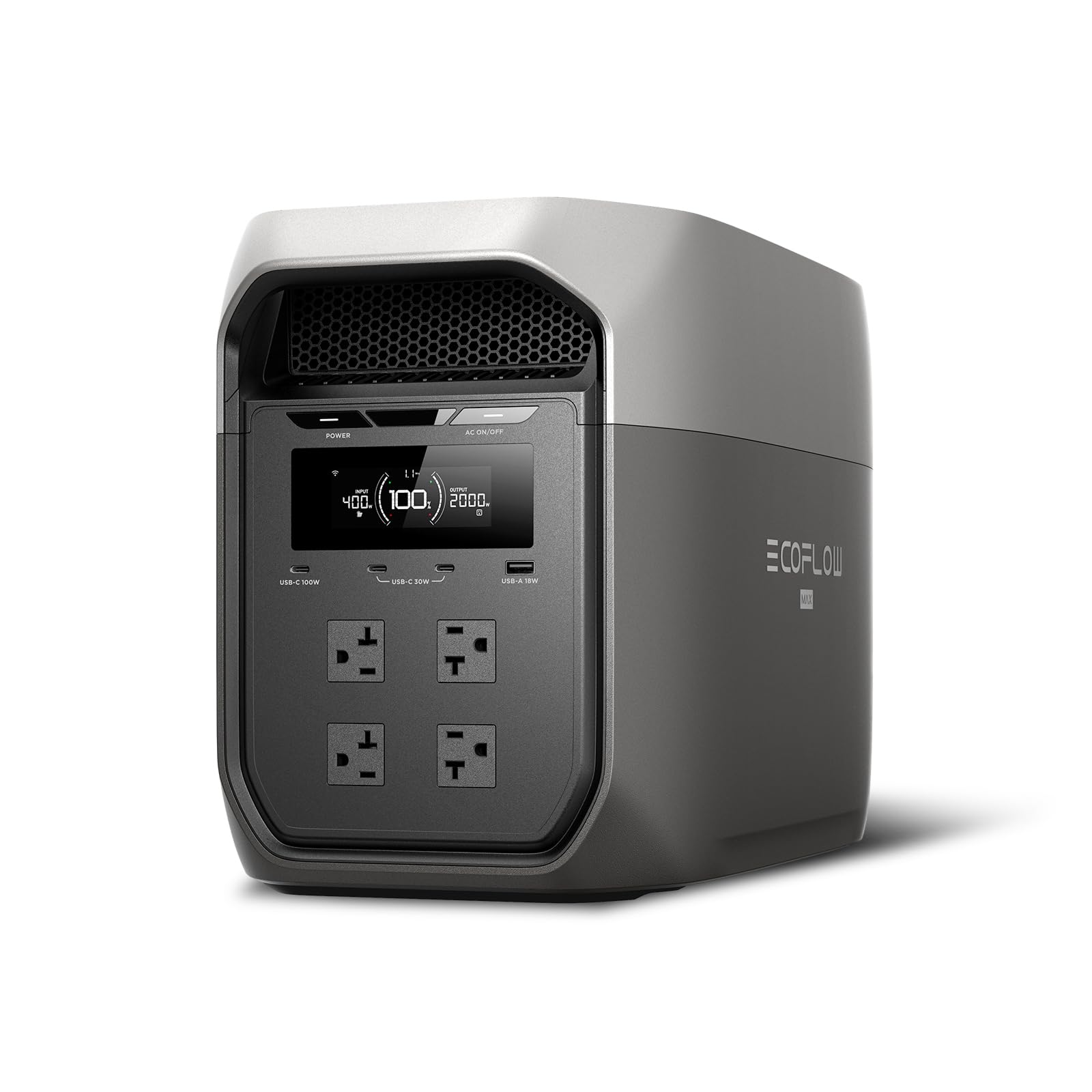
X-Stream refill in a little over an hour, X-Boost to run 99% of gear.
The DELTA 3 Max earns its place with two numbers: 0-80 percent recharge in 1.13 hours, and 3,400W of X-Boost output from a 2048Wh LiFePO4 battery. That X-Boost is the reason this unit can run appliances that would normally trip a smaller inverter — ECOFLOW rates it as covering 99 percent of typical household gear, including microwaves and power tools. The battery is rated for around 10 years of daily use, and the UL-style UPS switchover happens in under 10 milliseconds, fast enough to shelter desktop PCs and medical devices from an outage. A 5-year service policy backs the hardware.
Where owners get excited is the app and the charging speed. One customer running a family dessert business uses it to power a waffle iron and one to two freezers, leaning on the strong surge capability that carries the compressor startup on a chest freezer without tripping the inverter. A different user moved their whole household setup during a Cuba-wide outage onto a DELTA 3 Max, running a fridge and small appliances for basic household needs. Its 2400W continuous rating delivered sufficient headroom in both cases. The X-Stream technology that makes the fast recharge possible is the same mechanism buyers call out repeatedly as a favorite feature.
The honest note is a weight and app-learning detail. At 19.8 kilograms — about 48 pounds with a hand truck included — the DELTA 3 Max is mid-pack on portability, which is why the included hand-truck matters. Charging cables also matter: an XT60i cable open up higher solar current while a plain XT60 cable limits solar input to 12V at 8A, so pick your cable knowingly. Owners mention the app pairing cleanly over Bluetooth first, then needing WiFi to complete setup, and the second home screen can be confusing until you learn the layout. Front buttons can be hard to see in dim light. None of these is a dealbreaker — together they are the small costs of a very fast, very powerful station.
Why it stands out: 1.13-hour recharge, X-Boost to 3400W, and a 10ms UPS together make it among the most complete 2kWh stations in mid-size packaging.
The fine print: 48 pounds needs the included hand truck, and XT60 cables (not XT60i) will cap solar input to 12V/8A.
Ideal for: buyers who want the fastest all-around recharge and X-Boost headroom for high-surge appliances like freezers.
Not ideal for: anyone who wants a truly lightweight carry or hates configuring an app to open up the setup.
Understanding the Specs
Capacity in watt-hours (Wh)
Watt-hours are the size of the fuel tank — the total energy stored inside. A 2048Wh station, for the avoidance of confusion, holds roughly enough to run a 200W appliance for about ten hours in perfect conditions. Real life takes a cut: standby draw, inverter losses, and the depth of discharge all eat into the number on the box. That is why a station with just 6W of idle draw can deliver noticeably more usable hours than one with a 20W standby loss from the same battery. When you compare picks here, treat the Wh number as a starting point and factor in the idle draw and the cells’ health rating.
Battery chemistry and cycle life
LiFePO4 (lithium iron phosphate) is the chemistry used by most picks here, and it is rated for several times more charge-discharge cycles than the older lithium-ion NMC cells. Cycle life is how many full charges and discharges the battery survives before it drops to roughly 80 percent of its original capacity. LiFePO4 options in this list run from 3,500 cycles to 10,000 cycles — a wide spread that directly translates to how many years the station stays useful. If you plan to cycle daily, buy the longest-rated cells in your budget. If it is a storm tool that sits idle nine months a year, cycle life matters less than capacity and recharge speed.
Inverter output and peak power
The inverter is the part that turns the battery’s stored DC power into household-style AC. Its rated watts tell you what it can run continuously; its peak or lifting watts tell you how much momentary surge it can absorb when a fridge compressor or an air conditioner kicks on. A pick rated 2,400W continuous and 4,000W peak can start appliances that a 1,500W unit cannot, even when they draw the same watts once they are running. Look at both numbers rather than just one — and remember that pure sine wave output, which most picks here use, matches the shape of wall power and protects sensitive electronics better than cheaper modified sine wave inverters.
Recharge speed and solar input
How fast the station refills is a feature in its own right during storm season. Wall charging here ranges from under an hour on the fastest picks to around three and a half hours on the slower ones. Solar input is measured in watts, and the higher the ceiling, the fewer panels you need. Some picks here accept up to 1,200W of solar; others cap at a lower number. If you want a truly self-sufficient setup, look at the solar input wattage and how many panels the unit can take in series — that ceiling is what determines how quickly you can refill in a grid-down scenario.
FAQ
How long will a 2000 Wh power station run my refrigerator?
What is the difference between LiFePO4 and lithium-ion NMC batteries in a power station?
Can I use a power station as a UPS for my home office?
How fast can a 2000 Wh power station recharge from a wall outlet?
Do I need a solar panel to charge these stations, or can I just use the wall?
Will a 2048 Wh power station run a window air conditioner?
How long does the LiFePO4 battery in a 2000 Wh power station actually last?
What is peak or lifting output, and why does it matter?
Are these stations safe to use indoors like a gas generator?
How heavy are these stations, and can one person lift them?
Final Thoughts: The Verdict
For most people, the 2000 wh power station winner is the Anker SOLIX C2000 Gen 2 because it refills in 58 minutes, runs a dual-door fridge for up to 32 hours, and can grow to 4kWh with a bolt-on battery. If you want the fastest recharge possible or plan to run a dishwasher or induction cooktop, reach for the EF ECOFLOW DELTA 3 Max — its 1.13-hour recharge and X-Boost output carry loads few stations this size will. And for the longest battery lifespan across a decade of daily use, the BLUETTI Elite 200 V2 is the one to reach for, with 6,000+ cycles on a true automotive-grade LiFePO4 cell.
One honest nudge: if you have a specific appliance you need to power — a CPAP, a fridge, a freezer — match the station to that load first by checking continuous watts and cycle rating, then compare the smaller details. Fast recharge and long cycle life are what separate the picks here from the cheaper 1,000Wh-class units that will not carry you through a real outage.
How We Picked
We do not accept paid placement. Every pick is matched to a real buyer and a real use-case; we do not hands-on test units.
Sources & Methodology
Specifications: manufacturer listings and product documentation. Review insights: verified customer reviews, as of September 2026. Pricing: not shown on this page (it changes often); check the current price via the retailer link.
As an Amazon Associate, KitchPrep earns from qualifying purchases. This does not affect which products we feature.
Related Guides
