
Specs are compiled from manufacturer listings and verified buyer reviews and can change over time — please confirm the key details on the product page before buying.
If you are shopping for a 200-watt solar panel, the one thing that actually matters is whether it delivers near its rated watts in real sunlight — not in a lab. This list covers rigid rooftop panels built for vans and RVs, portable folding panels you can carry to a campsite, and a flexible panel that hugs a curved roof. Every pick here is genuinely a 200-watt-class panel: some are exactly 200W nominal, and a few sit in the same power tier with a slightly different footprint, which is the honest way to compare them.
I’m Mohammad Maruf — the founder and writer behind KitchPrep. This guide is built by comparing the manufacturers’ published specifications and the patterns across verified customer reviews, so you get each pick’s real strengths and trade-offs instead of marketing spin.
You will see conversion efficiency, cell type, and real-world wattage discussed in plain terms so you can pick the right panel without guesswork. Our breakdown of the best 200 W solar panel separates true rated output from wishful advertising.
Our Picks at a Glance

How To Choose The Best 200 W Solar Panel
A 200-watt panel is a serious power source, not a trickle charger. It can keep a camper battery topped up through a weekend or push meaningful charge into a portable power station. The trick is knowing which numbers tell you how it will behave once it is bolted to a roof or propped on a campsite table.
Efficiency and cell type
Efficiency is the share of sunlight a panel turns into usable electricity. A panel listed at 25% efficiency converts more of the light that hits it than a lower-rated one, so you get more watts from the same surface area. Cell type matters too: N-type cells and 16BB or 18BB busbars (the thin metal ribbons that carry current across the cells) generally reduce hot spots and hold output better in heat. If roof space is tight, higher efficiency does more for you than a bigger panel ever could.
Bifacial gain and shade handling
Bifacial panels capture light bouncing off the surface behind them — white roofing, sand, or gravel — which can add noticeable extra power in the right setup. Shade tolerance is the other half of the story: a panel split into independent halves keeps working when trees or a rooftop vent block one side. On a boat, RV, or van, real-world shading is the norm, so this matters more than a lab wattage figure.
Rigid versus portable versus flexible
Rigid glass panels are the go-to for permanent rooftop installs and last the longest in weather. Portable folding panels use a lighter build so you can carry them to a clearing and angle them at the sun, which is why they suit camping and emergencies. Flexible panels bend over curved surfaces like a van roof or the front of a car where a flat panel simply will not sit flush. Match the form to where it will actually live.
Quick Comparison
| Model | Best For | Efficiency | Weight | Cell / Busbar | Amazon |
|---|---|---|---|---|---|
| Callsun N-Type 200W Bifacial★ Best Overall | Class B vans and tight roofs | 25.6% | 23.8 lb | N-Type 16BB | Amazon |
| JJN 200W BifacialBest Value | Budget rooftop arrays | 23% | 25 lb | Monocrystalline 10BB | Amazon |
| Newpowa 10BB 200W MonoMost Proven | Cabin and RV roof solar | High Efficiency | 24.4 lb | Monocrystalline 10BB | Amazon |
| Renogy 200W N-Type 16BB | Space-saving van installs | 25% | 23.4 lb | N-Type 16BB | Amazon |
| BougeRV 200W Bifacial 16BB | Roof and off-grid rigs | 25% | 22.8 lb | N-Type 16BB | Amazon |
| ZOUPW 200W Portable | Power station camping | 23.5% | 19 lb | Monocrystalline | Amazon |
| RICH SOLAR 200W N-Type 18BB | Starlink and RV loads | 25% | 24 lb | N-Type 18BB | Amazon |
| Renogy 200W Portable E.Flex | Backpack-size off-grid power | 25% | 13.9 lb | N-Type 16BB | Amazon |
| BougeRV Arch Pro 200W Flexible | Curved roofs and shade | 25% | 7.9 lb | N-Type 16BB | Amazon |
| Go Power Overlander-E 200W Kit | Upgrading a Go Power RV system | High Efficiency | 24.5 lb | Monocrystalline | Amazon |
In‑Depth Reviews
1. Callsun N-Type 16BB 200W Bifacial Solar Panel
Our pick — over 4.5★ from 400+ verified ratings; the strongest balance of quality and price.
The highest efficiency on this list at 25.6%, and buyers report it exceeding its 200W rating in direct sun.
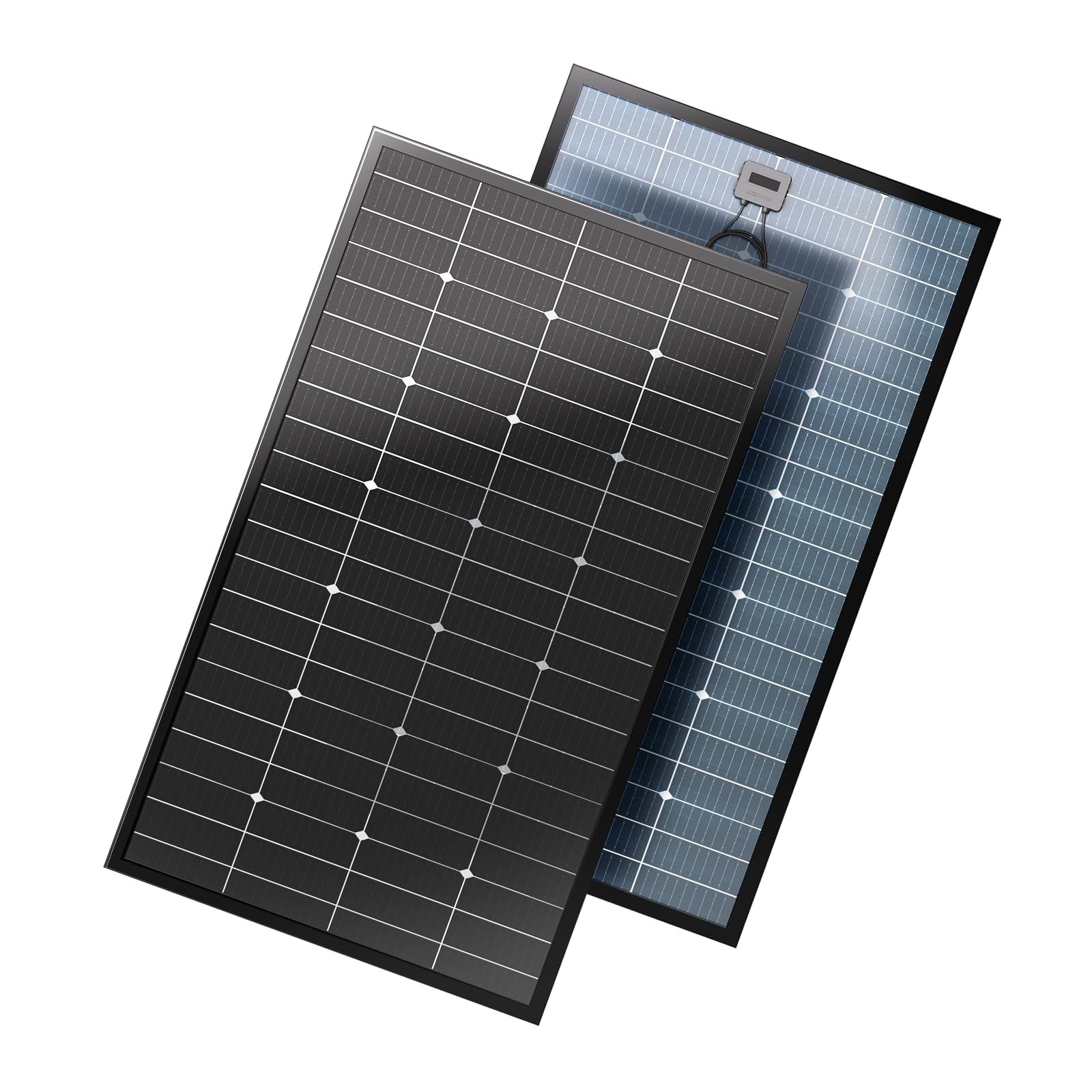
If your roof space is tight but you still want strong output, this panel is the one to pick. It uses N-type cells and 16BB busbars (the metal ribbons that collect current across each cell) to reach 25.6% conversion efficiency — the highest on this list, so more sunlight becomes usable watts. The panel measures 51.3 x 30.3 x 1.4 inches and weighs 23.8 pounds. That 1.4-inch depth is the trade-off: it sits a bit deeper than the slimmer Renogy 200W N-Type at 1.2 inches. The 16BB design also reduces hot spots and hidden cracks, which helps protect output over years of sun.
Where it earns its keep is shade. The dual-module parallel layout splits the panel into two independent halves, so when one side is blocked by a rooftop vent or tree branch, the other half keeps generating. Owners repeatedly confirm it overdelivers in good sun: a real-world 200W panel exceeding its rating and producing roughly 215W in direct light. The bifacial backsheet (the transparent rear layer that catches light bouncing off the ground) adds measurable gain when the panel sits over a reflective surface. The junction box is IP68-rated, meaning it is sealed against dust and continuous water immersion, and the temperature coefficient of -0.3%/K keeps output steady in scorching summer heat.
The catch is honest and worth knowing upfront: this is a heavy, deep rigid panel at 23.8 pounds, so you want it permanently mounted, not carted around. A few owners running it in Texas heat reported figures below rating in extreme temperatures. The company backs it with 10 years of support and a 25-year performance commitment that holds at least 84.5% output — that long-horizon promise is what you are paying for.
Why it takes the top spot
- 25.6% efficiency — the highest conversion rate on this list
- Bifacial backsheet adds extra output from reflected light
- TwinCell dual-module design keeps power flowing when one half is shaded
- IP68 junction box and -0.3%/K temperature coefficient for hot climates
- 25-year performance commitment holding at least 84.5% output
Where it asks you to commit
- 23.8 lb and 1.4 inches deep — a permanent-mount panel, not a portable one
- Some owners in extreme heat saw output dip below the rated figure
Reach for this if: you have a tight van or RV roof and want the most watts per square foot with real shade protection.
Look elsewhere if: you need something you can carry to a campsite — the weight and depth make that impractical.
2. JJN 200W Bifacial Solar Panel, 12/24V 23% Efficiency 10BB
A budget rooftop panel that runs 28.1 volts and 9.12 amps — more voltage and current than the pricier Callsun.
If you are building a multi-panel array on a budget, this is the one that keeps showing up in serious setups. It runs at 28.1 volts and 9.12 amps — higher voltage and current than the more expensive Callsun at 23.74 volts and 8.43 amps, so it moves more juice per panel. The trade-off is weight: at 25 pounds it is heavier than the 23.8-pound Renogy above, even though both are 200-watt panels. Efficiency sits at 23%, a touch behind the N-type crowd, but the price tier is where it wins.
The bifacial back can add up to 30% more power from the rear on white reflective surfaces, but only about 5–10% on grass and 15–25% on sand or gravel — so how you mount it changes what you get. It holds stable output on cloudy days and at dawn and dusk. The black corrosion-resistant aluminum frame handles 2400Pa wind and 5400Pa snow loads (a measure of how much pressure it can take). The IP68 junction box and connectors (sealed against dust and water) protect it from weather. Owners run serious rigs on these: eight panels in series and parallel pushing full wattage into a 24V system, four panels powering a whole shop, and one reporting a single panel hitting 220W peak — 110% of its rating — with about 195W sustained in full sun.
One thing to plan for: the connectors are MC4, and the included cables run short on some installs. A few units arrived cracked in transit, though the company replaced them quickly. For the money, this is high value per rated watt.
The value math: you give up roughly two efficiency points versus the top pick and gain a lower cost tier and higher voltage, which is why it anchors budget-minded rooftop arrays so well.
Build an array on a budget with this: it delivers full wattage and shrugs off weather at the entry tier.
Pass on it if: you need the lightest or slimmest panel — 25 pounds suits a fixed install, not a carry-along.
3. Newpowa 10BB 200W Monocrystalline Solar Panel
A long-running cabin-and-RV panel with pre-installed diodes and 3ft cables attached, keeping batteries topped up even under cloud.
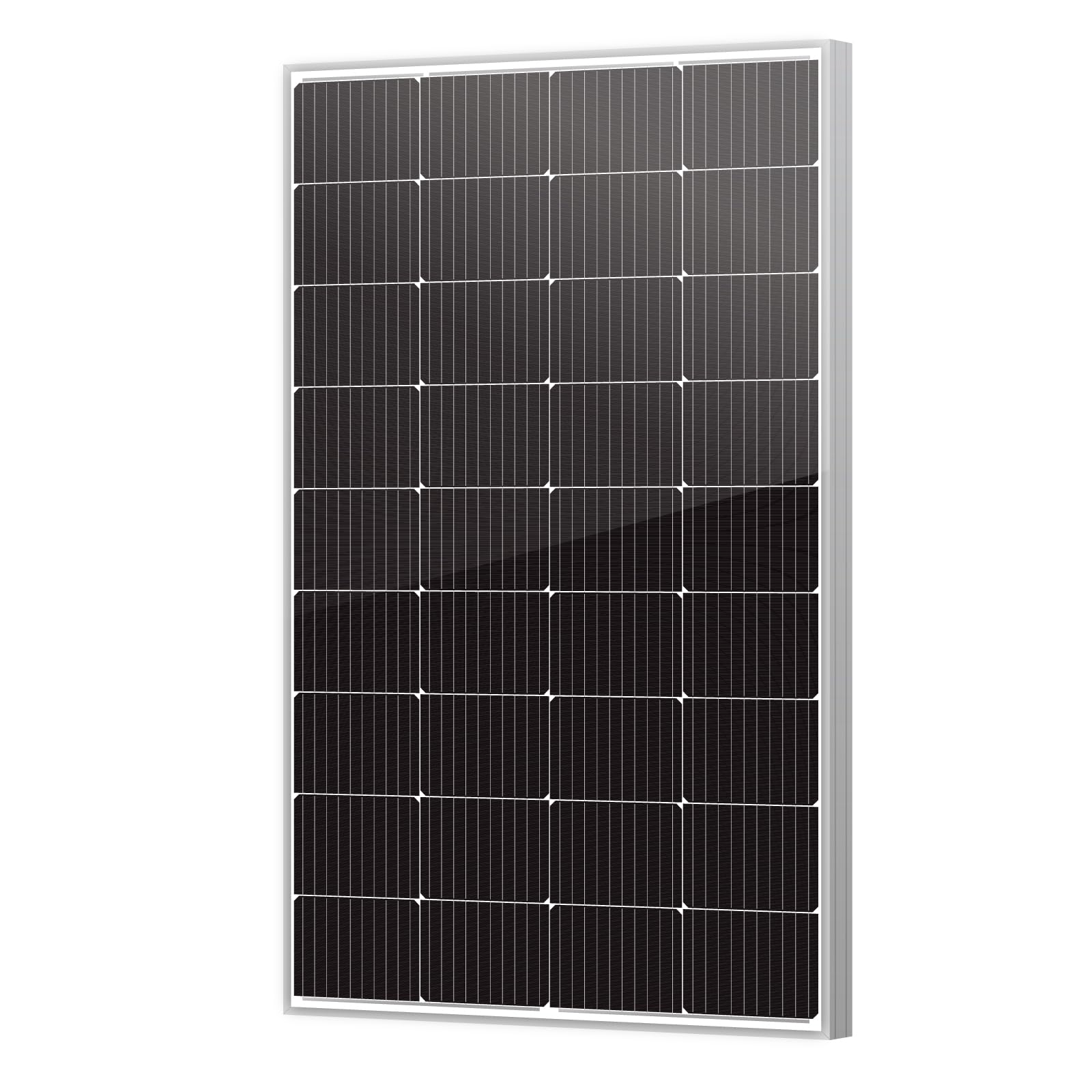
Some panels win on raw specs; this one wins on consistency. It is a 200W module running 9.68 amps at 20.74 volts, and it has been a staple of off-grid builds for years, which is why so many RV owners keep coming back to it. The 10 busbar cell design uses 182mm cells and is built for a longer lifespan than older 5BB panels, and the frame handles the same 2400Pa wind and 5400Pa snow loads you want on a roof. At 24.4 pounds and 52.36 x 30.12 x 1.38 inches, it is a standard-fit rigid panel.
Installation is genuinely fuss-free: diodes come pre-installed in the junction box and a pair of 3ft extension cables is already attached, so you are not hunting for parts on day one. Owners describe charging a cabin array until the batteries hit full by sunset, and one notes the panels keep batteries topped even through cloudy days. The mixed power-output feedback tends to appear in the real-world wattage question, since some setups in ideal sun pulled around 85% of the claimed figure. The 10-year output guarantee sits above 90% and the 25-year mark above 80%.
If you want the reassuring track record over the flashiest efficiency number, this is the steady hand — just set realistic expectations for peak output in real conditions.
The dependable everyday pick: it suits cabin, marine, and RV roof installs where reliability beats bragging rights.
skip it if: every last watt at peak is non-negotiable — some setups realize less than the lab figure.
4. Renogy 200W N-Type 16BB Solar Panel

At 49.7 x 30.1 x 1.2 inches and 23.4 pounds, it is the most compact rigid panel here for Class B van roofs.
When roof real estate is genuinely scarce — a Class B van, a small trailer, a truck cab — this panel is the smart fit. Renogy rates it at 25% efficiency with 16BB N-type cells, and the package is smaller and lighter than the brand’s previous 200W design. It measures 49.7 x 30.1 x 1.2 inches and weighs 23.4 pounds, making it shorter than the JJN above at 53.7 inches and lighter than the 24.4-pound Newpowa. It also runs at 37.44 volts with 6.85 amps, and the 24V design keeps current loss low so more of the harvest reaches your batteries.
Owners charging with these describe camper batteries full by morning and easy connection, with the compact size noted as a real advantage for tight storage and transport. The panel is compatible with 12V and 24V systems, including lithium, AGM, and deep-cycle batteries, so you can drop it into a wide range of off-grid builds. The low temperature coefficient keeps output strong in heat, and the low degradation spec — 1% or less in the first year — supports the long-term value story behind the 25-year 80% output commitment. Owners also report it producing power even when clouds shade the sun, which matters on a moving vehicle.
The honest limit: at 200W in a compact footprint you are relying on the panel’s efficiency, so any rooftop shading will cost you a bigger share of your total than on a larger, multi-panel array. Mount it where it catches the most light and it rewards you; tuck it behind an AC unit and it will not.
The fit-first choice: it belongs on a van or trailer roof where a longer panel simply will not squeeze in.
Ideal for the space-starved build: a compact, reliable 200W rooftop panel from a well-known solar brand.
Think twice if: you plan to mount it in an obstructed spot — compact panels give back less when shaded.
5. BougeRV 200W Bifacial N-Type 16BB Solar Panel

At 22.8 pounds, it is the lightest rigid panel here, edging out the 23.4-pound Renogy and 24-pound RICH SOLAR.
If you are installing on a roof that loads matter on, start here. At 22.8 pounds this is the lightest rigid panel in the group, edging out the 23.4-pound Renogy and the 24-pound RICH SOLAR. It runs 21.6 volts and packs 16BB N-type cells at a 25% conversion rate, and the compact cell design reduces the covered area. The transparent back allows light from both sides, and the bifacial gain here is listed at 80% versus 70% for older P-type cells — a real advantage on a white or reflective roof.
The 16BB cell layout improves current collection and, per the manufacturer, extends service life. Owners are enthusiastic about how it performs in real conditions: panels mounted due south pulling over 400W from a pair, and one noting near-200 watts on a cloudy day. One laid flat on a patio table produced 197 watts at 1 PM. It carries a 10-year product tech support promise and pre-drilled mounting holes for straightforward installs. The output figure does vary with sun intensity, angle, and temperature, which is true of every panel here — the rated number is a lab figure.
The caveat to weigh: the panel’s open-circuit voltage and the way it pairs with certain power stations can need checking before you buy, so confirm compatibility with your specific charge controller or power station.
Light on the roof: that 22.8-pound figure matters if you are already near a weight limit or installing solo.
Grab this for a weight-conscious rooftop: 25% efficiency and strong bifacial gain without the heft.
Double-check first if: you are pairing with a power station — verify the voltage matches your unit.
6. ZOUPW 200W Portable Solar Panel for Power Stations
Folds to 25 x 21.06 x 1.97 inches and ships with a 5-in-1 cable covering XT60, Anderson, DC7909, DC8020, and DC5521.
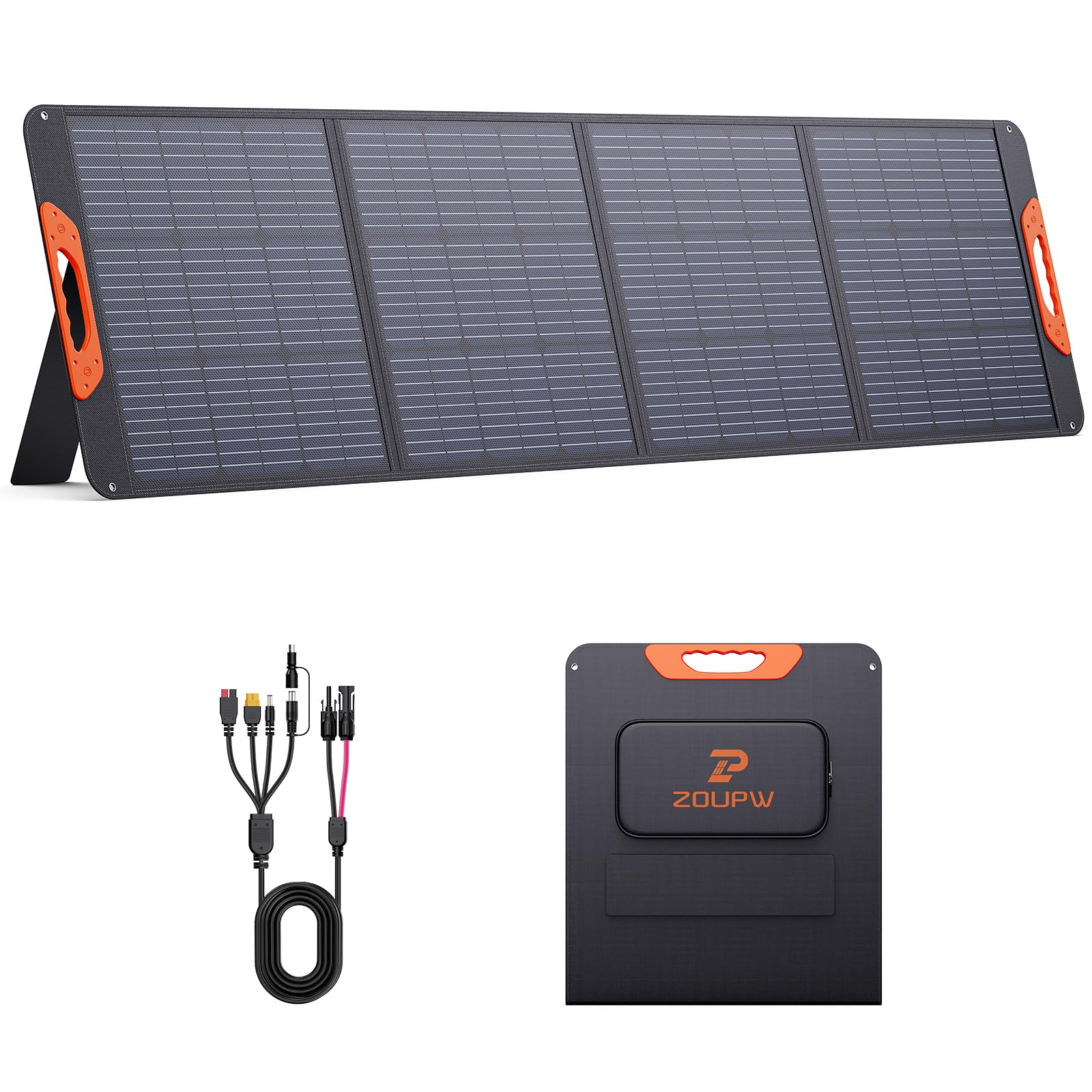
For camping and emergency backup, the killer feature is not efficiency — it is compatibility. This panel ships with a 5-in-1 cable covering XT60, Anderson, DC7909, DC8020, and DC5521 connectors, so it slots into most power stations without buying adapters. It runs 23.5% efficient monocrystalline cells at 10.5 amps, folds to 25 x 21.06 x 1.97 inches, and weighs 19 pounds. Four adjustable kickstands let you angle it 45 degrees toward the sun, which the manufacturer says captures 25–30% more energy than laying it flat.
Built-in USB-A and USB-C ports let you charge a phone or tablet directly from the junction box. The ETFE-coated surface (a tough, heat- and abrasion-resistant outer film) carries an IP67 waterproof rating (protected against dust and water). Owners power real loads with it: one ran Starlink, a computer, and a monitor while keeping a Jackery near full in clear skies. Another charged a Jackery 700 Plus from 74% to 95% on a cloudy winter day and ramped to 170W in full 50-degree sun. The recurring theme in the power-output feedback is that real output varies with sun intensity, and some units topped out closer to 120–150W in good light. The company replaced defective units at no charge, and customer support earns repeated praise.
Setup takes a little finessing the first time as you learn the fold pattern, and the junction box is water-resistant but not submersible, so keep it out of standing water.
Charge without adapters: that 5-in-1 cable is the reason this one is the easiest to hook up on a trip where you cannot order a missing connector.
Best for power-station owners on the move: folding, waterproof, and ready to charge straight from the start.
Set expectations if: you expect a flat 200W every time — actual output tracks the sun, like every portable panel.
7. RICH SOLAR 200W N-Type 18BB Solar Panel

At 10.9 amps and 18.39 volts, it delivers the highest amperage among the rigid panels here for 12V RV loads.
This is the panel to pick when you need current, not just watts. It pushes up to 10.9 amps at 18.39 volts — the highest amperage among the rigid panels here — which is what charges a 12V system fast. The 18BB N-type cell design hits 25% cell efficiency, reduces hot spots and micro-cracks, and holds output in low light and high heat. At 58.7 x 26.8 x 1.2 inches and 24 pounds it is a long, narrow panel, so measure your rail spacing before you commit. The frame is 1.3mm anodized aluminum with high-transmittance tempered glass, IP67 rated for 2,400Pa wind and 5,400Pa snow loads.
Owners put heavy duty on these: a 1,000W rooftop array on an RV running TVs, lights, a fridge, and Starlink. Others report steady output around 180W with peaks near 188W in cloudless conditions, and one long-term user has bought seven over five years without a failure. The 14 pre-drilled holes make mounting to Z-brackets and tilt mounts straightforward, and it works with PWM and MPPT controllers as well as grid-tied or off-grid inverters. It carries a 25-year linear power output warranty plus a 5-year material warranty.
The honest note: output is real-world dependent, with some owners seeing figures well under the rating in less-than-ideal light, and the leads are aluminum rather than copper. Size and panel durability draw more mixed feedback than output on this model.
What serious builds get
- 10.9 amps output — the fastest 12V charging current on this list
- 18BB N-type cells at 25% efficiency with strong low-light behavior
- 1.3mm anodized aluminum frame, IP67, UL certified
- 25-year linear power output warranty
What to measure first
- 58.7 inches long — check your rail spacing before ordering
- Aluminum leads introduce a small resistance loss versus copper
- Real-world output dips in poor light, as with any panel
For the high-demand RV build: when you need current to run a fridge, Starlink, and electronics all day.
Measure twice if: your roof rails are short — this panel wants a long, narrow footprint.
8. Renogy 200W Portable Solar Panel E.Flex
A backpack-sized foldable that beats the old 9BB standard by two efficiency points.
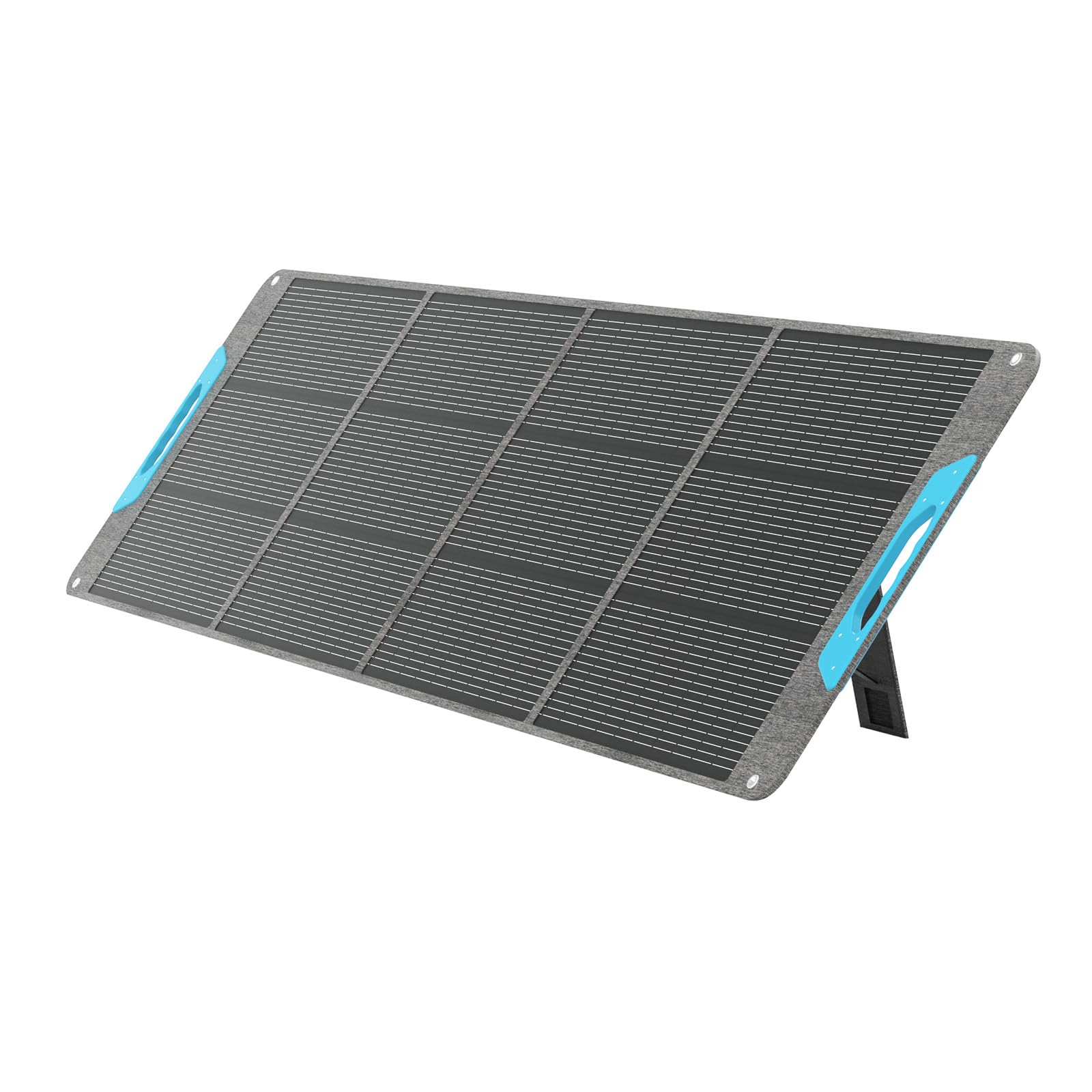
If your trunk space is the limiting factor, this is the panel that fits. It folds to 23.72 x 22.99 x 1.97 inches and weighs 13.9 pounds — around backpack size — and its 16BB N-type cells hit 25% efficiency against 22.5% for standard 9BB portable panels. That two-point gap means faster energy generation from the same sunlight. It runs 11.3 amps and offers MC4 output for a power station or 12V battery, plus three charging ports: one USB-C PD at up to 45W and two USB-A ports at 18W and 15W. Magnetic closures replace snap or Velcro, snapping shut without a case.
Owners charge a wide spread of gear well — power banks, laptops, cameras, and Anker units — and one reports a flooded battery fully charged in about four hours. The quadfold design has a built-in accessory pouch and four kickstands with three-angle adjustment at 40, 50, and 60 degrees, and ground studs plus reinforced grommets let you stake it down in wind. It is IP65 rated and certified to UL 61730 among other standards.
The recurring honest note in the power-output feedback is that hitting the full rated figure is hard, especially in partial shade or lower-voltage configurations — shadows cut the whole panel’s output, so keep it clear and angled at the sun. It also stops working if left in rain for long, despite the IP65 rating.
The portability payoff: at 13.9 pounds and backpack-sized folded, this is built for setups where a rigid panel simply has nowhere to live.
Ideal for the space-limited camper: backpack-size off-grid charging with USB ports for phones and laptops.
Know the limit if: you plan to leave it out in weather — keep it angled in sun and staked in wind.
9. BougeRV Arch Pro 200W Anti-Shading Flexible Solar Panel
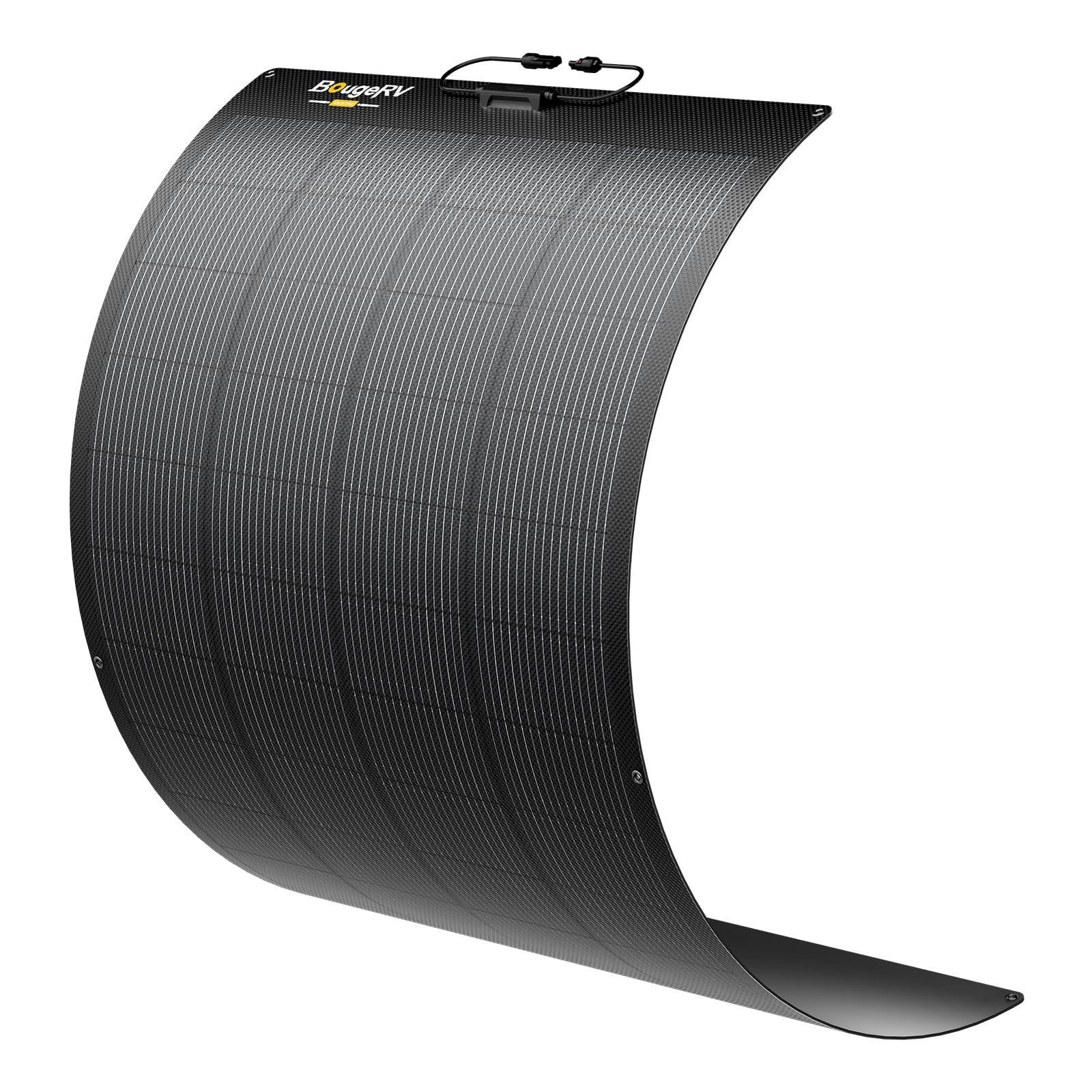
A flexible panel that clings to a curved roof and keeps working through shade.
When your roof curves, a rigid panel leaves gaps and catches wind. This flexible panel solves that — at 7.9 pounds and just 2.5mm thick, it bends up to 270 degrees to match a van’s curved roofline, and it uses special lamination to stay light without a frame. Built on 16BB N-type cells at 25% conversion, it runs a 24V output. The anti-shading design with bypass diodes captures more energy in low light and partial shade, which is exactly the condition a forest camp or tree-lined drive delivers.
Owners mount these creatively: one secured a panel on a travel trailer roof with VHB tape and reported it did not budge at 80 mph while topping a lithium battery in filtered sunshine. Another describes it as light and somewhat shade tolerant, roughly a match for heavier framed panels and better than a rigid competitor that shut down with a little shade. The ETFE coating resists scratches and cleans itself, and the panel handles rain and moisture with an IP68 rating on the weather-sealed construction. It attaches via hanging holes, adhesive backing, or glass glue, and carries 5-year product tech support.
One important caveat to check before buying: the open-circuit voltage range (36V ± 5%) may not match certain power stations, so confirm your unit’s specs. Mount with VHB tape and it stays; the flexible format is the whole point, and it delivers for a curved install. That single number — 7.9 pounds versus the 23.8-pound rigid top pick — is the entire story here.
Made for curved rooflines: a flexible, shade-tolerant panel that fits where a rigid one cannot reach.
Verify before you buy: check your power station’s voltage against the panel’s stated range.
10. Go Power Overlander-E 200W Solar Expansion Kit
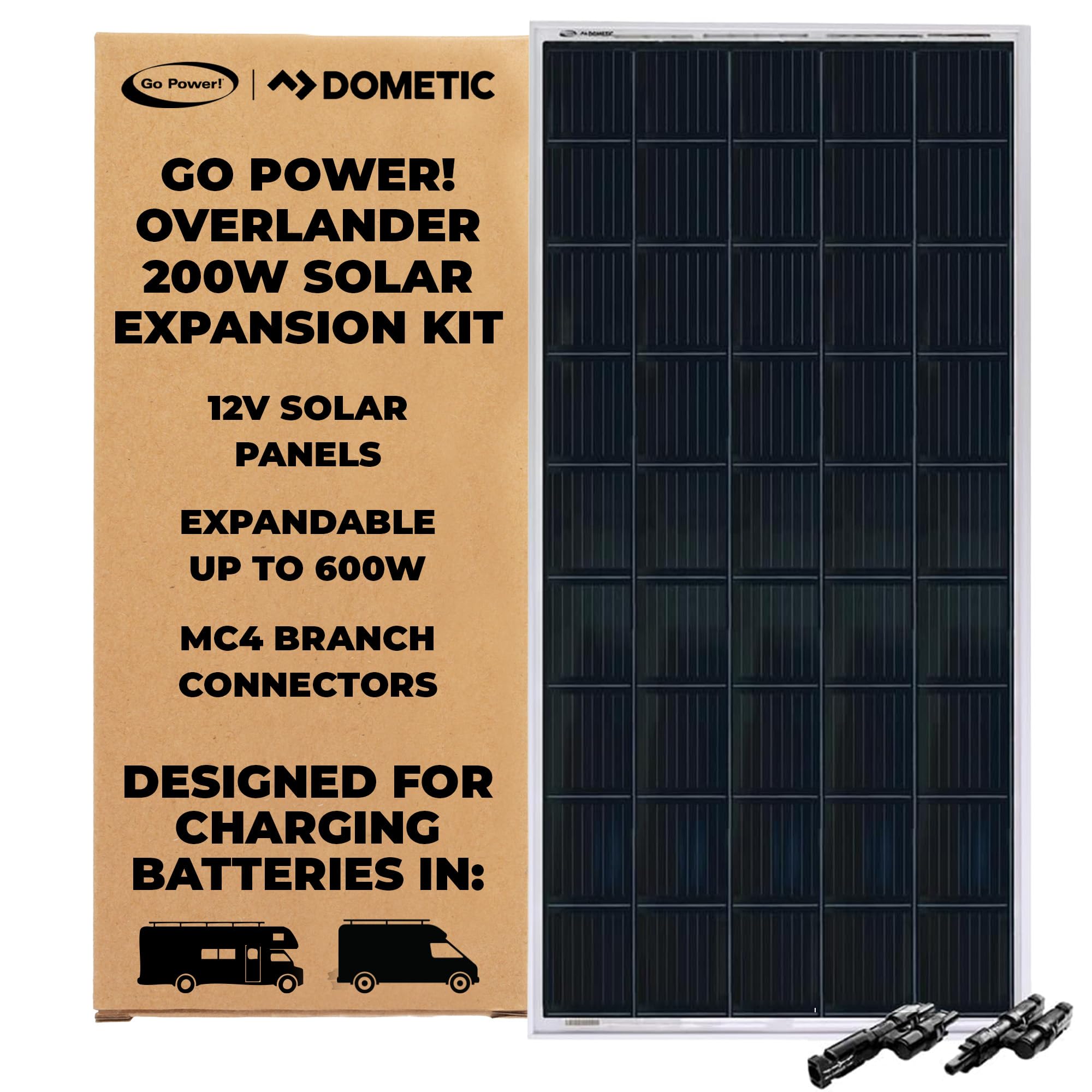
The panel designed to double a factory Go Power RV setup with no re-wiring.
If your RV already came with a Go Power solar system, this is the natural way to add a second panel. It is purpose-built as an expansion module — it includes the 200W panel plus MC4 parallel connectors so it integrates with an existing Go Power array without a full re-wire. It runs 200 watts on a 12V system and measures 58.3 x 26.5 x 1.4 inches at 24.5 pounds, shipping with mounting brackets, screws, and MC4 Y connectors. This is the same equipment the manufacturer installs on RVs, which is why it fits a Rockwood 200W setup so cleanly.
The value here is simplicity. Owners describe it as plug-and-play on a Class A, noting no changes were needed to keep the batteries full, and one says it charged a drained battery back up in a few hours the next morning — excellent for boondocking. It survived a severe hail storm, and owners mention that someone with no prior solar experience installed it without trouble. It is backed by a 25-year manufacturer warranty.
The honest caveat: you will likely need a separate 3-foot extension cable and proper sealing compound for a clean install, and customers note it lands in a premium tier compared with other brands of the same wattage. The wiring could also use clearer positive and negative labels. For a factory Go Power rig, though, the smooth fit is worth it.
The smooth-match advantage: buying into the same brand ecosystem means no adapter hunts and no guessing about compatibility with your existing Go Power controller.
Reach for this if: you already run a Go Power RV system and want to add 200W with minimal effort.
Look elsewhere if: you are building from scratch — the premium tier and brand-specific fit suit upgrades, not first installs.
Understanding the Specs
Conversion efficiency versus rated power
Rated power (the 200W figure) is measured under ideal lab conditions, and every panel here carries a note that real-world output varies with sunlight intensity, panel angle, and temperature. Conversion efficiency is the more useful number for tight spaces: it tells you how much of the sunlight that hits the surface becomes electricity. A 25% panel makes better use of a small footprint than a 22% one. When comparing, treat the watt rating as a ceiling and efficiency as how easily you reach it.
Bifacial gain and shade behavior
Bifacial panels collect light on the back side too, which adds output when the surface behind them reflects — white roofing helps, grass helps little. How much you gain depends entirely on your mounting surface. Shade tolerance is the flip side: panels split into independent halves keep producing when one section is covered, while a standard panel’s output can drop for the whole module. On mobile installs, honest shade handling often matters more than a slightly higher lab wattage.
FAQ
Will a 200W solar panel actually produce 200 watts?
Is a bifacial panel worth it for an RV roof?
Do 200W panels work in cloudy weather or shade?
What is the difference between 16BB and 10BB cells?
Can I mount a 200W panel on a curved van roof?
Are portable folding panels as powerful as rigid ones?
How long does a 200W solar panel last?
What cable and connectors do I need for a 200W panel?
Can I run a 200W panel with a portable power station?
Do I need a charge controller with a 200W panel?
Will a 200W panel charge a 12V battery overnight?
How much roof space does a 200W panel need?
Final Thoughts: The Verdict
For most people building an off-grid set up, the 200 w solar panel winner is the Callsun N-Type 16BB Bifacial Panel because it packs the highest conversion efficiency here at 25.6% into a compact footprint and splits its array into two independent halves that keep producing when one side is shaded. If you want maximum value per watt on a multi-panel roof array, the JJN 200W Bifacial Panel delivers higher voltage and current at a lower tier, and the higher amperage of the Rich Solar 200W N-Type makes it the pick when you are feeding a hungry RV load. And for a roof that curves where no rigid panel will sit flush, the BougeRV Arch Pro Flexible Panel is the one to reach for. Whichever you choose, match the panel’s format to where it will live and how you will mount it — that single decision does more for your real output than any spec-sheet number.
How We Picked
We do not accept paid placement. Every pick is matched to a real buyer and a real use-case; we do not hands-on test units.
Sources & Methodology
Specifications: manufacturer listings and product documentation. Review insights: verified customer reviews, as of September 2026. Pricing: not shown on this page (it changes often); check the current price via the retailer link.
As an Amazon Associate, KitchPrep earns from qualifying purchases. This does not affect which products we feature.
Related Guides
