
Specs are compiled from manufacturer listings and verified buyer reviews and can change over time — please confirm the key details on the product page before buying.
If you are shopping for a 200 W portable solar panel, the single biggest risk is buying a panel rated for 200 watts that only delivers 120 watts in real sunlight. The top performers here consistently hit 170 to 190 watts in full sun, enough to run a fridge or top off a large power station before lunch.
I’m Mohammad Maruf — the founder and writer behind KitchPrep. This guide is built by comparing the manufacturers’ published specifications and the patterns across verified customer reviews, so you get each pick’s real strengths and trade-offs instead of marketing spin.
When choosing from the best 200 w portable solar panels, you must match the panel’s voltage and connectors to your power station, or even a great panel will charge slowly.
Our Picks at a Glance


How To Choose The Best 200 W Portable Solar Panels
Before you compare prices or brands, understand that a 200 W rating is measured in a laboratory under perfect light. In the real world, you should expect 70% to 90% of that number, depending on the season, cloud cover, and the angle of the sun.
Match the Voltage to Your Power Station
Mismatching voltage is the most common buying error. Some panels push 40 volts or more, while others stay near 18 to 20 volts. If your power station has a low maximum input voltage limit, a high-voltage panel simply will not work. Check your station’s spec sheet before buying.
Check the Connectors Before You Order
Most modern panels ship with adapters like XT60, Anderson, MC4, and DC7909. The more adapters included, the wider the range of power stations you can plug into. If a panel only offers one connector type, you might need to buy a separate cable.
Weight and Folded Size Affect Portability
A 200 W panel is a large piece of gear. Folded sizes range from about 21 to 25 inches across, and weights span roughly 13 to 19 pounds. If you are hauling it into a campsite by hand, a lighter panel is worth the extra cost.
Quick Comparison
| Model | Best For | Efficiency | Weight | Max Voltage | Amazon |
|---|---|---|---|---|---|
| MHPOWOS 220W★ Best Overall | Peak Voltage Output | 23.5% | 8.07 kg | 48 V | Amazon |
| Jackery SolarSaga 200WAlso Great | Premium Brand Pairing | 26.7% | 14.3 lbs | 600 V | Amazon |
| BougeRV 200WCrowd Favorite | Durability on a Budget | 25% | 13.8 lbs | — | Amazon |
| Renogy E.Flex 200W | Lightweight Travel | 25% | 13.9 lbs | — | Amazon |
| ZOUPW 200W | Built-in USB Ports | 23.5% | 19 lbs | — | Amazon |
| EBL 200W | Proven Reliability | 23.5% | 18 lbs | — | Amazon |
| SOLUPUP 200W | Fast Charging Amps | 24% | 8.2 kg | 19.8 V | Amazon |
| GRECELL 200W | Smart Charging Tech | 23.5% | 18 lbs | 18 V | Amazon |
| VLAIAN 200W | Entry-Level Budget | 23.5% | 4 lbs | 18 V | Amazon |
In‑Depth Reviews
1. MHPOWOS 220W Portable Solar Panel
Our pick — 4.5★ from 250+ verified ratings; the strongest balance of quality and price.
The 220W overachiever that hit 198W even in December sun
Technically a 220W panel rather than a 200W one, this MHPOWOS unit earns its place by delivering more wattage than its rating suggests in challenging conditions. It pushes an unusually high 40V output at 48 volts maximum — a 2.4x gap versus the SOLUPUP’s 19.8 volts — which makes it a powerful match for stations that accept high input voltage. This voltage difference is why one owner reported hitting 198W in December post-solstice.
Owners single out its sturdiness more than any other feature, so you can trust it on rough campsites. The IP67 waterproof rating (meaning it is fully protected against dust and can handle immersion in up to 1 meter of water briefly) makes it more weather-ready than the IP65-rated Renogy and BougeRV. Folded, it measures 23.5 x 21.25 x 2.3 inches, and four kickstands let you angle it toward the sun.
Here is the catch, and the seller states it plainly: the 40V output is not compatible with every power station. Some portable power stations have a maximum input voltage limit that will simply reject this panel. Owners also note the included kickstands need re-Velcro attention and the wires run short. If your station accepts 40V plus, this is a value-packed workhorse; if not, it will not charge at all.
Why Owners Rave
- Hit 198W in weak December sun
- IP67 rated for serious weather resistance
- 23.5% efficiency from monocrystalline cells
The Important Caveat
- 40V output only works with compatible high-voltage stations
- Short cables and kickstands needing re-Velcro noted by owners
Power hunters take note: If your solar generator accepts 40V input, this delivers more real watts per dollar than nearly anything else here.
Look elsewhere if: your power station’s input limit sits below 40V — this panel simply will not pair with it.
2. Jackery SolarSaga 200W Portable Solar Panel
The bifacial premium that pulls 165 watts average even when dusty
You get the most power per square inch of sunlight with this panel, thanks to its top efficiency rating. It uses bifacial cells (which capture light from both the front and back surfaces) plus IBC technology to reach a conversion efficiency of up to 26.7% — the best figure of any panel reviewed here, even beating the Renogy and BougeRV at 25%. That means more wattage from the same patch of sunlight, so your power station charges faster.
The real-world reports back up the spec sheet. Owners run this panel keeping a 12v freezer and fridge charged on a long camping trip, pulling an average of 165W in full sun even with dusty panels. One owner noted it pulled 145 plus watts without actively chasing the sun across the sky. This is the panel to beat for pure energy harvest.
Compatibility is the catch here. This panel is engineered to pair beautifully with Jackery power stations, using its DC8020 port, but you get just one DC8020 * 1 port plus USB-A and USB-C. If you own an EcoFlow or Bluetti station, check the adapter situation carefully. Weighing 14.3 pounds, it is also not the lightest pick, though it folds down to roughly the same size as many 100W panels.
Why It Wins
- Highest efficiency on the list at up to 26.7%
- IP68 rated — shrugs off rain and dust better than most
- Buyers report sustained 165W average output in full sun
Who Should Look Elsewhere
- Single DC8020 port favors Jackery ecosystem owners
- Priced at the premium end of the 200W range
- Cable is not weatherproof, per the maker
The brand-loyal premium pick: If you own a Jackery Explorer and want maximum efficiency plus a rugged IP68 build, this is the definitive match.
Reach for it only if: you are comfortable staying inside the Jackery ecosystem, since its charging port is the key to its best performance.
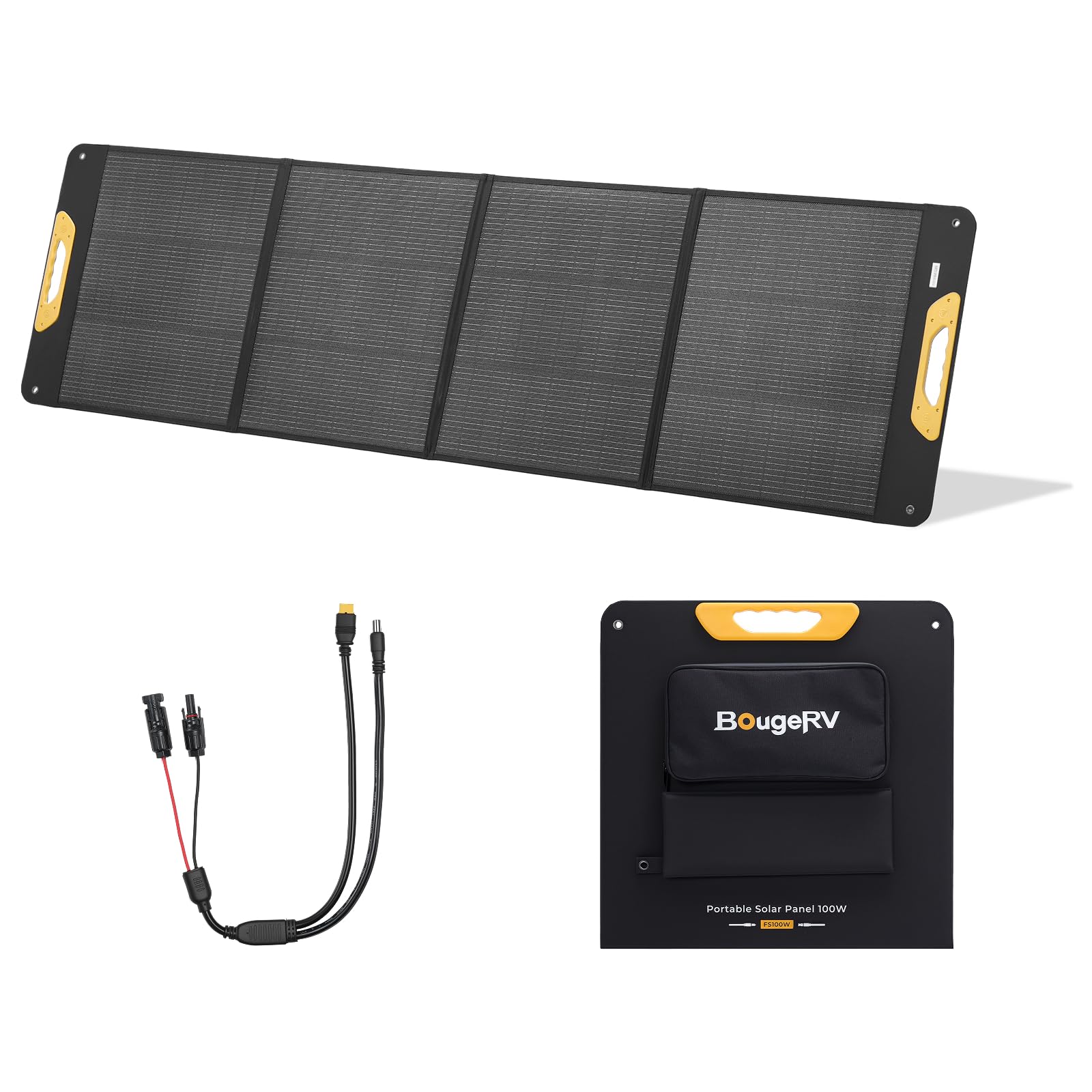
3. BougeRV 200W Portable Solar Panel
The rugged N-Type panel that charges an EcoFlow Delta 2 in 2-3 hours
This is the pick that wins over owners who want near-premium performance without the top-tier price. It leverages N-Type solar cells for 25% conversion efficiency — matching the Renogy above and trailing only the Jackery’s 26.7%. The unique twist is a fiberglass reinforcement layer that resists cracking and surface abrasion better than standard plastic-backed panels.
Real-world numbers are impressive. In Honolulu sun, owners mention charging an EcoFlow Delta 2 from 64% to 100% in 2 to 3 hours while pulling 165-198W input — enough to simultaneously run a 45W cooler. In Arizona full sun, one owner saw 186W immediately without precise positioning. The included 8.2 ft extension cable lets you keep the panel in the sun while your station sits in the shade.
At 13.8 pounds, it is among the lightest full-size 200W panels here. The trade-off, as several owners note, is the tilt legs feel a little flimsy, and prolonged heavy rain should be avoided despite the IP65 rating. It is a panel built for repeated setup and teardown on camping trips, not for permanent installation.
What Owners Praise
- Charged a Delta 2 fully in 2-3 hours in Honolulu sun
- Fiberglass layer resists cracks from transport
- 8.2 ft extension cable allows flexible placement
Honest Trade-Offs
- Tilt legs feel flimsy to some owners
- IP65 means avoid heavy rain exposure
- Connectors limited to XT60 and DC7909
Best for the pragmatic camper: You get near-premium efficiency and proven wattage at a friendlier price than the big-name rivals.
skip it if: your power station needs Anderson or DC8020 connectors, since this panel sticks to XT60 and DC7909.
4. Renogy 200W Portable Solar Panel
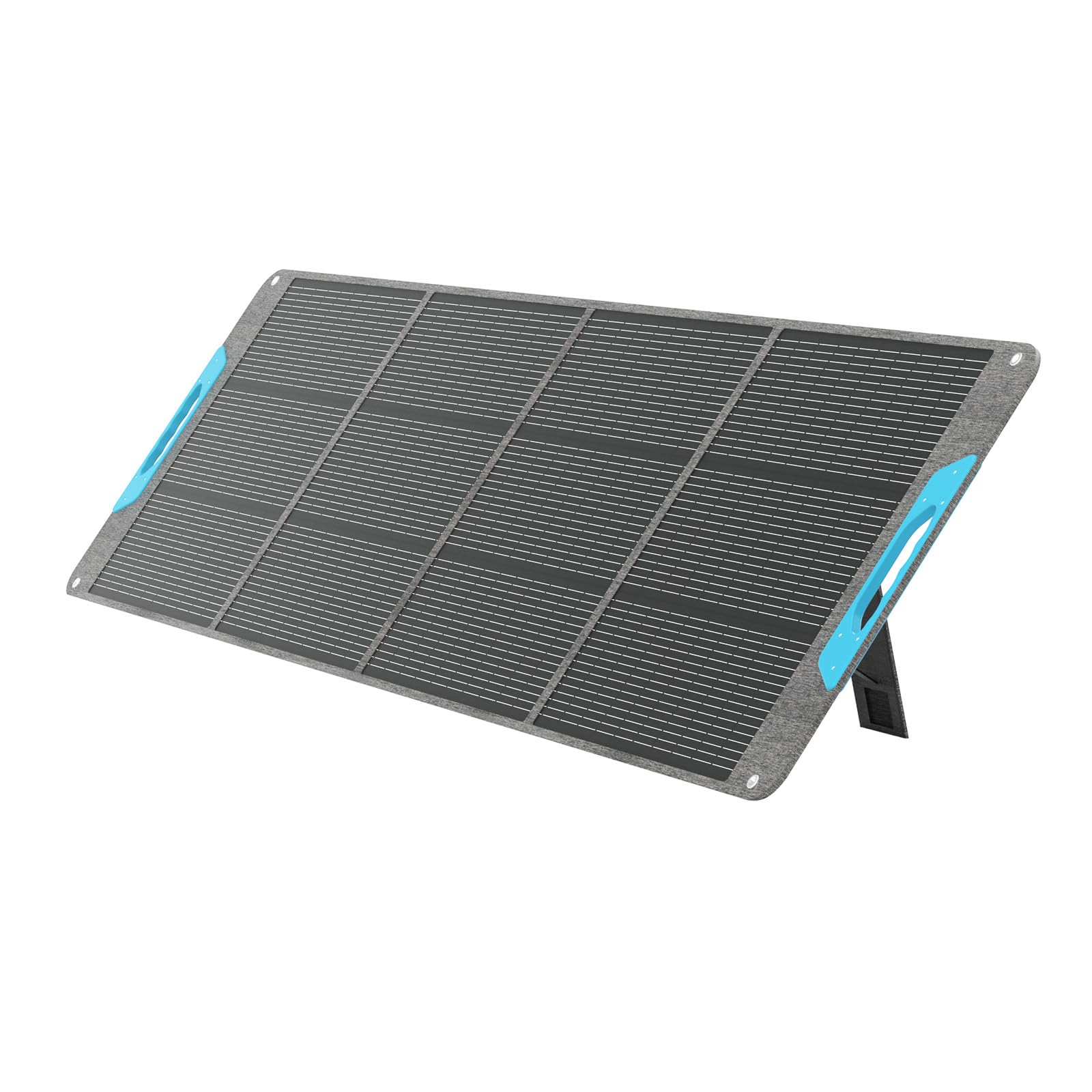
The featherweight 13.9 lb panel with a magnetic snap closure
You can carry this panel farther with less strain because it weighs just 13.9 pounds, the lightest full-size 200W panel in this lineup. It beats the BougeRV at 13.8 pounds by a hair and undershoots the MHPOWOS at 8.07 kg by a meaningful margin. Renogy is a household name in solar, and this E.Flex 200W model justifies the reputation with a 25% efficiency rating from upgraded 16BB N-Type cells.
What wins people over is the clever magnetic closure instead of snaps or Velcro. Owners describe it as a breeze to set up in tight camper spaces. The quadfold design packs down to 23.72 x 22.99 x 1.97 inches with a built-in accessory pouch. Real-world output sits around 154W flat (about 77% efficiency), and owners note it approaches a 100% match to rigid panels when kept cool and angled at the sun.
You can charge a laptop directly from the USB-C PD port (45W max) or use the two USB-A ports for smaller devices, while the MC4 output feeds your power station. The recurring gripe is the kickstand legs on uneven ground — they can be janky in wind. It is also certified to UL 61730 (a safety standard for solar panels) with a 2-year warranty.
What Makes It Stand Out
- Lightest option here at 13.9 lbs for easy hauling
- Magnetic closure beats snap designs for quick setup
- USB-C PD 45W charges a laptop directly
Where It Stumbles
- Kickstands can feel unstable on uneven ground
- Customers note around 154W real output, not the full 200W
- Basic travel bag included
The pick for travelers: If carrying weight matters more than anything, this is the one you will actually enjoy hauling to camp.
Think twice if: you camp on windy ridgelines — the legs need firm ground to stay put.
5. SOKIOVOLA N-Type 200W Portable Solar Panel
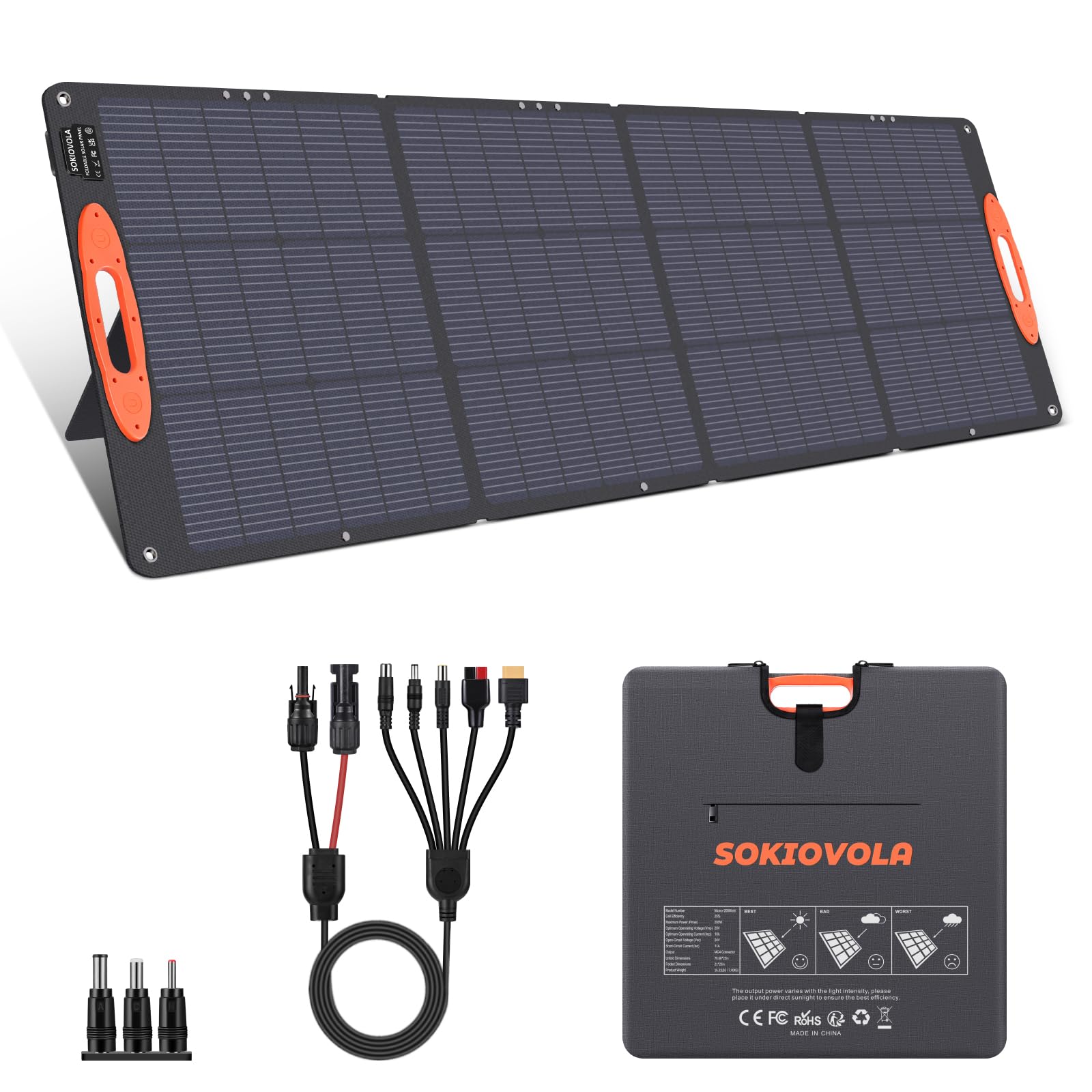
The 25% efficiency panel with 177W real-world punch in SoCal sun
This SOKIOVOLA panel brings the efficiency race to the value tier. Using A+ grade monocrystalline silicon cells with 16 busbars (the thin wires that collect electricity across the cell), it hits up to 25% conversion efficiency — the same headline number as the pricier Renogy and BougeRV. Owners measured 177W real-world output in Southern California sun, which works out to roughly 88-89% of the rated maximum.
What sets this panel apart in practice is the included kit. It ships with a 10.49 ft 5-in-1 extension cable covering XT60, DC5521, Anderson, DC7909, and DC8020 connectors, plus a storage bag and a 12-month warranty. Owners note the low 18-volt output works with most generators, and the multi-connector cable plays nicely with Jackery, EcoFlow, and Bluetti stations. The ETFE coating gives it an IP68 waterproof rating, meaning it survives dust and prolonged immersion better than IP65 rivals.
Honest concerns exist. The foldable panel weighs 16.3 pounds, making it heavier than the Renogy for backpacking. Some owners describe the material as thin with flimsy cables, and one long-term report flagged degradation over months despite daily care. It is a strong value for weekend campers, but if you need a panel that will take years of heavy abuse, the premium brackets may serve you better.
The Value Case
- 25% efficiency at a mid-range price
- 177W real output measured in SoCal sun
- 10.49 ft 5-in-1 cable covers nearly every station
Considerations
- Heavier at 16.3 lbs for backpacking use
- Thin build quality noted by some owners
- Longevity concerns raised in a 6-month review
The value hunter’s choice: You get premium-level efficiency and a full cable kit without paying the premium brand tax.
Who should pass: rough-and-tumble users who need a panel that survives years of being tossed around the back of a truck.
6. ZOUPW 200W Portable Solar Panel
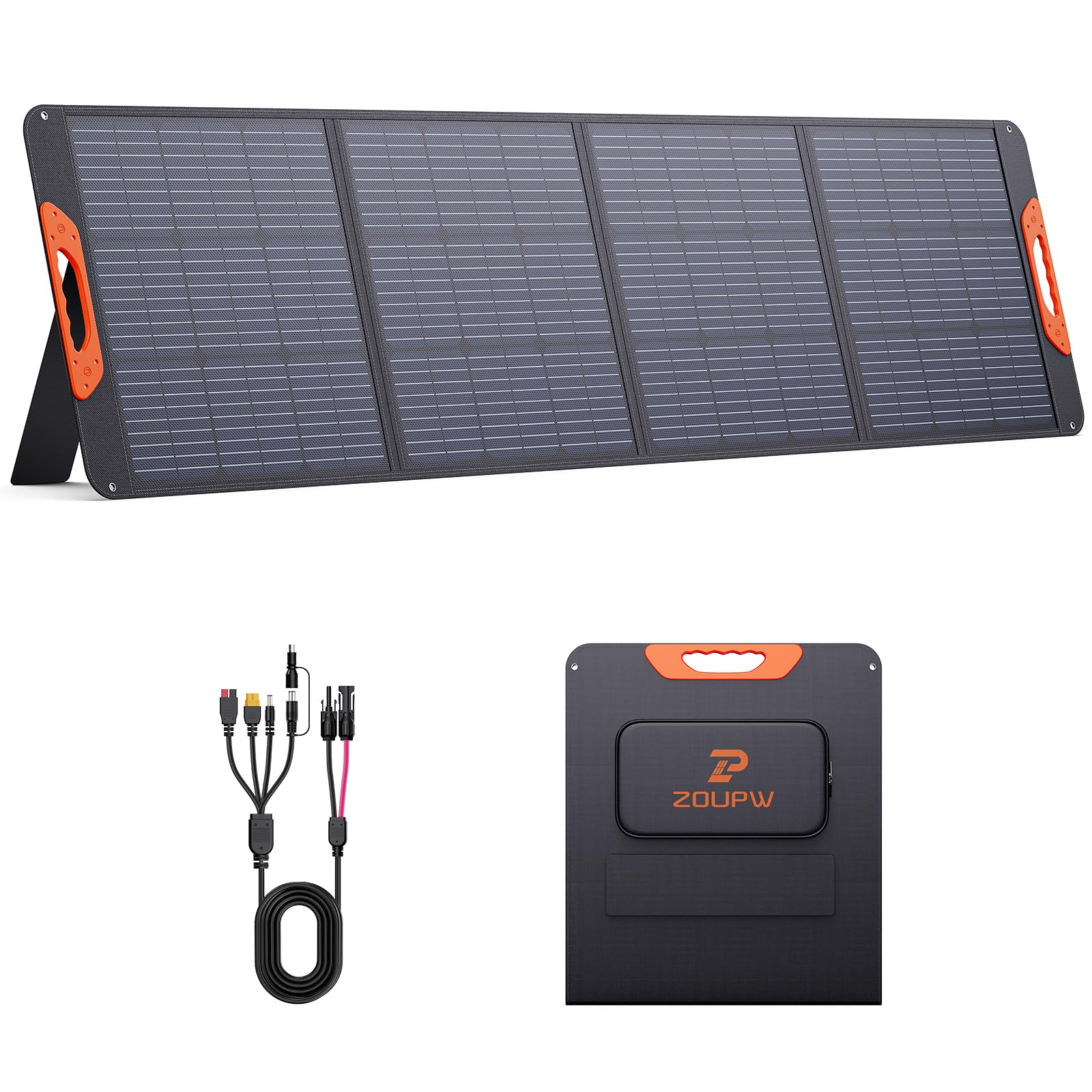
The briefcase panel that charges your phone straight from the box
This is the panel to buy when you do not want to carry a separate power station for small devices. The ZOUPW features a built-in USB controller with a USB-A QC3.0 port and a USB-C PD 60W port, letting you plug a smartphone, tablet, or camera directly into the panel itself. Owners describe it as essential for emergency blackouts when you just need to keep communication devices powered.
The 23.5% efficiency comes from A+ grade monocrystalline cells, and the panel includes a 5-in-1 cable (XT60, Anderson, DC7909, DC8020, DC5521) for feeding most major power stations. Its ETFE coating and IP67 waterproof rating handle damp RV camping and marine use. Owners successfully ran a Starlink and computer all day off a Jackery 1000 V2 in clear skies.
Power output draws mixed feedback, with some owners reporting 168-170W and others under 130W. While some reviewers point out 168-170W in full sun, others note it does not exceed 130 watts. The panel also weighs 18.96 pounds, making it one of the heavier options here. The four adjustable kickstands let you angle it up to 45 degrees, which the maker claims captures 25-30% more energy than flat-laying panels.
Standout Features
- USB-C PD 60W port charges devices with no station needed
- IP67 waterproof ETFE coating for marine use
- Survived Hurricane Milton per one owner’s report
What to Weigh
- Mixed wattage reports — some cap near 130W
- Heaviest panel in this review at 18.96 lbs
The off-grid communicator’s pick: When the grid drops and you need to charge devices directly from sunlight, this panel’s built-in USB-C output is a lifesaver.
Reconsider if: raw maximum wattage into a power station is your priority — some units fall short of the 200W rating.
7. EBL 200W Portable Solar Panel
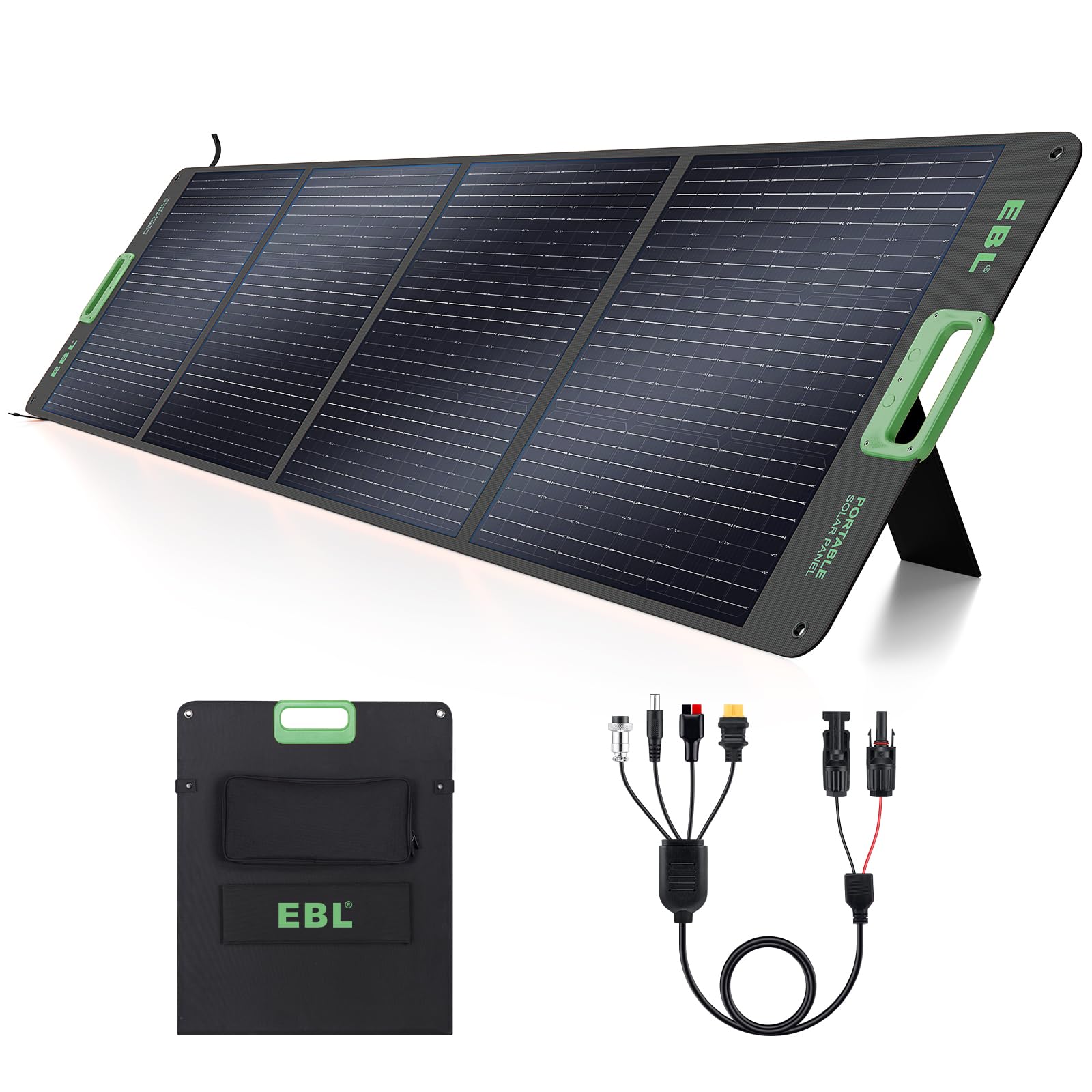
Maxed out near 191 watts and still pulling 157W at 5 pm
You do not need a premium badge for premium output, and EBL’s 200W model proves it. It uses monocrystalline silicon at up to 23.5% conversion efficiency, but the real story is in owner results: one buyer maxed out around 191 watts and was surprised it was still pulling 157 watts at 5 pm. In central Ohio summer, another owner got a consistent 148 watts from a 4 pm sun angle.
The build quality leans on upgraded PET lamination technology wrapped in a rugged 840D Oxford cloth outer layer. Owners find the cables and connectors store easily in the back pocket, and the 17.95-pound weight is manageable for campsite use. It is FCC, RoHS, and EMC certified with short circuit and surge protection built in. The MC-4 to 4-in-1 cable covers XT60, Anderson, DC7909, and Aviation connectors for wide compatibility.
Output reports are mixed, with some owners seeing only 65W on clear days. Some shoppers say a maximum of 65W on clear days, dramatically below the rating, though these appear to be a minority experience. One owner ran a CPAP, fan, and phones off a 1kW EBL brick for two days, ending with over 69% charge. The 6-foot cable is short, and the panel is not truly waterproof despite claims, so daily setup may be needed in wet weather.
Owner Highlights
- 191W max output reported by one owner
- Withstood 15-20 mph wind without issues
- 840D Oxford cloth outer for durability
Owner Caveats
- Some units deliver well below the 200W rating
- Short 6 ft cable limits placement options
The reliable mid-ranger: If you want a proven brand with strong owner results and wide connector support, this balances price and performance well.
Not the pick if: you need guaranteed peak output — a minority of buyers report significantly lower wattage.
8. SOLUPUP 200 Watt Portable Solar Panel
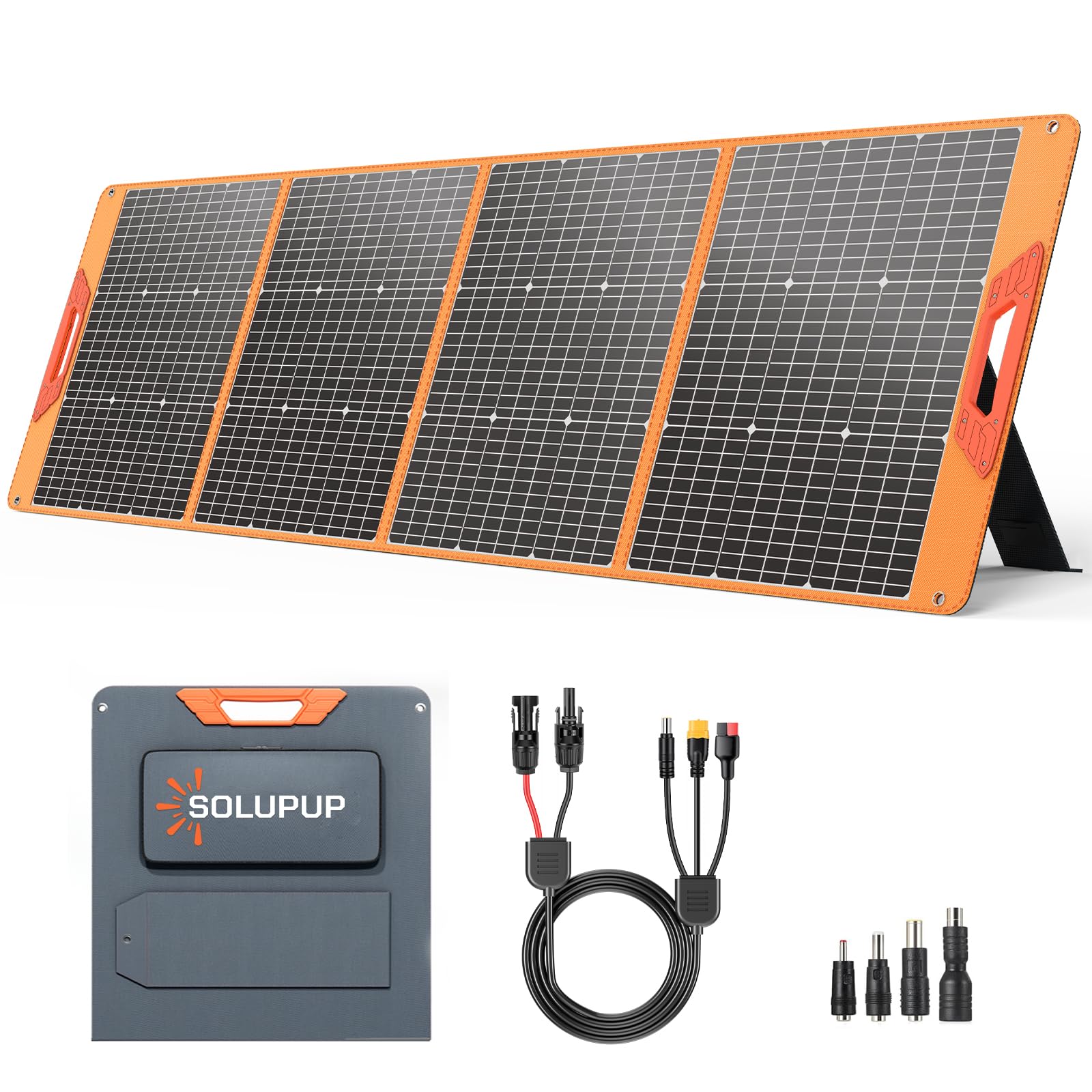
The 10.1 amp output that refills a VTOMan from 52% to full in 2 hours
If charging speed is your obsession, the SOLUPUP delivers with a 10.1 A amperage capacity alongside its 24% efficiency — a full 84% more amperage than the MHPOWOS’s 5.5 A. Owners saw the benefit immediately: in winter morning sun, one report shows ~182W input to a VTOMan 1500W power station, charging it from 52% to 100% in about 2 hours. Another ran a DC fridge directly off it at ~95W.
The lower 19.8-volt output (versus the MHPOWOS’s 48V maximum) makes it broadly compatible with 98% of power stations, per the maker. It ships with MC4 to DC5521, Anderson, and XT60 adapter cables plus 4 DC conversion ports. The power box adds 1 SAE, 2 Type-C, and 2 USB-A fast-charging ports for devices. It folds to 24.4 x 20.8 x 1.9 inches and weighs 8.2 kg with a magnetic handle.
Multiple owners mention the panel blows over in the slightest wind. Multiple owners note the panel will blow over in the slightest wind, so you will want to weigh down the feet or use the hanging holes against a wall. The ETFE-coated surface with an IP66 rating handles sudden downpours and dusty environments. It is a charging beast, but it demands a sheltered setup spot.
The Charging Edge
- 10.1 A amperage charges stations notably faster
- 182W winter input refilled VTOMan 52% to 100% in ~2h
- Broad connector support covers most stations
What to Watch
- Blows over in the slightest wind — needs ballast
- Weighs 8.2 kg, on the heavier side
The speed demon: When you need maximum amps flowing into a big power station fast, this panel’s 10.1 A capacity delivers.
Choose differently if: your camp spot is exposed and windy, since this panel’s light frame needs help staying upright.
9. GRECELL 200W Portable Solar Panel
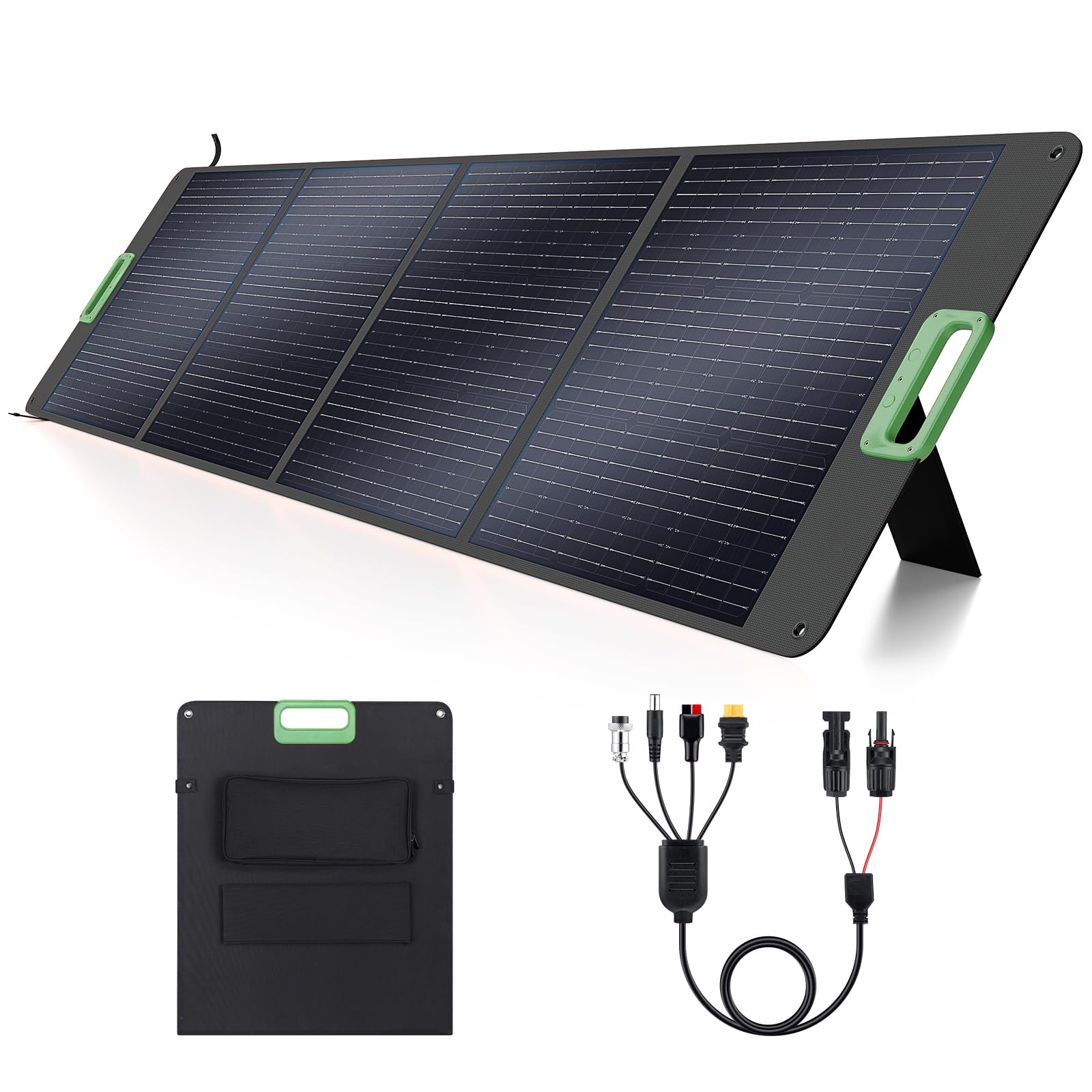
Smart charging tech that claims 20% faster refills than basic controllers
This GRECELL panel brings a piece of technology most rivals skip: an integrated MPPT controller (Maximum Power Point Tracking, which constantly adjusts to pull the most power available from changing sunlight). The maker claims this boosts charging efficiency by 20% compared to basic PWM controllers. It supports up to 11.1 A current with overcharge protection and automatically resumes charging when sunlight returns after clouds pass.
The 23.5% efficiency comes from 6-layer ETFE lamination over monocrystalline silicon cells, with 97% light transmittance claimed. Owners find it extremely easy to set up, charging at 125-138W in full sun, and one described it generating 30-60W on sunny mornings — enough to top up a Grecell battery by midday. The foldable design compresses to 23.1 x 22.8 x 1.4 inches (a quarter of full size) at 17.9 pounds.
Real-world output varies widely, with some owners reporting under 100W. Several customers note they have not reached 100 watts, let alone the 200W rating, and one measured only ~140W average in direct sun. The MC-4 to 4-in-1 cable covers XT60, Anderson, DC7909, and Aviation connectors, and with optional alligator clips it charges 12V batteries directly. A 2-year manufacturer warranty backs the unit.
Tech Advantages
- MPPT controller tune charging automatically
- 6-layer ETFE lamination for durability
- Charges 12V batteries with optional clips
Real-World Limits
- Several reviewers point out under 100W output
- Kickstands not lockable per one owner
- Heavy at 17.9 lbs
The tech enthusiast’s pick: If you want a panel that actively tune its own output in changing light, the MPPT controller is a genuine differentiator.
Pass on it if: you need guaranteed near-rated wattage — this panel’s real-world numbers vary widely among owners.
10. VLAIAN 200W Solar Panel
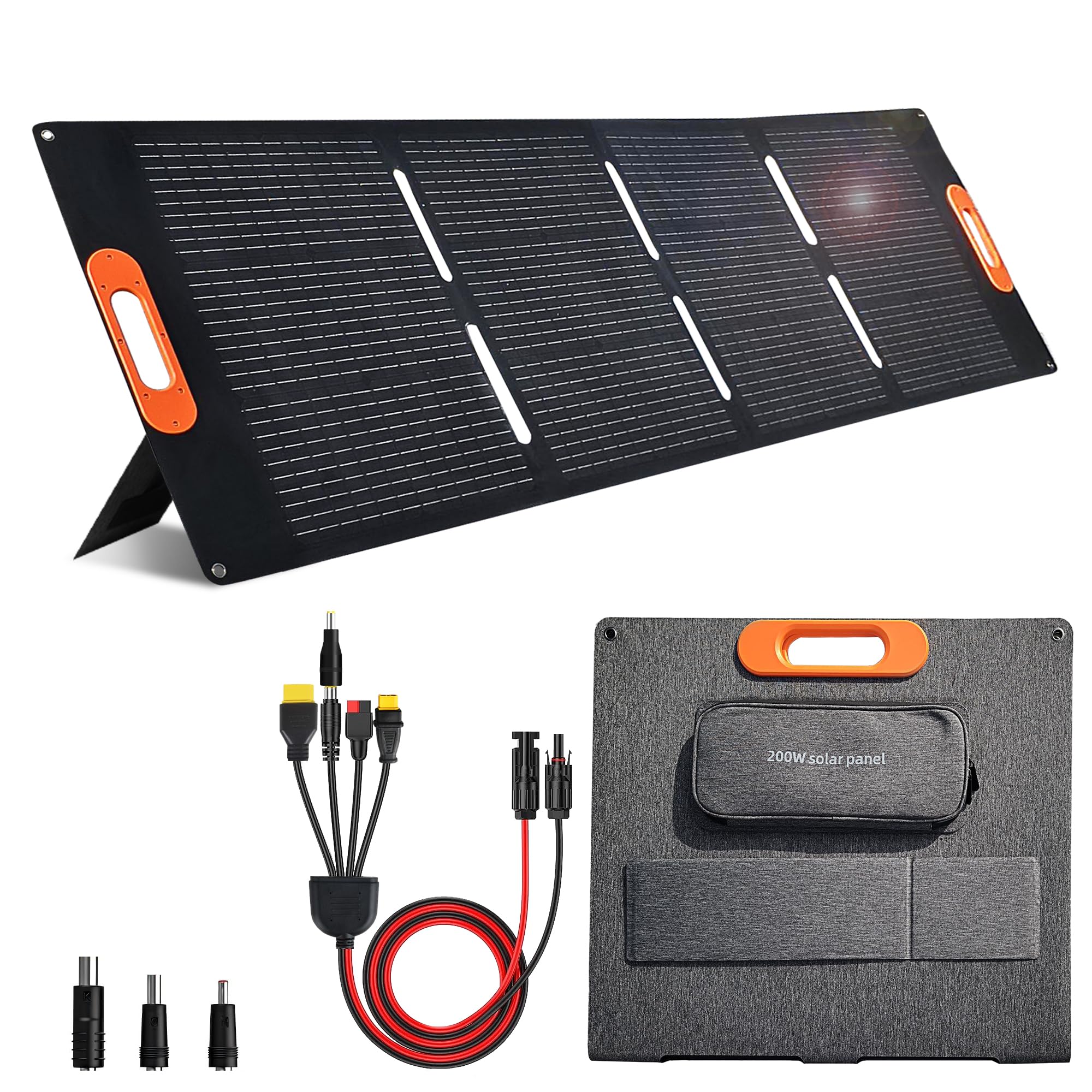
The budget briefcase design that works well for travel-first buyers
You get a 200W-class panel without spending premium money with the VLAIAN. It uses monocrystalline silicon cells rated at 23.5% conversion efficiency, and its key selling point is broad compatibility: it ships with an MC4 to Anderson, XT60, XT90, DC7909, and DC5521 cable, plus a 3-in-1 DC connector covering DC8020, DC5525, and DC35135. The maker claims compatibility with 99% of portable power stations, including EcoFlow, Anker, Bluetti, and Jackery lines.
Owners who ran it hard found it capable. One report shows three 200W panels connected to an Oupes generator delivering a combined 400W input. The 4-fold design weighs in at 8.0 kg and folds to a compact 23.6 x 20.7 x 1.4 inches with a magnetic handle, making it genuinely easy to store. The IP67 waterproof rating (listed in the description despite an IP68 mention in the title) handles outdoor weather.
This panel draws the most negative feedback in this guide. One owner reported a storage pocket detaching after roughly 10 uses, and another found no latch to keep the panel closed when folded. Output fell short for one owner at 120W versus ~170W expected. This is a capable budget pick for occasional travel use, not a daily workhorse. Check the included cables and treat the folding mechanism gently.
Budget Appeal
- Compact 4-fold design at 8.0 kg
- Impressively wide connector compatibility
- Three panels delivered 400W combined to an Oupes
Honest Weaknesses
- Durability concerns reported after repeated use
- No latch keeps panel closed when folded
- Real-world output can fall well below rating
The occasional camper’s pick: If you need a foldable 200W-class panel a few times a year and want to spend the minimum, this fits the bill.
Avoid it if: you plan to set up and break down the panel weekly for years — durability reports suggest a heavier-duty option is wiser.
Understanding the Specs
Conversion Efficiency
This tells you how much of the sunlight hitting the panel becomes usable electricity. Standard panels hover around 17%, while the picks here range from 23.5% up to 26.7%. Higher efficiency means more watts from the same panel area, which matters when you have limited sunny space.
Maximum Voltage vs. Your Station
Panels on this list operate anywhere from about 18 volts up to 48 volts. Your power station has a maximum input voltage limit, and if the panel exceeds it, charging simply will not happen. Always check this number against your station’s spec sheet before you buy — it is the most common reason a great panel ends up in the “does not work” pile.
FAQ
Will a 200 W panel work with my Jackery, EcoFlow, or Bluetti power station?
Why does my 200 W panel only produce 120-150 watts in full sun?
What is the difference between IP65, IP67, and IP68 waterproof ratings?
How long will a 200 W panel take to charge a 1000Wh power station?
Can I connect two 200 W panels together for more power?
What is N-Type solar cell technology and why does it matter?
How much does a 200 W portable solar panel weigh?
Can I charge my phone or laptop directly from a 200 W panel?
What is the difference between MC4, XT60, and Anderson connectors?
Is a bifacial 200 W panel worth the extra cost?
Final Thoughts: The Verdict
For most buyers, the 200 w portable solar panels winner is the Jackery SolarSaga 200W because its 26.7% bifacial efficiency delivers the highest real-world output per square foot of sunlight. If you want rugged durability without the brand premium, grab the BougeRV 200W — its fiberglass layer and 25% efficiency make it the smart value play. And for the SOLUPUP 200W with its 10.1 A amperage, you get the fastest refills for large power stations, provided you shelter it from wind.
How We Picked
We do not accept paid placement. Every pick is matched to a real buyer and a real use-case; we do not hands-on test units.
Sources & Methodology
Specifications: manufacturer listings and product documentation. Review insights: verified customer reviews, as of September 2026. Pricing: not shown on this page (it changes often); check the current price via the retailer link.
As an Amazon Associate, KitchPrep earns from qualifying purchases. This does not affect which products we feature.
Related Guides
