
Specs are compiled from manufacturer listings and verified buyer reviews and can change over time — please confirm the key details on the product page before buying.
If you are shopping for a flexible solar panel that actually delivers close to its rated wattage, the short answer is this: the BougeRV Arch Pro 200W is the most reliable pick for most people, the DOKIO 200W two-panel set is the budget-friendly standout, and the BougeRV Yuma CIGS panel is the premium choice for shade-heavy installs. Watts on a label and watts at your battery are two different things — and that gap is the whole story of this category.
I’m Mohammad Maruf — the founder and writer behind KitchPrep. This guide is built by comparing the manufacturers’ published specifications and the patterns across verified customer reviews, so you get each pick’s real strengths and trade-offs instead of marketing spin.
Here is one honest heads-up before you scroll: this list covers panels in the roughly 190 to 210 watt class, so not every pick is the exact number you typed into the search bar — the nearest same-type size serves the same purpose. Read on for the 200 w flexible solar panel picks that hold up in real sun.
Our Picks at a Glance


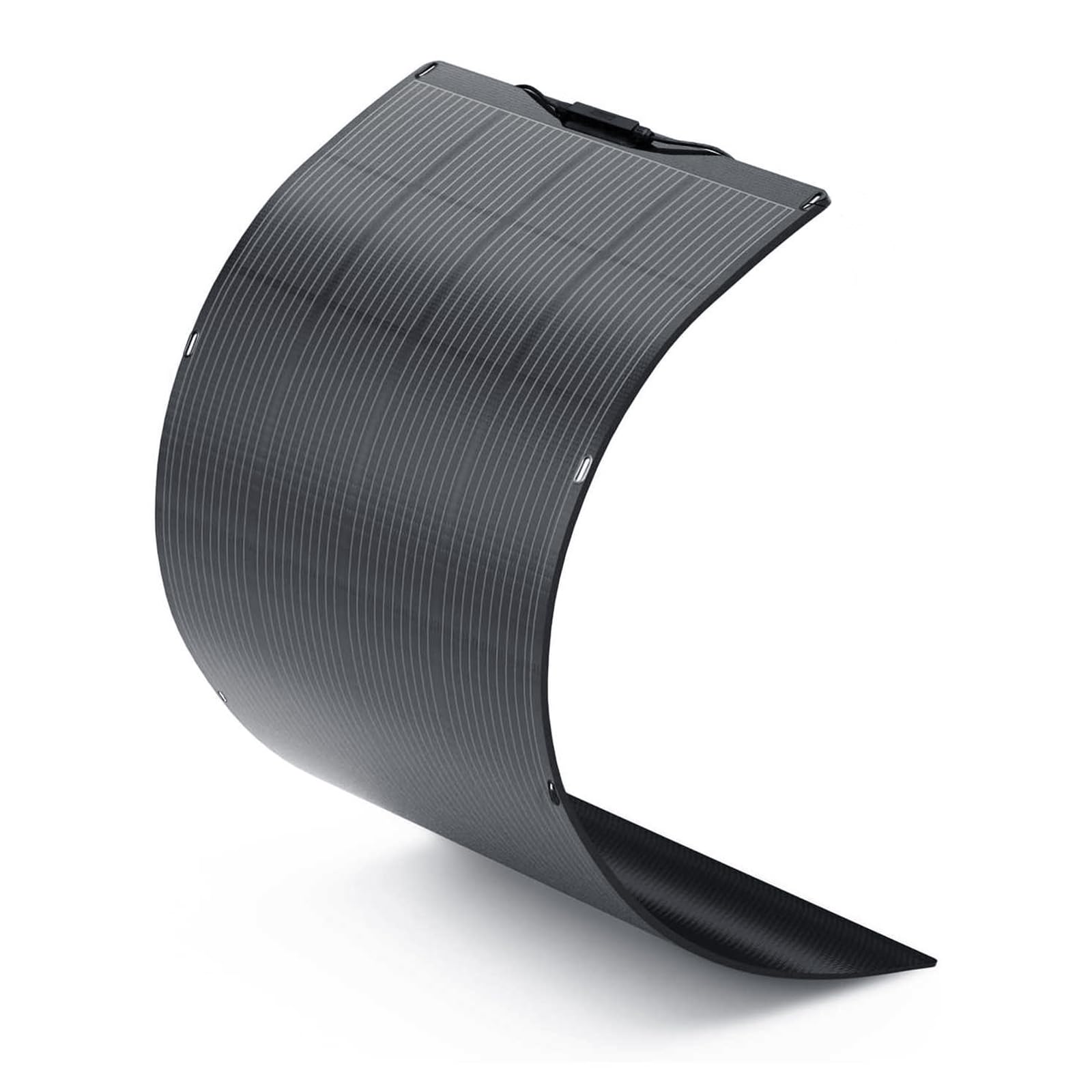
How To Choose The Best 200 W Flexible Solar Panel
Buying a flexible panel is less about the label and more about three things: whether the cells can survive the curve you plan to mount them on, whether the surface coating will outlast a few seasons of UV, and whether the output voltage will actually talk to whatever you are charging. Get those three right and the watts take care of themselves.
Cell type: monocrystalline vs CIGS thin-film
Most flexible panels in this class use monocrystalline silicon cells — those are the rigid little rectangles laminated under a clear coating. They are efficient in direct sun and cheaper to make, but they crack if you flex them past their rated arc and they lose a big chunk of their output when shade falls across them.
CIGS (a thin-film chemistry that is far more tolerant of bending) can flex further and handles partial shade more gracefully, which matters if you park under trees or live somewhere with broken cloud cover. The trade-off is usually cost and a different voltage curve.
Bend radius and how you’ll mount it
A bend rating is the arc the panel can wrap without damaging the cells. Monocrystalline picks here tend to sit between 240° and 270° of flex; a CIGS panel can reach 360°. If your roof is gently arched, most of these will conform fine. If you are wrapping a tight curve on the front of a van or a boat rail, check that number before you buy.
Coating and waterproofing
ETFE is the clear top sheet you want — it resists UV yellowing, scratches, and water far better than older PET coatings, and it is what nearly every pick on this list uses. Pair that with an IP rating for the junction box (the little sealed block where the wires exit) and you have a panel that can take rain, salt mist, and road grit without shorting out.
Quick Comparison
| Model | Best For | Rated Power | Efficiency | Weight | Amazon |
|---|---|---|---|---|---|
| Renogy 200W Ultra Flex Bendable★ Best Overall | Established brand, marine and RV installs | 200 watts | 22% | 10.8 lb | Amazon |
| DOKIO 200W Flexible Set (2x100W)Best Value | Budget builds and small power stations | 200 watts | — | 4.6 lb | Amazon |
| ALLPOWERS SF200 200WBest for Power Stations | Power station owners needing 32V output | 200 watts | 25% | 5.3 lb | Amazon |
| Greenmagic 200W Flex 260° | Tight curves and unusual mounting surfaces | 200 watts | 23% | 8.5 lb | Amazon |
| Callsun 200W (2x100W) Stealth | Stealth van builds and flat truck beds | 200 watts | 23% | 5.7 lb | Amazon |
| Callsun 200W 12V Motorhome | Motorhome roofs and marine decks | 200 watts | 23% | 11 lb | Amazon |
| BougeRV Arch Pro 200W Anti-Shading | Shade-prone camping and forested sites | 200 watts | 25% | 7.9 lb | Amazon |
| BougeRV Yuma 200W CIGS | Extreme flex and shade tolerance | 200 watts | High Efficiency | 6.4 lb | Amazon |
In‑Depth Reviews
1. Renogy Flexible Solar Panel 200 Watt, 240° Ultra Flex Bendable
Our pick — 4.5★ from 150+ verified ratings; the strongest balance of quality and price.
A 200W half-cut PERC panel that bends to 240° and holds up to 5400 Pa snow load.
Renogy has been the default name in off-grid gear for years, and this 200W flexible panel is the reason. It uses half-cut PERC cell technology — cells sliced in half and wired so they capture more light and waste less energy as heat — rated at 22% efficiency. In practical terms, Renogy figures it can put about 1000 Watt-hours into your battery on a day with roughly 5 hours of good sun. That is enough to keep a 12V deep-cycle bank topped off while your fridge and LED lights run through the night.
Physically, it is the heavyweight of this list at 10.8 pounds, and it measures 63.2″L x 29.4″W x 0.1″H. Set that next to the DOKIO two-panel set, which weighs 4.6 pounds and comes in at 22.2″L x 0.04″W x 38.4″H — the Renogy is more than twice the weight and a far larger single footprint, so plan your mounting surface accordingly. What you get in return is a rugged all-black panel that bends up to 240°, shrugs off up to 5400 Pa of snow load and 2400 Pa of wind, and ships with pre-drilled mounting holes plus 27.6-inch 12 AWG cables for a genuine plug-and-play install.
What wins owners over is the raw reliability of the output. People running two of these on a Ford E-250 roof rack report just over 400W at midday in full sun, which is exactly the kind of headroom a 200W nameplate is supposed to promise. Others have taped them to a carport awning tarp and left them plugged into an RV to keep a 300A battery continuously topped off. One long-term owner summed it up best: “Prefect I bought 3 those is works great 👍 I receive 500 or close 600 watts I got three years with this panels renogy is the best company for reals.” The recurring gripe is maintenance — dust and snow collect on the horizontal surface, so a mounted panel needs periodic wiping to stay efficient.
Why owners stay loyal
- 22% efficiency with half-cut PERC cells for better light capture and less heat loss
- Bends to 240° for RV, boat, and van curves without cracking
- Handles up to 5400 Pa snow load and 2400 Pa wind — built for real weather
- Pre-drilled holes and 27.6-inch 12 AWG cables mean a fast, clean install
Real-world friction
- At 10.8 pounds, it is the heaviest panel here and needs a solid mounting plan
- Large 63.2″ x 29.4″ footprint limits where it fits
- Needs periodic cleaning on horizontal mounts to hold efficiency
Go for it: Buyers who want a proven, weather-hardened 200W panel for a permanent RV, van, or marine install and will trade weight for durability.
Think again if: You are mounting on a small or oddly shaped surface where that 63.2″ length simply won’t lay flat.
2. DOKIO 200W Flexible Solar Panel Set, Two 100W 18V ETFE Modules
Two 100W ETFE modules with MC4 connectors that total just 4.6 pounds.
If you want your 200 watts in two smaller pieces rather than one big sheet, the DOKIO set is the smart-money pick. It ships as two 100W panels with an ETFE top sheet — a clear, scratch-resistant laminate that lets more light through and stands up to UV far better than older coatings — and MC4 connectors (the industry-standard click-together plugs that make wiring simple without soldering). You can run them in series for higher voltage or parallel for higher current, whichever your battery bank prefers.
At 4.6 pounds for the pair, this is genuinely the lightest way to get 200 watts on this list. Compare it to the Renogy above at 10.8 pounds and you can see why van builds and trailer roofs love it — the two-panel approach also lets you spread them around obstacles instead of fighting one large sheet. The output voltage is 18V, and each 100W module is a well-tested format that trades blows with far pricier branded panels in real-world testing.
What buyers report most often is that these panels hit their numbers. One verified owner put it plainly: “Flexible panel consistently hits real 100W in full sun, rare at this price.” Others note they charge reliably even when light is shifting or partial shade is creeping across the deck. The honest caveat, straight from the included instructions, is ventilation — you need an air gap behind the panels so heat can escape, and DOKIO specifically warns against mounting directly on combustible materials like wood, foam, or asphalt shingles.
Why it earns a spot: Two 100W ETFE panels with MC4 leads, 18V output, and a combined 4.6-pound weight — the lightest route to a 200W array here.
What to plan for: The 30° bend limit is real, so leave yourself a little flat space rather than trying to wrap a tight curve, and don’t skip the ventilation gap.
Reach for this if: You want maximum flexibility in layout and a low weight budget — this is the setup for a small van or a lightweight trailer.
Look elsewhere if: You need one continuous sheet for a clean, unbroken look on a large flat roof.
3. ALLPOWERS SF200 Flexible Solar Panel 200w Ultra Thin 3mm Bendable Monocrystalline
A 25%-efficient 200W sheet just 0.11 inches thick with 32V output for power stations.
Here is the one spec that jumps out: 25% conversion efficiency, the highest number in this lineup, matched only by the two BougeRV N-type panels further down. That 25% figure (versus the Renogy’s 22%) means more of the sunlight hitting the panel actually becomes usable power. ALLPOWERS pairs it with advanced bypass diodes — small internal valves that reroute current around a shaded section — so a shadow falling on one part of the panel does not cripple the whole thing.
The headline feature for many buyers is the 32V output, which is high in this class and specifically tuned to charge ALLPOWERS power stations like the R600, R1500 Lite, S2000 Pro, and R2500. That is nearly double the 18V the DOKIO set outputs. If your power station favors higher input voltage, this panel matches up better than most. The 0.11-inch thickness and 5.3-pound weight make it one of the easier sheets to handle, and six pre-drilled 8mm grommets support screw or VHB tape mounting so you can install it without drilling.
The real-world picture is more mixed. Owners who use this panel in dull, overcast conditions — think Seattle-level gray — report it still trickles charge in. One reviewer noted it “initially charged phone 30% in 45 min,” which is a fair indicator of decent low-light performance for a small device. But the output story splits: some buyers see only around 150 watts where 200 was advertised, and the worst reports describe a unit that worked well for a day and then failed in the field. That is a minority experience, not the norm, but worth knowing before you commit to a long backcountry trip.
The standout number: 25% efficiency plus 32V output — the highest voltage in this group and a strong pair for ALLPOWERS-style power stations.
The honest read: Real-world output sometimes lands closer to 150W than 200W, so if you are sizing a system, treat the nameplate as a ceiling rather than a guarantee.
Pick it for: Anyone charging an ALLPOWERS power station or a device that benefits from 32V input and wants a very thin, very light panel.
skip it if: You need rock-solid output on every single trip and can’t afford an occasional underperformer.
4. Greenmagic 200 Watt Flexible Solar Panel Charger Flex Up to 260°
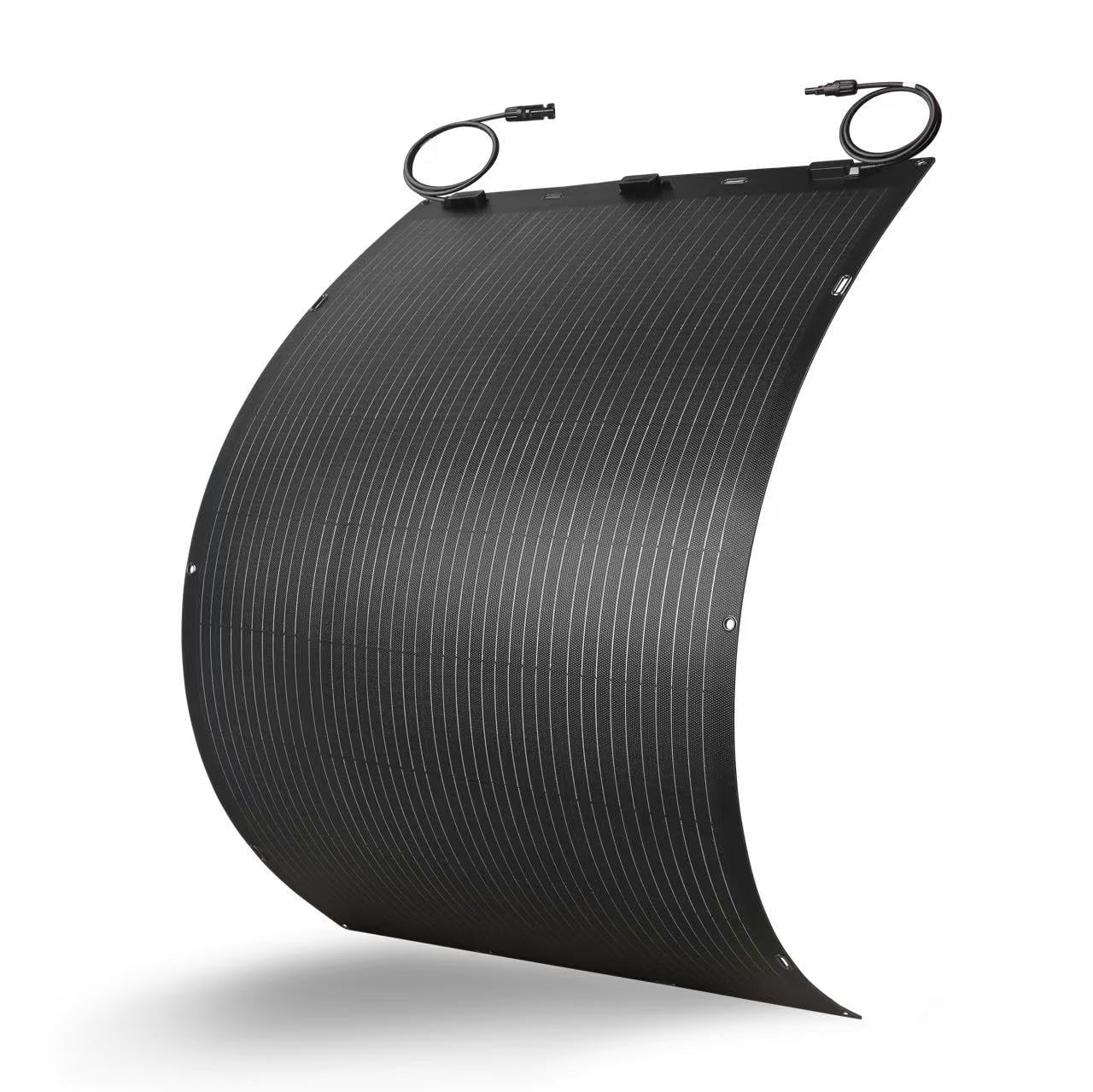
A 260°-flex panel with honeycomb ETFE and an IP67 waterproof rating.
Greenmagic’s 200W flex panel takes the category’s core idea and pushes the bend limit: 260°, which is more than most monocrystalline panels here. Its top surface is honeycomb ETFE — a textured, light-catching pattern that refracts sunlight from different angles into the cells, which can help when the sun isn’t hitting dead-on. Inside, Monocrystalline cells deliver a 23%-25% conversion rate, and the panel includes bypass diodes plus current and reverse protection to guard against damage.
The rest of the spec sheet is solid: 8.5 pounds, 0.11 inches thick, MC4 output ports, and six included straps for mounting to RV roofs, campers, trailers, boats, or cabins. For buyers mounting on a textured or uneven surface, that extra flex margin matters — the more the panel can conform, the less chance of a stress crack down the road.
Performance data is genuinely mixed, and worth being upfront about. Some owners mention exactly what the label promises — one review from a boat owner noted the panel kept the vessel powered throughout the season, and another mount on polycarbonate sheets held up while being crawled on during installation. But at least one buyer tested three panels over months and measured only 150W against the claimed 200W, calling the specs misleading. That is a real-world gap you should factor in rather than assume every unit hits rated power.
What stands out
- 260° flex — more than most monocrystalline offerings here
- 23%-25% conversion efficiency with honeycomb ETFE light capture
- IP67 waterproof for high temperature, freezing, sandstorms, and rain
- Bypass diode and over-current/reverse protection built in
Set your expectations
- Real-world output does not always hit the 200W nameplate
- At 8.5 pounds, mounting on a tight roof curve still needs care
- Fewer total reviews than the bigger brands, so long-term data is thinner
Worth it if: The curve you’re mounting on is tighter than 240° allows and you need the extra flex margin.
Consider the Renogy instead if: You want the bigger, more battle-tested name for a straight-ahead flat install.
5. Callsun 200W Flexible Solar Panel (2x100W), Ultra-Thin ETFE
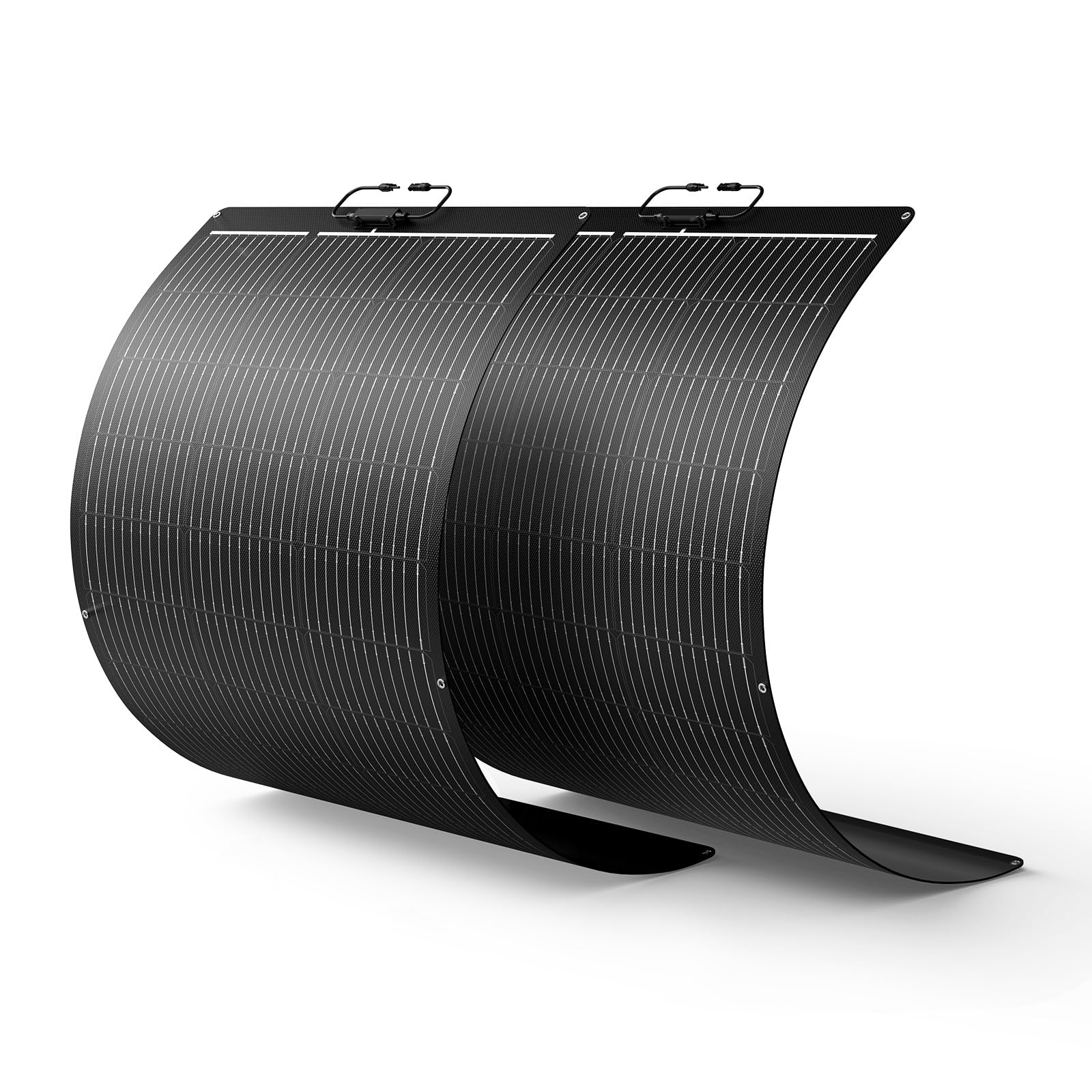
Two all-black 100W panels just 0.1 inches thick for a nearly flush van roof mount.
For stealth camping and low-clearance builds, the visual profile counts as much as the spec sheet. This Callsun kit comes as two all-black 100W panels just 0.1 inches thick, so the mount sits nearly flush against the roof — no raised frame, no glare, no silhouette that announces a solar array to anyone walking past. The pair weighs a combined 5.7 pounds, and the 5.38A amperage capacity keeps wiring runs light and tidy.
The kit runs on 11BB monocrystalline cells with an ETFE coating and a 23% efficiency rating, and it bends up to 240° for curved van roofs or teardrop trailers. A 5-year warranty backs the panels, which is a long window in this category. Under ideal conditions, the pair is rated to harvest up to 1kWh of daily power — enough to keep a portable power station topped up over a long weekend off-grid.
What clearly wins owners over is the quality of the build. One buyer mentioned that the panels were “made with good-quality materials, it’s flexible, and easy to install,” and reported that the kit does exactly what the spec promises. Others have mounted them on a truck bed and value the near-invisible look. A couple of buyers have flagged that the cells themselves are fragile — one cracked a panel by leaning on it, though it still output around 105W afterward. Handle these with care and they will return the favor.
Why it earns its spot: All-black 0.1-inch panels that disappear against a roof, with a 5-year warranty backing them up.
Handle with care: The cells are thin and can crack under direct pressure, so avoid kneeling or leaning on the panel while mounting it.
Best matched to: Van lifers and stealth campers who want a flush, all-black install and care about keeping the vehicle’s look clean.
Less suited to: Owners who need to walk across their mount surface or regularly rest heavy gear on the panels.
6. Callsun 200W 12V Flexible Solar Panel, 11BB Ultra-Thin ETFE
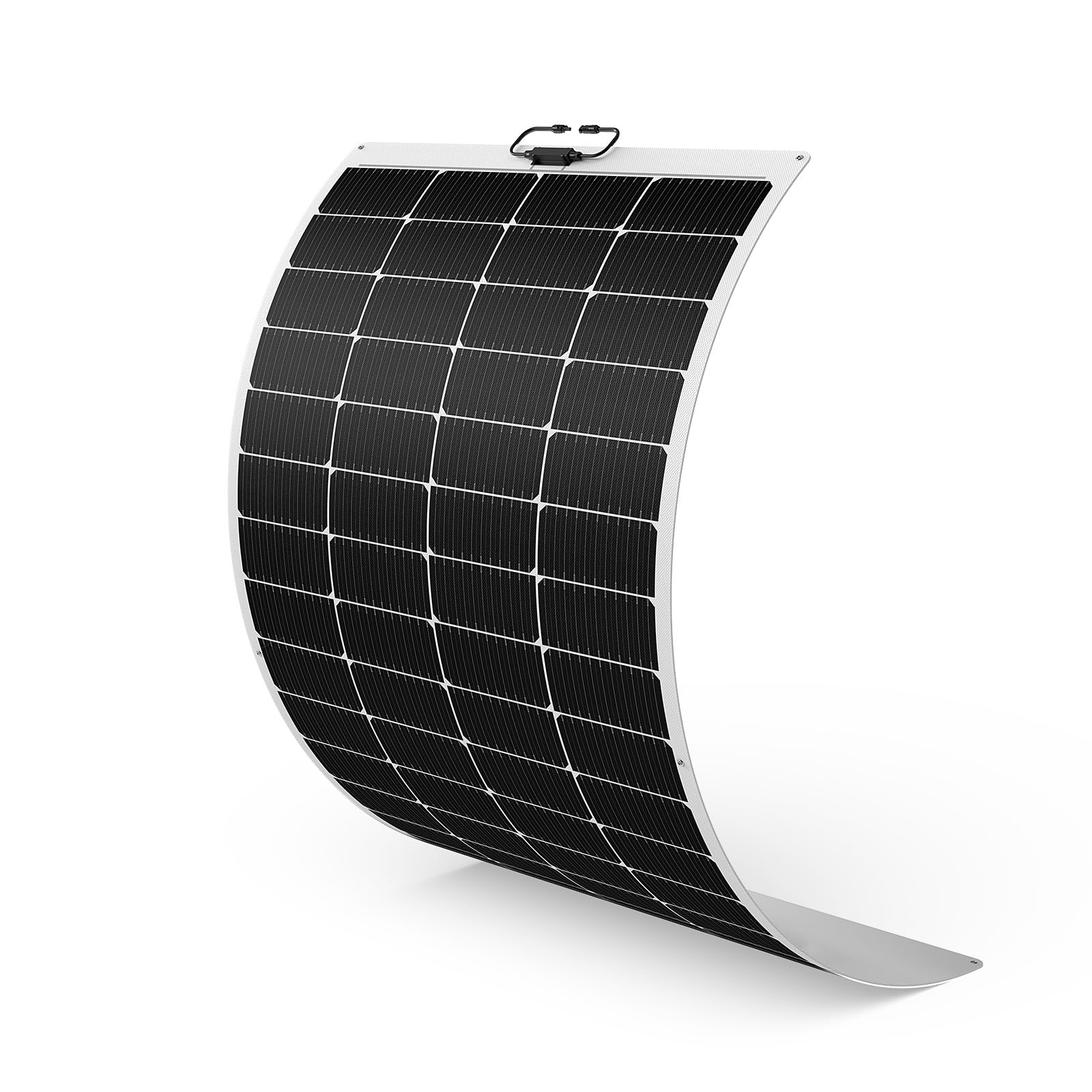
A single 200W Grade A+ monocrystalline panel with an IP68 junction box and 19.1V output.
Where the Callsun kit above splits the watts across two panels, this one does it with a single 200W sheet designed specifically for the arched roofs of motorhomes and travel trailers. It uses Grade A+ monocrystalline cells (the highest quality tier in the monocrystalline grading system) at 23% efficiency and bends to 240°, with a stated weight roughly half that of a comparable rigid panel.
The 11-pound panel measures 65.7″L x 31.7″W x 0.98″H, so it wants a long, flat-ish surface to lay on. Its marine-focused spec — salt-mist resistance, corrosion resistance, UV-yellowing resistance — suits sailboat decks and masts as much as it suits a motorhome. Output voltage is 19.1V, and the panel ships with an IP68 waterproof junction box, meaning it can be submerged briefly without damage. A 5-year warranty covers the unit.
In the field, most owners find this panel outperforms its own label. One owner reported output between 120W and 155W midday on a cloudy day and 180W to 185W in full sun, wired in parallel for a power station. Others report seeing peak figures above 200W when two of these run in series. There is a dissenting report from a buyer who measured significantly less total wattage across a larger array than expected — but the general picture from the review body is a panel that meets or exceeds its rating in real daylight.
The numbers that matter: 23% efficient Grade A+ cells, IP68 junction box, 19.1V output, and a 5-year warranty — heavy on durability features.
The trade-off: It is the second-heaviest panel in this lineup at 11 pounds, and the 65.7-inch length needs a genuinely long roof surface.
Built for: Motorhome and sailboat owners who want a single durable panel with a long warranty and don’t mind the weight.
Not the one if: Your roof surface is short and awkward — the 65.7-inch length is unforgiving.
7. BougeRV Arch Pro 200W Anti-Shading N-Type Fiberglass Flexible Solar Panel
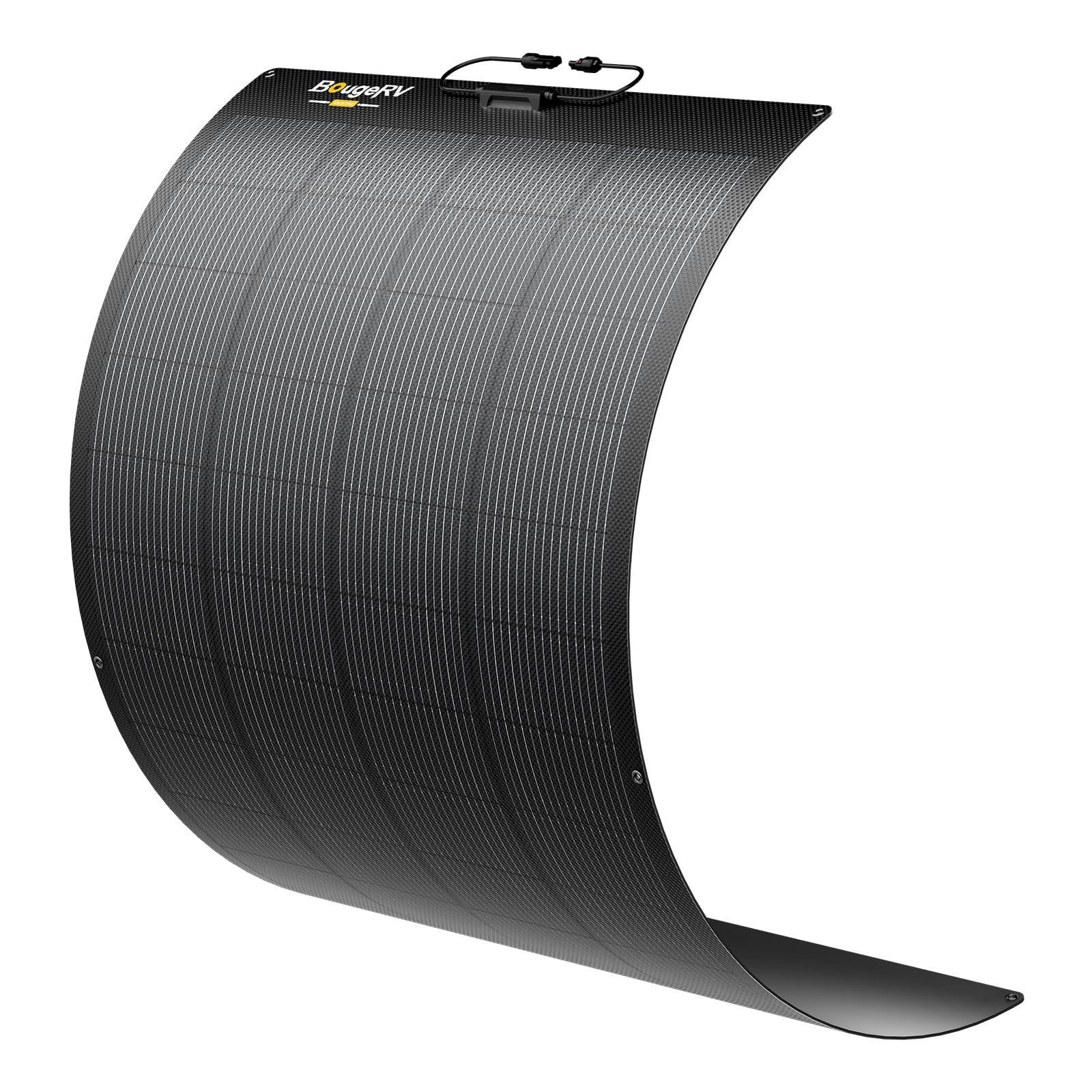
The panel that keeps working when a tree is halfway across the sun.
If you camp under trees or park where shade is unavoidable, this is the pick. BougeRV’s Arch Pro uses built-in bypass diode technology — small internal reroute paths that let current flow around a shaded section instead of stalling the whole panel — paired with upgraded shade-tolerant diodes that reduce hot-spot risk and extend the panel’s lifespan. The N-type 16BB cells hit 25% conversion efficiency, the top figure in this lineup, and the panel bends to 270°. It weighs 7.9 pounds, making it the lightest of the three BougeRV single panels here, with a 52.95″L x 30.91″W x 0.1″H footprint and 24V DC output.
Everything about this panel is built for real-world survival. IP68-rated construction seals the junction box, wire ends, and controller housing against rain and moisture. The ETFE surface is anti-scratch, self-cleaning, and sand-proof. Two pre-attached 2.95-foot cables and multiple mounting options — hanging holes, adhesive backing, or glass glue — make it adaptable across RV, marine, camping, and off-grid setups.
What customers note most often is that the shade tolerance is genuinely noticeable. One travel-trailer owner fixed it with VHB tape and reported it held firm at highway speed while continuing to produce in filtered sunlight. Another returned a heavier competitor after concluding it was less shade-tolerant than the BougeRV. Real output runs a bit below the nameplate — one owner measured 60-65% of rated wattage daily on a flat surface — but the panel’s whole point is that a shaded section does not kill the entire string, and that alone changes what your daily harvest looks like in a treed campsite.
The shade story: Bypass diodes with hot-spot protection mean a partial shadow no longer means zero output — the difference between this and a plain mono panel is very real.
One number to set: The 36V±5% open circuit voltage, like the Arch 2.0, needs a compatibility check against your power station before purchase.
For shade-prone sites: Forest campers, tree-lined driveways, and anyone whose panel will spend time partially covered.
Not the cheapest route: If your install sees full sun all day every day, the anti-shading premium buys you less.
8. BougeRV Yuma 200W CIGS Thin-Film Flexible Solar Panel with Pre-Punched Hole

The one panel on this list that can flex a full 360 degrees.
This is the premium end of the category, and it earns that label with its cell chemistry: CIGS thin-film instead of monocrystalline silicon. CIGS cells are inherently flexible — that’s the whole reason this panel can bend 360°, the widest arc here. The wire-intensive CIGS design also captures more energy in low-light and partial shade, giving it anti-shading behavior without relying on bypass diodes alone. The panel weighs just 6.4 pounds and comes in a 82.77″ x 27.14″ footprint — the longest, thinnest form factor in the lineup.
The construction backs it up. ETFE coating, IP68 waterproof rating on the panel, connectors, and junction box, and improved rainfall drainage that helps reduce the effects of partial shade. Pre-drilled 5mm holes (about 0.2 inch) allow screw mounting, hanging with rope or wire, or adhesive tape attachment. BougeRV backs this CIGS panel with a 10-year tech support window — the longest in this group — and rates it for up to 25 years of service.
Field performance shows why some buyers happily pay the premium. One owner with ten+ panels reported the 200W units yielding around 100W+ each, with an 800W array peaking over 400W feeding a Bluetti station, and called them clearly better than their old suitcase and rigid panels. Others note the CIGS approach performs meaningfully better in clouds and shade than a standard mono panel, and that the panels survive highway driving and rainy weather without issue. The recurring caveat is that real output runs below the rated 200W per panel — owners frequently report seeing around half that in everyday conditions.
Where it beats everything else
- 360° flex — the widest bend arc in this lineup
- CIGS cells hold output better in shade and low light than monocrystalline
- 6.4-pound weight in a long, thin, rollable form factor
- IP68 waterproofing and 10-year tech support
What you pay for
- The highest-tier pricing in this list
- Real-world output typically lands below the rated 200W per panel
- Pre-drilled grommets can loosen — a couple of owners noted a grommet falling out
Best for: Owners who need the absolute maximum flexibility and shade tolerance and are willing to pay for the thin-film advantage.
Not worth it if: Your setup is flat, sunny, and straightforward — the budget picks deliver the same practical wattage for less.
Understanding the Specs
Efficiency rating (why 22% vs 25% matters)
Efficiency is the percentage of sunlight hitting the panel that gets turned into usable electricity. A 25% panel squeezes more power from the same patch of roof than a 22% one, which matters when space is tight. Higher efficiency also usually means less heat buildup, so performance holds up better on a hot summer roof. You’ll notice the difference most in marginal conditions — first light, late afternoon, or a hazy day.
Bend radius and mounting method
The bend figure (240°, 260°, 270°, 360°) is the arc a panel can safely wrap across. Match it to your surface: flat-ish RV roofs work with 240°, tight van curves want 260° or more, and CIGS thin-film handles a full 360°. Mounting matters just as much — pre-drilled grommets allow screw or hanging mounting, adhesive backing works on fiberglass, and VHB tape is a common no-drill option. Whatever you choose, leave a ventilation gap so the panel doesn’t trap heat behind it.
Output voltage and charging compatibility
The voltage a panel outputs — whether that’s 18V, 24V, or 32V — has to match what your charge controller or power station accepts. Some stations have a minimum voltage threshold below which they register nothing, so a panel producing 28V may simply not wake up a 30V-minimum input. That’s why checking the open circuit voltage spec against your gear is the single most important compatibility step.
Coating, IP rating, and weather survival
ETFE coating is what protects the solar cells from UV, scratches, and water, and it outlasts the older PET coatings. The IP rating (like IP67 or IP68) describes how well the junction box and connectors resist dust and water — IP68 being the more thoroughly sealed of the two. Together, these two specs decide whether a mounted panel survives a full season of rain, salt spray, and highway grit.
FAQ
Will a 200W flexible solar panel charge my power station?
How many degrees of bend can a flexible solar panel handle?
Does a 200W flexible panel really produce 200 watts?
Can I walk on a flexible solar panel?
What is the difference between monocrystalline and CIGS flexible panels?
How do I mount a flexible solar panel without drilling?
Will a flexible solar panel survive rain and salt water?
How long does a flexible solar panel last?
Do I need a charge controller with a 200W flexible solar panel?
Can I mix a 200W flexible panel with a rigid panel in one system?
How much daily power does a 200W flexible solar panel produce?
Final Thoughts: The Verdict
For most buyers, the 200 w flexible solar panel winner is the Renogy Flexible Solar Panel 200 Watt, 240° Ultra Flex Bendable because it backs a 22% efficiency rating with real durability — up to 5400 Pa snow load, 2400 Pa wind, an IP67 junction box, and pre-drilled holes for a fast install. It is the heaviest panel here at 10.8 pounds, and that weight is the price of a build that survives year after year. If you want the lightest, most affordable way to reach 200 watts and can plan around a 30° bend limit, grab the DOKIO 200W Flexible Solar Panel Set — its two 100W ETFE modules total 4.6 pounds. And if shade is your daily reality, the BougeRV Arch Pro 200W Anti-Shading with its bypass diodes and 25% N-type cells is the one to reach for.
How We Picked
We do not accept paid placement. Every pick is matched to a real buyer and a real use-case; we do not hands-on test units.
Sources & Methodology
Specifications: manufacturer listings and product documentation. Review insights: verified customer reviews, as of September 2026. Pricing: not shown on this page (it changes often); check the current price via the retailer link.
As an Amazon Associate, KitchPrep earns from qualifying purchases. This does not affect which products we feature.
Related Guides
