
Specs are compiled from manufacturer listings and verified buyer reviews and can change over time — please confirm the key details on the product page before buying.
Blackouts don’t care about your schedule, and a generator leaves you tethered to fuel. The real question for a 200-amp solar setup is which all-in-one unit can actually run your whole house — heavy loads, fridge, lights — without tripping or blinking. This guide breaks down three 10kW-class 48V systems to help you make that call with confidence.
I’m Mohammad Maruf — the founder and writer behind KitchPrep. This guide is built by comparing the manufacturers’ published specifications and the patterns across verified customer reviews, so you get each pick’s real strengths and trade-offs instead of marketing spin.
When the grid goes down, you want your lights, fridge, and AC to keep running without a hiccup. That requires a 200 amp solar system that pairs a 200A charge controller (the part that manages battery charging) with clean, steady power. Here are the options that actually deliver.
Our Picks at a Glance

How To Choose The Best 200 Amp Solar System
Think of the inverter as the brain of your backup power—it decides how your home draws energy. Specs like “200A” (the maximum battery charge current) and “MPPT” (a smart tracker that squeezes more power from your solar panels) sound technical, but your choice really depends on three questions: what you need to power, how you get that power, and how it all connects.
Match the Inverter to Your Loads
First, list what must run during an outage. A 10,000-watt inverter handles big items like a well pump, a central AC, and multiple refrigerators, but only if you don’t turn everything on at once. Peak power—the surge capacity to start motors—is just as important as the continuous rating.
Understand Your 48V Battery Bank
These systems run on 48 Volts of direct current (DC) from a battery bank. The “200A” spec generally describes the inverter’s maximum battery charging current. Your battery chemistry—LiFePO4, AGM, Gel, or Flooded—must match what the inverter supports to avoid damage.
Quick Comparison
| Model | Best For | Max Charging | Solar Input | AC Output | Amazon |
|---|---|---|---|---|---|
| SunGoldPower 10kW★ Best Overall | Custom, heavy-load home systems | 200A | 2 MPPTs / 10kW | 120V/240V Split | Amazon |
| ECO-WORTHY Liber 10kW | Off-grid cabins & RVs | 200A | 2 MPPTs / 11kW | 120V/240V Split | Amazon |
| ECO-WORTHY 10kW Kit | All-in-one home backup bundle | 200A | 2 MPPTs | 120V/240V Split | Amazon |
In‑Depth Reviews
1. SunGoldPower 10kW 48V Solar Inverter
Our pick — over 4★ from 90+ verified ratings; the strongest balance of quality and price.
The serious whole-home workhorse with the flexibility to match your exact power needs.
This is the pick for demanding loads. Buyers report it runs a 5-horsepower compressor, central AC, and refrigerators quietly, with a smooth automatic transfer between solar, battery, and grid power. Its two MPPT solar charge controllers (trackers that pull maximum power from the panels) handle up to 500VDC and 10kW of solar, feeding a sturdy 200A battery charge—so you can run heavy equipment without worrying about brownouts.
The flexibility here is what wins people over. You get 68 different settings, including the ability to schedule charging when grid power is cheap. It supports a variety of battery types—AGM, Gel, Flooded, Lithium—and even runs without a battery if you prefer a direct solar setup.
Owners with large setups report impressive results: One owner reports the inverter refills a 30-kWh bank in under 3 hours.. While installation experiences vary—some find it easy, others report difficulties—the inverter itself earns consistent praise for reliability and value. Just keep in mind the monitoring app is a known weak point, with some recommending third-party tools for remote control. Uniquely, it also supports parallel operation with up to 6 units for future expansion, giving you the guts to grow a 20kW system later. This system also excels as a grid-charging option, giving you control over when you pull grid power.
What Owners Rave About
- Handles heavy 5hp loads without breaking a sweat
- Quiet performance with a smooth auto grid transfer
- Extensive 68-setting customization for control freaks
Where it Gets Tricky
- Monitoring app is weak for remote adjustments
- Installation can be complex for DIY beginners
Reach for it when: you need a powerhouse inverter that can handle starting a big motor or an entire house worth of appliances.
Look elsewhere if: you want a plug-and-play setup or expect flawless app-based control from the start.
2. ECO-WORTHY Liber 10kW Inverter
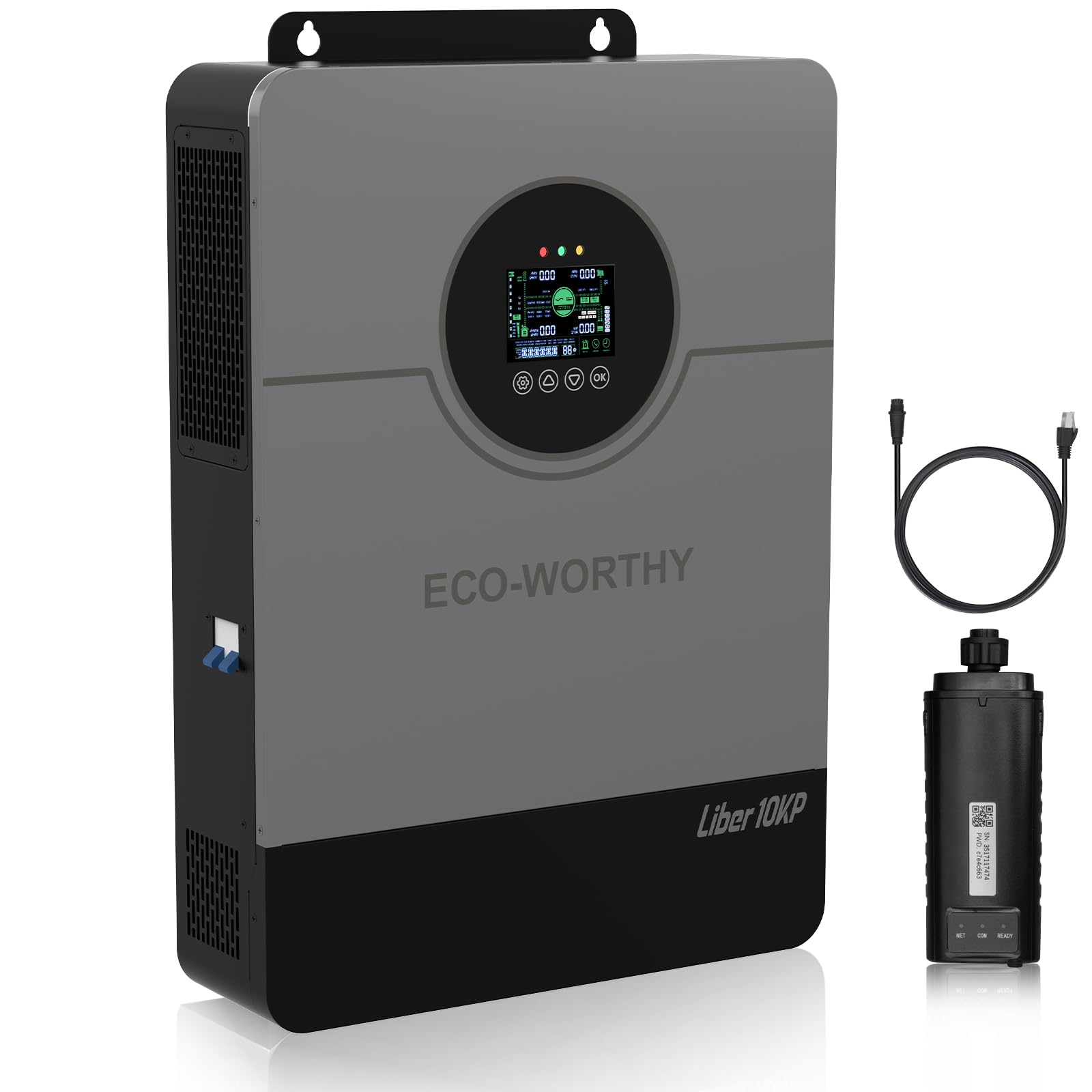
A solid, expandable off-grid brain that pairs strong construction with a slightly steeper learning curve.
If you’re building a serious off-grid setup—a cabin, an RV, or a dedicated backup system without any grid-tie plans—this unit delivers. It puts out a clean, stable 120V/240V split-phase or 120V single-phase output from its 200A charger.
Safety and ruggedness are front and center here. It’s UL1741 certified and packs 14 protection functions against short circuits, overloads, and voltage fluctuations. Buyers describe it as “easy to manage” with “strong construction,” and the solid build quality is a recurring point of praise.
The catch is the user experience. Setup can be confusing, and the manual is often described as vague, with a responsive support team behind it. The companion app for Android is a known weak spot, lacking remote settings adjustments and having a finicky Wi-Fi setup that has frustrated even users with a networking background. This is a candid look at the trade-offs: you get a lot of power for the money, but be prepared to invest time in learning its quirks.
Solid yet complex: Buyers agree the construction and power output are excellent, but the manual and app will test your patience.
The takeaway: A fantastic choice if you value raw capability and have the technical expertise to dial it in.
3. ECO-WORTHY 10kW Home Backup Power Kit
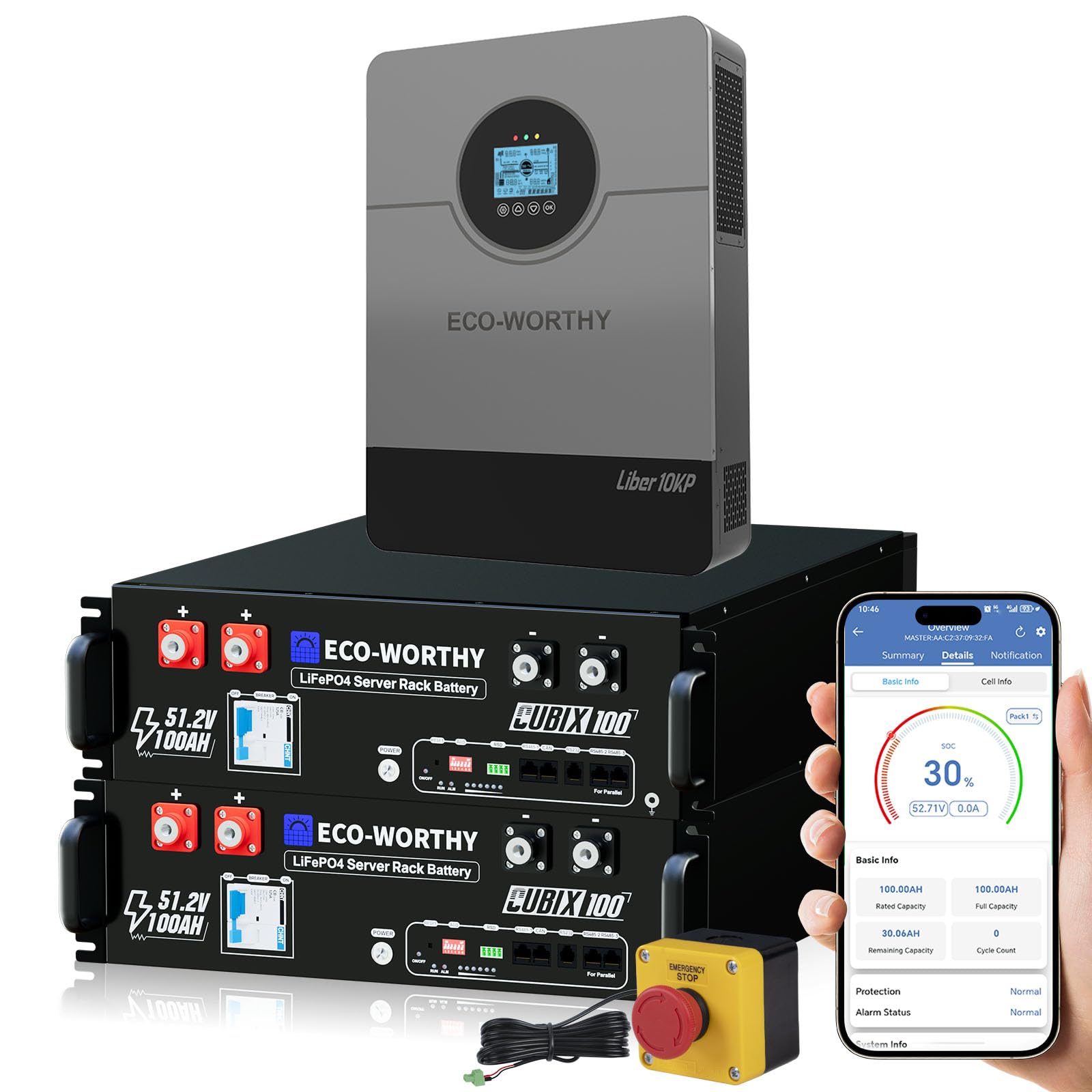
The “power in a box” solution: inverter, batteries, and brain bundled to conquer outages.
If the thought of piecing together a system feels overwhelming, this kit simplifies everything. It bundles a 10,000W inverter with two 51.2V 100Ah LiFePO4 batteries, delivering 10,240Wh of usable storage. to keep essentials running through a blackout. This isn’t just an inverter; it’s a complete system designed to power a home and its appliances.
The performance is the highlight. The inverter offers a 200A max charging rate and the batteries use “Grade A LiFePO4 cells” known for longevity. The kit is built for easy monitoring, with Bluetooth and Wi-Fi built into the batteries for an app view of your system. It also scales impressively—You can link up to 6 units for a combined 60kW output..
However, the battery life and charging have drawn negative feedback, with some owners reporting issues with the batteries not charging properly, which often traces back to confusing settings. There’s also a single, specific hurdle: one buyer notes the battery lacks a 9540 certification needed for a code-compliant rack install in Colorado. This is a nuanced point for permitting, so check local codes first. It’s powerful and convenient, but less tech-savvy users might find the setup a bit more of a project than expected.
Buy it for the Convenience
- Complete, bundled kit takes the guesswork out of pairing
- Backed by UL1973 & UL1741 safety tests
- Expandable design supports up to 32 batteries
Consider the Caveats
- Some owners mention finicky battery charging setups
- Check state-level rack certifications before you buy
Best for: someone who wants a single, coordinated order for a home backup station without sourcing parts separately.
Think twice if: you are installing in a jurisdiction with strict racking codes, or if you want support that responds faster than a week by email.
Understanding the Specs
What does “200A” actually mean here?
In these systems, the 200A rating refers to the maximum current the inverter’s built-in battery charger can push into your battery bank. A bigger number means faster refills from solar or grid, letting you pack more midday sun into your batteries before the clouds roll in.
MPPT Charge Controllers Explained
MPPT stands for Maximum Power Point Tracking. It’s a smart technology that adjusts the voltage to pull the absolute most power from your solar panels. “Dual MPPT” means the inverter has two of these trackers, allowing you to face panels in different directions (like east and west) without losing efficiency.
FAQ
Will a 200A solar system power my whole house?
Can I run a 200A solar system on-grid or off-grid?
What is the difference between 120V and 240V output?
How many solar panels do I need for 200A charging?
Can I use my existing batteries with a 200A system?
Is the UL1741 certification important for a solar inverter?
Will my electronics be safe with a pure sine wave inverter?
What does “parallel up to 6 units” mean for a 200A system?
Final Thoughts: The Verdict
Your final choice depends on your energy needs and how hands-on you want to be. For heavy loads and proven reliability, the SunGoldPower 10kW is our top overall inverter. If you’re building a pure off-grid retreat and want solid value, the ECO-WORTHY Liber is a strong choice. For the easiest, single-order home backup solution with batteries included, the ECO-WORTHY 10kWh Kit gets you powered up fast.
How We Picked
We do not accept paid placement. Every pick is matched to a real buyer and a real use-case; we do not hands-on test units.
Sources & Methodology
Specifications: manufacturer listings and product documentation. Review insights: verified customer reviews, as of September 2026. Pricing: not shown on this page (it changes often); check the current price via the retailer link.
As an Amazon Associate, KitchPrep earns from qualifying purchases. This does not affect which products we feature.
Related Guides
