
Specs are compiled from manufacturer listings and verified buyer reviews and can change over time — please confirm the key details on the product page before buying.
You do not need the flashiest 200 amp fuse — you need one rated for your exact voltage, interrupt capacity, and holder. Get those three right and the fuse clears a fault instead of failing in your hand. Get them wrong and a nuisance blowout can leave a home, boat, or solar bank dark. This guide sorts the published specs — class, voltage, interrupt rating — so you can match a fuse to your holder and fault current.
I’m Mohammad Maruf — the founder and writer behind KitchPrep. This guide is built by comparing the manufacturers’ published specifications and the patterns across verified customer reviews, so you get each pick’s real strengths and trade-offs instead of marketing spin.
Fuses are unforgiving components — a mismatched interrupt rating or holder size turns a simple repair into a rewrite of your whole circuit. This walkthrough breaks down exactly what separates a good 200 amp fuse from one that quietly fails when you need it most.
Our Picks at a Glance
How To Choose The Best 200 Amp Fuse
A 200 amp fuse is a safety device that has one job — to melt and open the circuit before fault current damages your equipment or starts a fire. The catch is that “200 amp” only tells you the current it is designed to carry, not the current it can safely interrupt. That second number, the interrupt rating, is where most buyers get tripped up. Here’s what actually matters before you buy.
Match the fuse class to your holder first
Class RK5, Class T, and ANL are the three families you’ll encounter in the 200A range, and they are not interchangeable in the same holder. A Class RK5 cartridge is long and cylindrical; a Class T is much shorter and physically smaller. A Class RK5 fuse can run 7.5 inches long, while the Class T version sits at just over 2.7 inches — that size gap is the difference between dropping into your existing panel and forcing a new holder.
Check the voltage and interrupt rating against your system
Voltage rating tells you the maximum circuit voltage the fuse is designed to clear without restriking the arc. Interrupt rating, expressed in kiloamperes (kA), is the maximum available fault current the fuse can safely extinguish. If your system can deliver more fault current than the fuse is rated to interrupt, the fuse may fail violently instead of opening cleanly. Always match or exceed the system’s available fault current.
Decide if you need time-delay
Time-delay fuses tolerate brief current surges — like the inrush when a motor starts — without blowing. If you’re protecting a circuit that sees motor startups or transformer inrush, a time-delay class is the right choice. For pure fast-acting protection on inverters and DC systems, a fast-acting class stops current quicker.
Quick Comparison
| Model | Best For | Fuse Class | Voltage Rating | Interrupt Rating | Amazon |
|---|---|---|---|---|---|
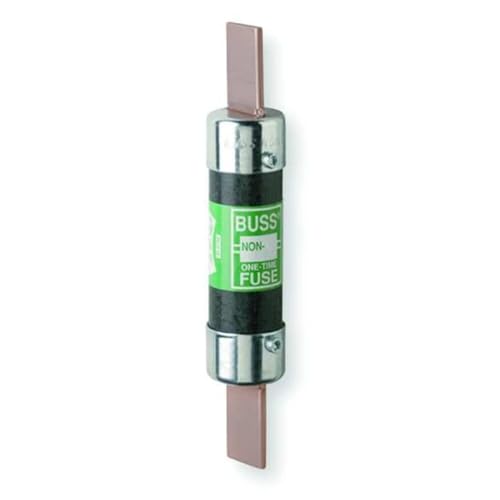
| Bussmann NON-200★ Best Overall | Home & general AC panels | Class K5, one-time | 250 V | Not published | Amazon |
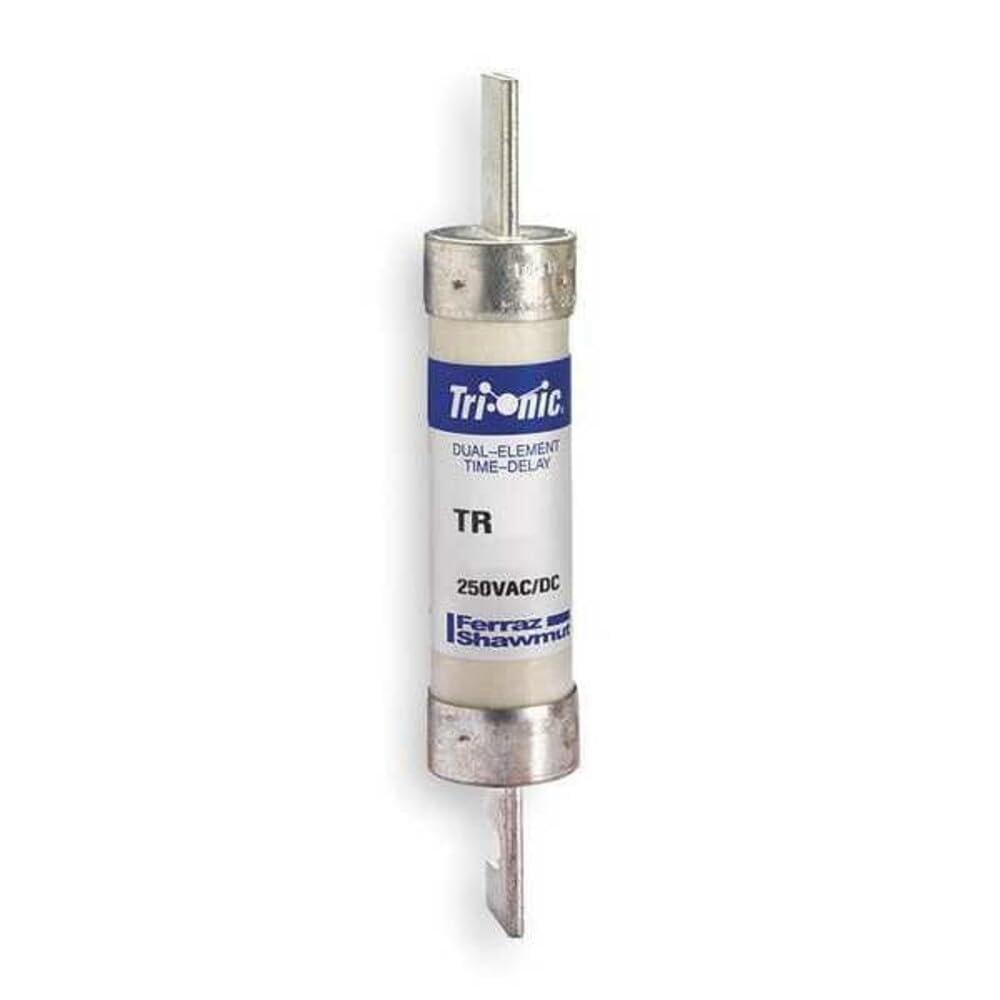
| Mersen TR-R Tri-Onic TR200RTime-Delay Pick | Motor start-ups & transformer circuits | Class RK5, time-delay | 250 VAC / 250 VDC | 200 kA AC / 20 kA DC | Amazon |
| Blue Sea Systems 5129 | Marine & RV DC fuse blocks | ANL | 32 VDC | Not published | Amazon |
| Blue Sea 5129 (B00MYS4T4Y) | Gasoline-boat main battery disconnect | ANL, ignition protected | 32 VDC | Not published | Amazon |
| Mersen A3T200 | Solar inverters & compact DC panels | Class T, fast-acting | 300 VAC / 160 VDC | 200 kA AC / 50 kA DC | Amazon |
| Bussmann FRN-R-200 | Motor-heavy AC disconnects | Class RK5, time-delay | 250 VAC / 125 VDC | 200 kA AC / 20 kA DC | Amazon |
| Go Power FBL-200 | Inverter systems 12–48 V | Class T block with 200A fuse | 12–48 V systems supported | Not published | Amazon |
In‑Depth Reviews
1. BUSSMANN FUSES NON-200 250V K5 One-Time 200 Amp Low-Voltage Cartridge Fuse
Our pick — over 4.5★ from 90+ verified ratings; the strongest balance of quality and price.
The everyday workhorse for home panels and general AC service calls
The Bussmann NON-200 is the fuse a working electrician grabs when a home panel pops and the job needs to be finished today. It’s a one-time 200 amp cartridge rated for 250 volts with a Class K5 body, through-hole mounted, and built with a copper and plastic construction that holds up to repeated service-panel swaps. At 2 pounds and 1.8 x 7.5 x 1.7 inches, it’s a substantial chunk of equipment — the size telling you this is a main-level fuse, not a snap-in miniature.
What wins people over is how well it fits real-world panels. Buyers report going to Amazon because nobody local stocked the size — one describes ordering after pulling the main and finding only 100 amp spares in the sub-panel. Another writes that “it worked” after an island-wide search for a washer and dryer repair, and another says it fit the disconnect panel “like it was supposed to.” Durability and construction quality are the two things buyers keep coming back to, which tracks with the maker’s published “highly durable” note.
The catch worth knowing: this is a one-time fuse — it doesn’t allow you to reset it, and once it blows you replace it, not reset it. That’s the design, not a flaw, but it means keeping a spare on hand is a real convenience. Availability is also more limited than the big box brands, so plan ahead rather than assuming a local supply house will have it on the shelf.
The case for it
- Rated 200A at 250V for standard home service panels
- Class K5 one-time design matches existing NON-200 holders
- Copper-and-plastic build holds up in service-grade duty
- Buyers regularly note it arrives at a fraction of local supply house cost
The honest trade-off
- One-time design means replacing rather than resetting
- No published interrupt rating on the product page, so verify against your system’s available fault current before you buy
- Local availability is spotty in many areas
Reach for this if: you’re servicing a home panel and need a mainstream 200A Class K5 cartridge that drops into an existing NON-200 holder.
Look elsewhere if: your circuit sees motor start-up surges (a time-delay class serves you better) or you need a published interrupt rating for a high-fault-current industrial install.
2. Mersen TR-R Tri-Onic Time-Delay/Class RK5 Fuse, 250VAC/250VDC, 200kA AC/20kA DC, 200 Ampere
The time-delay cartridge that rides through motor inrush without nuisance trips
If you’ve ever had a fuse blow the instant a motor spins up, you already know what a time-delay fuse solves. This Mersen TR-R carries a 200 amp rating and a two-part voltage spec of 250 volts AC and 250 volts DC, with an interrupt rating of 200 kiloamperes on AC and 20 kiloamperes on DC. Time-delay behavior is the headline feature: it lets brief current spikes from motor start-ups and transformer inrush currents pass through without opening, then still clears a real fault.
It measures 7.5 x 1.5 x 1.5 inches — noticeably longer and thinner than the compact Class T fuses further down this list. That size matters when you’re deciding whether a fuse will physically drop into an existing Class RK5 holder. The rejection-style body is shaped specifically so you can’t drop in a different class by mistake. The SmartSpot solid-state blown-fuse indicator is offered as an optional build, so you can see at a glance whether it has opened.
What owners flag most is how the fuse behaves in real restoration work — the story of pulling a 200 amp fuse from an older building, finding the underlying fault, and reinstalling the replacement carries the “power restored” verdict that shows up again and again. The honest caveat: a couple of reports involve damaged or long-shelf-life units shipped from third-party sellers, so check the physical body and any date code carefully on arrival. At 4.4 stars and modest review volume, this is a niche pick for someone who specifically needs Class RK5 time-delay behavior.
Where it earns its place: the combination of Class RK5 time-delay performance with a 200 kA AC interrupt rating covers motor-heavy circuits that a fast-acting fuse simply can’t.
The real-world catch: third-party seller inventory can arrive with older manufacture dates — verify the fuse body and reject anything that looks pre-used or damaged before installing.
Suits you when: your circuit sees motor start-ups, transformer inrush, or any surge current that routinely pops a fast-acting fuse.
Skip if instead: your inverter or DC gear needs fast-acting clearing, or you need a size that matches a compact Class T holder — the Class RK5 body won’t drop in.
3. Blue Sea Systems 5129 Fuse ANL 200-AMP
A DC-rated ANL fuse built for salt air, sealed engine rooms, and RV battery banks
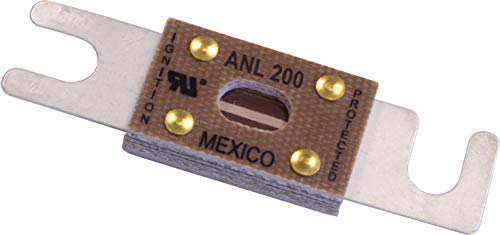
Blue Sea Systems built its 5129 ANL fuse for the realities of a marine DC system — damp bilges, vibration, and the corrosive whiff of salt air. The silver-plated connector blades are there specifically for corrosion resistance, and the whole fuse weighs just 22.68 grams, so it’s a light, low-profile cartridge that leaves plenty of room in a crowded DC fuse block. At 5 x 3 x 1 inches, it’s anchored by surface-mount installation rather than a through-hole cartridge holder.
The window feature is what experienced DC installers care about — one buyer explains that the viewing window shows intact versus blown status in a sealed engine room where cracking the enclosure to check is a hassle. The same buyer’s guidance is worth repeating: buy the amperage just above your expected load rather than oversizing, because the 200 amp rating is designed for loads like 12V thrusters where the inrush actually justifies it. It pairs directly with the Blue Sea Systems 200A fuse holder, so the system stays matched.
Where buyers push back is fit. A handful of reports describe the fuse arriving longer than the fuse block expected, which is a real compatibility risk if you’re matching a specific holder from another brand. The 200A rating also assumes a DC application — this is not a general-purpose AC service fuse, so if you’re working a household panel, look at the Class K5 and RK5 fuses on this list instead.
What stands out
- Silver-plated blades resist corrosion in marine environments
- Visible blown-condition window for sealed enclosures
- Light 22.68 g body frees up space in tight DC panels
- ANL class matches Blue Sea Systems’ own holder lineup
Where it pushes back
- Fit varies by fuse block — verify length against your existing holder
- DC-application only; not rated for AC household service
- No published interrupt rating to verify against a high-fault system
The one for you when: you’re protecting a marine or RV DC circuit and want a corrosion-resistant, seal-friendly ANL fuse with a visible blown indicator.
Not your pick if: you’re servicing an AC household panel or need a fuse with a documented interrupt rating for a high-fault-current install.
4. Blue Sea Systems Blue Sea (5129) ANL Fuse
Same 5129 ANL number, but rated ignition-protected for gasoline-boat installs
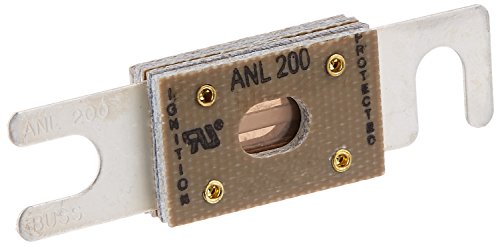
Here’s the difference a buyer needs to see clearly: this listing carries the same 5129 model number as the marine ANL fuse above, but it is ignition protected (conforming to SAE J1171, a standard for parts that won’t spark in fuel-vapor areas), which means it’s rated for installation aboard gasoline-powered boats up to 500 amp. If your vessel has a gasoline engine and the fuse lives in an engine space where fuel vapor could collect, that rating is not optional — it’s the whole reason to choose this version. The window still shows blown condition, and the silver-plated blades still resist corrosion.
In practice this is the 12V/24V main battery disconnect fuse. Owners describe using it on a 400Ah 12V bank as a proper disconnect fuse, noting it’s “not a cheap stereo fuse” — the distinction being that a cheap knockoff might melt without opening or fail to clear a fault at all. The physical body weighs 1.28 ounces with a silver, ceramic, and glass material build, and the mounting is surface-mount to a Blue Sea Systems ANL fuse block.
What buyers should verify before purchase: this fuse carries no AIC (ampere interrupting capacity) rating suitable for lithium, and it is not rated for 48 volt systems. For lead-acid banks at 12V or 24V, it’s a solid choice; for a 48V lithium bank, you’ll want a Class T design instead. It also needs a matching ANL fuse block — it is not a standalone cartridge that drops into a generic holder.
Why gasoline-boat owners reach for it: the SAE J1171 ignition-protection rating is what makes this safe in a fuel-vapor environment, and it’s a rating most generic DC fuses simply don’t carry.
An honest limit to file: no AIC rating for lithium and no 48V support — if you’re building a lithium bank or a 48V system, this is the wrong fuse family.
Choose this when: you’re installing a main battery disconnect on a gasoline-powered boat or a 12V/24V lead-acid bank and need the SAE J1171 ignition-protection rating.
Keep looking if: you’re protecting a lithium bank that needs AIC capability or any 48V system — neither is supported here.
5. Mersen A3T Fast Acting/Class T Fuse, 300VAC/160VDC, 200kA AC/50kA DC, 200 Ampere
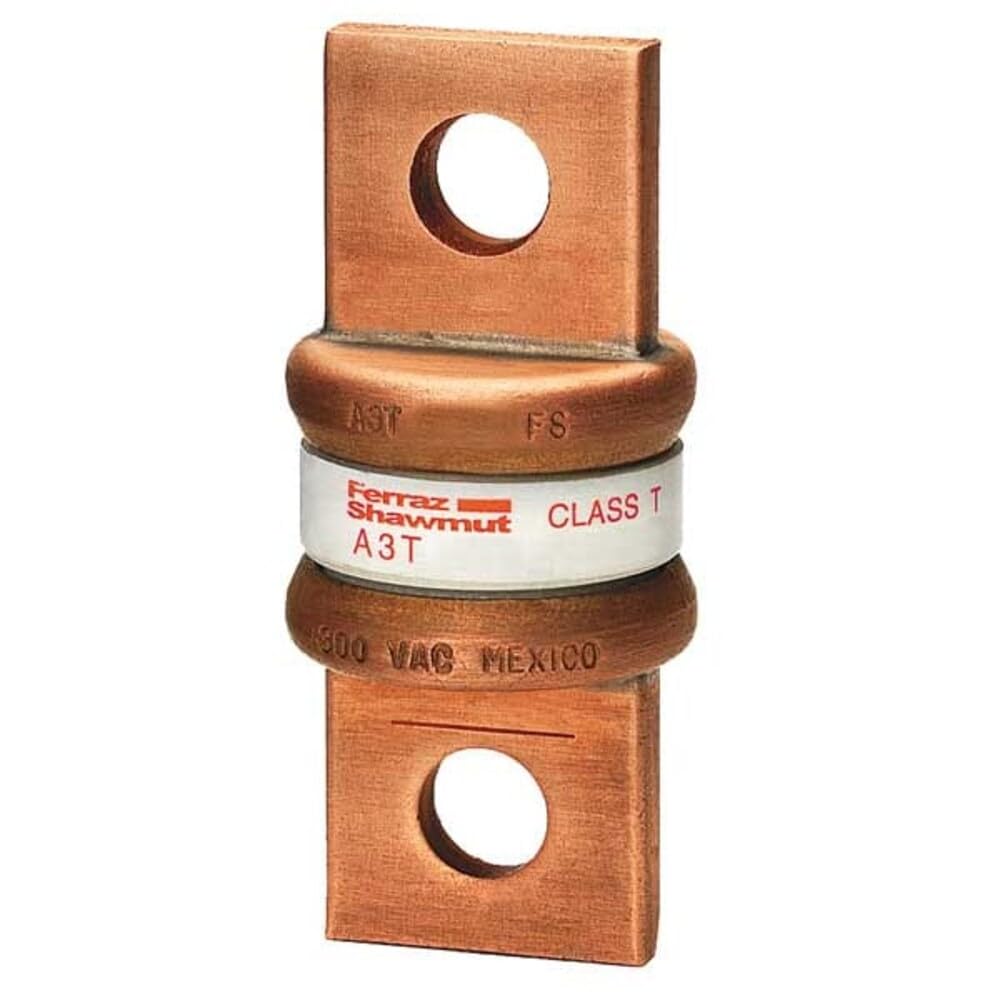
The tiny 200A cartridge that answers in an instant when a fault hits
Size is the first thing you notice — this Mersen A3T is a 1.2 x 1.2 x 2.7 inch rectangle, and it holds the same 200 amp rating as the long 7.5 x 1.5 x 1.5 inch Class RK5 cartridge above it. That physical gap matters when your panel has no room for a full-length RK5 body. Under the shell, the spec is serious: 300 volts AC, 160 volts DC, with an interrupt rating of 200 kiloamperes on AC and 50 kiloamperes on DC (a kiloampere is 1,000 amps, so it can safely stop a huge fault current). Fast-acting behavior means the current is cut in a fraction of the time a time-delay fuse would allow.
Where this fuse shines is compact high-voltage DC gear. Owners use it on 48 volt battery banks specifically because it’s rated for the higher voltage, and one buyer replaced an inverter fuse in an older solar system using this exact part. The blade-stamped catalog number and unique Class T dimensions are there to prevent someone from dropping a wrong-class fuse into the holder — the trade-off being that Class T holders are less common than RK5, so you have to plan around that.
The one real gripe: a non-trivial handful of reports cite poor quality control on individual units — one noted the two blade ends arrived clocked a few degrees apart, which would prevent a clean contact in the holder. That’s a rare-enough miss that it depends on inspecting each fuse on arrival rather than condemning the model. At 4.5 stars it also carries CSA certification, which is real third-party verification the fuse meets the Class T standard.
Where it wins
- Small 1.2 x 1.2 x 2.7 inch body fits tight DC panel layouts
- 200 kA AC / 50 kA DC interrupt rating handles heavy fault currents
- Fast-acting Class T clears the current well before a time-delay fuse would
- CSA certified and blade-stamped for permanent identification
What to know going in
- Class T holder is required — no adapter fits an RK5 footprint
- Occasional units arrive with misaligned blade ends; inspect on arrival
- Higher price bracket than the mainstream home-panel fuses
The right fuse for you if: you’re protecting a solar inverter, 48V bank, or compact DC panel that needs fast clearing and a small footprint.
Move on if instead: your circuit needs a time-delay response for motor inrush, or you’re not prepared to source the matching Class T holder.
6. Eaton Bussmann UL Class Fuse, RK5 Class, Time-Delay, 200A, 250V AC, FRN-R-200
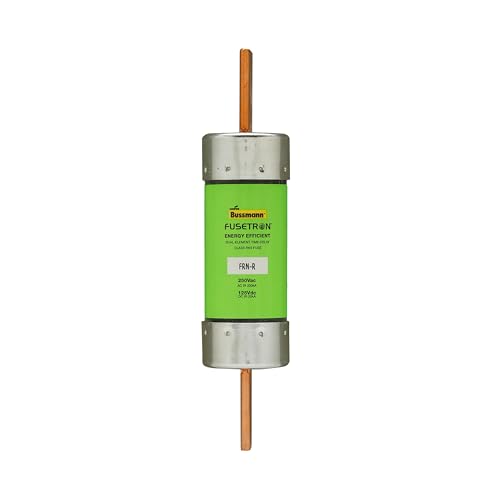
The dual-element time-delay workhorse that Eaton’s name has carried for decades
When a disconnect box needs a replacement fuse and the electrician cares about the label on the barrel, the FRN-R-200 is the name that shows up. It’s a Class RK5 dual-element time-delay fuse, UL Listed, rated 200 amps at 250 volts AC with a 125 VDC arm as well. The interrupt ratings are declared openly on the product body: 200 kiloamperes on AC and 20 kiloamperes on DC — real numbers you can hold against your system’s available fault current before you install it. Physical dimensions are 7.7 x 2 x 1.9 inches and weight is 4.8 ounces, so the body is substantial and matches the standard RK5 holder footprint.
Time-delay is again the point — dual-element construction means it tolerates motor start-up surges and transformer inrush while still cutting a real fault. What buyers keep coming back to on this listing is the direct line between the disconnect and the fuse: the story of ordering a pair for a new-home Eaton disconnect and finding them at a fraction of what the local electrical supply wanted is repeated across the review pages. It’s the fuse for someone matching a specific disconnect brand.
One consideration for a buyer scanning quickly: this listing is for the non-indicating version, so there’s no visible blown-fuse indicator on the barrel — a standard multimeter or visual check on the disconnect remains your method.
Where it earns the premium: the dual-element time-delay behavior and UL Listing are concrete reasons to pay more than a one-time cartridge fuse, especially in motor circuits.
The trade-off to weigh: you pay more for the Eaton name and dual-element construction, and the non-indicating version gives no visible blown-fuse signal — a plain cartridge at a lower tier does the same job in a simple home panel.
Made for you when: you’re replacing a fuse in a branded Eaton disconnect or need dual-element time-delay behavior with a declared 200 kA interrupt rating.
Look past this one if: you just need a simple one-time fuse for a home panel with no motor loads, or you need the blown-fuse indicator version of the same fuse.
7. Go Power FBL-200 Class T 200 Amp Fuse with Block, Heavy-Duty DC-Rated Fuse

The one-box answer for inverter installs that need the fuse and its block together
Most 200 amp fuses on this list are cartridges — you still have to source the holder. The Go Power FBL-200 arrives as both, pairing a 200A Class T DC-rated fuse with a matching block in a single package, which is a meaningful shortcut for anyone wiring an inverter from scratch. It’s rated for systems running at 12, 24, 32, or 48 volts, so the same block serves a range of battery banks without swapping components. The base is insulated, polyester-reinforced polycarbonate, and the whole assembly is 3.04 x 3.36 inches at 9.6 ounces.
Installation is where the design earns its keep. The block includes a transparent protective cover and offers either 5/16 inch studs or universal terminal lugs, and it accepts Class T fuses from 110 up to 400 amps with wiring from #6 to 4/0 gauge. That range is the practical reason to buy the kit rather than the fuse alone — you can size up later without replacing the block. Buyers put it to work on everything from a 24V off-grid solar bank to an RV inverter install, and one notes it stood up to a full year of marine exposure on a boat.
The catch worth naming: this is a bundle and the fuse is fixed at 200 amps as shipped — other fuse sizes are sold separately. If your application actually calls for, say, a 150 amp or 300 amp fuse, you’re paying for a block plus a fuse you’ll swap out anyway. It also carries a shorter two-year warranty expectation than some buyers prefer, though a few owners frame the whole purchase as cheap insurance rather than a luxury part.
What the kit gives you
- Fuse and matching block in one box — no separate holder to source
- Supports 12, 24, 32, or 48 volt inverter systems
- Accepts Class T fuses from 110 to 400 amps and wiring from #6 to 4/0
- Transparent cover with choice of 5/16 inch studs or universal terminal lugs
- Insulated polyester-reinforced polycarbonate base for demanding installs
Sized-down honesty
- Fuse ships at 200 amps; other sizes bought separately
- Premium bundle price versus buying a bare cartridge fuse
- Warranty coverage is shorter than some buyers expect
The quickest route for you when: you’re wiring an inverter, solar bank, or battery disconnect and want the fuse and its rated block in one purchase.
Skip the bundle if: you already own a matching block or need a fuse size other than the shipped 200 amps — the standalone Mersen Class T above is the leaner call.
Understanding the Specs
Voltage Rating (AC vs DC)
A fuse’s voltage rating is the maximum circuit voltage it can safely clear. Many of the fuses here carry dual ratings — for example, the Mersen TR-R is 250 volts AC and 250 volts DC, while the Mersen A3T is 300 volts AC and 160 volts DC. The DC rating is often lower than the AC rating on the same fuse because DC arcs are harder to extinguish. Match the rating to your actual system voltage; using a fuse below the circuit voltage risks failure to clear the fault.
Interrupt Rating (kA)
The interrupt rating, measured in kiloamperes (kA), is the maximum fault current the fuse can safely stop. Two models here publish 200 kA on AC — the Mersen TR-R and the Eaton Bussmann FRN-R-200 — while the Mersen A3T goes to 200 kA on AC and 50 kA on DC. If your system’s available fault current is higher than the fuse’s interrupt rating, the fuse may not contain the arc safely. Where a listing doesn’t publish this figure, treat that as a gap to fill before you install.
Fuse Class and Physical Size
Class determines both the electrical characteristics and the mounting footprint. Class RK5 bodies run long — the Mersen TR-R is 7.5 x 1.5 x 1.5 inches — while the Mersen A3T (Class T) is just 1.2 x 1.2 x 2.7 inches. The physical difference is a compatibility question, not just a preference: a Class T fuse won’t fit an RK5 holder and vice versa. Confirm the fuse class matches your existing holder before ordering.
Time-Delay vs Fast-Acting
Time-delay fuses (like the Class RK5 options) ride through brief motor start-up and transformer inrush currents without opening, then still clear a real fault. Fast-acting fuses (like the Class T A3T) interrupt current in a fraction of the time. Motor circuits want time-delay to ride through inrush; inverters and DC electronics want fast-acting to cut current sooner. Motor circuits want time-delay; inverters and DC electronics want fast-acting.
FAQ
What does the interrupt rating on a 200 amp fuse actually mean?
Will a Class T fuse fit in a Class RK5 holder?
Do I need a time-delay or a fast-acting 200 amp fuse?
Can I use a 200 amp ANL fuse for a home AC panel?
Is a 200 amp fuse the right size for a 200 amp service panel?
What is the difference between one-time and time-delay 200 amp fuses?
Can I install a 200 amp fuse in a 48 volt solar system?
How do I know if a 200 amp cartridge fuse has blown?
Can I use a 200 amp fuse to protect an inverter and a battery bank at the same time?
Final Thoughts: The Verdict
The best overall pick for most buyers is the Bussmann NON-200 because it’s a mainstream 200A Class K5 cartridge that drops into the existing holder on most home service panels and comes without the higher price of the branded disconnect fuses. If your circuit sees motor start-up surges or transformer inrush, step up to the Eaton Bussmann FRN-R-200 for its dual-element time-delay behavior and declared 200 kA AC interrupt rating. For marine, RV, or solar DC work, the Blue Sea Systems 5129 ANL and its gasoline-boat ignition-protected sibling are the correct fuse family — and if you’d rather buy the fuse and its Class T block together in one box, the Go Power FBL-200 is the shortcut worth taking.
How We Picked
We do not accept paid placement. Every pick is matched to a real buyer and a real use-case; we do not hands-on test units.
Sources & Methodology
Specifications: manufacturer listings and product documentation. Review insights: verified customer reviews, as of September 2026. Pricing: not shown on this page (it changes often); check the current price via the retailer link.
As an Amazon Associate, KitchPrep earns from qualifying purchases. This does not affect which products we feature.
Related Guides
