
Specs are compiled from manufacturer listings and verified buyer reviews and can change over time — please confirm the key details on the product page before buying.
When you need to cut power fast, the disconnect is the part you grab. A 200 amp 3-phase disconnect must open all three hot legs at once, shut down hard when you throw the handle, and survive whatever weather the enclosure sees. Get the amperage, pole count, or fuse choice wrong and the inspector fails it, or worse, the switch arcs under load. This shortlist covers four Siemens units that all carry the 200 A rating and the 3-pole configuration, so the real decision depends on fused or non-fused, indoor or outdoor, and general duty versus heavy duty.
I’m Mohammad Maruf — the founder and writer behind KitchPrep. This guide is built by comparing the manufacturers’ published specifications and the patterns across verified customer reviews, so you get each pick’s real strengths and trade-offs instead of marketing spin.
You will see how each unit handles wire bending room, enclosure rating, and neutral provisions, which is where most install headaches begin. Every pick below is rated for 200 amps and three phases, so the comparison zeroes in on 200 amp 3-phase disconnect fit for your specific panel and site.
Our Picks at a Glance
How To Choose The Best 200 Amp 3-Phase Disconnect
A disconnect is a safety device, not a convenience. It sits between your meter or feed and the equipment, and its only job is to cut all the power at once when you throw the handle. Because it deals with live conductors under load, the buyer has less room for guesswork here than almost anywhere else in an electrical project. Three specs decide almost everything: the current rating, the phase and pole count, and whether the box holds fuses.
Match the amperage and phase to your service, not the price tag
Start with the rating. A 200 A unit is built to carry 200 amps of current, and it should never be installed on a service that can exceed that. Next, count the wires. A three-phase circuit needs a 3-pole switch so all three hot legs open together when you pull the handle. A single-phase 2-pole switch will not do the job, no matter how it is rated, because it leaves a leg live. Everything in this guide is 3-pole and rated 200 A, so you are starting from the correct electrical class.
Fused or non-fused is the biggest fork in the road
A non-fused disconnect is simply a switch: it interrupts power but adds no overcurrent protection of its own, so your upstream breaker handles that job. A fused disconnect holds its own fuses, letting it serve as both a switch and a fault-protection point. Non-fused units are cheaper to buy and simpler to wire because there are no fuse blocks to size or replace. Fused units suit installations that need protection at the box itself, but they add a step to every service call since you are maintaining fuses too.
Indoor, outdoor, and duty rating decide where it can live
An outdoor-rated switch carries a weather-resistant enclosure that tolerates rain, dust, and sun, which is why they show up on solar arrays, generators, and outbuilding feeds. An indoor-rated unit needs a sheltered location, typically a utility room or mechanical space, and costs less because it skips the weather sealing. Duty rating matters too. General duty covers typical residential and light commercial loads, while heavy duty adds a sturdier mechanism and arc suppression for more demanding switching. Match the duty class to how often the switch will be thrown and how hard the load is.
Quick Comparison
| Model | Best For | Max Current | Poles / Wires | Fused or Non-Fused | Amazon |
|---|---|---|---|---|---|
| Siemens GNF324R★ Best Overall | Outdoor service and solar disconnects | 200 A | 3 Pole / 3 Wire | Non-fused | Amazon |
| Siemens GNF324 | Indoor panel and equipment shutdowns | 200 A | 3 Pole / 3 Wire | Non-fused | Amazon |
| Siemens HNF364R | Heavy duty AC and solar switching | 200 A | 3 Pole / 3 Wire | Non-fused | Amazon |
In‑Depth Reviews
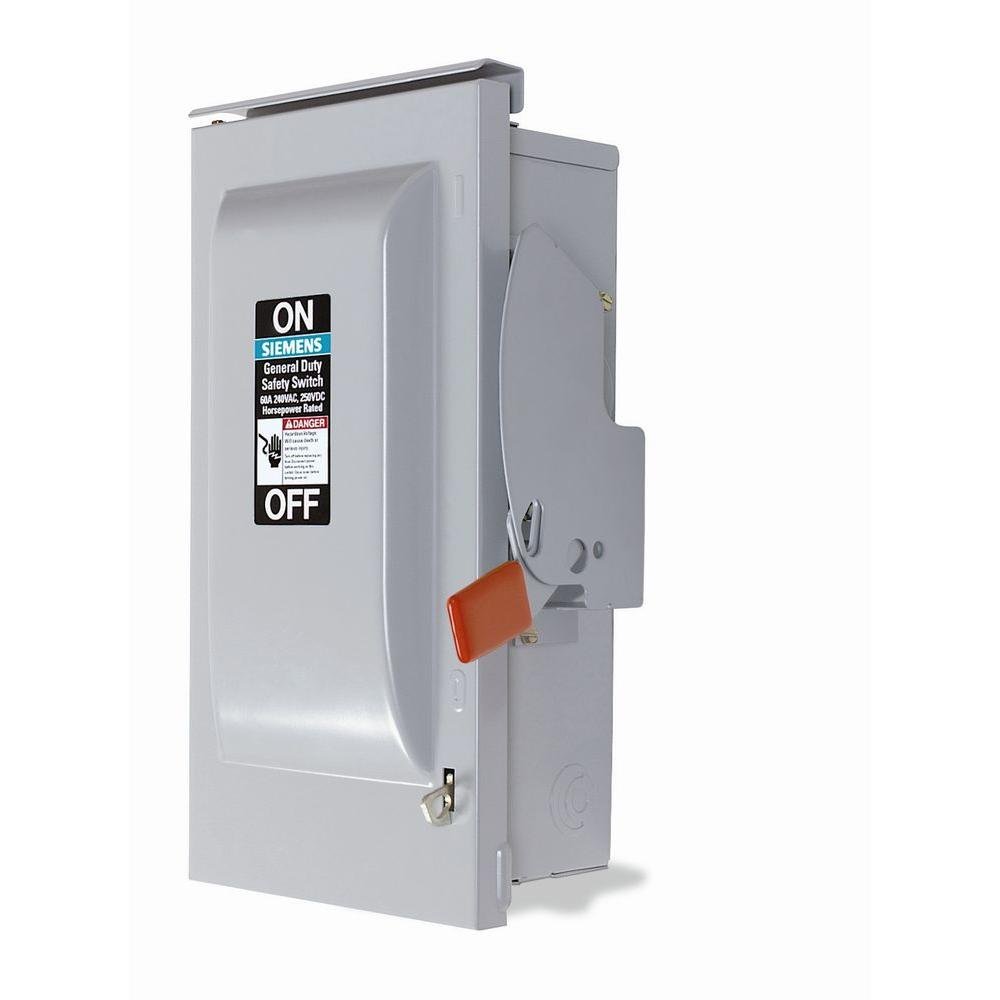
1. Siemens GNF324R 200 Amp, 3 Pole, 240-Volt, 3 Wire, NON-Fused, General Duty, Outdoor Rated
Our pick — over 4.5★ from 30+ verified ratings; the strongest balance of quality and price.
The outdoor disconnect that solar installers keep reaching for when the county wants a separate shutoff.
This is the pick for anyone mounting a disconnect outside, where rain, dust, and sun are part of the job. The 200 A rating, 3-pole, 3-wire layout, and 240-volt, non-fused build make it a straight switch rather than a protection device. That means your upstream breaker does the fault work, and the box itself simply cuts all three legs when you pull the handle. Its 35-pound weight tells you how much metal is in there, which matters when you are bolting a housing to a wall and bending heavy conductors into place.
The outdoor rating is the practical reason this one wins installers over. Buyers report using it as the required separate disconnect for backup generators and battery backup systems in residential solar work, where the local authority wants a visible, independent shutoff. It also handles a plain service feed to a barn or outbuilding. Aluminum and copper contacts inside carry the load, and the general duty mechanism suits the occasional switching a residential or light commercial site needs.
What buyers keep coming back to is trust in the name and the do-the-job reliability — the phrase “it does what it is supposed to do” sums up the pattern across the listing. The trade-off is that this is the priciest non-fused unit here, and it is a bare switch with no fusing and no neutral provision, so a 4-wire service will need the fused sibling below instead.
What earns its keep outdoors
- Rated for outdoor mounting on solar arrays, generator feeds, and outbuilding services
- 3-pole, 3-wire layout opens all three hot legs together at 200 A
- 35 pounds of housing with room to work heavy conductors into the terminals
Where it will not fit
- Non-fused, so it adds no overcurrent protection of its own
- 3-wire only — a 4-wire application needs a fused, 4-wire model
Reach for this one if: your disconnect lives outside and you want a simple, well-built 200 A switch from a brand electricians recognize.
Look elsewhere when: you need onboard fusing or a fourth wire for a neutral — those jobs belong to a fused unit.
2. SIEMENS GNF324 200 Amp, 3 Pole, 240-Volt, 3 Wire, NON-Fused, General Duty, Indoor Rated
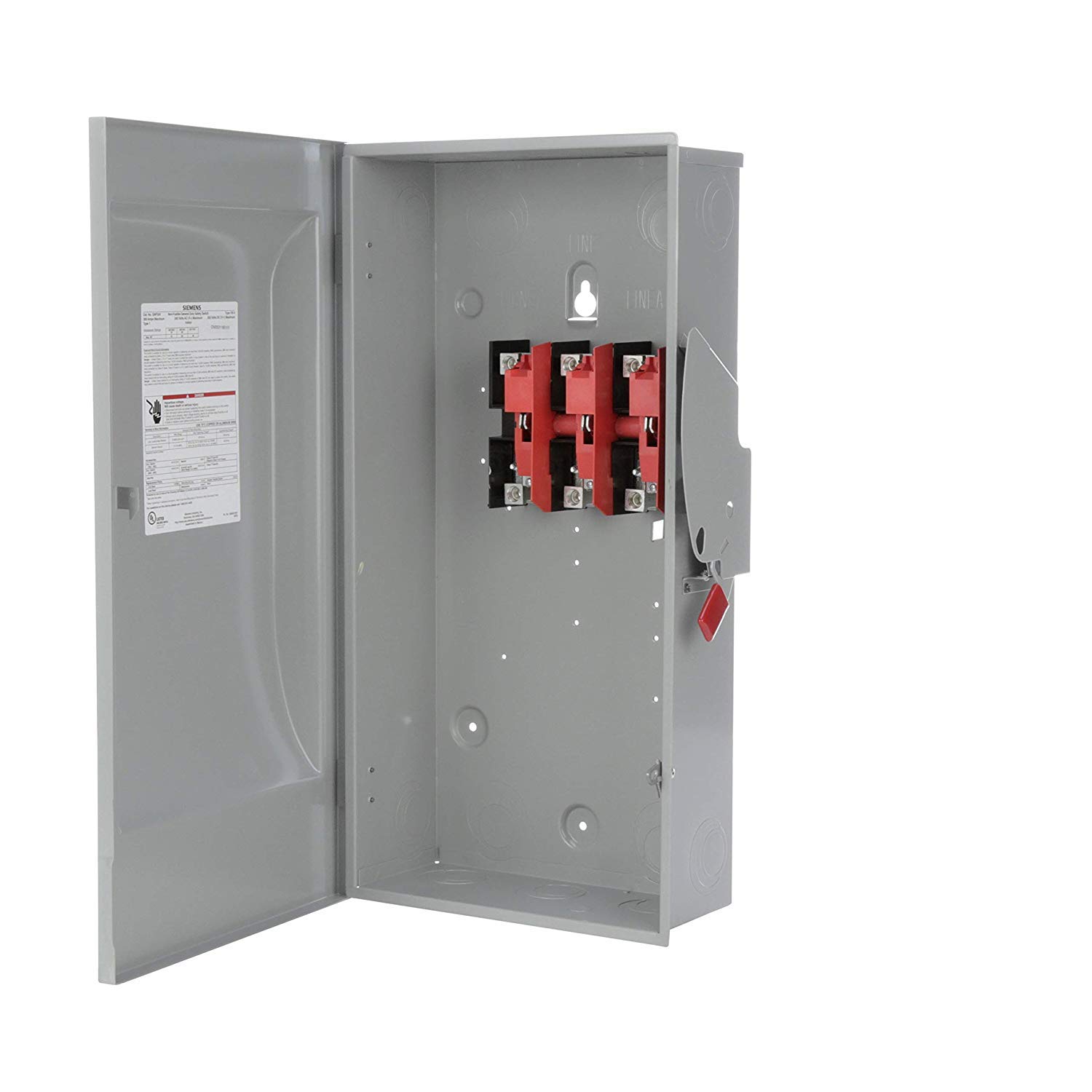
Same 200 amp guts as the outdoor pick, tucked into an indoor housing that trims the spend.
If your disconnect lives in a utility room or mechanical space instead of on a pole, this is where the smart money goes. It carries the identical electrical class as the outdoor pick above — 200 A, 3-pole, 3-wire, 240-volt, non-fused — but drops the weather-sealed enclosure, and that is the entire savings. Same Siemens build, same aluminum and copper internals, same general duty mechanism. What you give up is only the ability to sit out in the rain.
Buyers consistently describe this as a well-made switch that arrives as described. The positive notes that stand out most are the quality of construction and correct function, with buyers describing it as a top-quality product that does the job.
One honest limitation: it is strictly an indoor switch, so mounting it where it sees rain or direct sun voids its whole reason for existing. It is also a 3-wire, non-fused unit, so a service needing a neutral wire or onboard fusing needs a different model. For a sheltered shutdown point on a 3-phase load, though, this is the sensible buy.
The value case: you get the full 200 A, 3-pole non-fused switching of the outdoor model and simply skip the enclosure it does not need, which is why this is the pick for indoor feeds.
Pick this when: the disconnect goes in a dry, protected location and you want proven Siemens switching without paying for weather sealing.
Do not buy it for: an outdoor or damp mounting spot — step up to the outdoor-rated unit for that.
3. Siemens HNF364R 200-Amp 3 Pole 600-volt 3 Wire Non-Fused Heavy Duty Safety Switches
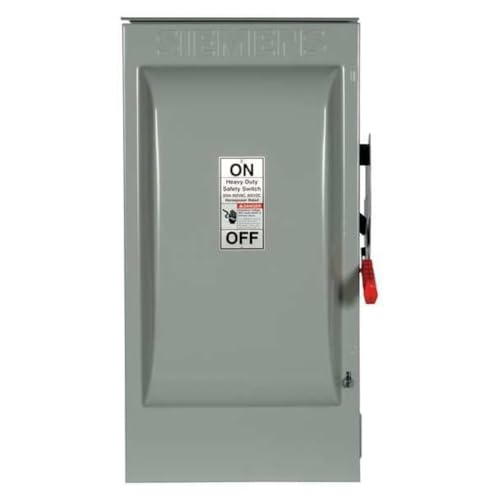
The heavy duty switch with a snappier throw and room to bend thick wire.
Here is the one to pick when you want the mechanism to feel solid every time you throw it. The headline spec is the 600-volt rating, which is higher than the 240-volt ceiling on the other picks here, so it covers a broader range of 3-phase systems at the same 200 A, 3-pole, 3-wire, non-fused configuration. If your site runs at a higher voltage than a typical 240-volt feed, this is the model that legally fits.
The heavy duty label comes from the mechanism itself. A quick-make, quick-break mechanism snaps the contacts open and closed decisively rather than easing them across, and arc chutes inside cool and quench the spark a loaded switch creates, which is what prolongs the contact life. A hinged clear line terminal shield with probe holes lets you inspect or test the line side without pulling the cover off. Buyers installing a solar AC disconnect describe a heavy unit with lots of room for wire bends and a crisp engage and disengage action, which lines up with the hardware described.
The recurring caution is on the listing, not the switch: the seller description is thin on whether a neutral kit, grounding lug, or specific fuse type is included, and owners mention no neutral kit ships in the box. For a high-amperage service disconnect that needs its first means of disconnect bonded, that gap can bite you, so plan the neutral kit as a separate line item before you start. Note too that this heavy duty unit was a cheaper route for some buyers than the general duty switch they expected to need.
Built for repeated switching
- Quick-make, quick-break mechanism gives a decisive, positive operation
- Arc chutes dissipate heat to prolong switch life
- 600-volt rating covers systems the 240-volt models cannot
- Hinged clear terminal shield with probe holes for testing the line side
Plan before you install
- No neutral kit included, which is a problem for high-amperage service disconnects
- Seller listing is unclear on fuse type and grounding lug
Best fit for: higher-voltage 3-phase feeds and anyone who wants a sturdy, crisp-throwing switch with arc suppression for frequent use.
Budget for extra: source a neutral kit separately if your install needs the first means of disconnect bonded.
Understanding the Specs
Amperage, poles, and phase
The current rating is the maximum load the switch is built to carry, so a 200 A unit belongs on a 200 A service and never on anything larger. The pole count tells you how many hot conductors the handle opens at once — a 3-pole switch opens all three legs of a three-phase circuit together. That is the difference that matters: a 2-pole switch leaves a leg live when thrown, which is why three-phase work requires a 3-pole unit. Get the phase and pole count right first; the rest of the choices follow.
Fused versus non-fused, indoor versus outdoor
A non-fused disconnect interrupts power but carries no overcurrent protection of its own, leaving that to an upstream breaker. A fused unit holds its own fuses, so it both switches and protects at the box. The enclosure rating decides where the unit can live: outdoor-rated housings tolerate rain, dust, and sun, while indoor-rated ones need a sheltered spot and cost less as a result. The wire count matters too — a 3-wire unit serves three hot legs, while a 4-wire unit adds a neutral path for services that need one.
FAQ
Can I use a 200 amp 3-phase disconnect on a single-phase service?
What is the difference between a fused and non-fused disconnect?
Do I need a 3-wire or a 4-wire disconnect for my service?
Can a 200 amp disconnect be mounted outdoors?
Does the Siemens HNF364R include a neutral kit?
What does 600-volt rated mean compared to 240-volt?
How much wire room does a 200 amp disconnect give you?
Can I use one of these as a solar array disconnect?
What is the difference between general duty and heavy duty?
How should I inspect a 200 amp disconnect on arrival?
Final Thoughts: The Verdict
For the most 200 amp 3-phase disconnect installs, the Siemens GNF324R is the pick worth starting with because its outdoor housing, 200 A 3-pole switching, and trusted non-fused build cover solar arrays, generator feeds, and outbuilding services alike. If your disconnect lives indoors and you want to skip the weather sealing, the Siemens GNF324 delivers the same switching for less. When your feed runs at a higher voltage or you want a crisper, more durable throw, the Siemens HNF364R and its 600-volt rating and arc chutes is the tougher call. And if your service needs both fusing and a neutral wire outdoors, the Siemens GF324NR is the only one here that gets you there.
How We Picked
We do not accept paid placement. Every pick is matched to a real buyer and a real use-case; we do not hands-on test units.
Sources & Methodology
Specifications: manufacturer listings and product documentation. Review insights: verified customer reviews, as of September 2026. Pricing: not shown on this page (it changes often); check the current price via the retailer link.
As an Amazon Associate, KitchPrep earns from qualifying purchases. This does not affect which products we feature.
Related Guides
