
Specs are compiled from manufacturer listings and verified buyer reviews and can change over time — please confirm the key details on the product page before buying.
The hardest part of buying hookup wire isn’t the copper — it’s figuring out how many strands sit inside the jacket and whether the insulation can handle the heat of your soldering iron. Get that wrong and you end up with wire that snaps at the terminal, frays at the strip, or stiffens in a cold garage. This guide walks you through the picks that hold up, sorted by what each spool is actually built to do.
I’m Mohammad Maruf — the founder and writer behind KitchPrep. This guide is built by comparing the manufacturers’ published specifications and the patterns across verified customer reviews, so you get each pick’s real strengths and trade-offs instead of marketing spin.
Strand count, jacket material, and temperature rating decide almost everything about how a spool behaves on your bench, so those three numbers are the ones we lead with for each of these best 20 gauge wire picks.
Our Picks at a Glance

How To Choose The Best 20 Gauge Wire
Twenty gauge wire — often written 20 AWG, where AWG is the American Wire Gauge standard for conductor thickness — sits in that useful middle zone for low-voltage work. It carries enough current for LED runs, speaker leads, model wiring, and 12V accessory circuits without being so thick that it refuses to bend around a tight corner. What separates a good spool from a frustrating one depends on what’s inside the jacket and what the jacket is made of.
Strand count decides how the wire feels in your hand
A stranded conductor is made of many thin copper threads twisted together, and the count changes everything about handling. A 100-strand 20 AWG conductor with 0.08 mm threads bends like cooked spaghetti and routs around tight obstacles without fighting back. A low-strand build like 10 strands of 0.25 mm copper is stiffer — it holds a bend once you form it, which is exactly what you want when you’re pulling wire through a firewall grommet or under carpet. Neither is better; they solve different problems.
Jacket material sets your temperature ceiling
Silicone insulation stays soft and pliable from deep cold up to high heat, which is why it dominates RC, drone, and 3D printer wiring where the cable flexes thousands of times. PVC jackets are stiffer and cheaper, and automotive-grade PVC resists oil and gas exposure in an engine bay. Check the rated temperature range on the listing before you buy — a jacket rated for a narrow window will crack or soften outside it, and that’s the failure that ruins an otherwise fine install.
Tinned versus bare copper
Tinned copper means each thin strand gets a thin coating of tin before it’s twisted into the bundle. That coating blocks corrosion and makes the wire take solder noticeably faster, which matters if you’re soldering dozens of connections in a session. Bare copper conducts marginally better, but it oxidizes in damp or marine environments. For most hobby, automotive, and repair work, tinned is the safer default.
Quick Comparison
| Model | Best For | Strands | Jacket / Temp | Length & Colors | Amazon |
|---|---|---|---|---|---|
| BNTECHGO 20 Gauge Silicone Wire Black 100ft★ Best Overall | Single-color bulk runs where flexibility wins | 100 strands of 0.08 mm | Silicone, -60°C to +200°C | 100 ft, black only | Amazon |
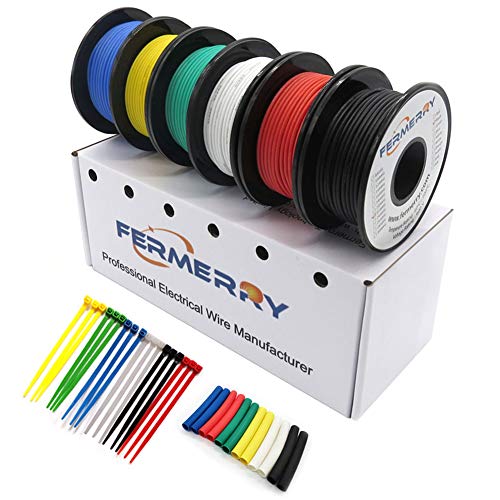
| Fermerry 20 AWG Stranded Wire Spool 10ft Each 6 ColorsBest Starter Kit | Small mixed-color projects and quick repairs | 100 strands of 0.08 mm | Silicone, up to 200°C | 60 ft total, 6 colors | Amazon |
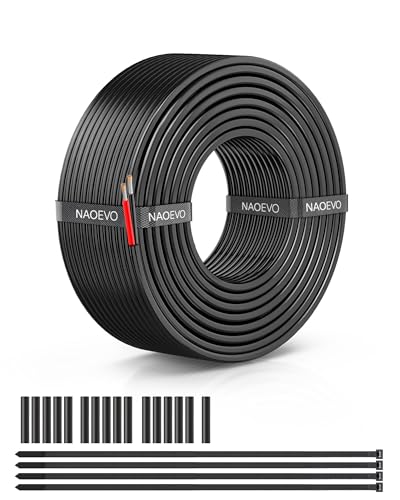
| NAOEVO 20 Gauge Wire 2 Conductor 30FTBest for Automotive | Automotive and outdoor 2-wire runs | 26 strands of 0.24 mm | PVC, IP68 waterproof | 30 ft, 2-conductor | Amazon |
| Haerkn 20awg Silicone Wire Kit 7 Colors 23ft Each | Color-coded bench work and boat or truck rewiring | 100 strands of 0.08 mm | Silicone, -60°C to +200°C | 161 ft total, 7 colors | Amazon |
| BNTECHGO 20 AWG Silicone Wire Kit 10 Colors 10ft Each | Multi-circuit panels needing ten distinct colors | 100 strands of 0.08 mm | Silicone, -60°C to +200°C | 100 ft total, 10 colors | Amazon |
| TUOFENG 20 AWG Silicone Wire Kit 6 Colors 138 ft | Long-run silicone jobs across six circuits | 100 strands of 0.08 mm | Silicone, -60°C to +200°C | 138 ft total, 6 colors | Amazon |
| TUOFENG 20 AWG Solid Wire Kit 6 Colors 26.3 ft Each | Breadboards and fixed point-to-point circuits | 1 solid conductor | PVC, -40°C to +80°C | 26.3 ft per spool, 6 colors | Amazon |
| GS Power 20 AWG Wire 100ft OFC Copper | Car audio and 12V runs needing red/black pairs | 10 strands of 0.25 mm per conductor | GPT PVC, -40°F to +176°F | 200 ft total, red/black pair | Amazon |
In‑Depth Reviews
1. BNTECHGO 20 Gauge Silicone Wire Black 100ft Stranded Tinned Copper Wire
Our pick — over 4.5★ from 800+ verified ratings; the strongest balance of quality and price.
A hundred fine strands in a 100-foot spool, coiled like thread for the jobs that bend a lot.
If your project moves — a 3D printer drag chain, a model plane wing, a battery lead that sees repeated flex — this is the spool to reach for. The 100 strands of 0.08 mm tinned copper sit inside a silicone jacket, and that combination is why the wire bends around tight corners without kinking. Heat is not a worry here either: it carries a 200°C high-temperature rating and a -60°C low-temperature rating, so a cold workshop in January doesn’t stiffen it into a broom handle. The 600-volt rating and 1.8 mm outside diameter are the same figures you’ll find on most of the quality silicone spools on this list.
Length is the real hook. At 100 ft, this spool carries ten times the wire you get in a single color from the small 10-ft Fermerry kit — the difference between running a full harness and running out at the last connector. Buyers keep coming back to that flexibility in their reviews, and the practical win is a full ground-plane radial run or a long internal harness without splicing. The silicone sheath also shrugs off pinches and the kind of abrasion that chews through thinner coatings, which is exactly why it holds up in continuous-motion builds.
What most buyers report is quiet, unflashy reliability — they buy it, work it, and reorder. The one honest limit worth knowing: silicone-coated wire this supple is deliberately bad at holding a shape. If you need wire to stay straight pushing through a waterproof plug or to sit rigid in a fixed panel, this is the wrong tool — go to a solid-core or stiffer PVC spool for that. It’s also a single color, so a project needing half a dozen identification colors means buying several spools. Its 4.8-star rating is the highest in this group, though the budget pick at the bottom of the list has more reviews.
Where It Pulls Ahead
- 100 strands of 0.08 mm tinned copper bend without kinking
- Wide -60°C to +200°C temperature window suits cold shops and hot enclosures
- 100 ft single spool runs a full harness without a splice
What To Watch
- Black only — no color coding on a single spool
- Silicone softness is a disadvantage when you need a wire to hold a straight line
Top of the class: the pick for anyone bending wire through moving parts, tight grommets, or a full harness that needs one long uninterrupted run.
Wrong spool for: rigid point-to-point panel work where the wire has to stay stiff and straight.
2. Fermerry 20 AWG Stranded Wire Spool 10ft Each 6 Colors
Six slim 10-ft spools with the little extras already in the box — the tidy answer for small jobs.
The number that decides this one is 6 — six separate colors at 10 ft each, plus 18 pieces of 2.4 mm heat-shrink tubing and 18 wire ties bundled in. That’s the difference between digging through one black spool and labeling circuits with actual colored wire. Each conductor is 100 strands of 0.08 mm tinned copper inside a silicone jacket rated to 200°C, with a 10A current rating and a 600-volt ceiling — the same core build as the bigger silicone kits here, just portioned small.
For quick repairs this size is genuinely the right call. Rewiring a couple of toy cars, swapping a broken LED lead, replacing an oxidized ground — you need a few feet of the right color, not a 100-ft drum. Owners who restocked describe burning through a 25-ft box and reordering the bigger kit. The included shrink and ties mean you’re not shopping for a second box to finish the job.
The honest trade-off is stretch. Sixty feet total goes fast once you start routing anything longer than a desk project, and the amount of black in the kit runs out first because black is the most-used color. There’s also a durability split in the reviews — some owners call it very strong, some reserve judgment — which for 20 AWG silicone is mostly a function of how much flex and heat it sees. Keep your runs short and this kit earns its place on the shelf.
Kit convenience at a glance: colors, heat-shrink, and ties arrive together, so a small repair is a one-box job rather than a scavenger hunt.
The stretch limit: 60 ft total is a small bench supply, not a wiring-harness supply.
Reach for this if: you want a color assortment and finishing accessories ready for small electronics and toy-repair jobs.
Look elsewhere if: your build needs long continuous runs instead of short color-coded jumps.
3. NAOEVO 20 Gauge Wire 2 Conductor, 20 Gauge Automotive Wire 12V Cable, 30FT
Two conductors bonded in one jacket, sealed to IP68 — built for the underside of a vehicle.
Under the truck or behind the bumper, single unsheathed wire doesn’t last. This spool solves that with a bonded pair — two conductors in one PVC jacket, 26 strands of 0.24 mm tinned copper inside each circuit — so a hot run and a ground travel together. The IP68 rating means it’s sealed against dust and full water immersion, and the PVC jacket handles -22°F to 221°F plus VW-1 flame-retardant certification. If you’re adding fog lights, rock lights, or any 12V accessory below the beltline, this is the spool that survives the road spray.
The included extras are a real convenience: 16 heat-shrink tubes and 4 cable ties ride along, which means a road-light install doesn’t stall on missing parts. The 30-ft length is enough for a full accessory run front to back on a typical truck. Owners mention it shrugging off mud and water on a side-by-side without issue. It handles marine and landscape uses the same way, so one spool can cover multiple low-voltage jobs.
There is one honest quirk worth knowing before you commit: the insulation has a slick surface that can slip against a pull tape when fishing through a wall, and it can cut or peel if you’re aggressive with it — a wrap of electrical tape solves the slipping, and taking your time with the strip solves the rest. Thickness also draws mixed feedback — some praise the durable coating, some find it thin — so this is a spool tuned for outdoor 12V work, not a high-abuse industrial line. Match it to automotive and marine duty and it’s a clean-fit pick.
Built for the elements: IP68 sealing, VW-1 flame rating, and a -22°F to 221°F window put it squarely in outdoor and engine-bay territory.
Strip with patience: the slick PVC jacket peels easily if you cut with firm, even pressure instead of forcing it.
Made for you if: your project lives outdoors or in a vehicle and needs a two-conductor cable that tolerates moisture and heat.
Try something else if: you want a soft, bendable silicone wire for tight in-cab or indoor routing.
4. 20awg Silicone Electrical Wire Cable Kit 7 Colors 23ft Each Spool

Seven colors on 23-ft spools with velcro straps that keep a working bench from turning into a knot.
If you’ve ever spent fifteen minutes untangling one spool while the other six sit quietly on the shelf, you’ll feel the difference here. Each of the seven color spools ships with its own velcro strap, and the whole set lives in a box that doubles as a dispenser. Each run is 23 ft, so the full kit totals 161 ft — more usable wire per color than the small 10-ft kits, without the commitment of a single 100-ft spool. The conductor is again 100 strands of 0.08 mm tinned copper in silicone, rated -60°C to +200°C at 600 volts, with a 5A current ceiling.
What makes this kit stand out for real projects is the color discipline it enables. When you’re restoring a boat’s distribution sub-panel or extending a truck harness, having distinct colors lets you track every circuit from switch to device without a meter, and the velcro straps mean the spool you’re using stays under control while you work. One owner rewired a boat’s electronics distribution sub-panel and praised how the color variety made every connection straightforward.
The genuinely honest caveat comes from the reviews: one owner measured resistance close to what they’d expect from thinner wire over a long run, so if your circuit runs on very tight tolerances, measure the length you’ll actually use before committing. That’s the outlier case, not the norm — the rest of the feedback focuses on quality, flexibility, and how easy the wire is to strip, solder, and color-code. Treat it as a great bench kit for DC projects and you’ll be well served.
What Earns It A Spot
- Seven colors, 23 ft each — 161 ft total with color-coded discipline built in
- Velcro straps and a dispensing box keep spools from tangling between uses
- 100-strand tinned copper in silicone rated -60°C to +200°C
The Honest Trade-off
- Resistance at long lengths can run higher than some tight-tolerance projects want
- Seven short spools means more swap-outs than one long continuous run
A solid bench pick: the kit to grab when a DC project has many circuits that need clear color separation.
Skip the color coding if: you’re wiring a single long run and would rather have one big spool than seven small ones.
5. BNTECHGO 20 AWG Silicone Wire Kit 10 Color Each 10ft Stranded Tinned Copper
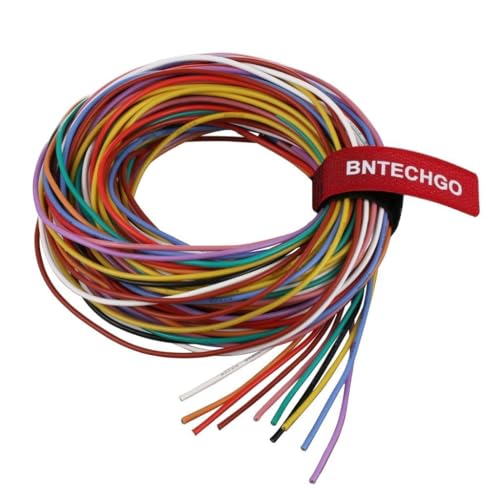
Ten distinct colors, 10 ft each — a wiring-panel palette that keeps every circuit traceable.
Where the seven-color Haerkn kit gives you more feet per color, this one gives you more colors — and when a project has more switches and sensors than a rainbow can cover, that extra range matters. Ten colors, 10 ft each, 100 ft total, with a 100-strand 0.08 mm tinned copper conductor in a silicone jacket rated -60°C to +200°C at 600 volts. It’s the same widely used stock build as the single-color BNTECHGO spool, just portioned into an assortment a wiring panel can actually use.
One owner runs a relay panel where every switch gets its own color, eliminating guesswork when tracing a fault. Another extended a Chevy Blazer air-conditioning harness while matching the OEM color scheme. The 10 ft per color is enough for internal panel work, and the silicone insulation stays soft enough to accept crimped terminals cleanly.
The honest limit is that 10 ft stops short of a full long-run job, and at this length patience with silicone’s thinness pays off — one owner noted the wire feels thin and flexible enough that time will tell on durability. That’s an odd concern for a spool rated for this temperature range and build quality, and the ratings overall are strong. Buy it for panels and internal harness work and it delivers exactly what the color spread promises. Buy it for a single long run and you’ll wish you’d picked the black 100-ft spool instead.
Color-coded control: ten colors makes every switch, ground, and signal path independently identifiable — the single biggest time saver during panel work.
Short-run specialist: with 10 ft per color, this kit keeps you inside a wiring panel rather than out on a long harness run.
Built for: multi-circuit panels and harness extensions where color identification earns back its shelf space.
Better options exist for: single long runs, where the black 100-ft spool wins on uninterrupted length.
6. TUOFENG 20 AWG Silicone Wire Kit, 6 Colors, 138 ft, Stranded Tinned Copper
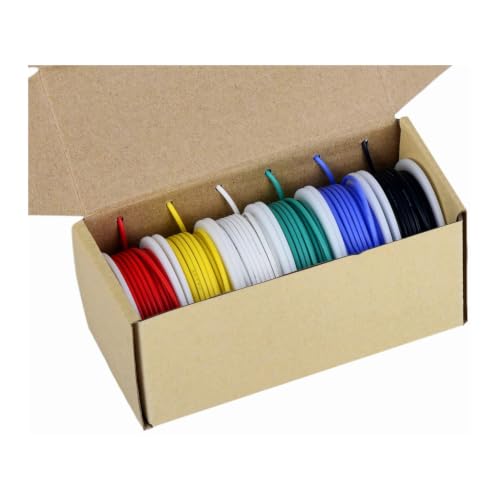
Six colors at 23 ft each, 138 ft total — the color kit that reaches across a whole build.
Length changes the job. At 23 ft per color and 138 ft total, this spool set threads a full multi-circuit project without running short the way 10-ft kits do. Each conductor is 100 strands of 0.08 mm tinned copper in a soft silicone jacket rated -60°C to +200°C at 600 volts, with a 5A current ceiling. The silicone means tight corners and delicate existing wiring accept it without fighting back — a specific advantage during repair work where the original insulation has gone brittle.
What buyers consistently come back for is how well it takes solder. The tinned strands tin cleanly and stay put, which the reviews note again and again, and the same quality shows up in LED strip wiring and model railroad projects. Having 23 ft of black and red means a full lighting circuit is one spool away instead of a half-spool plus a splice. The kit ships in a box that makes spool switching quick.
The single caveat that recurs is flexibility as a bend too far — one 20-gauge reviewer notes it can coil back on itself when fed through tight waterproof plug connectors, which risks nicking the insulation if you feed it too aggressively. For everything else — soldering, repair, LED work, model wiring — it earns its place.
Where it wins the shelf: 138 ft across six colors is true long-run coverage, not a bench-top sample.
One thing to expect: silicone this soft curls back on itself when forced through tight openings — feed it gently or use a stiffer wire for that leg.
Pick it when: a project needs six colors with enough length per color to finish a full circuit run.
Keep looking if: you need a wire that pushes rigidly through a tight grommet on its own.
7. TUOFENG 20 AWG Solid Wire Kit, 6 Colors, Tinned Copper, 26.3 ft Each, PVC
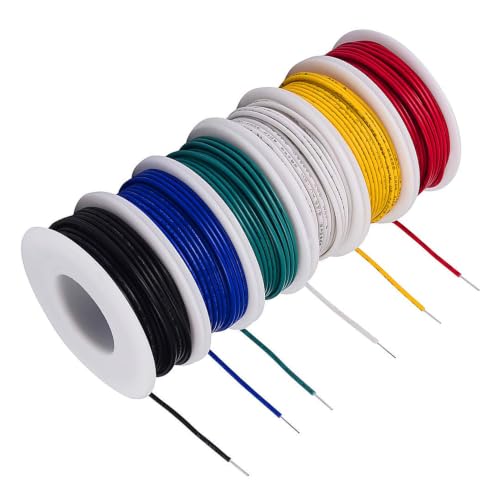
One solid tinned conductor per color — the wire that stays exactly where you bent it.
Solid-core wire solves a problem stranded wire creates: it holds its shape. Where the 100-strand silicone spools on this list coil into a knot the moment you let go, this one takes a bend and keeps it — a single solid tinned-copper conductor in each of six colors, 26.3 ft per spool. That’s the property that makes it right for breadboards, protoboards, and PCB through-holes, where a jumper needs to sit flat and stay put across a crowded board.
The kit leans into that purpose. Each color gets its own spool inside a pull-through box, and the package also lists a mini wire stripper, heat-shrink tubing, and colored cable ties — a start-to-finish kit rather than just a wire supply. The PVC jacket is rated -40°C to +80°C at 300 volts, so this is indoor-bench territory by design, not engine-bay territory. Six colors in a box that feeds spools one at a time keeps a working bench orderly instead of tangled.
The reviews show both sides clearly: buyers repeatedly mention that it strips cleanly and holds its shape for structural circuits — one engineer-style buyer praised the stiffness for structural layouts, while another described breadboard use as requiring a bit of effort to insert but bending well without being too stiff. The honest limit is exactly what the solid core implies: it won’t flex around vibrating or moving parts the way stranded wire does. That’s not a flaw, it’s the spec doing its job. Match it to fixed routing and it’s a pleasure to work with.
Static-routing champion: a single solid conductor keeps the bend you form, so jumpers stay flat across a breadboard.
Where it stops: 300V PVC and -40°C to +80°C says indoor fixed wiring, not vibration or engine-bay duty.
Choose this for: breadboards, protoboards, and point-to-point circuits where the wire needs to hold its shape.
Not for: anything flexing, vibrating, or running under a hood where stranded silicone earns the job instead.
8. GS Power 20 AWG Wire 100ft – OFC Copper Automotive Speaker Wire Spool
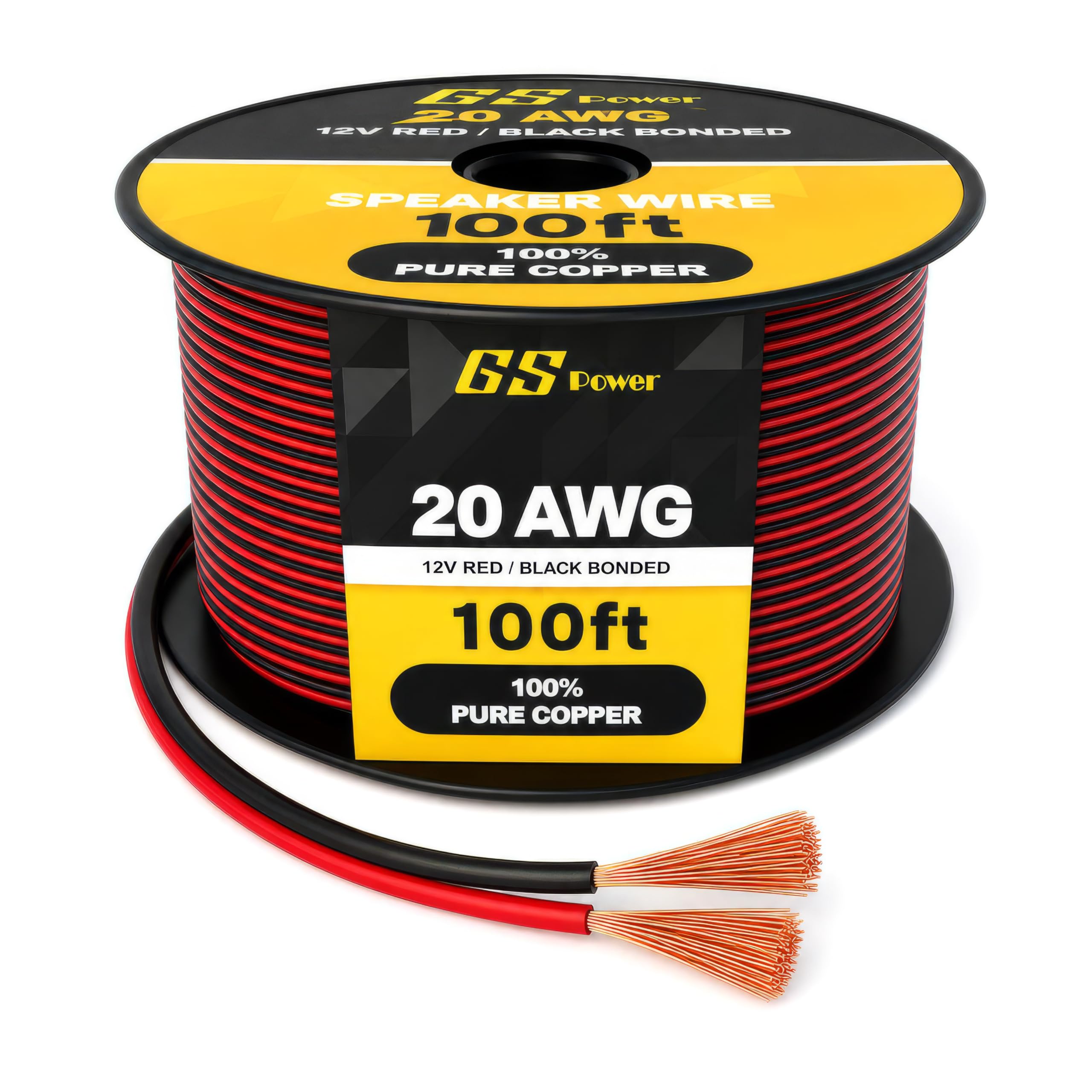
A bonded red-and-black pair in true oxygen-free copper — signal and return travel together.
Speaker runs want two things this spool delivers: matched conductor pairs and copper that doesn’t add resistance. The GS Power spool is 99.99% oxygen-free copper — OFC, meaning the conductor is refined to strip out oxygen so it conducts cleanly — with 10 strands of 0.25 mm copper per conductor, bonded red-to-black and separable when you need individual runs. Total is 200 ft across the pair: 100 ft of red plus 100 ft of black. That’s a full four-speaker car audio install or a home-theater run out of one box.
The 10-strand build also plays to a practical strength — at 10 strands per conductor it’s noticeably stiffer than the 100-strand silicone wire on other spools here, and that rigidity is exactly right for holding a route along a trailer frame or under carpet without drooping. The GPT PVC jacket resists oil and gas and is rated -40°F to +176°F, and the whole cable is RoHS compliant. Customers note pulling it through a firewall grommet to trigger relays and replacing decades-old speaker wire in a vintage radio. Buyers who measured found approximately 0.24-0.27 mm per strand and confirmed genuine copper rather than copper-clad aluminum.
The honest caveat is the same rigidity that makes it great in an engine bay — it’s stiff enough that a tight 90° bend wants a bit of overbending to hold, and it’s tuned for 12V low-voltage DC work only, not AC mains. It’s also a two-color spool, so a project needing an assortment goes elsewhere. For audio, trailer, and 12V accessory runs, the matched pair and 200 ft of copper are the whole point.
Why It Belongs Here
- 99.99% oxygen-free copper conductors for clean signal and low resistance
- 200 ft total (100 ft red + 100 ft black) covers a whole four-speaker install
- GPT PVC jacket resists oil and gas, rated -40°F to +176°F
Who Should Pass
- 10 strands per conductor makes it stiff for tight 90° bends
- Not intended for AC mains or high-voltage circuits
The audio pick: reach for this whenever you’re running matched pairs of speaker or 12V power wire where clean copper matters.
Different tool needed for: tight, flexing indoor routing — the silicone spools handle that better.
Understanding the Specs
Strand Count and Conductor Size
Strand count is how many individual thin copper threads are twisted together to make one conductor. The gauge — 20 AWG here — describes the overall thickness, but the strand count tells you how the wire will behave. A 100-strand, 0.08 mm build bends like thread and handles repeated flex without breaking. A low-strand build such as 10 strands of 0.25 mm feels stiffer and holds a shape, which is why it suits trailer and engine-bay runs. Neither is superior; the correct choice depends on whether the wire moves or stays put after install.
Insulation Material and Temperature Range
The jacket around the conductor decides where the wire can safely live. Silicone insulation typically stays pliable across a much wider temperature window — often from -60°C up to 200°C — and stays soft even when cold. PVC jackets are stiffer and usually have a narrower range, while automotive-grade GPT PVC adds resistance to oil and gas exposure. Always check the rated voltage and temperature figures on the listing against your project, because running a jacket outside its rated window is what causes premature cracking or melting.
FAQ
What is 20 gauge wire actually useful for?
Should I choose stranded or solid 20 gauge wire?
Does 20 gauge wire fit standard crimp connectors?
What does tinned copper mean and do I need it?
Can I use 20 gauge wire for car speakers and lights?
What temperature can 20 gauge silicone wire handle?
How much length do I actually need for a typical project?
Is 20 gauge wire waterproof enough for marine use?
Why does silicone wire feel so soft compared to PVC?
Does the number of strands affect how much current the wire carries?
Final Thoughts: The Verdict
Across the range of 20 gauge wire here, the pick that earns the top spot is the BNTECHGO 20 Gauge Silicone Wire Black 100ft — a full 100 ft of 100-strand tinned copper in a silicone jacket rated from -60°C to +200°C, which is the combination that bends cleanly, solders fast, and never leaves you short mid-install.
If your project needs colors and outdoor sealing, the NAOEVO 20 Gauge Wire 2 Conductor is the automotive-grade pick, with IP68 sealing and a bonded two-conductor jacket. For a fixed indoor bench, the TUOFENG 20 AWG Solid Wire Kit holds its shape where silicone can’t. And for speaker runs, the GS Power 20 AWG OFC Copper spool delivers the matched red/black copper pairs a full four-speaker install wants.
Whichever job is on your bench, match the spool to the environment — silicone where the wire moves, PVC where it stays fixed, sealed jackets outdoors — and the 20-gauge wire you choose will outlast the project it was bought for.
How We Picked
We do not accept paid placement. Every pick is matched to a real buyer and a real use-case; we do not hands-on test units.
Sources & Methodology
Specifications: manufacturer listings and product documentation. Review insights: verified customer reviews, as of September 2026. Pricing: not shown on this page (it changes often); check the current price via the retailer link.
As an Amazon Associate, KitchPrep earns from qualifying purchases. This does not affect which products we feature.
Related Guides
