
Specs are compiled from manufacturer listings and verified buyer reviews and can change over time — please confirm the key details on the product page before buying.
You want a 20-gallon air compressor that runs your nailers, impact wrenches, or spray guns without making you shout over the motor. The real trade-off is noise: many models hit 90 dB (as loud as a lawnmower), while quieter ones stay in the 68-80 dB range (closer to a normal conversation). Modern 20-gallon models now deliver 5+ CFM at 90 PSI while staying under 70 dB, so you get both airflow and hearing protection. We ranked the top 20-gallon compressors by CFM at 90 PSI, max PSI, and decibel output to match your garage, shop, or jobsite.
I’m Mohammad Maruf — the founder and writer behind KitchPrep. This guide is built by comparing the manufacturers’ published specifications and the patterns across verified customer reviews, so you get each pick’s real strengths and trade-offs instead of marketing spin.
The best 20-gallon compressors pair a 20-29 gallon tank with 4-5.3 CFM at 90 PSI and 68-80 dB noise for tool power without ear damage.
Our Picks at a Glance

How To Choose The Best 20 Gallon Air Compressors
To pick the right compressor, you need to match its airflow output and pressure to the tools you actually plan to run. A framing nailer needs far less air than a spray gun or an impact wrench, so knowing your tool’s demands is the first step.
Start with CFM at 90 PSI, Not Just Motor HP
The single most important number on a compressor’s spec sheet is its CFM (cubic feet per minute) rating at 90 PSI — this tells you how much air the pump can push at the pressure most tools use. A 2 HP motor sounds strong, but if it only delivers 4 CFM, it will struggle to keep a high-consumption tool running nonstop. For intermittent tools like brad nailers or staplers, a lower CFM around 4-5 is plenty. For continuous-use tools like paint sprayers or die grinders, you want the highest CFM you can find, ideally above 5.
The Tank Size Sets Your Working Rhythm
A 20-gallon tank stores a reserve of compressed air, so the motor doesn’t have to run constantly every time you pull the trigger. A bigger tank means longer run times before the pump cycles back on, which is why some users step up to a 29-gallon model like the Klutch (a 45% larger capacity) for less frequent motor cycling. However, a larger tank also takes longer to fill from empty and takes up more floor space, so consider your typical task duration when choosing.
Noise Level Changes Where You Can Use It
If your compressor sits in a residential garage or shared workspace, the decibel rating matters most. Standard models can hit 90 dB (decibels, a sound level unit) or louder, which can damage your hearing over time and makes talking impossible. Quieter models run in the 68-80 dB range, so you can hold a conversation nearby. Check whether the spec says dB or dBA (A-weighted decibels, which reflect how human ears perceive sound); a lower number means less noise for your ears.
Quick Comparison
| Model | Best For | Airflow (CFM @ 90 PSI) | Max Pressure (PSI) | Noise Level | Amazon |
|---|---|---|---|---|---|
| Klutch 29-Gallon★ Best Overall | High-volume DIY & continuous tools | 5.1 CFM | 175 PSI | Quiet (per reviews) | Amazon |
| Stealth 20 GallonUltra Quiet | Noise-sensitive garages & detailing | 5.0 CFM | 150 PSI | 68 dB | Amazon |
| California Air Tools 20020Balanced Pick | Quiet operation & low amp draw | 5.3 CFM | 125 PSI | 70 dB | Amazon |
| Craftsman 20 Gallon | Value & high pressure | 4.0 CFM | 175 PSI | — | Amazon |
| Stealth SAQ-12018 | Versatile 1.8 HP with large wheels | 5.0 CFM | 150 PSI | Below 70 dB | Amazon |
| California Air Tools 20015HP | High-pressure quiet tasks | 3.8 CFM | 175 PSI | 70 dB | Amazon |
| NorthStar Single-Stage | Durability & dual-voltage flexibility | 5.0 CFM | — | Quiet (per reviews) | Amazon |
| Ingersoll Rand P1.5IU-A9 | Professional-grade continuous use | 5.2 CFM | — | 80 dBA | Amazon |
| Ingersoll Rand P1.5IU-A9-H | Heavy-duty horizontal tank with warranty | 5.2 CFM | 135 PSI | 80 dBA | Amazon |
In‑Depth Reviews
1. Klutch 29-Gallon Air Compressor
Our pick — over 4★ from 700+ verified ratings; the strongest balance of quality and price.
More capacity and pressure than any 20-gallon rival, wrapped in a vertical design that saves floor space.
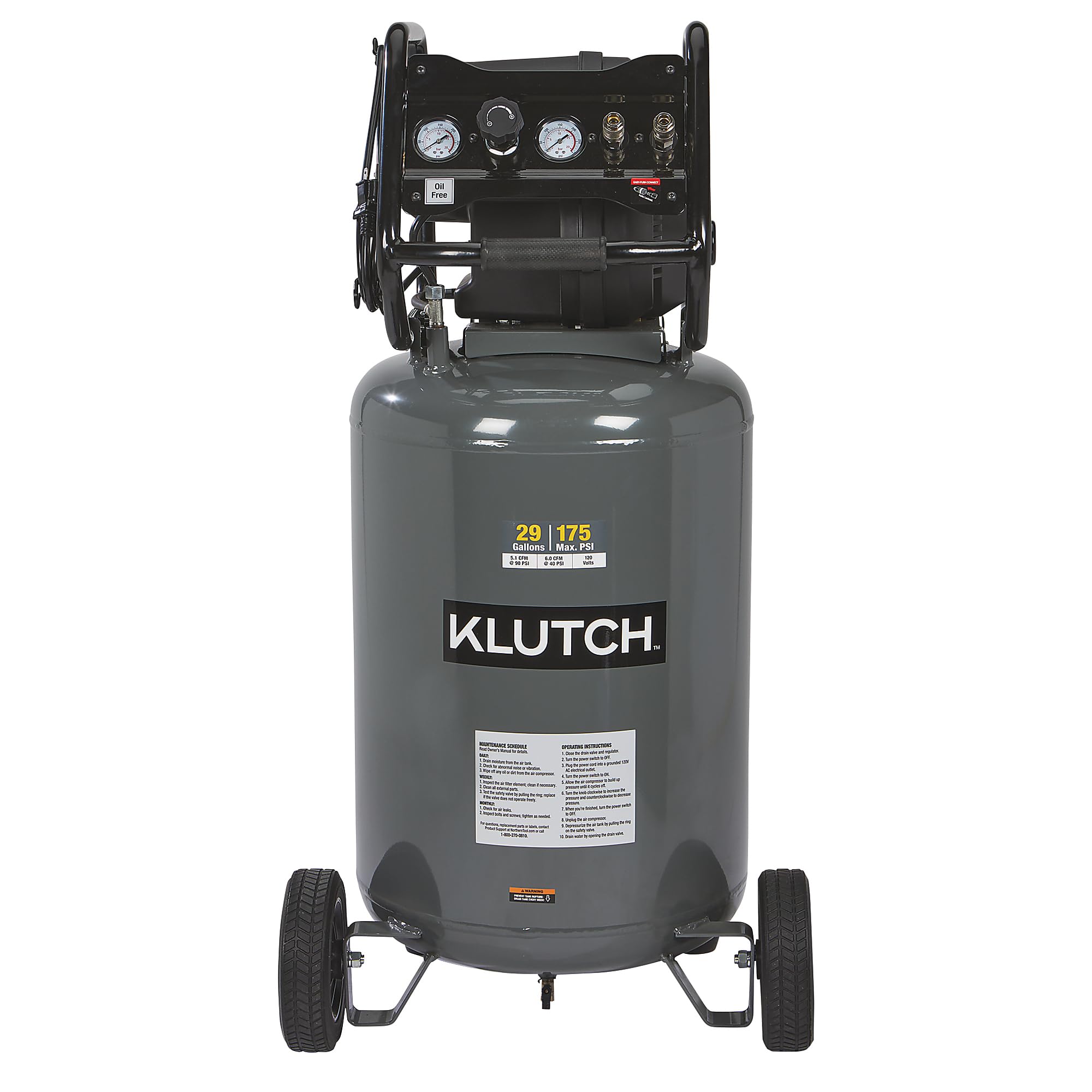
If you hate waiting for the motor to catch up, this Klutch is your answer. It jumps past the 20-gallon class to a 29-gallon tank (45% more capacity) while pushing out 5.1 CFM (cubic feet per minute, a measure of airflow) at 90 PSI (pounds per square inch, a measure of pressure) from a 2.5 HP (horsepower) motor — enough airflow to keep nailing, stapling, painting, and blow guns running steadily. The 29-gallon tank extends run time before the pump cycles, ideal for continuous garage work.
The 175 PSI max pressure lets you store more air in the tank, so tools run harder before you drop into the motor’s recovery zone. Buyers report it “holds 150 psi a week, no leaks” and that the initial fill is slow but quick after that. The oil-free pump means no oil changes and no spill risk, just maintenance-free duty. Large flat-free tires make it easy to roll around a workspace, and the brass quick-connect coupler lets you swap tools one-handed.
Weighing 127 pounds, it’s substantial but still mobile, and the vertical footprint is far more compact than a horizontal tank of similar size. The loudest praise centers on its performance — well over 150 owners single out how well it runs — with value-for-money running a close second. The main nitpick is a lack of built-in accessory storage, so plan a shelf for hoses and nozzles. For a home shop needing high output with low noise, this Klutch is the top choice.
Why it leads the list
- Largest tank here at 29 gallons for longer run times
- Highest pressure at 175 PSI
- Oil-free pump means zero maintenance
- Quieter than expected for its size
The honest trade-offs
- Large flat-free tires add weight at 127 lbs
- No onboard accessory storage
- Slow initial fill from empty
Reach for this if: you run multiple tools back-to-back and want the biggest air reserve and highest pressure in this roundup.
Look elsewhere if: you have very limited floor space and only need to drive a single nailer — a 20-gallon unit is lighter and cheaper.
2. Stealth 20 Gallon Ultra Quiet Air Compressor
A 68-decibel whisper that one owner measured at 65 dB from 8-10 feet away, replacing a 95 dB clatter.
This Stealth is the answer if your compressor shares space with your ears. Its headline claim is an ultra-quiet 68 dB operation, and the review pages back it up — owners describe a “softer purr” and one measured 78 dB point-blank and just 65 dB at 8-10 feet. At 68 dB you can talk normally; at 95 dB you’d need hearing protection and shouting. It’s the most-praised feature by far, with over 100 owners calling out the noise level.
Despite the low noise, the 1.8 HP motor still delivers 5.0 CFM at 90 PSI. The 1.8 HP oil-free motor delivers 5.5 CFM at 40 PSI and 5.0 CFM at 90 PSI, with a peak pressure of 150 PSI — enough for detailing tools and mechanical work. The quick-recovery design and two quick couplers let you switch between tools fast. Heavy-duty steel tank with 8-inch rubber wheels makes it stable and easy to move around the garage.
The main gulf here is durability: while many report it’s solid and holds air well, a few have hit premature failures. There’s also a common wish that it were larger than 20 gallons — some owners mention wishing for more capacity. The 68 dB operation justifies the occasional durability risk for noise-sensitive buyers. Weighing 121.4 pounds, it’s lighter than the Klutch by about 5% but still a two-person lift onto a truck bed.
The quiet king: If decibel level is your first priority, this is the pick — the noise data in reviews is exceptional.
One honest caution: A minority of owners mention units that didn’t last; an occasional lemon is possible with any compressor.
Choose this for: a home garage or shared shop where noise is the deal-breaker.
Think twice if: you need maximum durability for daily professional use — an oil-lubricated unit may be sturdier.
3. California Air Tools 20020 2.0 HP Ultra Quiet
A 70 dB whisper with a 2.0 HP motor running at just 1680 RPM for less wear and quieter duty.
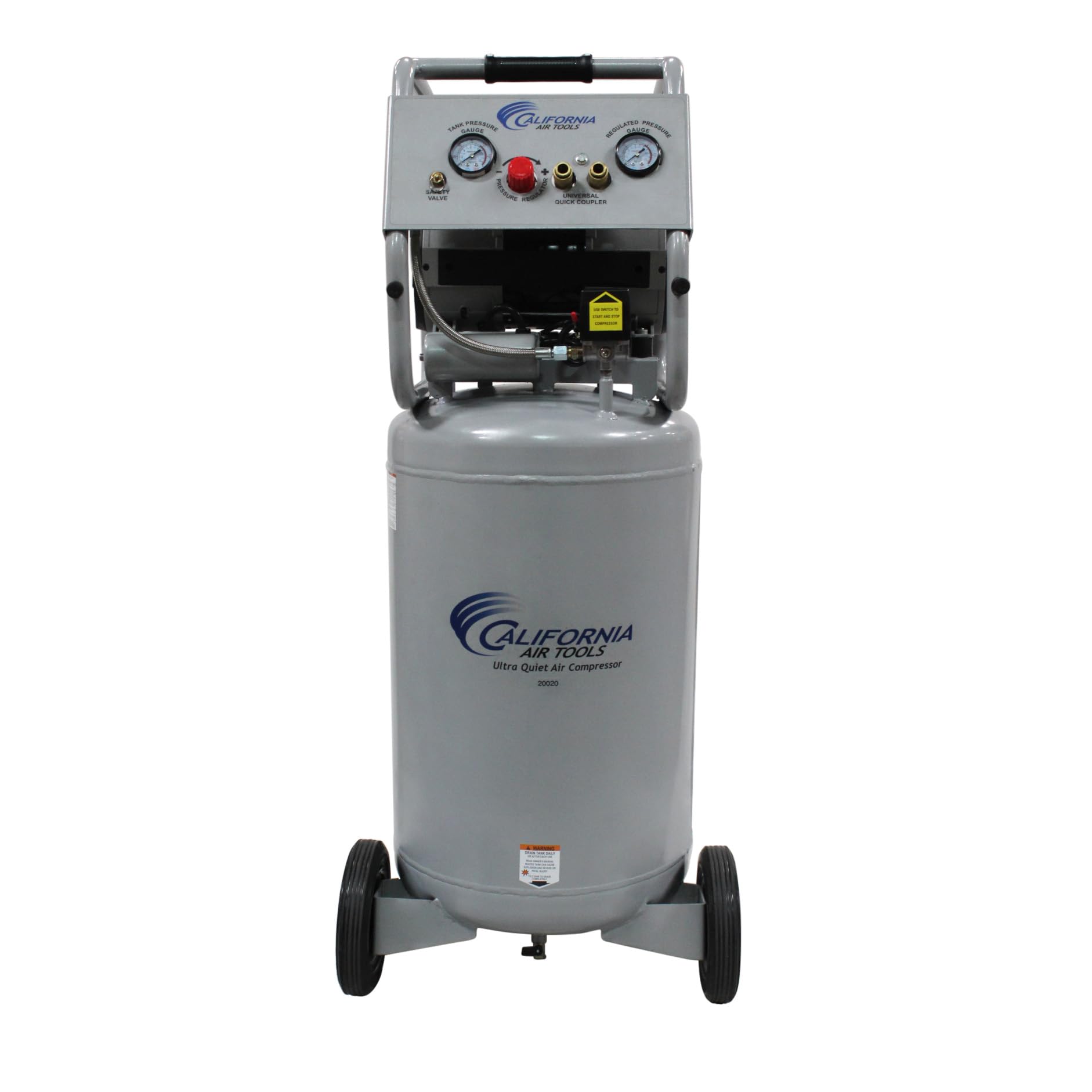
California Air Tools built its name on quiet operation, and the 20020 carries that flag well. The 2.0 HP motor spins at a low 1680 RPM to cut noise and wear, holding the unit to 70 dB. Owners say you can hold a normal conversation while it runs — the quiet operation is the most-praised feature, with over 30 buyers calling it out. It also delivers 6.40 CFM at 40 PSI and 5.30 CFM at 90 PSI, which is the highest airflow in this list at 90 PSI alongside the Klutch.
The oil-free dual-piston pump is rated for over 3000 hours of life and runs cooler at low RPM. Operating on just 14 amps, it works on standard 110V/60Hz outlets without tripping breakers in most garages. The 20-gallon steel tank sits upright, so the footprint is small. At 114 pounds, it’s lighter than the comparable Stealth and easier to wheel around with its no-flat wheels.
The durability picture is the mixed note here — some customers note units that stopped working after about four weeks, though others have had theirs for years. A long-term owner notes their first California Air unit lasted 3 years in a shop setting, which is a decent run by modern standards. If you want a proven quiet name with the best airflow per dollar, this is your balance point.
The strengths
- Highest airflow in class at 5.3 CFM @ 90 PSI
- Low 14-amp draw runs on standard outlets
- Oil-free with 3000+ hour rated pump
Watch for
- Reliability reports are mixed, with some early failures
- Slower to fill the 20-gallon tank than smaller units
Best for: a noise-sensitive garage that still wants the highest airflow in the 20-gallon class.
Maybe not for: owners who need guaranteed long-term reliability without any chance of an early failure.
4. Craftsman 20 Gallon Oil-Free Air Compressor

A 175 PSI workhorse with a 20-gallon steel tank that legacy owners trust and replace with again.
Craftsman knows its audience: the DIYer who wants a familiar red machine that just works. This 20-gallon unit tops out at 175 PSI — matching the Klutch for the highest pressure here — and delivers 4.0 SCFM at 90 PSI from a 1.8 HP oil-free motor. That’s enough to drive inflating, cleaning, staplers, brad nailers, roofing nailers, and even a paint sprayer for hobby-scale work. The stainless steel tank resists corrosion, and the rubber feet damp vibration.
Owners consistently praise the easy setup — many say it works right from the start. One long-time Craftsman owner replaced their old 30-gallon unit that had lasted 30+ years, calling the new one “amazingly easy to set up” and fairly quiet. The two quick couplers let you leave one hose connected while you swap tools on the second. It includes a 6-foot cord, ball drain valve, and plastic filter.
There’s a durability asterisk: a subset of reports mention motors burning up within a couple of months, though the overall quality sentiment runs positive with over 30 owners praising build quality. The 4.0 CFM is on the lower side for this class, so it’s best for intermittent tools rather than continuous spray work. For a straightforward, high-pressure tool-driver at a friendly price, this fits.
The value angle: You get 175 PSI and a familiar brand with solid review sentiment around build quality.
The honest gap: Durability reports are mixed, and 4.0 CFM is the lowest here — intermittent tools only.
Pick this if: you want a trusted name, high pressure, and a budget-friendly price for light-to-moderate garage use.
Step past it if: continuous-duty tools like spray guns are your main job — you need higher CFM.
5. Stealth 20 Gallon Air Compressor (SAQ-12018)

A 20-gallon unit that a guitar maker trusts for flawless lacquer finishes because it runs clean and quiet.
This is the Stealth alternative that artists and finish-focused users gravitate to. The induction motor operates below 70 dB with a service life over 1,000 hours, and the oil-free design means zero lubrication — so no oil vapor contaminates a spray finish. That’s why a guitar builder calls it ideal for lacquer spraying, reporting “flawless finishes” with no oil in the air. For anyone doing fine painting or finishing, that clean-air angle is a real edge.
Performance holds up: it delivers 150 PSI max pressure with 5.5 CFM at 40 PSI and 5.0 CFM at 90 PSI, enough to run a spray gun, impact wrench, and nail gun simultaneously. The 20-gallon tank with rubber-reinforced handle and large rubber wheels make transport easy. Owners also note it “doesn’t take up much room” and is “pretty quiet” compared to other oil-free compressors.
The catch shows up in support rather than the machine itself — a couple of reviewers point out a damaged part in shipping and found the company’s support loop unhelpful. But the strong effectiveness and noise-level reviews suggest the unit itself delivers. Weighing 121 pounds, it’s a manageable lift. If your work is finishing and you value clean air, this is the sleeper pick.
What wins people over
- Oil-free output is perfect for spray finishing
- Quiet induction motor below 70 dB
- Compact overall shape saves space
What to know
- Customer support can be hard to reach if parts arrive damaged
- 1,000-hour motor life is lower than California Air’s 3000+
Side with this one for: spray finishing and painting where oil-free, clean air matters most.
Reconsider if: you want the longest rated pump life in this roundup — the California Air units top it.
6. California Air Tools 20015HP 1.5 HP Ultra Quiet

A two-stage 175 PSI quiet performer that one owner said reaches 170 psi in just a few minutes.
California Air Tools’ 20015HP uses a 1.5 HP two-stage pump — the two-stage design compresses air in two steps for higher pressure output, and it shows. The unit delivers 145 to 175 PSI, letting you hit pressure levels typically reserved for harder-working pumps while keeping noise at 70 dB. Owners find it “the quietest compressor I have ever owned,” with one saying they bring it up to 170 pounds of pressure in a few minutes.
The trade-off is airflow: at 3.80 CFM @ 90 PSI, this is the lowest output in the lineup. That’s fine for intermittent tools like drivers and nailers, but the 20-gallon tank is what saves continuous-use tasks — one owner notes the tank compensates for low CFM and held pressure for 2 days. It runs on just 12 amps, so it’s the most outlet-friendly here, and weighs 113 pounds with easy-rolling wheels.
Reliability is the mixed note: some shoppers say a pressure control valve failing after a few months. But the quiet operation is the most-praised aspect, with 9 owners calling it out. If your priority is a whisper-quiet high-pressure unit for light shop use, this fits — just know the low CFM means slower recovery for high-demand tools.
The trade-off to know: Highest pressure-to-noise ratio in the list, but the lowest CFM means it’s not for high-consumption tools.
The warranty reality: A few buyers report valve issues in the first months — worth checking your unit on arrival.
Choose it for: a small shop where noise is critical and you run less air-hungry tools.
Skip if: you plan to run a paint sprayer or die grinder for long stretches — the CFM is too low.
7. NorthStar Single-Stage Air Compressor, 20-Gallon

A cast-iron 2 HP unit with a 4-year warranty and dual voltage that one owner calls the best value per CFM.
Here’s the machine for the buyer who wants industrial build with DIY sensibility. The NorthStar runs a 2-cylinder cast-iron single-stage pump driven by a 2 HP induction motor, and it delivers 5.0 CFM @ 90 PSI and 6.0 CFM @ 40 PSI. The cast-iron construction is more durable than aluminum and lowers noise, and indeed owners find it “quiet” and “easy on the ears” — the low-frequency hum is less harsh than typical compressors.
The flexibility is a standout: it’s a dual-voltage motor wired for 115V with a 6-foot cord, but it can be rewired for 230V by a qualified electrician. That means it can run on a standard garage outlet now and step up to a workshop circuit later. At 198 pounds it’s the heaviest in this roundup, so it’s more of a “wheel it around the shop” than “lift into a truck” unit — but the vertical tank keeps the footprint compact.
Owners praise its performance and note it arrived with “zero issues,” with the 4-year warranty sealing the deal for many — a longer safety net than most competitors offer. The recurring quirks are a tight regulator for heavy impacts and a belt that needed adjusting from the factory. For weekend garage warriors who want a tank that outlasts them, this is the pick.
The heavy-duty perks
- Cast-iron pump for durability and quieter operation
- 4-year warranty is the longest in this list
- Dual-voltage flexibility for future shops
The weight to expect
- 198 lbs is the heaviest here — not truly portable
- Factory belt may need a quick adjustment
Grab it for: a fixed shop location where cast-iron longevity and a 4-year warranty beat portability.
Pass it by if: you need to move your compressor between sites — this is a shop anchor, not a travel buddy.
8. Ingersoll Rand P1.5IU-A9 2 HP Single-Stage

A 100% continuous-duty pro machine that one owner says runs smooth and quiet, not fast and loud.
Ingersoll Rand is a name professionals trust, and the P1.5IU-A9 backs it with a spec sheet built for endurance. It’s rated for 100% continuous duty — meaning you can run it indefinitely without cool-down waits, a feature that separates it from every consumer unit in this list. The 2 HP motor delivers 5.2 CFM at 90 PSI from a 20-gallon vertical tank, and the cast-iron cylinder and frame with an enclosed belt guard protect the guts for the long haul.
The All Season Select synthetic lubricant runs 2,000 hours between changeouts — owners note they never wait for cooldowns. Noise is a low 80 dBA, which is louder than the ultra-quiet California Air units but still conversation-friendly for a pro shop. Owners describe it as “extremely quiet” and note it “holds pressure overnight.” The semi-pneumatic tires and ergonomic handle make it easy to roll, and the automatic start/stop switch simplifies operation.
The catch is price, and the durability stakes are real — a few report motor issues, though most call it “well-built.” At 90.7 kg (about 200 pounds), it’s a heavy unit, but that weight signals the cast-iron quality. If you need a compressor that earns its keep daily without breaking down, this is the professional choice.
The pro edge: 100% continuous duty and 2,000-hour lubricant intervals mean it’s built to run all day.
The honest cost: Premium pricing and occasional motor reports keep it from being a casual DIY buy.
Invest here if: you run a busy shop with continuous-demand tools and can’t afford downtime.
Stick with consumer picks if: your compressor sits idle for weeks between weekend projects — the pro price isn’t justified.
9. Ingersoll Rand P1.5IU-A9-H 7.5 HP Garagemate
A horizontal 20-gallon behemoth that one owner describes as heavy-duty metal built to outlast cheaper imports.
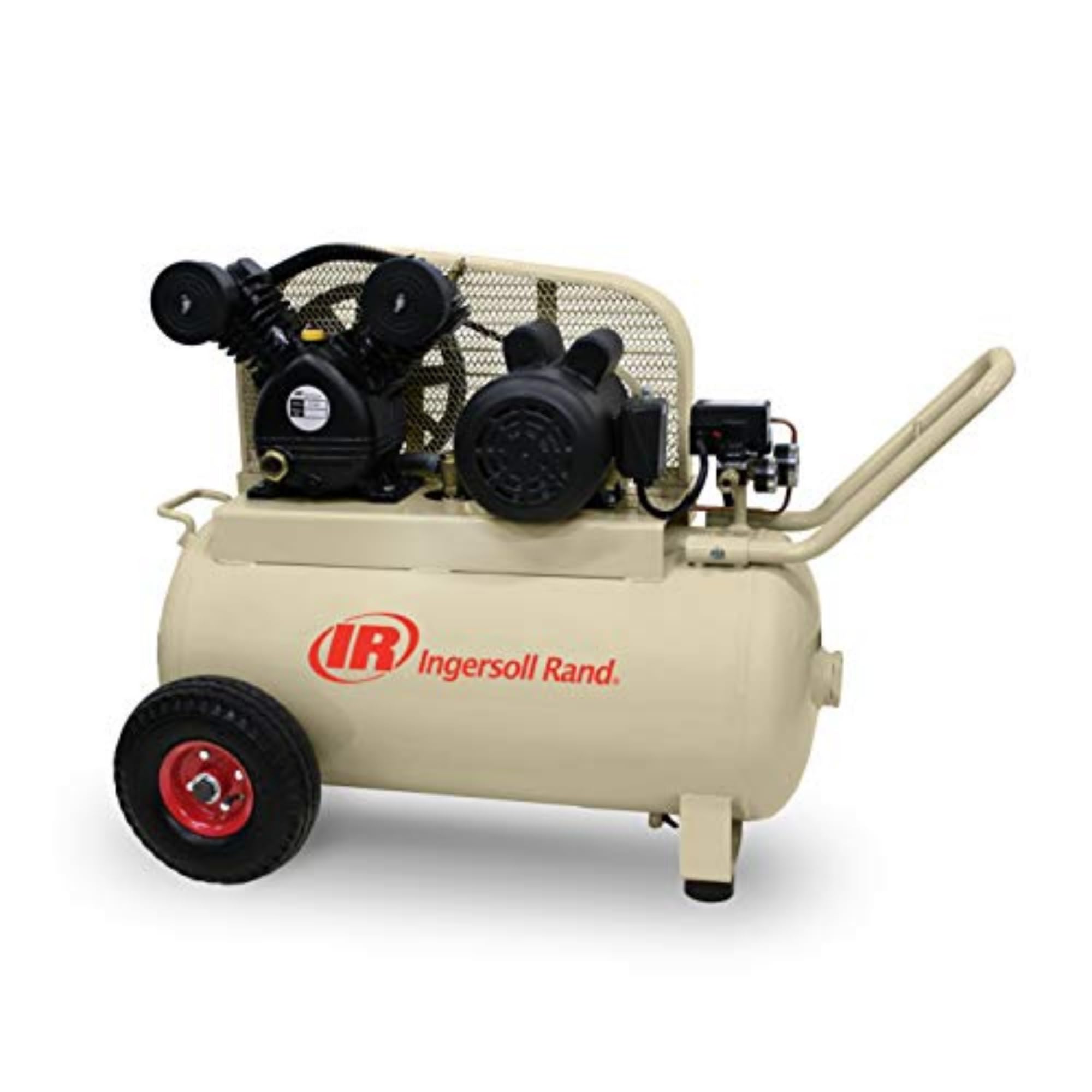
This is the Ingersoll Rand built for the buyer who values metal over plastic and longevity over price. The Garagemate uses a horizontal 20-gallon tank layout — better for low-ceiling spaces where a vertical unit won’t fit — and pushes out up to 5.2 CFM at 135 PSI. The cast-iron construction with an enclosed belt guard is the same pro-grade build as its sibling, and the ergonomic handle and semi-pneumatic tires make the 200-pound unit manageable on wheels.
Assembly is straightforward — one owner notes easy wheel, filter, and oil setup with excellent pallet packaging. The low 80 dBA noise level and automatic start/stop switch keep it user-friendly, and the All Season Select lubricant with 2,000-hour intervals mirrors the professional endurance of the P1.5IU-A9. Owners who prefer it over cheaper Chinese alternatives cite the heavy-duty metal build.
The conflicts are real, though: some report it arrives labeled “Made in China” despite expectations of USA assembly, and a few note a “little knock” when running. The owner’s manual also draws criticism for poor illustrations and a tank drain valve positioned awkwardly. If you want the horizontal form factor and Ingersoll Rand’s reputation, weigh those quirks against the premium price.
Why it stands out
- Horizontal tank fits under low shelves and benches
- Cast-iron heavy-duty build
- Pallet delivery with excellent packaging protection
What grates on owners
- Labeled “Made in China” despite some expectations of USA origin
- Owner’s manual is poorly illustrated and unhelpful
- Drain valve positioning makes it hard to fully open
Reach for it if: you need a horizontal 20-gallon layout and want Ingersoll Rand’s pro-grade metal build.
Look the other way if: country of origin or a polished manual matters to you — this unit may disappoint on both.
Understanding the Specs
CFM at 90 PSI — The Real Power Number
CFM (cubic feet per minute) at 90 PSI tells you how much air the pump can deliver at the pressure most tools run at. Higher CFM means tools run longer without the motor cycling on. For intermittent tools like nailers, 4-5 CFM is enough; for continuous tools like spray guns, aim for 5+ CFM. Always check this number against your tool’s own CFM requirement.
Decibel Ratings — What “Quiet” Really Means
Noise is measured in decibels (dB or dBA). Standard compressors hit 90+ dB, which can damage hearing over time. Ultra-quiet models like the Stealth run at 68 dB or the California Air units at 70 dB — a level where you can hold a conversation. Every 10 dB increase roughly doubles perceived loudness, so the gap between 68 dB and 80 dB is significant, not subtle.
HP and Motor Type — The Duty-Cycle Truth
Horsepower (HP) measures motor output, but it’s only useful with CFM. A 2 HP motor delivering 4 CFM is less useful than a 1.8 HP delivering 5. Also, oil-free motors need no maintenance but run hotter and louder; oil-lubricated cast-iron pumps are quieter and longer-lived but require oil changes. The best compressor is one you can run without constant cool-down waits, so check the duty cycle.
Tank Capacity — Your Air Reserve
The tank stores compressed air so the motor doesn’t run every time you trigger a tool. A 20-gallon tank balances run time and footprint for most garages. A 29-gallon tank like the Klutch holds 45% more air, meaning longer work stretches before the pump kicks in, but it takes longer to fill and occupies more floor space. Choose based on how long your tasks run between breaks.
FAQ
How much CFM do I need to run an impact wrench or paint sprayer?
Is an oil-free compressor better than an oil-lubricated one for a home garage?
Will a 20-gallon compressor run a framing nailer continuously?
What is the difference between a 20-gallon and a 29-gallon tank for daily use?
How loud is a 68 dB air compressor compared to a 95 dB one?
Can I run a 20-gallon compressor on a standard 110V household outlet?
What does a two-stage compressor do that a single-stage does not?
How do I know if a compressor is durable enough for regular shop use?
Is there anything I should check immediately when my new compressor arrives?
Final Thoughts: The Verdict
If you want one dependable pick, the 20 gallon air compressors winner is the Klutch 29-Gallon because its larger tank and 175 PSI pressure give you the longest run times and highest performance per dollar. If you want a whisper-quiet unit for a noise-sensitive garage, grab the Stealth 20 Gallon at 68 dB. And for a cast-iron tank with a 4-year warranty that will outlast your hobby, the NorthStar is the one to reach for.
The crowd favorite among all options — with a 4.4-star rating and over 700 ratings behind it — is the Klutch, and the math checks out: it packs the most usable air power into a vertical footprint. Whatever your choice, match the CFM to your tools, respect the noise level for your space, and drain the tank after each use to keep it running for years.
How We Picked
We do not accept paid placement. Every pick is matched to a real buyer and a real use-case; we do not hands-on test units.
Sources & Methodology
Specifications: manufacturer listings and product documentation. Review insights: verified customer reviews, as of August 2026. Pricing: not shown on this page (it changes often); check the current price via the retailer link.
As an Amazon Associate, KitchPrep earns from qualifying purchases. This does not affect which products we feature.
Related Guides
