
Specs are compiled from manufacturer listings and verified buyer reviews and can change over time — please confirm the key details on the product page before buying.
If your table saw or shop vac keeps tripping the breaker halfway through a cut, the problem is usually the strip you are plugged into — not your tools. A 20-amp surge protector is built to carry the same current your garage circuit already supplies, so heavy gear can run without browning out or cutting off mid-job. This guide covers six strips rated for 20 amps, explains what the box numbers mean, and points you to the one that fits your bench.
I’m Mohammad Maruf — the founder and writer behind KitchPrep. This guide is built by comparing the manufacturers’ published specifications and the patterns across verified customer reviews, so you get each pick’s real strengths and trade-offs instead of marketing spin.
You will see cord gauge, joule ratings, outlet counts, and breaker details spelled out in plain terms, plus honest notes on what each strip does and does not protect. The goal is simple: pick the right one for your bench the first time with this 20-amp surge protector breakdown.
Our Picks at a Glance


How To Choose The Best 20-Amp Surge Protector
Buying a 20-amp strip is really about matching three things to how you work: the load your tools pull, how far the outlet is from where you stand, and how much protection you want against spikes. Match those three and the rest of the spec sheet matters far less.
Cord Gauge (AWG) And Why It Matters
The gauge is the thickness of the copper wire inside the cord. Lower numbers mean thicker wire, which runs cooler and loses less voltage over a long run. A 12-gauge (12AWG) cord is built for 20-amp draws, while 14-gauge is typically capped at 15 amps. That difference is why a 20-amp tool on a thin cord can heat up or sag under load.
Joule Rating Explained
A joule is a unit of energy the strip can absorb before the surge reaches your equipment. Higher joule ratings mean the strip can take more or bigger spikes before it gives up. A 1200-joule strip handles everyday household surges; a 4800-joule unit is aimed at heavier, less predictable power in shops and older buildings.
Outlet Spacing And Plug Types
Wide-spaced outlets let bulky adapters sit side by side without blocking the neighbor. Most 20-amp strips use a standard 5-15P plug (the common three-prong plug) on the wall end, and some add 5-20R T-slot outlets (a wider, T-shaped socket) that accept both 20-amp and standard plugs. If your bench runs several transformer blocks, spacing is the spec you will notice every day.
Quick Comparison
| Model | Best For | Outlets | Cord Length | Surge Rating | Amazon |
|---|---|---|---|---|---|
| CCCEI 12 Gauge Heavy Duty Surge Protector★ Best Overall | Kitchen and shop appliances that need per-outlet control | 4 | 10 ft | 4800J | Amazon |
| JUNNUJ Heavy Duty 20 Amp Power StripBest for Workbenches | Mounted workbench rigs in tight spaces | 6 | 4 ft | 3000J | Amazon |
| 20Amp Power Strip Surge Protector, Long Metal 8-Outlets | Garage circuits running high-draw power tools | 8 | 6 ft | 1200J | Amazon |
| HEZI 20Amp Heavy Duty Surge Protector | Multi-machine sewing and craft stations | 8 | 6 ft | 1200J | Amazon |
| Magnetic Heavy Duty 20A Power Strip | Magnet-mounting on toolboxes and metal benches | 9 | 6 ft | 3600J | Amazon |
| KeBen 20A Heavy Duty Power Strip | Events, lighting runs, and factory-style benches | 8 | 10 ft | 1200J | Amazon |
In‑Depth Reviews
1. CCCEI 12 Gauge Heavy Duty Surge Protector, Yellow, 10FT
Our pick — over 4.5★ from 850+ verified ratings; the strongest balance of quality and price.
The workshop strip that puts a breaker and a switch on every single outlet.
If the goal is protecting a few expensive machines rather than plugging in everything on the bench, this is the one to start with. It is a 20-amp rated block with 4 outlets, and each socket gets its own 20-amp breaker and its own toggle. That means you can kill one device — a slushy machine, an air fryer, an ice maker — without pulling its plug or shutting down the rest of the row.
This strip soaks up the most spike energy in the group, which matters most if your shop sits in an older building or an area with shaky power. It is rated at 4800 joules of surge absorption (a joule is a unit of energy, so a higher number means more spike energy the strip can absorb) against the 1200 joules you get from the HEZI 20Amp Heavy Duty and the KeBen 20A Heavy Duty — a 4.0x gap. That 4.0x gap is the difference between a strip that absorbs a spike and one that passes it to your motor. The 10 ft cord is also the longest in this group, double the 4 ft on the JUNNUJ, so you are not hunting for an outlet right under your bench.
Two honest notes. Buyers widely flag the “20-amp” label as misleading, because the wall-side plug is a standard 5-15P (the everyday three-prong plug), not a 20-amp T-slot — so it carries up to 1875W, and you should stay under that. And on the day-to-day side, some bulky power-supply bricks block two sockets at once, which owners fix with short 1 ft extension cords. Neither rules it out, but both shape how you wire the bench.
The Strong Points
- Independent on/off switch and 20-amp breaker on each of the 4 outlets
- 4800 joules of surge absorption — the highest rating in this list
- 10 ft 12-gauge cord reaches across a bench without an extension
- Thickened metal shell, wall-mountable with included screws, ETL-listed
The Trade-Offs
- Wall-side plug is a standard 5-15P, so the practical ceiling is 1875W
- Bulky adapter bricks can block two sockets at once
- Only 4 outlets — less coverage than the 8- and 9-outlet picks
Best for: anyone protecting a small cluster of high-value appliances where being able to switch one device off without disturbing the others matters.
Think twice if: you need wall-side 20-amp T-slot plugging or a big outlet count — the HEZI 20Amp and Magnetic picks do that better.
2. JUNNUJ Heavy Duty 20 Amp Power Strip, Garage 6 Outlets Metal 12 Gauge, 4FT
A short-corded metal bar built to disappear under a bench and stay there.
For anyone mounting a strip to the underside of a workbench or sim rig, this is the practical pick. The metal housing is impact-resistant and rust-resistant, and the body carries 6 outlets rated at 20A/125V/2500W. That higher 2500W ceiling beats the 1875W ceiling on the CCCEI, which is the difference between covering a full 20-amp circuit and being capped below it.
Plug fit is where the 1.57-inch spacing earns its keep. The socket spacing is 1.57 inches center-to-center, so big transformer blocks sit side by side instead of fighting for space, and the 12AWG cord is rated for the full load. Reviewers keep returning to the construction — the metal case and 12AWG cord are the reasons it feels like serious hardware. The cord clicks into place with a positive feel, so you know a plug is seated all the way in.
The 4 ft cord is the shortest here, so if your outlet is not close to the mount point, budget for a short extension or plan your layout around it. And one long-form buyer took the unit apart and reported finding no varistors inside (a varistor is the part that actually absorbs a surge), suggesting the 3000J surge claim may not match the physical build despite the box label — worth weighing if surge protection is your top priority. On overload protection, the internal 20-amp breaker in the switch does the job.
Mounted-rig balance: the 1.57-inch socket spacing (the gap between outlets, wide enough for bulky plugs) and 2500W rating (watts measure how much power the strip can pass through) make this the cleanest choice for a fixed bench or sim rig that lives in one spot.
The cord caveat: at 4 ft it is the shortest in the group — half the CCCEI’s 10 ft — so measure your reach before you commit.
Reach for this if: you are bolting a strip under a bench and want tight socket spacing plus a true 2500W ceiling.
Look elsewhere if: you need the cord to travel far, or you put heavy weight on the joule number — the CCCEI covers more distance and more surge capacity.
3. 20Amp Power Strip Surge Protector, Long Metal 8-Outlets, Yellow, 6FT
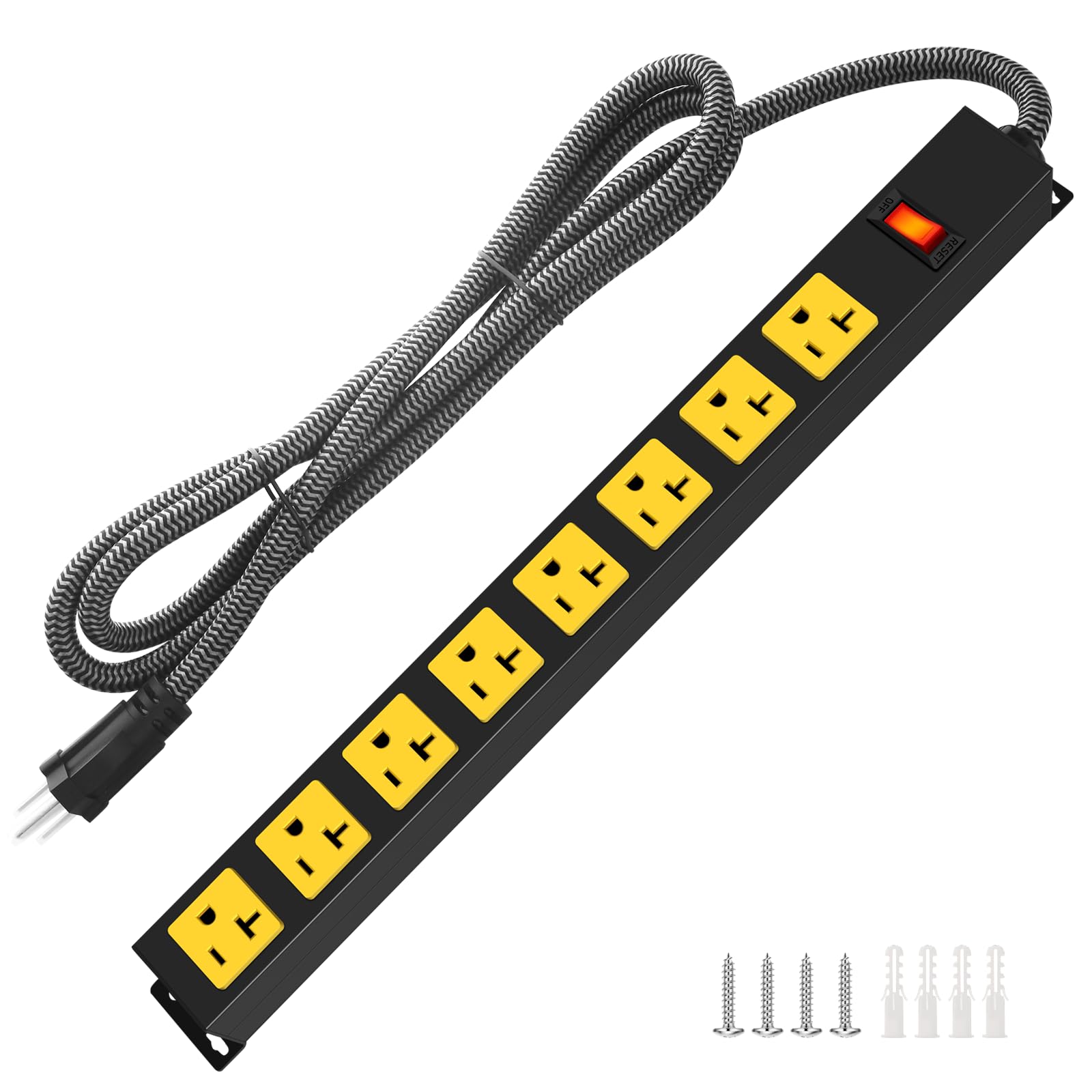
Eight wide sockets that ended one owner’s mid-cut breaker trips for good.
If you are upgrading a 15-amp strip that keeps cutting out while you work, this is the direct fix. The story that keeps coming up in reviews is a garage setup where a 15-amp strip tripped in the middle of a job, and switching to this 20-amp unit on a 20-amp circuit stopped it — with a sander, table saw, and planer all sharing the row. It is rated 20A/125V/2500W with a 20-amp breaker (a breaker is a switch that cuts power when the load gets too high), so it holds a heavy draw that a standard strip cannot.
It also pairs the highest outlet count in the CCCEI-and-HEZI comparison with genuine spacing. Eight outlets at 1.57 inches apart is double the CCCEI’s 4 sockets, so bulky chargers and fat tool plugs get room instead of fighting. When you feed it from a 15-amp circuit rather than a dedicated 20-amp line, remember the practical limit drops to 1875W — the breaker will still protect you, but you are capped lower.
The safety package is thorough: 1200 joules of surge protection, a 20-amp breaker that cuts power automatically above 20 amps, CSA and ETL and UL listings, and a thick aluminum housing with two mounting holes. The one recurring note is that the joule number is modest next to the CCCEI’s 4800J — fine for routine spikes, less headroom for a shop with genuinely erratic power.
Circuit-trip cure: the clearest case in this list for swapping a tripping 15-amp strip for a proper 20-amp unit on a 20-amp garage circuit.
Know the limit: on a 15-amp feed you are back under 1875W, so the full benefit depends on what circuit you plug into.
Pick this if: you want the most outlets and proper wide spacing for a workshop row of power tools.
skip it if: you need maximum surge capacity — the CCCEI’s 4800J beats this 1200J by a wide margin.
4. HEZI 20Amp Heavy Duty Surge Protector with 8 Outlets, 6FT

The high-capacity block a sewing station runs on without a single trip.
Picture a single 20-amp outlet feeding three sewing machines, a serger, and an embroidery machine at once. It carries 8 outlets rated 20A/125V/2500W with a 12AWG cord and a 20-amp breaker that trips above 20 amps and resets with a switch press.
The outlet type is a real advantage here. These are 5-20R T-slot sockets (a 20-amp outlet shape that also accepts normal plugs) plus a standard 3-prong 5-15P plug, so one strip handles both 20-amp tools and ordinary household devices without adapters. The metal casing and 6 ft cord make it mountable on a desktop, under a table, or on a wall, with 2 metal mounting holes for a quick install. What wins people over is reliability — toaster ovens and small appliances that tripped a lesser strip run fine here, and it has held up through surges and outages in areas where those are routine.
Spend the 1200 joules honestly: it is the same modest rating as the 20Amp 8-Outlet and the KeBen, well under the CCCEI’s 4800J, so this is a steady protection level rather than a heavy-surge specialist. Where it stands apart is coverage — this is the biggest outlet count of any standard three-prong-plug unit in the list, and the multi-machine reviewers treat it as a small-appliance workhorse.
Why Buyers Stick With It
- 8 T-slot outlets handle 20-amp tools and standard plugs together
- 2500W rating supports a full row of machines on one outlet
- 1200J surge protection plus a 20-amp breaker with easy reset
- Metal housing, 6 ft 12AWG cord, and 2 mounting holes for wall or bench
Worth Knowing
- 1200 joules is the lower end for surge absorption — fine for routine spikes
- On a 15-amp feed the usable output is capped at 1875W
Built for: craft and appliance stations where several machines share one outlet and you want the most sockets and both plug types covered.
Not the pick for: a shop chasing maximum joule protection — the CCCEI absorbs four times the surge energy.
5. Magnetic Heavy Duty 20A Power Strip with Surge Protector, 9-Outlet, 6FT
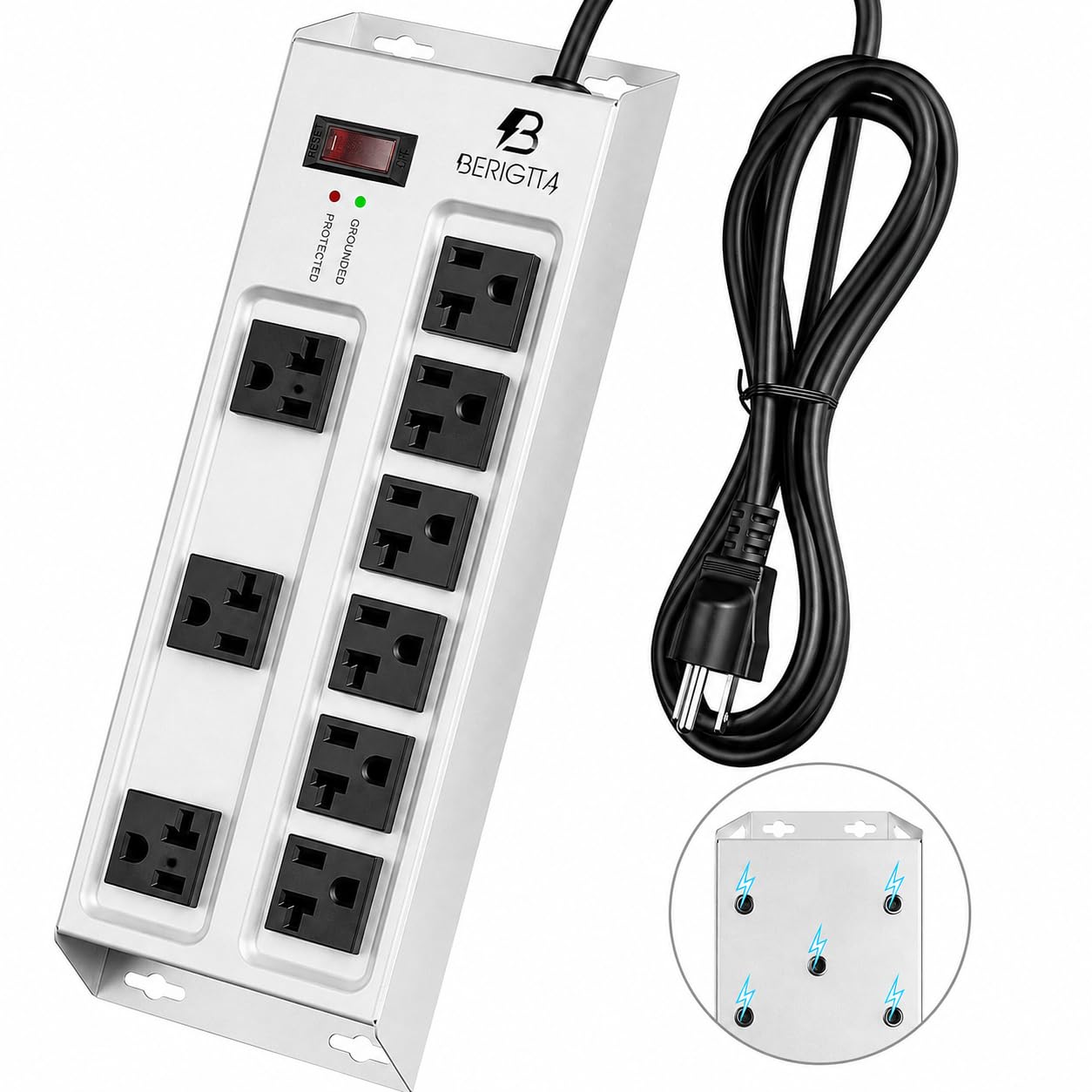
Nine outlets that stick to a toolbox instead of needing a screw hole.
If your power source moves — between a toolbox, a machine frame, and a garage shelf — this is the one that does not need a tool to relocate. Strong neodymium magnets (a type of very powerful permanent magnet) grab plain metal surfaces. Built-in wall-mount slots let you fix it permanently later if you change your mind. It is rated 20A/2500W and carries the most outlets here at 9, so heavy tools and pickup gear can share one bar.
The cord and casing match the ambition. The 6 ft 12-gauge cord (12-gauge means thicker copper wire that carries more current safely) is rated for the full 20 amps, and the aluminum alloy housing is built for garage grit with a lighted power switch for quick control in a dim corner. Its real edge over the standard picks is the surge number — 3600 joules, second only to the CCCEI’s 4800J and triple the 1200J units, so drills and saws on the same bar have more buffer for unpredictable spikes.
The honest limit is the magnet strength itself. The most-discussed aspect of this pick is precisely that — the hold — and the reviews are split, with some finding the magnets very strong and others saying the contact pads are smaller than expected. If your surface is thick-painted, uneven, or non-magnetic, plan on the wall-mount slots instead. Weighing 2.8 pounds, it is heavy enough to pull free of a marginal grip.
Where it shines: the 9-outlet count and 3600J surge rating make it the most capable pick for a magnet mount that moves around a metal shop.
The magnet catch: hold quality varies with the surface — strong steel benches love it, painted or thin panels may not.
The right call when: you want the highest outlet count plus a genuinely strong joule rating and tools that cling to metal.
Better to pass if: your mounting surface is non-magnetic or rough — a fixed wall-mount like the HEZI fits that scene more cleanly.
6. KeBen 20A Heavy Duty Power Strip Surge Protector, Yellow, 12 Gauge, 8AC/10FT
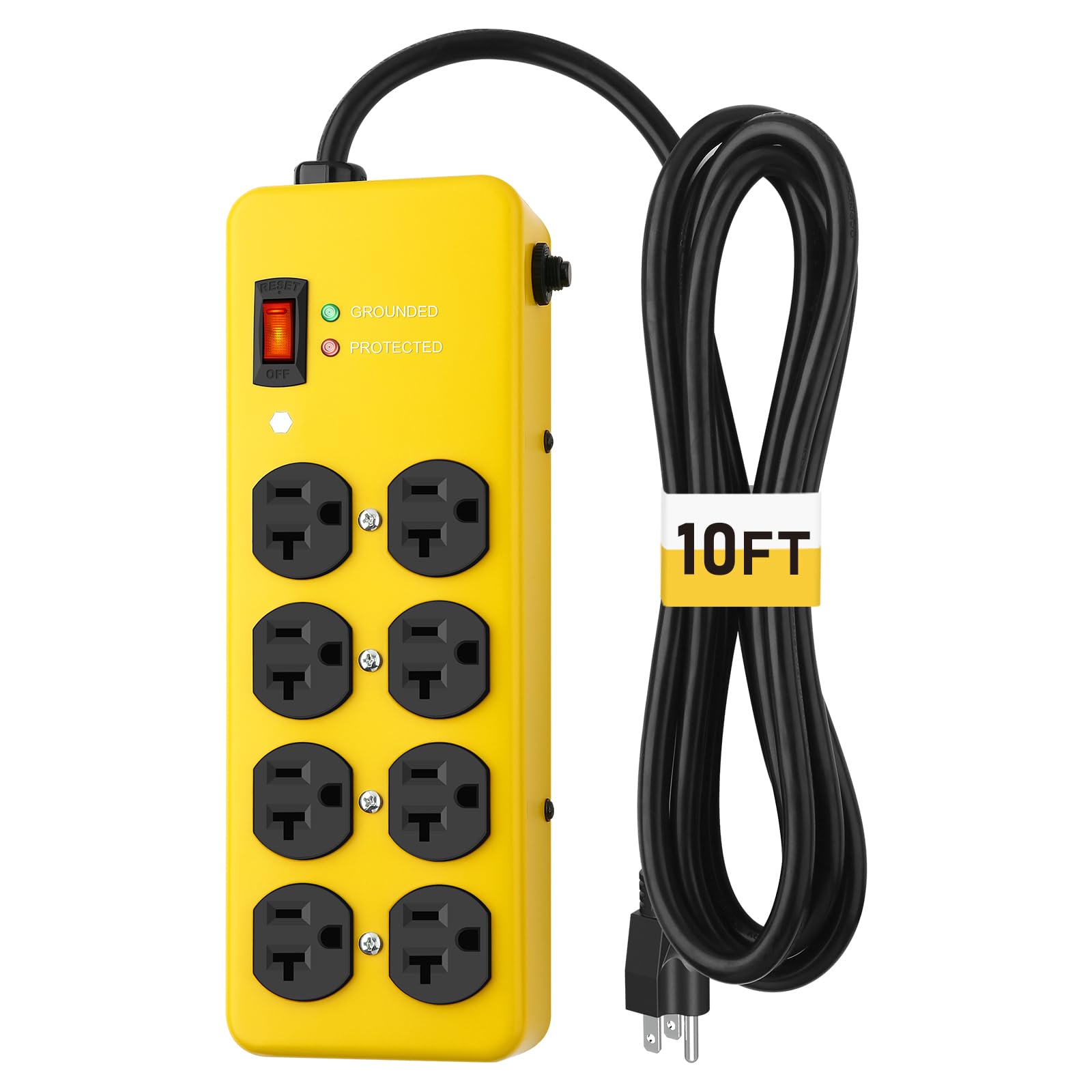
Ten feet of heavy cord for the jobs where the outlet is far away.
When the power source is nowhere near where the work happens, cord length stops being a detail and becomes the whole point. This strip pairs the longest reach — a 10 ft 12AWG cord, matching the CCCEI — with 8 T-slot outlets, so it covers lighting runs and event setups that out-distance a standard extension cord. It is rated 20A/125V/2500W with a standard 5-15P plug on the wall end.
The outlet design and housing suit tough work. Eight 5-20R T-slot sockets accept both 20-amp tools and ordinary 3-prong devices, and the metal housing is mounted on walls or workbenches to keep cords off the floor and reduce trip hazards in a garage or shop. For an event or a big exterior lighting run, having 8 outlets on a 10 ft cord beats daisy-chaining two shorter strips.
What stands out in the field reports is sheer mass — owners describe it as heavier than any strip they have used, with a very thick, strong cord and a conveniently placed switch. The one consistent note is the joule number: 1200J is on the low side for a heavy-duty protector, so if surge capacity matters most, it trails the CCCEI’s 4800J and the Magnetic pick’s 3600J. Straightforward protection, but not the heaviest armor.
Reach champion: the 10 ft 12AWG cord and 8 sockets make it the easy answer when the outlet is across the room.
The surge trade: 1200 joules is modest for a heavy-duty unit — enough for routine spikes, less buffer for wild power.
Choose this for: outdoor lighting, event power, and any bench where the outlet is far from the work.
Second-choice if: maximum surge absorption is your priority — the CCCEI covers more joules for a similar reach.
Understanding the Specs
Amps, Watts, And The Circuit You Plug Into
Amps measure current, and watts measure power — for a wall strip, watts are usually amps times volts. A 20-amp strip at 125 volts is often rated to 2500W, while the same strip on a 15-amp feed is commonly limited to 1875W. That is why the circuit behind the strip matters as much as the strip itself: a 20-amp unit on a 15-amp line still gives you solid protection, but the usable ceiling drops.
Joules And What They Actually Buy You
A joule rating tells you how much surge energy a strip can absorb in total before it can no longer protect. A 1200-joule unit suits normal household spikes; larger numbers like 3600J or 4800J suit shops, older wiring, or areas with frequent surges. Higher does not mean a specific tool is safer every time, but it does mean more total capacity to take hits over the life of the strip.
FAQ
What does 20-amp rating actually mean on a power strip?
Can I use a 20-amp power strip on a normal 15-amp household outlet?
What is the difference between a 5-15R outlet and a 5-20R T-slot outlet?
Does a higher joule rating mean better surge protection?
How do I reset the breaker if it trips?
Will a 20-amp power strip work with my table saw or air compressor?
Can I mount these strips on a wall or under a workbench?
Do I need a 12-gauge cord or is 14-gauge enough?
Is it safe to leave a 20-amp power strip on all the time?
Final Thoughts: The Verdict
For most people buying a 20-amp surge protector, the CCCEI 12 Gauge Heavy Duty Surge Protector is the one to start with — it leads on both fronts that matter, with the highest 4800J surge capacity and the longest 10 ft cord, plus per-outlet switches and breakers for hands-on control. If you want wide socket spacing in a compact mounted bar, grab the JUNNUJ Heavy Duty 20 Amp Power Strip. And for a job where the outlet sits across the room, the KeBen 20A Heavy Duty Power Strip trades a little surge headroom for the same 10 ft reach and 8 T-slot outlets.
How We Picked
We do not accept paid placement. Every pick is matched to a real buyer and a real use-case; we do not hands-on test units.
Sources & Methodology
Specifications: manufacturer listings and product documentation. Review insights: verified customer reviews, as of September 2026. Pricing: not shown on this page (it changes often); check the current price via the retailer link.
As an Amazon Associate, KitchPrep earns from qualifying purchases. This does not affect which products we feature.
Related Guides
