
Specs are compiled from manufacturer listings and verified buyer reviews and can change over time — please confirm the key details on the product page before buying.
Municipal water arrives at your tap carrying more than just H2O—chlorine for disinfection, sediment from old pipes, and rust that stains sinks and ruins the taste of coffee. A 2-stage water filter system tackles this head-on: the first stage traps the gritty particles, and the second stage strips out the chlorine and odors that make tap water smell like a swimming pool. The result is cleaner-tasting water from every faucet, minus the plastic waste of bottled water.
I’m Mohammad Maruf — the founder and writer behind KitchPrep. This guide is built by comparing the manufacturers’ published specifications and the patterns across verified customer reviews, so you get each pick’s real strengths and trade-offs instead of marketing spin.
From whole-house units that protect your plumbing to compact under-sink models for renters, this guide breaks down the best 2-stage water filter system options by flow rate, filter life, and installation ease.
Our Picks at a Glance

How To Choose The Best 2-Stage Water Filter System
Decide first: whole-house at the main line or under-sink for one faucet. This choice sets your flow rate needs, filter size, and installation effort.
Whole-House vs. Under-Sink
Whole-house systems use large 10″ x 4.5″ or 20″ x 4.5″ cartridges to handle high flow, protecting your water heater and washing machine from sediment while improving every shower. Under-sink models are smaller, cheaper, and only affect one faucet—usually the kitchen—which is where you actually drink the water.
Flow Rate Is the Silent Dealbreaker
Flow rate (GPM) measures how fast water passes through the filter. A whole-house system needs 10-15 GPM to keep your shower strong, while an under-sink unit only needs about 0.5-2.5 GPM to fill a glass quickly. Ignore it and you risk a trickle.
Filter Life and Replacement Costs
Sediment filters typically last 6-12 months, while carbon blocks last 3-6 months depending on water quality. Choose standard-size cartridges to avoid being locked into one brand’s pricing.
Quick Comparison
| Model | Best For | Flow Rate | Filter Life | Capacity | Amazon |
|---|---|---|---|---|---|
| iSpring F2WGB22B★ Best Overall | Whole-house replacement | 15 GPM | 100,000 gal | 5 micron sediment | Amazon |
| Waterdrop DSTRenter’s Pick | Renter-friendly under sink | 1.35 GPM | 12 months | 4,000 gallons | Amazon |
| WINGSOL WS-US-002Mineral Boost | Alkaline mineral water | 2.5 GPM | 6 months | Lead & chlorine removal | Amazon |
| A. O. Smith AO-US-200 | Certified contaminant reduction | 0.5 GPM | 6 months | 500 gallons | Amazon |
| Geekpure 2-Stage | Whole-house prefilter | 5-15 GPM | 6-12 months | 10″ x 4.5″ standard | Amazon |
| EcoPure ECOP20 | Bottled-water replacement | 0.5 GPM | 6 months | 7,500 liters | Amazon |
| SimPure DB10C-2 | Well water with iron | 15 GPM | 3-6 months | 80,000 gallons | Amazon |
| iSpring WGB22B | Complete whole-house system | 15 GPM | 1 year | 100,000 gallons | Amazon |
In‑Depth Reviews
1. iSpring F2WGB22B Whole House Replacement Filters
Our pick — over 4.5★ from 200+ verified ratings; the strongest balance of quality and price.
The crowd favorite that swaps into your existing housing and scrubs a year’s worth of water for a family of four.
This is a replacement cartridge set, not a full system—it slides into standard 20″ x 4.5″ whole-house housings, including iSpring’s own WGB22B. The first stage is a 5-micron polypropylene sediment filter that catches rust and grit, while the second stage uses coconut-shell carbon block to pull out chlorine, herbicides, and industrial solvents. Together they handle up to 15 GPM, so your shower pressure stays strong.
Both cartridges are rated for 100,000 gallons, which the brand says covers a family of four for a full year. They’re independently third-party tested to meet NSF/ANSI standards, and the set weighs 6.4 pounds. Owners consistently call these an exact match for the original equipment—buyers report the replacement is “Identical replacement. Simple to install once housings were removed.”
What wins people over is how well the filters simply do their job—functionality is the most-praised aspect, with quality close behind. This system doesn’t reduce Total Dissolved Solids (TDS), meaning it keeps healthy minerals like calcium and magnesium in your water, which is a plus if you don’t want the flat taste of reverse osmosis. The trade-off is that if your water has heavy metals, this pair won’t handle them.
Why owners stick with it
- 5-micron sediment catches fine rust and sand particles
- 100,000-gallon capacity means roughly one change per year
- 15 GPM keeps whole-house water pressure intact
Who should look elsewhere
- Not a full system—needs compatible housings already installed
- Does not reduce TDS or heavy metals
Reach for it if: you already own a 20″ x 4.5″ whole-house housing and want a proven, drop-in replacement that lasts a year.
Look elsewhere if: your water tests high in lead or other heavy metals—this handles sediment and chlorine, not dissolved metals.
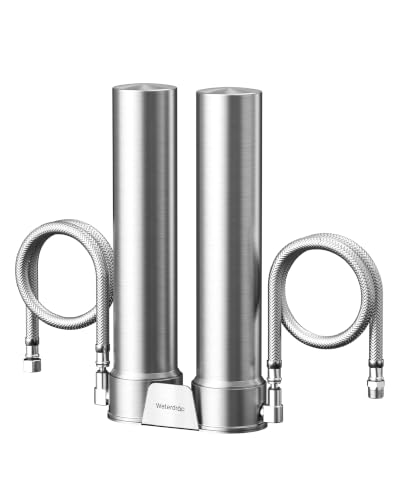
2. Waterdrop DST Under Sink Water Filter
A stainless-steel under-sink unit that installs in three minutes and won’t leave a single drill hole behind.
Renters, this one is built for you. The Waterdrop DST uses a twist-lock design with push-fit connections, so it mounts to your 3/8-inch cold water line without drilling. It measures just 2.76″W x 12.8″H x 7.28″L, fitting neatly beside a garbage disposal. The body is lead-free 304 stainless steel, which survived 100,000 water hammer and salt spray tests—so it resists rust and deformation over time.
The first stage lasts 8 months, the second 12, so you replace only inner cartridges, not the shell. It’s NSF/ANSI 372 certified and reduces chlorine, PFOA/PFOS, and odor. Owners mention it “Works great after 8 months, first filter replaced.” The flow rate of 1.35 GPM is more than enough for filling a glass or a pot, even if it would feel slow at a commercial scale—but it’s a full 11.1x slower than the 15 GPM whole-house iSpring above, which is expected for a point-of-use unit.
Installation is the thing everyone raves about—over 130 owners single out how easy it is, and improved taste is the second-most-praised aspect. The catch is that filter changes require disconnecting the unit to access the cartridges, so leave some clearance below. Also note this is strictly for municipal cold water; well water needs a pre-filtration setup first.
What makes it a renter favorite
- No-drill install protects your security deposit
- Stainless steel body resists rust and leaks
- 8 and 12-month filter stages reduce waste
What to plan around
- Must disconnect to swap filters
- Not rated for well water or hot water sources
Grab this if: you rent and want great-tasting water without modifying the sink or counters.
Think twice if: your home runs on well water—you’d need an extra pre-filter stage before this unit.
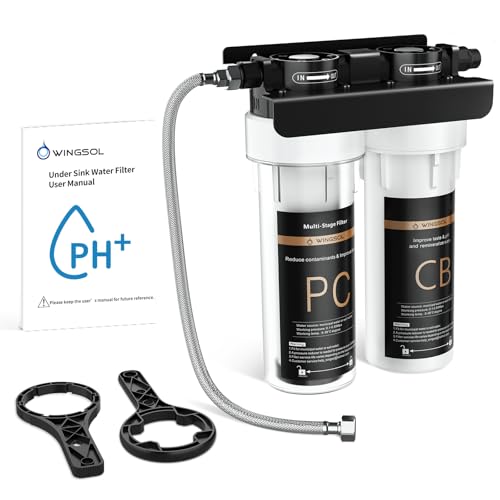
3. WINGSOL 2-Stage Under Sink Filter with Faucet
The under-sink option that alkalizes your water and keeps a strong 2.5 GPM flow while it purifies.
Most under-sink filters slow your tap to a trickle, but the WINGSOL maintains 2.5 GPM at 60 psi—customers note no drop in pressure compared to their unfiltered faucet. It’s a rare convenience: filling a large pot or a water bottle feels almost instant. The system also includes its own faucet, so you don’t need to tap into your existing fixture.
The two stages are a pleated sediment filter and a multi-function carbon block, which together reduce 99.99% of lead, chlorine, odor, sand, rust, benzene, cysts, and more. The second stage adds a mineral pH+ filter that remineralizes and alkalizes the water. The clear see-through housing lets you watch the filter’s condition, and the quick-change green housing turns a quarter-turn to pop cartridges out in seconds.
This unit meets NSF/ANSI 42 & 53 standards and works on both municipal and well water. Owners highlight the easy install and the dramatic taste improvement—one even noted it “dramatically reduces heavy metal levels.” The honest downside: a few buyers mention needing a strap wrench to unscrew the housing, and some fittings are tough to tighten by hand. If you’re after an alkaline boost at a strong flow, this delivers.
The flow advantage: at 2.5 GPM it pours like a normal faucet, not a filtered one—the top reason owners pick it over slower rivals.
Pick this for: households that want alkaline, mineral-boosted water without sacrificing faucet pressure.
skip it if: you want a no-tools filter change—this housing is best removed with a strap wrench.
4. A. O. Smith Claryum AO-US-200

The Wirecutter-endorsed under-sink system certified to reduce 78 specific contaminants—not just taste issues.
If you want proof over promises, the A. O. Smith Claryum is WQA tested and certified to NSF/ANSI Standards 42, 53, and 401—covering the whole system, not just the media. It reduces 99% of 78 harmful contaminants, including lead, PFAS, chlorine, mercury, asbestos, pharmaceuticals, and chloramine, while leaving essential minerals in your water. This is certification depth most rivals don’t match.
Installation connects to your 3/8-inch cold water line with an included tee and dedicated faucet, and the brand says no plumber is required. Each filter set lasts 6 months or 500 gallons, and the manufacturer quotes annual maintenance at or less. At 0.5 GPM, the flow is gentle—owners warn you’ll wait a moment for a full glass, and some find it slow. It’s built for families of 1 to 4, not for high-demand kitchens.
Owners consistently praise the easy install and taste improvement, with several switching from spring-water delivery to this filter and cutting yearly costs dramatically. The recurring note is the slow but steady flow: water comes out a trickle compared to a 2 GPM tap, so budget a few extra seconds per glass. The manual also advises replacing the housing every 5 years to avoid leak damage—factor that into your long-term cost.
The cert advantage: full-system NSF 42, 53, and 401 certification means the housing and faucet are verified, not just the carbon inside.
Choose it for: families who want verifiable reduction of 78 contaminants and don’t mind a slower pour.
Pass if: you need fast filling—0.5 GPM means patience at the tap.
5. Geekpure 2-Stage Whole House System with 1″ NPT Brass Ports
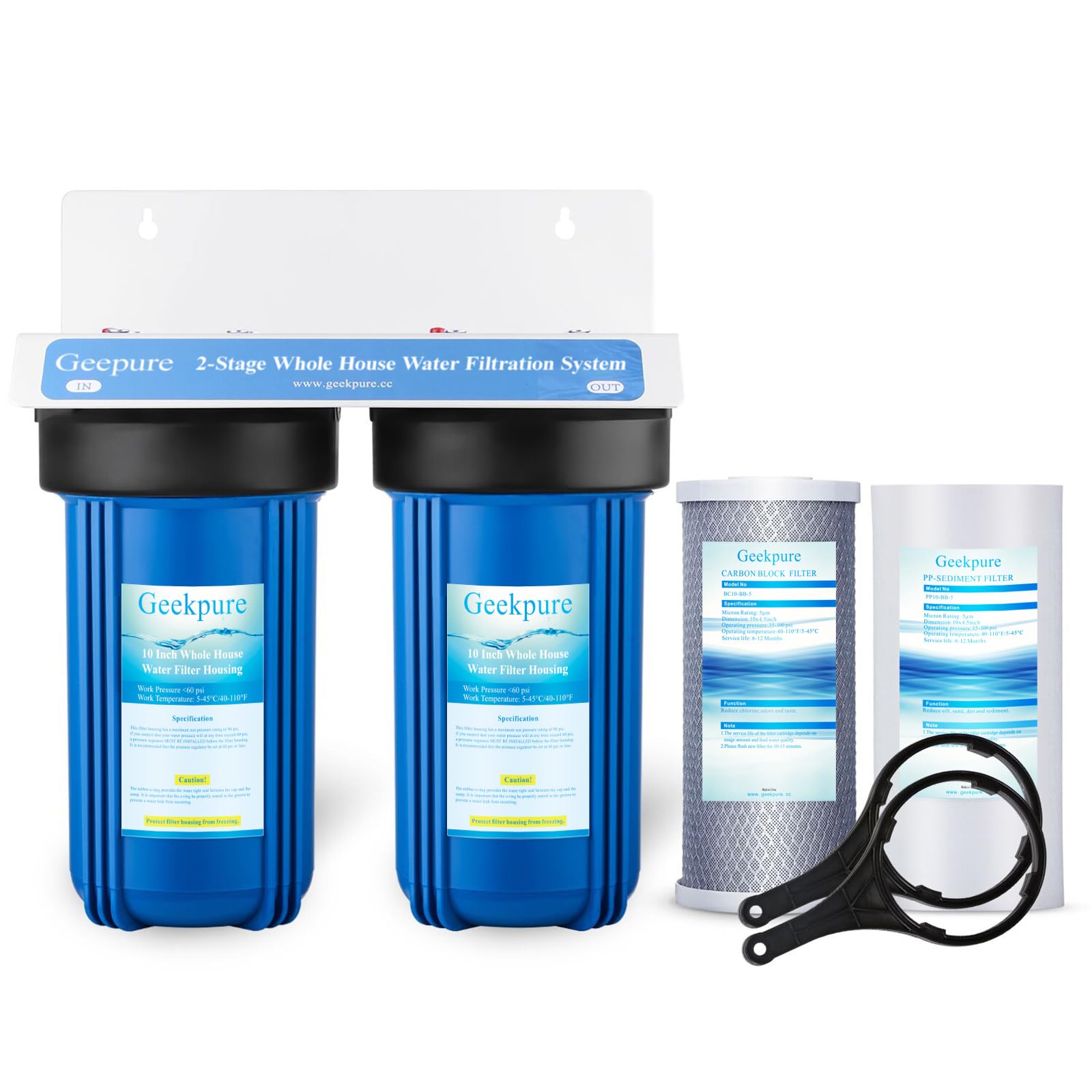
A heavyweight whole-house prefilter with brass ports and a built-in pressure release valve for safer swaps.
This complete system includes two 10-inch blue housings with 1″ NPT brass inlet/outlet, a plastic wrench, and a mounting bracket. The first stage is a 5-micron PP sediment filter with a color-changing indicator—when it turns dark yellow or brown, it’s time to replace. The second stage is a carbon block that strips chlorine, taste, and odors. It installs at your main water supply to protect water heaters, washing machines, and showers from sediment damage.
Flow rate runs 5-15 GPM depending on feed pressure, and the system weighs 19 pounds with a sturdy metal frame. The built-in pressure release valve is a thoughtful touch: it relieves internal pressure before you open the housing, making filter changes safer. It works with well water, though the brand recommends more frequent swaps—every 3 months or so—compared to tap water. It’s not for hot water, and it won’t reduce hardness, heavy metals, or TDS.
Owners praise the solid build and genuine filtration—one bought it as a pre-filter for car-washing water and found it “works perfectly,” while another reports it keeps iron and sulfur smell out of their lines. The honest catch: you’ll need to supply your own brass nipple to connect the two canisters, and installation is easier for someone handy. Reviewers point out a few experiences with leakage at fittings, so go easy on the Teflon tape—excess can puncture the brass threads.
The smart extra: a color-changing sediment indicator tells you when to swap without guessing, and the pressure relief valve makes the job cleaner.
Best for: DIYers who want a complete whole-house prefilter and don’t mind sourcing one brass connector.
Not for: first-time installers—this one rewards plumbing confidence.
6. EcoPure ECOP20 2-Stage Under Sink System
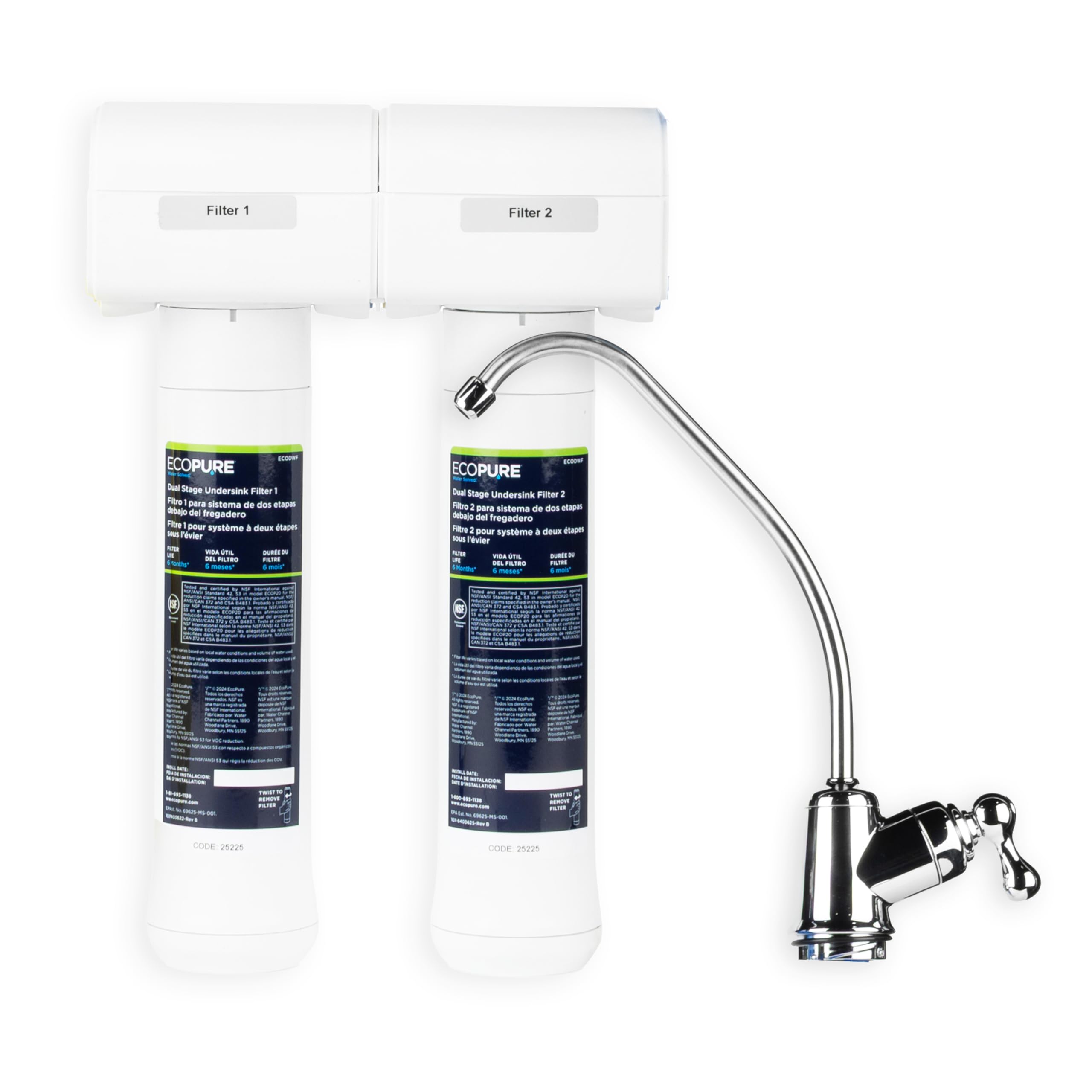
A 58-contaminant reducer with encapsulated filters that twist off in seconds—no tools, no mess, no water shutoff.
The EcoPure ECOP20 is designed as a bottled-water replacement, delivering crisp water for drinking, cooking, coffee, and even pets. It’s NSF-certified to reduce 58 contaminants, including chlorine taste and odor, lead, cysts, and chemicals. The included chrome faucet connects to your 3/8″ cold water line with provided connectors, so installation is a quick DIY job.
What sets this apart is the maintenance: encapsulated filters twist on and off in seconds, with no tools and no water shutoff. You never touch the dirty media, which keeps swap day stress-free. The system carries a 1-year full warranty, extendable to lifetime with product registration. It weighs just 4.5 pounds, making it one of the lighter under-sink units here.
Owners who’ve run it for years report the filters last longer than most—one installed it in 2020 and it was still going strong five years later. The recurring gripes are slow flow (0.5 GPM) and the occasional filter popping off, so handle the housing snaps with care. One owner noted a cracked press connector with no replacement parts available, so keep the warranty registration handy.
The maintenance win: tool-free, mess-free filter swaps are the standout feature, backed by owners who say replacements outlast expectations.
Reach for it if: you want the simplest possible filter changes and a dedicated faucet for clean drinking water.
Consider another if: you need fast flow—this pours at a gentle 0.5 GPM.
7. SimPure DB10C-2 Whole House System
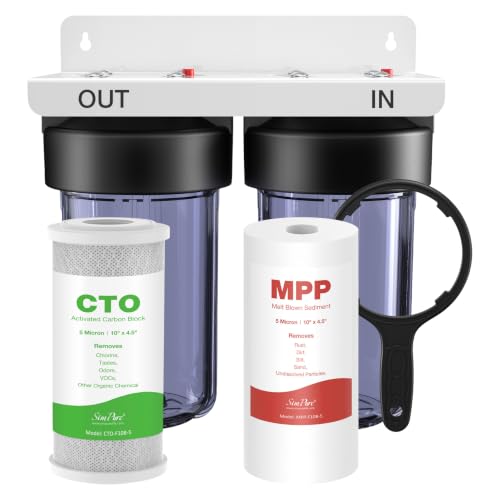
A well-water warrior with clear housings so you can watch the filters work without opening anything.
SimPure’s whole-house system stands out with two standard clear housings (DB10C) instead of the usual blue. You can monitor cartridge wear at a glance—no disassembly needed to check if it’s time for a swap. The dual 2×2 O-ring design with brass fittings focuses on leak-proof sealing, and the system weighs 18.25 pounds with dimensions of 14.2 x 7.5 x 15.5 inches.
The two stages use a premium MPP sediment filter for sand, rust, and large particles, plus a high-performance CTO carbon block for residual chlorine, discoloration, and odors. It delivers up to 15 GPM, making it a strong choice for whole-house coverage. The carbon filter lasts 3-6 months, while the sediment filter runs 6-12 months—longer than many standard cartridges. SimPure recommends operating between 25-90 psi and 41-100°F.
Owners with well water report the most dramatic results: one cabin owner saw no staining or sediment after a full season, with great taste and no smell. The most-praised aspect is build quality, followed by overall performance. The caveats are real, though: the unit is heavy when full, so mount it on studs or concrete—not drywall—and several owners mention leakage issues at the fittings. One experienced reviewer suggests adding a 50-micron spin-down sediment filter as a first stage for extra protection.
The well-water edge: owners with iron-heavy well water report no staining and clean taste after a season—exactly what this system promises.
Best for: well-water homes wanting visible filter monitoring and whole-house flow.
Be careful: this is a heavy unit—plan your mounting surface before you buy.
8. iSpring WGB22B Complete Whole House System
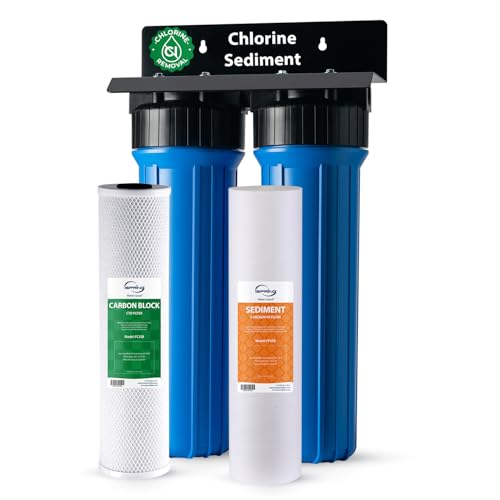
The complete 20″ x 4.5″ whole-house kit from a trusted American brand, engineered for DIY installation and 100,000 gallons of clean water.
This is the full system version of our top pick—two housings, two filters, a heavy-duty 9″ wrench, and a black metal bracket, all included. The first-stage sediment filter captures particles down to 5 microns, while the second-stage CTO carbon block uses premium coconut shell carbon. Independently tested to meet NSF/ANSI standards, it removes up to 99% of chlorine along with sediment, rust, odors, bad tastes, and herbicides.
At 15 GPM, it protects your entire home—showers, washing machine, and dishwasher—without noticeable pressure loss. The filters are standard 20″ x 4.5″ cartridges, which means you’re not locked into proprietary replacements; any brand’s compatible cartridge works, keeping long-term costs down. Weighing 36 pounds, this is a substantial unit, but the double O-ring seals and standard 1″ FNPT connections make the install straightforward, with YouTube guides to walk you through.
Owners consistently praise the after-sale support—one had a housing crack after a utility upgrade and iSpring overnighted a redesigned replacement free under warranty. Another reports removing manganese taste completely, with full pressure maintained after 6 months. The system retains healthy minerals since it doesn’t reduce TDS, so your water tastes clean without the flatness of reverse osmosis. A few owners wish a bottom drain valve came standard, since there’s no factory drain port for mess-free filter changes.
The brand trust: founded in 2007 and trusted across 21+ countries, with owners praising responsive U.S.-based support years after purchase.
Go with this if: you want a complete, proven whole-house system with standard-size filters and genuine warranty support.
Note the weight: at 36 pounds, plan a sturdy mounting spot before installation.
Understanding the Specs
Flow Rate (GPM)
Gallons per minute measures how fast water pushes through the filter. Whole-house systems need 10-15 GPM so your shower and appliances don’t slow to a drip. Under-sink units only need 0.5-2.5 GPM since they serve one faucet. Check your home’s pressure and the filter’s rating to match them.
Micron Rating
A micron measures the particle size a filter traps—smaller numbers catch finer particles. The 5-micron sediment filters on our picks handle rust, sand, and silt that stain sinks and wear out appliances. The carbon block stage then targets chemicals and taste, not visible particles.
FAQ
What does a 2-stage water filter actually remove?
Will a whole-house filter reduce my water pressure?
How often do I need to replace the filters?
Can I use a 2-stage filter on well water?
What is TDS and why do these filters not reduce it?
Is a 2-stage system enough for drinking water?
Can I install a 2-stage system myself?
What is NSF certification and why does it matter?
Do I need a dedicated faucet for an under-sink filter?
How much does maintenance cost per year?
Final Thoughts: The Verdict
For most buyers, the 2-stage water filter system winner is the iSpring WGB22B because it pairs whole-house 15 GPM flow with standard 20″ x 4.5″ filters and a 100,000-gallon capacity—the crowd favorite at 4.6 stars across 800+ owners. If you want the renter-friendly under-sink route, grab the Waterdrop DST for its no-drill stainless steel install. And for certified contaminant reduction, the A. O. Smith Claryum leads on NSF 42, 53, and 401 verification across 78 contaminants.
How We Picked
We do not accept paid placement. Every pick is matched to a real buyer and a real use-case; we do not hands-on test units.
Sources & Methodology
Specifications: manufacturer listings and product documentation. Review insights: verified customer reviews, as of September 2026. Pricing: not shown on this page (it changes often); check the current price via the retailer link.
As an Amazon Associate, KitchPrep earns from qualifying purchases. This does not affect which products we feature.
Related Guides
