
Specs are compiled from manufacturer listings and verified buyer reviews and can change over time — please confirm the key details on the product page before buying.
If your home has a two-stage heat pump or a two-stage furnace, you need a thermostat built to run both stages — otherwise your system either runs flat-out or cycles on and off all day. The picks below all support multi-stage heating and cooling, and the big differences come down to wiring support, how the display reads, and if you want app control. The White-Rodgers Emerson 80 Series is the safest first stop for most homes, and the Trane TCONT802 is the one to look at if you want a large touchscreen and outdoor temperature on screen.
I’m Mohammad Maruf — the founder and writer behind KitchPrep. This guide is built by comparing the manufacturers’ published specifications and the patterns across verified customer reviews, so you get each pick’s real strengths and trade-offs instead of marketing spin.
Two-stage equipment asks more of a thermostat than most people expect when they buy one. Wiring labels, swing settings, and heat pump behavior all decide whether your second stage ever actually kicks in. This guide walks through the eight strongest 2-stage thermostat options worth putting on your wall.
Our Picks at a Glance

How To Choose The Best 2-Stage Thermostat
A two-stage thermostat is the control box that decides which stage of your heating or cooling equipment runs, and for how long. Get the wiring match wrong and your second stage may never turn on, no matter what the spec sheet claims. Here is what actually decides whether a thermostat works in your home.
The terminal labels come before everything else
Look at the labels on your old thermostat’s base plate before you buy anything. W2 drives second-stage heat, Y2 drives second-stage cool, and O/B controls the reversing valve on a heat pump. If your new thermostat does not carry those terminals, it cannot run your equipment the way it was designed to run.
C-wire or batteries, depending on your system
Some thermostats run on AA batteries alone, which means no common wire is needed. Others pull power from your HVAC system through a C-wire — the common wire that supplies steady low-voltage power. Battery models are simpler to swap in, but hardwired models never need a battery change.
Heat pump, gas furnace, or both
A dual-fuel setup pairs a heat pump with a gas or propane furnace, and the thermostat picks which one runs based on outdoor temperature. If you run one of those systems, you need a thermostat that explicitly supports dual fuel, not just multi-stage heating.
How much control you actually want
Programmable schedules, app control, and voice assistants are all optional layers on top of the wiring basics. Decide between a set-and-forget schedule and full remote control before comparing models.
Quick Comparison
| Model | Best For | Stages Supported | Connectivity | Power Source | Amazon |
|---|---|---|---|---|---|
| White-Rodgers Emerson 80 Series 3562416★ Best Overall | Simple, dependable multi-stage control | 2 Heat / 1 Cool | Wired | 2 AA batteries | Amazon |
| Pro1 IAQ T755Best Value | Independent swing tuning per stage | 3 Heat / 2 Cool | Wi-Fi | Batteries | Amazon |
| YoLink Thermostat 2Best Range | Long-range remote sensor control | Dual-stage heat and cool | LoRa (hub required) | C-wire, 24VAC | Amazon |
| Aprilaire 8466 | Auto changeover in mixed climates | 2 Heat / 1 Cool | Wired | Dual powered | Amazon |
| Honeywell Home T6 Pro Z-Wave | Local Z-Wave smart control | 3 Heat / 2 Cool | Z-Wave | 3 AA batteries or C-wire | Amazon |
| Pro1 T855iSH | Whole-home app scheduling | 4 Heat / 2 Cool | Wi-Fi | Low voltage | Amazon |
| Honeywell TH8321WF1001 | Large homes and light commercial | Up to 3 Heat / 2 Cool | Wi-Fi | Hardwired 24VAC | Amazon |
| Trane TCONT802AS32DAA | Touchscreen with outdoor temp display | 3 Heat / 2 Cool | Wi-Fi | Wired | Amazon |
In‑Depth Reviews
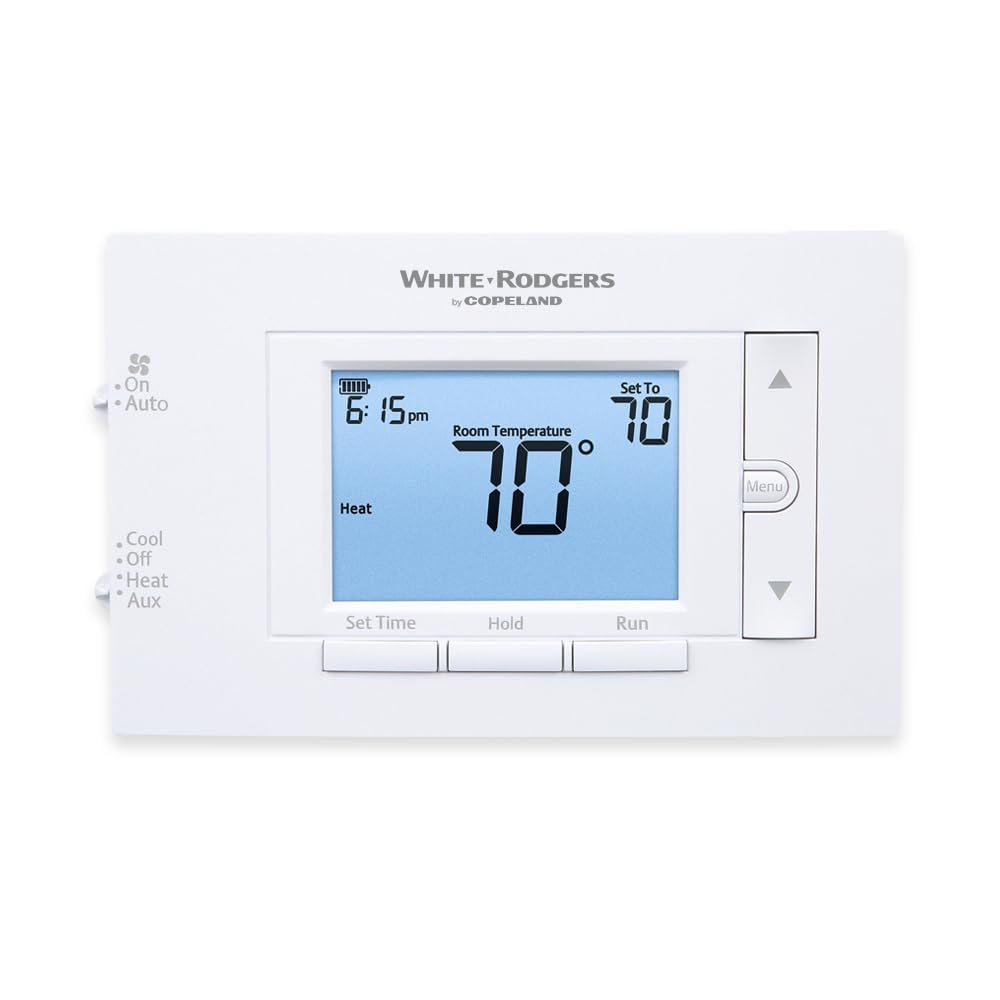
1. White-Rodgers 3562416 Emerson 80 Series Programmable Heat Pump Thermostat
Our pick — over 4.5★ from 400+ verified ratings; the strongest balance of quality and price.
The plain-LCD workhorse that wires up in minutes and never asks for your Wi-Fi password.
If your heat pump has a second heating stage and you just want it controlled properly, this is the one to start with. The Emerson 80 Series carries 2 Heat / 1 Cool staging, and the built-in level indicator plus pluggable terminals are the two details that make a self-install go smoothly. The display is a 4.5-inch LCD with a backlight button, so you can read it in a hallway with no overhead light. Dual fuel is standard here too, meaning a heat pump paired with a gas or propane furnace is handled without adding sensors.
Owners consistently describe the install as the easy part. Wiring goes one terminal at a time, the configuration menu walks you through the settings, and you can set a separate program for each day of the week — or run 5-1-1, or turn programming off entirely. One buyer swapped out an old unit in under 10 minutes using the same terminal designations, compared to the 2+ hours the previous thermostat took. It runs on 2 AA batteries, so no C-wire is needed, and buyers report months of runtime on the original set. There is also a keypad lock and temperature limits if you want to stop anyone else from changing your settings.
What wins people over is how solidly the basics are done — the build quality and the installation experience are the two things that come up over and over, well ahead of any feature on the list. Accuracy shows up repeatedly too, with owners saying it holds temperature within a tighter band than the thermostat it replaced. The honest catch is the programming menu: it works, but the layout takes some getting used to, and if you plan to build complex schedules you may find it fussy. Most owners simply set a schedule once and leave it. This thermostat is 6.4 inches deep by 4.4 inches wide by 2 inches tall, which is worth checking against your old wall footprint before ordering.
What buyers keep coming back to
- Pluggable terminals and a built-in level indicator turn a nervous DIY job into a 10-minute swap
- Dual-fuel support is standard, so a heat pump plus furnace setup needs no extra parts
- Backlit 4.5-inch LCD with keypad lock and temperature limits
- Runs on 2 AA batteries — no C-wire required
Where it asks patience
- Only 1 cool stage, so a two-stage AC system needs a different model
- The programming menu layout takes some trial and error to learn
Worth it if: you have a heat pump with two heat stages and one cool stage, and you want a dependable, battery-powered thermostat with no app or account.
Think twice if: your system has a second cooling stage — you need Y2 support that this model does not carry.
2. Pro1 IAQ T755 3 Hot/2 Cold 7 Day Thermostat
Three heating stages and two cooling stages, with stage tuning you can adjust independently.
This is the pick for a home running three-stage heat and two-stage cool where you want to fine-tune how aggressively each stage kicks in. The T755 gives you separate swing adjustments — that is the temperature gap before a stage turns on or off — for heating and cooling individually. That matters on a two-stage system, because the second stage should only fire on larger temperature swings, not every time the room drifts a degree. The display measures 4 square inches with a blue backlight plus a glow-in-the-dark light button, and programming runs on a 5/1/1 schedule with wake, leave, return, and sleep icons built into the menu.
Buyers keep pointing to value here, and it earns that reputation honestly: separate B and O terminals (wires that control reversing valves for heat pumps), a filter change indicator you can toggle on or off, room temperature calibration, and electric or gas configurability all come standard. One owner reported 11 months of trouble-free use after swapping out a unit that had started reading temperature incorrectly, describing it as an easy switch. Another had a first unit arrive with a fan that would not run on manual, got a prompt replacement, and was fine after that.
Set your expectations on the install, though. The rear wiring connections are tight and the design is not especially generous with space, which is where the friction shows up — some owners find it straightforward and others find it fiddly. If you want the third heating stage enabled, that has to be turned on through the phone app rather than on the device itself. If you have a two-stage heat pump and want more control over how each stage behaves than a basic model offers, this is a strong fit. The 5-year warranty is a longer safety net than most here.
What stands out: Independent swing adjustments for heating and cooling let you stop the second stage from cycling too often, which is the exact problem that sends people shopping for a multi-stage thermostat in the first place.
The trade-off: Tight rear wiring space makes the install less forgiving, and the third heat stage lives behind the app rather than the keypad.
Reach for this if: you want per-stage swing control and a 3H/2C ceiling without paying smart-thermostat money.
Look elsewhere if: you would rather never open a phone app — the third heating stage requires it.
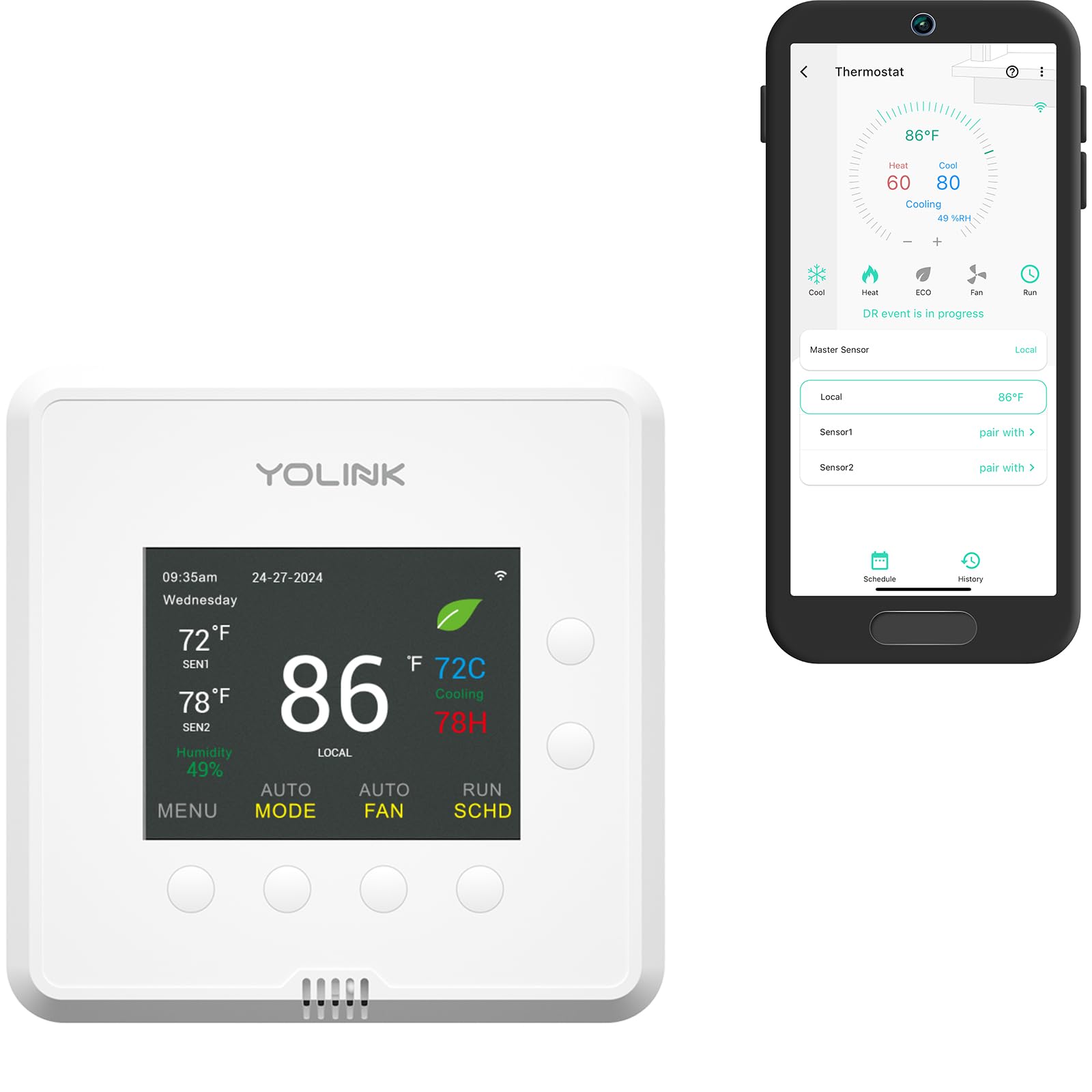
3. YoLink Thermostat 2 Smart Home and Commercial Thermostat
The one that reaches the far end of a big building and takes orders from a temperature sensor instead.
Dual-stage heating and cooling is the headline, but the real differentiator here is reach. YoLink uses LoRa — a low-power radio designed for long distance — and the stated range runs up to a quarter mile, which is why this shows up in commercial buildings and large homes where Wi-Fi drops out. It also accepts up to two YS8007-UC sensors, letting a room sensor act as the control point instead of the wall unit. Setup for 24VAC systems with a C-wire is DIY, and a YoLink hub is required and sold separately.
The physical footprint is unusually small — 0.87 inches deep by 4.52 inches wide by 0.87 inches tall. Compared to the White-Rodgers above at 6.4 inches deep by 4.4 inches wide by 2 inches tall, that is a dramatically slimmer profile on the wall. Functionality is what carries this one in owner feedback, well ahead of everything else, with easy installation a distant second. Owners mention it holds temperature reliably and does not suffer the connection dropouts they had with older Z-Wave gear. It also tunnels into the wider YoLink ecosystem — door locks, water valves, sensors — and one buyer described setting it so a leak sensor shuts the condenser off automatically.
Be aware of two things. Temperature control, connectivity, and accuracy all draw mixed feedback, with some owners reporting inaccurate readings and app timeouts even after firmware updates. And the heat pump versus gas switch defaults to heat pump, which is a setting worth checking immediately if you run a gas furnace with dual fuel. Otherwise the complaints land on missing refinement — remote sensors display as generic labels rather than room names, and the aux-heat setting can revert to primary-first after about a day.
Why it earns a spot: A quarter-mile LoRa range and external sensor support solve the two problems that kill ordinary smart thermostats in large or metal-heavy buildings.
Know before you buy: The hub is not included, and the dual-fuel default setting needs verifying on day one.
This is your pick if: you have a spread-out property or commercial space and want the thermostat acting on a sensor in the room that actually gets cold.
skip it if: you want a self-contained unit — the hub requirement is non-negotiable.
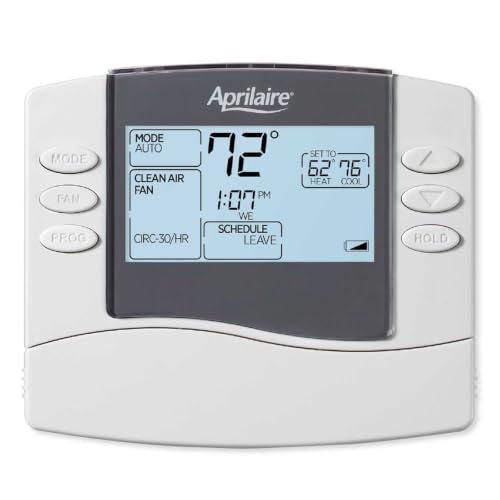
4. Aprilaire 8466 Heat Pump Thermostat
No app, no cloud, no fuss — just steady two-stage heat with auto changeover handling the seasons.
Where the YoLink above leans on radio range and app control, this Aprilaire goes the other direction entirely: it is a hardwired, programmable unit that works with a weekly and weekend schedule and never touches your network. It manages 2 Heat / 1 Cool (two heating stages and one cooling stage), includes auto changeover so it flips between heating and cooling on its own as outdoor temperatures swing, and supports three stages of heat with two stages of cool according to the manufacturer. That auto changeover behavior is exactly what makes it a favorite in Southern climates, where a single day can call for both.
The pattern in owner feedback is a thermostat that runs quietly and accurately rather than one that chases every degree. Functionality is far and away the most-mentioned strength, with programmability next. Owners describe it as an industrial-strength, non-smart unit that only turns the AC on when it is actually needed — one noted that smart thermostats in the same house would overrun and raise the bill. The word that keeps appearing is accurate. The large lit screen and button-based programming get consistent praise for being easy to read and operate.
The neat part for existing owners: it drops onto the same base plate as earlier Aprilaire models with no wiring changes, so replacing a unit takes minutes. Where you may need help is close temperature settings or auxiliary heat configuration — those land in territory where a call to tech support is worth making, and owners rate that support highly. On the flip side, this model has drawn a report of repeat failures from one long-time user, so it is not a lifetime-forever unit for everyone. Treat it as a solid, serviceable control rather than an indestructible one.
Why owners stick with it
- Auto changeover handles heat-to-cool swings without you touching anything
- Drops onto the existing Aprilaire base plate — no rewiring needed
- Large lit screen with straightforward button programming
- Strong tech support for aux heat and tight temperature settings
Worth knowing upfront
- Only 1 cool stage, so a two-stage AC system is out of scope
- Aux heat settings may need a support call to dial in
Suits you when: your climate flips between heat and AC in the same week, and you want a hardwired unit with no cloud dependency.
Move on if: you are replacing a different brand with a differently shaped base plate — the easy-swap benefit only applies to existing Aprilaire installs.
5. Honeywell Home TH6320ZW2007/U Z-Wave T6 Pro Programmable Thermostat

Local-only smart control for a heat pump running up to three heating stages.
If your priority is smart control that never leaves your house, this is the one to look at. It handles up to 3 Heat / 2 Cool on a heat pump or up to 2 Heat / 2 Cool on conventional equipment, and it talks Z-Wave Plus rather than Wi-Fi. That means no cloud account, no microphone, and no monthly subscription — you control it locally through a hub. It can be programmed on a 7-day, 5-1-1, or 5-2 schedule, run non-programmed, or be driven entirely by occupancy through your Z-Wave panel.
Compatibility is the second thing owners lean on here, right behind raw functionality. It pairs with Hubitat and works with Home Assistant over Z-Wave, and owners repeatedly note it as an upgrade over Nest hardware — smaller footprint, no cloud dependency, and steadier temperature. Power comes from 3 AA batteries or a hardwired C-wire connection, so you can keep the batteries as a fallback. There is also a humidity sensor onboard, and the UWP mounting system with the included cover plate makes the swap reasonably clean.
The Z-Wave experience is where opinions split. Compatibility and Wi-Fi connectivity both come in mixed, and the harshest accounts describe unintuitive menus, inconsistent option codes, and tedious re-pairing after a hub replacement. If you plan to run Home Assistant, go in expecting to do your homework first. Owners who just want local control with a straightforward hub pairing are happy; owners expecting polished documentation are not.
The case for it: A subscription-free, cloud-free thermostat with 3H/2C capability, an onboard humidity sensor, and a footprint around 4.06 inches square.
The honest caveat: The setup documentation is the weak point — budget an evening for hub pairing if you are new to Z-Wave.
Pick this one if: you run a local hub, want your thermostat off the internet, and need three heating stages covered.
Pass if: you want plug-and-play — this rewards someone comfortable in a hub interface.
6. Pro1 T855iSH WiFi Thermostat, 7 Day Programmable

Four heating stages and two cooling stages, controlled from your phone across the house.
The stage count is the reason this model exists on a list for multi-stage equipment. It supports 4 Heat / 2 Cool, which is more staging than anything else here, and it is a 7-day or 5/1/1 programmable unit with the same wake, leave, return, and sleep menu icons as the T755 above. It is Wi-Fi connected, so you can adjust temperature from bed or from another state. The terminal blocks are color-coded and the universal sub-base is designed to make wiring identification easier than a bare screw strip.
Owners who like it tend to talk about two things: the scheduler running reliably, and the convenience of remote access. Being able to change the temperature without getting up is the single most-repeated reason people keep it. Wi-Fi pairing is described as simple, and the app itself as easy to navigate. Functionality is the strongest signal in the feedback by a wide margin.
Now the part you need to hear. The battery compartment draws clear negative feedback, with multiple buyers reporting units arriving with missing or broken battery terminals — and the pattern repeats across separate orders, which points at a quality-control gap rather than a one-off. There is a workaround some owners use: wiring a common wire transfer cable to the C and Rh/RC terminals to power the unit from the furnace board instead of the batteries. It works, but it requires drilling a hole for the power feed. Also expect the app connection to occasionally drop, requiring you to re-enter the Wi-Fi network on the thermostat — a few minutes of work about once a month.
The reason to pick it
- 4 Heat / 2 Cool staging — the highest capacity in this lineup
- Colour-coded terminal blocks and a universal sub-base simplify wiring
- Reliable 7-day or 5/1/1 scheduling with remote app control
Weigh this carefully
- Battery compartment quality is a recurring weak point across orders
- App connection can drop about once a month and needs a quick re-setup
Best matched to: homes running four heating stages that need app control and a colour-coded wiring layout.
Consider something else if: you are not comfortable troubleshooting a battery compartment or a C-wire workaround.
7. Honeywell TH8321WF1001/U Wi-Fi Thermostat for Residential or Commercial Use

The facility-grade pick with an admin lock, temperature limits, and remote access from anywhere.
This is the one built for spaces where you cannot control who touches the thermostat. Up to 3 Heat / 2 Cool staging is supported (three heating stages and two cooling stages), and the admin lock with temperature limits lets you cap cooling at a floor and heating at a ceiling — one owner managing a 17,000 square foot facility set cool minimum to 66 degrees and heat maximum to 73 to stop instructors leaving the system running. Equipment check and change reminders keep filter and maintenance tasks visible, and it is programmable for annual energy savings.
What has made this a long-running favorite is how consistently it performs the basics. Functionality and Wi-Fi connectivity lead the feedback, with accuracy right behind. Customers note accurate temperature control, straightforward programming, and a connection that works without a REDLINK device. Remote access runs through the phone app or a computer, and outdoor temperature plus humidity can be displayed once an outdoor sensor is added. It also supports fan-only schedules — useful for air circulation in a large hall.
Two things to plan for. This unit requires a power feed from the HVAC system and does not run on batteries, so you need a C-wire equivalent (a common wire that supplies continuous power) for it to operate — one owner needed a C-wire adapter, and older wiring in some homes may lack the 24VAC power and ground required. Second, technical support has been criticized hard by at least one buyer who was redirected to a paid third-party service. As long as your wiring supports it, this is a set-it-and-leave-it thermostat that quietly does exactly what it says.
The standout spec: Admin lock with configurable temperature limits — a feature no other pick in this lineup pairs with a 3H/2C ceiling.
Practical requirement: It needs a C-wire or equivalent power feed from your HVAC system, and it will not run on batteries.
Made for: rental properties, classrooms, and commercial spaces where you need to lock down the setpoint.
Not for: older homes without a usable C-wire, unless you are prepared to add an adapter.
8. Trane TCONT802AS32DAA Multi-Stage Programmable Touchscreen Thermostat

A fluorescent-backlit touchscreen with three heating stages and outdoor temperature on screen.
Three-stage heat — gas or electric — plus two-stage cool, a bright backlit interactive touchscreen, and an outdoor temperature readout are what this Trane delivers. Programming is stored in permanent memory, so a power blip does not wipe your schedule, and a dedicated filter clean/replacement key keeps maintenance on your radar. It is the premium pick here, and the hardware reflects that.
Owners overwhelmingly frame this as a replacement purchase, and functionality is the strongest signal by a wide margin. It swaps in as a direct replacement for older Trane units — one reviewer noted it saved a significant amount over an HVAC quote, and another described popping the new unit onto the existing base plate with no rewiring. If your goal is to restore a Trane system to how it originally ran, this does the job cleanly.
Two real cautions. First, the setup is not plug-and-play: before removing your old unit, you need to enter the installer menu and record roughly 20 settings categories — including dual-fuel enable — onto your instructions, then re-enter them on the new unit. Miss that and the system will not behave correctly. Second, the new unit will not fit an older base plate because of an angled tab, so you will need to swap the base plate. Also worth knowing: build-up of cleaning spray directly on the screen can damage the touchscreen, and a leaked backup battery damaged a unit in one account, so keep the battery maintained and spray your cloth, not the glass.
Why it belongs on the shortlist
- 3 Heat / 2 Cool with gas or electric heat configuration
- Outdoor temperature display built in
- Permanent memory holds your programming through power loss
- Direct replacement for older Trane units — often no rewiring
What you must handle
- Requires copying roughly 20 installer settings from your old unit before removal
- New base plate required — the old one will not fit
This is the answer if: you already have a Trane system and want a bright touchscreen with permanent programming memory.
Look elsewhere if: you are not willing to document your installer settings first — this unit will not run correctly from the start.
Understanding the Specs
Staging, explained plainly
A two-stage system has a first stage that handles most of the work and a second stage that kicks in when the first cannot keep up. Your thermostat decides when that happens. A thermostat rated 3 Heat / 2 Cool can control three heating stages and two cooling stages; a 2 Heat / 1 Cool model covers two heating stages and one cooling stage. Match the rating to what your equipment actually has, and check the W2 and Y2 terminal support before you buy.
Power: C-wire versus batteries
A C-wire is the common wire that carries steady low-voltage power from your HVAC system to the thermostat. Thermostats that require it never need a battery change, but they will not operate if your existing wiring lacks the connection. Battery-powered thermostats work with 2 AA or 3 AA batteries and need no common wire at all, which makes them easier to swap into an older home. Some models run on either, so you get the option.
Connectivity: local, cloud, and long-range
Z-Wave is a local wireless protocol — your thermostat talks to a hub in the building, not to a cloud server. Wi-Fi connects straight to your home network and usually to an app you can reach from anywhere. LoRa is a long-range, low-power radio used in larger properties where Wi-Fi cannot reach. Choose Wi-Fi for remote access, Z-Wave for local-only privacy, or LoRa for coverage across a big building.
Swing, or cycle rate
Swing is the temperature gap the thermostat allows before switching a stage on or off. A tight swing keeps temperature steady but makes the equipment cycle more often; a wider swing lets the second stage run longer and heat or cool more thoroughly. Some thermostats let you set heating and cooling swing separately, which helps when your two-stage system behaves differently in each mode.
FAQ
What is a 2-stage thermostat and do I actually need one?
How do I know if my heat pump is two-stage?
Will a 2-stage thermostat work without a C-wire?
What is the difference between dual fuel and two-stage heating?
Can a two-stage thermostat cut my energy bill?
How long does a two-stage thermostat usually last?
Do I need a smart hub to use a Z-Wave thermostat?
Why does the second stage on my heat pump barely run?
Is a programmable two-stage thermostat better than a smart one?
Can I install a 2-stage thermostat myself or do I need an HVAC technician?
Final Thoughts: The Verdict
For most homes running a two-stage heat pump, the 2-stage thermostat winner is the White-Rodgers 3562416 Emerson 80 Series — it nails the fundamentals with dual-fuel support, battery power, and a pluggable wiring layout that keeps a DIY install simple. If you need per-stage swing tuning or a 3H/2C ceiling without smart-thermostat pricing, the Pro1 IAQ T755 is the value pick to grab. And for a large property or commercial space where Wi-Fi will not reach, the YoLink Thermostat 2 with its LoRa range and external sensor support is the one to reach for.
How We Picked
We do not accept paid placement. Every pick is matched to a real buyer and a real use-case; we do not hands-on test units.
Sources & Methodology
Specifications: manufacturer listings and product documentation. Review insights: verified customer reviews, as of September 2026. Pricing: not shown on this page (it changes often); check the current price via the retailer link.
As an Amazon Associate, KitchPrep earns from qualifying purchases. This does not affect which products we feature.
Related Guides
