
Specs are compiled from manufacturer listings and verified buyer reviews and can change over time — please confirm the key details on the product page before buying.
Two people, one box, and a shared fate: that is the whole appeal of a great two-player co-op game, and it is also where most games fail. Some boxes hide a competitive scoring rule, some list two players but play best with four, and some need a full table to function. The seven games below all let exactly two people win or lose together, and each one suits a different kind of night.
I’m Mohammad Maruf — the founder and writer behind KitchPrep. This guide is built by comparing the manufacturers’ published specifications and the patterns across verified customer reviews, so you get each pick’s real strengths and trade-offs instead of marketing spin.
Some two-player co-op games are over in five minutes; others run a slow 45-minute jungle expedition. Which one fits your table depends on if you want a five-minute scramble or a 45-minute jungle crawl. This breakdown of the best 2 player co-op board games matches each box to the players who will actually love it.
Our Picks at a Glance


How To Choose The Best 2 Player Co-Op Board Games
For two players, the box copy is everything — and it is also where most buying mistakes happen. A box can say “2 to 5 players” and still play beautifully as a duo, or it can technically allow two and feel hollow. Learn to read four things before you buy.
Check the player count and the win condition together
Look at the listed player range first: “2-5 players,” “1-4 players,” or “2-6 players” all confirm two is a valid mode. Then check the genre line. If it says cooperative anywhere on the box or listing, everyone wins or loses as one team. If it says competitive, you are playing against each other — a different kind of night entirely.
Match the playing time to the evening you actually have
A “5 minutes” estimate means a round, not a session, and a “60 minutes” estimate means a proper sit-down. Faster games suit impatient kids and weeknights; longer games reward a slow evening with snacks and no schedule.
Weigh the learning curve honestly
Complexity is the quiet reason co-op games get shelved. A game with a steep learning curve can still be enormously rewarding, but only if both players are ready to sit through the first teach. If one of you checks out during a rulebook read, lean toward the simpler boxes.
Quick Comparison
| Model | Best For | Player Count | Play Time | Age Range | Amazon |
|---|---|---|---|---|---|
| Wiggles 3D 5-Minute Dungeon★ Best Overall | Fast hands, quick rounds | 2-5 players | 5 minutes | Ages 8 & up | Amazon |
| Gamewright Forbidden JungleFamily Adventure | Family adventure nights | 2-5 players | 45 minutes | Ages 10 & up | Amazon |
| Spin Master Escaping Extinction | Dino-mad families | 1-4 players | — | Ages 12 & up | Amazon |
| Ravensburger Horrified: Greek Monsters | Monster-movie fans | 1-5 players | 60 minutes | Ages 10 & up | Amazon |
| Hasbro D&D: Bedlam in Neverwinter | Three-part mystery nights | 2-6 players | 90 minutes | Ages 12+ | Amazon |
| Everdell Duo | Couples and duos | 1-2 players | — | Ages 10 & up | Amazon |
| Asmodee Paleo | Deep strategic teams | 2-4 players | 60 minutes | Ages 10 & up | Amazon |
In‑Depth Reviews
1. Wiggles 3D 5-Minute Dungeon A Chaotic, Co-Operative, Real-time Card Game
Our pick — over 4.5★ from 750+ verified ratings; the strongest balance of quality and price.
A real-time card scramble where two players have five minutes to beat a boss or lose together.
You and your partner are racing the clock, not each other. Every round is capped at an estimated playing time of 5 minutes (a round, not an entire evening), and the goal is to defeat all 6 bosses as a team. That immediacy is the point: you cannot stall or overthink, and there is no time to argue about whose turn it is.
Communication wins this game, and it rewards players who can read each other fast. Each hero mat has a different skill set, and you need the right card — a symbol match to the current dungeon card — from the right player at the right second. It scales in a way few co-op games do: the box plays with 2-5 players, and buyers report it gets tougher and more tense with fewer hands on the table.
As owners mention, “This is a super fun game! I definitely recommend playing with all 5 players, it makes it way easier, but adds a great challenge when playing with 4 or less.” That tension is exactly why the box plays so well as a duo. What wins people over is that the game is genuinely fast to learn and fast to teach, and the free companion timer app with its themed narrators adds to the chaos without adding setup time.
Where it earns its keep
- 5-minute rounds mean you can knock out several bosses in a single sitting without committing your whole night
- The free timer app brings themed narrators that keep the pressure up between rounds
- Easy to teach: the whole game is a symbol-match race, so kids and adults start together
- 275 cards and 10 heroes give genuine variety across plays
The honest trade-offs
- Real-time pressure makes it genuinely stressful — great fun for some players, exhausting for others
- There is a lot of shuffling between rounds, which slows the pace slightly
Grab it if: you want a co-op game you can teach a first-timer in minutes and finish in under fifteen.
Think twice if: one of you hates split-second decisions under a ticking clock.
2. Gamewright – Forbidden Jungle – Cooperative Board Game
A team escape from a jungle island where two players coordinate every move against a rising threat.
If you and your partner want a proper sit-down adventure, this is the box for it. The estimated playing time is 45 minutes, and the whole point is cooperation: you share roles with special abilities and take four actions per turn — move, reveal, use equipment, and shift tiles to align crystals near the portal. The threat deck escalates as aliens mature from egg to hatchling to adult, and sinkholes remove tiles from the board, so the pressure keeps climbing.
For a two-player game, the role system carries it. Each character has a distinct ability, so two players means two toolkit halves that have to combine. It is harder than its Forbidden Island and Forbidden Desert siblings, so think of it as a step up in challenge rather than a step down in depth. The adjustable starting threat level lets you dial the difficulty to your table on any given night.
What buyers praise most is the pure gameplay loop — the shifting tiles, the escalating threat, the satisfying snap when the crystals finally line up. It is a 1-hour learn-and-play for adults, and the pieces hold up over repeated plays. The miniatures are plastic and solid, the tile quality and artwork are strong, and the whole set compacts neatly back into the box after a game.
The real-world takeaway: this is the jungle-crawl game to reach for when you and a partner want challenge without a three-hour commitment, and when one of you is happy to play two characters at once.
Right for your table if: you want a 45-minute adventure with real strategic decisions every turn.
Skip it when: your duo needs something you can finish in a single sitting without learning new rules — try the 5-Minute Dungeon instead.
3. Spin Master Games, SolidRoots Escaping Extinction

You are ingenious dinos racing to build a 3D rocket before the meteor lands.
Here is the hook: you and your partner play as dinosaurs trying to escape extinction, exploring a prehistoric world to collect all the rocket parts before the meteor hits. The board is tile-based, so it lays out differently every single game. That dynamic layout is what keeps it interesting when you have only two players at the table — you cannot memorise a path, because there isn’t one.
The player count runs 1-4, which makes it among the most flexible boxes in this list for a duo. Earthquake cards shuffle the board mid-game, adding pressure and a bit of chaos at the exact moment you think you have a plan. Cooperative play means every exploration card is a shared decision — nobody gets to play the hero alone.
The honest catch is the rulebook. Instructions can be a little confusing the first time through, and reviewers report that wood/healing and vines/rocket rules are swapped in the printed rulebook compared to the reference card. The good news is that once you play a game or two, the mechanics click, and the corrected reference card inside the box is accurate. Younger kids can play with an older player even though the box says 12 and up.
Why two players will reach for this
- The tile-based board reshuffles every game, so two-player sessions stay fresh
- Quick to learn and easy to play once you get past the initial rulebook hurdle
- Plays well solo for a quick evening, and scales up to four for game night
- Earthquake cards change the board mid-game, which forces you to adapt together
What to know before it ships
- The printed rulebook has a couple of errors that slow the first session down
- Lightweight strategic depth — this is a family game, not a brain-burner
Pick this up when: the box’s dinosaur theme lands with your kids and you want a co-op that plays well as two.
Skip ahead if: you and your partner only want heavier strategy — this is a light-hearted co-op.
4. Ravensburger Horrified Games – Greek Monsters
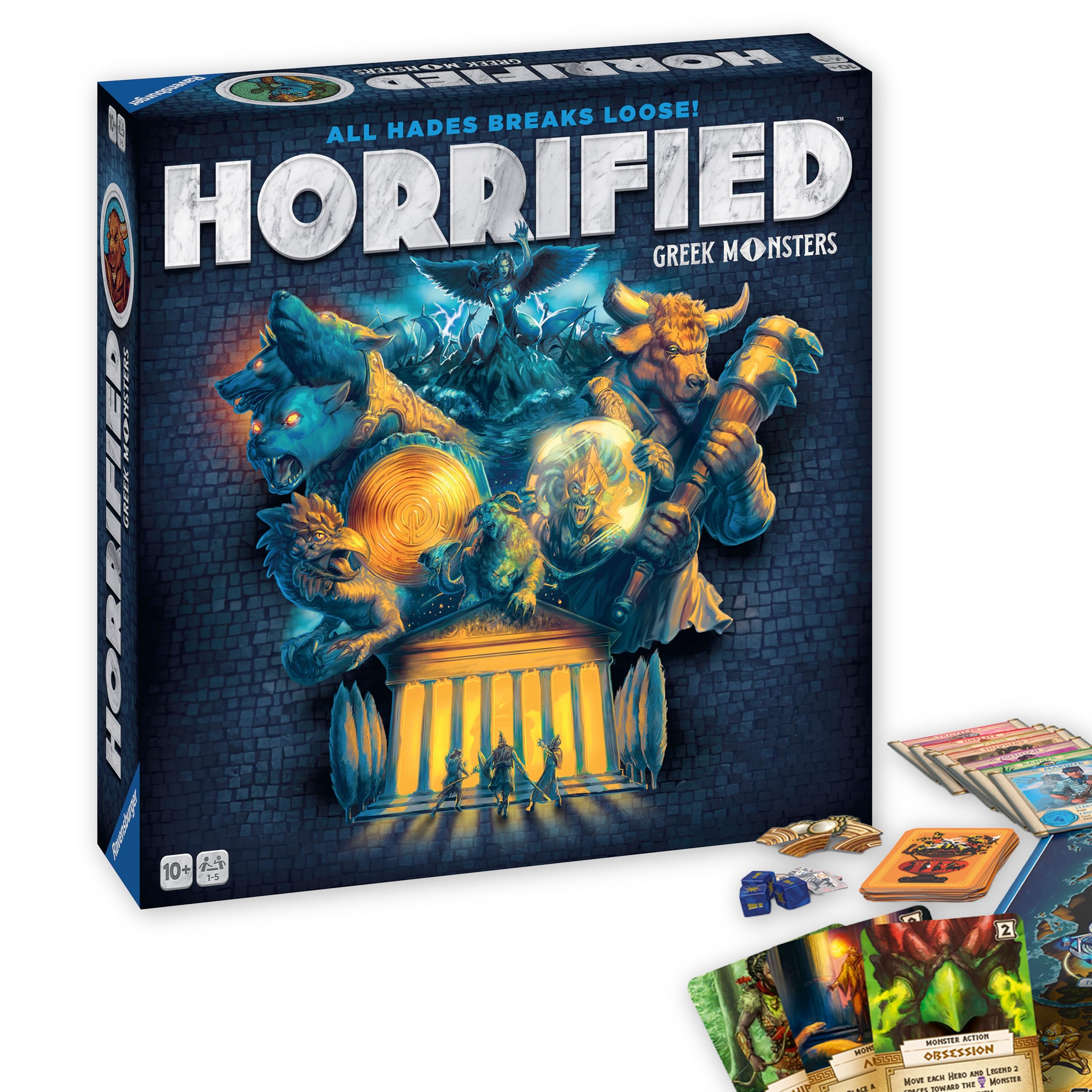
Defend Elysium against Medusa, Cerberus and four more monsters, with a style that plays beautifully as two.
This one earns its spot on the sheer strength of the monster-as-variable puzzle design. Each of the 6 monsters has a distinct defeat method and its own challenge, which means every session against a new monster is effectively a fresh game. The estimated playing time is 60 minutes, so two players can finish a monster hunt in a single evening and still have time for something else.
The scale for a duo is friendly: 1-5 survivors, and this game is genuinely fun with just two. Seven hero tiles and seven hero standees mean there are real character choices every session, and each hero has a unique ability called a Favor of the Gods. The board itself is colourful and sturdy, the six monster figures are top-notch, and the miniatures share the same craft quality you’d expect from this series.
The honest catch is that the first play takes some learning. The rulebook is streamlined, which is good for gameplay flow, but it also skips some of the lore depth that veteran players of this style tend to enjoy. The learning curve is a bit steep for younger kids — reviewers report pairing it with an adult helps. What wins the table is the moment cooperation genuinely saves the day: clearing the lairs, aligning items, and putting a monster down together.
The monster-hunter’s verdict: 6 monsters, 7 heroes, and a cooperative loop that plays beautifully with two — a really strong two-player pick for adult teams who already enjoy horror themes.
One caveat to plan for: the first game runs slow while you learn the lair mechanic, and some hero abilities feel weaker than others in a two-player run.
Reach for it if: you and a partner love monster movies and want a 60-minute co-op with real strategic bite.
Look elsewhere if: you want something lighter for kids — the steep learning curve will frustrate younger players.
5. Hasbro Gaming Dungeons & Dragons: Bedlam in Neverwinter

A three-part escape-room mystery built for two players to solve together over three separate sessions.
The structure here is the standout feature: three Acts, each with an estimated playing time of 90 minutes, so the box is really three connected game nights rather than one. For a two-player team, that pacing is the biggest gift — you do not have to cram the whole campaign into a single evening. Each Act ends with a solved mystery, letting you stop cleanly and pick up again next week.
The player count runs 2-6, and it genuinely works at the low end. Two heads tackling wordplay puzzles and multi-card visual riddles is arguably the ideal number: more people, more hands trying to flip the same card. You choose a Race, Class, and Starting Weapon to build your character, then collect loot and battle monsters on the hunt for an evil mage and his cult. The dungeon-crawl board builds and changes as you solve puzzles, open up new locations.
What buyers praise most is the accessibility. This is a great D&D introduction for players who have never rolled a die, with smooth turns, minimal downtime, and high-quality minis. The one real caveat is replayability — the puzzles are solvable, and once you have worked through the mystery, the second run loses some magic. The upside is that the game makes an excellent gift to pass along once your team has finished it.
The deep-dive write-up: 298 cards, 11 gameboards, 6 plastic figures and a d20 die make this a substantial box, and the 3-Act structure is what makes it work as a two-player adventure across multiple sessions.
The catch: the escape-room style puzzles are the real draw, and once solved, they are solved — this is a single-arc experience, not a forever game.
Made for: two players who want a shared story to work through over three evenings, D&D fans or not.
Better to pass when: you need a game that keeps giving after the mystery is solved.
6. Everdell Duo Standalone Board Game for 2 Players
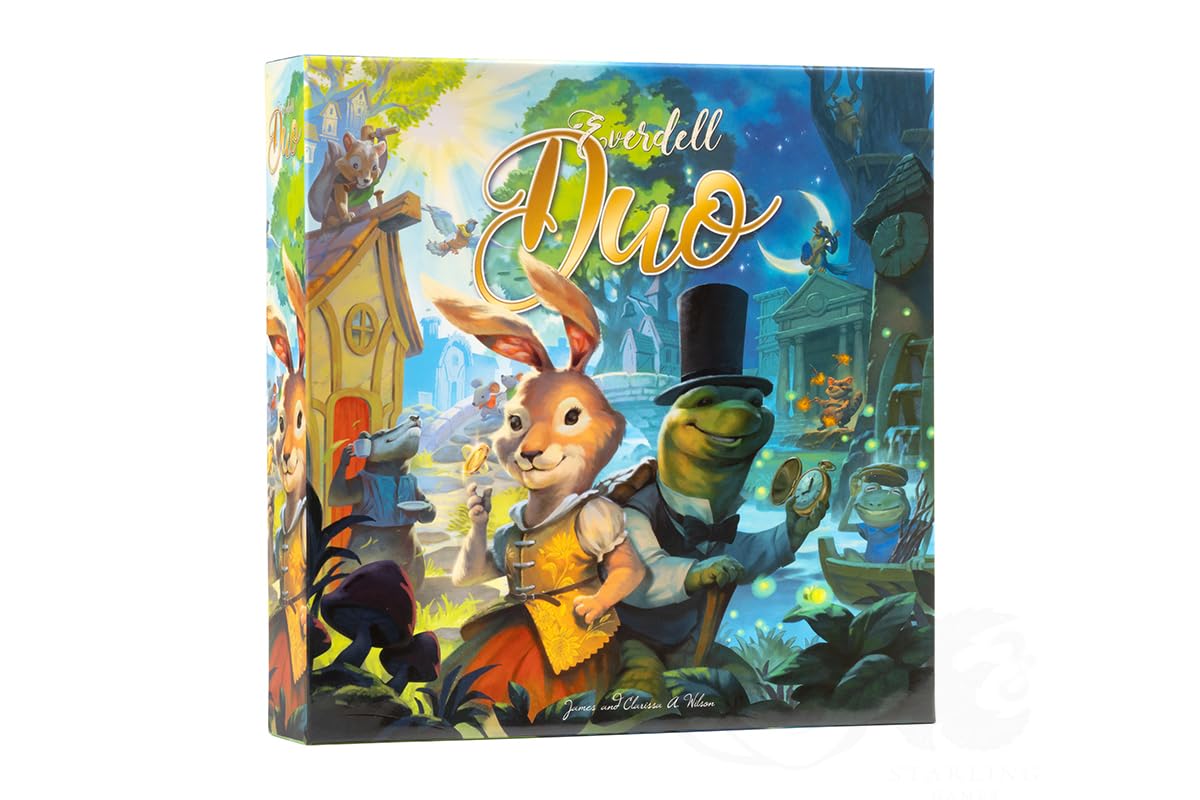
A box designed from the ground up for two players, with a 15-chapter campaign that runs as full co-op.
Most games on this list started as four-player designs and scaled down. Everdell Duo went the other way: it is a complete game built specifically for 1-2 players, with quick setup and a short footprint on the table. That design focus shows up immediately — you are not playing a diluted version of a bigger game, you are playing the game it was always meant to be.
The flexibility is the second half of the appeal. Compete head-to-head building competing critter cities, or switch into full co-op mode to build a city together and tackle the 15-chapter campaign. For a couple who cannot decide whether tonight is competitive or collaborative, that is a genuinely useful switch. The charm factor is real too — the woodland theme, cute critters, and high-quality components make it genuinely satisfying to handle, even between turns.
What wins people over is the whole package: strong co-op mode, the long campaign, strategic depth that stays approachable, and art and pieces that earn their shelf space. It plays well with a partner and works as a solo game too. A duo with an eye on aesthetics will get more out of this box than almost anything else in the lineup.
Built for two players, from the ground up
- Designed specifically for 1-2 players — quick setup and a tight table footprint
- Co-op and competitive modes in one box, plus a 15-chapter campaign
- Premium components and charming woodland art that make play feel special
- Strategic but approachable — easy to learn even for a first-time engine-builder
Small frictions worth knowing
- The rulebook needs some improvement, and occasional mid-game lookups happen
- Cards are small enough that shuffling takes practice
Line up for this if: you want a two-player game that was designed as one — no compromise in the rules or in the box.
Look past it if: your duo only ever wants to play against each other, not with each other — the co-op campaign will feel like a wasted half of the box.
7. Asmodee Paleo Board Game

A Stone Age survival puzzle where two players feel every resource decision they get wrong.
For two players who want depth rather than speed, Paleo is the one that rewards the long game. The estimated playing time is 60 minutes, the player count runs 2-4, and the strategy is genuinely cooperative — you and your partner send characters to different locations, gather food, craft items, and face unexpected dangers together. A shared mammoth cave painting is the goal, and you either finish it as a team or you do not.
The replay value is unusually strong. Multiple modules introduce new people, locations, and quests, so each adventure in 10,000 BCE brings something different. The box includes 222 cards, 40 wood tokens, 98 cardboard tokens, and 3 boards — a substantial amount of content that stays fresh over many plays. Component quality earns its shelf price, and the theme (early human survival against a hostile world) lands hard when the group is committed.
The one honest caveat is the learning curve. The rulebook is information-heavy, and some rules — the spear mechanic in particular — take a read or two to click. That learning curve is why reviewers report sticking with it: once the mechanics lock in, the game becomes deeply rewarding and stays that way. Two players willing to invest the first session will get years of sessions from the start.
The strategic case: 222 cards and multiple modules make this among the most replayable boxes here, and the co-op loop genuinely forces shared decision-making — you cannot win by playing your own hand well.
The honest trade-off here is the rulebook — information-heavy, with a few rules that need double-checking. That is detail, not a flaw: the same review pages say the reward is worth it, particularly for couples and small groups who want a deeper co-op than a 5-minute filler.
Choose it if: you and a partner want a strategic 60-minute co-op that rewards the time you invest in the rules.
Leave it if: you want something your group can teach and play in a single evening with no rulebook deep-dive.
Understanding the Specs
Estimated Playing Time — Why It Lies In Both Directions
A listed playing-time number is a round or session estimate from the publisher, not a promise. A 5-minute game means each round lasts about five minutes, so a real evening is several rounds back to back. A 60- or 90-minute estimate is much closer to a full sitting, but setup and teaching time usually sit outside that number. For two-player nights, the estimate is the single most useful filter: it tells you whether the box fits the time you actually have.
Player Count — Why “2-5” Is Not the Same as “Built for 2”
A player count of “2-5” means two players is a valid mode. It does not mean the game was designed for two. Some games scale down elegantly because they use shared resources or role-based turns — Forbidden Jungle and Horrified both play beautifully as a duo. Others feel empty at the bottom end because they rely on overlapping actions. The safest read: look for “1-2” or “2 players” if maximum fidelity matters, or check whether the mechanics rely on role abilities (which scale down well) rather than raw player count.
FAQ
Can all of these games really be played with just two players?
What does “cooperative” actually mean in a board game?
Is a 5-minute playing time a full game or a single round?
How much does rulebook quality matter for a two-player night?
Are any of these games playable solo as well as with two?
Is a faster game better for two players than a long campaign?
What is the difference between a campaign game and a replayable game?
How many cards and components does a good two-player game really need?
Do I need to know Dungeons & Dragons to play the D&D board game?
Final Thoughts: The Verdict
For most two-player tables, the 2 player co-op board games winner is the Wiggles 3D 5-Minute Dungeon, because the 5-minute rounds, 2-5 player support, and 275-card set deliver a genuinely short but intense co-op experience that works from the very first teach. If you want a proper 45-minute jungle adventure with role abilities and escalating threat, grab the Gamewright Forbidden Jungle. And for a couple who want a game built from the ground up for exactly two, the Everdell Duo is the one to reach for — the 15-chapter campaign and dual co-op/competitive modes give you the widest shelf life of any box on this list.
How We Picked
We do not accept paid placement. Every pick is matched to a real buyer and a real use-case; we do not hands-on test units.
Sources & Methodology
Specifications: manufacturer listings and product documentation. Review insights: verified customer reviews, as of September 2026. Pricing: not shown on this page (it changes often); check the current price via the retailer link.
As an Amazon Associate, KitchPrep earns from qualifying purchases. This does not affect which products we feature.
Related Guides
