
Specs are compiled from manufacturer listings and verified buyer reviews and can change over time — please confirm the key details on the product page before buying.
A true two-part epoxy primer is a coating you make by combining a resin with a separate hardener — the chemical reaction is what locks the film to steel, aluminum, or fiberglass. Skip that step and you are just painting over trouble. This guide walks through what separates a primer that holds for years from one that lifts the first time you hit it with sandpaper.
I’m Mohammad Maruf — the founder and writer behind KitchPrep. This guide is built by comparing the manufacturers’ published specifications and the patterns across verified customer reviews, so you get each pick’s real strengths and trade-offs instead of marketing spin.
Some mixes demand a full spray gun setup while others activate inside the can — knowing which one fits your garage changes everything about the job. The right 2-part epoxy primer seals bare steel, sands flat, and holds a topcoat without lifting.
Our Picks at a Glance

How To Choose The Best 2-Part Epoxy Primer
The biggest mistake first-time buyers make is grabbing a single-component “epoxy” can off the shelf. That product dries, but it does not crosslink the way a true two-part system does, so it will not grip bare metal the same way or hold up under a topcoat. Every pick below is a genuine two-part formula where a resin and a hardener come together to form the film.
Match the mix ratio to your equipment
A 1:1 or 4:1 mix ratio tells you how much hardener goes into the resin. Simple ratios like 1:1 are easier for a beginner because there is less room to misjudge the pour. If you are spraying with an HVLP gun — a spray gun that uses high volume and low pressure to lay down a smooth coat — the ratio also sets your reducer and tip size. Spray-can versions handle the mixing for you through an internal valve, so you shake and spray with no measuring cups at all.
Understand pot life and dry time
Pot life is how long the mixed primer stays usable before it starts to set in the cup. A long pot life gives you time to cover a whole panel without rushing. Dry time is separate — it is how long until the film is ready to sand or overcoat. Short dry times speed up a shop job; longer dry times are more forgiving if you are working in a humid garage.
Know your substrate and coverage
Direct-to-metal primers bond to bare steel, aluminum, fiberglass, and gelcoat, and many also grip body filler and sanded factory finishes. Coverage is the other half of the math: a quart kit goes further than a 12-ounce aerosol, and a gallon kit is built for full panels. Measure your project area before you buy, because running short mid-panel means a visible seam.
Quick Comparison
| Model | Best For | Mix Ratio | Dry Time | Form | Amazon |
|---|---|---|---|---|---|
| Sherwin-Williams Finish 1 FP410★ Best Overall | Small shops and DIY car work | Quart kit with hardener | 2 hours | Liquid | Amazon |
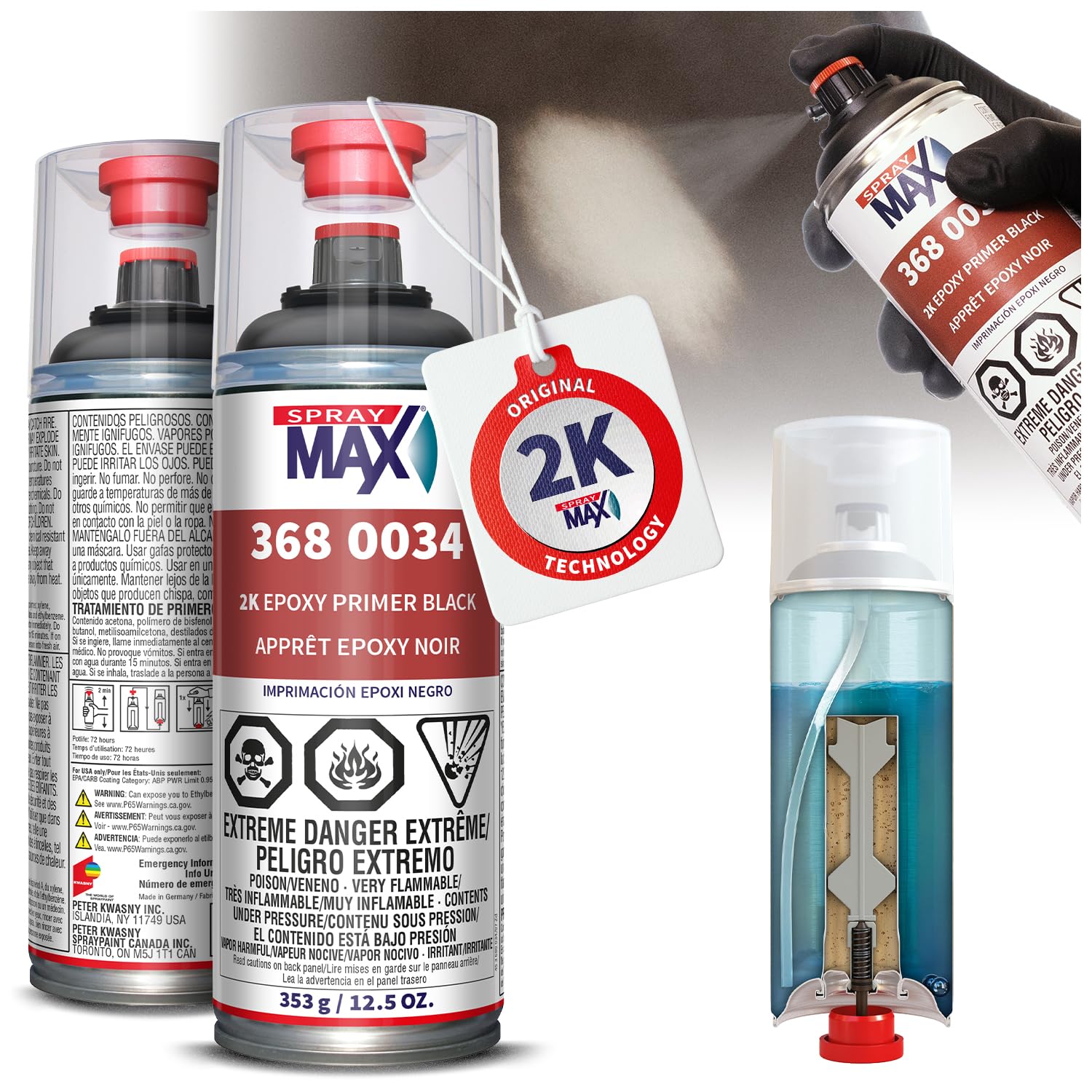
| SprayMax 2K Epoxy Primer BlackBest for Touch-Ups | Spray-can touch-ups and parts | Internal 2K valve | 12 hours | Aerosol | Amazon |
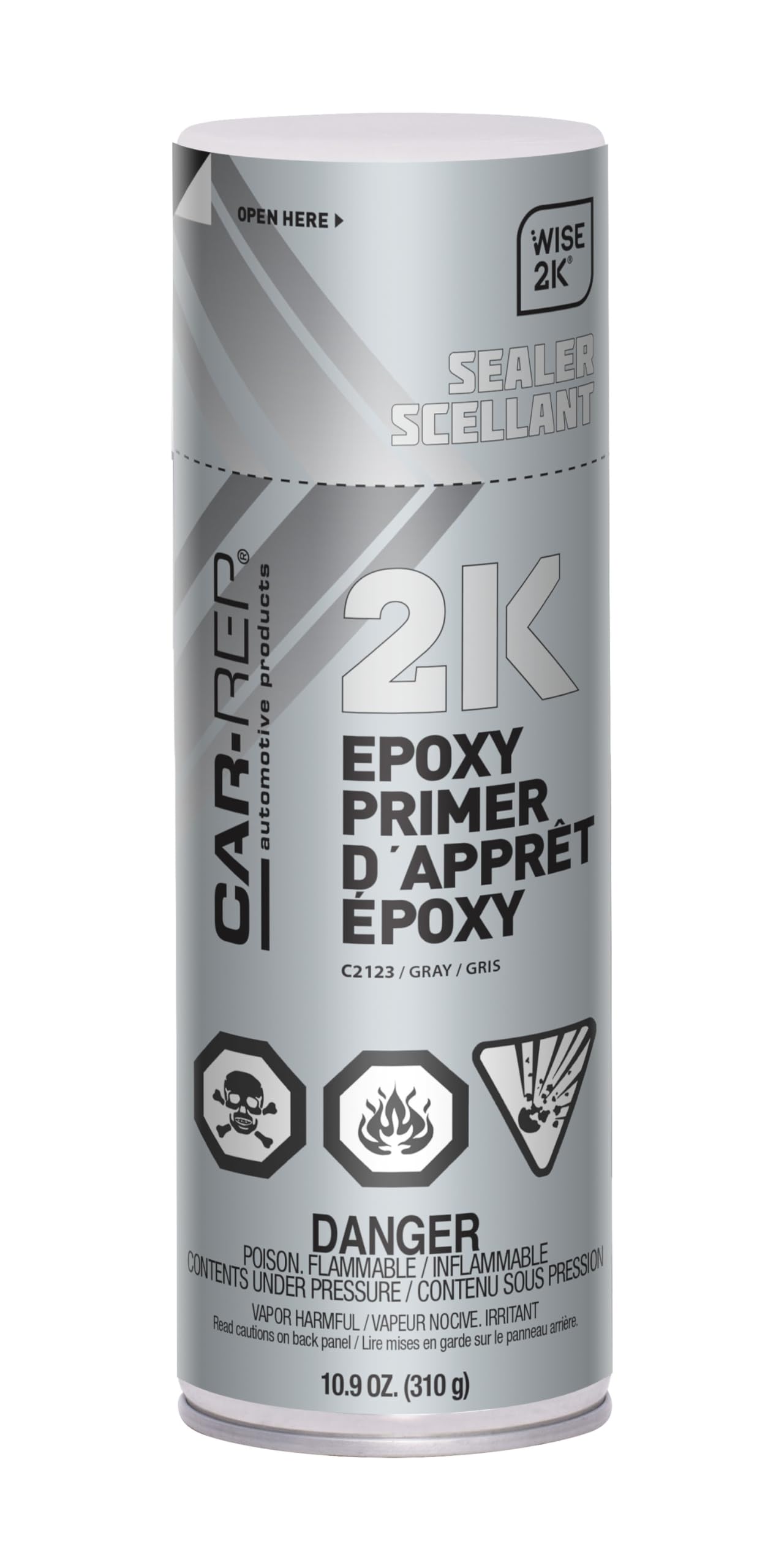
| Car-Rep 2K Epoxy PrimerNo-Mix Pick | Unlimited pot life, no mixing | Humidity-activated | 24 hours | Aerosol | Amazon |
| Eastwood 2K Epoxy Gray Primer | Direct-to-metal small jobs | 2K activator built in | 48 hours | Aerosol | Amazon |
| Raptor Anti-Corrosive Epoxy Primer 2K | Under RAPTOR bed liner | Base-valve activation | 0.5 hours | Aerosol | Amazon |
| Custom Shop Gray DTM Epoxy Primer | Beginner-friendly spraying | 1:1 mix | 0.5 hours | Liquid | Amazon |
| Speedokote Epoxy Fast Dry Quart Kit | Fast-dry sealing jobs | 4:1 mix | 3 days full cure | Liquid | Amazon |
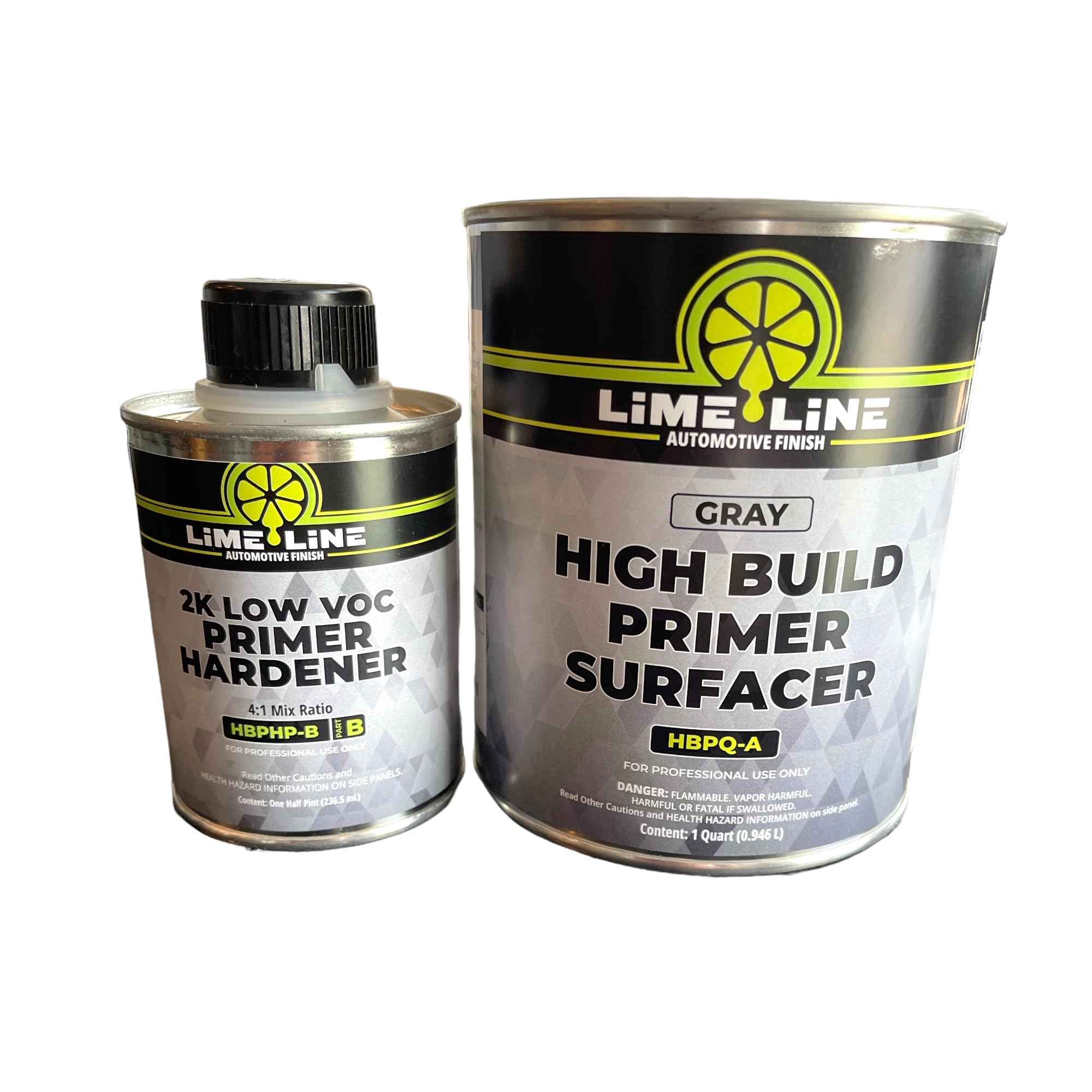
| LiME LiNE High Build Primer | Filling imperfections | 4:1 mix | — | Liquid | Amazon |
| Speedokote Epoxy Fast Dry Gallon Kit | Large panel coverage | 4:1 mix | 3 days full cure | Aerosol | Amazon |
In‑Depth Reviews
1. acme Sherwin-Williams Finish 1 FP410 High Build 2K HS Gray Urethane Primer Quart Kit
Our pick — over 4.5★ from 200+ verified ratings; the strongest balance of quality and price.
The shop-grade quart kit that sands clean and lays flat without a fuss
You get a quart of grey primer plus a half-pint of hardener in one can, and that is the whole kit. Mix it, spray it, and the film is dry and ready to sand in 2 hours. Put that next to the Car-Rep aerosol in this list and the difference is stark — 24 hours versus 2 hours, a 12x gap in how long you wait before touching the panel. For anyone running through panels in a weekend, that speed is the entire point.
The formula is built to resist sand-scratch swelling, which is the annoying habit some primers have of puffing back up when you wet-sand them. Mix ratios are simplified, so there is less chance of getting the hardener proportion wrong. Buyers report it “works well and shoots well” through an LVLP gun with a 10% medium urethane reducer cut, which matches how a small shop would actually run it.
What wins people over is the quality of the finish — it self-levels and sprays evenly enough for show-car work, and the value holds up against primers that cost meaningfully more. The honest trade-off is build thickness. Some buyers find it sprays flatter than they expected and not quite as thick as a “high build” label implies, so if you are trying to bury deep scratches in one pass, plan on more coats. It carries a 4.7-star rating across verified buyer reviews.
Where it earns its place
- Dries in 2 hours, so you are sanding the same day you spray
- Resists sand-scratch swelling that ruins a wet-sanded panel
- Simplified mix ratio cuts the odds of a botched batch
- Self-leveling enough for a show-quality finish
What to weigh first
- Thinner film than the “high build” name suggests
- Quart volume limits you to small panels and parts
- Not waterproof on its own, so it needs a topcoat
Reach for this if: you are priming doors, fenders, or small parts and want to sand the same afternoon.
Look elsewhere if: you need to bury deep bodywork in a single heavy coat on a large panel.
2. SprayMax 2K Epoxy Primer Black
A two-part epoxy inside a can, with no compressor crowding your garage
This is the primer for the guy who wants real 2K chemistry without owning a spray gun. You activate the can, shake it, and spray — the resin and hardener combine internally. The 12-hour dry time is slow compared with the Speedokote quart at a 3-day cure, but it is a rattle can, and the convenience buys you that trade. At 341 ml per can it is aimed at parts, not whole cars.
Build quality of the finish is where the mixed feedback lives. When the can behaves, the black lays down evenly, hides well, and shrugs off corrosion. But the loose spray head and orange cap show up as a recurring frustration — some cans sputter or push a three-direction stream instead of a clean fan, which leaves patchy, thin coverage that is hard to rescue. If your can sprays right, it works; if it does not, you find out fast.
The way most people run it is smart: three cans for two coats on motorcycle parts, plastics, and fenders, over a Rust-Oleum adhesion promoter, with the adjustable tip dialed in. It grips bare and cleaned metal and body filler without complaint, and a two-pack covers a Jeep hood and two fenders. Just pick up an extra can — running dry halfway through a panel is the one outcome nobody recovers from gracefully.
Straight read: the convenience is genuine and the adhesion is solid when the nozzle cooperates, but coverage per can is thin enough that you need to buy more than you think.
Best for: motorcycle tanks, brackets, and small panels where a compressor setup is overkill.
Think twice if: you are priming a full car body, since the can volume and inconsistent spray head will fight you.
3. Car-Rep 2K Epoxy Primer with Wise 2K Technology
No measuring, no activation — the hardener waits for the air to wake it up
Wise 2K Technology flips the usual 2K routine on its head. There is no mixing and no activation step, and the pot life is unlimited because the de-activated hardener only starts to react when it meets humidity in the air. That means you can reach for the same can weeks apart and it is still ready to use — a real advantage over the Sherwin-Williams quart, where a mixed batch has to be sprayed before it sets.
The 24-hour dry time is the slowest in this group, and the matte grey finish is designed as a foundation layer rather than a final look. It is built for steel, aluminum, carbon fiber, and most automotive plastics, and the anti-corrosion pigments are meant to hold up indoors and out. Once it is touch-dry you can overcoat it wet-on-wet with solvent or waterborne base coats, which keeps a paint job moving without a full sand between layers.
Here is the catch a buyer needs to know up front: the spray can function is the weak point. Some cans spray fine from the first press, while others arrive with a clogged nozzle stem that will not dispense even with full propellant and a clear tip. The reliability of the aerosol valve is the thing to weigh, because a can that will not spray wastes your whole prep afternoon. It is a clever product let down by the delivery method.
Why it stands out
- No mixing and no activation — shake and spray
- Unlimited pot life means the can keeps for future projects
- Wet-on-wet overcoatable once touch-dry
- Bonds to steel, aluminum, carbon fiber, and most plastics
Where it falls short
- Nozzle clogging shows up often enough to plan around
- 24-hour dry time is the slowest here
- Matte finish is a base layer, not a topcoat
Pick it for: projects that stretch across weeks, where a can that stays usable matters more than speed.
Leave it for: anyone who needs a reliable spray valve on the first try without a backup can on hand.
4. Eastwood 2K Epoxy Gray Primer AeroSpray

A German-made fan-pattern can that sprays like a gun, not a rattle can
The nozzle is the story here. Instead of the usual round spray, Eastwood engineered a wide fan pattern, so the primer goes on the way an HVLP gun would lay it. That single design choice separates it from every other aerosol on this page, and it is the reason the coverage reads even and controlled. The 2-component formula pairs Eastwood’s gray epoxy with a 2K activator, and the can carries a 3-year shelf life plus a 48-hour pot life once activated.
This one is genuinely direct-to-metal. Apply it to steel, aluminum, or fiberglass car body panels and it creates a durable, waterproof film that holds back rust and sets a foundation for paint. It is rated at 10 square feet of coverage in a 12-ounce can, which tells you the honest scope: it is a small-project format. One can went about 1.5 coats on a full truck roof, so a large panel realistically wants two.
Where it shines is on a tight repair. It covers a 2-foot-square patch cleanly, sprays smooth, and saves the cleanup that a full gun setup leaves behind. Owners mention that a second can is the safe move for anything larger than a fender.
The smart ordering tip: if the panel is bigger than a fender, order two cans up front — one can only stretches to about 1.5 coats on something as large as a truck roof.
Suits: the DIYer priming a small panel or two, who wants fan-pattern control without buying a spray gun.
Not for: full-body jobs, where the coverage per can will leave you under-supplied.
5. Raptor Anti-Corrosive Epoxy Primer 2K

Built as the bonding layer that makes a bed liner actually stick
The team behind RAPTOR makes truck-bed liners, and this primer exists for one job: to sit underneath that coating and give it something to bite into. The base-valve activation means you press the valve to trigger the 2K reaction, so there is no spray equipment, no mixing cup, and no measuring. Its half-hour dry time and 2-hour full cure make it one of the fastest-setting cans here, and the anti-corrosive additives are formulated to fight rust in harsh environments.
Adhesion is the headline. The resin technology is built to grip bare metal and most prepared surfaces, giving the protective coating a solid base to bond to. Spray it inside a tub, over roof rails, or across a hood before a roll-on liner goes down, and it does the job — one buyer sprayed most of a Jeep’s interior tub ahead of a roll-on liner and never looked back.
Two things to know going in. First, the nozzle is genuinely fragile, and the can can stop flowing well before it should, so treat the valve like glass and do not force it. Second, buy from the manufacturer directly rather than a third-party seller — a can that sat in a warehouse for years sprays badly, and old stock is behind a lot of the application complaints. Read the full directions and wear a respirator; this one is serious about ventilation.
What it does well
- Activates with a base valve — no gun, no mixing
- Half-hour dry time gets you to the liner fast
- Formulated specifically to bond under RAPTOR coating
- Self-levels somewhat for an even base
Watch-outs
- Nozzle is weak and prone to stopping mid-job
- Old stock from resellers sprays poorly
- Requires a respirator and good airflow
Choose it when: a RAPTOR bed liner is the finish you are laying down and you want the proper base coat underneath.
Skip it when: you are priming for a glossy topcoat, since this is engineered as a foundation, not a finish.
6. Custom Shop Gray DTM Epoxy Primer/Sealer 2.1 VOC

A one-to-one pour that takes the guesswork out of mixing for a beginner
The mix ratio is what makes this one approachable. Pour one part resin, one part hardener, and stir — that is it. Because it is a precise 1:1, there is less chance of a lopsided batch than with a lopsided 4:1 pour. There is no induction time to wait through before spraying, and the pot life gives you 4 hours of working room once the two parts are combined.
The formula is direct-to-metal, with anti-corrosive additives that are lead- and chromate-free, and the film is waterproof. It bonds to bare steel, aluminum, fiberglass, gelcoat, body filler, and sanded factory finishes, so it doubles as a sealer for single-stage urethane and basecoat-clearcoat jobs. As a sealer, you add a half-part reducer and the topcoat can go on 30 minutes later, with good gloss holdout underneath.
The honest snag is consistency across batches. The current formulation can spray glossier than older versions, and that glossier film has a habit of clogging sandpaper and refusing to flow out unless you lay it on thick — which then drags the dry time out. The cause is well known to regular users: the can holds a hard pigment ball that a paint shaker cannot break up, so you have to manually stir and poke it until the pigment fully dissolves before you spray. Do that and it performs; skip it and you are fighting the finish.
Mixing note: stir thoroughly by hand until the hard ball of pigment dissolves — a mechanical shaker alone will not do it, and un-stirred pigment is behind the uneven spray reports.
Go with this: if you are new to spraying 2K and want a forgiving 1:1 mix that works as both primer and sealer.
Pass on it: if you want a matte, sand-friendly film straight out of the can without watching for gloss and clogs.
7. Speedokote Epoxy Fast Dry 2.1 Low VOC DTM Primer & Sealer Gray Quart Kit

Sprays hard and seals rust fast once bare steel meets epoxy chemistry
This is a 4:1 epoxy that lets you tack on a 5-10% cut of a 0-VOC reducer for smoother flow, so you can tune the spray to your gun and conditions. What people rave about is how it dries — it flashes into a hard, scratch-resistant coat that seals rust out rather than letting it creep back through. Owners describe it hardening overnight on a clean steel motorcycle bracket that an enamel primer had failed to even stick to.
Adhesion is the quiet strength. It clings to bare steel, aluminum, and fiberglass, and lays down smooth when you dial in the mix and the tip. One long-term user ran it through a 1.3 tip with a 20% reducer against a BASF base for a tintcoat match, and reports show-quality results — though note the medium-light grey out of the can is not the final shade, so you may want to adjust it toward your target color.
One practical note: the finish cures hard and glossy, so if you are chasing a softer, more sand-friendly film you may want to plan your topcoat timeline around the full 3-day cure. A quart kit covers roughly a few panels, so measure your project and buy a second kit for anything larger. Reach for it when a fast, hard, rust-blocking sealer is exactly what the panel needs.
Reach for this if: you want a hard, quick-setting epoxy sealer that locks bare metal down before a topcoat.
Look past it if: your job calls for a light, easy-sanding film and a color that is ready to spray as-is.
8. LiME LiNE Sand-able High Build 2K Urethane Primer Surfacer
The high-build surfacer that fills imperfections and sands like a dream
When the goal is a glass-smooth panel rather than a rust-blocking base, this is the one. It is a high-build 2K urethane surfacer at a 4:1 mix, coming in a 1.25-quart kit with the hardener included, and it is built to level out the small dips and sanding scratches before color goes on. What owners praise most is the quality and how it sands — it lays down smoothly and cuts quickly under paper, so you spend less time chasing the surface flat.
It is not forgiving at the nozzle, though. This primer wants a bigger tip than a 2.0, and even then it sprays thick enough that you may need to reduce it, skip the filter, and raise your air pressure to get a clean fan. Set up properly, the payoff is a beautiful finish and a durable, waterproof film with strong weather and corrosion resistance.
The one real grumble is cost relative to volume — customers note it is a high-build product but not a budget one, and delivery can be slow enough that it is worth ordering ahead. The upside is a professional-grade surfacer that a working painter rates as outstanding and dependable to spray over. Plan your tip and air pressure before you start and it delivers.
The case for it
- High build fills small imperfections before color
- Sands quickly and lays down smooth
- 4:1 mix in a 1.25-quart kit with hardener
- Durable, waterproof, weather and corrosion resistant
What to plan for
- Needs a tip bigger than 2.0 and may need reducing
- Pricier per quart than the aerosol options
- Shipping can run slow
Ideal for: bodywork where you are blocking out filler and sanding scratches into a flat, paintable surface.
Not the pick for: a quick rust-sealing job where a thin, fast-dry epoxy makes more sense.
9. Speedokote Epoxy Fast Dry 2.1 Low VOC DTM Primer & Sealer Gray Gallon Kit

The big-volume version of a rust-sealing epoxy, cut for whole vehicles
This is the same Speedokote fast-dry formula as the quart kit, sized up into a 1.25-gallon kit with the catalyst included. Same 4:1 mix, same optional 5-10% cut with a 0-VOC reducer, same grip on steel, aluminum, and fiberglass — but now with enough volume to prime a full truck or several panels without stopping to reorder. It is the pick for a serious restoration where coverage stops being a worry.
Owners run it through an HVLP gun and the performance shows. It goes on flat with no orange peel, dries quickly, and covers well enough to seal the front half of a truck in short order. Sprayed at a reduced mix and moderate pressure, it lays out an even coat. Large jobs can also be rolled on and brushed out in one direction to save time, though the finish comes out rougher than a sprayed coat.
Two honest cautions. This formula has little to no shelf life once opened, so buy only what you will actually spray — a half-used kit may not be good by the time the next project comes around. And it demands clean prep: skipped degreasing is behind the rare reports of a coat lifting off bare metal later. Prep properly and it holds. It carries a 4.6-star rating, matching the quart kit, so the larger volume does not drop the quality.
Why builders grab it
- 1.25-gallon kit covers large panels and full vehicles
- Sprays flat with no orange peel through an HVLP gun
- Works as both primer and sealer
- Same fast-dry 4:1 formula as the quart kit
Keep in mind
- Little to no shelf life once the kit is opened
- Poor degreasing prep can cause lifting later
- Too much volume for a small touch-up job
Buy this when: you are priming a whole vehicle or a stack of panels and want one kit to cover the job.
Buy the quart instead if: your projects are small and spread out, since this kit does not keep well once opened.
Understanding the Specs
Mix Ratio
The mix ratio tells you how much hardener goes into the resin — a 1:1 pour is one part of each, while a 4:1 pour needs four parts resin to one part hardener. A simple ratio is easier for a beginner because there is less room to misjudge the pour. Get it wrong and the film may stay soft, refuse to cure, or fail to bond. Spray-can primers like the Car-Rep and Eastwood versions handle the two-part reaction internally, so you never measure anything.
Pot Life and Dry Time
Pot life is the working window after the two parts are combined — the Custom Shop kit gives you 4 hours before the mix starts to set. Dry time is how long until the film is ready to sand or overcoat, and it varies widely: the Custom Shop and Raptor cans turn dry in about half an hour, the Sherwin-Williams quart in 2 hours, and the Car-Rep at 24 hours. Match these to how fast you work — a short window suits a shop, a long one suits a weekend DIYer.
Direct-to-Metal (DTM) Adhesion
Direct-to-metal describes a primer that bonds straight to bare steel, aluminum, or fiberglass without a separate etch step. It saves a whole stage of prep. The Custom Shop and LiME LiNE kits both name DTM adhesion, and the Sherwin-Williams and Speedokote formulas are built to grip bare and properly prepared metal. The key is surface prep — clean, degreased metal is what the resin actually locks onto.
Form and Volume
Epoxy primer comes two ways. Aerosol cans are ready to spray with no equipment, and their internal volumes run from 341 ml up to 14.1 ounces. Quart, 1.25-quart, and gallon kits are liquids you mix and spray with a gun, and they cover far more area per kit. Aerosols suit parts and touch-ups; the larger kits suit whole panels, full vehicles, and shop work where you need volume on hand.
FAQ
Do I have to mix a 2-part epoxy primer or can I just spray it from a can?
What is the difference between a 2-part epoxy primer and a regular primer?
How long does a 2-part epoxy primer take to dry before I can sand it?
Can I spray epoxy primer without a compressor or spray gun?
Does 2K epoxy primer work on plastic or only metal?
Why did my epoxy primer not stick to the bare metal?
How much area does a quart of epoxy primer cover?
How long does mixed 2-part epoxy primer stay usable?
Can I topcoat epoxy primer wet on wet without sanding?
Is a 4:1 epoxy primer harder to use than a 1:1 mix?
Final Thoughts: The Verdict
For most people priming bare metal, the 2-part epoxy primer that earns its keep first is the Sherwin-Williams Finish 1 FP410. It dries in 2 hours so you can sand the same day, resists sand-scratch swelling, and its mix ratio is simple enough to get right the first time. If you want to skip mixing and spraying entirely, grab the Eastwood 2K Epoxy Gray Primer with its fan-pattern nozzle. And for a whole vehicle or a stack of panels, the Speedokote gallon kit is the one to reach for. Whichever way you go, degrease the metal and measure your mix ratio exactly — that is what separates a coating that lasts from one that lifts.
How We Picked
We do not accept paid placement. Every pick is matched to a real buyer and a real use-case; we do not hands-on test units.
Sources & Methodology
Specifications: manufacturer listings and product documentation. Review insights: verified customer reviews, as of September 2026. Pricing: not shown on this page (it changes often); check the current price via the retailer link.
As an Amazon Associate, KitchPrep earns from qualifying purchases. This does not affect which products we feature.
Related Guides
