
Specs are compiled from manufacturer listings and verified buyer reviews and can change over time — please confirm the key details on the product page before buying.
A great 2-inch water pump starts on the first pull, handles grit without clogging, and survives a season of hard use. This guide ranks 2-inch pumps by flow rate, lift height, and verified owner feedback for pond, pool, and job-site use.
I’m Mohammad Maruf — the founder and writer behind KitchPrep. This guide is built by comparing the manufacturers’ published specifications and the patterns across verified customer reviews, so you get each pick’s real strengths and trade-offs instead of marketing spin.
If you’re comparing models to move serious water fast, this breakdown of the 2-inch water pump market highlights the top performers for draining, irrigating, and dewatering.
Our Picks at a Glance


How To Choose The Best 2-Inch Water Pump
Before you pick, you need to know what kind of water you’re moving. A clean-water transfer pump is great for draining a pool, but it will choke on leaves and mud. That’s where a “trash pump” comes in—it’s designed to chew up small solids.
Match the Pump Type to the Job
A submersible pump sits in the water and pushes it up and out—perfect for flooded basements. A self-priming gas pump sits on dry land and pulls water up through a suction hose, ideal for ponds and irrigation far from power outlets.
Look at Flow Rate and Lift, Not Just Horsepower
The two specs that matter most are gallons per minute (GPM) and maximum lift height. GPM tells you how fast it moves water; lift height tells you how high it can push it. Match GPM and lift to your job—a big engine on a small impeller won’t compensate for mismatched specs.
Quick Comparison
| Model | Best For | Flow Rate | Max Lift | Power Source | Amazon |
|---|---|---|---|---|---|
| Tsurumi HS2.4S★ Best Overall | Reliable submersible trash | 53 GPM | 39 ft | 0.5 HP Electric | Amazon |
| VEVOR Gas PumpAlso Great | Portable heavy lifting | 142 GPM | 98 ft | 7 HP Gas | Amazon |
| DuroMax XP652WPBest Value | First-pull start irrigation | 158 GPM | 92 ft | 7 HP Gas | Amazon |
| BILT HARD Semi Trash | Complete kit value | 158 GPM | 91 ft | 7 HP Gas | Amazon |
| Honda WB20 | Commercial-grade trust | 164 GPM | 105 ft | GX160 Gas | Amazon |
| Multiquip Bon | Plug-and-play flooding | 73 GPM | 37 ft | Electric | Amazon |
| Liberty LE51A | Automatic sewage handling | 160 GPM | 25 ft | 0.5 HP Electric | Amazon |
| NorthStar High Pressure | Long-distance pressure | 135.4 GPM | — | Honda GX160 Gas | Amazon |
| Pacer SE2PL | Agricultural chemicals | 150 GPM | 100 ft | 127cc Gas | Amazon |
| Aceup Energy | Garden & farm irrigation | 158 GPM | 95 ft | 7 HP Gas | Amazon |
| YOUZAQUA Pool Pump | Quiet pool circulation | 8100 GPH | 72 ft | 2.5 HP Electric | Amazon |
In‑Depth Reviews
1. Tsurumi Pump HS2.4S Submersible Trash Pump
Our pick — over 4.5★ from 600+ verified ratings; the strongest balance of quality and price.
The quiet, tank-like submersible that eats sand and solids for breakfast.
For dewatering jobs where debris is a given, this Tsurumi is a legend. Its semi-vortex impeller and integrated agitator handle solids up to 0.3 inch, so sand, silt, and small debris won’t clog it. A 1/2 HP motor delivers 53 GPM and a 39-foot max lift, powered by a standard 115V outlet.
What wins people over is the build quality—the #1 aspect owners praise, with 90 mentions in the review data. The pump runs 24/7 for years, with one pool pro noting it drained pools for new liners over 5 years of hard use. It’s also remarkably quiet, an aspect owners highlight, and it includes a 20ft cord for setup flexibility.
The angled 2-inch discharge port lets you run hoses in tight spaces. It’s UL & CSA certified and backed by a 2-year warranty. Just know it’s a heavier unit at 29.1 pounds, though far lighter than the gas-powered VEVOR above.
Durability first: this is a buy-it-once tool that pros rely on, not a budget gamble.
Keep in mind: at 53 GPM it’s not the fastest, but it’s among the most dependable.
2. VEVOR Gas Powered Water Pump 2 Inch
The off-grid workhorse that lifts water nearly a hundred feet without needing an outlet.
If your water source is far from power, this gas-powered pump is your answer. Its 7 HP engine moves 142 gallons per minute and pushes water up to 98 feet of head lift, making it ideal for hillside irrigation or draining a large pond. You don’t need an electrical outlet, so it shines on farms and in remote locations.
The build matches the ambition: an aluminum alloy body paired with a cast iron impeller for wear resistance. Owners rave that it starts easy—the review pages note it often fires on the first pull—and runs great for draining large ponds. It comes with a 25 ft discharge hose, but the suction hose is not included, so plan to grab that.
In the head-to-head, this VEVOR crushes the Tsurumi on raw power—142 GPM versus 53 GPM, 98 feet of lift versus 39 feet—but it’s also a bulkier beast at 50.2 pounds versus 29.1 pounds. That’s the trade-off: massive capability for a heavier frame.
Why It Wins
- No electricity needed, perfect for outages
- 142 GPM flow clears big jobs fast
- Cast iron impeller handles debris
- 25 ft discharge hose included
The Trade-Offs
- Suction hose not included
- 50.2 lb weight makes it a two-person lift
- Occasional pump failures reported after months
Reach for this if: you need portable, powerful water movement on a farm or remote site without power.
Plan for: buying a suction hose and a longer discharge line if 25 ft isn’t enough.
3. DuroMax XP652WP 2-Inch Gasoline Water Pump
The reliable first-pull starter that’s become a California favorite for daily irrigation.
The thing everyone raves about is the starting time—30 owners in the data single it out. The EZ-Pull Recoil Start System means you’re not fighting a rope when you need water moving now. It pushes 158 GPM with a 92-foot max overhead lift, powered by a 7 HP engine.
A 1-gallon gas tank gives you a 2.4-hour run time. The included kit has intake hose strainer, threaded connectors, hose clamps, and a tool kit with plug wrench, so setup is straightforward. An automatic low-oil shutoff protects the engine, and the back flow check valve prevents water from siphoning back.
Owners confirm it fills 1100-gallon tanks in under 20 minutes and runs quietly. The durability is the honest caveat—it’s mixed in the data, with one report of a unit lasting less than 4 hours. It’s not self-priming, so you’ll need to fill the pump with water first.
What Shines
- First-pull starts, verified by many owners
- 158 GPM fills tanks fast
- Low-oil shutoff protects the engine
- 50-state EPA approved
Know Before You Buy
- Durability is a mixed bag in owner reports
- Not self-priming; needs a water fill
- Hoses can kink easily
The value play: you get premium flow and easy starts without paying a premium price.
Look elsewhere if: you demand a proven multi-year lifespan over the budget savings.
4. BILT HARD Semi Trash Pump 2 Inch
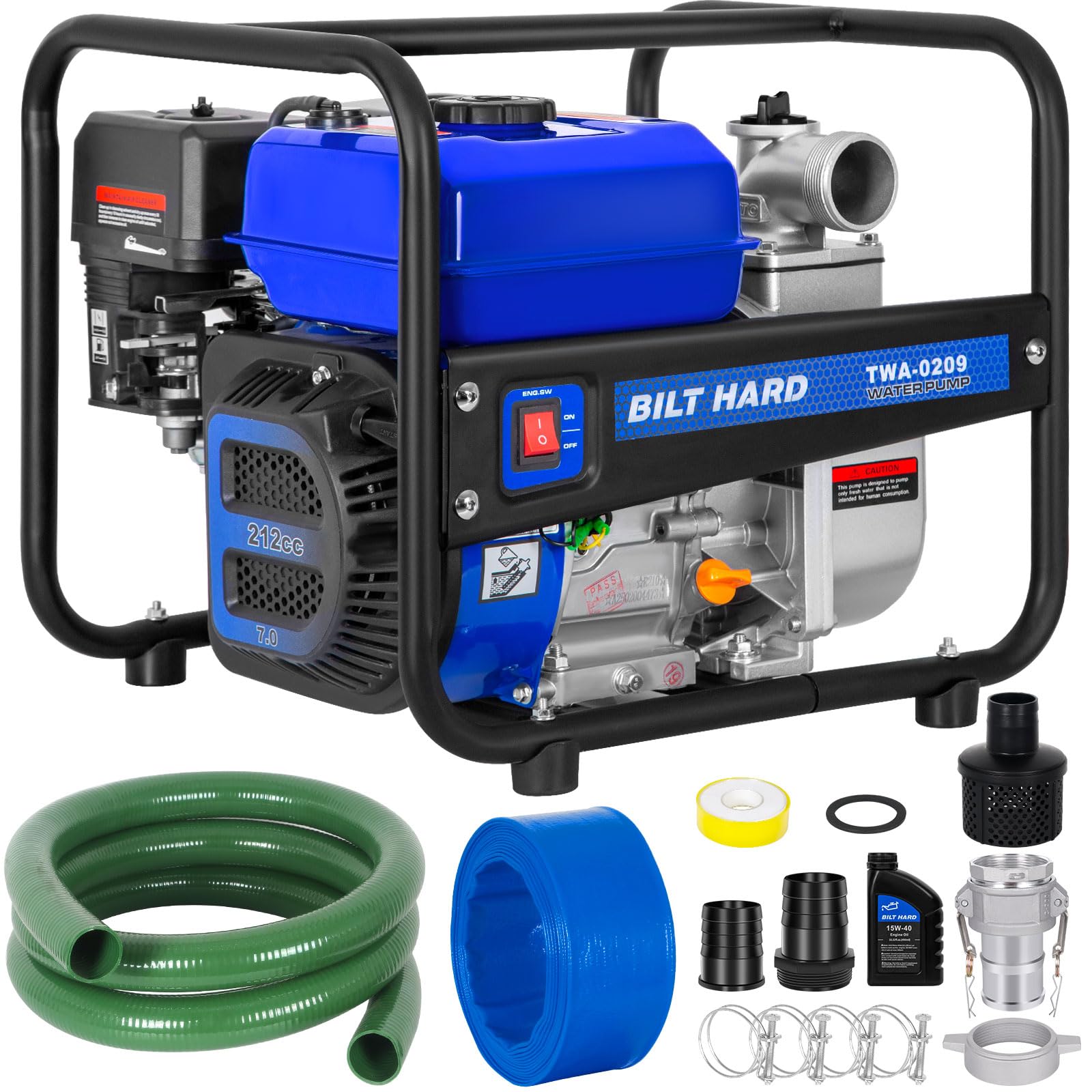
A ready-to-run kit that empties a 1,000-gallon tank in about seven minutes.
This one wins on completeness. You get a 50 ft discharge hose, a 12 ft suction hose, cam lock coupler, filter, oil funnel, spark plug socket, clamps, fittings, and adapters—everything to start working the day it arrives. The 7 HP, 212cc, 4-stroke OHV engine delivers 158 GPM with a 91-foot total head lift.
The engine is EPA Phase III compliant and includes low oil shutoff and idle control. Owners praise its functionality—59 mentions, the top aspect—with performance close behind at 37. It fires right up and one owner runs a hydroseeder off it, going through a 275-gallon tank in a minute at wide open.
The durability is the honest split: some buyers report the pump would start then quit. The manufacturer notes the pump may arrive with oil stains from factory testing, which doesn’t affect use. There’s a 90-day warranty, and you’ll want to drain it regularly to prevent freeze cracks.
The all-in-one: if you want a single box with everything inside, this is the easiest path.
The catch: durability reports are mixed, so treat the 90-day warranty as your safety net.
5. Honda WB20 2-Inch Gas Water Pump
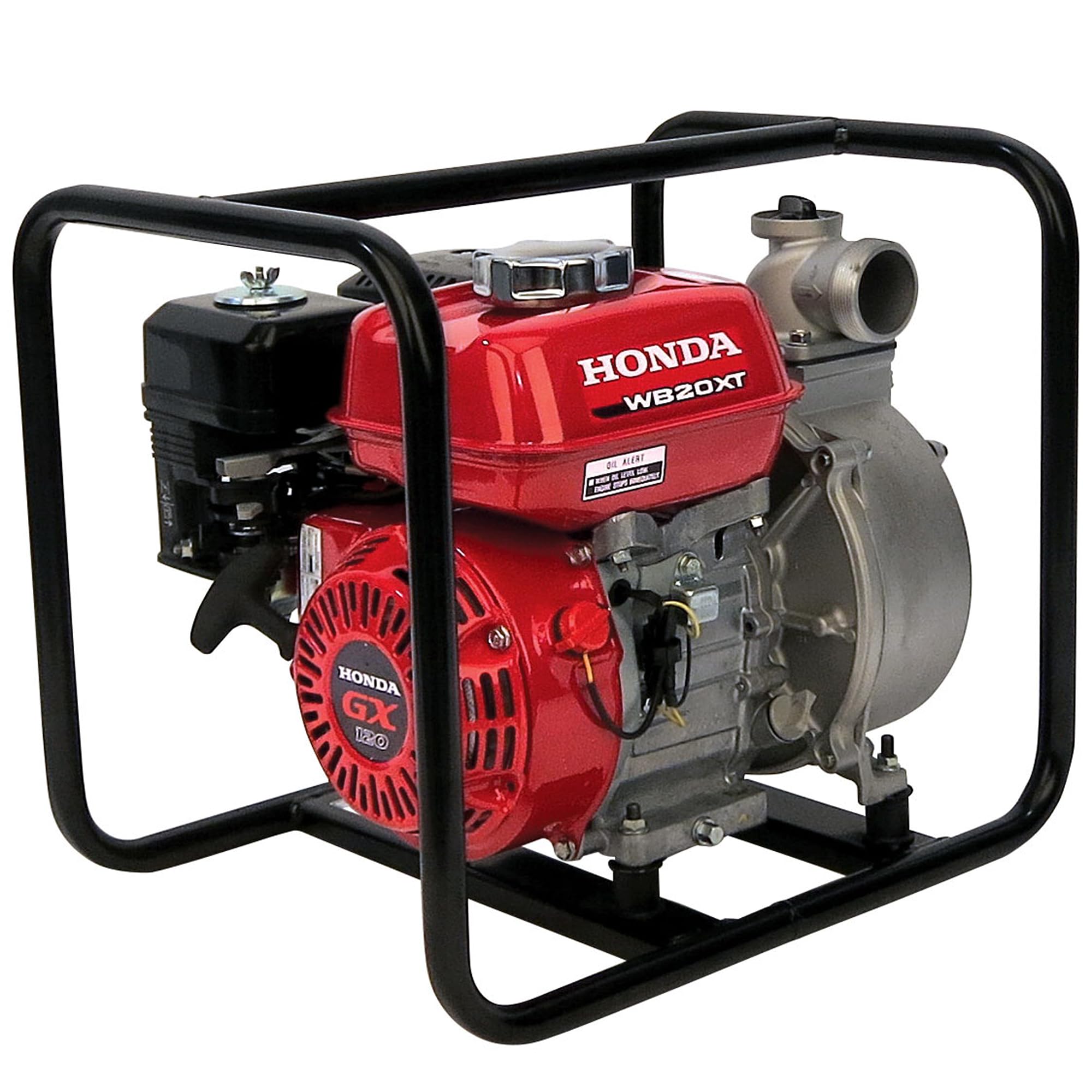
The premium pick that owners call a workhorse, moving 164 gallons per minute.
When reliability is non-negotiable, the Honda name carries weight. This pump moves 164 GPM—the most on this list—with a 105-foot total head lift, powered by the legendary GX series commercial-grade engine. It’s built for agriculture, construction, and landscaping demands.
The durability-focused design includes a large strainer allowing solids up to 5/16 inch through, a cast iron volute, and a 4-vane high-efficiency impeller. Abrasion-resistant silicone-carbide mechanical seals extend wear life. Isolation mounts reduce vibration, so the pump doesn’t “walk” away or bury itself in soft soil.
Owner feedback is glowing—owners mention great pressure and quick pumping speed, with 35 owners praising functionality. The premium cost is the main hurdle, but many see it as worth it for the Honda engine’s lifespan. There’s a 2-year residential warranty and a 1-year commercial warranty.
Why It’s Worth It
- 164 GPM, the highest flow here
- Reliable GX engine starts easily
- Handles solids up to 5/16 inch
- 2-year residential warranty
What Gives You Pause
- Premium price tag
- Hoses not included
- One report of a bracket breaking
Choose this for: years of dependable service where downtime isn’t an option.
Budget reality: you pay more upfront, but owners largely find the reliability worth the premium.
6. Multiquip Bon Submersible Electric Pump

The plug-in-and-toss-it-in-the-water pump that turns flooding into a non-event.
For emergency flooding, this is the definition of simple. Just plug it in, throw it down in the water, and step back—it pumps like crazy, as one owner put it. The compact, streamlined design hides serious power: 73 GPM with a 37-foot max lift, driven by an electric motor on a standard circuit.
Performance is the top praise at 24 mentions in the data, with pumping power close behind. The cast aluminum housing keeps it lighter than steel at 32.7 pounds, while the stainless steel strainer and hardware resist corrosion. Customers note it outlasts other models, with one noting their last one from the manufacturer lasted 20+ years.
It’s proven in tough roles—one buyer uses it for tugboat ballast dewatering. You’ll need to source your own fittings and hoses, but for pure, tireless water removal, this is a top-tier choice.
The emergency tool: for fast flood response near an outlet, this is the one to grab.
Fair warning: it’s on the heavy side, and you supply the hoses.
7. Liberty Pumps LE51A Submersible Sewage Pump
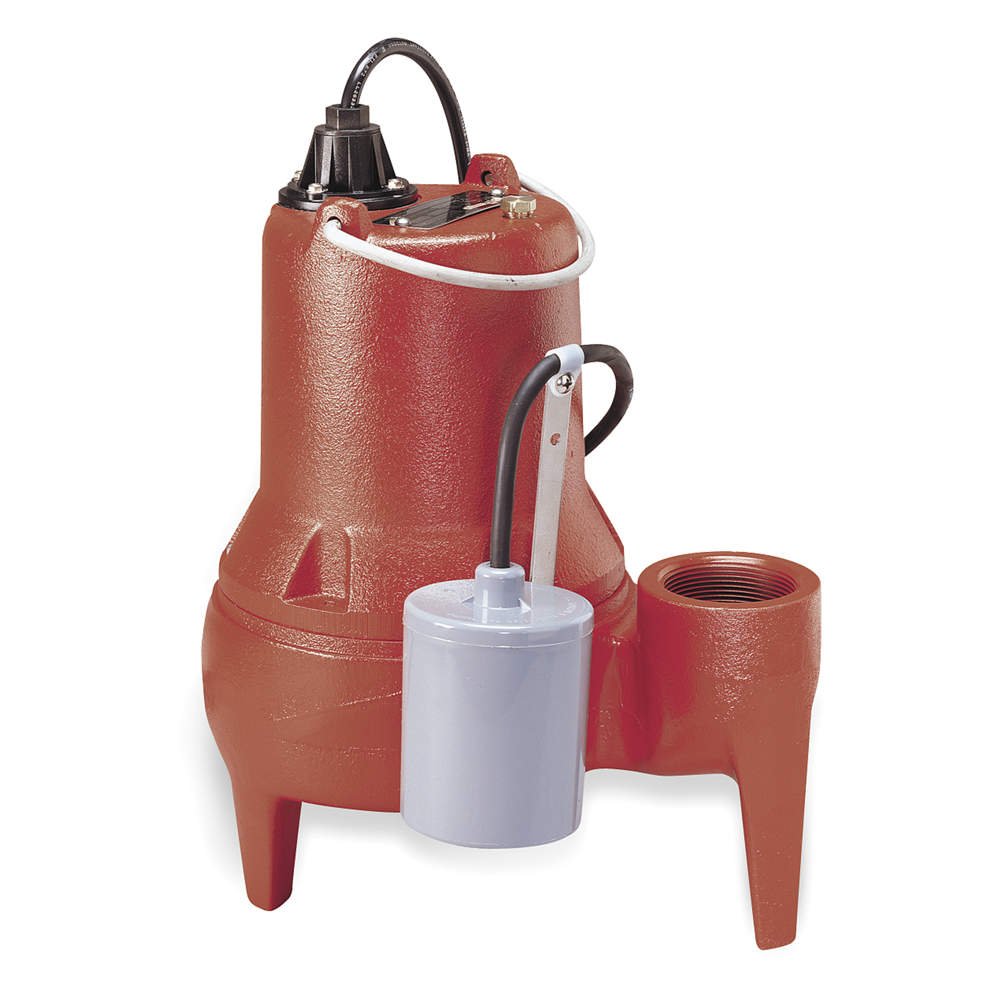
The cast-iron automaton that handles sewage and sump duty on its own.
This isn’t just a water mover—it’s an automatic sewage pump with a 2-inch discharge, built to handle the gritty duty of a septic or sump system. The heavy cast iron construction is the headline, with 46 owners praising the quality. A 1/2 HP motor pushes 160 GPM with a 25-foot lift.
It’s an automatic model, meaning it cycles on and off via a float switch to maintain water levels. The oil-filled, thermally protected motor and permanently lubricated ball bearings mean no maintenance. A quick-connect 10′ power cord simplifies installation.
Owners highlight easy installation and note it runs a year or more without issues. The noise level is a mixed point—some find it much quieter than expected, which is a bonus. One buyer recommends the tethered float switch over the sliding-on-bar version, which can get gunked up.
What You Get
- Heavy cast iron, built to last
- Automatic float switch operation
- 160 GPM flow for fast removal
- 2-year manufacturer warranty
Consider This
- 25 ft lift is low, for sump not hills
- Noise level is a mixed bag
- Sliding float switch can jam
Best for: basement sump pits and sewage ejector systems needing reliable automation.
skip it if: you need high lift for irrigation—25 feet won’t reach a hillside.
8. NorthStar High-Pressure Water Pump

The pressure specialist built to push water long distances and up serious grades.
This pump is designed for one thing: pressure. Rated at 8,120 GPH (135.4 GPM) and 94 PSI, it’s built to push water to great heights or over long distances. The Honda GX160 engine with an adjustable throttle lets you control the pressure for the job.
Quality and reliability are the standout aspects, with 29 and 24 owner mentions respectively. A gold dredger uses it with a 2-inch venturi-style setup, and a firefighter uses it for uphill water movement. The fully welded industrial steel roll cage holds up to jobsite abuse.
The silicon carbide seals are a key spec—they’re 2 times harder, 15% tougher, and 50% stronger than common aluminum oxide seals. It has a strong 26-ft max suction lift. The pressure output is mixed in some owner feedback, so check your specific needs, but the build is solid.
The specialist: if your bottleneck is pressure and distance, not raw volume, this excels.
Check first: some buyers couldn’t get the pressure they needed, so verify it suits your setup.
9. Pacer Pumps SE2PL Multi-Purpose Transfer Pump

The American-made agricultural ace that handles fertilizer and saltwater with ease.
If you’re moving more than just water, this Pacer is built for you. It’s designed specifically for agricultural and dewatering use, handling fresh water, saltwater, AND many agricultural chemicals. The glass-reinforced polyester case resists corrosion, while stainless-steel fasteners and EPDM elastomers add durability.
It delivers a maximum 150 GPM flow, a 100-foot TDH, and 50 PSI working pressure. The self-cleaning double volute and built-in check valve make it reliable. One owner has had another Pacer for 19 years and it’s still running—a strong vote for longevity.
Performance is a standout, with one owner timing it at 250 gallons in just 1 minute 30 seconds. It starts first pull every time, per buyer reports. The durability has mixed feedback though, with one report of a motor failing after minimal use. It comes with a 1-year limited warranty.
The Strengths
- Handles agricultural chemicals and saltwater
- Fast—250 gallons in 90 seconds
- Corrosion-resistant construction
- American-made with 1-year warranty
The Risk
- Durability is mixed in owner reports
- Some find the 4-stroke motor underpowered
Pick this if: you spray fertilizers or pump from saltwater sources.
Think twice if: you need heavy continuous duty—check the mixed durability reports first.
10. Aceup Energy Semi Trash Pump 2 Inch
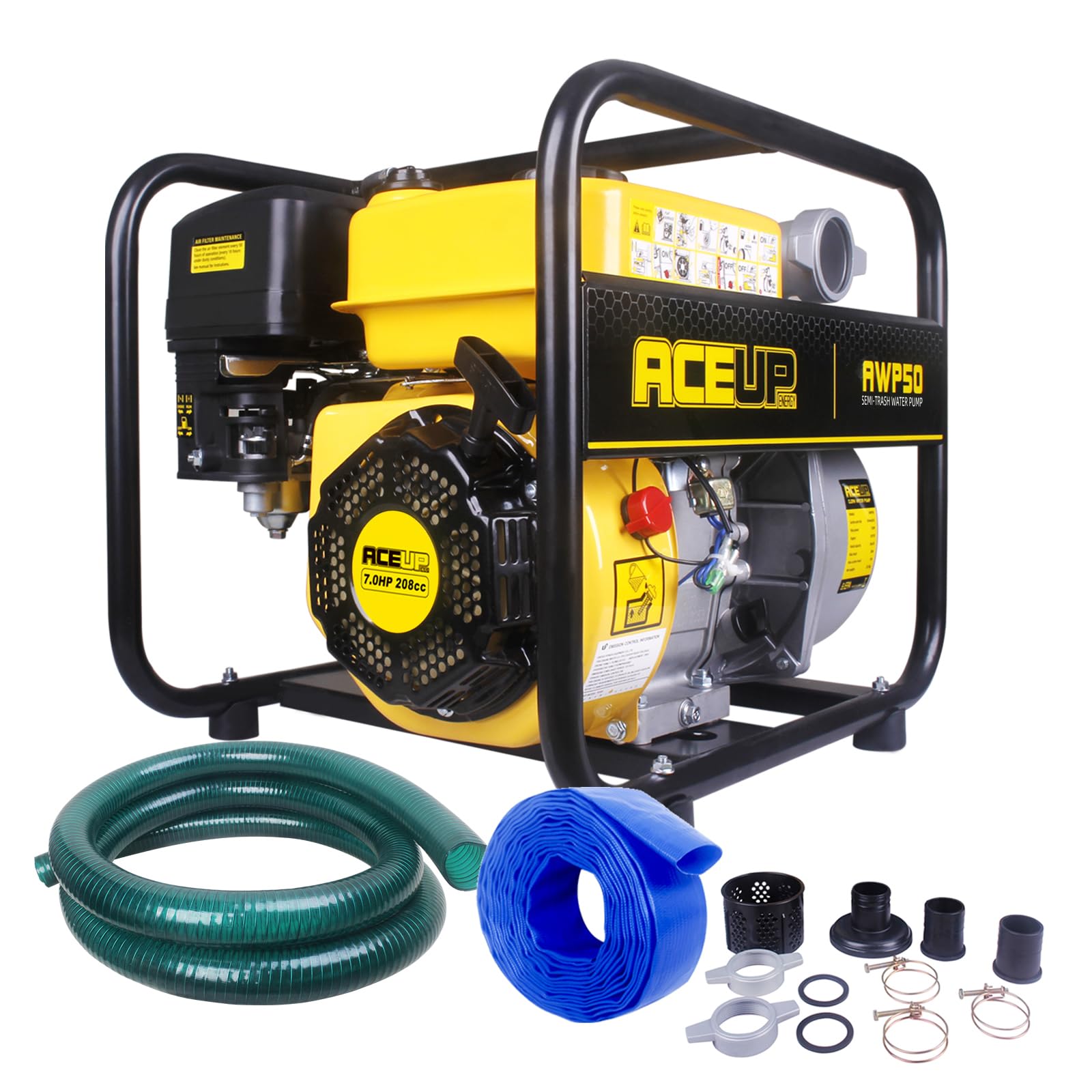
The garden-to-farm transfer pump that emptied an 18,000-gallon pool in four hours.
For irrigation and water transfer around a property, this Aceup Energy pump delivers a strong 158 GPM flow with a 95-foot max head and 27-foot max suction. The 7 HP, 4-stroke 208cc engine provides the push, powered by gasoline for full portability.
Owner feedback highlights real-world capability—one drained an 18,000-gallon pool in 4 hours and was able to prime again and again from 9 feet to reach the bottom without moving the pump. Small leaves and trash got sucked out without clogging. It’s a semi-trash pump, so it handles light debris.
The included kit covers you for setup: a 12-foot suction hose, a 25-foot discharge hose, clamping ring, hose connector kit, and intake strainer. It’s EPA compliant, functionally tested before leaving the factory, and backed by a 1-year limited warranty plus free lifetime technical guidance.
The versatile mover: one pump that handles garden, farm, and pool draining duties.
Remember: you add water to prime it before the engine will work properly.
11. YOUZAQUA 2.5HP Two Speed Inground Pool Pump
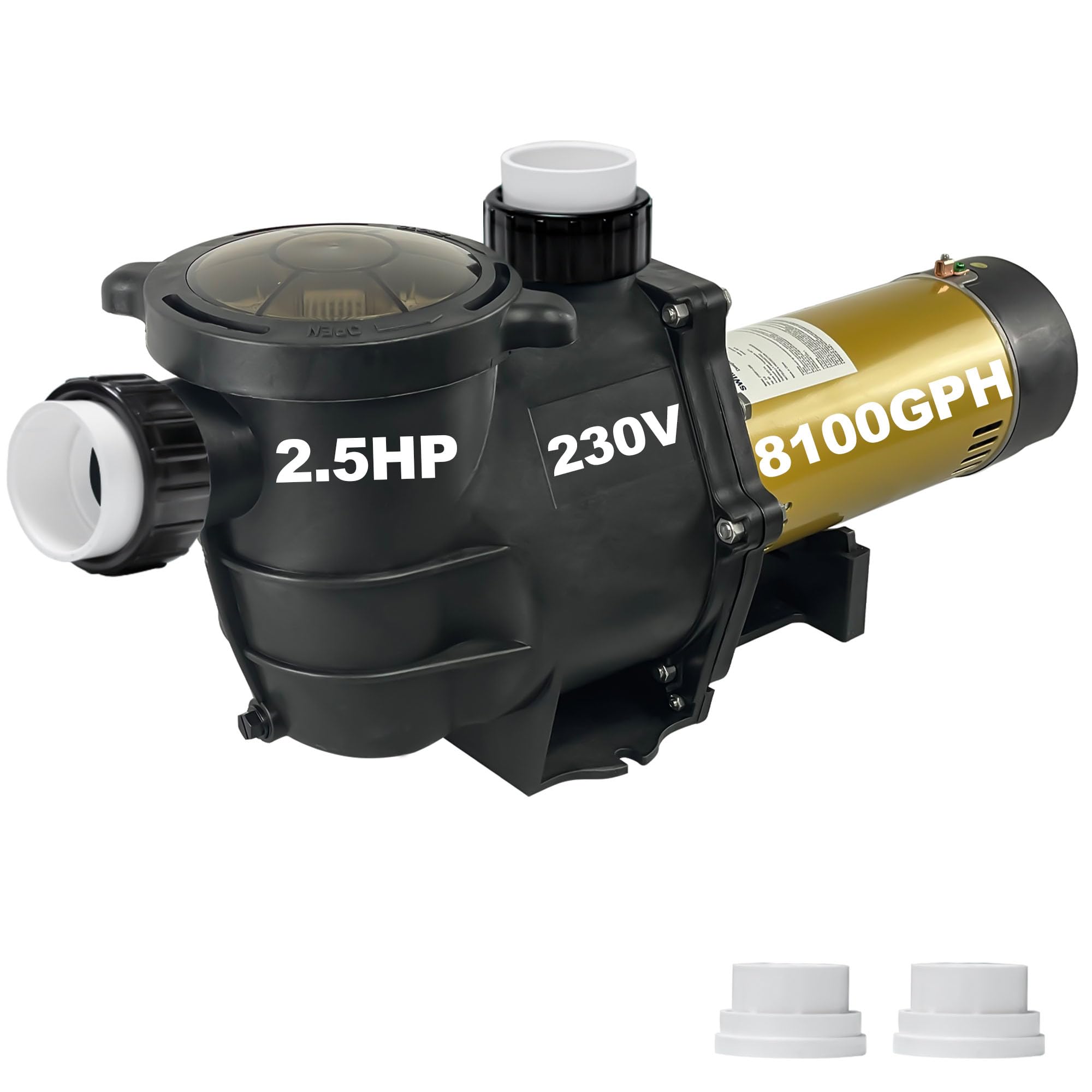
The energy-saving two-speed pool circulator that keeps the neighborly peace at 60dB.
This is a different kind of 2-inch pump—a pool circulator, not a dewatering tool. The two-speed design is its party piece: running at low speed can save as much as 74% energy, ideal for routine filtration, while high speed brings maximum power when you need it. The switch toggles High/Off/Low without plugging or unplugging.
It’s built strictly for 230V systems, so check your electrical setup first. The self-priming design targets inground pools or super large above-ground pools. It includes both 1.5″ and 2.0″ pipe fittings, making the 2.0″ port flexible for installation. Weighing in at 2.5 HP, it moves 8,100 GPH with a 72ft max head.
Despite the power, it operates at just 60dB—far quieter than standard motors, and the noise is a point owners praise. A thermal-protected TEFC motor stops if it overheats and restarts when cool. Durability is a mixed note, with one owner reporting a 3-month lifespan, though others have had it run for years.
Why Choose It
- 74% energy savings at low speed
- 60dB quiet operation
- 2.0″ port with 1.5″ and 2.0″ fittings
- Thermal protection for safety
Watch Out
- Requires 230V, verify your setup
- Durability reports are mixed
- Reviewers point out a buzzing sound developing
Pick this for: a quieter, more energy-efficient pool circulation over a single-speed motor.
Be cautious if: longevity is your top priority—some units have failed within months.
Understanding the Specs
Flow Rate (GPM)
Gallons per minute tells you how fast the pump moves water. For draining a pond or pool, higher is better—158 GPM moves a 1,000-gallon tank in about 7 minutes. For precision like irrigation, a lower rate with more control might suit you better.
Max Lift (Feet)
This is how high the pump can push water vertically. A 98-foot lift means you can send water up a steep hillside. For a sump pit only a few feet deep, a 25-foot lift is plenty. Match this to your actual terrain.
FAQ
What is the difference between a trash pump and a regular water pump?
Can a 2-inch pump run without electricity?
Why does my gas pump need to be primed before starting?
How long will a 2-inch water pump last?
Can I use a 2-inch pump for sewage?
What size hose do I need for a 2-inch pump?
Is a submersible or a self-priming pump better for a flooded basement?
Why does my pump keep losing its prime?
What does the horsepower rating really mean for a pump?
Final Thoughts: The Verdict
Across the board, the 2-inch water pump winner is the VEVOR Gas Pump because it delivers powerful, portable performance without needing electricity. If you want a plug-in-and-forget tool for flooding and debris, the Tsurumi HS2.4S is the durable submersible to trust. And for the highest flow rate with a legendary engine, the Honda WB20 is the premium pick that owners say justifies its cost with years of reliable service.
How We Picked
We do not accept paid placement. Every pick is matched to a real buyer and a real use-case; we do not hands-on test units.
Sources & Methodology
Specifications: manufacturer listings and product documentation. Review insights: verified customer reviews, as of September 2026. Pricing: not shown on this page (it changes often); check the current price via the retailer link.
As an Amazon Associate, KitchPrep earns from qualifying purchases. This does not affect which products we feature.
Related Guides
