
Specs are compiled from manufacturer listings and verified buyer reviews and can change over time — please confirm the key details on the product page before buying.
When water is rising, a 2-inch submersible pump is the difference between a damp floor and a soaked basement. These workhorses move dirty, debris-filled water fast — usually between 53 and 160 gallons per minute — so you can drain a sump pit, a flooded basement, or a pool liner change without babysitting the process. Below, we break down the 10 models worth your attention, from value picks to premium, industrial-grade machines.
I’m Mohammad Maruf — the founder and writer behind KitchPrep. This guide is built by comparing the manufacturers’ published specifications and the patterns across verified customer reviews, so you get each pick’s real strengths and trade-offs instead of marketing spin.
Choosing the right 2-inch submersible pump depends on matching horsepower, flow rate, and debris handling to the specific job you face.
Our Picks at a Glance

How To Choose The Best 2-Inch Submersible Pump
Most buyers make their choice on horsepower alone, but that only tells one part of the story. For a pump that moves dirty water, the two numbers that matter more are flow rate and maximum lift height — and how the pump handles solids in the water.
Flow rate and lift height work together
A pump’s flow rate is measured in gallons per minute (GPM) or gallons per hour (GPH). That rating is only true at zero lift — meaning water exits at the same level as the pump. As you push water up a hill or into an overhead pipe, the flow drops. Check the maximum lifting height (in feet) to know if the pump can handle your setup. A pump rated for a 39-foot head will push water much higher than one rated for 25 feet, at the same flow.
Quick Comparison
| Model | Best For | Horsepower | Flow Rate | Max Lift | Amazon |
|---|---|---|---|---|---|
| Tsurumi HS2.4S★ Best Overall | Dirty water & debris | 0.5 hp | 53 GPM | 39 ft | Amazon |
| LANCHEZ 1HPBest Value | High-volume sewage | 1 hp | 94.07 GPM | 27 ft | Amazon |
| Acquaer 1/2 HPAuto-Run Pick | Automatic sump duty | 0.5 hp | — | 27 ft | Amazon |
| BOMGIE 3/4 HP | Basement drainage | 0.75 hp | 107 GPM | 29 ft | Amazon |
| FOTING 1.5HP | Max pumping volume | 1.5 hp | — | 29 ft | Amazon |
| Aquastrong 1 HP | Grinding tough debris | 1 hp | 4200 GPH | 40 ft | Amazon |
| WASSERMANN 3/4 HP | Reliable cast iron value | 0.75 hp | 120 GPM | 32 ft | Amazon |
| Multiquip Bon | Contractor-grade abuse | — | 73 GPM | 37 ft | Amazon |
| Tsurumi HSZ2.4S | Auto-operation dewatering | 0.5 hp | 53 GPM | 4 ft spec | Amazon |
| Liberty LE51A | Long-term sewage installs | 0.5 hp | 160 GPM | 25 ft | Amazon |
In‑Depth Reviews
1. Tsurumi Pump HS2.4S
Our pick — over 4.5★ from 600+ verified ratings; the strongest balance of quality and price.
The dirt-water specialist that chews through sand and debris without clogging
When your water has grit in it, this is the pump you want. The Tsurumi HS2.4S pairs a semi-vortex impeller with an integrated agitator, so it handles debris up to 0.3 inch with far less wear and clogging than a standard sump pump. That design is why buyers report using it to drain pools before liner changes and pulling silt-heavy water from streams for cedar hot tubs — jobs that would choke a typical pump.
The 1/2 horsepower motor runs on a standard 115V outlet and moves water at 53 gallons per minute, lifting up to 39 feet — a full 44% more lift than the LANCHEZ below, which only reaches 27 feet. The angled 2-inch discharge port makes hose and fitting setup flexible, and the 20-foot cord gives you room to work. It weighs in at 29.1 pounds, so the build quality is immediately obvious when you lift it from the start.
Owners mention these units running 24/7 for 4-5 years of hard use without complaint, and the phrase “pumped out a flooded basement with ease” comes up repeatedly. Owners single out build quality above all else, and the 2-year warranty plus UL and CSA certifications back that confidence.
Tough enough for the messy jobs
- Semi-vortex impeller passes 0.3-inch debris without clogging
- 39-foot max lift beats nearly every pick here
- Customers note 4-5 years of heavy, near-constant use
The honest trade-offs
- No float switch — you control on/off manually
- 29.1 lbs is heavy to carry around
- Higher sticker than budget sewage pumps
Reach for this if: your water carries sand, silt, or solids and you want a pump proven to survive years of punishment.
Look elsewhere if: you need a hands-off automatic pump — there is no float to kick it on when water rises.
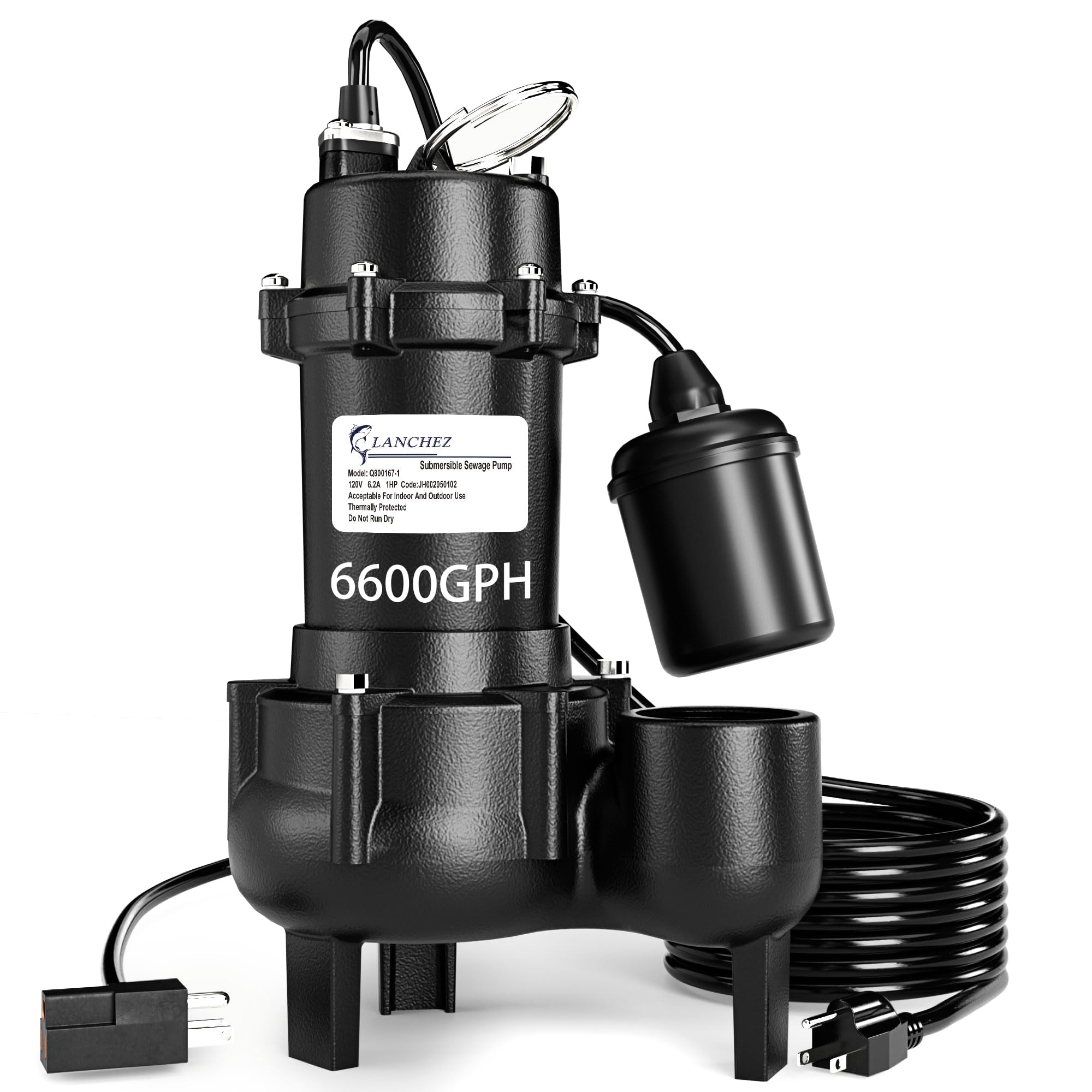
2. LANCHEZ 1HP 6600 GPH
A cast-iron life-saver for basements that moves water at a furious clip
This is the pump for the moment you walk into a flooded basement and need water gone fast. The LANCHEZ packs a full 1-horsepower motor that pushes 6,600 gallons per hour at zero feet of lift — a 94.07 gallons-per-minute flow that is roughly double the Tsurumi above. That output is exactly why reviewers point out it saved their house from flooding, and the cast iron casing keeps it planted and corrosion-resistant in tough sump duty.
The automatic tethered float switch turns the pump on when water rises and kills power when it can’t pump, so you are not standing there watching it. It lifts to 27 feet of vertical height, which works for most residential basins even if it can’t match the Tsurumi’s 39-foot reach. The 10-foot grounded cord includes a portable handle, and the 2-inch NPT discharge handles high-capacity pumping for sewage and dewatering alike.
Across the review pages, the quality of the cast iron build earns the most praise, and quiet operation shows up repeatedly as a pleasant surprise. Be aware the pump performance itself gets mixed feedback — most owners see incredible rates, but an occasional unit fails early. That uncertainty is the trade-off at this price point, though the 3-year manufacturer after-service is a solid safety net.
The flood-fighting credentials
- 1 hp motor moves 6,600 GPH at ground level
- Automatic float switch runs hands-free
- Cast iron casing resists corrosion and stays put
What to weigh first
- 27-foot max lift trails the Tsurumi by 12 feet
- Performance reports are mixed, with some early failures
- Heavy, awkward handle digs into your hand
The verdict: buy it for emergency sewage and sump duty where raw volume beats lifting height.
Think twice if: you need a pump that must never fail silently — consider the longer-track-record Tsurumi instead.
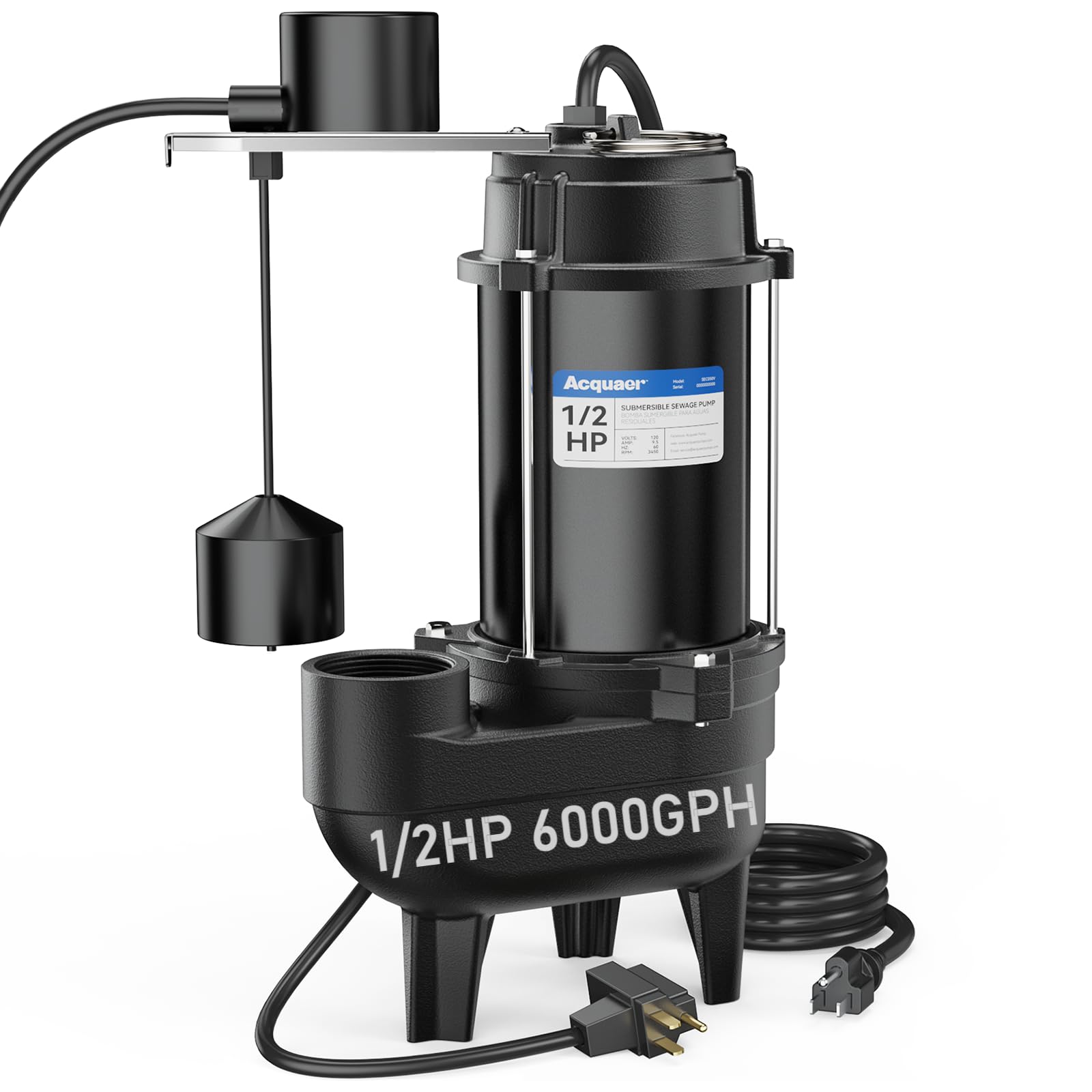
3. Acquaer 1/2 HP Sewage Pump
The set-and-forget sewage pump that switches itself on precisely when needed
If you want a sewage pump you can install and forget, the Acquaer’s integrated vertical float switch is the standout feature. It turns the pump on when water rises above 14.5 inches and shuts it off below 6.3 inches — precise, predictable levels that keep a sump basin from overflowing. The 1/2 horsepower, oil-filled motor lifts water 27 feet and handles up to 6,000 gallons per hour, with a 2-inch NPT discharge port that passes solids up to 2 inches in diameter.
The cast iron body and vortex impeller are designed to minimize clogging from debris sitting at the bottom of the pit, which is the classic failure point of cheaper pumps. Buyers call it powerful and easy to install, with the build quality drawing steady praise across the review pages. The 10-foot UL-listed power cord gives you flexibility on placement.
Here is the honest catch: reliability gets mixed feedback. Some shoppers say the pump working beautifully for a year, while others describe it stopping or burning out within months — one account mentions burnout around the six-month mark despite strong initial flow. The good news is the seller consistently steps up with replacements outside the normal window, so the after-sales support is where the value comes back. This is a fair mid-range pick, not a lifetime purchase.
Why owners stick with it
- Vertical float automates start and stop at set water levels
- Vortex impeller resists clogging from pit debris
- Cast iron construction praised across reviews
The reliability reality
- Mixed reports of early burnout and shutdowns
- 27-foot lift is average for the category
- Not designed for septic tank use
Best suited for: hands-off sump basin and laundry-room ejector duty where precise float levels matter.
Who should skip it: anyone needing a pump for constant, unattended critical duty — reliability is the open question here.
4. BOMGIE 3/4 HP Sewage Pump

The 29-foot-lift workhorse that runs quiet enough to forget it is there
Deep basement drainage is this pump’s home turf. The BOMGIE’s 3/4 horsepower, oil-filled split capacitor motor delivers a 107 gallons-per-minute flow rate and lifts water a full 29 feet, beating the LANCHEZ’s 27-foot reach while running noticeably quieter. Buyers repeatedly call it barely audible — a genuine plus when the pump sits near living space.
Automatic and manual operation get separate plugs, so you can run it hands-free with the float or force it on when draining a pit that is only partially filled. The non-clogging vortex impeller passes 2-inch NPT debris, and the silicon carbide mechanical seal holds up under wear. An IP68 waterproof rating and UL certification are rare at this price tier, and the 33-pound cast iron build keeps it stable in the basin.
The review pattern shows owners using it for everything from pond duty to basement flooding — one swapped out a constantly-clogged pond pump for this and found it “a beast” that chews up debris. The recurring caution is mixed longevity: some units die early (one failed at five months), so the two-year warranty matters. And quietly, more than one owner recommends buying the extended warranty anyway.
The quiet strength
- 107 GPM flow at 29-foot max lift
- IP68 waterproof rating with UL certification
- Separate auto and manual plugs for full control
Where it gets cautious
- Long-term reliability is mixed in owner reports
- Manual mode requires unplugging to stop
- 33 lbs makes it a two-hand carry
The fit: basement sump and drainage jobs where high lift and quiet operation matter more than raw volume.
The caution: if the pump must run unattended for years, its durability is the thing to keep an eye on.
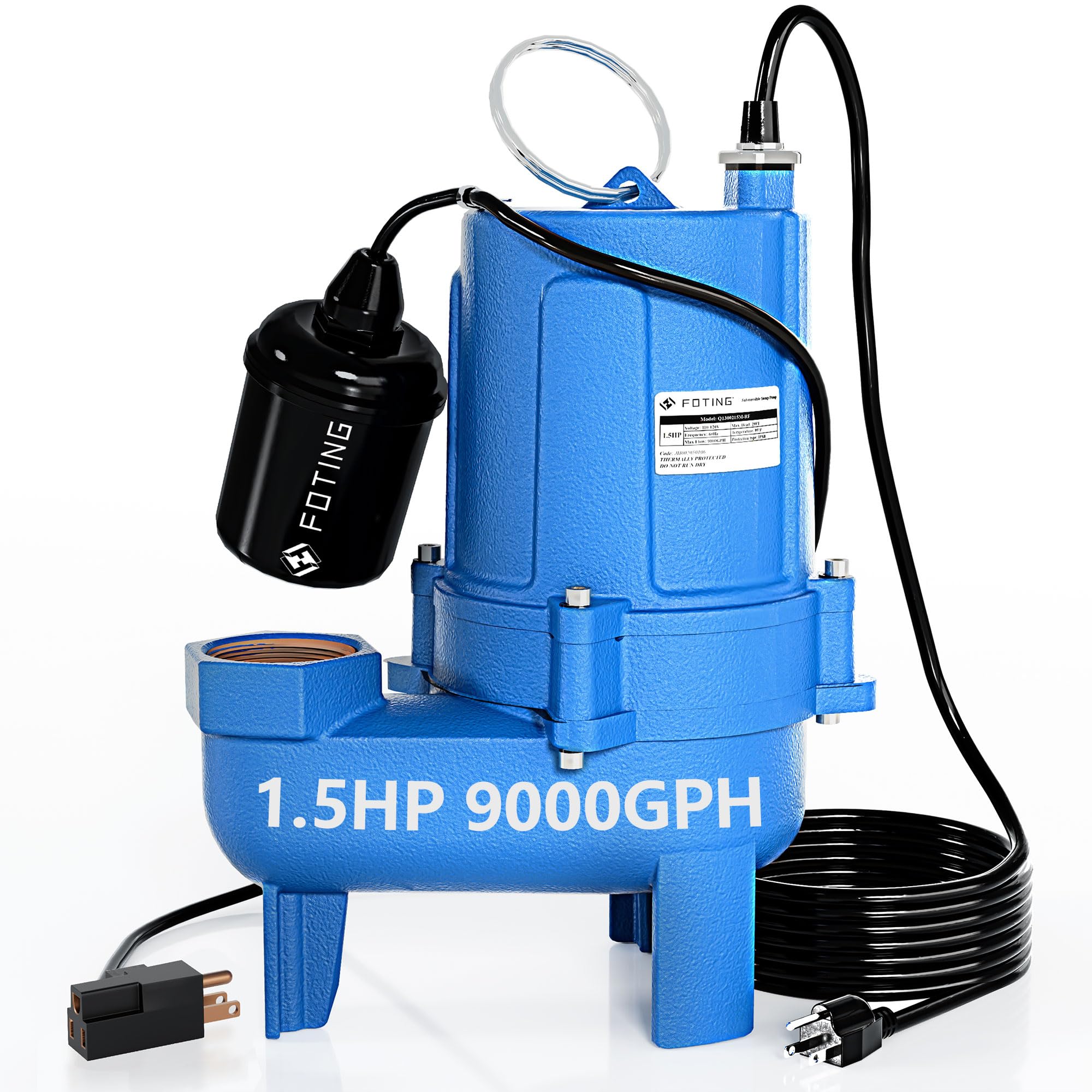
5. FOTING 1.5HP Sump Pump
The strongest motor here, built to move massive water volumes fast
When you need maximum brute-force volume, the FOTING’s 1.5-horsepower PSC motor is the biggest punch in this lineup. It pumps up to 9,000 gallons per hour and lifts to 29 feet, handling solids up to 2 inches through a 2-inch NPT discharge. For a lift station or a large basin, this is the volume king.
An adjustable tethered float switch offers both automatic and manual operation via a piggyback plug, and you can tweak the float length with a cable lock to match your pit’s water levels — handy for preventing freezing in winter. The 34.2-pound cast iron casing and reinforced vortex impeller give it the rugged DNA of a serious waste mover, and a built-in air venting valve prevents air lock that can stall lesser pumps.
Owner stories back the power claims: one reports the 2-inch pump actually out-discharged the dying 3-inch pump it replaced. Another has run it for a year on a 300-foot horizontal run with a 15-foot rise without a problem. The honest caveat is quality control — most buyers get a superb unit, but the occasional one stops working within months, which is why the three-year after-sale service matters.
The raw muscle
- 1.5 hp motor moves 9,000 GPH for big jobs
- Adjustable float handles varying pit levels
- Air venting valve prevents stall-causing air lock
The honest trade-off
- Occasional early failures reported despite strong performance
- 34.2 lbs is the heaviest pick here
- Value questions come up in mixed reviews
Reach for it when: you have a high-volume lift station or septic system that needs maximum water movement.
skip it if: your job only needs modest flow — the extra horsepower is wasted money and weight.
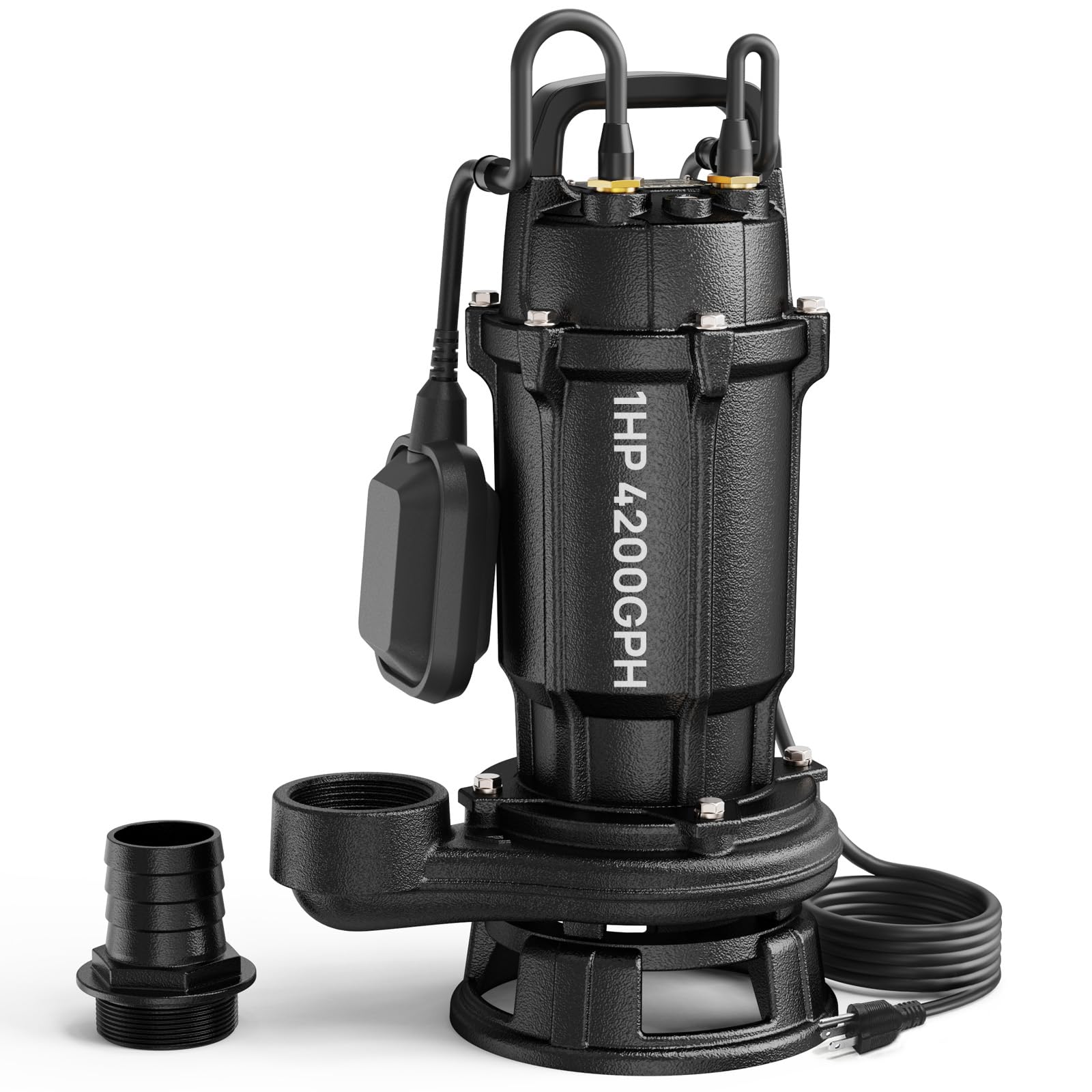
6. Aquastrong 1 HP Grinder Pump
The shredder that turns wipes and twigs into non-clogging slurry
For sewage lines that carry things they should not, the Aquastrong’s stainless steel blades are the answer. This grinder pump cuts through soft and semi-rigid debris like wipes, twigs, and zip ties before they can form a clog — a job no standard vortex impeller can do. It delivers 4,200 gallons per hour with a top-tier 40-foot max lift, the tallest of any pick in this guide.
The cast iron body and 2-inch discharge handle solids up to 2 inches, and the adjustable float switch gives you automatic or manual operation. On the 115V single-phase motor, buyers report dependable running — one had it going a full year without issues — and note it cut pool-draining time to a third of what a standard pump took. That efficiency is a recurring theme in the reviews.
The catch is on the intake side: the grinder wants soft or semi-rigid debris only. Rubber items and thick towels are off-limits and can jam the blades. Noise gets mixed feedback, and the warranty contact initially proved hard to find — though once found, the company responded quickly with a replacement. For a sewage ejector system that handles modern “flushable” wipes, this is the right tool.
The clog-killing advantage
- Stainless blades shred wipes and twigs
- 40-foot max lift tops every pump here
- Efficient enough to slash pool drain time by two-thirds
Know before you buy
- Avoid rubber items and thick towels
- Contacting warranty support took some digging initially
- Noise level earns mixed feedback
The pick for: sewage ejector systems where wipes and small debris are the recurring nightmare.
Not for you if: your water is clean — you would pay for grinding you never use.
7. WASSERMANN 3/4 HP Sewage Pump
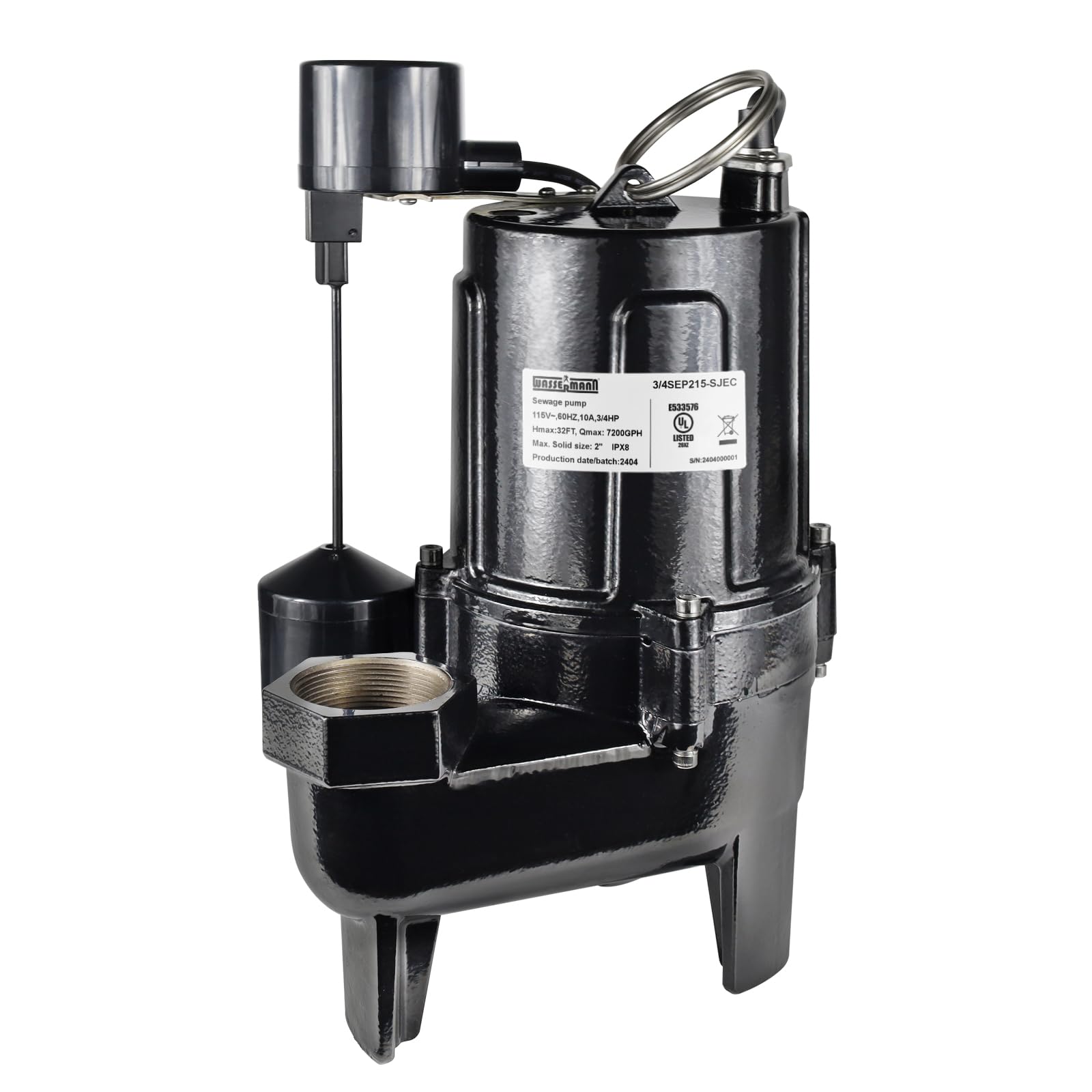
The strongest flow-per-horsepower value in the mid-range tier
Here is a 3/4-horsepower pump that out-flows some 1-horsepower rivals. The WASSERMANN moves 120 gallons per minute — beating the LANCHEZ’s 94.07 GPM despite 25% less horsepower — and lifts water to 32 feet. That is a genuine efficiency win for anyone moving serious volume from a basement sump or sewer well.
The cast iron casing and non-clogging vortex impeller pass 2-inch solids, and the auto/manual dual-plug system makes setup straightforward: connect the float for automatic level control, or bypass it for continuous manual operation. It arrives with the float switch included, and owners mention the installation comes with everything needed. The 10-foot cable covers typical pit placements.
Owners describe it as stronger than expected, with six months of solid performance grinding solids and pushing waste up and out. Owners praise quality and performance, and the heavy feel signals durability. One owner did flag a quality-control issue — a torn rubber boot around the cord on arrival — so inspect yours on delivery. The 32-foot lift makes it the best mid-priced match for below-grade installations.
Why it stands out
- 120 GPM flow with only a 3/4 hp motor
- 32-foot max lift for below-grade pits
- Auto and manual operations each have their own plug
The fine print
- An occasional unit arrives with a torn cord boot — inspect on arrival
- Heavy enough that install is a two-person job
- Smaller review base than the big names
The fit: homeowners who want near-1hp flow without paying for a full 1hp motor.
Check this if: you need a specific caveat — the occasional QC issue means inspect the cord entry before you drop it in the pit.
8. Multiquip Bon Submersible Pump

The job-site bruiser that takes abuse and keeps pumping for decades
This is the pump you hand to the crew that is hard on equipment. The Multiquip Bon moves 73 gallons per minute, lifts to 37 feet, and is built around a cast aluminum housing that keeps weight down to 32.7 pounds while a stainless steel strainer and hardware shrug off corrosion. A tugboat company runs these dewatering ballast water in barges and reports the crew is “not nice to them in any sense of the word” — yet they keep running.
The compact 7.4-inch square footprint and streamlined design make it easy to drop into tight spaces, and the strain relief cord protection prevents the most common field failure — a yanked cord tearing out at the housing. Unlike the homeowner-focused picks above, this one skips the float switch entirely: you plug it in and it pumps until you unplug it, which is exactly what emergency and contractor work wants.
Owner history here is remarkable: one reports a previous unit from this manufacturer lasting over 20 years, and another says this pump pushes 250 gallons into an IBC tank in under seven minutes. Owners praise its performance and pumping power above all else. It is heavier than a utility pump and needs fittings and hoses supplied by you, but for raw, dependable water-moving muscle, the Bon is the proven pro.
The endurance machine
- Cast aluminum housing keeps weight manageable
- Stainless strainer and hardware resist corrosion
- Customers note 20+ year service life on prior units
The professional reality
- No float switch — manual on/off only
- Fittings and hoses sold separately
- Heavier than typical utility pumps
Best for: contractors, farmers, and anyone who needs a pump that survives being tossed around and forgotten in a truck bed.
Consider another if: you want automation — this pump has no brain, just brute force.
9. Tsurumi HSZ2.4S Trash Pump

The Tsurumi trash-pump DNA with a float switch bolted on for auto duty
Take everything that makes the Tsurumi HS2.4S great and add a built-in ball float switch, and you get this. The HSZ2.4S keeps the same semi-vortex impeller that handles sand, solids, and debris up to 0.3 inch, and the same 53 gallons-per-minute flow on a 1/2-horsepower 115V motor. The difference is the float, which starts the pump automatically when water rises and shuts it off when levels drop — no more worrying about burnout from running dry.
The 20-foot cord and angled 2-inch discharge port carry over from the base model, giving you the same flexible hose setup and reach. It weighs 30 pounds and comes with the same 2-year warranty and UL/CSA certifications that make the Tsurumi brand the default choice for construction and rental fleets. A hill-drainage buyer praises the float for letting him run water to the street without standing watch.
Owners praise performance above all, calling it “an absolute beast” that revived a dry cellar after seven years idle. The caveat: the mechanical float activates only when water is well above the unit, so for shallow dewatering you might find the activation point too high. The listed max lift spec reads as 4 feet here, unusually low versus the 39-foot sibling — treat this as an auto-operated companion, not a high-head machine.
Hands-off dewatering
- Built-in ball float automates on/off
- Handles sand and debris up to 0.3 inch
- Semi-vortex impeller minimizes wear and clogging
The caveat
- Float activates only well above the unit
- Max lift spec reads low versus the non-float sibling
- 30 lbs and premium pricing
The fit: anyone who wants Tsurumi durability but needs automatic operation for a drainage pit or low spot.
Note first: confirm your pit depth against the float’s high activation point before buying.
10. Liberty Pumps LE51A
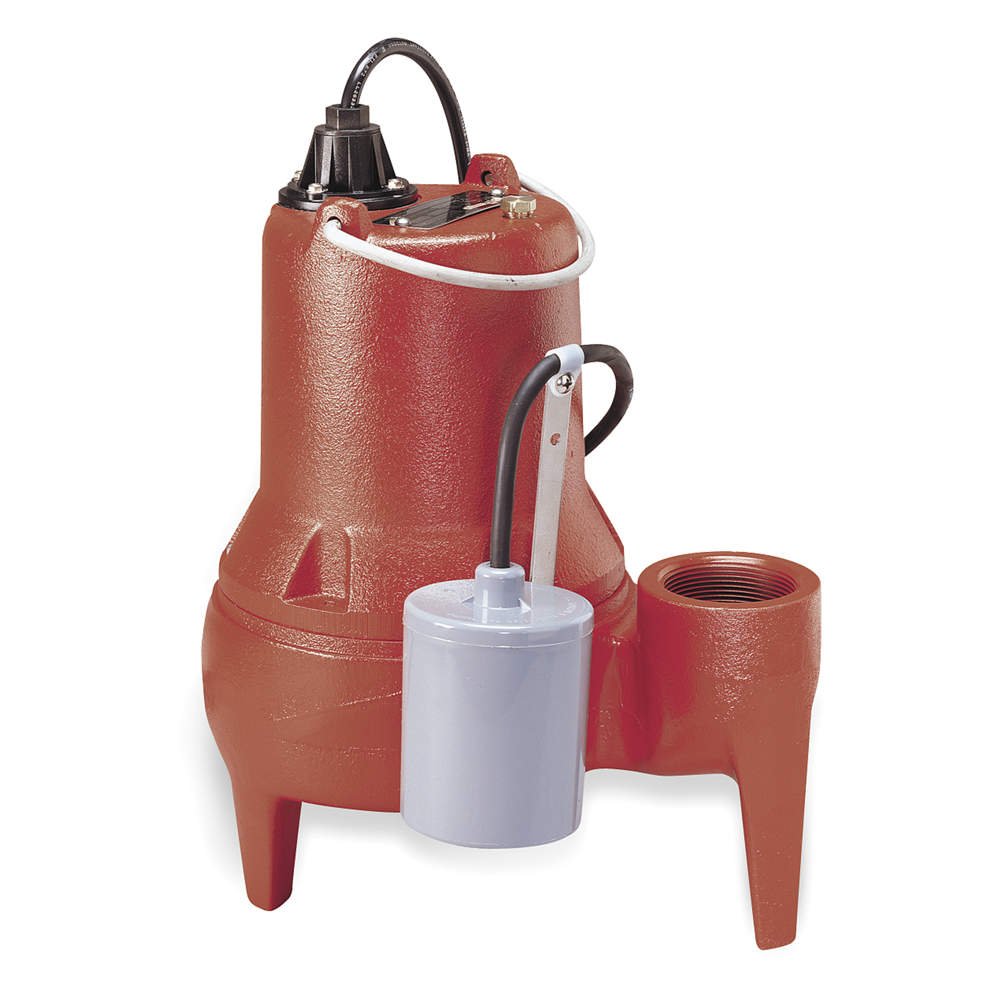
The plumber-recommended sewage pump with the fastest flow in this guide
When a trusted plumber recommends a pump by name, that is signal worth hearing. That is exactly what happens with the Liberty LE51A — it shows up repeatedly in reviews as the model a professional chose. Its claim to fame is a 160 gallons-per-minute flow rate, the highest in this entire guide, on a 1/2-horsepower motor. That volume is what makes it the go-to for serious residential sewage and effluent systems.
The heavy cast iron construction, oil-filled thermally protected motor, and permanently lubricated ball bearings are built for a decade-plus of service. Stainless steel fasteners and a stainless steel rotor shaft resist the corrosion that kills lesser pumps, and the quick-connect 10-foot power cord simplifies installation. It lifts to 25 feet — the shortest reach here — so this is a volume-first, not height-first, machine.
Durability is the story across the review pages: reviewers point out it running for a full year without a single issue, and the quality and functionality combine for the most-praised aspects. It is “plug and play” as one owner put it, with no tricks. The noise level gets mixed feedback — several owners found it much quieter than expected. At 42 pounds, it is the heaviest pick here, which is the weight of confidence in a cast iron pump built for the long haul.
The pro-grade strengths
- 160 GPM flow leads the entire guide
- Cast iron and stainless build for long service life
- Plumbers recommend it by name in reviews
Weigh these first
- 25-foot max lift is the shortest here
- 42 lbs is a serious two-person lift
- Noise level earns mixed feedback
The call: the right choice for a permanent sewage install where maximum volume and decades of reliability beat lifting height.
Pass if: your discharge line runs high overhead — this pump prefers pushing big volume at modest heights.
Understanding the Specs
Flow Rate vs. Lift Height
Flow rate, in GPM or GPH, is the headline number, but it only holds at zero lift — when water exits at pump level. Every foot you push water upward reduces flow. That is why a pump rated for a 39-foot head can be the right call for a hillside drain, while a 25-foot-head pump with higher flow wins for a flat basement. Match the lift to your actual pipe run, not just the flow number.
The Impeller Matters
The impeller decides what the pump can swallow. Semi-vortex design (like the Tsurumi) lets sand and 0.3-inch debris pass with minimal wear. Full vortex impellers (on most sewage pumps) spin debris in a chamber without touching the blades, passing 2-inch solids. Grinder pumps add blades that shred wipes first. Water that is clean needs none of this — but if grit or wipes are in your future, the impeller is the spec that saves you.
FAQ
What does a 2-inch discharge size actually mean for my setup?
How do I know if I need an automatic float switch?
What happens if a pump runs dry?
Can a 2-inch submersible pump handle raw sewage with solids?
How high can these pumps lift water?
What is the difference between a trash pump and a sewage pump?
Do I need a check valve on the discharge line?
Why is cast iron better than other materials for a sump pump?
What size power cord do I need?
Is a 1/2 HP pump enough for a basement sump?
Final Thoughts: The Verdict
If you want one dependable pick, the 2-inch submersible pump winner is the Tsurumi HS2.4S because it is the only pick that pairs 53 GPM of flow with a 39-foot lift and proven 4-5 year service life on dirty water. If you want maximum flood-fighting volume at a value price, grab the LANCHEZ 1HP for its 6,600 GPH output. And for a permanent sewage install where the pros weigh in, the Liberty LE51A is the one to reach for — its 160 GPM flow leads every pick here, and it is the pump your plumber would name first.
How We Picked
We do not accept paid placement. Every pick is matched to a real buyer and a real use-case; we do not hands-on test units.
Sources & Methodology
Specifications: manufacturer listings and product documentation. Review insights: verified customer reviews, as of August 2026. Pricing: not shown on this page (it changes often); check the current price via the retailer link.
As an Amazon Associate, KitchPrep earns from qualifying purchases. This does not affect which products we feature.
Related Guides
