
Specs are compiled from manufacturer listings and verified buyer reviews and can change over time — please confirm the key details on the product page before buying.
If you want the short answer for a 2-inch belt sander, the JET J-41002 is the one most workshop owners keep pointing to — a 3/4 HP machine with cast iron under it. Everything below explains which of these four earns your bench space and which one you should walk past.
I’m Mohammad Maruf — the founder and writer behind KitchPrep. This guide is built by comparing the manufacturers’ published specifications and the patterns across verified customer reviews, so you get each pick’s real strengths and trade-offs instead of marketing spin.
The four machines here split cleanly into a heavy cast-iron workhorse and three benchtop combos for smaller shops, so the pick depends on how much steel you plan to push through it. Here is the real breakdown of the best 2-Inch Belt Sander.
Our Picks at a Glance
How To Choose The Best 2-Inch Belt Sander
A 2-inch belt sander is a narrow-belt machine, which means the belt is only two inches wide from edge to edge. That narrowness is the whole point — it lets you grind into tight spots, shape a knife bevel, or clean up a curve that a wide belt would flatten. The trade-off is that everything about the machine has to be tuned for precision, because a two-inch belt wanders fast if the tracking is off.
Motor Size And Amperage
The amperage rating tells you how much current the motor draws, and it is the closest thing to a power guarantee you get. Amperage on these machines ranges from a light 2.5 A all the way up to 6.2 A. Higher draw generally holds speed better when you lean into metal. A lower-amp motor is fine for wood, light chamfering, and hobby work.
Belt Tracking And Tensioner Adjustment
Belt tracking means the belt staying centered on the rollers instead of creeping to one side. On a two-inch belt, even a small drift makes the belt rub the frame. Look for a tracking knob or screw you can reach and turn while the machine is running. Check that the tensioner hardware is standard-sized, because oddball fasteners make a simple adjustment a scavenger hunt.
Dust Collection And Debris
Grinding metal throws fine dust, and grinding wood throws chips. A dust chute or vacuum port gives that debris somewhere to go. If you sharpen knife blades or grind steel, plan on a vacuum setup — fine metal dust settles into a motor that has no way to keep it out.
Quick Comparison
| Model | Best For | Motor Amperage | Disc Diameter | Max Speed | Amazon |
|---|---|---|---|---|---|
| JET J-41002★ Best Overall | Serious knife and metal shops | 6.2 A | 8 inches | — | Amazon |
| KFMK 2×42 Belt & 6″ Disc Combo | Sharpening blades and chisels | 3.5 A | 6 inches | 3580 rpm | Amazon |
| VEVOR 2IN1 Belt Grinder | Small hobby and apartment benches | 250 W motor | — | 3450 rpm | Amazon |
| SEESII Bench Grinder & Belt Sander Combo | Budget garage grinding and polishing | 2.5 A | 6 inches | 2950 rpm | Amazon |
In‑Depth Reviews
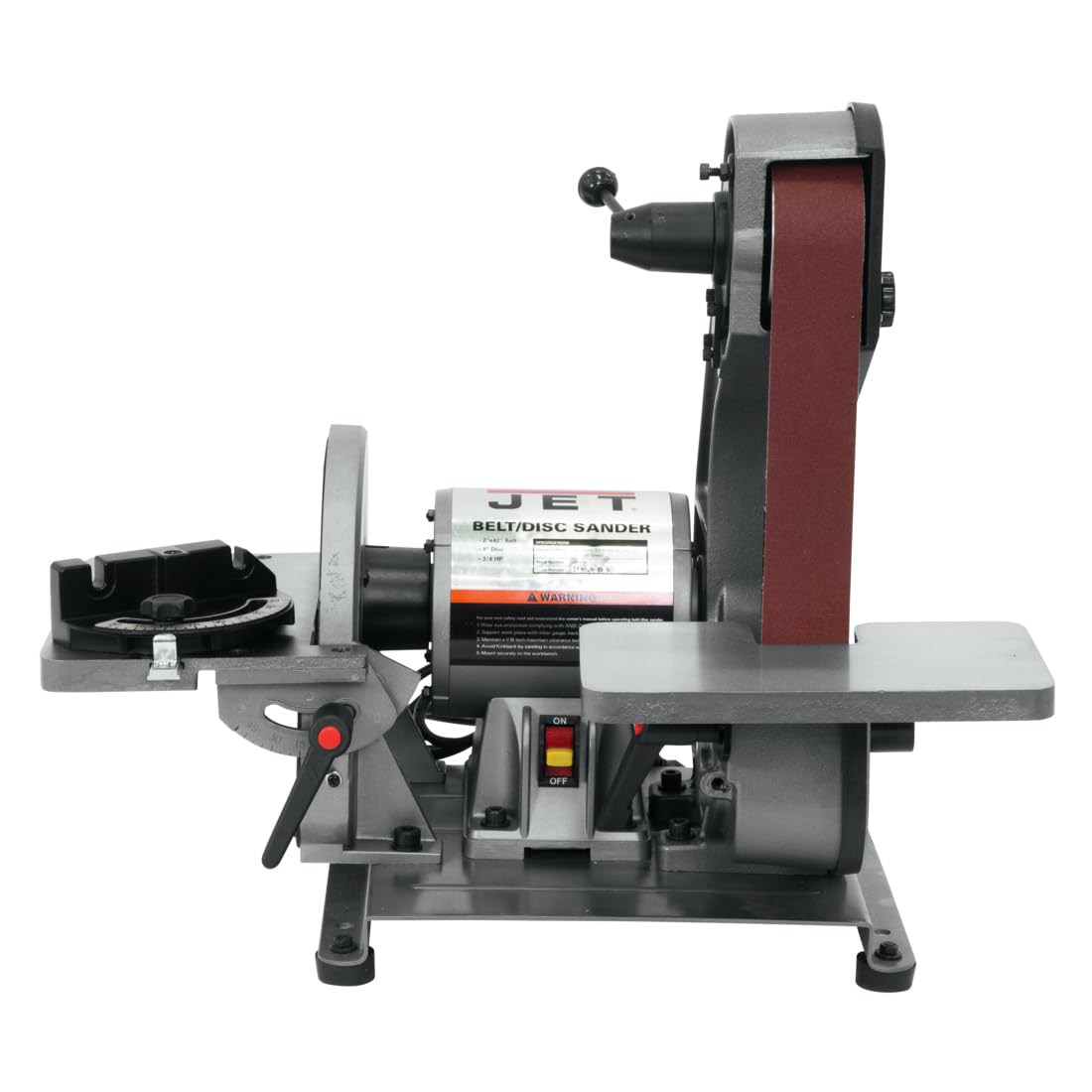
1. JET 2″ x 42″ Belt and 8″ Disc Sander, 3/4 HP, 1Ph 115V (Model J-41002)
Our pick — over 4★ from 250+ verified ratings; the strongest balance of quality and price.
The cast-iron bench anchor that pulls 6.2 amps and refuses to walk.
If your 2-inch belt sander will live on a dedicated bench and run every day, this is the one to buy. It runs on corded 115 V power and draws 6.2 A through a 3/4 HP motor, so it has enough muscle for daily metal and knife work. It also packs the widest disc here — an 8-inch disc against the 6-inch disc on the SEESII, which is a full 33% more disc face for cleaning up edges and squaring stock.
The 2″ x 42″ belt is a common size, so belts are easy to find. The 100-grit medium belt that ships in the box removes metal and finishes at the same time, which matters when you are grinding a knife bevel and want a clean surface without a second pass. There is a removable platen, and pulling it off lets you work outside curves and odd-shaped pieces on the belt instead of fighting a flat backing. A deluxe miter gauge turns and locks at common angles, 45 degrees left and right, and the adjustable dust deflector and chute give shavings a defined path out.
What wins people over is that it simply does the job — the 40 functionality mentions in its review record make it the single most-cited thing about this sander, and owners who bought it for knife making keep coming back to the same point: you can’t go wrong. Belt speed is the one place opinions split — some find it runs smoothly, others hit a slow start. A pair of real owner notes worth hearing before you buy: buyers report “Belt drifts 3/8″; supplied Allen wrenches don’t fit tracking screw (need 5mm).” Treat the tracking screw as a known quantity, grab a 5mm hex key, and also be gentle with the spring-loaded tracking handle — forcing it into lock can seize the motor.
The backbone of a busy shop
- 6.2 A through a 3/4 HP motor holds speed through metal and hardwood
- Cast iron and heavy-duty steel base keep the machine planted — 60 pounds of it
- Removable platen opens up outside curves and irregular workpieces
- Miter gauge locks at 45 degrees in both directions
What to expect going in
- Belt tracking and belt changes drew mixed owner notes — plan on dialing it in yourself
- Ships with plastic covers on the disc side; the disc, not the belt, is where stability complaints cluster
- Adjustments are needed after shipping, and the included hex wrenches may not fit every fastener
Built for the shop wall: knife makers, metalworkers, and anyone whose 2-inch belt sander runs daily and gets leaned on hard.
Look past it if: you are a weekend hobbyist who wants a machine that bolts together and works untouched — this one asks for setup and a tracking tune first.
2. 2×42 in. Belt Sander & 6″ Disc Sander Combo, 3.5Amp Bench & 1/2HP (Model KFBD6242)

A 3.5-amp belt-and-disc combo that turns chisels and blades into working edges.
If your whole reason for owning a 2-inch belt sander is sharpening, this is the one to line up first. It is a 2″ x 42″ belt with a 6″ disc, and it pulls 3.5 A from a corded 120 V supply through a direct-drive structure the maker lists as a 1/2 HP induction motor. That is roughly half the amp draw of the JET — 3.5 A against 6.2 A — so it is a lighter-duty machine by design, best suited to blades, chisels, and general sanding rather than hogging metal all day.
The disc side is the standout for edge work. Its 6″ disc sits under a 6-1/8 x 9 in. work table that adjusts to 45 degrees for angled work, and the belt side gets a big 6-3/4 x 9 in. table for flat backing. The belt can be flipped vertically or horizontally, so you can set it up the way you naturally hold a blade. Sharpening performance is the aspect owners single out most after raw functionality, and the sense from the review record is that you can achieve a perfect edge on just about anything with the right conditioning belt.
The catch is real but manageable. The disc-side rest table is not a precision surface, and the belt rest table grooves arrive uneven and feel rough to work against. The motor is also labeled 1/2 HP, though a careful owner’s teardown put it closer to 1/3 HP — worth knowing if you plan to lean on it. Owners who upgraded the platen and rest table report it runs markedly better, and belt speed gets mixed feedback depending on how you run it. Assembly hardware is the other spot to watch: the included honing stone can arrive warped, though that is a cheap item to swap.
Where it earns its place: 3.5 A of direct-drive pull, a 6″ disc that tilts to 45 degrees, and two large work tables — the combination that makes a sharpening station feel settled rather than improvised.
The honest trade-off: value-priced construction shows up in the rest table and the stone accessory, so budget a few upgrades if you sharpen daily.
Best for edge work: anyone sharpening blades, chisels, or plane irons who wants a belt and disc in one bench footprint.
Think twice if: you need a production-grade machine that holds speed under continuous heavy load — the light amp draw is the limit here.
3. VEVOR 2IN1 2″ Belt Grinder for Knife Making, 6″ Belt Sander, 3450RPM

A 250-watt apartment-sized sander that fits where a full bench setup won’t.
The VEVOR 2IN1 is the one to pick when space is the constraint. It runs a 250 W pure-copper motor at 3450 rpm at the disc, and that disc speed is what separates it from the SEESII combo below it — 3450 rpm against 2950 rpm, a real 17% faster disc. Steel construction and a strong base with rubberized pads keep the machine from dancing across the bench, and the belt runs both horizontally and vertically.
For knife makers and hobbyists, the thoughtful extras matter as much as the motor. An LED working lamp lights the work area so you can see the scratch pattern as it forms, and the tri-function shield combines light focusing, magnification, and splash protection so sparks and chips stay off your face. A detachable water tray cools the workpiece as you grind, so a knife edge doesn’t lose its temper. It ships with an 80-grit belt, 120-grit replaceable paper, and a 60-grit wheel, covering wood, metal, and plastic in one kit.
Now the honest part, and it is the biggest single caveat on this list: several owners mention the machine is not ready the moment you unbox it. You will likely need to tighten the hardware and wheels, align the belt, and check that the rest is square before you trust a cut. The recurring gripe is a slow startup — the motor spins up without the snap some buyers expect, and one owner flatly described waiting for it to reach speed as a test of patience. The manufacturer’s own instructions are thin on assembly detail, and you may want a speed controller if you plan to run low rpms on plastics.
Why the small footprint wins
- 3450 rpm disc speed leads the group
- LED work lamp plus a magnifying, splash-protecting shield
- Detachable sink cools ground material as you work
- Comes with 80-grit belt, 120-grit paper, and a 60-grit wheel
What you’ll be fixing
- Not ready from the start — expect to tighten, align, and square it yourself
- Slow startup on the motor is the most repeated complaint
- Assembly instructions leave gaps for a first-time user
The compact answer: hobbyists in apartments or tight garages who need a small-form belt and disc sander with a work light, and don’t mind a setup session.
Skip if you need: a machine that makes a perfect first cut straight from the box — this one rewards a patient hand.
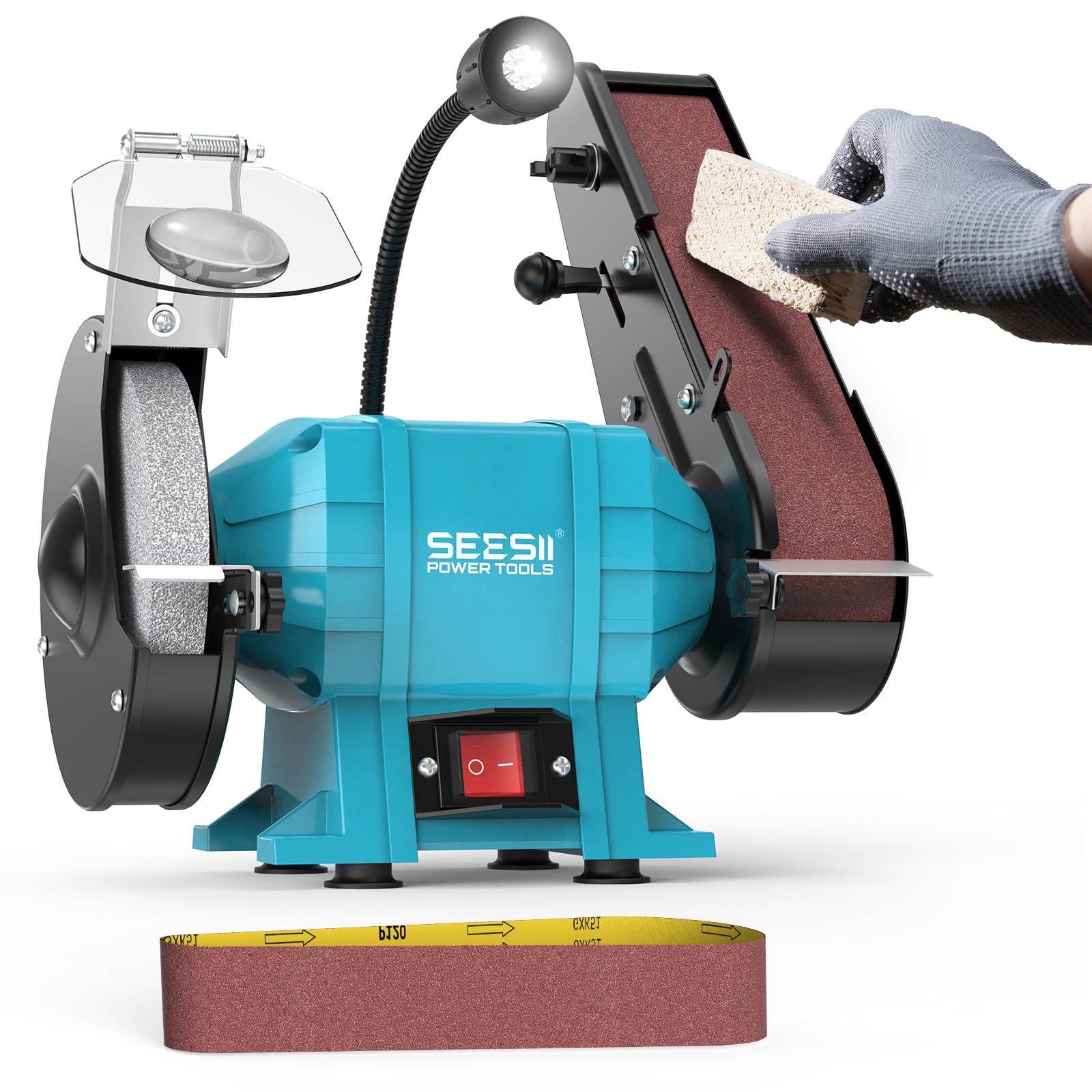
4. SEESII Bench Grinder and Belt Sander Combo: 2″x27″ Belt + 6″ Disc, 2.5A Motor
A 2.5-amp two-in-one that grinds and sands without swapping machines.
Entry-level buyers should start here. The SEESII pairs a 2″ x 27″ sanding belt with a 6″ grinding wheel so you can grind one side and sand the other without changing tools, and the 2.5 A motor spins to 2950 rpm from a 110 V corded supply. Against the JET above it, the difference is plain: 2.5 A versus 6.2 A, a 2.5x gap in current draw, so this is a light-duty machine for home jobs and weekend projects rather than a production bench. It also takes the smallest footprint in the group at 18.5″ wide — tighter than the 22.75″ of the JET.
The features that earn it a spot are aimed squarely at beginners. A belt release latch lets you swap sandpaper with one touch instead of fighting the tensioner, and a tracking adjustment knob controls belt position to keep it from creeping. The tri-function shield focuses light while magnifying the work and blocking sparks, and an adjustable LED work light helps in dim corners of a garage. It ships with an 80-grit belt, 120-grit paper, and a 60-grit wheel for wood, metal, and plastic.
Here is the trade-off to size correctly: this machine needs adjustment before it runs well, and it is not the right pick if you want out-of-the-box perfection. The 2.5 A limit means it bogs sooner on thick steel than the higher-amp machines, and a minority of the smaller owner base hit belt path issues. Size the machine to the job — light grinding, blade touch-ups, and hobby sanding are where it feels settled. Owners who took the time to tighten the hardware and align the belt report it performs well for a DIY garage, and the compact build keeps it stable without bolting down.
Value read: the most compact and least expensive machine here, with a belt release latch and tracking knob that make it friendly for a first-time sander buyer.
Best for the first-timer: home DIYers who want a combined grinder and belt sander in a small footprint and accept a setup and align session on day one.
Step up instead if: you plan to grind thick metal regularly — the 2.5 A motor is the ceiling you will feel quickest.
Understanding the Specs
Amperage (A) — The Power Number
Amperage is how much electrical current a motor pulls while working. Higher amperage means the motor resists bogging down when you press harder or feed thicker steel. On 2-inch belt sanders the range spans 2.5 A up to 6.2 A. A 2.5 A machine is fine for wood and light touch-ups, while a 6.2 A unit is built to hold its speed through metal and hardwood. If you sharpen knife blades or grind steel all day, a higher amp draw is worth shopping for.
RPM — Speed Where It Counts
RPM stands for revolutions per minute, and it describes how fast a disc or wheel spins. Higher rpm removes material faster and leaves a finer scratch pattern, but it also builds heat faster — which matters when you grind blade steel. Note that rpm is only useful when you know what it refers to — a disc speed and a belt speed are different numbers on the same machine. Check which surface the rpm is quoted for before you assume it describes the belt.
FAQ
What can a 2-inch belt sander actually do that a wider one cannot?
How do I stop the belt from drifting off to one side?
Is a higher amp rating always better on a 2-inch belt sander?
Do I need dust collection on a belt and disc sander?
What grit belt should I start with on a 2-inch belt sander?
Why does my belt sander take so long to reach full speed?
Can I use a 2×42 belt on a sander that ships with a 2×27 belt?
Is a 2-inch belt sander good for sharpening a chisel or plane iron?
How much space does a bench belt and disc sander need?
Should I buy a belt and disc combo or a belt-only machine?
Final Thoughts: The Verdict
For most shop owners buying a 2-inch belt sander, the winner is the JET J-41002 because its 6.2 A draw, cast-iron base, and 8″ disc hold up to daily metal and knife work that lighter machines cannot match. If sharpening blades and chisels is your main job, reach for the KFMK 2×42 combo and its tilting 6″ disc. For a compact bench in a small garage, the VEVOR 2IN1 brings 3450 rpm disc speed into a footprint that fits apartment-sized shops. Budget-first buyers who accept a setup session get solid value from the SEESII combo. Buy the belt grits to match how hard you push, keep a vacuum hooked up for metal dust, and whichever machine you pick will return the favor.
How We Picked
We do not accept paid placement. Every pick is matched to a real buyer and a real use-case; we do not hands-on test units.
Sources & Methodology
Specifications: manufacturer listings and product documentation. Review insights: verified customer reviews, as of September 2026. Pricing: not shown on this page (it changes often); check the current price via the retailer link.
As an Amazon Associate, KitchPrep earns from qualifying purchases. This does not affect which products we feature.
Related Guides
