
Specs are compiled from manufacturer listings and verified buyer reviews and can change over time — please confirm the key details on the product page before buying.
A water heater that pops, drips, or trips its relief valve is usually telling you one thing: expanding hot water has nowhere to go. A 2-gallon expansion tank fixes that by giving the extra volume a place to sit, which steadies your whole plumbing system. Quick note before you shop: this list uses flexible sizing, so it accepts the nearest sold tank size (roughly 2 to 2.5 gallons) rather than only a tank labeled exactly “2 gallon.” A 2.1-gallon tank does the same job as a 2-gallon one, so nothing here is a compromise on purpose.
I’m Mohammad Maruf — the founder and writer behind KitchPrep. This guide is built by comparing the manufacturers’ published specifications and the patterns across verified customer reviews, so you get each pick’s real strengths and trade-offs instead of marketing spin.
What follows is a plain-English walkthrough: how to size a tank, what the pre-charge number means, and which connection thread fits your pipe. By the end you should be able to pick the right expansion tank for your system without a plumber standing over your shoulder.
Our Picks at a Glance


How To Choose The Best 2-Gallon Expansion Tank
An expansion tank is a small steel or plastic vessel with a rubber bladder inside. When your water heater warms up, the water inside it grows in volume. That extra water needs somewhere to go, or it pushes back against the pipes and the relief valve. A tank gives it that room. Get the size, the pressure setting, and the thread match right, and the whole thing installs in under an hour.
Start with the pre-charge pressure, not the tank
Every tank arrives with air already sealed behind the bladder — the “pre-charge,” measured in pounds per square inch (PSI). That number has to sit close to your home’s own water pressure before you connect anything. Too far off and the bladder may not flex the way it should. Most tanks here ship set between 30 and 40 PSI, so a quick check with a standard tire gauge and a bicycle pump is the first job.
Match the connection thread to your pipe
The threaded fitting where the tank meets your plumbing is the one part you cannot adjust later. Most of these tanks use a 3/4-inch male connection (written as 3/4″ MNPT — a standard tapered pipe thread). One pick here uses a 1/2-inch female NPT instead, which means you thread a male fitting into it. Check your existing pipe or your old tank’s fitting before you order.
Know when potable approval matters
A potable-water tank is built to sit on the drinking-water side of your system, so its materials are rated for contact with water you drink. A non-potable tank is meant for closed-loop heating circuits, where the water recirculates through radiators or baseboard and never touches a tap. Buying the right one for your loop is the simplest safety decision in this whole category.
Quick Comparison
| Model | Best For | Capacity | Connection | Max Pressure | Amazon |
|---|---|---|---|---|---|
| Watts PLT-5★ Best Overall | Potable water heater protection | 2.1 gallons | 3/4″ Male | — | Amazon |
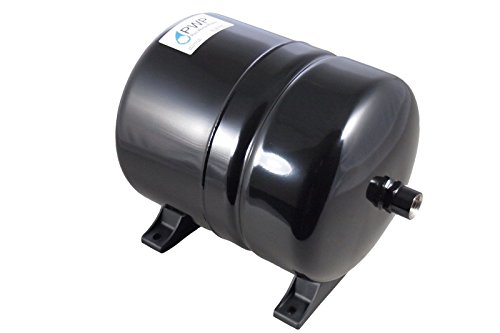
| 2 Gallon Accumulator Tank With BracketMost Versatile | RV and off-grid pump systems | 2 gallons | 1/2″ Female NPT | 130 PSI liquid | Amazon |
| EASYFLEX Thermal Expansion TankCompact Pick | Water heater retrofits | 2.1 gallons | 3/4″ MIP | — | Amazon |
| Watts ETX-15 | Closed-loop hydronic heating | 2.1 gallons | 1/2″ MNPT | 75 PSI | Amazon |
| SEAFLO Accumulator Tank | RV, marine and off-grid water | 2 gallons (8L) | 3/4″ MNPT | 87 PSI | Amazon |
| Neo-Pure Thermal Expansion Tank | Systems with backflow preventers | 2.1 gallons | 3/4″ MNPT | — | Amazon |
| GE Appliances Expansion Tank | Tight water heater closets | 2.1 gallons | 3/4″ MNPT | 80 PSI charge | Amazon |
| Thrifco 4906032 | Under-sink and compact installs | 2 gallons | 3/4″ MIP | 150 PSI | Amazon |
| EFIELD Water Heater Expansion Tank | Budget water heater protection | 2.1 gallons | 3/4″ MNPT | — | Amazon |
In‑Depth Reviews
1. Watts PLT-5 Potable Water Expansion Tank 2.1 Gallon 3/4″ Male Connection
Our pick — over 4.5★ from 450+ verified ratings; the strongest balance of quality and price.
A 2.1-gallon steel tank with a stainless inlet that holds your house pressure steady at 70 psi.
If your water heater pops and your relief valve keeps firing, this is the tank most people end up buying — and the crowd backs it, at 4.7 stars from 400+ ratings. Watt’s PLT-5 holds 2.1 gallons inside a carbon steel shell with an epoxy finish, and the expansion membrane inside is built to keep its air charge instead of slowly bleeding it away. That membrane is the part that matters: a tank only works while there is still air behind the bladder to push back against the water.
The 3/4-inch male connection (a standard tapered pipe thread, so it screws straight into a matching female fitting) mounts directly to your supply piping, standing on a pipe or hanging from one. Buyers report it holds a peak of about 70 psi, which is exactly the job — absorbing expansion so the pressure never climbs to the point where the relief valve opens. Install follows a familiar pattern: teflon tape and pipe dope on the threads, a pressure gauge to read your house pressure, and a small portable compressor to bring the tank up to that same number before it goes on.
What wins people over is the build quality, and it is not close — the tank is the single most-discussed strength here, far ahead of everything else. The honest caveat sits with durability, where the picture is genuinely mixed: some tanks run for years, and a few owners have seen one give out after about four years. Worth knowing before you buy, but it is not the headline. One practical tip from the review pages: add a snubber or throttle valve on the tank branch to stop water hammer, since the flow rate is low enough that a small opening does the job.
What Holds Up
- 2.1-gallon capacity absorbs thermal expansion on a residential closed loop
- Stainless steel inlet with a 3/4-inch male connection for a direct fit on supply piping
- Epoxy-finished carbon steel body and an expansion membrane that resists air-charge loss
- Owners mention it holding a peak of about 70 psi, which keeps the relief valve quiet
What To Weigh
- Durability feedback is mixed — most last years, a few report failure around the four-year mark
- Needs teflon tape, pipe dope, a pressure gauge and a compressor on hand at install
- Removing the old tank takes two wrenches, so allow more time than the swap itself suggests
Go with this if: you want the tank with the strongest track record on a drinking-water system and you have basic tools plus an air compressor. Look elsewhere if: you are working on a closed-loop boiler circuit — that loop needs a non-potable tank instead.
2. 2 Gallon Accumulator Expansion Tank With Wall Mount Bracket 1/2″ Female NPT
The bracket is already on the tank, so it goes on the wall instead of fighting for floor space.
RV owners are the loudest fans of this one, and the reason is simple: it stops the water pump from clicking on and off every few seconds. That stop-start cycling is the thing people hate most about an RV pump — the noise, the pulsing pressure, the wear on the pump motor. This tank kills most of it. Owners describe pressure strong enough to wash hands without the pump kicking in, and roughly 30 seconds of continuous pressurized flow from the stored air charge.
Inside is a 2-gallon tank built for gas, oil or electric water heaters and potable water storage, rated to 130 PSI of liquid pressure and pre-pressurized to 30 PSI of air. That pre-charge is a starting point, not a setting — a Shurflo pump switching on at 38 psi and off at 55 psi wanted the bladder inflated to about 35 psi to behave properly. Get that number dialed in and the pump runs far less often, recharging in roughly 20 seconds instead of pulsing constantly. Handy bonus: the custom wall brackets are in the box, so you only need two screws.
The one to know about is sizing in a tight rig — a couple of RV owners find it takes up more room than the benefit justifies in a small camper, though the same tank moved under a bed and ran fine for another bathroom. The pump-cycling fix is what this tank is known for, and it is the most-discussed strength by a wide margin here. If your pump cycles and you have a wall to mount to, that is the whole pitch.
Where it earns its keep: a 2-gallon tank rated to 130 PSI liquid with pre-pressurized air at 30 PSI, wall brackets included, and a 1/2-inch female NPT port that takes a male fitting from your PEX or push-to-fit line. Owners isolate it with a shut-off valve and a sprinkler adapter so winterizing stays simple.
Where it asks something back: you have to tune the air charge yourself — start near your pump’s cut-in pressure and drop it 4 to 5 PSI if the tank is not filling the way you expect. Getting that number wrong is the difference between smooth flow and no change at all.
Reach for this if: you run an RV, camper or boat pump and want the cycling to stop without cutting a new hole in your plumbing. Think twice if: your compartment is genuinely tiny — measure the mounting spot before you commit.
3. EASYFLEX 2.1 Gallon Thermal Expansion Tank for Water Heaters, 304 Stainless Steel, 3/4″ MNPT Connection
A stainless connection and a full butyl diaphragm aimed at the owner who wants a quiet, long-lived swap.
Here is the detail that separates this tank from the pack: the 3/4-inch connection is 304 stainless steel (a corrosion-resistant grade of steel), not plain coated metal. On a tank that sits on your water line for years, that connection is the part most exposed to water and the part most likely to seize or pit. The body underneath is heavy-duty cold-rolled steel with a 100% butyl rubber diaphragm — a synthetic rubber that holds up better than natural rubber against hot water — plus a polypropylene liner to keep water off the tank wall.
It is made in South Korea in facilities that undergo annual quality audits for major North American home-improvement retailers, and it carries UPC certification with NSF/ANSI 61 compliance and lead-free construction for drinking-water contact. A service technician working on one owner’s heating system called the tank superior quality compared to what he would have pulled from his own truck inventory. That is a working pro’s read on the part, which carries more weight than a spec sheet.
Where it separates from the Watts PLT-5 above is choice: EASYFLEX also offers this tank in a 4.5-gallon capacity, so if your expansion math comes out larger, you are not stuck at 2.1 gallons. Against the smaller Thrifco, the stainless connection and the 100% butyl diaphragm are the step up. The honest note is that the diaphragm can need a recharge with air over time, so keep a pump and gauge handy. An optional wall mounting bracket kit exists separately if you want it off the floor.
The stainless detail that lasts: a 304 stainless 3/4-inch MIP connection, a heavy-duty cold-rolled steel body, a 100% butyl rubber diaphragm and a polypropylene liner — the combination that keeps a tank working instead of corroding from the inside.
What to plan around: the wall bracket is a separate purchase, and the air charge is not a fit-and-forget setting. Customers note recharging occasionally with air, which is normal for any bladder tank but worth a calendar note.
Pick this one if: you want a potable-rated tank with stainless threads, a butyl diaphragm and the option to size up to 4.5 gallons. Pass if: you need a packaged mounting bracket included — this one sells it as a separate kit.
4. Watts ETX-15 2.1-Gallon Non-Potable Expansion Tank for Closed-Loop Systems
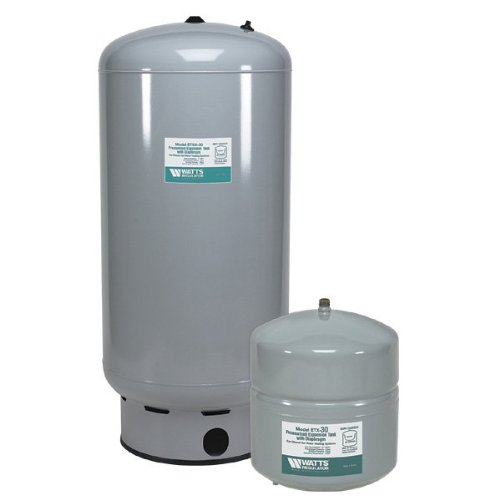
Built for boiler water that never touches a tap, with a 12 psi factory charge already in the bladder.
Do not buy this one for your drinking water line. The ETX-15 is a non-potable tank made for closed-loop hydronic heating — the sealed circuit that runs through radiators or baseboard and recirculates forever. It holds 2.1 gallons inside an epoxy-finished carbon steel shell, comes pre-charged at 12 psi, and carries a maximum pressure of 75 psi. The connection is 1/2-inch MNPT, smaller than the 3/4-inch fittings on most of the water-heater tanks here, so check your boiler piping before ordering.
For a boiler loop, the work it does is dramatic in plain numbers. Owners replacing an old tank of the same size report the loop pressure now peaking at 25 to 28 lbs even as water temperature climbs from 115°F to 180°F — before, that same temperature swing was pushing pressure high enough to dribble the relief valve. It is a direct-fit replacement in most cases, and one owner swapped it in around 45 minutes.
Two things stand out from the long-term picture. First, these tanks can run a very long time — one owner’s original lasted at least 16 years before the bladder split. Second, when they do fail, they fail at the bladder, and a handful of owners have found pinhole leaks. Leakage feedback lands mixed and durability leans negative here, which is the normal end-of-life story for a bladder tank rather than a reason to avoid the model. Expect to replace one eventually; that is what expansion tanks do.
The boiler-loop case: a 2.1-gallon non-potable tank pre-charged at 12 psi, capped at 75 psi maximum, with a 1/2-inch MNPT connection and a durable expansion membrane built to keep its air charge over a long service life.
The bladder reality: these fail at the membrane eventually, and the review pages show an occasional pinhole leak and one dented-on-arrival unit. A 16-year run is not unusual, so treat replacement as maintenance, not a fault.
This is your tank if: you have a hydronic boiler or baseboard loop with a 1/2-inch connection and a pressure gauge creeping upward. Keep looking if: you need a drinking-water tank — this one is not rated for potable use.
5. SEAFLO 2 Gallon Pre-Pressurized Accumulator Expansion Tank, 87 PSI, 3/4″ MNPT

A 2-gallon marine-grade tank with a bicycle-pump valve on top and a four-year warranty behind it.
Saltwater is brutal on plumbing, and SEAFLO built this for exactly that environment. It holds 2 gallons (8 liters in the listing’s own measure), handles up to 87 PSI, and wears a corrosion-resistant coating aimed at marine conditions and outdoor off-grid installs. The 3/4-inch MNPT inlet and outlet are universal, so it drops into most existing pump setups without adapters, and the compact body mounts in tight compartments aboard boats, RVs and cabins.
The part you will actually use is the Schrader valve on top — the same valve as a bicycle tire, so a standard pump adjusts the internal air pressure. That is how you match the tank to your pump’s cut-in pressure, and getting it right is what reduces cycling and steadies the flow to showers, sinks and faucets. Cutting pump starts also means drawing less battery power, which matters on a solar or off-grid setup. The four-year limited warranty is the longest coverage on this list.
The recurring gripe is the threads — thread quality draws the most negative feedback here, and a few owners found them rough on arrival. Run a close look at the fittings before install and use tape generously. Everything else lands positive: the pump function is the most-discussed strength, followed by pressure control and fit. One owner dropped it into a sprinkler supply line purely as an anti-hammer device and reported the pipe knock vanished entirely, after smaller anti-hammer devices had done nothing.
What sets it above the RV bracket tank: an 87 PSI maximum makes it the higher-pressure option of the two, and the built-in Schrader valve puts pressure tuning right on top of the tank with no extra port needed.
What you should inspect first: the connection threads. They are the weakest point in the feedback, so check them before you seal anything up.
Built for you if: you run a boat, RV or off-grid cabin pump in a wet or saltwater environment and want the longest warranty on the list. Skip if: you want a tank for a residential water heater — this one belongs on a pump circuit.
6. Neo-Pure 2.1 Gal Thermal Expansion Tank, 3/4″ MNPT, Butyl Diaphragm and Corrosion-Resistant Finish
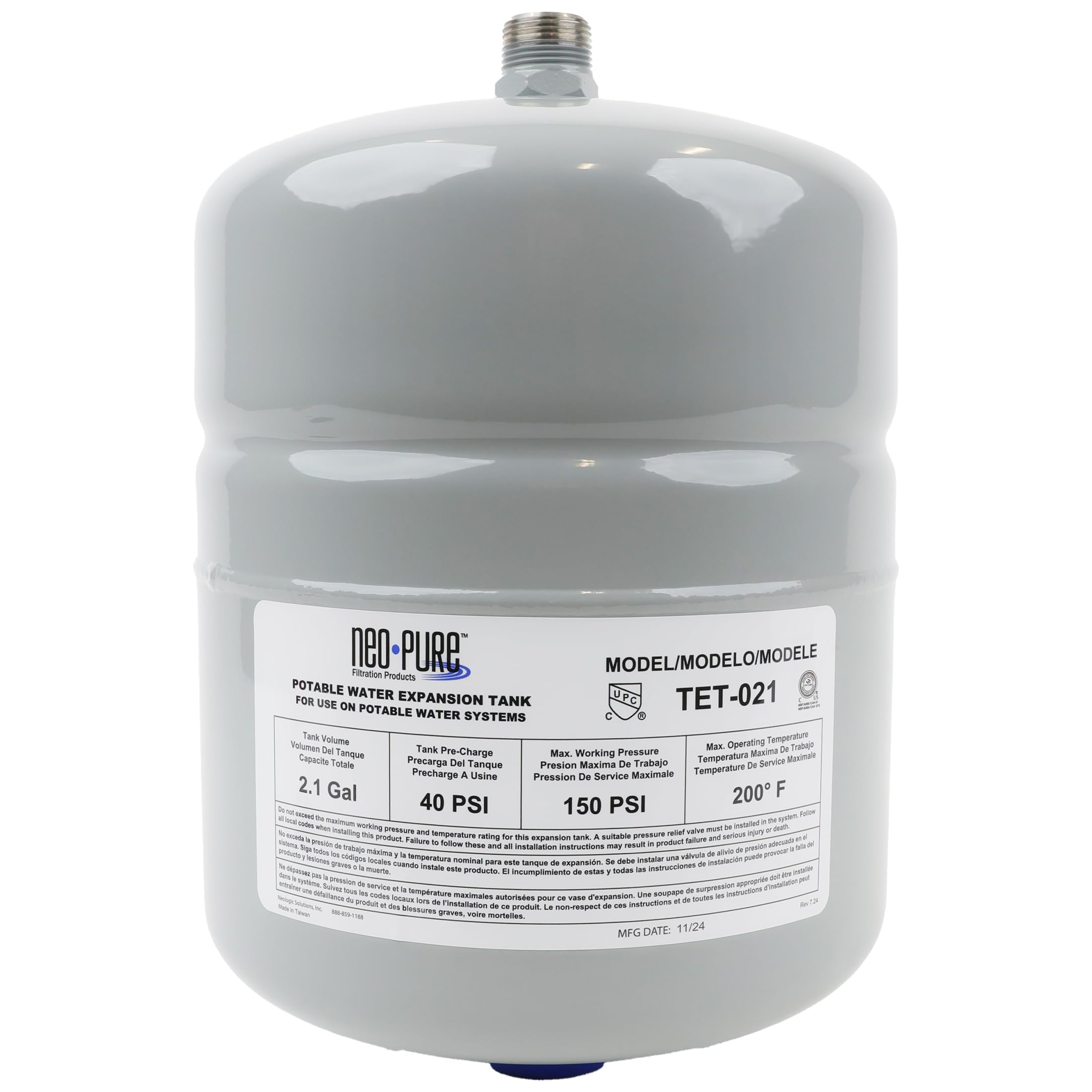
A 2.1-gallon tank aimed at homes fitted with a backflow preventer or check valve.
If your system has a backflow preventer or a check valve, your plumbing is already sealed — and sealed systems are where expansion tanks stop being optional. That is the exact case this Neo-Pure tank is built for. It holds 2.1 gallons, manages the extra water volume a water heater creates as it warms, and uses a butyl rubber diaphragm to keep system water away from the tank’s inner steel wall. A polypropylene liner adds a second layer against corrosion.
The 3/4-inch MNPT connection matches the standard fitting on most residential water heaters, and the five-pound tank is light enough to handle alone. Function is what this tank is known for, and it is the most-discussed strength by a clear margin. Owners running a 55 psi system behind a 40-gallon heater describe a problem-free install and a tank that simply does the job it was bought for.
Value comes second in the feedback, which tracks with the price — this sits in the middle of the pack, below the premium Watts tanks and above the entry-level EFIELD. The trade-off is simply that it is a no-frills part. There is no wall bracket included, and no extra capacity option like the EASYFLEX’s 4.5-gallon size. If your loop is a standard residential heater on a sealed line, none of that matters.
The clean setup for a sealed system: 2.1 gallons, a butyl rubber diaphragm separating water from the tank wall, a polypropylene liner against corrosion, and a 3/4-inch MNPT connection that matches standard heater fittings.
The no-frills note: you get the tank and nothing else — no bracket, and no larger size in this model line. Budget for a strap or bracket if you want it off the floor.
Right for you if: your home has a backflow preventer or check valve and you need a straightforward 2.1-gallon potable tank. Not for you if: you want a mounting bracket in the box or the option to size up.
7. GE Appliances Water Heater Expansion Tank, 2.1 Gallon, Pre-Charged 40 PSI, 3/4″ MNPT, Max Temp 200°F
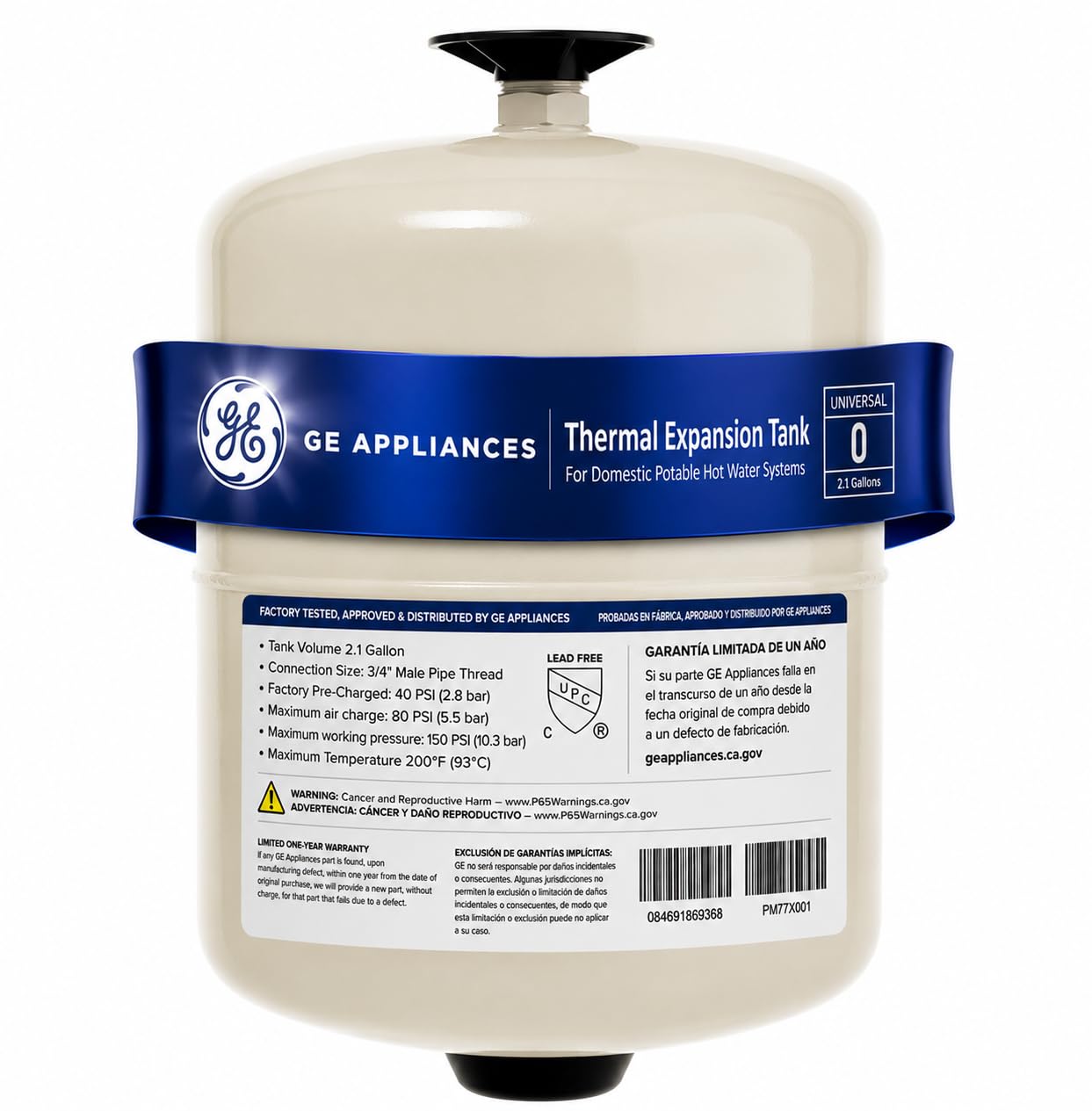
A 2.1-gallon tank that still fits when the water heater is shoved into a closet.
Small water closets are where most expansion tanks become a problem, and this GE tank was bought specifically because it fit. It holds 2.1 gallons in a free-standing carbon steel body, arrives factory pre-charged to 40 PSI, and takes a charge up to 80 PSI — a range that covers a well system with room to spare. The 3/4-inch MNPT fitting is standard, and the carbon steel construction is rated to a maximum temperature of 200°F for residential water heaters.
The install story is refreshingly short on drama. One owner swapped out an old Watts tank in about 15 minutes, and the trick to the old unit coming off was patience — it held roughly 15 lbs of water, so unscrewing it fast would have made a mess. Thick grey Teflon tape did the sealing job, and the factory air charge was left at 40 PSI. A GE-branded tank also means you can match it to a GE water heater and keep the whole system on one brand.
What stands out most is a pattern in who buys it: this tank catches a lot of owners who are not plumbers. One admitted they were not handy at all, bought it on brand trust, and had a technician install it — and that technician called it “a good one.” It also arrives bubble-wrapped, and the plastic cap over the threads keeps them clean and undamaged in the box. Three months in, one install was still leak-free. That is the whole review, and it is a good one.
Straightforward Wins
- 2.1-gallon free-standing tank compact enough for a tight water closet
- Factory pre-charged at 40 PSI, chargable up to 80 PSI for well systems
- 3/4-inch MNPT fitting and carbon steel construction rated to 200°F
- Arrives bubble-wrapped with a plastic thread cap protecting the connection
Consider Before Buying
- No bracket included, and the free-standing body needs floor space
- The 40 PSI factory charge may need adjusting to match your system pressure
- A newer listing with a shorter track record than the long-running Watts models
Choose this if: your water heater lives in a cramped closet and you want a mainstream-brand tank with a 200°F rating. Look at the Watts PLT-5 instead if: you want a longer-proven model and do not need the compact footprint.
8. Thrifco 4906032 2 Gal. Thermal Expansion Tank for Potable Water Heater
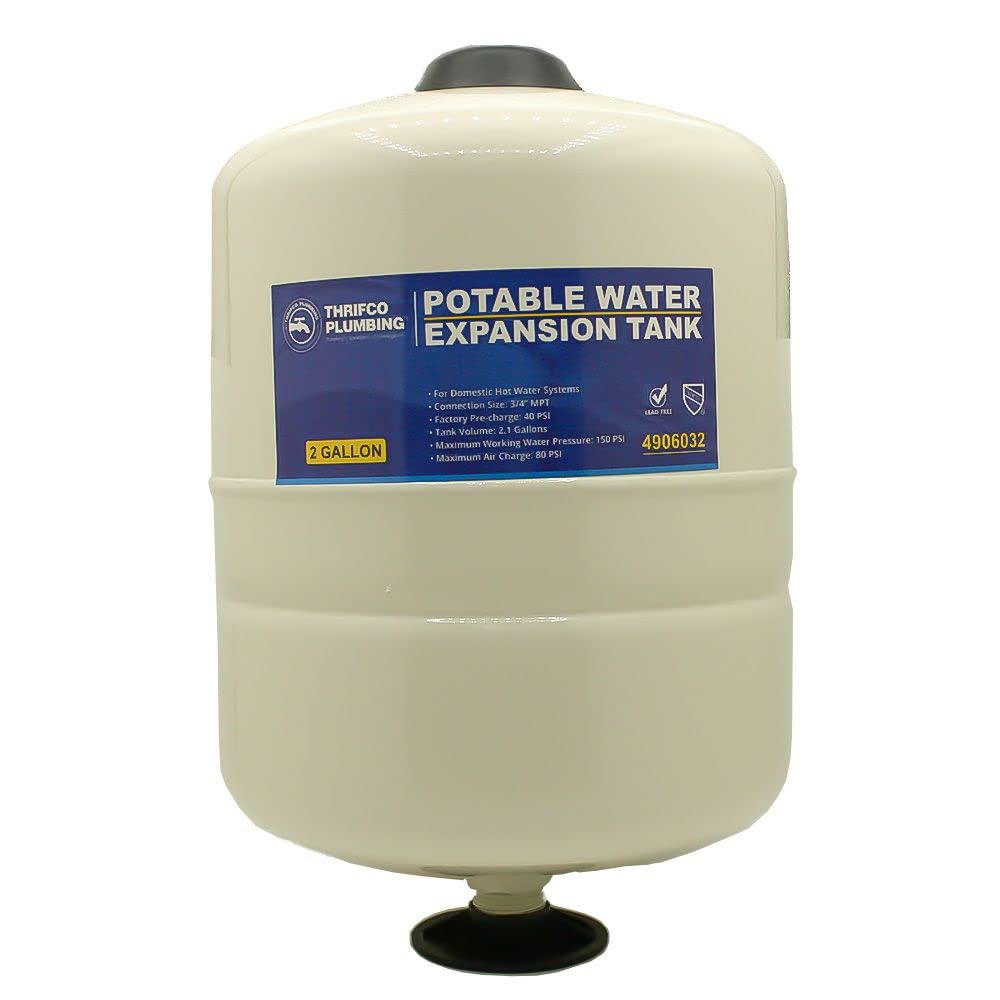
A 150 PSI tank with a butyl diaphragm that slides under a kitchen sink without a fight.
Under-sink installs are where this Thrifco earns its spot. One owner fitted it beneath a kitchen sink alongside an auxiliary electric hot water heater and reported it functioning exactly as intended. The 2-gallon tank measures 7.5 inches wide by 12 inches tall, which is short enough to tuck into a cabinet space. The 150 PSI maximum pressure rating is the highest on this list, and the factory pre-charge sits at 40 PSI with an operating limit of 200°F.
The internals are the interesting part. A butyl diaphragm absorbs the expansion, a polypropylene liner stops internal corrosion, and the pre-charge valve is protected to remove a potential leak path. MIG welding is used on the body to eliminate interior rough spots and sharp edges, every tank is factory leak tested, and the shell is carbon steel with a baked epoxy-polyester coating for a durable finish. The connection is a stainless steel 3/4-inch MIP with a hex fitting, and the tank is UPC certified and NSF 61 compliant for potable water.
Getting the pressure right is the one step nobody skips. The recommended routine is to run a tap for a minute, check your water pressure, then pump the tank with a bicycle pump to match that number before shutting off the water and swapping the old tank out. Reviewers point out the result: stable water pressure and no more dripping from the temperature-and-pressure valve. Weight the whole picture and this is a solid, well-specified tank at an approachable price, in a body small enough for places a bigger tank cannot go.
What the spec sheet gives you: a 150 PSI maximum, a 40 PSI factory pre-charge, a 200°F operating limit, a butyl diaphragm with a polypropylene liner, MIG-welded interior, and a stainless 3/4-inch MIP connection — more headroom than a standard residential loop ever asks for.
The habit it asks for: match the tank’s air charge to your house pressure before install. Do that with a gauge and a bicycle pump and the pressure stays steady; skip it and the tank underperforms.
Best suited to: anyone mounting a tank under a sink or in a cabinet where height and clearance are tight. Think again if: you need a wall bracket or want a tank with a long-running review history — this one is the newer, compact specialist.
9. 1PC EFIELD Water Heater Expansion Tank, 2.1 Gallon, 3/4 in MNPT Connection
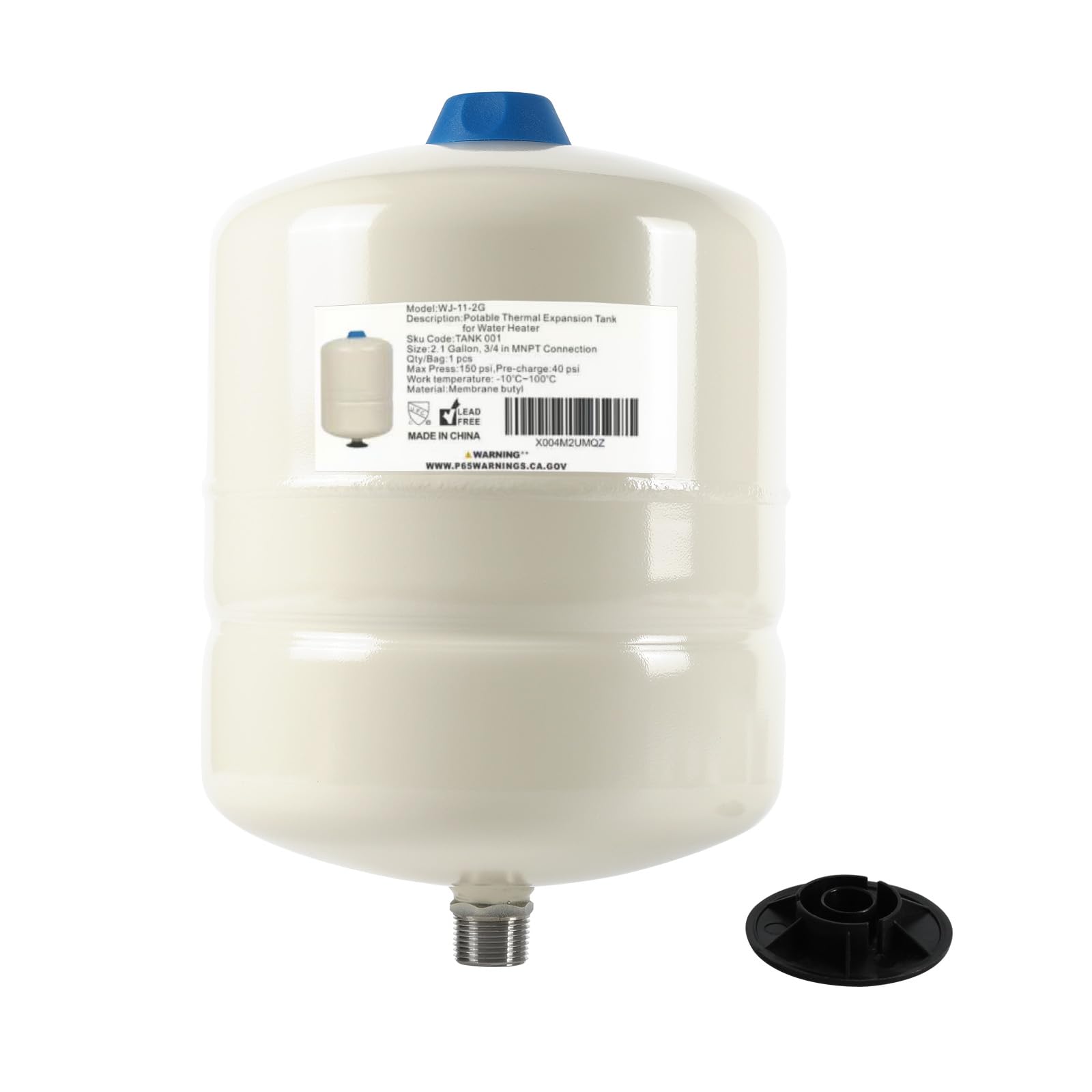
The entry-level 2.1-gallon tank that stops a water heater from popping its relief valve.
This is the least expensive way onto this list, and it covers the essentials without trimming the parts that matter. You get 2.1 gallons of capacity, a 3/4-inch MNPT connection for a quick hookup, and construction rated for potable water — so it is safe on the drinking-water side of your system. The tank weighs 5 pounds and mounts on the floor, with securing straps included to hold it in place.
The problem it solves is the one that sends most people shopping. A water heater that keeps popping its over-pressure valve is a classic symptom of a sealed system with nowhere for expanding water to go. Owners who added this tank to their heater report that the popping went away. Another described it as a direct replacement for a tank with a ruptured bladder, pressurized to just over 60 psi against a 60 psi house system and running fine.
Two honest notes. The finish is a plain white coating, not the epoxy finish on the premium Watts tanks, so it is a plainer-looking part once installed. Owners also describe it as heavy for its size — the same metal that makes it sturdy is the same weight you handle at install. And be deliberate about mounting: it is oversized for some setups, and sitting it lower than the top of the plumbing helps avoid an air bubble forming in the line.
Why It Sells
- 2.1-gallon potable-rated tank at the lowest entry point on this list
- 3/4-inch MNPT connection installs easily with a standard nipple
- Metal body that is well welded and sturdy, with securing straps in the box
- Shoppers say it stopping water heater pressure-valve popping
What To Expect
- Plain white finish instead of a baked epoxy coating
- Heavy for its size, so plan a two-hand install
- Needs a lower-than-plumbing mount to avoid trapping an air bubble
Made for: a first expansion tank on a standard residential water heater, when you want the job done without paying top tier. Step up if: you want an epoxy-finished shell and a longer-proven brand — the Watts PLT-5 above is the same 2.1 gallons with more polish.
Understanding the Specs
Capacity in Gallons
Capacity is how much expanded water the tank can absorb before the pressure climbs past your relief valve’s setting. Every tank on this list sits at 2 or 2.1 gallons, which covers a standard residential water heater. Bigger heaters or systems that run very hot water can call for more room, which is why a tank sold in a larger capacity matters — the EASYFLEX here also comes in a 4.5-gallon size. Match the tank to your heater’s size and the temperature it runs at, not just to the number on the label.
Pre-Charge Pressure (PSI)
The pre-charge is the air pressure sealed behind the bladder at the factory, measured in PSI — pounds per square inch of force. Before installation you compare it to your home’s water pressure and adjust with a bicycle pump if the two are far apart. Tanks here ship set at a range of values: 12 psi on the Watts ETX-15, 30 psi on the Pro Water Parts accumulator, and 40 psi on the GE and Thrifco models. A pre-charge close to your system pressure lets the bladder flex the way it was designed to.
Connection Threads
This is the fitting where the tank screws onto your plumbing, and it is fixed — you cannot change it after purchase. Most tanks here use a 3/4-inch male NPT thread written as 3/4″ MNPT or 3/4″ MIP, which threads into a matching female fitting. A couple use other sizes: the Pro Water Parts accumulator takes a 1/2-inch female NPT, and the Watts ETX-15 uses a 1/2-inch MNPT. Write down your existing fitting or your old tank’s thread before you order, or the install stalls on day one.
Potable vs Non-Potable
Potable means the tank is built for contact with drinking water, using materials rated for that job. Non-potable tanks are meant for closed-loop heating circuits, where water recirculates through radiators and never reaches a tap. Tanks here carry potable ratings and certifications such as NSF 61, while the Watts ETX-15 is explicitly a non-potable model for closed-loop systems. Buying the right type for your loop is the single most important safety call in this category.
FAQ
Do I actually need a 2-gallon expansion tank on my water heater?
What PSI should my expansion tank be charged to?
Will a 2-gallon tank fit above my water heater?
Can I install an expansion tank myself or do I need a plumber?
How long does an expansion tank last before it needs replacing?
Where do I mount an expansion tank if I have no space above the heater?
Is a non-potable tank the same as a potable one?
My tank reads different from the factory setting — can I adjust it?
Why does my water pressure spike when the heater runs?
Can I use one tank for both my water heater and my hydronic boiler?
Final Thoughts: The Verdict
For most households on the drinking-water side, the 2-gallon expansion tank winner is the Watts PLT-5 because it pairs a 2.1-gallon capacity and a stainless inlet with the strongest build-quality reputation on this list — the crowd favorite at 4.7 stars across 400+ ratings. If you are fixing a boiler loop instead of a heater, grab the Watts ETX-15, which is the non-potable 2.1-gallon tank rated to 75 psi and pre-charged at 12 psi. And for an RV, boat or off-grid pump that cycles constantly, the 2 Gallon Accumulator Tank With Wall Mount Bracket is the one to reach for, brackets included. Match the tank to your loop, set the air charge to your house pressure, and the popping stops.
How We Picked
We do not accept paid placement. Every pick is matched to a real buyer and a real use-case; we do not hands-on test units.
Sources & Methodology
Specifications: manufacturer listings and product documentation. Review insights: verified customer reviews, as of September 2026. Pricing: not shown on this page (it changes often); check the current price via the retailer link.
As an Amazon Associate, KitchPrep earns from qualifying purchases. This does not affect which products we feature.
Related Guides
