
Specs are compiled from manufacturer listings and verified buyer reviews and can change over time — please confirm the key details on the product page before buying.
A 1500W space heater cannot hold a 400–600 sq. ft. two-car garage at temperature in freezing weather. That cold slab of concrete soaks up warmth, the door seals leak, and a little plug-in box just hums at the baseboards while your breath still fogs. The fix is matching fuel type — electric, propane, or natural gas — to your garage’s square footage and available wiring. This guide covers ten garage heaters, from 1500W wall units to an 80,000 BTU gas unit heater.
I’m Mohammad Maruf — the founder and writer behind KitchPrep. This guide is built by comparing the manufacturers’ published specifications and the patterns across verified customer reviews, so you get each pick’s real strengths and trade-offs instead of marketing spin.
You will see what each heater needs to run, how much space it actually warms, and the wiring or fuel setup behind it. By the end you can match a heater to your garage’s square footage, wiring, and fuel access. Here is a clear look at the 2 car garage heater options worth putting on your shortlist.
Our Picks at a Glance


How To Choose The Best 2 Car Garage Heater
To choose a garage heater, answer three questions: how much heat you need, what fuel or power you have, and where the unit will live. Get those right and the rest is detail.
Match Heat Output To Your Square Footage
Heat output is measured in BTU (British Thermal Units — the standard unit for how much heat a device produces). A two-car garage is typically 400 to 600 square feet, and most heaters in this range are rated for a specific coverage area. An 18,000 BTU propane unit covers up to 450 square feet, while a 7,500W electric unit can handle 1,250 square feet. Overshoot the coverage and you waste energy; undershoot it and you will never feel warm.
Electric vs Propane vs Natural Gas
Electric heaters plug in or hardwire to your panel and need no fuel delivery. Higher-wattage models like 5,600W or 7,500W units require a dedicated 240V circuit — that means a double-pole breaker, heavy-gauge copper wire, and often an electrician. Propane gives you portability and works during power outages, but needs a tank and ventilation. Natural gas is the cheapest to run long-term but requires a permanent gas line and professional installation.
Mounting, Safety, And Clearance
Ceiling and wall mounts keep the floor clear and put heat where you work, but they add installation steps. Look for overheat protection, tip-over shut-off on portable units, and ETL or UL certification. Radiant heaters warm people and objects in front of them, which suits a workbench; forced-air units circulate warmth through the whole room, which suits open floor plans. For fuel-burning models, always check the clearance requirements and ventilation needs before you buy.
Quick Comparison
| Model | Best For | Heat Output | Coverage | Power Source | Amazon |
|---|---|---|---|---|---|
| GASLAND MHA18BN Propane Radiant Heater★ Best Overall | Portable off-grid warmth | 18,000 BTU | 450 sq. ft. | Propane | Amazon |
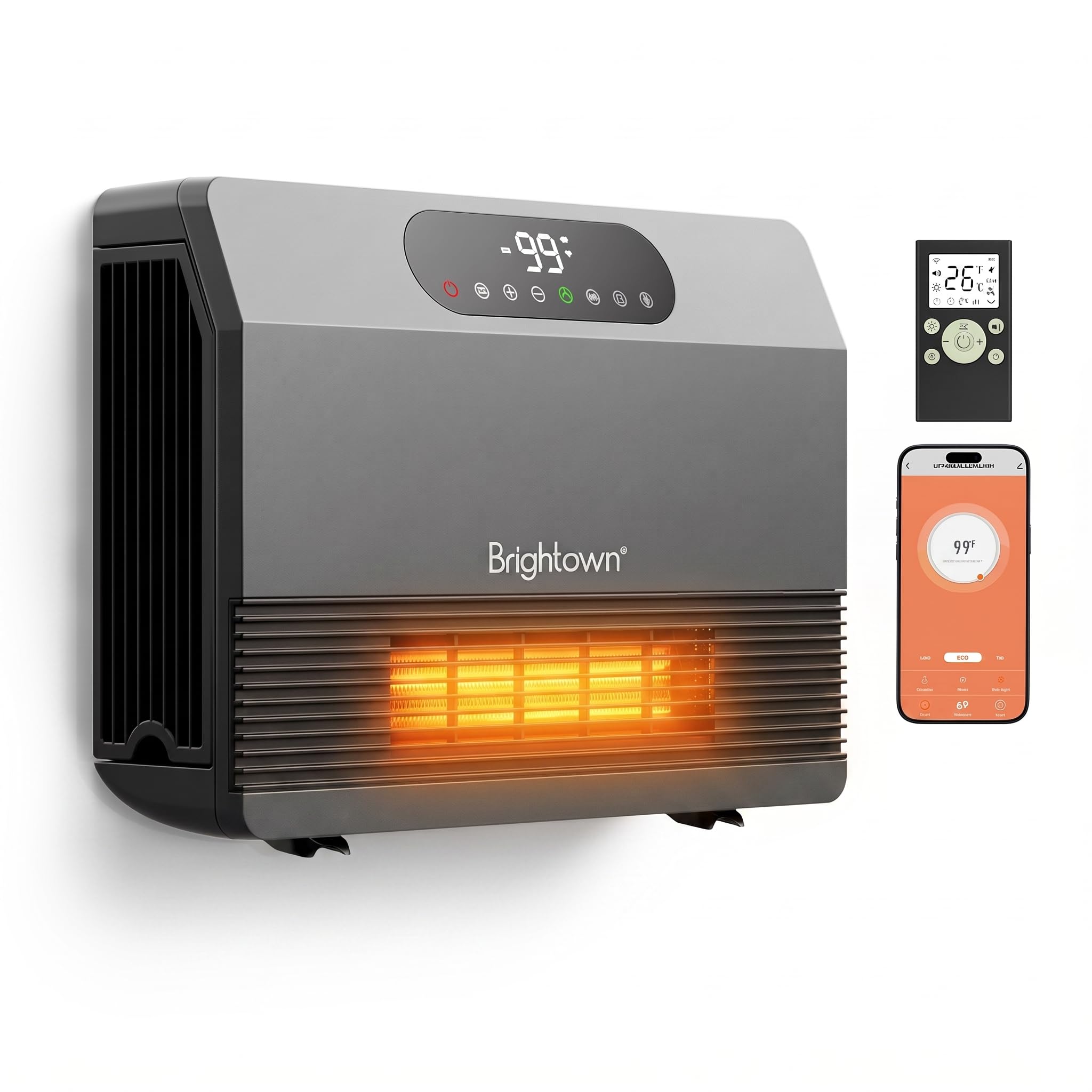
| Brightown 1500W Smart Wall HeaterSmartest Pick | Smart-controlled small spaces | 1500W | 200 sq. ft. | 120V Electric | Amazon |
| TURBRO GH7500 Electric Garage HeaterBest Value | Hardwired DIY install | 7,500W / 25,589 BTU | 1,250 sq. ft. | 240V Hardwired | Amazon |
| DR. INFRARED DR-988 Industrial Heater | Plug-in portability | 5,600W | 600 sq. ft. | 240V NEMA 6-30P | Amazon |
| Shinic 2-Pack Ceiling Mounted Heaters | Targeted workbench heat with light | 1500W / 750W each | 400–600 sq. ft. | 120V Electric | Amazon |
| ROVSUN 6000W Ceiling Heater | App-controlled large spaces | 6000W / 20,000 BTU | 1,100 sq. ft. | 240V Hardwired | Amazon |
| TEMPWARE 7500W Garage Heater | Quiet high-output heating | 7,500W / 25,590 BTU | 1,250 sq. ft. | 240V Hardwired | Amazon |
| InoKraft 7500W Garage Heater | Plug-in 240V convenience | 7,500W | 750 sq. ft. | 240V NEMA 14-50P | Amazon |
| VEVOR 10000W Garage Heater | Maximum coverage | 10,000W / 34,129 BTU | 90 sq. m. | 240V Hardwired | Amazon |
| Mr. Heater 80,000 BTU Unit Heater | Whole-building power | 80,000 BTU | 2,667 sq. ft. | Propane / Natural Gas | Amazon |
In‑Depth Reviews
1. GASLAND MHA18BN Propane Radiant Heater
Our pick — 4.5★ from 1,500+ verified ratings; the strongest balance of quality and price.
Burns propane to pour out warmth where electric heaters wave the white flag.
If your garage sits far from the breaker box or you lose power in winter storms, the GASLAND MHA18BN solves the problem no plug-in unit can. It runs on a 20lb liquid propane cylinder — no electricity required — and throws up to 18,000 BTU of radiant heat across a 450 square-foot space. That radiant design warms the people and objects in front of it rather than the air, so you feel the benefit the moment you stand near it. Owners who made the switch from electric describe the difference bluntly: “Heats attached 2-car garage where 1500W electric failed below 30°F.”
What wins people over is how portable and self-contained it is. It rolls on built-in wheels, an easy-carry handle makes repositioning simple, and the propane tank hides inside the cabinet so nothing looks messy. Three heating modes (High/Medium/Low) let you dial the output instead of running full blast, and a genuine 20lb cylinder stretched to roughly three tanks per winter for one owner heating an open-concept space. Safety is covered with tip-over shut-off and low-oxygen detection — two features that matter because the heater will cut itself off if it gets knocked over or the air around it gets thin.
The recurring trade-off is that radiant heat needs supervision. The front-facing element gets hot enough to be a hazard around pets and clothing, and placement matters — carpeted rooms and spots next to upholstered furniture are best avoided. It also emits a slight propane smell when the tank runs low, which is normal but worth knowing. An occasional unit arrives with a faulty thermocouple, though the company’s no-hassle replacement covers that. At 17.5″D x 15″W x 21.7″H it takes up less floor space than many portable cabinet heaters. This is the pick when you want heat independence, not a permanent ceiling fixture.
The Unplugged Advantage
- 18,000 BTU radiant output warms up to 450 sq. ft. without needing a single outlet
- Tip-over and low-oxygen shut-off add real safety for garage use
- Built-in wheels and easy-carry handle make it genuinely portable
- Propane tank stores inside the cabinet for a clean look
Where It Falls Short
- Radiant front heat needs supervision around pets, kids, and flammables
- Not a fit for carpeted rooms or placement against upholstered furniture
- A low-tank propane smell is normal but noticeable
Made for this: garages with no nearby outlet, homes that lose power, and anyone who wants off-grid warmth that rolls wherever the work is.
Think twice if: you want a hands-off ceiling fixture or your garage is carpeted and packed with flammable clutter.
2. Brightown 1500W Smart Wall Heater
Warms your garage before you walk in, then turns itself down to save power.
Nobody wants to step into a cold garage and wait for warmth. The Brightown wall heater lets you start the heat from your phone on the drive home instead. It runs on standard household power up to 1500W, sets its target anywhere from 40 to 99°F with 1°F accuracy, and mounts on the wall so it eats none of your floor. At only 4.3 inches deep, it hugs the wall in a way that keeps a crowded two-car garage workable — that footprint is far slimmer than the GASLAND cabinet heater’s 17.5-inch depth. “Great, I have this unit for about 2 months now, it keeps my place warm,” one buyer reports, and that is the through-line here.
The controls are the headline. You get touch, remote, app, and Alexa voice — and the ECO mode is the smart part. Once the room hits your set temperature, it trims its own output to hold the line instead of blasting away. Five modes total (ECO, P3 at 1500W, P2 at 1000W, P1 at 600W, and FAN-only) mean you can scale the heat to the day. Setup is refreshingly simple: no 240V wiring, no electrician, just a wall bracket and an outlet. Buyers repeatedly note it looks good once mounted and installs without fuss.
Know its ceiling: the rated coverage is 200 square feet, so this earns its keep in a single bay, a hallway, or a well-insulated small space rather than a cavernous double garage. It uses a 12.5A draw, so avoid sharing the circuit with other high-power appliances. The smart features are the recurring gripe — a slice of owners hit WiFi pairing snags, and the P1/P2/P3 modes will keep heating continuously rather than stopping at your target, which burns more power than ECO does. The display darkening in ECO mode is a small quirk some find annoying.
Best for a smart setup: if you want app and voice control, wall-mounted floor savings, and gentle heating in a smaller insulated space, this is the one that feels modern.
Grab it if your garage or workshop is on the smaller side and you love warming a room from your phone.
Pass if you have a full two-car bay of uninsulated concrete that needs raw output instead of smart flexibility.
3. TURBRO GH7500 7500W Electric Garage Heater
Delivers 25,589 BTU of ceiling-mounted power for the price of a mid-tier space heater.
Hardwired heat usually means hardwired cost, and the TURBRO GH7500 sidesteps that. It serves up your choice of 5,000W or 7,500W — a hefty 25,589 BTU at full tilt — to heat 800 to 1,500 square feet, and it mounts to the ceiling so your floor stays clear. A built-in blower fan pushes the warmth around faster, and adjustable louvers plus adaptable mounting angles let you aim it right where you stand. For a garage that sees real winter, that is genuine grunt for the money.
It keeps working past heating season too. A dedicated fan mode lets it circulate air in warm months, so it earns its ceiling space year-round rather than hibernating. Safety is solid with ETL certification, an integrated thermostat, and an auto shut-off if it overheats. The remote and touchscreen controls make it easy to fire up from across the room. Buyers running it in real cold describe it as dependable — several note it working near zero and one reports it keeping a 320 square-foot greenhouse above 50°F when it is below freezing outside.
Know the catch: this is a 240V (a high-voltage circuit, like an electric stove uses), hardwired unit, so it needs a certified electrician, 8 AWG copper wire (a thick wire gauge for high current), and a dedicated breaker (a separate switch just for this heater) — no power cord in the box, and the minimum wire rating must meet 75°C (167°F, the heat the wire insulation can handle). That install reality shapes who should buy it. Output is also a fit question — an insulated two-car garage handles it well, but an unsealed barn of a space may call for more. If you already have 240V service, this is one of the smartest value buys on the list.
Why It Earns Its Spot
- 25,589 BTU across 800–1,500 sq. ft. on high or low settings
- Ceiling mount frees up floor space and keeps heat up high
- Fan mode makes it useful in summer too
- ETL listed with overheat auto shut-off
What to Plan For
- Needs 8 AWG copper wire, a dedicated breaker, and an electrician
- No power cord included in the box
- Not the pick for a small single-bay or lightly insulated space
Reach for this if you have 240V service and want serious ceiling-mounted heat at a value price.
Look elsewhere if you lack a spare breaker or need something that plugs into a wall outlet.
4. DR. INFRARED DR-988 Industrial Garage Heater

The 5,600W shop heater that plugs into a high-voltage outlet instead of a panel.
This one solves a specific headache: most powerful electric garage heaters need hardwiring, which means an electrician. The DR. INFRARED DR-988 comes with a 6-foot cord and a NEMA 6-30P plug (a plug type for 30-amp, 250-volt circuits) that fits a dedicated NEMA 6-30R 250V 30-amp outlet — so if your shop already has that receptacle, you are running in minutes, not hiring a pro. It delivers a sturdy 5,600W (watts, a measure of heating power) of radiant and forced-air heat across up to 600 square feet, and you can set the thermostat anywhere from 37°F to 113°F.
Flexibility is where it shines. You can leave it on the floor as a portable unit or mount it to a wall or ceiling to reclaim floor space, and the built-in cord storage keeps a tidy bench. The all-metal housing, steel safety grille, and aluminum fan blades are built to take abuse in a workshop, and the UL and C-UL listings cover both US and Canadian safety standards. Owners pushing it hard report impressive results: one kept a 6000W unit in a 20x40x10-foot metal shop and raised it from 49°F into the 60s within an hour on a 19°F day.
The honest caveats center on the thermostat and the wiring. Multiple owners find the stock thermostat has a sloppy differential and end up adding the external Dr. Infrared wall thermostat for tighter control. The ground wire runs a touch short for some installs, and it needs a dedicated 30-amp circuit regardless. A rare unit arrives reading lukewarm at the vent, though the overwhelming pattern is strong heat that nobody regrets.
The plug-in advantage: if you already have a 240V outlet, this is one of the few high-output electric heaters you can set up without an electrician.
Fair warning: the built-in thermostat is its weak point, so plan to add an external wall thermostat if you want steady, accurate temperatures.
Built for shops with an existing 240V outlet that want maximum heat with minimum installation pain.
Not your match if you have no dedicated high-voltage outlet or want a set-and-forget thermostat right from the start.
5. Shinic 2-Pack Ceiling Mounted Garage Heaters

Two overhead radiant heaters with built-in work lights, aimed right at your bench.
This pair is not trying to heat the whole garage in January. Each unit uses dual quartz tubes to radiate instant warmth onto whatever is in front of it, and each includes a halogen work light so you can actually see your project. You get two heaters, two adjustable brackets, and a 90° rotation on each, so you can aim the heat exactly where you are standing. With 750W and 1,500W settings, plus modes that combine heat with the light, it is a focused workstation warmer rather than a whole-room furnace. As buyers put it: “They aren’t gonna heat the whole garage, but if you sit under them in a cold garage it’ll keep you warm enough.”
The numbers back up that framing. The coverage is listed at 400 to 600 square feet, and the specs land with 90 positive owner mentions for heat output. Radiant quartz heat goes to work the second you flip it on — no warm-up wait — which makes it ideal over a soldering bench, a spray booth, or a chair where you tinker. The 120V, 3-prong grounded plug means no special wiring, and the metal housing plus overheat auto-off and ETL listing keep safety simple. One owner runs a pair through the night on low with no trouble.
Where reviews get honest is effectiveness versus expectation. Mounted high in a big open bay, the warmth drops off fast beyond the immediate area, and a few owners found they had to reposition them lower to feel the benefit. They also draw real current — running two on high can strain a shared circuit — so a breaker check is smart. The pull-cord switch and durability drew some criticism too. Used as a targeted work-station heater for the money, though, it delivers.
Ideal Overhead Assets
- Two heaters in one pack with independent 90° aim
- Instant radiant quartz heat with zero warm-up time
- Halogen work light built into each unit
- 120V plug means no special wiring required
Know Before You Hang Them
- Best for warming people directly, not whole-room air
- Mounting high in a large bay weakens the effect — aim lower
- Two units on high can tax a shared circuit
Perfect for the tinkerer who wants instant warmth and light right over the workbench in a garage or workshop.
skip it if your goal is to bring the entire two-car bay up to room temperature.
6. ROVSUN 6000W Electric Garage Heater
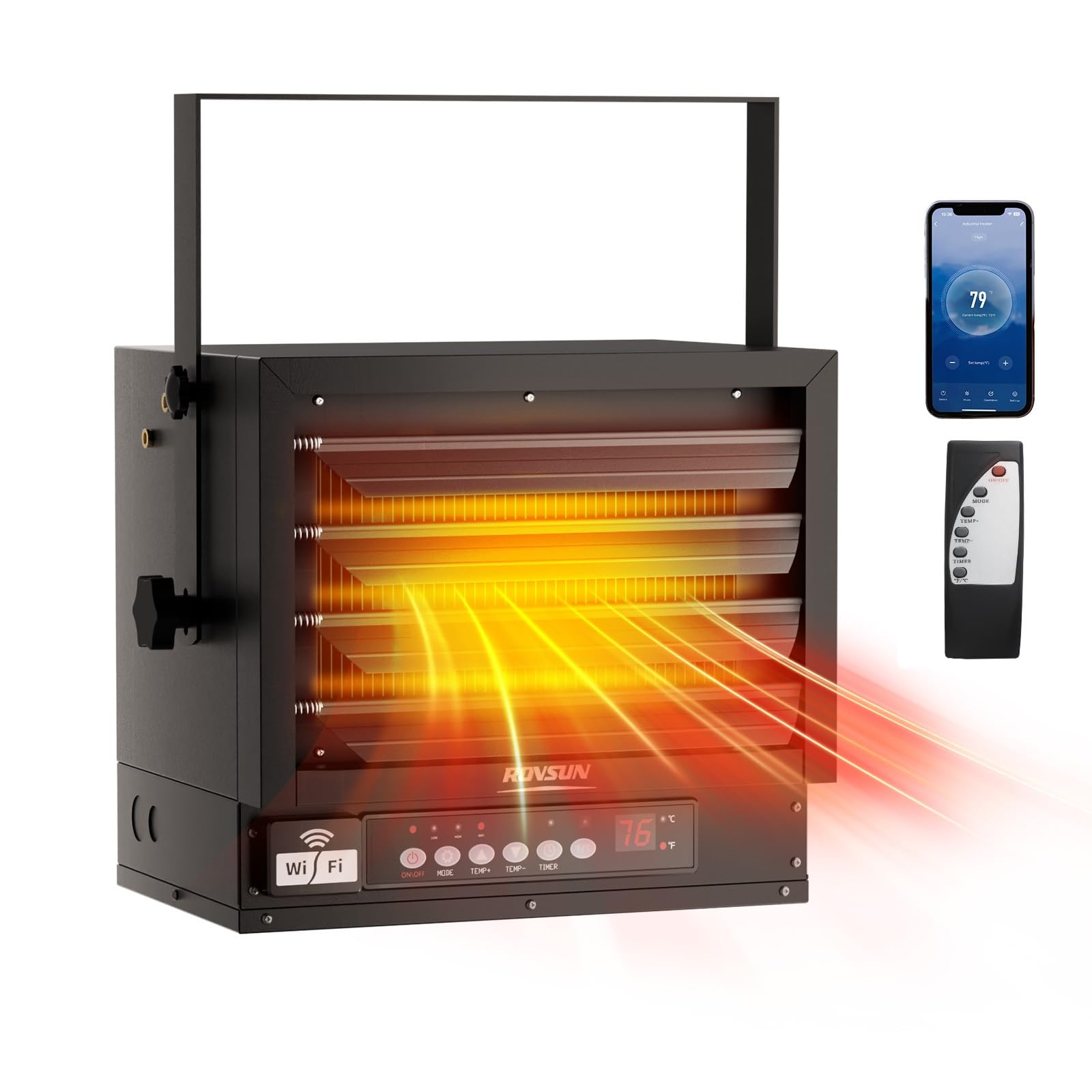
A fan-forced ceiling heater that puts 20,000 BTU under app control from anywhere.
Want the garage already warm when you get home? The ROVSUN 6000W delivers 20,000 BTU through a fan-driven system that pushes heat into every corner of a space up to 1,100 square feet, and you can run it from the panel, the remote, or your phone. Adjustable 0°/20°/40° directional air outlets let you point the flow where you need it, and the app handles temperature setting, a 12-hour timer, and scheduling so you are not paying to heat an empty room.
The control flexibility is the reason to pick this over a basic hardwired unit. You can dial in a scene and let automation handle the rest, warm the space before a morning workout, or shut it off remotely if you forget. A sturdy steel frame and ETL certification round out a package built for demanding spaces, and the mounting bracket is adjustable for precise alignment overhead. Buyers using it as a garage booster when the house duct heat gives up below 35°F describe it as efficient and great value.
Two things temper the enthusiasm. First, this is a 240V hardwired install that calls for 10 AWG wire and an electrician — no power cord in the box, and the total wiring setup can add real cost beyond the unit itself. Second, the smart side is the recurring complaint: WiFi pairing trips up a share of owners on modern routers, and the internal thermostat can read about 10°F off. If app control is your reason for buying, budget a little patience for setup.
Smartest feature set: the triple control — panel, remote, and app — plus the 12-hour timer makes it genuinely convenient to run on a schedule.
Choose this if you value app-based scheduling and can dedicate a 240V circuit to a large, hardwired setup.
Weigh it carefully if reliable WiFi is essential, since pairing and thermostat accuracy are the weak points some owners hit.
7. TEMPWARE 7500W Garage Heater
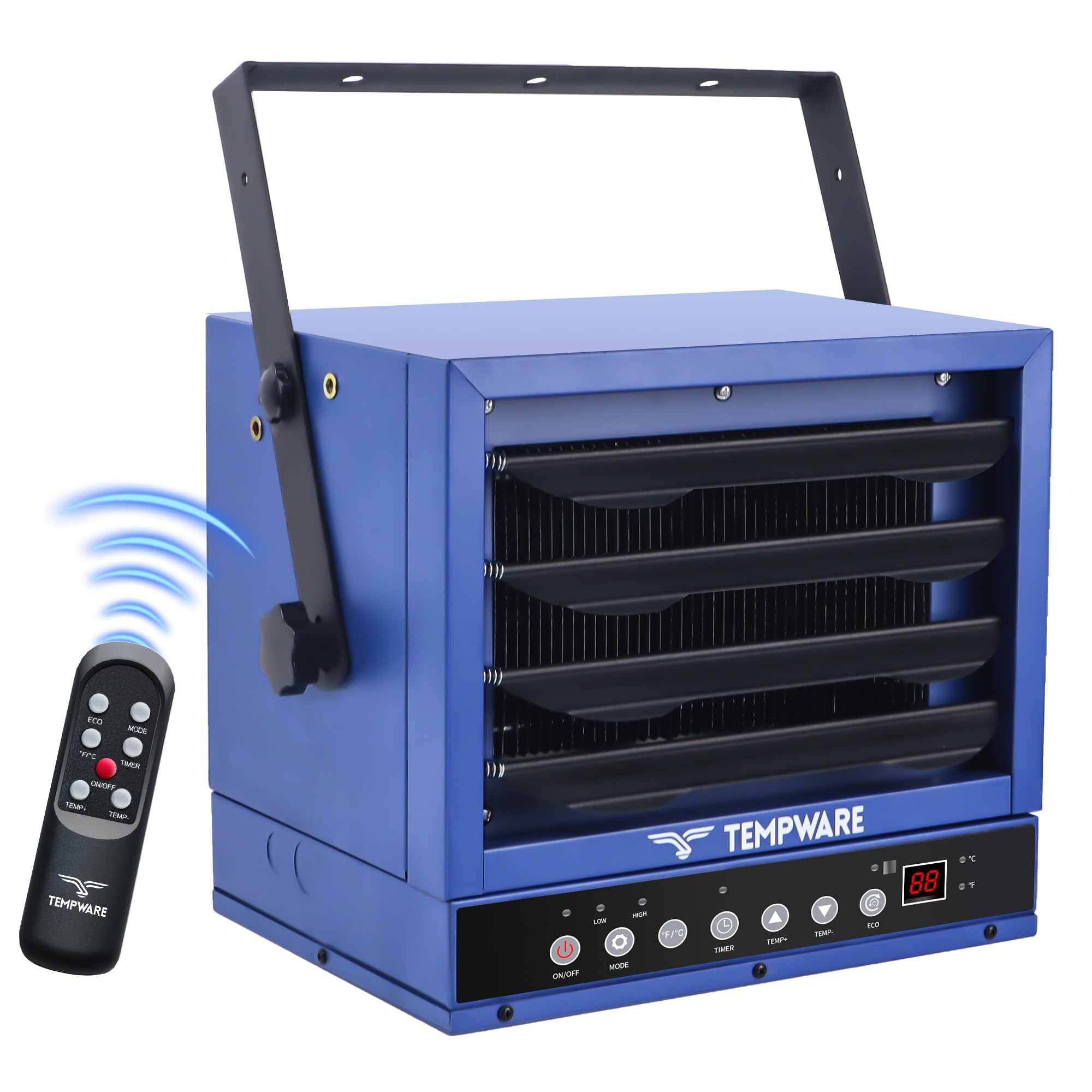
Big 7,500W output that runs quiet enough to keep the garage conversation-friendly.
Heat you barely hear is rare in this category. The TEMPWARE 7500W pushes a powerful 25,590 BTU of forced-air warmth across up to 1,250 square feet, and it does it without the roar that plagues so many ceiling shop heaters. Adjustable louvers and a variable mounting angle let you steer the flow to your exact spot, while low (6,250W) and high (7,500W) settings let you match output to the day. A 45°F to 95°F digital thermostat keeps the temperature steady without constant fiddling.
Buyers repeatedly mention the quiet operation, and that’s why this unit suits a space where you actually want to spend time — a home gym, a hobby shop, a garage you hang out in — rather than just a job site. The one-to-12-hour programmable timer is a nice touch for energy savings, letting you heat for a set window and cut off automatically. ETL certification (a safety mark from a testing lab), overheat auto-shutoff, and a heavy-duty steel body cover the safety and durability side, and buyers report it bringing a 24×24 attached garage up 20°F in about two hours at 26°F outside.
The setup reality is standard for the power class: this is a 240V hardwired unit that needs an electrician and a properly sized breaker, and the power cord is not included. Some owners also note that the thermostat sits near the ceiling, so it reads warmer than floor level and you may want to offset your target accordingly. Stack it against the TURBRO GH7500 and the comparison is a coin flip — same 7,500W class, same coverage zone, with the TEMPWARE leaning quieter for a space you use socially.
Best fit for the climate-controlled garage, home gym, or workshop where noise would ruin the space.
Heads up that it still needs 240V hardwiring and a breaker upgrade by a pro before it runs.
8. InoKraft 7500W Electric Garage Heater
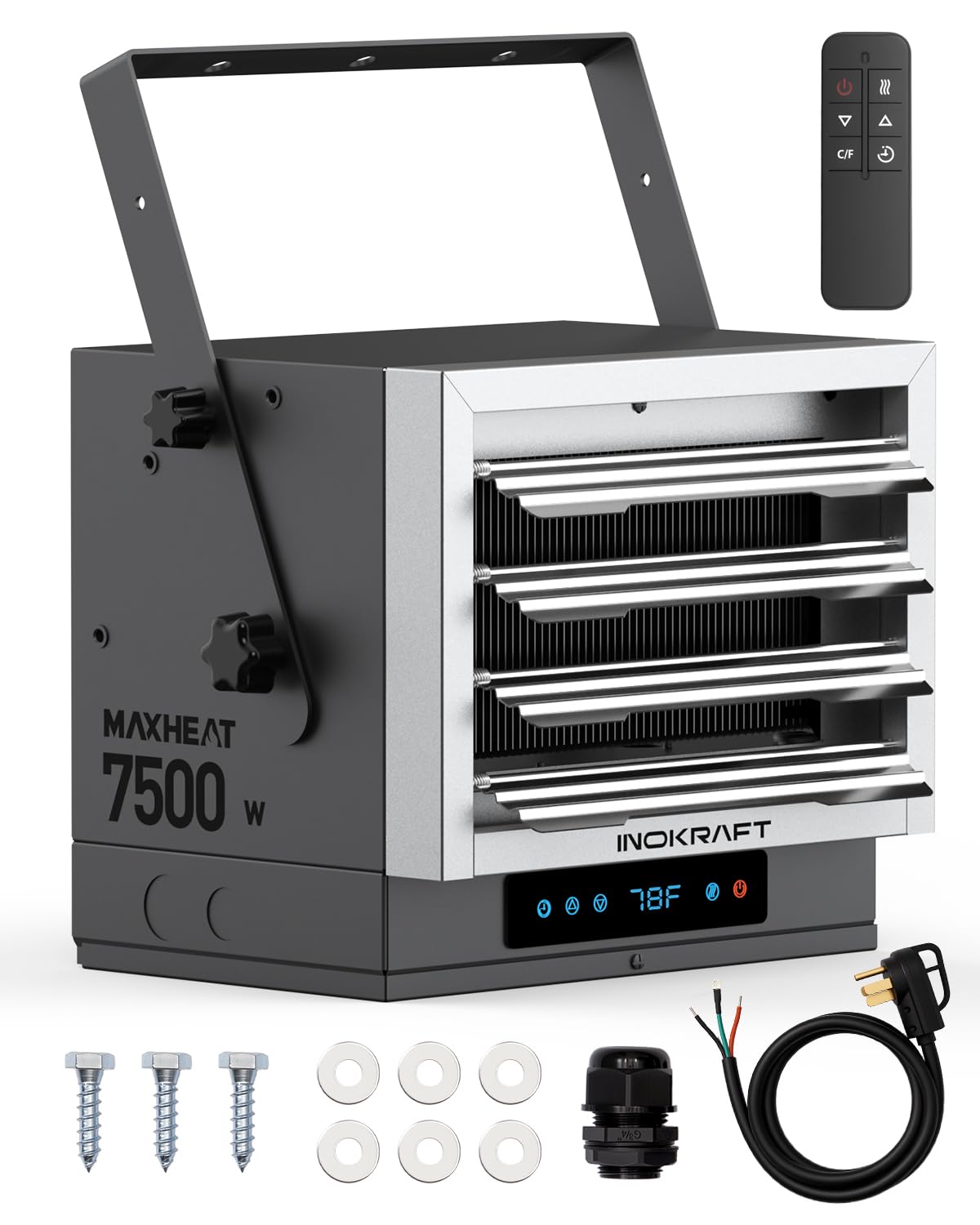
Comes with everything you need to plug into a 240V outlet and heat 750 square feet.
For a 7,500W heater, this one is unusually friendly to install. The InoKraft bundles an 8.2-foot power cord with a NEMA 14-50P plug — the same plug a range or dryer uses — so if you have that outlet in your garage, this hardwired-class unit becomes a plug-in. It delivers 7,500W of fan-forced heat to a 750 square-foot space at a stated 65 dB, and the built-in digital thermostat runs from 40°F to 99°F with a 1-to-24-hour timer. Five installation angle positions and flexible louvers let you aim the warmth precisely.
The smart ECO mode is the standout. Instead of guessing, it automatically adjusts heating output based on ambient temperature and cuts power when it is not needed — good for keeping energy use in check without giving up comfort. It runs manually selectable high and low modes too, so you can take over when you want full blast. Owners mention it heating fast: a 950 square-foot garage climbed from 39°F to 65°F in two hours on a 10°F day, and a 24×24-foot two-and-a-half-car space warmed in minutes. The unit can be wall-mounted or hung from the ceiling to free up floor area.
The main catch on any high-output unit applies here too: it draws 31.25A, so it needs a proper 240V supply and, ideally, a professional install. The built-in thermostat also sits near the heat source, so when it is mounted high, it can read up to about 10°F warmer than reality — an external 240V wall thermostat is an option some owners add. The included cord is the differentiator here, so check your outlet situation before ordering. It stands as the simplest big-output setup on this list.
Install Without the Electrician
- Includes 8.2-ft cord and NEMA 14-50P plug for outlet plug-in
- 7,500W heats up to 750 sq. ft. with 40–99°F thermostat
- ECO mode auto-adjusts output to save energy
- 1–24-hour timer and five angle positions for directed airflow
Worth Knowing
- Needs a NEMA 14-50R outlet and a 240V circuit to run
- Built-in thermostat can read high when mounted near the ceiling
- No separate external thermostat included
Your pick if you have a 240V range-style outlet and want big heat without hardwiring.
Rethink it if you lack that outlet or want pinpoint thermostat accuracy straight from the start.
9. VEVOR 10000W Electric Garage Heater

Ten thousand watts of wall or ceiling heat for the biggest bays on the list.
If your garage is more warehouse than workshop, the VEVOR 10,000W is the heavyweight here. It puts out 34,129 BTU (British thermal units, a measure of heat output) and covers an area of 90 square meters, with two adjustable power levels so you can scale it to the weather. High air circulation keeps hot air moving through every corner rather than pooling on the ceiling, and the intelligent temperature control holds the room within about 2°F of your target — a tight margin that means steady, even warmth rather than swinging hot and cold.
It is built to run and keep running. The SPCC cold-rolled steel shell resists deformation over long-term use, and overheat automatic power-off protection plus ETL certification handle the safety side. You can wall-mount or hang it to free the floor, adjust the angle at install, and fine-tune the louvers for even distribution. A remote control adds convenience, and the automatic fan delay helps transfer heat efficiently before the fan winds down. The thermostat feature earns praise once set, and owners note the running cost is manageable for the output class.
Two facts frame who this is for. First, it is a serious amperage load — 41.67A, with a required breaker rating of at least 42A — so the electrical service has to support it, and hardwiring by a pro is the only safe path. Second, the noise divides people: some find it quiet for its size, others call the fan loud. At 30.2 pounds, the unit is heavy enough that mounting is a two-person job. This is the pick for a large, insulated building that needs to be brought up to temperature, not a quick pre-heat.
Built for volume: the 10,000W output and 90 square-meter coverage make it the right call for a big, insulated shop that must hold a stable temperature.
Check your panel first: at 41.67A it needs a dedicated 42A-plus breaker and a professional install, so the electrical service is the real gate.
The one for large insulated garages and workshops with enough panel capacity to feed a 10,000W draw.
Not for you if your service is limited or your space is a small, lightly insulated bay.
10. Mr. Heater 80,000 BTU Forced-Air Unit Heater
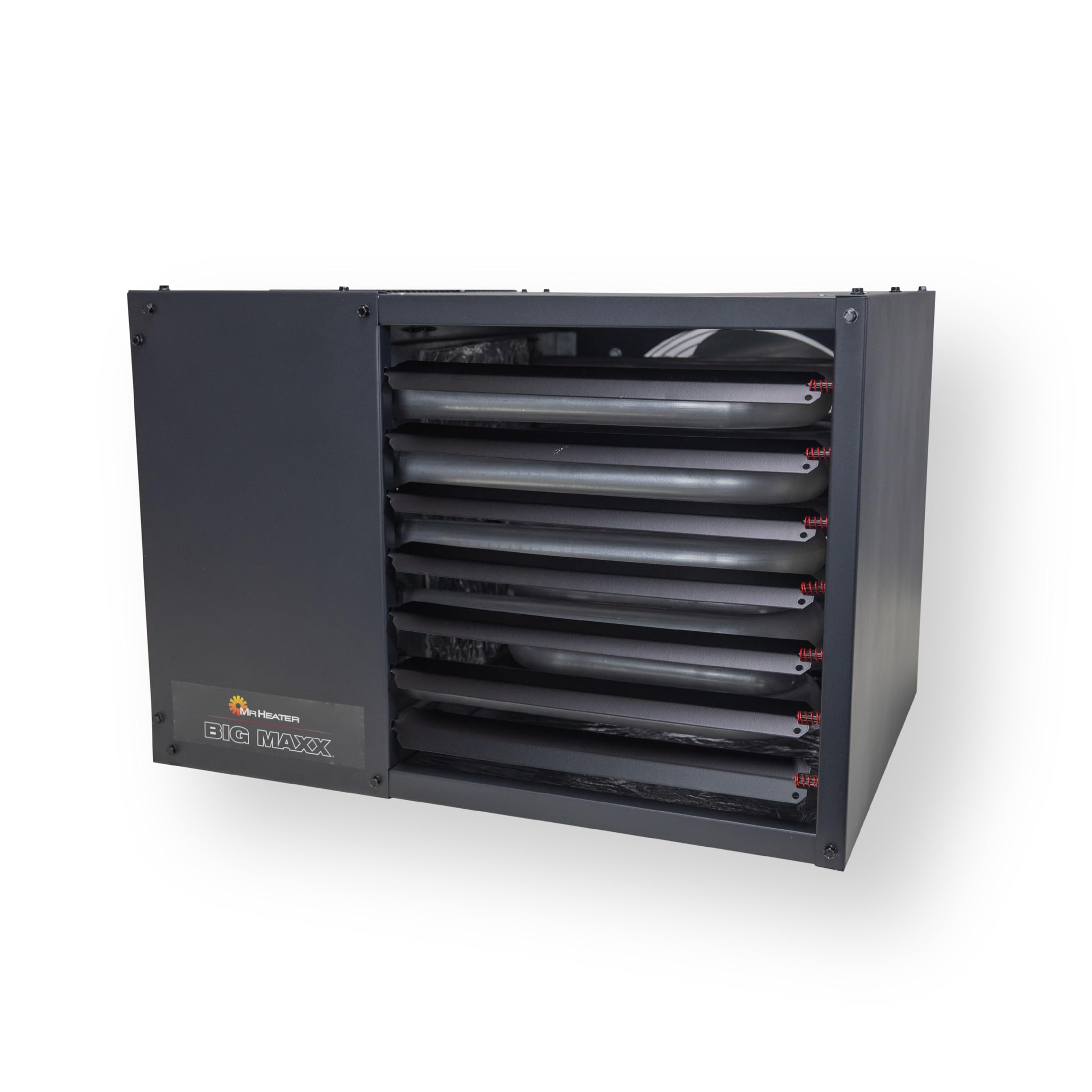
Cranks 80,000 BTU of forced-air heat that can swallow an entire barn.
This is a different league from the electric units on this list. The Mr. Heater unit heater throws 80,000 BTU of ceiling-mounted forced air, enough to warm up to 2,667 square feet — think a large detached garage, a barn, or a workspace bigger than most two-car bays. It runs on propane or natural gas, and it is compatible with standard 24-volt or new Wi-Fi enabled thermostats (sold separately), so you can pair it with a smart thermostat and schedule it like a furnace. At 80,000 BTU, it costs less per hour to run than the 10,000W VEVOR on electric.
Owners who heat with gas say it is the sensible long-term move. One hung it in a 1,300 square-foot shop, tied it to a Nest thermostat, and found it heated faster on propane than the old heater it replaced. Another reported holding 40°F in a 24×36 shop at 10°F outside on very little fuel. The low-profile design and included gas conversion kit keep installation flexible, and the high-temperature safety shut-off and gas flame sensor protect the supply side.
Plan the install carefully — this is not a plug-and-play appliance. It requires a 10-foot minimum ceiling height with 8 feet of clearance from the heater base to the floor, so a low shop ceiling is out. It also needs separate venting, a thermostat, a gas supply (or a tank), and professional installation, which is where the real cost lives. A rare unit arrives with a damaged component, though most buyers find it built like a tank. With proper venting and 10-ft ceiling clearance, it delivers 80,000 BTU at a lower running cost than any electric unit here.
The Case for Gas
- 80,000 BTU covers up to 2,667 sq. ft. of space
- Works with standard 24V or Wi-Fi thermostats sold separately
- Cheap to run on propane or natural gas for the output
- Ceiling-mounted forced-air design frees the floor
The Install Realities
- Requires 10-ft minimum ceiling and 8-ft floor clearance
- Needs separate venting, a thermostat, and pro installation
- Not suited to low-ceiling or light-duty garages
Best for large detached garages, barns, and shops where cheap, powerful gas heat beats electric.
pass on it if your ceiling is low, you have no gas line, or you cannot take on a full professional install.
Understanding the Specs
BTU and Watts: Measuring Heat
BTU is the standard measure of heat output — think of it as how much warmth a heater can pour out per hour. Watts are the electric equivalent, and in this category a rough pairing holds: 7,500W equals 25,589 BTU on the TURBRO, and 10,000W equals 34,129 BTU on the VEVOR. Higher numbers mean more heating power, which matters most in a large or poorly insulated garage. Match the number to your square footage and insulation quality, not just to the biggest figure on the page.
Radiant vs Forced Air: Two Ways to Feel Heat
Radiant heaters warm the people and objects directly in front of them, which is why the GASLAND propane unit and the Shinic quartz pair work best for spot heating. Forced-air heaters, like the hardwired electric units, blow warmed air around the room to raise the whole space. Radiant heat feels immediate and targets a workbench; forced air takes longer but warms everything. Choose radiant for a workstation you occupy and forced air when you want the entire garage at a comfortable temperature.
FAQ
What size heater do I need for a 2 car garage?
Do I need a 240V outlet for an electric garage heater?
Can a space heater heat my garage in freezing weather?
How much does it cost to run an electric garage heater?
Can I run a propane garage heater indoors safely?
Which is better for a garage, radiant or forced air heat?
How high do I need to mount a ceiling garage heater?
Do these garage heaters come with a power cord?
Can I control a garage heater with my phone or a smart thermostat?
Will a garage heater work with a low ceiling or a small single bay?
Are propane and natural gas garage heaters cheaper to run than electric?
Final Thoughts: The Verdict
For most people, the 2 car garage heater that wins is the GASLAND MHA18BN Propane Radiant Heater because it heats without needing a single outlet — 18,000 BTU across 450 square feet, with tip-over and low-oxygen shut-off for safety and a portable cabinet that rolls where you need it. If you have 240V service and want serious hardwired electric heat, grab the TURBRO GH7500 for its 25,589 BTU of ceiling-mounted power at a value price. And for a space bigger than any two-car bay, the Mr. Heater 80,000 BTU Unit Heater is the one to reach for, with enough gas-fired output to swallow an entire barn.
How We Picked
We do not accept paid placement. Every pick is matched to a real buyer and a real use-case; we do not hands-on test units.
Sources & Methodology
Specifications: manufacturer listings and product documentation. Review insights: verified customer reviews, as of September 2026. Pricing: not shown on this page (it changes often); check the current price via the retailer link.
As an Amazon Associate, KitchPrep earns from qualifying purchases. This does not affect which products we feature.
Related Guides
