
Specs are compiled from manufacturer listings and verified buyer reviews and can change over time — please confirm the key details on the product page before buying.
When you shop for a 2.5-ton mini split, you are really shopping for about 30,000 BTU of cooling power. BTU (British Thermal Unit) measures how much heat the unit can remove from a room in an hour. Brands sell that same job as anything from 28,000 to 32,000 BTU, so this list accepts the nearest sold size in that range. That means not every pick matches the exact number you typed into the search bar. The closest same-type size does the same job, and we tell you exactly which unit runs at which number so you are never misled.
I’m Mohammad Maruf — the founder and writer behind KitchPrep. This guide is built by comparing the manufacturers’ published specifications and the patterns across verified customer reviews, so you get each pick’s real strengths and trade-offs instead of marketing spin.
Single-zone or multi-zone, wall-mount or ductless, you will find a pick that fits. The five units below range from a 750-square-foot tri-zone to an 1,800-square-foot single-zone, and each one is rated by real owners who installed them in shops, RVs, and whole homes. Every pick is a genuine 2.5-ton mini split ac class unit, so you can compare them on the same footing.
Our Picks at a Glance
How To Choose The Best 2.5-Ton Mini Split AC
To pick the right mini split, match three numbers to your actual space: the BTU output, the SEER2 efficiency rating (a score for how much cooling you get per watt-hour of electricity over the season), and the square footage the unit is built to cover. Get those three aligned and everything else — noise, app control, zone count — becomes a comfort preference rather than a dealbreaker.
Start With BTU, Not With “Tons”
A “ton” of cooling is a historical unit equal to 12,000 BTU, so 2.5 tons lands at 30,000 BTU. In practice, brands sell 28,000 BTU and 30,000 BTU units in the same aisle and describe both as roughly 2.5-ton class. If you have a 1,400 to 1,800 square foot open space, a 30,000 BTU single-zone unit is the natural fit. If you want to cool three separate rooms from one outdoor unit, you are better served by a multi-zone system that splits 28,000 to 30,000 BTU across 9,000 and 12,000 BTU indoor heads.
Read SEER2 Before You Read the Price Tier
SEER2 is the updated version of the Seasonal Energy Efficiency Ratio — a score that estimates how much cooling you get per unit of electricity across a typical season. A higher SEER2 number means the compressor works less hard to hit the same temperature, which is where the monthly savings live. On this list, the top efficiency scores run up to 25 SEER2, and the value picks sit in the 20 to 22 range. For a unit you will run every summer for a decade, that spread adds up in a way that a lower up-front number cannot offset.
Decide Single-Zone or Multi-Zone First
A single-zone mini split has one indoor air handler and one outdoor condenser. A multi-zone system has one outdoor condenser feeding two to four indoor heads, each with its own temperature control. The catch with multi-zone is that the outdoor condenser usually serves one zone at a time — the indoor heads take turns rather than running flat out simultaneously. That is normal behavior, not a fault, but it means you should size the condenser for the total load of all rooms.
Plan the Install Before the Unit Arrives
Every unit on this list uses refrigerant lines, which means you need a vacuum pump, a gauge set, and either a licensed HVAC technician or a willingness to follow YouTube tutorials carefully. Some units ship in multiple boxes that can arrive on different days, so confirm every box is on-site before you schedule a technician. Line-set lengths vary from 16 feet to 25 feet, and longer runs require extra refrigerant charge — check the manual before you cut into a wall.
Weather Performance Matters More Than You Think
Even a great heat pump has a cold-weather floor. On this list, the operating ranges stretch as low as -13°F on the warm-heat side and up to 122°F on the cooling side, which matters if you live somewhere with real winters or brutal Augusts. Below the unit’s rated low temperature, the system will struggle and may need a backup heat source — the manual will tell you the exact number for the model you buy.
Quick Comparison
| Model | Best For | Cooling Power | SEER2 | Coverage | Amazon |
|---|---|---|---|---|---|
| TOSOT Cosmo 30,000 BTU★ Best Overall | Whole-home single-zone coverage | 30,000 BTU | 22 | 1,800 sq. ft. | Amazon |
| ROVSUN 28,000 BTU Tri-ZoneMost Versatile | Three rooms, one condenser | 28,000 BTU | 20 | 750 sq. ft. | Amazon |
| Senville LETO 30,000 BTU | Voice control and quiet rooms | 30,000 BTU | — | 1,400 sq. ft. | Amazon |
| DELLA 28K BTU 3-Zone ODU | Multi-room Alexa setups | 28,000 BTU | 20 | 1,350 sq. ft. | Amazon |
| Cooper & Hunter 28,000 BTU 3-Zone | High-efficiency three-room builds | 28,000 BTU | 25 | Multi-room | Amazon |
In‑Depth Reviews
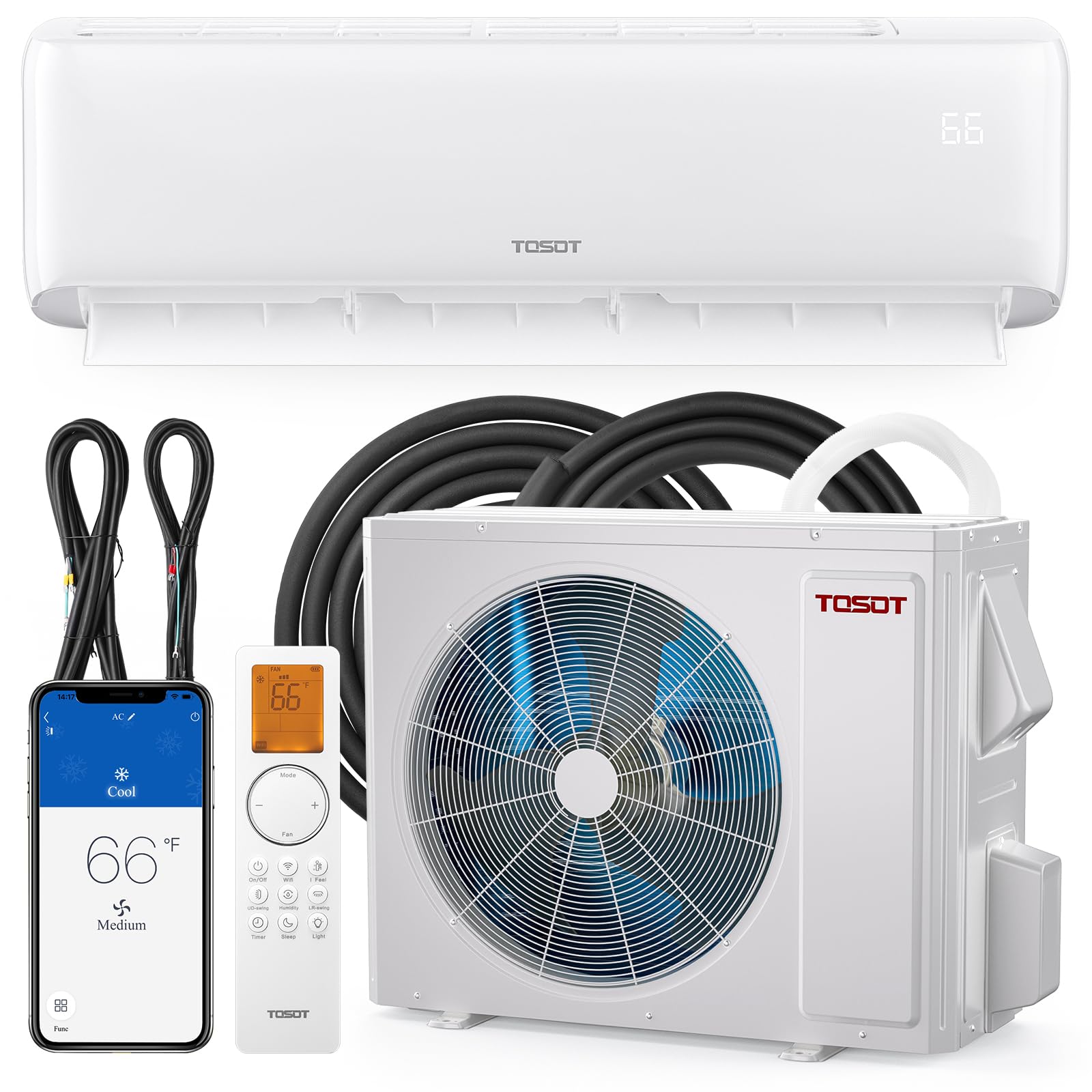
1. TOSOT 30,000 BTU Mini-Split Air Conditioner and Heating System, 22 SEER2
Our pick — 4.5★ from 200+ verified ratings; the strongest balance of quality and price.
One 30,000 BTU unit for a whole 1,800 square feet — no second condenser required.
If you want a single indoor head to hold a big open floor plan at temperature, the Cosmo Series is the natural center of this list. Its cooling power is 30,000 BTU, which covers up to 1,800 square feet — that is the largest coverage here, and it out-reaches the ROVSUN tri-zone’s 750 square feet by more than double. In practical terms, you are cooling a whole house off one wall unit instead of splitting the load across three rooms.
Efficiency is where the TOSOT pulls ahead of the value picks. Its 22 SEER2 rating sits above the ROVSUN and DELLA units at 20 SEER2, and the compressor is built to cool in ambient temperatures up to 122°F and to heat as low as -13°F. In plain terms, that is a unit that keeps running when summer peaks are brutal and does not tap out the first time winter dips into single digits. The Gree+ app handles scheduling and voice control, so you can nudge the temperature before you walk in the door.
You get quiet operation: the indoor range sits between 22dB and 36dB, and the low end is roughly a whisper, so a bedroom install is realistic. On the installation side, owners consistently describe the work as moderate difficulty for a confident DIY’er with a YouTube video pulled up, and the included 16-foot copper line set covers most single-room wall mounts. As owners put it: “1.5yr RV full-time use: flawless through hot summers, mild winter, single digits.” That same RV owner noted the unit handles single-digit cold without an auxiliary heat source, though it struggles at the very bottom of its range — which is worth knowing before you rely on it as your only heat.
What Works In Your Favor
- 30,000 BTU covers up to 1,800 sq. ft. — the largest floor area in this lineup
- 22 SEER2 beats the 20 SEER2 value picks on seasonal efficiency
- 22dB low-noise floor is bedroom-friendly
- Works down to -13°F heating and up to 122°F cooling
- Wi-Fi and voice control through the Gree+ app
Where It Gets Tricky
- Some owner reports describe shipping in multiple boxes that arrive separately — confirm all packages are on-site before scheduling install
- Instructions can be thin on torque specs and adapter sizes, and buyers often turn to YouTube
- Heat output tapers at the very bottom of its rated cold range
Reach for this if: you want one unit to condition an open living area or a full-time RV setup and value efficiency without jumping to premium pricing.
Look elsewhere if: you need independent temperature control in three separate rooms — a tri-zone setup handles that better.
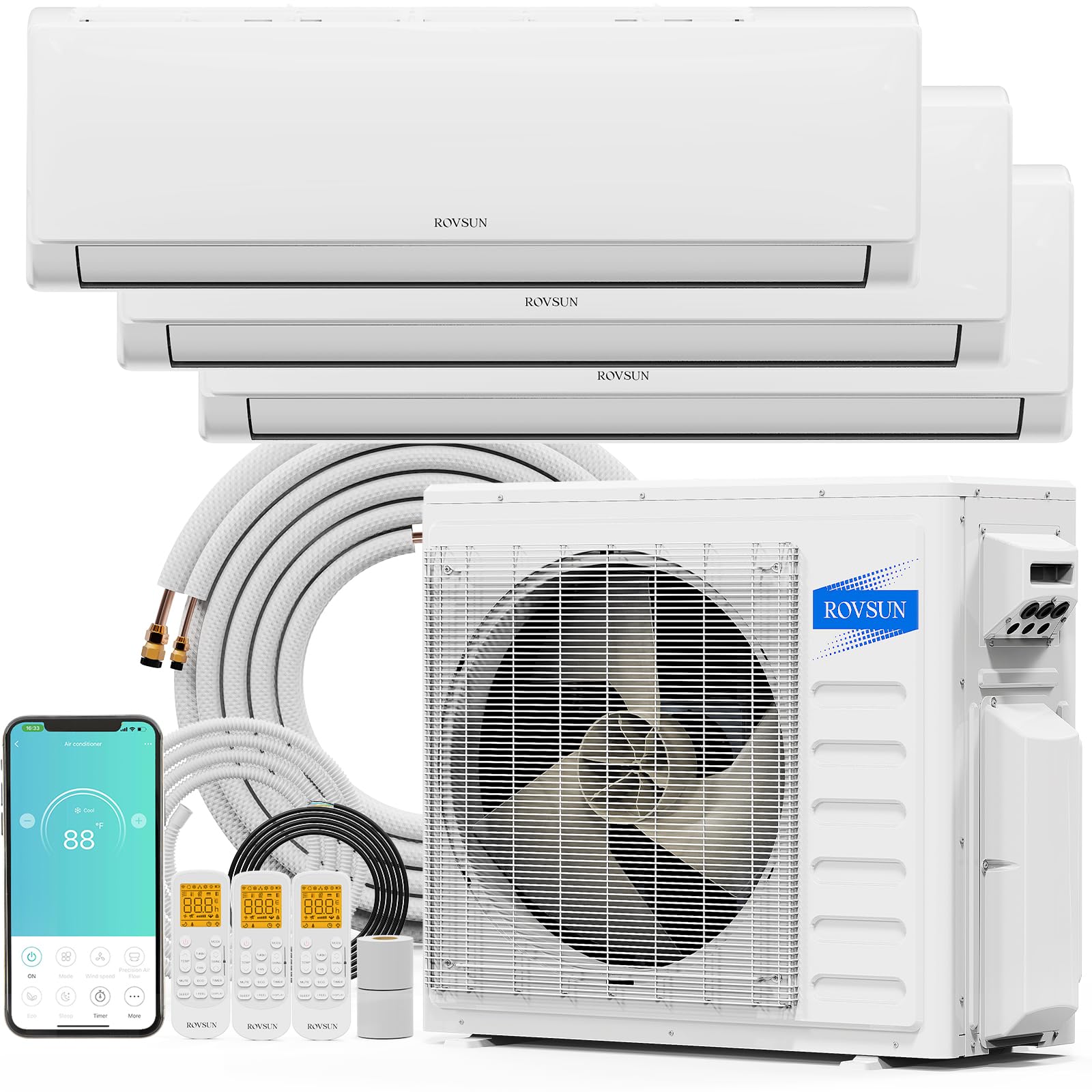
2. ROVSUN 28000BTU Tri Zone Mini Split AC/Heating System, 20 SEER2
Three rooms, three remotes, one 28,000 BTU condenser doing all the work.
The ROVSUN earns its spot by spreading coverage across three rooms instead of one. A single outdoor 28,000 BTU condenser feeds three 9,000 BTU indoor air handlers, each with its own controller, so the bedrooms, the office, and the living room all set their own temperature. Floor area tops out at 750 square feet, which is a fraction of what the TOSOT’s 1,800 square feet handles on a single head. What you trade in raw area, you gain in zone independence.
Efficiency sits at 20 SEER2 with an inverter compressor and a 130 kWh annual energy consumption rating. The heat pump range runs from -4°F to 122°F ambient, and an auto-defrost cycle keeps the outdoor coil productive through cold snaps. Extras that matter in daily use include a 24-hour timer, 4-way air swing that pushes air to the corners, a sleep mode, and an iFEEL mode that reads the temperature at the remote rather than the wall unit. The indoor heads run at 27–42 dBa, quiet enough for a conversation or a nap.
Reliability is the mixed bag here. Buyers who like the system describe the cooling as impressive and the setup as straightforward with the right tools — a vacuum pump, gauges, and about fifteen minutes of patience. The recurring wrinkle is electrical: at least one owner hit a “will not heat or cool” fault code roughly eight months in that traced to a loose connection inside the machine, though it was resolved and cooling resumed. Short wiring, occasionally kinked line sets, and minor shipping dents on arrival also show up in the mix. None of these are universal, but they are worth knowing before you plan a complex install.
Who it fits beautifully: If your home has three distinct rooms that need their own settings — a bedroom wing, an office, a kitchen — this is the least fussy way to get there. Each room’s remote controls its own head independently.
The honest catch: The line sets and wiring run in different lengths than a pro might expect, and one owner hit an eight-month fault code tied to an internal connection. That is a small share of the units, but on a system this complex, treat the install as the part worth paying attention to.
Confident pick for: multi-room homes where independent zone control is worth more than raw square footage.
Second-guess if: you are cooling one big open space — the TOSOT covers twice the floor area on a single head.
3. Senville LETO Mini Split Air Conditioner, Heat Pump, 30000 BTU

A 30,000 BTU four-in-one that earns its place on reliability and near-silent running.
The LETO is the middle-priced balance on this list — a 30,000 BTU, 2.5-ton wall-mounted unit covering up to 1,400 square feet, matching the TOSOT’s cooling capacity while staying a notch below it on efficiency. It is a 4-in-1 system: cooling, a heat pump that keeps working down to 5°F ambient, a dehumidifier, and a fan with a turbo boost. The DC inverter is UL Listed and AHRI Certified, and the package includes the indoor air handler, outdoor condenser, remote control, and a 16-foot line set with communication wire, pre-loaded with refrigerant for runs up to 25 feet.
Alexa integration is the headline feature. You can adjust the unit from another room, set a routine for a temperature change at a specific time, and skip the wall panel altogether. Senville backs the unit with a 5-year parts warranty and a 5-year compressor warranty, with technical assistance included — labor is not. It runs quietly enough that homeowners describe it as whisper-quiet indoors and out, which is a real asset if the outdoor unit is going near a patio you actually use.
Where the LETO earns its place is the daily-use details that reviewers keep coming back to: the fan drops to low speed rather than stopping completely once it hits temperature (keeping air moving steadily), the shop installs go smoothly for first-timers following the precharged instructions, and the heat pump covers winter reliably. A couple of caveats travel with that: the coil filter is porous enough that it wants annual cleaning, and the copper line will deform if you re-bend it after installation — so the line run is a one-shot deal. One reviewer running it alongside a central AC system in a 1,800 square foot home described the farther rooms as warmer but still comfortable. That is the zone-heating reality: a single head reaches the space nearest to it best.
Smart-Home And Daily Comfort
- Alexa voice control plus a phone app for scheduling from anywhere
- 4-in-1 function covers cooling, heat, dehumidifying, and fan
- 5-year compressor and parts warranty with included tech support
- Whisper-quiet indoor and outdoor operation
Setup Realities To Plan Around
- Copper line deforms if re-bent — the first run is the only run
- Porous coil filter needs yearly cleaning to keep efficiency up
- Labor is not covered by the warranty
Great fit for: a home office, shop, or living area where Alexa control and quiet operation are worth a step up from the value tier.
Think twice if: you are set on multi-room zoning — this is a single-head unit and only cools the space around it.
4. DELLA 28K BTU ODU Mini Split AC 3 Zone (2 * 9K + 12K BTU) 20 SEER2
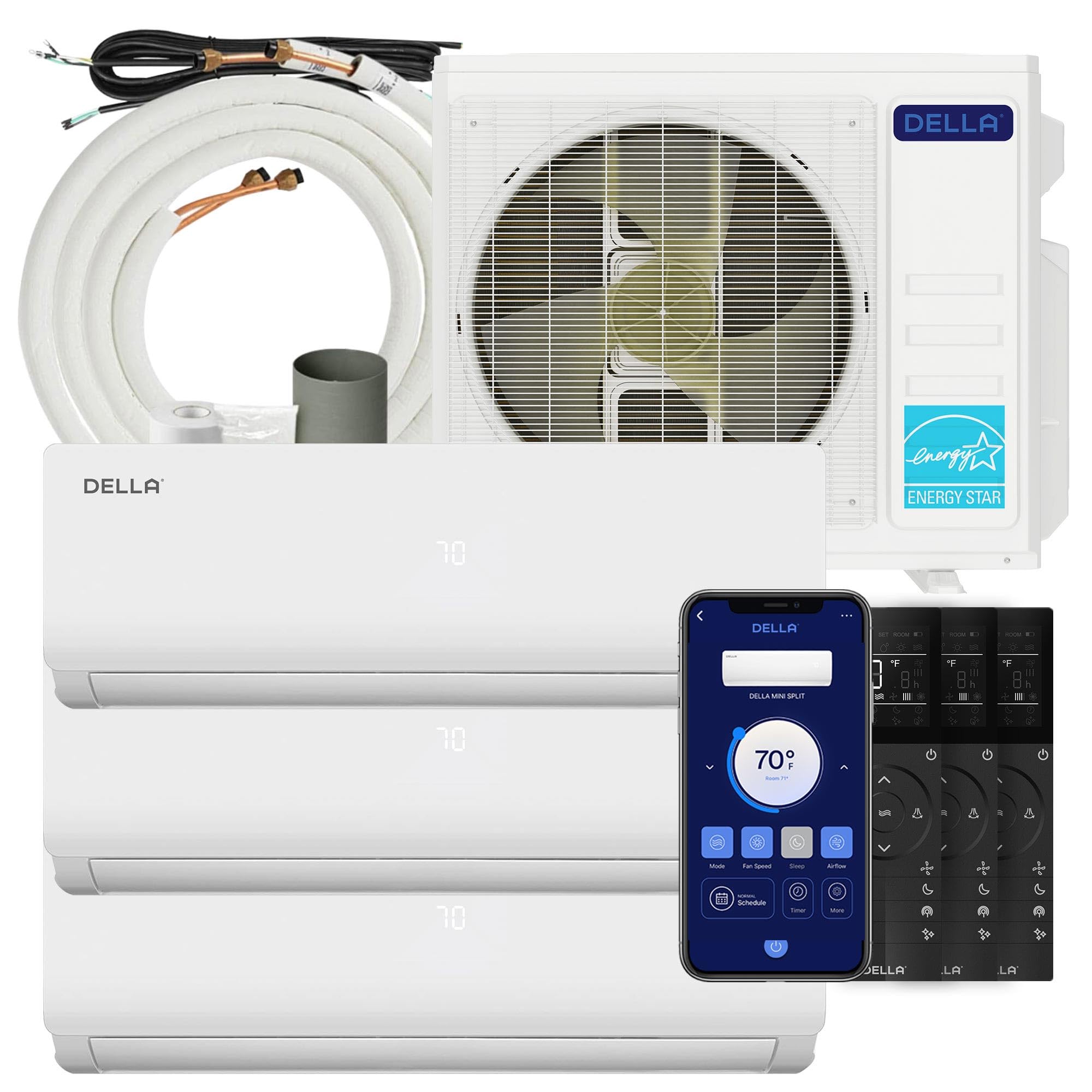
A 28,000 BTU tri-zone built around 2×9K heads and a single 12K for the biggest room.
DELLA’s three-zone setup is the one to look at if your rooms are not the same size. Rather than three equal 9,000 BTU heads like the ROVSUN, this system pairs two 9,000 BTU indoor units with one 12,000 BTU unit — so the largest room in the house pulls more cooling from the same 28,000 BTU outdoor condenser. Total coverage sits at 1,350 square feet, and each indoor unit handles its own controller. The full kit includes three 16-foot copper line sets, three drain pipes, and three installation kits, plus Alexa and WiFi control through the DELLA app.
Efficiency is 20 SEER2 with a DC inverter rated for up to 30% power savings, and the heat pump heats down to -13°F ambient. The outdoor unit runs at just 29 dBa, quiet enough to sit on the patio beside it. The indoor heads deliver 4D airflow (up-and-down plus left-and-right), an iFEEL mode, a sleep mode, and an eco energy-saving mode. DELLA is explicit in the listing that this is not a DIY unit: line-set length changes require a refrigerant adjustment, and the line sets must be vacuumed during install, so plan for a licensed tech.
The copper line sets are the one thing worth calling out honestly. A pro installer’s take on this exact system flagged that the factory lines crimp and twist easily, and a reviewer who went through the install noted the same thing. Elsewhere, owners describe the system as easy to install for a proper HVAC setup, incredibly quiet, and well-supported by the app. A separate owner with a 3-head install on the same hardware reported that customer service stepped in to help when a line-set size issue came up, which is a good sign for post-purchase support.
The zone-size advantage: Two 9K heads plus one 12K head lets you prioritize the room that actually needs the power instead of spreading equal cooling across three spots.
The trade-off to accept: The included copper line sets are not the strongest part of the kit — several installers recommend replacing them with better-quality lines before the job starts. Budget for that line upgrade if you want a clean install.
Best for: a three-room layout where one area clearly needs more cooling than the others and you have a licensed installer booked.
Not the one if: you plan a DIY install — DELLA requires vacumming and refrigerant adjustment from a professional.
5. Cooper & Hunter 28,000 BTU 3-Zone Wall Mount Mini Split AC Heat Pump, 230V
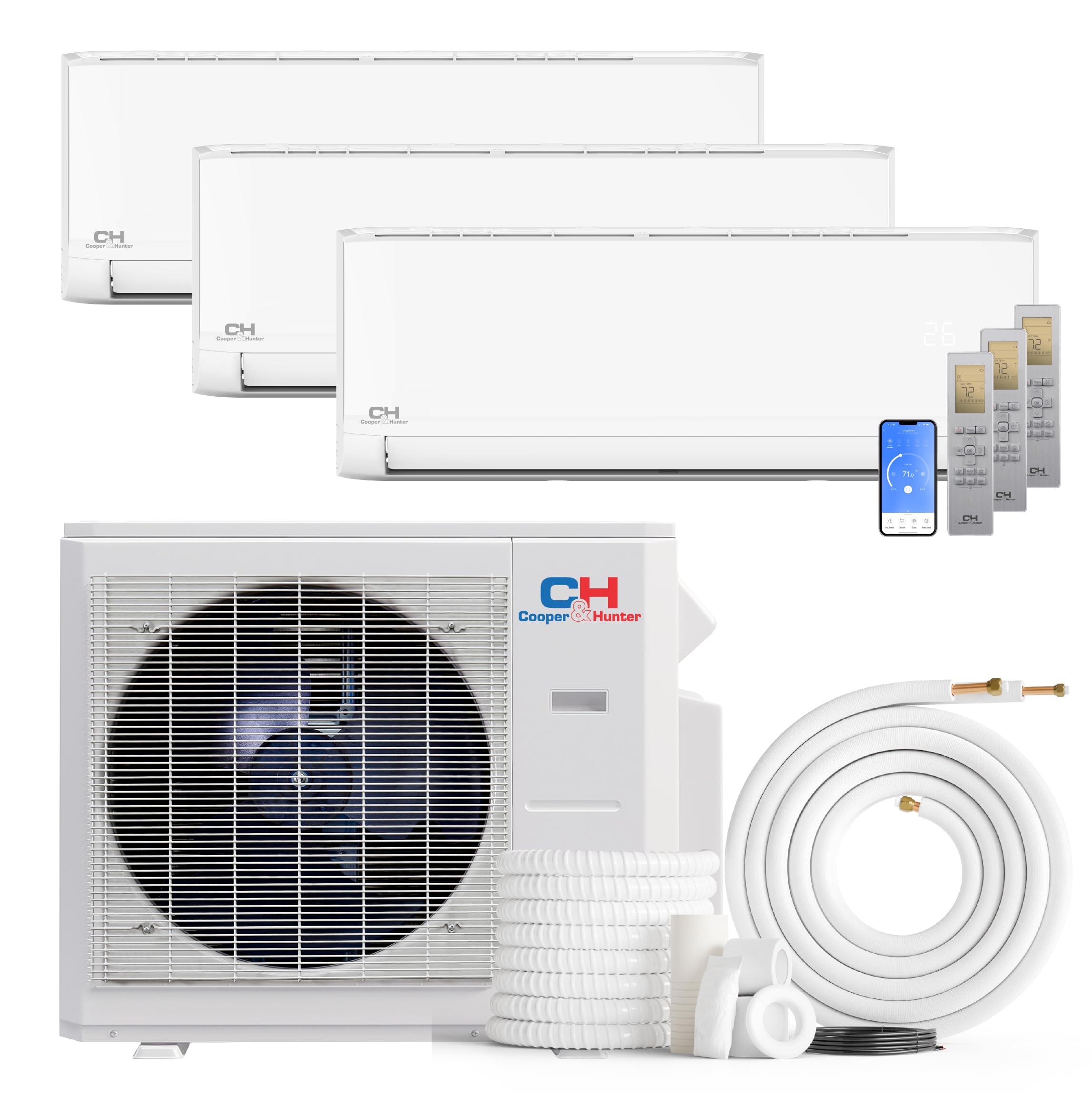
The highest-efficiency unit here — 25 SEER2, three smart kits, and US-based support.
Cooper & Hunter’s three-zone package is the efficiency leader of this list. Its 25 SEER2 rating beats every other unit here, and it pairs a 28,000 BTU / 2.3-ton outdoor condenser with three wall-mounted indoor heads — 9,000 BTU plus 12,000 BTU plus 12,000 BTU — for independent temperature control across three rooms or areas. It is designed for residential and commercial installs alike: houses, garages, master suites, offices, stores, and restaurants all show up in the intended-use list. The kit ships with three Smart Kits for phone control, three 25-foot insulated line sets, three 25-foot communication cables, three 16-foot drainage extensions, and small install accessories.
Cooling and heating both run through the same inverter heat pump, so the same condenser that beats summer heat also handles winter without a separate furnace. Installation is explicitly not a DIY job — line sets need vacuuming, and the unit ships by freight and is delivered to the nearest accessible point outside your home, with the carrier coordinating delivery. US-based technical support is available if issues come up after the install. That said, one reviewer found the included manual is generic and loosely translated, and that the factory flares and indoor line-lengths were not quite consistent — a common theme with much of this category’s documentation.
What owners rave about most is how well this thing handles a multi-story house. A buyer cooling a 2,700 square foot home with the 12K and 9K heads described the upstairs cooling like a whisper, with the outdoor unit as quiet as a box fan on low. Zones take turns by design rather than all running flat out at once, which buyers report keeps the temperature stable without abrupt jumps. Wi-Fi control means the system can be nudged on the drive home. If a premium efficiency build with room to expand is your target, this is the one to look at first.
Efficiency Standouts
- 25 SEER2 — the highest efficiency score in this lineup
- Three Smart Kits and three 25-foot line sets included
- US-based technical support on top of the hardware
- Quiet operation on both indoor and outdoor units
Honest Constraints
- Freight shipping — delivery is to the nearest accessible outdoor point, not inside the home
- Professional install required; line sets need vacuuming and possible re-flaring
- Manual is generic and loosely translated from the original language
Worth it if: you want the most efficient three-zone build on this list and are set up for a licensed-installer job.
skip it if: you need a single-head unit for one space or you plan to avoid freight delivery logistics.
Understanding the Specs
BTU And “Tons” — What Both Numbers Mean
BTU (British Thermal Unit) is the traditional measure of how much heat a unit can remove from a room in an hour. A “ton” is simply 12,000 BTU — so a 2.5-ton unit is advertising 30,000 BTU. The trouble is that real products are sold in even-numbered BTU classes (28,000 / 30,000 / 32,000), and all three get labeled “roughly 2.5-ton” by their makers. That is why this list accepts the 28,000 to 32,000 BTU range as the same functional tier — the difference between 28,000 and 30,000 BTU is small enough that a 750 to 1,800 square foot space can be served by either depending on layout.
SEER2 — The Number That Predicts Your Bill
SEER2 is a standardized efficiency score that estimates how many BTUs of cooling you get for each watt-hour of electricity across the whole cooling season. Higher numbers mean less compressor work per degree of cooling and lower monthly bills. A jump from 20 SEER2 up to 25 SEER2 (both ratings appear on this list) tends to mean the higher-rated unit uses less electricity for the same job — the exact split depends on your climate, runtime, and local rates, so brands rarely publish a universal percentage. The single best thing to do is compare SEER2 between two units you are considering and pick the higher one when the price difference is reasonable.
Multi-Zone: Three Indoor Heads, One Condenser
A multi-zone system’s outdoor condenser has a fixed total BTU capacity that gets distributed among the indoor heads. If you install three 9,000 BTU heads on a 28,000 BTU condenser, the condenser serves whichever zone calls for cooling — the heads cycle rather than all running simultaneously at full power. That is a design feature, not a defect, but it means sizing matters: pick a condenser whose total BTU can realistically feed every room you plan to condition. If you want all rooms working at once without competition, a larger condenser is the answer.
Noise, Refrigerant, And Cold-Weather Cutoffs
Two remaining specs are worth a quick scan before you buy. First, indoor noise is measured in decibels (dB or dBa): the indoor range on this list starts around 22dB at the quiet end — a level you would not notice in a bedroom — and can rise toward 42dB when pushed. Second, the low-temperature cutoff tells you how cold it can get outside before the heat pump loses effectiveness. Below that threshold, expect the system to lean on a backup heat source.
FAQ
Is a 2.5-ton mini split the same as 30,000 BTU?
Will a 30,000 BTU mini split cool my whole house?
How much does a 2.5-ton mini split cost to run per month?
Can I install a 2.5-ton mini split myself?
Do mini splits heat as well as they cool?
What size breaker does a 2.5-ton mini split need?
How loud is a 2.5-ton mini split indoors and outdoors?
What is the difference between the ROVSUN 28,000 BTU and the DELLA 28K 3-Zone?
Do these mini splits work with Alexa or just their own app?
How long does a mini split typically last?
Final Thoughts: The Verdict
If you want the most efficient single-head mini split that covers the largest floor area on this list, grab the TOSOT 30,000 BTU Cosmo Series — 30,000 BTU, 22 SEER2, up to 1,800 square feet, and cold-weather heating that reaches -13°F. It is the crowd favorite of the group, rated 4.5 stars across 200+ owners. For three rooms that all need their own temperature, the ROVSUN 28,000 BTU Tri-Zone is the easiest way to get there. And if highest efficiency is the goal and freight delivery plus a licensed install is not a dealbreaker, the Cooper & Hunter 28,000 BTU 3-Zone at 25 SEER2 is the one to reach for.
How We Picked
We do not accept paid placement. Every pick is matched to a real buyer and a real use-case; we do not hands-on test units.
Sources & Methodology
Specifications: manufacturer listings and product documentation. Review insights: verified customer reviews, as of September 2026. Pricing: not shown on this page (it changes often); check the current price via the retailer link.
As an Amazon Associate, KitchPrep earns from qualifying purchases. This does not affect which products we feature.
Related Guides
