
Specs are compiled from manufacturer listings and verified buyer reviews and can change over time — please confirm the key details on the product page before buying.
If you need a clean 70mm hole in tile, stone, or steel, the answer is simpler than most shoppers expect: match the cutter to the material, not the price tag. Diamond-grit saws are built for porcelain, ceramic, granite, and glass, while tungsten-carbide and bi-metal saws are built for metal. Pick the wrong family and you will burn a bit on the first hole. This guide covers nine saws that all cut a true 2-3/4-inch (70mm) opening, explains what each one is actually for, and tells you plainly which one fits your job.
I’m Mohammad Maruf — the founder and writer behind KitchPrep. This guide is built by comparing the manufacturers’ published specifications and the patterns across verified customer reviews, so you get each pick’s real strengths and trade-offs instead of marketing spin.
You will see where diamond beats carbide, why pilot bits snap, and which cutter survives a full day of install work. Below is a plain-English breakdown of the 2 3/4-inch hole saw options worth your money.
Our Picks at a Glance
How To Choose The Best 2 3/4-Inch Hole Saw
Most disappointing hole-saw purchases are not caused by a bad brand. They happen because the cutter and the material never matched in the first place. A diamond-grit saw on mild steel will glaze over and stop cutting. A bi-metal saw on porcelain will skate across the surface and chip the glaze. So the first decision is not which model, it is which family of teeth you actually need.
Match the cutting edge to your material
Diamond-grit cutters, like the DKIBBITH and MOLLOM picks here, are ground for tile, ceramic, porcelain, granite, glass, and stone. Tungsten-carbide-tipped (TCT) cutters, like the cenyb and GRIXLEN models, are built for hard metal, stainless steel, iron, and aluminum. Bi-metal saws such as the Morse cut mild steel and pipe. None of these cross over well: the DKIBBITH block states it is for ceramic, porcelain, granite, stone, and glass, while the METALLIXITY block explicitly says it is not recommended for wood and plastic.
Cutting depth matters more than diameter
Every saw here bores the same 2-3/4-inch (70mm) opening, so diameter is settled. Depth is where they separate. A 1-inch (25mm) cutting depth handles a countertop, a steel plate, or a door skin. A 1-3/16-inch depth reaches through thicker tile. If you are boring through a deep block or pipe wall, the shallower saws will bottom out before the cut is finished.
Shank, pilot bit, and cooling
Check the shank (the tail that clamps into your drill) against your chuck before you buy. The Morse and carbide cutters fit a standard 3/8-inch or 5/8-inch arbor, while the BINOTA is built for a rotary hammer with an SDS-Plus shank. The pilot or center bit is what keeps the hole centered, and it is also the part most likely to snap if you push too hard. Finally, cooling decides lifespan: the diamond and carbide makers all say to add water or cutting oil during the cut, and skipping that step is the usual reason a bit dies early.
Quick Comparison
| Model | Best For | Cutting Edge | Cutting Depth | Shank | Amazon |
|---|---|---|---|---|---|
| 2-3/4″ Diamond Hole-Saw Bits (DKIBBITH)★ Best Overall | Tile and stone | Diamond-tipped | 1-3/16″ | Hex | Amazon |
| Morse MHS44 Bi-MetalShop Favorite | Metal and pipe | Bi-metal | — | Standard arbor | Amazon |
| MOLLOM Diamond Hole SawBest for One-Off Jobs | Tile, glass, marble | Diamond | 1-3/8″ | 3/8″ | Amazon |
| cenyb Tungsten Carbide Tipped | Hard metal | TCT carbide | 1″ | 3/8″ | Amazon |
| GRIXLEN Tungsten Carbide Tip | Stainless and iron | TCT carbide | 1″ (25mm) | Standard drill | Amazon |
| AOKAIMIAR 2-3/4″ Carbide | Steel and aluminum | TCT carbide | — | Standard drill | Amazon |
| METALLIXITY 70mm TCT | Thick stainless | TCT carbide | 25mm (1″) | Triangular | Amazon |
| DKIBBITH TCT Hole Saw Set | Steel plate work | TCT carbide | 1″ (25mm) | Standard drill | Amazon |
| BINOTA Concrete Hole Saw | Concrete and masonry | Tungsten carbide | — | SDS-Plus | Amazon |
In‑Depth Reviews
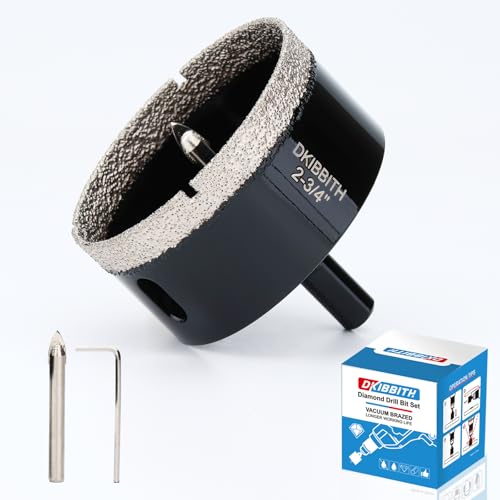
1. 2-3/4″ Diamond Hole-Saw Bits with Pilot Drill Bit, 2-3/4 in Diamond Tipped Tile Hole Saws with Guiding Bit for Accurate Drilling, for Porcelain Tile Ceramic Pottery Granite Stone Glass Bottles 70mm
Our pick — over 4.5★ from 700+ verified ratings; the strongest balance of quality and price.
A diamond-grit cutter that eats porcelain fast and still reaches through thicker tile.
The job this saw wins is the one that scares most homeowners: boring a faucet or soap-dispenser hole through a finished countertop without cracking the glaze. The diamond-tipped edge handles ceramic, porcelain tile, granite, stone, and glass bottles, and the 1-3/16-inch cutting depth means it can reach through tile that a shallower cutter would bottom out on. The pilot drill bit is removable so you can position precisely first, then pull it and finish the hole with the saw alone. The diamond grit cuts porcelain tile and slices through 2-inch stone without fuss, while carbide-tip alternatives stall and crack the plate.
You swap the setup with the included hex wrench, and the locating bit keeps the opening centered as long as you check that its point still protrudes every few holes. The one non-negotiable is cooling. Run a spritzer of water while you cut, dip the bit periodically, and clear the residue from inside the barrel after each hole, or performance drops off sharply. Every bit in the set is a spare you can swap in if one dulls, which matters because durability is the honest wildcard here — early bits in a batch can wear out after a couple of plates while others cut four and still look new. Buyers report, as one put it: “Quality inconsistent: first 4 bits lasted only 1-2 plates before coating wore off; last bit cut 4 plates and looks new.” Treat the multi-bit set as your insurance against that spread.
What earns its keep
- Diamond-tipped edge cuts porcelain, ceramic, granite, stone, and glass, materials that defeat toothed saws.
- 1-3/16-inch cutting depth clears thicker tile than most rivals.
- Removable pilot bit plus hex wrench lets you aim first, then finish the bore cleanly.
- Water cooling keeps the grit sharp and the cut smooth.
Worth knowing before you buy
- Bit-to-bit durability is uneven, so plan on the extras earning their place.
- It needs water and regular debris-clearing to perform or it dulls fast.
- Diamond grit is not the right edge for metal.
Reach for this if: you are cutting tile, stone, or granite and want the fastest clean bore with spares on hand for a full install day.
Look elsewhere if: you are boring through steel or pipe — a carbide or bi-metal edge is the correct tool there.
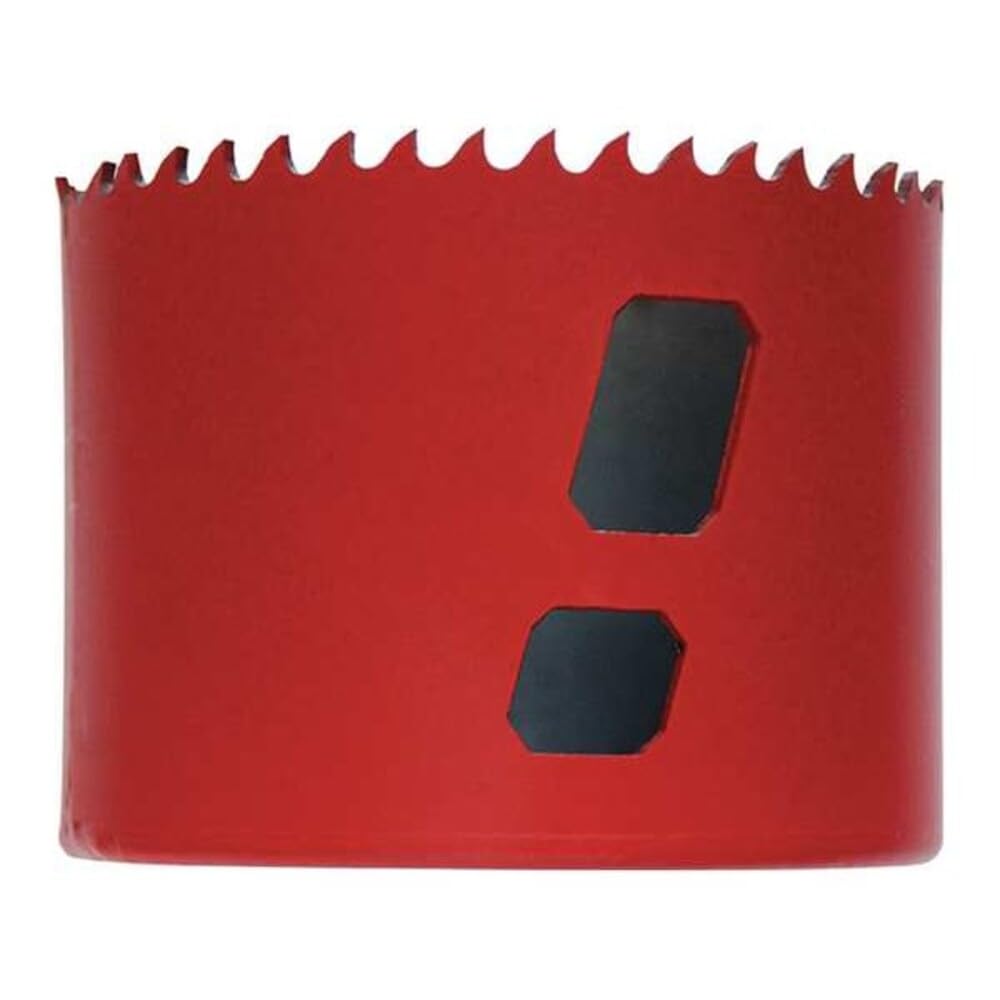
2. Morse MHS44 Bi-Metal Hole Saw, 2-3/4″ Diameter, 1 Piece
The metal-cutting workhorse that leaves a round, weld-ready saddle on pipe and plate.
When the material is steel rather than stone, this is the blade-type that belongs in the chuck. Morse builds the MHS44 from bi-metal with a heavy-duty.050 side wall for stability, and the housing design is aimed at less runout and vibration — meaning rounder holes and less chatter. A side slot gives you leverage to pop the cut slug out faster, and the red exterior coating is there to cut side-wall friction as the saw sinks through. On pipe it slices schedule 40 2-3/8-inch oil field pipe cleanly for precise or angled cuts before welding, though it dulls after roughly six pipes and the body is too short to pass through a thick wall in one pass.
The teeth arrive sharp out of the package and the arbor fit is secure, and the saw threads onto a universal 5/8-inch x 18 arbor — a fact worth confirming against your own arbor before you buy. Compared with a Milwaukee set that some find runs oval and oversized, this one is prized for cutting a genuinely round hole. The honest catch is that sharpness feedback is split: plenty of cuts go through oak without complaint, but a few teeth have been reported to break on first use, typically when the saw is pushed rather than fed. Let the tool do the work and feed it slowly.
Where it shines: clean saddle cuts on steel and pipe, sharp teeth out of the cylinder, and a secure arbor fit that keeps the cut true.
The trade-off to plan around: it is not a deep-bore saw, and it dulls after about six pipe cuts, so keep a spare if you have a stack of them to run.
Match this one to: metalworkers and pipe fitters who want a round, weld-ready cut on steel and mild metal.
Not your pick if: you are cutting porcelain tile or glass, where a diamond edge is required.
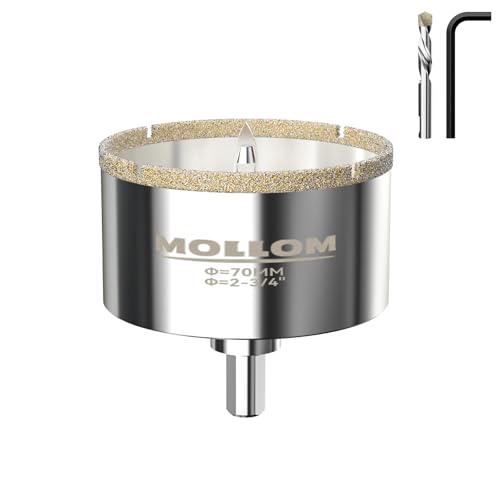
3. MOLLOM 2-3/4″ (70mm) Diamond Hole Saw with 2 Pilot Drill Bit
Two pilot bits, plenty of depth, and a cut that leaves tile edges chip-free.
If your project is a finished countertop and you expect to use the saw once, this diamond cutter is built for exactly that. It boasts a 1-3/8-inch hole-saw depth — deeper than the DKIBBITH’s 1-3/16-inch — so it clears thicker tile and stone in a single pass, and it ships with two removable pilot bits, one diamond-tipped and one center bit, so you can swap if the first one wanders or breaks. Its standout is the smooth bore: a tile countertop install goes quickly with a clean, chip-free edge, and it handles plastic that shatters under a toothed blade without cracking it.
The method matters, and the maker spells it out: install the pilot to position, drill a starter hollow, then remove the pilot and rotate slightly to finish. Water or coolant throughout is required to keep the hole clean and the saw alive, and you must clear debris from inside the barrel after every cut — stacking two pieces of debris will clog the barrel for good. The one flaky element is the pilot. Because it sits below the saw body’s grade, it can be tricky to keep dead-center, so on a precious surface start slow and let the diamond find its line rather than forcing it.
Why it earns a slot: the extra depth and the spare pilot bit give you margin on thicker tile and a backup if the first center bit fails.
What to watch: the pilot is hard to keep centered and the barrel must be cleared between holes or it plugs up.
Go for it when: you have one tile or quartz job to finish and want clean edges with a spare pilot in the kit.
Choose differently if: you need to bore deep concrete or heavy steel — this is tile-family tooling only.
4. 2-3/4″ (70mm) Tungsten Carbide Tipped Hole Saw with 2Pcs Titanium-Plated Pilot Drill Bits
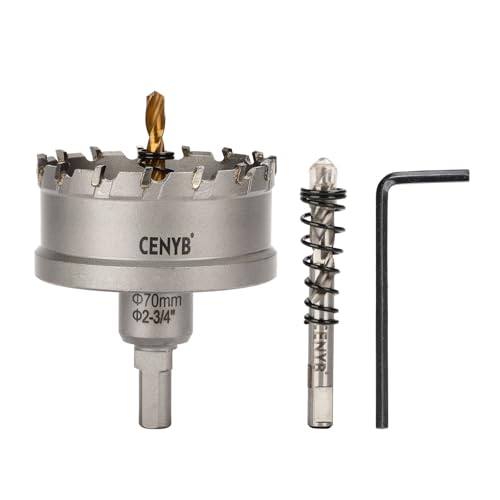
Fifteen carbide teeth that tear through hard metal and leave a clean, true hole.
This is the saw for metalworkers who want speed first. Fifteen carbide teeth and a three-blade design — outer, middle, and inner edges — give it more bite on hard metals, stainless steel, square tube, iron, and aluminum than a coarser cutter, and the titanium-plated pilot bits fight off rust while they center the bore. The 1-inch depth covers typical plate, tubing, and alloy work, and the assembly drops into bench drills, magnetic drills, and gun drills, not just a hand tool.
It cuts a clean, true hole in aluminum and chews through mild steel, and owners who go through thick stock find the carbide lasting much longer than the steel-tooth version. The tool is built sharp and abrasive enough that it needs you to control the feed — let it bite at its own pace. The 2-3/4-inch cutter is part of a family owners often buy across several diameters, which is a good sign you will reach for it again.
Two practical wrinkles to know. First, the stated diameter can run slightly over on some sizes, so if your fitment is critical, measure the hole rather than assuming an exact bore. Second, the storage case is short and may not close unless the center bit is removed. Neither is a deal-breaker, but both are worth knowing before the box lands.
The strong points
- 15 carbide teeth and a three-blade design cut hard metal and stainless faster than coarse cutters.
- Thick, sharp carbide holds its edge well on plate and tubing.
- Titanium-plated pilot bits resist rust and keep the hole centered.
- Works in bench, magnetic, and gun drills as well as hand tools.
Keep in mind
- Some sizes bore slightly oversized, so verify the fit on critical work.
- The storage case is too short to close with the center bit installed.
- It is not built for concrete, tile, or stone.
Suits you if: you are boring stainless and hard metal on a drill press or magnetic drill and want more teeth doing the work.
Skip it when: your material is tile, concrete, or wood — every material in that group is off the menu for this cutter.
5. 2-3/4″ (70mm) Tungsten Carbide Tip Hole Saw with M2 Pilot Bits
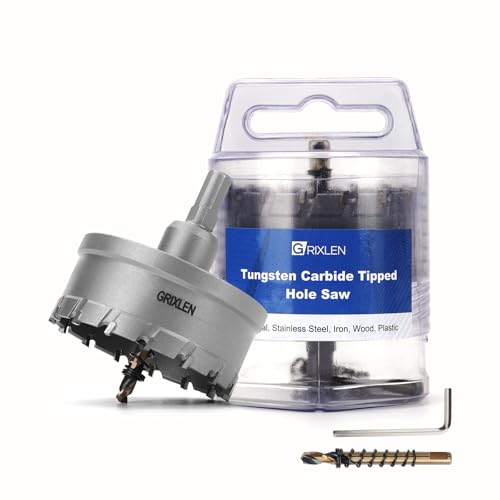
An M2 pilot bit holds the line on stainless, headers, and thin sheet metal.
This GRIXLEN cutter is aimed at the metalworking detail jobs: sensor bungs in stainless headers, lock plates on a gate, and sheet-metal work where a clean, centered hole matters more than brute speed. The M2 pilot bit is the reason — it keeps the saw tracking as it enters so the opening lands where you marked it, and the flat 1-inch (25mm) cutting depth is tuned for plate and sheet. It runs in drills, bench drills, handheld tools, CNC machines, and impact drills, giving you flexibility in what you mount it to.
What it does well is bite hard metal fast. It chews through a stainless header for an O2 sensor or a metal gate plate cleanly and quickly, and with cutting oil it still cuts well on the twelfth hole in 1/4-inch carbon steel. The M2 pilot delivers the positional stability that makes those holes come out true rather than wandering.
The catch is how it behaves in a hand drill on thick steel. It is quick in a drill press but a bit delicate when hand-fed, and hard pushing can snap a bit after a handful of holes. The maker’s own guidance points the way: use coolant for continuous high-speed cutting, and wear goggles and gloves. This is not a plywood or tile tool — it is aimed squarely at iron, stainless, and plastic.
What it does best: fast, stable cuts in stainless and sheet metal thanks to the M2 pilot bit and a wide choice of mounting tools.
Honest limit: hand-drilling thick steel is where it struggles, so a drill press and coolant get far more life out of it.
Bring it home for: header bungs, gate plates, and sheet-metal jobs where a centered hole is the whole point.
Look past it if: your work is thick steel by hand — the GRIXLEN’s carbide edge prefers a press and steady coolant.
6. 2-3/4 Inch Carbide Hole Saw with Titanium Plated Center Drill Bit, Heavy Duty TCT Metal Hole Cutter
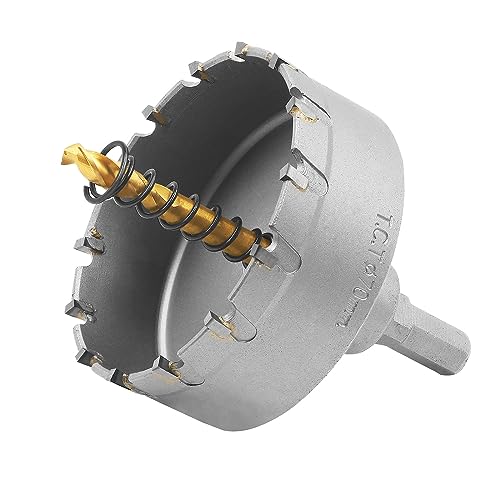
A tungsten-carbide cutter that leaves a razor-sharp, burr-free finish on thick steel.
The AOKAIMIAR is built around a tungsten carbide tip (TCT) — a hard cutting edge that resists wear and holds up to heavy-duty use — and it is aimed at people who care about the finish of the hole, not just the speed of making it. It is suited to stainless steel plate, hard metal, iron, mild steel, alloy steel, aluminum, FRP, and plastic, so it covers a wide spread of the metal and sheet materials a workshop actually handles. With a titanium-plated center drill bit keeping it on axis, the saw is meant to cut cleanly with minimal tear-out.
On a thick steel plate this is where the carbide earns its keep: holes come out with an excellent surface finish and the teeth stay razor-sharp through a run, even on 1/4-inch steel with a little lubricant, slow RPM, and light pressure. It zips through thin 14-gauge aluminum almost immediately with no cutting oil, and the included hex wrench makes assembly straightforward.
The honest snags are minor but real. Once assembled, the saw no longer fits back in its plastic case, so storage is a two-step affair. And the shank on some units has three rounded edges that need a touch of grinding to seat in an extender, while the setscrew can loosen from vibration — a dab of threadlocker settles that. None of it affects the cut quality, but plan for a small finishing step.
The headline: clean, burr-free holes in thick steel and alloy, with carbide teeth that keep their edge through a run.
Factor in: the case no longer closes once assembled and the shank may need minor grinding to fit an extender.
Best matched to: fabricators cutting thick steel or aluminum plate who want a tidy, precise finish on every hole.
Steer away if: you want zero setup fuss — this one may need a shank tweak and threadlocker on the setscrew first.
7. METALLIXITY Hole Saw 70mm 2-3/4″ Tungsten Carbide for Metal
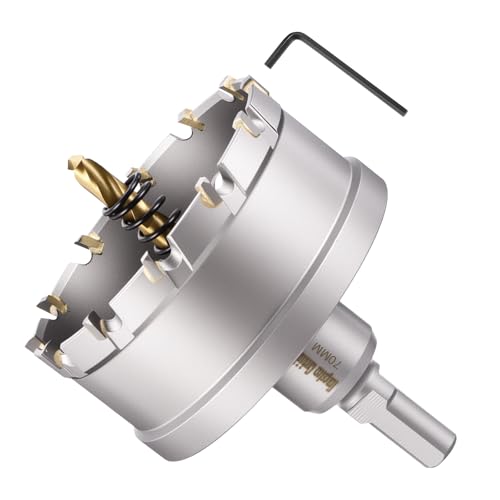
A carbide cutter tuned for the thick stuff — stainless, alloy steel, and cast iron.
Most 70mm saws here are built for plate and sheet. This METALLIXITY is the outlier that names its limits up front: it is suited to stainless steel 15mm or less, alloy steel 10mm or less, and cast iron, which tells you exactly who it is for. The triangular shank grips more firmly and resists slipping in the chuck, and the cutter carries a sandblasted surface and a PVD coating (a hard-wearing surface layer applied during manufacturing) baked over a heat-treated body for stable, long cutting life. The package includes a center drill bit and a hex key.
With a starter hole and cutting oil it goes through 1/2-inch steel plate and travel-trailer I-beam without complaint, and under a mill it holds a true line with no wobble even boring a large round opening in thick aluminum. In a run of oak paneling, the spring-loaded guide bit clears sawdust and ejects the cut disc to keep the work moving. If you want a cutter that feels industrial in the hand, this is that saw.
But respect the warnings the maker posts. It is not recommended for thin metal sheet, wood, or plastic, so do not reach for it on a quick plastic job. And it bites hard on wood — kickback can be violent — so this stays a metal tool. Ask for concentration on the hard materials it was built for and it delivers; use it outside that lane and it will fight you.
Strength in heavy stock
- Built for stainless steel 15mm or less, alloy steel 10mm or less, and cast iron.
- Triangular shank resists slipping; PVD coating and heat treatment extend cutting life.
- Spring-loaded guide bit clears sawdust and ejects the disc on wood paneling.
- Holds a true line under a mill with no wobble.
Respect the limits
- Not recommended for thin metal sheet, wood, or plastic.
- Can bite hard and kick back on wood, so keep it to metal.
- Strictly a metal-focused tool, not a general-purpose cutter.
The right saw for: machining and heavy fabrication work in stainless, alloy steel, and cast iron.
Pick something else for: thin sheet, wood, or plastic — the maker rules those out, and the kickback on wood is real.
8. TCT Hole Saw Set, 2-3/4″ (70mm) Heavy Duty Tungsten Carbide Tipped Hole Cutters
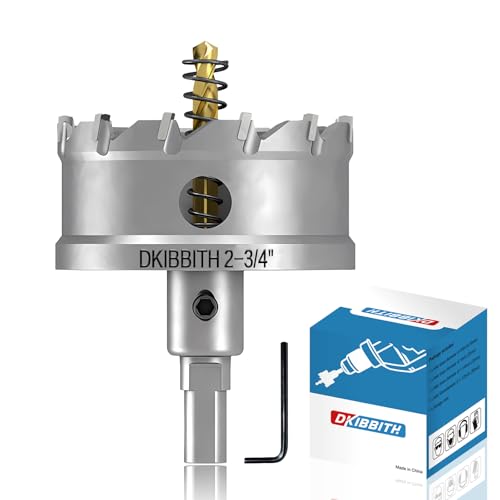
A do-everything carbide set for installers who bore steel doors, plates, and tubing.
This DKIBBITH set is built for the trades: electrical installs, plumbing and pipe work, HVAC, and metalworking, with a single cutter that handles stainless steel, mild steel, iron, copper, aluminum, FRP, plastic, and brass sheet up to 1-inch (25mm) thick. Two features do the practical work — a split-point pilot drill bit that stops the bit walking as it starts, and an ejection spring that pops the cut slug out for you. It runs in handheld cordless drills, drill presses, magnetic drills, impact drills, and CNC machines, so it fits most setups.
It slices a clean deadbolt opening through a steel door in seconds where a cheaper saw refuses to bite, and it handles 1/2-inch and 3/8-inch steel in the right hands. The maker’s own instructions are the operating manual — go slow, let the tool work, keep the speed down on hard material, add oil after each job, and store it in the case to keep the teeth sharp.
Here is the honest part. Durability feedback is genuinely split: some users cut cleanly for a full project while others see the carbide tips or pilot bit fail early, and the pilot has a reputation for snapping while the setscrew loosens under vibration. The design also does not tolerate rough handling — a drop that would shrug off a bi-metal saw can chip these high-hardness teeth. Feed it gently and it can be a productive set; force it and the teeth are what give.
Why trades like it: one cutter covers steel, copper, brass, aluminum, and plastic up to 1-inch thick, with a split-point pilot and a spring that ejects the slug.
Where it is fragile: the tips and pilot are the weak links, and a dropped or force-fed bit is where these sets fail.
Consider it if: you are an installer cutting steel doors, plates, and tubing and want one versatile carbide set in the bag.
Pass if: you want a rugged, low-maintenance cutter you can abuse — this one rewards a light hand.
9. BINOTA 70 mm (2-3/4″) Concrete Hole Saw with SDS-Plus Shank
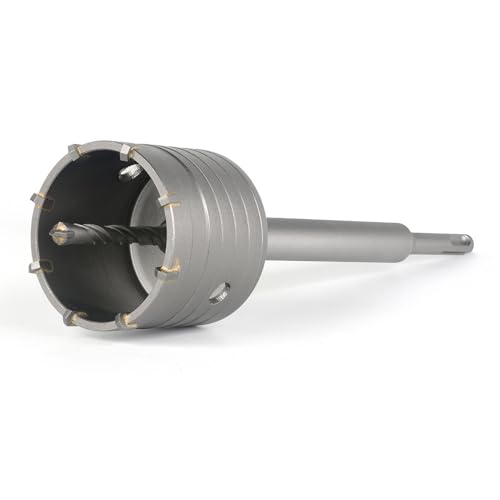
The masonry specialist — a rotary-hammer saw that bores concrete and brick without water.
Every other saw on this list skips the wall material that trips up most DIYers: concrete. The BINOTA is built for a rotary hammer with an SDS-Plus shank (220mm), and it is made of tungsten carbide for efficient dry drilling into concrete, brick, cement, stone, and adobe — no water cooling required. The set includes the hole saw, the SDS-Plus shank, a cross center drill bit, and two spring washers. The cross-shaped center bit with its alloy teeth is the anti-wander feature: it positions the saw and keeps the hole accurately centered, with no pre-drilling needed. Its self-tightening thread keeps the center drill locked and reduces wobble, and the built-in wrench slot lets you disassemble with a standard wrench.
In cement block and concrete it drills a 70mm hole in minutes where a masonry twist bit would crawl. Use it the way it is designed — start at low speed to protect the teeth, drill dry, and add occasional water cooling only on extended heavy work — and it earns its place on any concrete project.
Know the two catches before you commit. First, it needs a rotary hammer; it will not run in a standard drill, so check your tool before ordering. Second, the pilot bits and shaft can fail on hard runs, and there have been compatibility complaints about SDS-Max shafts not seating. It is also not for rebar or marble, which the maker rules out. Stay on the materials it names and it is a capable concrete tool.
Why it stands apart
- Drills concrete, brick, cement, stone, and adobe, with no water required for normal use.
- Cross-shaped center bit positions the saw and holds the hole accurate with no pre-drilling.
- Self-tightening thread reduces wobble; wrench slot makes disassembly easy.
- SDS-Plus shank fits major-brand rotary hammers.
Before you order
- Requires a rotary hammer — it will not run in a standard drill.
- Pilot bits and the shaft can fail on hard runs, and pilot bits arrive broken for a few users.
- Not for rebar or marble, and there are reports of incompatibility with SDS-Max shafts.
Buy it for: boring clean 70mm openings through concrete, brick, and masonry walls with a rotary hammer.
skip it if: you only own a standard drill — this saw is built around the SDS-Plus shank and needs that tool.
Understanding the Specs
Diamond grit vs. tungsten carbide
These are the two cutting edges you will see here, and they are not interchangeable. Diamond-grit cutters are ground with diamond particles brazed to the rim, which makes them the right choice for abrasive, brittle materials like porcelain tile, ceramic, granite, stone, and glass. Tungsten-carbide-tipped (TCT) cutters use hard carbide teeth and are built for metal — stainless steel, iron, alloy steel, aluminum, and cast iron. Put a diamond cutter on steel and the grit glazes over; put a carbide cutter on tile and it skates and chips. Match the edge to the material and the saw will last.
Cutting depth and shank type
Cutting depth is how far the rim reaches into the material, and it decides whether a saw can finish a thick cut or bottom out partway. A 1-inch (25mm) depth covers most plate and countertop work, while a saw like the MOLLOM reaches 1-3/8 inches for thicker tile. Shank type is the other fixed choice, because it must match your tool: most saws here use a standard 3/8-inch or 5/8-inch arbor, but the BINOTA concrete saw uses an SDS-Plus shank meant only for rotary hammers. Check your chuck before you buy, or the saw will not mount.
FAQ
Will a 2-3/4-inch hole saw cut through porcelain tile without cracking it?
Can I use a diamond hole saw on metal?
What shank size fits the Morse MHS44 bi-metal hole saw?
How do I keep a hole saw from wandering off the mark?
Do I really need to use water or coolant with a hole saw?
What is the difference between a diamond bit and a carbide bit for tile work?
Will the BINOTA concrete hole saw fit my drill?
How long does a hole saw bit last before it wears out?
Can a 2-3/4-inch hole saw be used on wood and plastic?
What cutting depth do I need for a countertop or steel plate?
Final Thoughts: The Verdict
Across the board, the 2 3/4-inch hole saw winner is the DKIBBITH Diamond Hole-Saw Bits because its diamond-tipped edge cuts porcelain, granite, and stone cleanly at a 1-3/16-inch depth, and the multi-bit set covers you if one wears unevenly. If you are boring steel and pipe instead of tile, grab the Morse MHS44 Bi-Metal Hole Saw, which leaves a round, weld-ready saddle on schedule 40 pipe. And for concrete and masonry walls, the BINOTA Concrete Hole Saw is the one to reach for — just make sure you have a rotary hammer for its SDS-Plus shank.
How We Picked
We do not accept paid placement. Every pick is matched to a real buyer and a real use-case; we do not hands-on test units.
Sources & Methodology
Specifications: manufacturer listings and product documentation. Review insights: verified customer reviews, as of September 2026. Pricing: not shown on this page (it changes often); check the current price via the retailer link.
As an Amazon Associate, KitchPrep earns from qualifying purchases. This does not affect which products we feature.
Related Guides
